Forehand vs Backhand Welding — Techniques, Torch Angles & When to Use Each
Every welder makes a choice with every bead they run: which direction will the torch, gun, or electrode point relative to the direction of travel? This seemingly simple decision — forehand or backhand, push or pull — has direct and measurable consequences on bead shape, penetration depth, heat distribution, shielding gas coverage, and the overall quality of the completed weld. Getting this choice right for the process, material, thickness, and joint type is one of the marks of a skilled welder. Getting it wrong is one of the most common sources of poor penetration, excessive spatter, and inconsistent bead geometry in everyday production welding.
This guide covers forehand and backhand welding techniques in complete technical detail — not just for oxy-acetylene welding where these techniques were first formally described, but for every major arc welding process: SMAW (stick), GMAW (MIG), FCAW, and GTAW (TIG). It then moves into fillet welding technique in detail, because the fillet weld is the most widely used weld type in fabrication and deserves thorough treatment of its geometry, strength, and positional technique requirements.
Forehand (Push) Welding
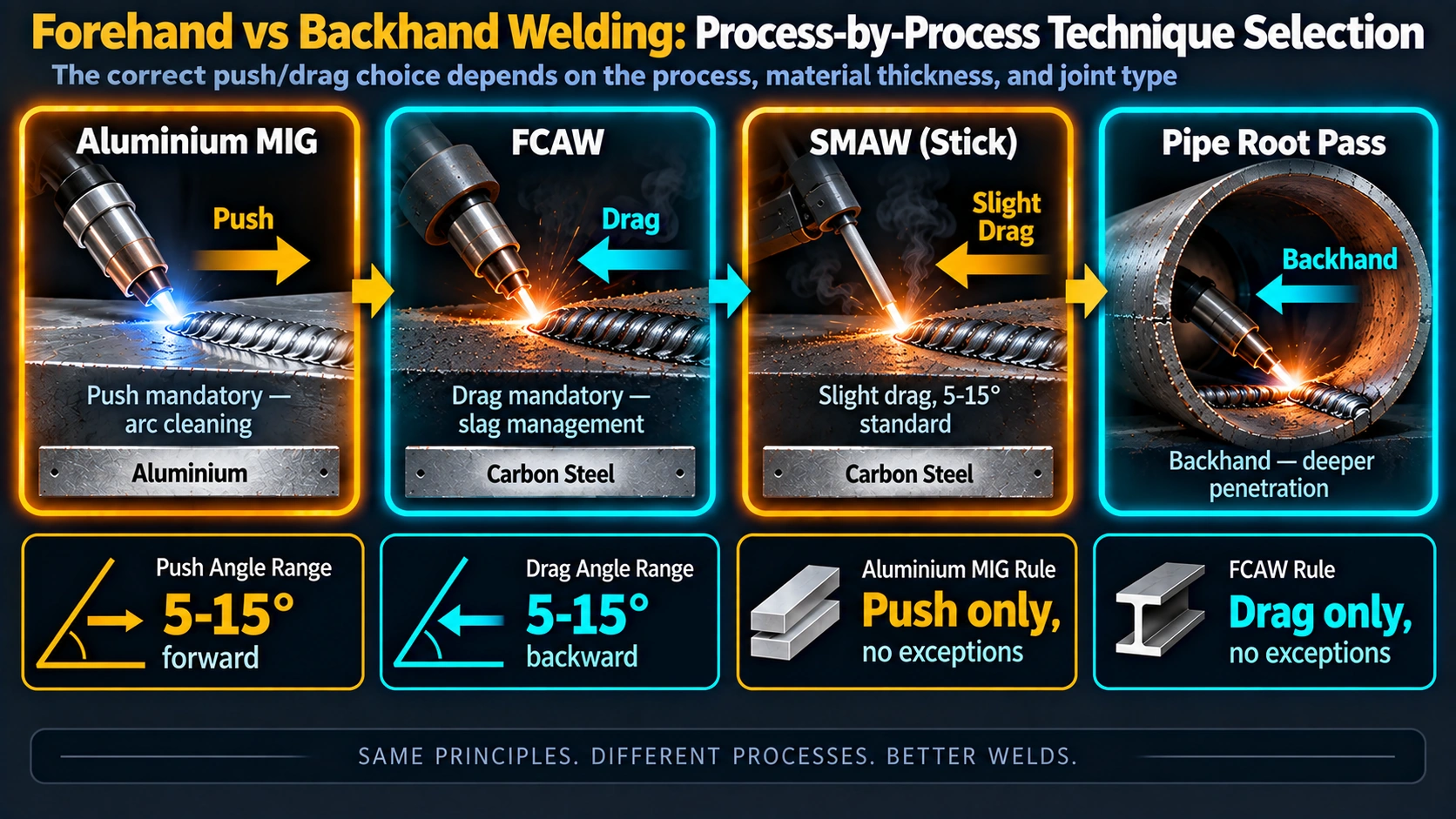
In forehand welding, the welding torch or electrode is tilted forward — angled in the direction of travel — so that the flame or arc points ahead of the puddle toward the unwelded joint. This means the welder is essentially “pushing” the puddle along the joint.
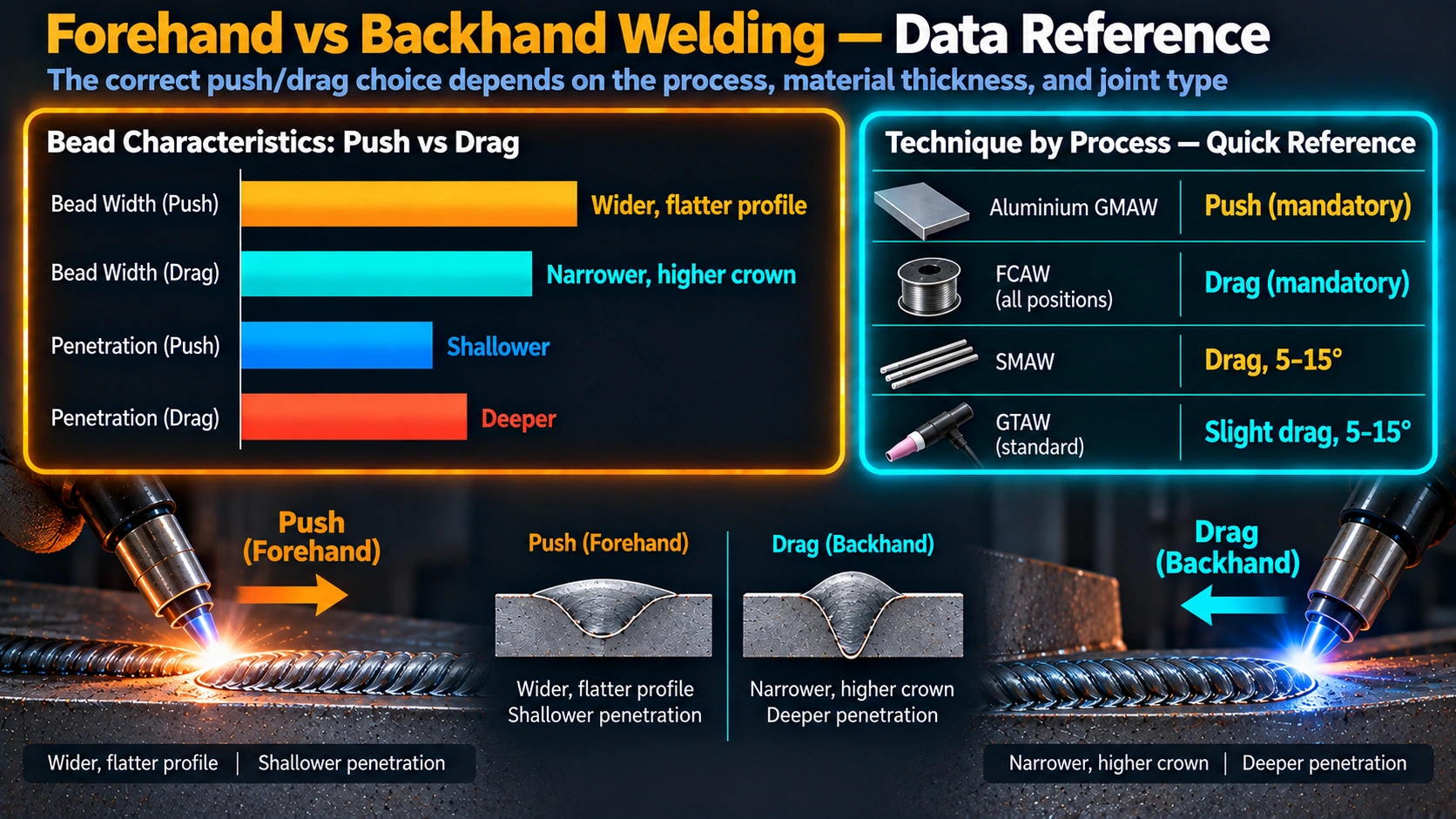
The key characteristic of the forehand technique is that the heat is directed toward the cool, unmelted base metal ahead of the puddle, preheating it before the puddle arrives. This preheating effect produces a wider, shallower heat-affected zone, a flatter and wider bead profile, and a more gently sloping fusion boundary. The molten puddle itself receives less direct heat than in backhand welding — so it is cooler relative to the arc, which means the puddle is smaller and easier to control.
What the Welder Sees
Because the torch or electrode is angled forward, the welder has a clear, unobstructed view of the joint ahead of the puddle. This excellent forward visibility is one of the most practical advantages of forehand technique — the welder can see where the joint is going, track the joint line accurately, and anticipate changes in fit-up or joint gap before the puddle reaches them.
When to Use Forehand (Push)
- Thin materials (up to 3.2 mm / ⅛ in): The shallower penetration and smaller, more controllable puddle make forehand ideal for thin sheet and plate where burn-through is the primary risk.
- Sheet metal oxy-acetylene welding: OAW on thin sheet uses forehand almost exclusively for the puddle control and smooth bead profile it produces.
- Out-of-position welding (overhead and vertical): The smaller, cooler puddle is easier to control against gravity in difficult positions.
- Aluminium MIG welding (push is mandatory): For aluminium GMAW with argon shielding, push technique is essential — the arc cleaning action that removes the aluminium oxide layer occurs at the leading edge of the puddle and only works correctly when the arc points forward.
- When joint tracking is difficult: The forward visibility advantage makes forehand preferable for narrow V-grooves, curved joints, or complex fit-up where the welder needs to see the joint ahead.
- Solid wire GMAW on thin material: Push angle produces a flatter, more consistent bead with good gas coverage on thin carbon steel.
Backhand (Drag/Pull) Welding
In backhand welding, the torch or electrode is tilted backward — angled away from the direction of travel — so the flame or arc points back toward the completed weld behind the puddle. The welder is pulling the puddle along the joint.
The defining characteristic of backhand technique is that the heat is directed at the molten puddle itself, not at the unwelded base metal ahead. This concentrated heating of the puddle raises the puddle temperature, promotes deeper penetration into the joint faces, and produces a higher, narrower bead profile. The puddle tends to be larger and more fluid than in forehand welding, which is ideal for filling groove welds in thicker material but requires more skill to manage in difficult positions.
What the Welder Sees
In backhand technique, the torch or electrode body is angled back across the already-welded bead, which somewhat obstructs the view of the joint ahead. The welder can see the puddle clearly but sees the joint ahead at an angle past the torch body. This reduced forward visibility is the primary practical disadvantage of backhand — for complex or irregular joints, tracking can be more difficult than with forehand.
When to Use Backhand (Drag/Pull)
- Thick materials (above 3.2 mm / ⅛ in): The deeper penetration and larger, hotter puddle make backhand more efficient for filling thick-section groove welds.
- Root passes in pipe welding: Backhand is the standard for root passes in pipe groove welds where maximum root penetration and a smooth root bead profile are critical.
- SMAW (stick) welding: Most SMAW welding uses a slight drag angle — the slag following behind the electrode naturally falls into position behind the puddle when dragging, improving slag coverage and weld appearance.
- Flux-cored arc welding (FCAW): Drag technique is preferred for FCAW because it promotes proper slag formation and prevents the slag from running ahead of the puddle and being buried under new weld metal.
- Surfacing / hardfacing overlay: Backhand provides the heat concentration in the puddle needed for thorough fusion of the overlay with the substrate.
- OAW on material 3.2 mm and thicker: Backhand OAW allows faster travel speed and better root fusion than forehand on material above 3.2 mm.
- Slightly reducing flame OAW: The backhand technique can be combined with a slight acetylene feather (slightly reducing flame) on thick pipe joints to increase carbon content at the surface, lowering the melting point and increasing welding speed.
Torch and Electrode Angles — Defined and Illustrated
Before looking at each process individually, it is important to understand the two separate angle components that define torch and electrode position: the work angle (angle to the joint faces) and the travel angle (whether it is forehand or backhand, and by how many degrees).
Work Angle vs Travel Angle — The Two Independent Parameters
The travel angle describes forehand vs backhand — it is the angle of tilt in the direction of travel, and it determines penetration, bead shape, and heat distribution as described above.
The work angle describes the torch/electrode angle relative to the joint faces — the angle measured across the joint, perpendicular to the travel direction. For a flat butt weld, the work angle is 90 degrees (torch points straight down into the joint). For a fillet weld in a T-joint, the work angle is typically 45 degrees (bisecting the angle between the two plates). The work angle determines how heat is distributed between the two joint members.
Both angles operate independently — a welder can use backhand (drag) technique with a 45-degree work angle for a fillet weld, or forehand (push) with a 90-degree work angle for a butt weld. Specifying only one angle without the other is an incomplete description of the torch or electrode position.
Forehand and Backhand in Oxy-Acetylene Welding (OAW)
Oxy-acetylene welding is the process for which forehand and backhand techniques were originally defined, and understanding them in this context provides the clearest physical picture of what each technique achieves.
Forehand OAW — Technique Details
In forehand OAW, the torch is held at approximately 45 degrees from the vertical in the direction of welding. The welding rod precedes the torch — the rod is in front of the flame, dipped into the leading edge of the puddle. The flame is directed between the rod and the puddle, preheating the base metal immediately ahead.
The torch and rod are moved in opposite semicircular (oscillating) paths to distribute heat evenly across the joint width. This oscillation prevents the puddle from becoming too deep or too concentrated at one side of the joint. The rod melts from the heat reflected backward off the leading edge of the puddle, and the molten filler drops into the puddle from the front.
Forehand OAW is recommended for material up to 3.2 mm (⅛ in) thickness because the small puddle is easily controlled. For thicker material, the required 90-degree included angle V-groove preparation and the resulting large puddle make forehand increasingly difficult to control — backhand becomes the better choice.
Backhand OAW — Technique Details
In backhand OAW, the torch precedes the welding rod. The torch is held at approximately 45 degrees from the vertical but tilted backward — away from the direction of travel. The flame points toward the molten puddle already formed. The welding rod sits between the flame and the puddle, melting as it is consumed.
Less transverse oscillation is required in backhand OAW than forehand — the technique is more linear, which contributes to faster travel speeds. The flame directed at the puddle maintains higher puddle temperature and produces deeper fusion at the root of the joint. Backhand OAW is more efficient than forehand for material from 3.2 mm upward, requiring less edge preparation (narrower bevel angle), faster travel speed, and better root penetration.
Backhand OAW may also use a slightly reducing flame — a small acetylene feather beyond neutral — particularly for pipe joints in the 6.4 to 7.9 mm (¼ to 5/16 in) wall thickness range where joint groove angle is less than standard. The slight excess acetylene creates a carburising atmosphere at the puddle surface, slightly lowering the melting point of the surface layer and increasing travel speed.
| Parameter | Forehand OAW | Backhand OAW |
|---|---|---|
| Torch angle | 45° from vertical — forward (pointing ahead) | 45° from vertical — backward (pointing at puddle) |
| Rod position | Ahead of torch — dipped into leading puddle edge | Between torch and puddle |
| Material thickness | Best for up to 3.2 mm (⅛ in) | Best for 3.2 mm (⅛ in) and above |
| Joint preparation | Wide 90° included V for thick sections | Narrower groove angle acceptable — less prep |
| Puddle size | Small, easy to control | Larger, hotter — more skill required |
| Travel speed | Slower on thick material | Faster for the same material thickness |
| Penetration | Shallower — better for thin material | Deeper — better for thick material and root passes |
| Torch motion | Semicircular oscillation required | Less lateral motion required — more linear |
| Flame type | Neutral flame standard | Slightly reducing (acetylene feather) permitted on pipe |
Forehand and Backhand in SMAW (Stick Welding)
In SMAW (Shielded Metal Arc Welding), the electrode angle combines both the work angle and the travel angle. Standard SMAW technique uses a slight drag angle — a mild form of backhand — with the electrode holder tilted 5 to 15 degrees away from the direction of travel. This slight drag angle is the standard for most SMAW positions because it optimises slag coverage and produces a clean, well-formed bead.
Why SMAW Uses Drag Rather Than Push
The flux coating on a SMAW electrode melts and produces slag that follows behind the arc in the molten puddle. If the electrode is pushed (forehand), the slag tends to run ahead of the arc — under the puddle — and can become buried as weld metal solidifies over it, causing slag inclusions. Dragging the electrode ensures the slag flows away from the arc into the trailing portion of the puddle where it solidifies on top of the completed bead and can be easily chipped off after cooling.
SMAW Electrode Angle by Position
| Position | Work Angle (across joint) | Travel Angle | Notes |
|---|---|---|---|
| Flat butt weld (1G) | 90° (perpendicular to plate) | 5–15° drag (backhand) | Standard drag angle for most flat position work |
| Flat fillet — T-joint (1F) | 45° (bisecting joint angle) | 5–15° drag | 45° work angle distributes heat equally to both plates |
| Horizontal fillet (2F) | 30–45° from vertical plate (toward lower plate) | 5–15° drag | Lower work angle deflects heat toward lower plate to counter rising heat on top plate |
| Vertical up (3G) | 90° to plate face | 0–5° — nearly perpendicular or very slight push | Near-perpendicular or slight push helps control upward puddle; whipping technique common |
| Overhead butt (4G) | 90° to plate face | 5–15° drag | Short arc length critical; fast travel speed; small bead per pass |
| Pipe root (5G/6G) | 90° to pipe surface | Keyhole technique — slight push for root; drag for fill/cap | Root pass often uses keyhole puddle to ensure complete root fusion |
Push vs Drag in MIG/GMAW Welding
In GMAW (MIG) welding, the choice between push and drag angle has particularly clear and consistently reproducible effects on bead shape, penetration, and shielding gas coverage. Understanding these effects allows welders to fine-tune their technique for specific application requirements.
Push Technique in MIG Welding
Push angle means the gun is angled forward in the direction of travel, typically 5 to 15 degrees from vertical. Effects of push technique in MIG welding:
- Flatter, wider bead profile — the arc preheats the base metal ahead, spreading heat over a wider area
- Better shielding gas coverage — the gas nozzle leads the puddle, directing shielding gas over the hottest portion of the puddle and the joint ahead simultaneously
- Slightly less penetration compared to drag at the same parameters — because the arc is not concentrated at one point
- Better joint visibility — the nozzle is angled away from the completed weld, giving a clear view of the joint ahead
- Preferred for: Solid wire carbon steel MIG (flat and horizontal), aluminium MIG (push is mandatory), thin material, joint tracking on complex geometries
Drag Technique in MIG Welding
Drag (pull) angle means the gun is angled back away from the direction of travel, typically 5 to 15 degrees from perpendicular. Effects of drag technique in MIG welding:
- Higher, narrower, more convex bead — heat is concentrated at the puddle, building it up more vertically
- Slightly deeper penetration — the arc is more concentrated at a single point
- More spatter with solid wire on carbon steel compared to push at the same parameters
- Mandatory for flux-cored arc welding (FCAW) — drag ensures slag forms properly behind the arc rather than running ahead and becoming trapped
- Preferred for: FCAW (all positions), flux-cored stainless steel, thicker carbon steel where maximum penetration is needed
Push (Forehand) — MIG/GMAW
- Gun angled 5–15° forward in travel direction
- Flatter, wider, more cosmetically appealing bead
- Better gas coverage over puddle
- Better forward visibility of joint
- Lower spatter with solid wire
- Mandatory for aluminium — cleaning action
- Best for: thin steel, aluminium, all push-compatible joints
Drag (Backhand) — MIG/GMAW/FCAW
- Gun angled 5–15° backward from travel direction
- Higher crown, narrower, more convex bead
- Slightly more penetration
- More spatter with solid wire on carbon steel
- Mandatory for FCAW — slag management
- Better for fill passes and heavier sections
- Best for: FCAW, flux-cored wires, thick steel, hardfacing
Forehand and Backhand in TIG/GTAW Welding
In GTAW (TIG) welding, the tungsten electrode angle and the filler rod addition technique work together to define the welding technique. Unlike SMAW and FCAW where slag management drives technique choice, TIG’s choice between forehand and backhand is driven primarily by penetration profile and puddle visibility requirements.
Standard TIG Technique (Modified Backhand)
Most manual TIG welding uses a slight drag (backhand) travel angle of 5 to 15 degrees — the torch is angled slightly back from the perpendicular toward the completed weld. The tungsten tip leads the filler rod addition, which is dipped into the leading edge of the puddle from the forehand side. This combination of slight torch drag with forehand filler rod addition gives good penetration control and clear puddle visibility.
When to Use Push TIG
Push (forehand) TIG technique is used for welding very thin materials (below 1 mm) where the excellent puddle visibility of the forehand view prevents overheating; for aluminium GTAW with AC current where the leading cleaning action is beneficial; and for situations where the welder needs maximum visibility of the joint ahead, such as welding around tight curves or into confined access joints.
DCEN vs AC and Technique Choice
For TIG welding on stainless steel and carbon steel (DCEN — direct current electrode negative), the standard slight drag technique applies. For aluminium TIG welding with AC (alternating current), push technique is preferred because the electrode-positive half-cycle provides the cathodic cleaning action at the leading edge of the puddle — the same principle as push MIG on aluminium.
Complete Comparison — Forehand vs Backhand Across All Processes
| Feature | Forehand (Push) | Backhand (Drag/Pull) |
|---|---|---|
| Torch/electrode angle | Tilted forward — points ahead in direction of travel | Tilted back — points toward completed weld |
| Heat direction | Toward unwelded base metal ahead of puddle | Toward the molten puddle directly |
| Bead profile | Flatter, wider, lower crown | Higher crown, narrower, more convex |
| Penetration | Shallower — better for thin material | Deeper — better for thick material and root passes |
| Puddle size | Smaller, cooler, easier to control | Larger, hotter, requires more skill to manage |
| Joint visibility | Excellent — clear view ahead of puddle | Reduced — torch body partially obstructs view ahead |
| Shielding gas coverage (MIG) | Better — nozzle leads the puddle | Slightly reduced coverage over puddle leading edge |
| Spatter (MIG solid wire) | Lower | Slightly higher |
| Slag management (SMAW/FCAW) | Risk of slag running ahead | Slag correctly follows behind arc — preferred |
| Best for material thickness | Up to 3.2 mm (⅛ in) for OAW; thin section generally | 3.2 mm and above; pipe wall; heavy plate |
| SMAW application | Not standard — only for specific vertical-up technique | Standard for almost all SMAW positions |
| MIG/GMAW solid wire | Preferred for flat and horizontal | Acceptable — slightly higher crown and penetration |
| FCAW | Avoid — slag inclusion risk | Mandatory — slag flows correctly behind arc |
| Aluminium MIG | Mandatory — cleaning action requirement | Do not use on aluminium MIG |
| TIG/GTAW standard | Very thin material and aluminium AC TIG | Standard for most TIG applications (5–15° drag) |
| Pipe root pass | Used in some pipe keyhole technique variants | Standard for most pipe root pass applications |
| Hardfacing/surfacing | Not preferred | Preferred — heat concentration aids fusion with substrate |
Fillet Welding — The Most Common Weld Type
The fillet weld is the most widely used weld type in structural and fabrication work, applied to lap joints, tee joints, and corner joints without any joint preparation. Understanding fillet weld geometry, strength, and technique is essential for any welder or welding engineer — and fillet welding involves its own specific technique requirements distinct from butt welding, particularly regarding heat distribution between the two members being joined.
Why Fillet Welds Dominate Fabrication
The fillet weld’s dominance in structural and pressure equipment fabrication comes from its combination of simplicity and versatility. No edge preparation is needed — square cut plate edges are sufficient. The same joint design works for all three joint types (lap, tee, corner). In some configurations, a fillet weld is actually less expensive overall than a groove weld of the same strength, because zero preparation cost offsets the higher weld metal volume. AWS D1.1, ASME Section VIII, and all major fabrication codes rely on fillet welds as the default joint type for a large proportion of structural connections.
Fillet Weld Geometry — Legs, Throat, and Root
A standard fillet weld is described by its leg length — the distance from the root (inner corner of the joint) to the toe (outer edge of the weld face) along each plate face. For an equal-leg fillet weld, both leg lengths are the same value, which defines the weld size as called out on engineering drawings (e.g. a “6 mm fillet” has 6 mm leg lengths on both plates).
The theoretical throat is the shortest distance from the root to the hypotenuse (face) of the theoretical weld triangle. For an equal-leg fillet weld, this is: t = L × sin(45°) = L × 0.707. The theoretical throat is the dimension that governs strength calculations — it is the minimum cross-sectional area through which the weld must transmit shear loads.
The effective throat may be greater than the theoretical throat if consistent root penetration is achieved, as may occur with deep-penetrating processes (SAW, GMAW in spray transfer) under controlled conditions. AWS D1.1 permits credit for root penetration in automatic and semi-automatic welding under strict procedure controls, allowing a smaller fillet size to achieve the same strength as a larger conventionally-made fillet.
An unequal-leg fillet — where the two leg lengths differ — is specified by both leg dimensions (e.g. 6 × 10 mm fillet). The throat of an unequal fillet must be calculated geometrically and is the perpendicular distance from the root to the weld face at its shortest point — it will be less than 0.707 times either leg length.
Fillet Weld Strength — The Throat Controls Everything
The structural strength of a fillet weld is governed by its throat dimension and weld length — not by its leg length directly. This is why the relationship between leg size, weld metal volume, and strength is so important for economical design.
The doubling rule is fundamental to fillet weld economics: if you double the leg length, you double the throat dimension, which doubles the strength — but the cross-sectional area of the weld triangle increases by a factor of four (area = ½ × L × L = ½L²), so you need four times as much weld metal. This means large fillet welds are extremely expensive per unit of strength compared to smaller fillets. In design work, it is almost always more economical to use two small continuous fillets, or one small continuous fillet, rather than a single oversized fillet:
Single vs Double Fillet — Critical for Tension Loading
Single fillet welds — where only one side of a tee or lap joint is welded — are extremely vulnerable to cracking when the root of the weld is subjected to tension loading. When tension is applied in the direction that opens the root of the weld (pulling the plates apart), the entire load is transmitted through the single fillet and its root is in tension — the most crack-prone loading mode for a fillet. The simple and robust solution specified in design codes is to use double fillet welds on both sides of the joint whenever the loading analysis shows that root tension loading is possible. Double fillets prevent any tensile load from being applied directly to the fillet root of either weld, shifting both welds into shear, which is their most efficient load-carrying mode.
Fillet Welding Technique in All Positions
Flat Position Fillet (1F) — Balanced Heat
In flat position fillet welding, the joint is positioned with both plates at 45 degrees (the “boat” or “downhand fillet” position). The torch or electrode is pointed at the root of the joint with a 90-degree work angle to both plates and a standard 5–15-degree drag travel angle. Because both plates are at equal angles below the electrode, heat distributes evenly to both members without special technique adjustments. This is the most straightforward fillet position and produces the best weld quality.
Horizontal Fillet (2F) — The Heat Rising Problem
Horizontal fillet welding on a vertical plate presents the key challenge of this position: heat from the arc naturally rises, tending to melt the top (vertical) plate more than the bottom (horizontal) plate. If the electrode work angle is set at 45 degrees to both plates, the horizontal plate receives insufficient heat while the vertical plate overheats and undercuts. The correction is to reduce the work angle — pointing the electrode more at the horizontal (bottom) plate, typically to 30–40 degrees from the vertical plate (60–50 degrees from the horizontal). This directs more arc heat to the horizontal plate, compensating for the natural heat rise toward the vertical member.
Vertical-Up Fillet (3F) — Small Beads, High Consistency
Vertical-up fillet welding requires the most active puddle control of any fillet position. The welder must prevent the liquid puddle from sagging downward under gravity while maintaining fusion at the joint root. Technique elements for vertical-up fillet welds include: small bead diameter (smaller puddle is easier to control against gravity); a slight push angle or near-perpendicular electrode position to help support the puddle; a weave motion (triangular or crescent) to allow the puddle edges to solidify before the next weave pass; and slightly reduced current compared to flat position.
Overhead Fillet (4F) — Speed and Arc Length Control
Overhead fillet welding requires a short arc length, faster travel speed, and smaller bead size than flat position. The combination of shorter arc and faster travel reduces the amount of molten metal in the puddle at any moment, minimising the drop hazard from overhead. The electrode drag angle should be maintained at the standard 5–15 degrees; excessively steep or flat angles contribute to puddle instability. Multiple stringer passes are preferable to single large beads in overhead fillet welding.
The Critical Rule — Root Fusion First
The most important quality requirement in any fillet weld position is achieving complete fusion at the root — the inner corner where the two plates meet. An unfused root is a planar discontinuity at a stress concentration, which in service acts as a crack initiator under cyclic loading. The technique adjustment that ensures root fusion differs by position:
- Flat/1F: Point arc at root corner, not at the plate faces
- Horizontal/2F: Never point flame directly into the corner — direct heat at the lower plate to achieve root fusion from below
- Vertical/3F: Start at the bottom and weave upward with the arc directed into the root on each pass
- Overhead/4F: Short arc into the root corner; small beads with complete fusion at root before adding fill passes
Intermittent Fillet Welds — When and How
Intermittent fillet welds are a sequence of short fillet weld segments spaced at regular intervals along a joint, rather than a continuous fillet along the full joint length. They are used to reduce weld metal volume and heat input when the full joint length is not required for strength, and when distortion control is a design priority.
The intermittent fillet is specified by its length and pitch — for example, “6 mm fillet, 50–150” means a 6 mm fillet in 50 mm segments at 150 mm pitch (centre-to-centre). The proportion of the joint that is welded is 50/150 = 33%, so the weld metal used is approximately one-third of a continuous fillet of the same size.
Pipe Welding Technique — Forehand, Backhand, and Position Transitions
Pipe welding brings a unique challenge: as the welder progresses around the circumference of the pipe joint, the welding position changes continuously from flat (12 o’clock) through vertical to overhead (6 o’clock) and back. The technique must adapt to each position while maintaining continuous bead quality through the position transitions.
Root Pass — Forehand or Backhand?
The root pass technique in pipe welding varies by pipeline specification and operator preference. The two main approaches are:
- Downhand root (5G top-down method): Root pass welded downhill from the 12 o’clock position, using a whipping forehand technique that creates a keyhole at the root opening. This approach is fast and produces consistent root profiles but requires controlled technique to avoid the sagging that can occur in downhill welding.
- Uphill root (conventional 5G): Root pass welded uphill from the 6 o’clock position through vertical to the top, typically using a backhand technique that provides better fusion at the root face. Most process piping qualification under ASME B31.3 uses uphill root passes.
A great deal of pipe welding — even in 9.5 mm (3/8 in) wall thickness — is done using the forehand technique for the root pass because of the controllable keyhole that forehand produces at the root opening. For wall thicknesses beyond this, backhand is typically more efficient for root passes due to its deeper penetration into the root land (root face).
Hot Pass, Fill, and Cap
After the root pass, the hot pass, fill passes, and cap pass each have their own technique requirements. The hot pass is made immediately after the root pass while the root is still hot, using higher current and faster travel to achieve good fusion over the root bead. Fill passes use standard drag technique in the applicable position. The cap pass is typically a weave bead that fills to just above the pipe surface, followed by grinding or dressing to the required crown profile.
Recommended Learning Resources
Disclosure: WeldFabWorld participates in the Amazon Associates programme (StoreID: neha0fe8-21). If you purchase through these links, we may earn a small commission at no extra cost to you. This helps support free technical content on this site.