API 510 Pressure Vessel Inspector Certification — Complete Study & Exam Guide
The API 510 Pressure Vessel Inspector certification is the industry-standard credential for professionals responsible for the in-service inspection, integrity assessment, repair authorisation, and alteration oversight of pressure vessels in refinery and process plant service. Issued by the American Petroleum Institute (API) through its Individual Certification Program (ICP), API 510 is the single most important and most widely required inspection credential in the oil and gas, petrochemical, chemical processing, and power generation industries globally.
Every major oil company, refinery operator, petrochemical complex, and third-party inspection agency that manages fixed equipment integrity requires API 510 certified inspectors on-site. When a pressure vessel in a crude distillation unit needs a thickness survey, when a hydroprocessing reactor vessel head requires a repair weld after a turnaround inspection finds cracking, when a fixed-roof separator needs a fitness-for-service assessment before the next operating cycle — an API 510 Authorized Pressure Vessel Inspector has the training and certification authority to direct, accept, or reject that work.
This guide covers everything you need to plan, prepare for, and pass the API 510 certification examination: exact eligibility requirements by education level, the exam structure in full detail, a topic-by-topic breakdown of the Body of Knowledge with weighting guidance, all referenced codes and what to know from each, a topic-specific breakdown of what is closed-book versus open-book, a structured 12-week study plan, and the recertification requirements to maintain your credential once earned.
Who Needs the API 510 Certification?
The API 510 certification is sought by professionals in four primary roles. The first and most direct group is pressure vessel inspectors working for owner-operators (refineries, petrochemical plants, chemical companies) who conduct periodic internal and external inspections, corrosion monitoring programmes, and fitness-for-service assessments on in-service vessels. The second group is third-party inspectors working for TPI companies (Bureau Veritas, TUV, SGS, Intertek, ROSEN) who provide independent inspection services to owner-operators under contract.
The third group is inspection engineers and mechanical integrity engineers who manage pressure vessel integrity programmes — setting inspection intervals, reviewing inspection data, approving repair and alteration work packages, and maintaining fitness-for-service records — even if they do not personally conduct field inspections. The fourth group is turnaround (TAR) inspection specialists who mobilise to refineries during planned maintenance shutdowns to conduct intensive multi-vessel inspection campaigns, often as independent contractors on day-rate arrangements.
Beyond these primary roles, the API 510 is increasingly valued as a supplementary credential by NDT Level III professionals working in refinery environments, quality assurance engineers managing pressure equipment fabrication, and plant reliability engineers seeking to broaden their mechanical integrity expertise.
Eligibility Requirements API 510 Appendix B
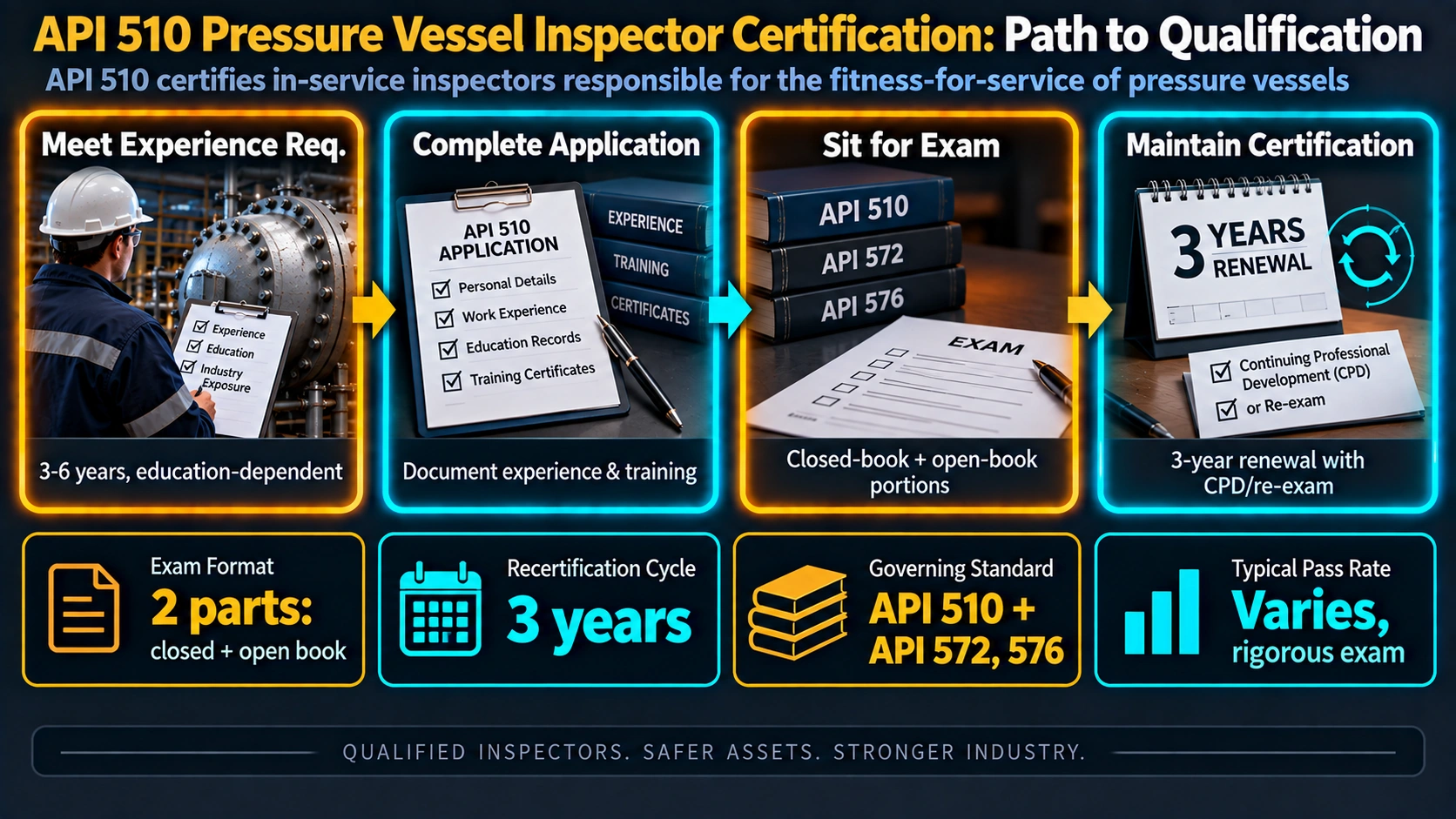
API 510 eligibility is determined by the combination of your education level and years of relevant experience. Two rules apply to every candidate regardless of education level: all experience must have been acquired within the last 10 years, and all experience must have been acquired while employed by or under contract with an authorised inspection agency as defined in API 510. Volunteer experience, academic research, and experience outside the scope of API 510 inspection activities does not qualify.
| Education Level | Minimum Total Relevant Experience | Notes |
|---|---|---|
| No formal education beyond basic schooling | 5 years | Experience must be in pressure vessel inspection, construction, maintenance, or related technical discipline |
| High school diploma / GED or equivalent | 3 years | Most common path for experienced inspection technicians transitioning to certified inspector roles |
| 2-year degree or certificate in engineering or technology | 2 years | Associate degree or technical certificate specifically in an engineering or technology field |
| Bachelor’s degree or higher in engineering or technology | 1 year | Engineering degree (mechanical, chemical, materials, metallurgy, civil) or technology degree from accredited institution |
Application Process
Applications for the API 510 exam are submitted online through the API ICP Portal at myicp.api.org. The application requires documentation of your education (transcripts or degree certificates) and experience (employment records or a signed statement from your employer confirming the duration, nature, and relevant inspection content of your experience). Applications are verified after submission — inaccurate or unverifiable experience claims are grounds for rejection.
Once your application is approved, API issues an eligibility notification that allows you to schedule the exam at a Prometric testing centre. Prometric has over 450 authorised centres worldwide; centres are available in most countries where oil and gas industry activity creates demand. Schedule early — popular exam windows (particularly the September and February cycles) fill up several months in advance, especially in high-demand locations such as Houston, Jubail, Abu Dhabi, and Singapore.
Exam Structure — Closed-Book and Open-Book
The API 510 exam is administered entirely at Prometric computer-based testing centres. There are no physical books, notes, or printed materials permitted in the testing room. The open-book portion uses PDF versions of the referenced codes and standards provided on the exam computer — these are the exact same documents you study from, but accessed digitally without the ability to annotate or tab them. This is a critical point: your ability to navigate the PDF documents quickly is as important as knowing what to look for.
The exam has two portions that test fundamentally different competencies. The closed-book portion tests knowledge that a competent pressure vessel inspector must carry in their head — the formulas they need to calculate in the field without reference materials, the damage mechanisms they must recognise from visual or data clues, the inspection interval determination rules, and the core API 510 code requirements. The open-book portion tests the ability to navigate complex technical codes under time pressure to find specific requirements, apply them to inspection scenarios, and select the correct answer from four options.
| Portion | Questions | Time Allowed | Reference Materials | Primary Skill Tested |
|---|---|---|---|---|
| Closed-Book | 110 questions (includes some unscored pretest) | 2 hours 45 minutes | None — memory only | Formulas, damage mechanisms, inspection interval rules, core code requirements from memory |
| Lunch Break | — | 45 minutes | — | Rest and mental reset between portions |
| Open-Book | 60 questions (includes some unscored pretest) | 3 hours 45 minutes | PDF codes on exam computer — no physical materials | Code navigation, code application, interpretation of specific requirements from referenced standards |
| Total Scored | 140 questions | 6.5 hours of active exam time | — | Both portions combined determine pass/fail |
API 510 Exam Day — Hour by Hour
Bring two forms of ID (passport + national ID or driver’s licence). No books, notes, phones, or smart watches permitted. You will be photographed and fingerprinted at check-in. A locker is provided for your belongings.
A short computer-based tutorial familiarises you with the exam interface — how to flag questions for review, navigate between questions, and use the on-screen calculator. Complete this carefully — do not skip it even if you feel comfortable with computers.
110 questions. No reference materials. Average 90 seconds per question. Flag difficult questions and return to them — do not spend more than 2 minutes on any single question on the first pass. Calculation questions require the on-screen calculator; practise with it before exam day.
Mandatory break. You may leave the testing room. Do not discuss exam content with anyone. Eat, hydrate, and mentally reset — the open-book portion is longer and requires sustained PDF navigation concentration.
60 questions. PDF codes available on-screen. Average 3 minutes 45 seconds per question — significantly more time per question than closed-book. Most questions require locating a specific table, clause, or requirement in one of the referenced codes. Navigate directly to the relevant code rather than reading linearly.
A preliminary pass/fail result is displayed on-screen at the Prometric centre. The official result and certificate are issued by API after verification, typically within 2 to 4 weeks.
Body of Knowledge — Five Topic Areas
The API 510 Body of Knowledge (BOK) is the official document published by API that specifies exactly what will be tested on the exam. It is organized into five topic areas. Understanding the relative weight of each area allows you to prioritise study time toward the highest-yield topics. The BOK is available as a free download from api.org — download the current cycle BOK, not an older version.
Welding
Covers the inspector’s ability to review WPS, PQR, and Welder Performance Qualification (WPQ) records for compliance with ASME Section IX and API 510 supplementary requirements. The inspector must determine if essential and non-essential variables are properly addressed, if the correct mechanical tests are listed on the PQR, and if the WPQ covers the positions and materials being welded. Key reference: API RP 577 (Welding Processes, Inspection, and Metallurgy). Exam focus: ASME Section IX QW-200 series, essential variables, F-Numbers, P-Numbers, and preheat requirements.
Nondestructive Examination
Covers NDE requirements specifically as applied in pressure vessel in-service inspection under ASME Section V. Articles tested are Article 1 (General Requirements), Article 2 (Radiographic Examination — RT rules for pressure vessels including film quality, IQI placement, density requirements), and Article 6 (Liquid Penetrant Examination including Mandatory Appendices II and III). The inspector must understand RT quality indicators, PT technique requirements, and know when each NDE method is applicable under API 510 and ASME Section VIII.
Practical Knowledge — General
This is largely a closed-book topic area. Candidates must perform calculations from inspection data for in-service pressure vessels: corrosion rate calculation (short-term and long-term), remaining life calculation, next inspection date determination, and minimum required wall thickness using the ASME Section VIII internal pressure formula. Joint efficiency factor (E) determination and its effect on minimum required thickness are tested. Inspection interval setting rules under API 510 and the risk-based inspection (RBI) alternative are also covered. These formulas are frequently tested in the closed-book portion.
Practical Knowledge — Specific
The highest-weighted and broadest topic area. Covers all of API 510 (Pressure Vessel Inspection Code), API RP 572 (Inspection Practices including Annex B), API RP 576 (Inspection of Pressure-Relieving Devices — entire document except annexes), API RP 578 (Material Verification Programme), and all of API RP 571 (Damage Mechanisms Affecting Fixed Equipment — the 70+ damage mechanisms, their recognition, severity, and mitigation). RP 571 alone is one of the most heavily tested documents in the open-book portion.
Other Referenced Material
Covers supplementary topics including material verification requirements under API RP 578 (positive material identification procedures, traceability requirements for new and existing assets), pressure-relieving device inspection requirements under API RP 576, and general familiarity with ASME Section VIII Division 1 design rules as they apply to in-service inspection — particularly the internal pressure design formula, allowable stress selection, and corrosion allowance concepts. Calculations under this topic are exclusively for in-service assessment, not new vessel design.
Referenced Codes and Standards — What to Know from Each
| Document | Scope Relevant to API 510 Exam | Primary Exam Use | Portion |
|---|---|---|---|
| API 510 (Primary code) | The in-service inspection, rating, repair, and alteration code for pressure vessels. All sections applicable unless specifically excluded. Section 9 (Repairs and Alterations) and Appendix E are included. | Inspection interval rules, repair authorisation, alteration requirements, owner-user responsibilities, RBI application, fitness-for-service references, PRD inspection requirements | Both C/B and O/B |
| API RP 571 | Damage mechanisms affecting fixed equipment in refining — 70+ damage mechanisms with causes, affected materials, critical factors, appearance/morphology, prevention, and inspection/monitoring guidance | Recognising damage mechanisms from description of service conditions or appearance; knowing which NDE methods detect each mechanism; understanding susceptible materials | Primarily O/B |
| API RP 572 | Inspection practices for pressure vessels — entire document including Annex B (all other annexes excluded). Covers inspection planning, internal/external inspection procedures, frequency, acceptance criteria concepts | Inspection preparation procedures, what to inspect in external vs internal surveys, equipment types, access requirements, records management | Primarily O/B |
| API RP 576 | Inspection of pressure-relieving devices — entire document except annexes. Covers PRD types, inspection intervals, testing procedures, acceptance criteria, records | PRD inspection frequencies, testing methods, set pressure verification, reasons for PRD inspection, when PRDs must be replaced vs repaired | Primarily O/B |
| API RP 577 | Welding processes, inspection, and metallurgy — all requirements. Covers welding processes used in refinery/pressure vessel work, metallurgical considerations, PWHT, preheat, NDE of welds | Welding inspection requirements, preheat and PWHT requirements for repair welds, understanding WPS/PQR review as it applies to in-service repair authorisation | Primarily O/B |
| API RP 578 | Material Verification Programme for new and existing assets — entire document. Covers PMI methods, traceability requirements, documentation, and scope of material verification programmes | When PMI is required, which PMI methods are acceptable, traceability requirements for repair materials, scope of MVP for existing vessels | Primarily O/B |
| ASME Section V | Articles 1 (General), 2 (RT), and 6 (PT — including Mandatory Appendices II and III) specifically. Not Articles 4, 7, or others unless incidentally referenced. | RT film quality requirements, IQI type and placement, density limits, PT materials, dwell time, interpretation, acceptance criteria concepts | Primarily O/B |
| ASME Section VIII Div. 1 | Pressure vessel design — applicable to in-service assessment calculations only. Internal pressure formula, joint efficiency, material allowable stress, corrosion allowance concepts. Not for new vessel design questions. | Minimum required thickness calculations, MAWP determination for existing vessels, joint efficiency factor E selection (Table UW-12) | Both — formulas in C/B; tables in O/B |
| ASME Section IX | Welding and brazing qualifications — WPS, PQR, and Welder Performance Qualification requirements for repair and alteration welding on pressure vessels | Essential variables, test coupon requirements, mechanical test acceptance criteria, PQR review — as the inspector’s responsibility to verify compliance | Primarily O/B |
Closed-Book Topics — What You Must Memorise
The closed-book portion is the portion most candidates underestimate. With 110 questions in 2 hours 45 minutes, you have approximately 90 seconds per question — not enough time to work out anything you don’t already know. The following are the highest-priority closed-book topics that require committed memorisation before exam day.
1. The Internal Pressure Wall Thickness Formula
The most fundamental calculation in the API 510 exam. You must be able to apply this without reference to tables for the basic formula and know where to look for allowable stresses and joint efficiency values. The ASME Section VIII Division 1 formula for cylindrical shells under internal pressure is:
t = (P × R) / (S × E − 0.6P)
Where:
t = minimum required wall thickness (inches or mm)
P = internal design pressure (psig or MPa)
R = inside radius of shell (inches or mm)
S = allowable stress of material (from ASME IID tables, psi or MPa)
E = joint efficiency factor (from API 510 / ASME Table UW-12)
Rearranged for MAWP of existing vessel:
P = (S × E × t) / (R + 0.6t)
Where t = current measured wall thickness minus future corrosion allowance
2. Corrosion Rate and Remaining Life Calculations
API 510 requires inspectors to calculate short-term and long-term corrosion rates from thickness measurement data, and to use these to determine remaining life and next inspection date. These are closed-book because an inspector in the field must be able to make these determinations from their inspection data without reference materials.
CR_ST = (t_prev − t_current) / (years between measurements)
Long-Term Corrosion Rate:
CR_LT = (t_original − t_current) / (total years in service)
Remaining Life:
RL = (t_current − t_min_required) / CR
Use the HIGHER of short-term or long-term corrosion rate for conservative RL calculation
Next Inspection Date:
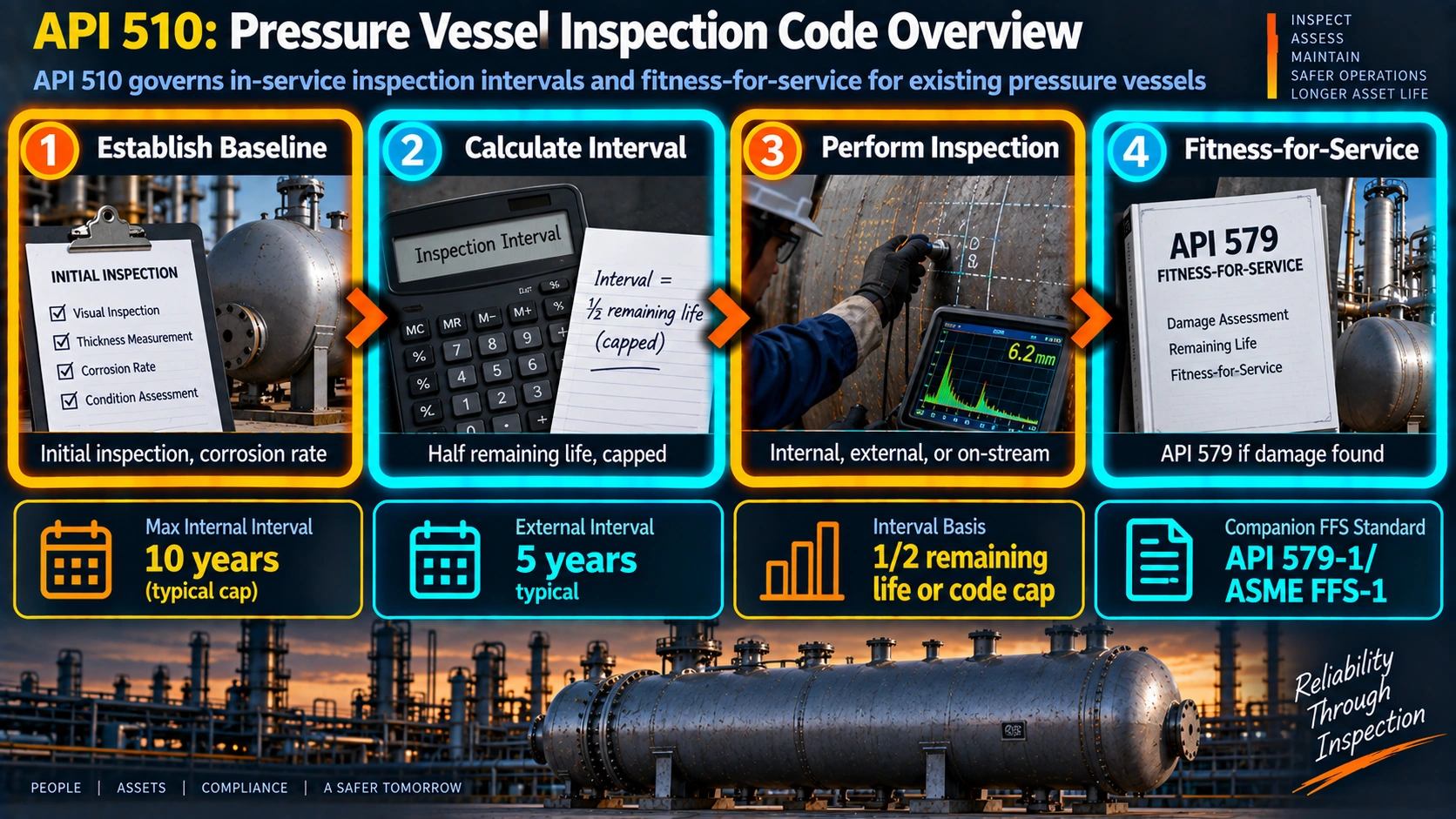
Max inspection interval = RL / 2 (per API 510)
→ Also subject to maximum calendar intervals per API 510 Section 6
3. API 510 Inspection Intervals (Closed-Book)
API 510 Section 6 specifies maximum inspection intervals for internal and external inspections. The examiner asks candidates to determine correct intervals from given vessel parameters. Know these rules without reference:
| Inspection Type | Maximum Interval | Governing Rule |
|---|---|---|
| Internal (or equivalent) | 10 years maximum OR remaining life / 2 — whichever is less | API 510 §6.3 |
| External (on-stream) | 5 years maximum OR remaining life / 2 — whichever is less | API 510 §6.4 |
| Pressure-relieving devices (PRDs) — general | 10 years maximum — or per API RP 576 Table | API 510 §6.5 / API RP 576 |
| PRDs — clean, non-corrosive, non-fouling service | 10 years OR ½ remaining life of protected vessel | API RP 576 §5 |
| RBI (Risk-Based Inspection) alternative | No fixed maximum — interval set by RBI analysis; must be documented and approved by owner-user | API 510 §6.6 / API 580 |
4. Joint Efficiency Factor E
The joint efficiency factor E significantly affects the calculated minimum required wall thickness. From ASME Section VIII Division 1 Table UW-12, the E factor depends on the weld joint type and the radiographic examination performed on the weld. Know the four key E values for the most common configuration:
| Weld Joint Type | Radiographic Examination | E Factor |
|---|---|---|
| Type 1 (double-welded butt joint) | Full radiography (100%) | E = 1.0 |
| Type 1 (double-welded butt joint) | Spot radiography | E = 0.85 |
| Type 1 (double-welded butt joint) | No radiography | E = 0.70 |
| Type 2 (single-welded butt joint with backing) | Spot radiography | E = 0.80 |
| Type 2 (single-welded butt joint with backing) | No radiography | E = 0.65 |
Open-Book Topics — Code Navigation Strategy
The open-book portion’s 60 questions in 3 hours 45 minutes averages nearly 4 minutes per question — considerably more than the closed-book average. This additional time is needed because most open-book questions require locating a specific clause, table, or figure in one of the referenced codes before you can answer. Candidates who are unfamiliar with the structure of the codes will spend 5 to 8 minutes searching for each answer and will run out of time.
API RP 571 — The Single Most Important Open-Book Document
API RP 571 (Damage Mechanisms Affecting Fixed Equipment) is the most heavily tested individual document in the API 510 open-book portion. It covers over 70 distinct damage mechanisms, each described with: the mechanism description and affected equipment, critical factors, susceptible materials, appearance/morphology (what the damage looks like on inspection), prevention and mitigation, and inspection and monitoring methods. Exam questions present a scenario — a service environment, a material, a symptom — and ask which damage mechanism is occurring, which NDE method would detect it, or what mitigation measure would prevent it.
Key API RP 571 Damage Mechanisms to Master
| Damage Mechanism | Key Facts for Exam | Detection Method |
|---|---|---|
| High-Temperature Hydrogen Attack (HTHA) | Occurs above Nelson Curve limits; methane bubble formation; C steel and Cr-Mo alloys susceptible above threshold; no external indication until failure | Metallographic examination; TOFD; phased array UT |
| Hydrogen-Induced Cracking (HIC) | Wet H₂S service; stepwise cracking parallel to plate surface; no applied stress required; NACE MR0175 compliance materials | UT straight beam; RT (laminar cracking visible) |
| Stress Corrosion Cracking (SCC) — Caustic | Caustic soda service; austenitic SS and carbon steel susceptible; temperature and concentration dependent; PWHT mitigates | PT (surface), UT, WFMT |
| Chloride SCC (CLSCC) | Austenitic SS in aqueous Cl⁻ service; temperature above ~60°C; transgranular cracking; duplex SS more resistant | PT; EC; UT |
| Wet H₂S Cracking (SOHIC, SSC) | Wet H₂S environment; HAZ cracking; hardness >HRC 22 increases susceptibility; NACE MR0175 | WFMT; ACFM; UT |
| Amine SCC | Amine treating units (MEA, DEA, MDEA); CS vessels; weld HAZ cracking; PWHT required per API 945 | WFMT; PT (crack detection) |
| Naphthenic Acid Corrosion | High-temperature crude above 220°C; high TAN crude; 316L SS or 317L offers resistance over 304/316; velocity dependent | UT thickness measurement; visual (accelerated at welds) |
| High-Temperature Oxidation | Carbon steel above ~480°C; 5Cr-1Mo and 9Cr-1Mo progressively more resistant; scaling rate follows parabolic law | Visual (scale); UT thickness |
| Mechanical Fatigue | Cyclic loading; starts at stress concentrations (notches, weld toes, nozzles); crack propagation to fracture; vibrating lines | PT; MT; UT for growing cracks |
| Creep | Elevated temperature service near or above design temperature; P91 and other Cr-Mo alloys; Type IV cracking at weld HAZ; long-term damage | Metallography; hardness testing; UT |
API RP 576 — Pressure-Relieving Devices
API RP 576 is tested extensively in Topic IV. Know the PRD types (conventional spring-loaded safety valve, balanced bellows, pilot-operated, rupture disk), inspection interval rules, testing procedures, and when a PRD must be replaced versus repaired. A frequently tested topic is the use of rupture disks upstream or downstream of safety relief valves — the code specifies specific requirements for drain holes, pressure gauges, and rupture disk material compatibility that are tested as detailed open-book questions.
12-Week Study Plan
Weeks 1–2: Orientation and Code Acquisition
Download the current API 510 BOK and Publication Effectivity Sheet. Acquire the correct editions of all referenced codes. Read API 510 completely once — cover to cover — without trying to memorise, to understand the structure and scope. Download and study the ICP API 510 exam tutorial at api.org. Take a baseline practice exam if available from your training provider to identify your starting weakest areas. Register your Prometric appointment for your target exam window.
Weeks 3–4: Calculations and Closed-Book Topics
Master the wall thickness formula, corrosion rate/remaining life/inspection interval calculations, and joint efficiency factor E table until you can execute them from memory in under 2 minutes each. Work through at least 100 calculation practice questions. Study API 510 Section 6 (inspection interval rules) in complete detail — memorise the maximums and the RL/2 rule. These are the highest-yield closed-book topics and the ones most candidates feel under-prepared for.
Weeks 5–6: API RP 571 — Damage Mechanisms
Spend two full weeks on API RP 571. Read each damage mechanism section systematically: for each mechanism write a one-line summary of (1) what environment causes it, (2) what materials are susceptible, (3) what it looks like, and (4) which NDE method detects it. Focus extra time on the mechanisms most commonly tested: HTHA, HIC, wet H₂S cracking, chloride SCC, caustic SCC, amine SCC, naphthenic acid corrosion, high-temperature oxidation, sulphidic corrosion, and creep. Complete at least 80 RP 571 practice questions.
Week 7: Welding (API RP 577 + ASME Section IX)
Study API RP 577 completely — the inspector’s role in welding oversight, preheat and PWHT requirements, NDE of welds, and the welding processes covered. From ASME Section IX, understand the WPS/PQR review process: how to check essential variables, which mechanical tests are required for a given coupon thickness, and what constitutes a proper WPQ. Topic I is approximately 15% of the exam — it is worth understanding thoroughly but should not crowd out the higher-weighted topics.
Week 8: NDE (ASME Section V Articles 1, 2, and 6)
Study ASME Section V Article 1 (General Requirements), Article 2 (Radiographic Examination — all rules for RT as applied to pressure vessels: film quality, IQI type and selection tables, penetrameter placement, density requirements, T-2-T rule for hole-type IQIs), and Article 6 (Liquid Penetrant — PT techniques, dwell times, developer types, interpretation, Mandatory Appendices II and III). Focus on the tables you will need to navigate quickly in the open-book portion.
Week 9: API RP 572, RP 576, and RP 578
Study API RP 572 (Inspection Practices for Pressure Vessels) focusing on Annex B and all inspection procedure sections. Study API RP 576 (Pressure-Relieving Devices) with emphasis on inspection intervals, PRD types, testing requirements, and the rupture disk combination rules. Study API RP 578 (Material Verification Programme) covering PMI methods, traceability requirements, and scope of MVPs. These documents together account for a substantial portion of the Topic IV questions.
Weeks 10–11: Full Practice Exams and Gap Closure
Take at least 3 full-length timed practice exams — 110 questions in 2h45m closed-book, then 60 questions in 3h45m open-book with PDF access. Score each topic area separately. Identify any topic where you score below 70% and dedicate focused review. Practice open-book PDF navigation speed — can you locate a specific API RP 571 damage mechanism within 90 seconds? Can you find the relevant table in ASME Section V Article 2 within 60 seconds? Navigation speed is the open-book bottleneck for most candidates.
Week 12: Final Review and Logistics
Light review only — no new material this week. Review your calculation formula sheet one final time. Confirm your Prometric appointment details, travel route, and required identification documents. Review the exam tutorial on api.org. Get consistent sleep for 3 nights before the exam. On exam day: take the full tutorial time, flag difficult questions and return to them, never leave closed-book questions blank, and manage your open-book time assertively — skip a question you cannot find in 3 minutes and return to it rather than letting one question consume 10 minutes.
Recertification Requirements
API 510 certification is valid for 3 years. Recertification is not automatic — it requires a positive application demonstrating that you have remained active in pressure vessel inspection work and have met the continuing professional development (CPD) requirement. The consequences of missing the recertification window are significant: if the certification expires before the application is submitted, you must sit the full examination again to recertify.
| Requirement | Detail | Verification |
|---|---|---|
| Activity Requirement | Minimum 20% of time over the 3-year certification period spent performing or supervising pressure vessel inspection activities as described in API 510 | Self-declaration on application; employer verification may be requested. Inspectors not meeting this must take the full examination. |
| CPD Hours | 24 Continuing Professional Development hours per 3-year cycle, completed across a minimum of two CPD categories. Hours must be relevant to inspection and mechanical integrity in the petroleum/petrochemical industry. | Upload proof of CPD activities (certificates, training records) to ICP Portal Education page with recertification application |
| Application Window | Submit 90 days before expiration date OR during the 90-day grace period after expiration. Late fees apply after expiration date. | Application submitted through API ICP Portal. Payment of recertification fee required. |
| 6-Year Web Quiz | Every 6 years (every second 3-year cycle), an online open-book web quiz must be completed in addition to standard 3-year requirements | Quiz available via ICP Portal 90 days before expiration. Must be completed before end of grace period. Score must meet passing threshold. |
| Lapsed Certification | If application not submitted by end of 90-day grace period, certification expires. Full examination required to recertify — no experience-based waiver available. | New full application and exam required. Travel circumstances and work location do not constitute exceptions. |
Salary and Career Outlook — API 510 Certified
API 510 certification significantly increases the market value of a pressure vessel inspector. The combination of the certification’s recognition across global oil and gas markets, its ANSI/ISO 17024 accreditation, and the scarcity of genuinely qualified pressure vessel inspectors in high-demand markets means that API 510-certified professionals command substantially higher compensation than their uncertified counterparts.
The API Credential Stack — Building on API 510
API 510 is the foundation of the fixed equipment inspection credential path within the API ICP programme. Once earned, it opens pathways to additional API credentials that significantly expand your scope of authority and market value.
| Credential | Scope | Recommended After API 510? | Market Value Added |
|---|---|---|---|
| API 570 | Piping Inspector — in-service inspection of process piping systems under ASME B31.3 and API 570 code | Yes — highest priority next credential | Combined API 510 + 570 is the standard requirement for most fixed equipment inspector job postings in oil and gas; immediately expands billable scope |
| API 571 | Corrosion and Materials — demonstrates advanced competency in the damage mechanisms covered in API RP 571; natural extension of API 510 knowledge | Yes — strengthens damage mechanism expertise | Positions candidate as a corrosion/materials specialist rather than general inspector; relevant for RBI implementation roles and integrity engineering |
| API 580 | Risk-Based Inspection — covers RBI methodology, risk assessment, consequence of failure analysis, and RBI programme implementation | Yes — particularly for integrity engineering roles | RBI is now the dominant inspection strategy in major oil companies; API 580 + API 510 is the combination for mechanical integrity programme leadership roles |
| API 653 | Aboveground Storage Tank Inspector — in-service inspection of API 650/653 tanks | Situational — if tank inspection is relevant to your work | Expands scope to tank farms; common supplementary credential for refinery inspectors who cover both vessels and storage tanks |
| API 577 | Welding Inspection and Metallurgy — validates welding inspection knowledge at a depth beyond the API 510 welding topic area | Situational — if welding inspection oversight is primary role | Useful for inspectors in maintenance/turnaround roles where approving weld repairs is a frequent primary activity |
| ASME National Board (NB) Commission | Authorizes inspectors to act as Authorized Inspector or Authorized Inspector Supervisor for ASME-stamped vessels and Code repairs | Situational — required for certain ASME Code jurisdictions | Required in US jurisdictions that require NB-commissioned inspectors for ASME Code repair authorisation on registered vessels |
Common API 510 Exam Mistakes — and How to Avoid Them
| Mistake | Consequence | Prevention |
|---|---|---|
| Studying from the wrong edition of referenced codes | Questions and answers that reference table numbers, clause numbers, or specific requirements that differ between editions — leading to wrong answers from correct knowledge | Download and verify the Publication Effectivity Sheet for your specific exam cycle from api.org before purchasing or downloading any reference document |
| Underestimating the closed-book portion | Candidates spend 90% of study time on open-book code navigation and arrive at the exam unable to complete the corrosion rate, remaining life, and MAWP calculations from memory | Dedicate Weeks 3–4 exclusively to closed-book calculation mastery. Write the formulas from memory daily until they are automatic. |
| Not practising PDF navigation under timed conditions | Open-book questions require finding specific clauses in complex codes within 3–4 minutes each. Candidates who have only read the codes linearly cannot navigate them quickly enough under exam conditions. | Practice navigating the PDF versions of the codes specifically — not physical books. Know the document structure well enough to go directly to the relevant chapter or table in under 60 seconds. |
| Neglecting API RP 571 | API RP 571 damage mechanisms are among the most heavily tested topics in the open-book portion. Candidates who have not thoroughly studied it consistently report running out of time on open-book questions. | Spend a minimum of 2 dedicated study weeks on RP 571. Create a one-page summary card for each major damage mechanism category. |
| Answering every question in sequence without flagging difficult ones | One difficult calculation or code navigation question can consume 10+ minutes and leave insufficient time for later questions that might be straightforward | Flag any question that cannot be answered within 90 seconds (closed-book) or 3 minutes (open-book) and return to it after completing the rest of the portion. |
| Leaving blank answers on closed-book questions | The API 510 exam has no penalty for wrong answers — an unanswered question scores zero; a guessed answer has a 25% chance of being correct. Never leave a question blank. | With 90 seconds per closed-book question, eliminate obviously wrong answers first and then choose the best remaining option. Always provide an answer. |
Essential Study Materials
Disclosure: WeldFabWorld participates in the Amazon Associates programme (StoreID: neha0fe8-21). If you purchase through these links, we may earn a small commission at no extra cost to you. This helps support free technical content on this site.