Heat Exchanger Types — Shell & Tube, Plate, Air-Cooled: Engineering Guide
Shell-and-tube heat exchangers are the most widely fabricated type of pressure vessel in the global process industry. Refineries, petrochemical plants, power stations, pharmaceutical facilities, and offshore platforms collectively operate hundreds of thousands of these units, ranging from small 0.1 m² process heat exchangers to massive 2,000 m² main fractionator overhead condensers. Understanding the engineering basis for heat exchanger design, the TEMA class and nomenclature system that governs their construction, the three principal bundle configurations and their thermal-mechanical implications, and the ASME code requirements that apply to their fabrication and inspection is therefore fundamental knowledge for any pressure equipment engineer, inspector, or procurement specialist.
This guide covers the complete engineering framework for heat exchanger selection and specification: TEMA class designations R, C, and B; the three-letter TEMA nomenclature system; all seven standard TEMA shell types; the fixed tubesheet, U-tube, and floating head bundle configurations with their thermal expansion treatment; baffle design and tube pitch; plate heat exchanger types and their operating limits; air-cooled heat exchanger design and API 661 requirements; ASME Section VIII fabrication considerations; tube-to-tubesheet joint qualification; and a systematic approach to inspection under API 510 and API 570. An interactive selection tool is provided to guide preliminary type selection from basic service parameters.
While this guide focuses on the mechanical and fabrication engineering of heat exchangers, the thermal and hydraulic design — calculating required surface area, setting tube-side and shell-side flow arrangements, and sizing nozzles — is governed by the TEMA standards and specialised thermal design software (such as HTRI Xchanger Suite and ASPEN HYSYS). The two disciplines are inseparable in practice: a thermally optimal design that does not satisfy TEMA and ASME mechanical requirements cannot be fabricated or certified, and a mechanically compliant design that is thermally undersized fails its process duty. Both must be resolved before a heat exchanger specification is finalised.
Overview of Heat Exchanger Classification
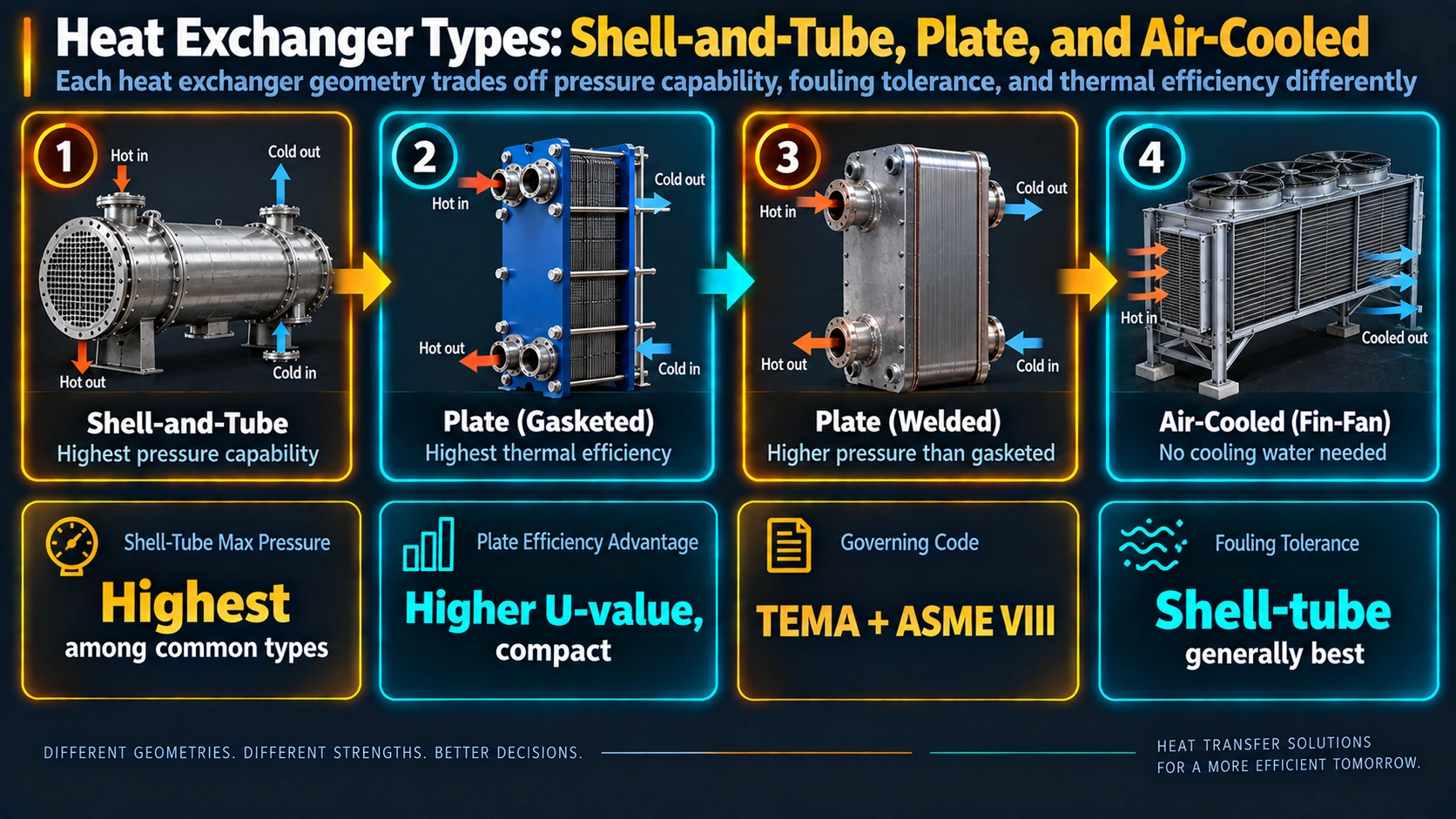
Heat exchangers transfer thermal energy between two fluid streams without mixing them. The classification of heat exchangers into types is based on the mechanism of heat transfer, the geometric arrangement of the heat transfer surface, and the flow arrangement of the two fluid streams. The three principal types encountered in industrial process applications are the subject of this guide:
| Type | Heat Transfer Surface | Typical Pressure Range | Typical Duty Range | Primary Standard |
|---|---|---|---|---|
| Shell and Tube | Cylindrical tubes inside a cylindrical shell | Vacuum to >600 bar | 0.1 kW to >100 MW | TEMA + ASME VIII |
| Plate (Gasketed) | Corrugated metal plates with gasket seals | Up to ~25 bar | 0.01 kW to ~20 MW | Manufacturer std. + ASME VIII |
| Plate (Brazed) | Brazed corrugated plates, no gaskets | Up to ~30–45 bar | Small to medium duty | ASME VIII / manufacturer |
| Air-Cooled (Fin-Fan) | Finned tubes in rectangular header box | Up to design (ASME VIII) | 0.1 MW to >100 MW | API 661 + ASME VIII |
| Double-Pipe | Inner pipe inside outer pipe (annulus) | Wide range | Small duty (<1 MW) | ASME VIII or B31.3 |
| Spiral | Two concentric spiral channels | Up to ~20 bar | Small to medium | ASME VIII / manufacturer |
TEMA Class Designations — R, C, and B
TEMA (Tubular Exchanger Manufacturers Association) publishes standards for the design, fabrication, materials, testing, and nomenclature of shell-and-tube heat exchangers. The TEMA standards define three construction classes, each calibrated to a different severity of service requirement. The class designation is specified by the purchaser in the exchanger data sheet and governs the fabrication tolerances, corrosion allowances, bundle clearances, nozzle sizing, and material quality requirements throughout the design and fabrication process.
Key Differences Between TEMA Classes
| Parameter | TEMA R | TEMA B | TEMA C |
|---|---|---|---|
| Minimum corrosion allowance (shell) | 3.2 mm (1/8 in) | 1.6 mm (1/16 in) | 1.6 mm (1/16 in) |
| Bundle-to-shell clearance (floating head) | Tightest — detailed in tables | Intermediate | Widest — allows lighter construction |
| Impingement protection | Required when ρv² > 2,230 kg/(m·s²) for non-abrasive, non-corrosive single-phase fluids | Same threshold as R | Threshold differs; less restrictive |
| Nozzle minimum size | Specific minimum bore tables for shell and channel nozzles | Same as R | Smaller minimums permitted |
| Tube-to-tubesheet joints | Detailed requirements for groove dimensions and expansion procedures | Same as R | Simpler requirements |
| Floating head backing ring | Bolted, accessible without removing bundle | Same as R | May differ by configuration |
TEMA Three-Part Nomenclature System
The TEMA nomenclature system uses a standardised three-letter code that completely and unambiguously describes the mechanical configuration of any shell-and-tube heat exchanger. Every equipment data sheet, purchase order, and drawing for a shell-and-tube heat exchanger should specify this code. The three letters designate, in order: the front-end stationary head type, the shell type, and the rear-end head type.
Front-End Stationary Head Types
| Code | Type | Description | Access for Cleaning? |
|---|---|---|---|
| A | Channel with removable cover | Cylindrical channel with a separate bolted cover plate — provides easy tube-side access without disconnecting nozzles | Yes |
| B | Bonnet (integral cover) | Hemispherical or dished head welded directly to the tubesheet — lower cost but requires nozzle disconnection for access | Nozzles only |
| C | Channel integral with tubesheet | Channel forged or welded as part of the tubesheet assembly; used in removable-bundle designs | Bundle removal |
| N | Fixed tubesheet channel | Integral channel for fixed tubesheet design — tubesheet is part of the shell structure | Limited |
| D | Special high-pressure closure | Breech-lock or other special closure for very high pressure; used in reformer feed-effluent exchangers | Design-specific |
Rear-End Head Types
| Code | Type | Thermal Expansion | Bundle Removal? |
|---|---|---|---|
| L | Fixed tubesheet (like A-front) | None — expansion joint required if ΔT too large | No |
| M | Fixed tubesheet (like B-front) | None — expansion joint required if ΔT too large | No |
| N | Fixed tubesheet (like N-front) | None — expansion joint required if ΔT too large | No |
| U | U-tube bundle | Inherent — tubes free to expand at U-bend | Yes |
| P | Outside packed floating head | Full — floating tubesheet moves in packing gland | Yes |
| S | Floating head with backing device | Full — split backing ring retains floating head cover | Yes |
| T | Pull-through floating bundle | Full — entire bundle pulls through shell | Yes — easiest |
| W | Externally sealed floating tubesheet | Full — stuffing box or packing gland external to shell | Yes |
Shell Types — E, F, G, H, J, K, X
The middle letter of the TEMA three-part designation specifies the shell type, which defines the flow path of the shell-side fluid through the exchanger. The choice of shell type directly affects the number of shell-side passes, the temperature cross capability, the pressure drop, and the achievable heat transfer coefficient.
| Shell Type | Flow Arrangement | Typical Application | Key Advantage |
|---|---|---|---|
| E | Single pass, one inlet & one outlet | General service — the most common type | Simplest, lowest cost, easiest to design |
| F | Two pass via longitudinal baffle | Services requiring temperature cross; high-temperature-difference services | Can achieve true counter-current flow; handles temperature cross in single shell |
| G | Split flow — inlet at centre, outlets at ends | Horizontal thermosiphon reboilers; low-pressure-drop shell-side required | Low shell-side pressure drop; self-draining |
| H | Double split flow — two inlets, two outlets | Where very low shell-side pressure drop is required | Lowest pressure drop of all non-crossflow shells |
| J | Divided flow — two inlets, one outlet (or reverse) | Condensers; reboilers; low-pressure-drop vapour services | Low pressure drop; accommodates high vapour volumes |
| K | Kettle reboiler — oversized shell with weir | Process reboilers; boiling services requiring vapour disengagement | Vapour-liquid disengagement space above tube bundle; flooded bundle operation |
| X | Pure crossflow | Gas-to-gas cooling; very low pressure drop services | Extremely low shell-side pressure drop; suitable for large gas flow volumes |
Bundle Configurations — Fixed Tubesheet, U-Tube, and Floating Head
The three bundle configurations define how differential thermal expansion between the shell and the tube bundle is managed, whether the bundle can be removed for mechanical cleaning and inspection, and whether tubes can be individually re-rolled or replaced. Each configuration has a distinct cost profile, maintenance requirement, and service suitability.
Thermal Expansion Calculation — Fixed Tubesheet
For a fixed tubesheet exchanger, the differential thermal expansion between the shell and tubes creates a net axial force on both the tubesheet and the shell or tube welds. If this force exceeds acceptable limits, an expansion joint must be added to the shell. The differential expansion is calculated as follows:
Internals — Baffles, Tube Pitch, and Bundle Design
Segmental Baffles
Baffles are internal plates that direct the shell-side fluid across the tube bundle in a defined pattern, increasing velocity and turbulence to enhance heat transfer. The standard segmental baffle is a disc with a cut segment — the baffle cut — at the top or bottom through which the fluid flows from one compartment to the next. Typical baffle cuts range from 15% to 45% of the shell inside diameter. A smaller cut creates a higher velocity and better heat transfer but also higher pressure drop. A larger cut reduces pressure drop but may allow bypass and reduce heat transfer effectiveness.
| Baffle Parameter | Typical Range | Effect of Increasing |
|---|---|---|
| Baffle cut (%) | 15–45% | Lower pressure drop but higher bypass; reduced heat transfer coefficient |
| Baffle spacing | 0.2D to 1.0D (shell ID) | Wider spacing lowers pressure drop and velocity; reduces heat transfer; increases vibration risk |
| Baffle thickness | TEMA minimum per shell ID | Must resist flow-induced vibration forces and bundle weight |
| Number of baffles | Determines number of shell-side passes | More baffles: higher velocity, better HTC, higher pressure drop |
Flow-Induced Vibration
Flow-induced vibration (FIV) is one of the most common root causes of heat exchanger tube failure in service. When shell-side fluid flows across tubes, it can excite the tubes into resonant vibration — particularly in the unsupported spans between baffles. The natural frequency of the tube depends on the tube diameter, wall thickness, material modulus, and unsupported span length. When the vortex shedding frequency of the cross-flow approaches the tube natural frequency, resonant vibration occurs and can cause tube-to-baffle impact damage, baffle hole wear, and ultimately tube fatigue failure. TEMA and HTRI provide methods for checking FIV risk during the design phase.
Tube Pitch and Layout
Tube pitch is the centre-to-centre distance between adjacent tubes in the bundle. TEMA specifies minimum pitches to ensure adequate structural integrity of the tubesheet. Four standard tube layout patterns are used, each offering different heat transfer and pressure drop characteristics:
| Layout Pattern | Pitch Angle | Mechanical Cleaning? | Relative HTC | Typical Use |
|---|---|---|---|---|
| Triangular (30°) | 30° | No | Highest | Clean shell-side service; maximum tube density per shell |
| Rotated triangular (60°) | 60° | No | High | Slightly lower tube density than 30° triangular |
| Square (90°) | 90° | Yes | Moderate | Fouling or dirty shell-side fluid; allows cleaning lane |
| Rotated square (45°) | 45° | Yes | Higher than 90° | Better heat transfer than 90° while maintaining cleanability |
Plate Heat Exchangers — Gasketed, Brazed, and Welded
Plate heat exchangers transfer heat through thin corrugated plates rather than tubes. The corrugated pattern creates a chevron or herringbone profile that generates intense turbulence even at low flow velocities, resulting in overall heat transfer coefficients typically 3 to 5 times higher than shell-and-tube units. This compactness — high heat transfer area per unit volume and per unit mass — is the primary reason plate exchangers dominate in food processing, pharmaceutical, HVAC, and medium-duty process industries.
Gasketed Plate Heat Exchangers (GPHE)
A gasketed plate heat exchanger (also called a plate-and-frame exchanger) consists of a stack of corrugated metal plates clamped between a fixed frame plate and a movable pressure plate. Elastomeric gaskets seal the perimeter of each plate and direct the two fluid streams into alternating channels. The key advantage is accessibility — the unit can be completely disassembled for cleaning, inspection, and plate replacement or addition by releasing the frame bolts. This makes it ideal for fouling services where frequent cleaning is required.
| Parameter | Gasketed Plate | Brazed Plate | Welded Plate (Semi-welded) |
|---|---|---|---|
| Max pressure | ~25 bar | 30–45 bar | 40–100+ bar (design-specific) |
| Max temperature | ~200°C (gasket limited) | ~200°C (brazing alloy) | ~350°C+ |
| Cleanable? | Yes — full disassembly | No — chemically clean only | Partial — one side accessible |
| Thermal efficiency | Excellent — approach ΔT 1–3°C | Excellent | Excellent |
| Refrigerants / Phase change | Limited by gasket material | Yes — widely used in refrigeration | Yes |
| Suitability for hazardous fluids | Limited — gasket failure risk | Better integrity than gasketed | High — welded primary side |
| Cost | Lowest capital | Low to moderate | Moderate to high |
Air-Cooled Heat Exchangers — Fin-Fan Coolers
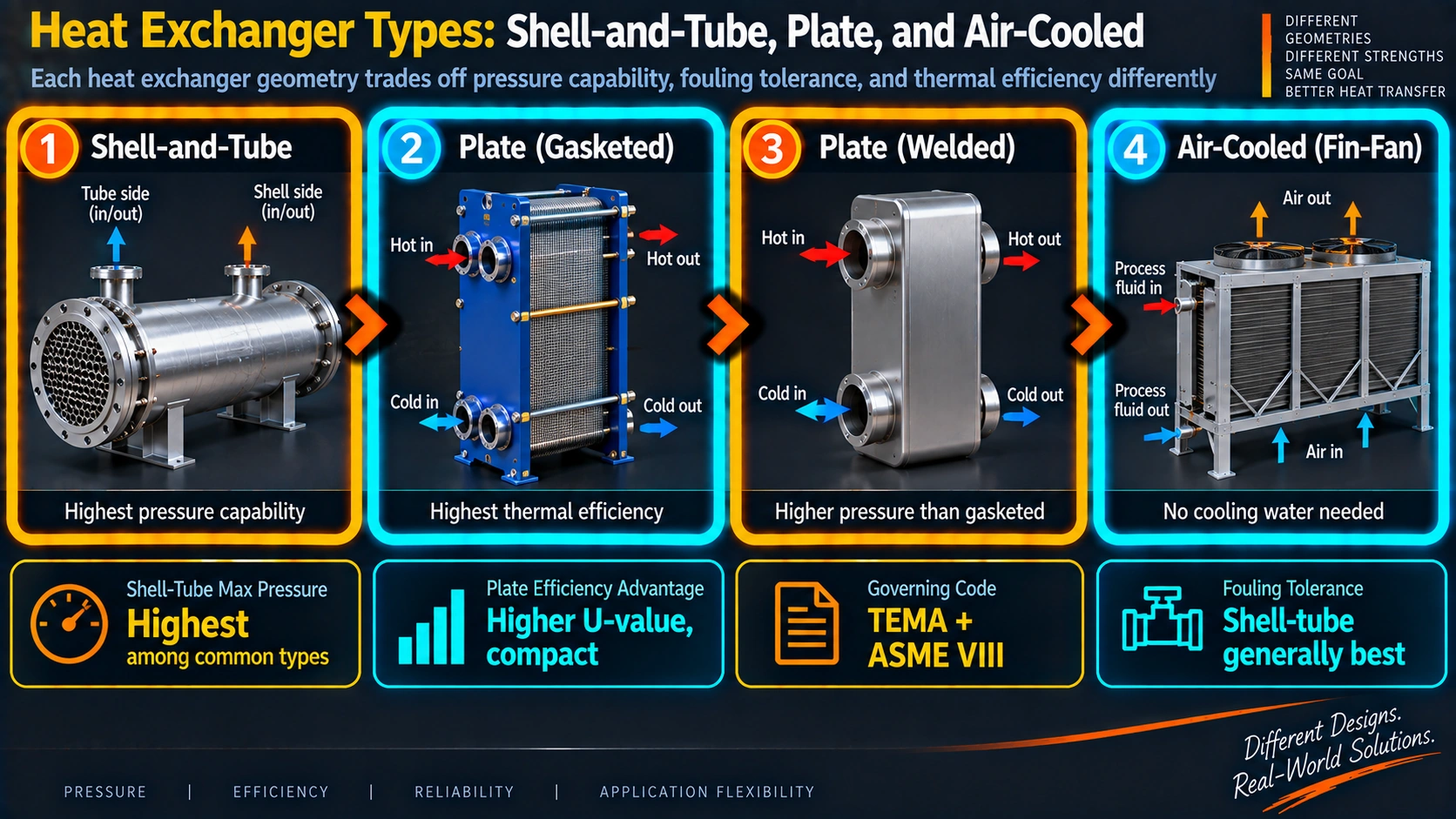
Air-cooled heat exchangers — universally known as fin-fan coolers or air-fin coolers — cool process fluids by forced convection of ambient air across finned tube bundles. They eliminate the need for cooling water, making them essential in arid regions and offshore environments where cooling water is unavailable, expensive to treat, or environmentally restricted. They are governed by API 661 in addition to ASME Section VIII for the header box.
Key Components
| Component | Description | Key Engineering Consideration |
|---|---|---|
| Finned tubes | Carbon steel or alloy tubes with attached aluminium or stainless fins — fin density typically 8–11 fins per inch | Fin efficiency; tube material compatible with process fluid; fin attachment method (embedded, tension-wound, extruded) |
| Header box | The pressure-containing manifold that distributes and collects tube-side fluid — plug header (individual plug per tube end) or cover-plate header | ASME Section VIII pressure design; plug access for tube-end inspection and plugging; PWHT if required by material/thickness |
| Fan and driver | Axial-flow fan (propeller type) driven by electric motor or steam turbine; induced-draft (fan above bundle) or forced-draft (fan below) | Fan blade pitch adjustable for seasonal ambient variation; vibration detection interlock; induced-draft preferred for hot services |
| Structure | Structural steel plenum and support frame; wind loading design | API 661 structural requirements; seismic loading in applicable zones |
| Louvers | Adjustable louver blades for cold-weather control — prevent freezing or overcooling | Fail-open (air side) for safety; motorised for automatic control |
Induced Draft vs Forced Draft
In a forced-draft arrangement, the fan is located below the tube bundle and pushes ambient air upward through the bundle. In an induced-draft arrangement, the fan is located above the bundle and draws air upward through it. Induced-draft units are generally preferred for high-temperature services (above approximately 90°C outlet) because the hot outlet air does not pass through the fan blades — reducing the temperature rating and material requirements for the fan. Forced-draft units are less expensive and easier to maintain but are more susceptible to hot-air recirculation.
ASME Section VIII Fabrication Requirements
Heat exchangers that function as pressure vessels — which includes all shell-and-tube heat exchangers, air-cooled header boxes, and most plate exchangers in industrial service — must be designed, fabricated, examined, and certified in accordance with ASME Boiler and Pressure Vessel Code Section VIII Division 1 (or Division 2 for higher-pressure designs). The ASME U-stamp on the heat exchanger nameplate indicates that the unit was fabricated by an authorised manufacturer and inspected by an authorised inspection agency (AIA) in accordance with ASME Section VIII.
Key ASME VIII Requirements for Heat Exchanger Fabrication
| Requirement | ASME VIII Clause | Heat Exchanger Application |
|---|---|---|
| Shell pressure design | UG-27 (cylindrical shells) | Minimum shell wall thickness at design pressure; applies to both shell and channel |
| Tubesheet design | UHX (heat exchanger tubesheets) | Tubesheet thickness for pressure loads, differential pressure, and thermal stress |
| Tube-to-tubesheet joints | UW-20; Appendix A | Strength-welded or expanded joints; qualification requirements per UW-20 |
| Nozzle reinforcement | UG-36 to UG-45 | All shell and channel nozzles must meet area replacement requirements |
| Weld joint efficiency | Table UW-12 | E = 1.00 for full radiography; E = 0.85 for spot; E = 0.70 for no RT |
| PWHT | UCS-56 (CS and low-alloy) | Required for thick-wall carbon steel shells and heads; TEMA Class R typically specifies PWHT |
| Hydrostatic pressure test | UG-99 | 1.3× MAWP hydrostatic test after fabrication completion; separate shell-side and tube-side tests |
| Impact testing | UG-84; UCS-66 | Required for low-temperature service per minimum design metal temperature (MDMT) curves |
| Nameplate and stamping | UG-116 | ASME U-stamp; separate MAWP stamped for shell side and tube side |
Welding Requirements for Heat Exchanger Fabrication
All pressure-containing welds on heat exchangers must be made by qualified welders using qualified welding procedure specifications (WPS) in accordance with ASME Section IX. Key weld joints in a shell-and-tube heat exchanger include: shell longitudinal and circumferential seam welds, shell-to-tubesheet weld, channel-to-tubesheet weld, nozzle-to-shell and nozzle-to-channel welds, and — when strength welded — tube-to-tubesheet fillet or groove welds. The P-number system governs welding procedure qualification for each combination of shell and internals materials. PWHT requirements are governed by the material P-number, thickness, and TEMA class specification.
Tube-to-Tubesheet Joint Design and Qualification
The tube-to-tubesheet joint is the most reliability-critical connection in a shell-and-tube heat exchanger. Its integrity determines whether the two process fluids remain separated throughout the design life of the unit. Failure of a tube-to-tubesheet joint results in cross-contamination, which in petrochemical service can be immediately hazardous. Three joint types are used in practice, each with specific ASME qualification and examination requirements.
| Joint Type | Description | Pressure Differential Limit | ASME Requirement | Typical Use |
|---|---|---|---|---|
| Mechanical expansion (rolling) | Tube expanded into grooved tubesheet holes using a roller expander — mechanical interference fit | Moderate — depends on groove geometry and tube OD | UW-20(a); groove dimensions per TEMA; pull-out test qualification | Non-lethal, clean service; low to moderate pressure differential between sides |
| Seal welding | Light fillet weld over the tube-tubesheet interface — prevents leakage but not full structural contribution | Seal function only — combined with expansion for structural load | UW-20(c); WPS qualification required; RT or UT of welds | Supplementary to expansion in moderate-to-high differential pressure service; corrosive environments |
| Strength welding | Full-penetration groove weld providing complete structural and seal function — no expansion required | Full design differential pressure capacity | UW-20(d); procedure qualification test including pull-out or push-out test; RT or TOFD of welds | Lethal or high-hazard service; high differential pressure; sour service; TEMA Class R mandatory for some configurations |
Inspection of Heat Exchangers — Methods and Intervals
Heat exchanger inspection is governed by API 510 (as pressure vessels) and API 570 (for the connected piping and nozzles). The primary maintenance-driven inspection concern is tube deterioration — which accounts for the majority of heat exchanger failures in service — followed by tubesheet corrosion and erosion, shell and channel corrosion, and fouling-related performance degradation.
In-Service Condition Monitoring
Without opening the exchanger, several indicators of internal deterioration can be monitored continuously from process data:
- Fouling resistance monitoring: Track the overall heat transfer coefficient (U) over time. A declining U at constant flow rates indicates fouling accumulation on one or both surfaces. Fouling factor benchmarks from TEMA Appendix C provide expected fouling resistance values for common fluid types.
- Pressure drop monitoring: Rising shell-side or tube-side pressure drop at constant flow rates indicates fouling, baffle hole wear (increasing bypass), or flow obstruction.
- Tube-side to shell-side leakage detection: Routine analysis of the tube-side outlet fluid for trace contaminants of the shell-side fluid (or vice versa) provides early warning of tube or tube-to-tubesheet joint leakage.
Shutdown Inspection Methods
| NDE Method | Primary Application | Coverage | Detection Capability |
|---|---|---|---|
| Eddy Current Testing (ECT) | Tube wall thickness and flaw detection — primary method for non-ferromagnetic tubes (Cu alloy, SS, titanium) | 100% of tube length at high speed (up to 100 tubes/hour) | Excellent for pitting, uniform corrosion, cracks, erosion |
| Remote Field ET (RFET) | Tube inspection for ferromagnetic tubes (carbon steel, low alloy) where standard ECT is limited | 100% of tube length; lower speed than ECT | Good for general wall loss; less sensitive than ECT for pits |
| Internal Rotating Inspection System (IRIS — UT) | Precise wall thickness measurement for all tube materials | 100% of tube length; slowest method (~10 tubes/hour) | Excellent accuracy; good for sizing confirmed defects from ECT screening |
| Visual Inspection (VT) | Tubesheet face, tube ends, shell interior, nozzles, baffles | Accessible surfaces only | Corrosion, erosion, tube collapse, fouling buildup |
| UT Thickness (shell, channel, heads) | Shell and channel wall thickness at established CMLs per API 510 | Spot measurements at CMLs | General corrosion rate; remaining life |
| Hydrostatic Pressure Test | Leak testing after repair, tube plugging, or re-tubing | Overall leak integrity | Confirms seal integrity of all tube-to-tubesheet joints and repaired welds |
Interactive Heat Exchanger Selection Tool
Answer four questions about your service to receive a preliminary heat exchanger type recommendation. This tool provides engineering guidance only — final selection requires full thermal-hydraulic design and TEMA/ASME compliance review.
Frequently Asked Questions — Heat Exchanger Engineering
What do the TEMA class designations R, C, and B mean?
TEMA R is the most stringent class, intended for the generally severe requirements of petroleum and related processing applications — it specifies the heaviest construction tolerances, most generous corrosion allowances, tightest bundle-to-shell clearances, and most demanding material requirements. TEMA C is the least stringent class for commercial and general process applications. TEMA B is an intermediate class for chemical process service. All three classes use the same TEMA nomenclature and dimensional standards; the differences lie in construction tolerances, corrosion allowance minimums, bundle-to-shell clearances, impingement protection thresholds, and nozzle sizing requirements.
What is the difference between a fixed tubesheet, U-tube, and floating head heat exchanger?
A fixed tubesheet exchanger has both tubesheets welded permanently to the shell — simplest and cheapest, but requires an expansion joint if the shell-to-tube metal temperature difference is large, and the shell side cannot be mechanically cleaned. A U-tube exchanger uses a single tubesheet with tubes bent into U-shapes — the bundle can be removed, it inherently accommodates thermal expansion, but tube interiors cannot be mechanically cleaned and U-bends are susceptible to erosion and stress corrosion. A floating head exchanger has one fixed and one floating tubesheet — it fully accommodates differential thermal expansion and the bundle can be removed for complete cleaning of both sides, but it is the most complex and expensive configuration.
How does the TEMA three-part nomenclature designation system work?
The TEMA nomenclature system uses a three-letter code. The first letter designates the front-end stationary head type (A = channel with removable cover, B = bonnet integral cover, N = fixed tubesheet channel, D = special high-pressure). The middle letter designates the shell type (E = one-pass shell, F = two-pass with longitudinal baffle, G = split-flow, H = double split-flow, J = divided-flow, K = kettle reboiler, X = crossflow). The third letter designates the rear-end head type (L/M/N = fixed tubesheets, U = U-tube bundle, P = outside packed floating, S = floating head with backing device, T = pull-through floating bundle, W = externally sealed floating tubesheet). For example, AES = channel front, single-pass shell, floating head with backing device — the most common configuration in refinery service.
What ASME code governs the fabrication and inspection of heat exchangers?
Heat exchangers functioning as pressure vessels are fabricated and inspected under ASME Section VIII Division 1 (or Division 2 for higher-pressure designs). The ASME code governs design, materials, fabrication, examination, testing, and certification of the shell, heads, nozzles, and tubesheets. Tube-to-tubesheet joint qualification is governed by ASME Section VIII Appendix A and UW-20. Welding procedures and welder qualifications must comply with ASME Section IX. Air-cooled heat exchangers are also subject to API 661 for the overall mechanical design and header box in petroleum, petrochemical, and natural gas industry service.
What are the advantages of a plate heat exchanger over a shell-and-tube design?
Plate heat exchangers offer significantly higher heat transfer efficiency per unit volume and weight — corrugated plate surface creates turbulent flow at lower velocities, giving overall heat transfer coefficients 3 to 5 times higher than typical shell-and-tube values. They are compact, easy to clean by disassembly (gasketed type), and can achieve very close temperature approaches of 1°C to 3°C. However, they are limited in pressure (typically below 25 bar for gasketed plates) and temperature (below approximately 200°C for elastomeric gaskets), cannot handle two-phase or severely fouling fluids as well as shell-and-tube, and require special materials for aggressive corrosive service. Brazed and welded plate types extend the pressure and temperature limits at the cost of cleaning flexibility.
When is an air-cooled heat exchanger preferred over a water-cooled shell-and-tube exchanger?
Air-cooled heat exchangers are preferred when cooling water is scarce, expensive, or environmentally restricted — common in arid regions, offshore platforms, and desert refineries. They are also preferred when the process outlet temperature is above approximately 65°C (the practical lower limit of air cooling in hot climates), or when the fouling, corrosion, or scaling of a water-cooled system would create excessive maintenance cost. Air-cooled units have higher capital cost per unit duty than water-cooled units but lower operating cost with no cooling water treatment or pump energy for cooling water circulation. They are governed by API 661 and subject to ASME Section VIII for the header box assembly.
What is the tube-to-tubesheet joint and why is its qualification important?
The tube-to-tubesheet joint connects each individual tube to the tubesheet plate. It is the most reliability-critical joint in the exchanger because failure results in immediate cross-contamination between shell-side and tube-side fluids. Joints are made by mechanical expansion, seal welding, strength welding, or a combination. ASME Section VIII Appendix A requires procedure qualification testing replicating the production joint geometry — including pull-out or push-out testing. The joint type depends on the pressure differential between sides, fluid hazard, temperature, and whether complete leak-tightness is required. For lethal service or high differential pressure, strength-welded joints with full NDE are mandatory.
What inspection methods are used for heat exchangers during operation and shutdowns?
Online monitoring includes process performance tracking (fouling via pressure drop and duty degradation), acoustic emission for leak detection, and infrared thermography for hot spots. Shutdown inspection methods include: eddy current testing (ECT) for tube wall thickness and defect detection — the primary and most efficient method for non-ferromagnetic tubes, covering 100% of tube length rapidly; remote field ET (RFET) for ferromagnetic (carbon steel) tubes; IRIS ultrasonic testing for precise wall thickness measurement; internal visual inspection of shell, tubesheet, and bundle; UT thickness measurement of shell and channel at CMLs; and hydraulic pressure testing after repair or tube plugging. Defective tubes are plugged until bundle replacement becomes economically justified.