Heat Treatments in Welding: Annealing, Normalizing, Quenching and Tempering
Heat treatment in welding is the deliberate application of controlled thermal cycles — heating, holding, and cooling — to a metal in order to produce specific, predictable changes in its microstructure and mechanical properties. In welded fabrication, heat treatments may be applied to the base metal before welding to place it in an optimum condition for joining, or to the completed weldment after welding to restore or improve properties that the welding thermal cycle has degraded. For the welding inspector, understanding what each heat treatment accomplishes — and why it is specified — is not an optional refinement; it is a core professional competency.
The heat-affected zone (HAZ) produced by welding is, in metallurgical terms, a miniature heat treatment laboratory. Within the space of a few millimetres, the metal is subjected to every transformation temperature from room temperature to near the melting point, at rates of heating and cooling that can reach hundreds of degrees per second. Unless subsequent heat treatments are applied to correct the microstructural consequences, the HAZ of a structural weld may contain hard, brittle martensite, coarsened grains, or elevated residual stresses — any of which can compromise service performance. Understanding martensite, bainite and pearlite formation is the starting point for appreciating why these treatments work.
This article provides a technically rigorous, practically grounded guide to all heat treatments relevant to welded fabrication: annealing, normalizing, quenching, tempering, preheat, and post-weld heat treatment (PWHT). Temperature ranges, hold times, microstructural outcomes, and inspector monitoring requirements are all covered. A comparison table and worked example for preheat estimation via carbon equivalent (CE) calculation are also included.
Categories of Heat Treatment in Welding
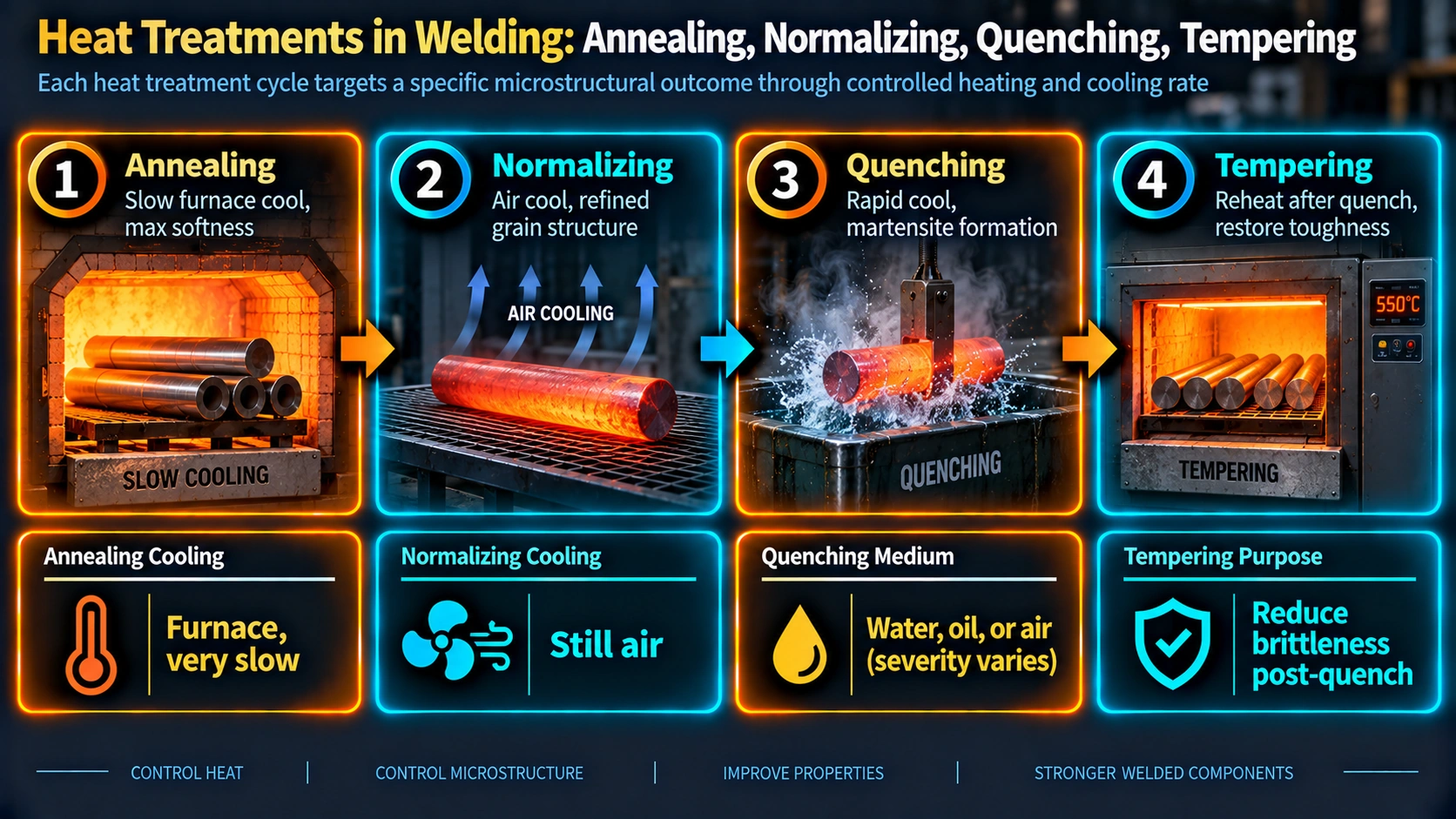
Heat treatments applicable to welding and fabrication can be grouped into two broad categories: those applied before or during welding to control the HAZ thermal cycle, and those applied after welding to modify the as-welded microstructure. The table below summarises all six primary treatments and their key characteristics.
| Treatment | When Applied | Temperature Range | Cooling Method | Primary Purpose |
|---|---|---|---|---|
| Annealing | Pre-weld (base metal prep) | Above A₃ (typically >900 °C) | Furnace cool (very slow) | Soften Maximum ductility |
| Normalizing | Pre-weld or post-weld | Above A₃ (typically 850–950 °C) | Still air cool | Refine grain Homogenise |
| Quenching | Pre-weld (base metal production) | Above A₃ | Water, oil, or brine | Harden Maximise strength |
| Tempering | After quenching | 150–650 °C (below A₁) | Air or furnace | Toughen Restore ductility |
| Preheat | Immediately before & during welding | 50–350 °C (material-dependent) | N/A — maintains temperature | Prevent crack Slow HAZ cooling |
| PWHT / Stress Relief | Post-weld | 593–760 °C (below A₁) | Slow controlled furnace or band | Relieve stress Temper HAZ |
1. Annealing
Annealing is the softest, most ductile condition a steel can be placed in through heat treatment. It is achieved by heating the metal into the full austenite range (above A₃), holding to ensure homogeneous austenitisation throughout the section, and then cooling at the slowest possible rate — typically by switching off the furnace and leaving the part inside to cool with it.
The Annealing Cycle in Detail
- Heat to austenitising temperature: For most plain carbon steels, this means heating to 30–60 °C above A₃ — approximately 880–940 °C for steels in the 0.2–0.5% C range. The temperature must be high enough to fully dissolve all cementite into austenite.
- Hold (soak): A common rule of thumb is one hour per inch of the thickest cross-section (minimum one hour). This ensures the through-thickness temperature is uniform and that austenitisation is complete.
- Furnace cool: The furnace is de-energised and the part cools inside at the furnace’s natural cooling rate — typically 20–60 °C per hour. This extremely slow rate allows the austenite to transform to pearlite under near-equilibrium conditions, producing the coarsest possible pearlite lamellae and therefore the lowest possible hardness.
Microstructural Outcome
The product of full annealing is coarse lamellar pearlite (and ferrite for hypo-eutectoid steels). Typical Brinell hardness values for fully annealed carbon steels range from 110–150 HB for low-carbon grades to 180–220 HB for medium-carbon grades. Cold forming, machining, and deep drawing are all easiest in the annealed condition.
When Annealing is Specified in Fabrication
- Forgings and castings — to relieve manufacturing stresses and provide a uniform starting microstructure
- Cold-worked parts — to restore ductility lost during cold forming (process annealing, sometimes carried out below A₁)
- Previously hardened parts — to soften before re-machining or re-forming
- Weld repairs on castings — to restore the casting to a machinable, low-stress condition
2. Normalizing
Normalizing is sometimes described as a “homogenising” or “conditioning” treatment because its primary purpose is to produce a uniform, fine-grained microstructure throughout the section. The process is identical to annealing up to the austenitising soak; the difference is that the part is removed from the furnace and allowed to cool in still ambient air rather than slowly in the furnace.
The Normalizing Cycle
- Heat above A₃: Typically to the same temperature range as annealing — 30–60 °C above A₃. Complete austenitisation is equally important.
- Hold: The same one-hour-per-inch rule applies, though the hold time can be somewhat shorter than for annealing since uniform temperature is the primary goal.
- Still-air cool: The part is removed from the furnace and cooled in still (not blown) ambient air. This gives a cooling rate significantly faster than furnace cooling but much slower than water quenching — typically 150–300 °C per hour depending on section size.
Mechanical Properties vs Annealing
Because the air-cooling rate is faster than furnace cooling, the resulting pearlite is finer — the lamellar spacing is smaller — producing slightly higher hardness and tensile strength than the fully annealed condition. Yield strength, tensile strength, and hardness are all modestly higher; ductility and toughness are slightly lower. Normalised carbon and low-alloy steels in the 0.2–0.4% C range are generally readily weldable with no special precautions.
| Property | Fully Annealed | Normalized | Quenched & Tempered |
|---|---|---|---|
| Hardness (typical, 0.3% C) | ~160 HB | ~180 HB | ~300–450 HB |
| Tensile Strength | ~480 MPa | ~550 MPa | 800–1400 MPa |
| Yield Strength | ~260 MPa | ~330 MPa | 650–1300 MPa |
| Elongation (%) | ~28% | ~24% | 12–22% |
| Microstructure | Coarse lamellar pearlite | Fine lamellar pearlite | Tempered martensite |
| Machinability | Excellent | Very Good | Difficult |
| Weldability | Excellent | Excellent | Requires care |
Normalizing as a Post-Weld Treatment
Normalizing is occasionally specified as a post-weld treatment for thick section carbon steel weldments, particularly pipe bends, formed heads, and heavy structural components. Post-weld normalizing achieves grain refinement in the coarsened HAZ grains, partial removal of residual stresses, and homogenisation of the weld-HAZ-base metal microstructure. However, it also heats the entire weldment above A₃, which means the full mechanical properties are reset — any prior Q&T condition of the base metal is destroyed. Post-weld normalizing is therefore only appropriate for non-Q&T steels.
3. Quenching
Quenching is the hardening treatment that transforms steel from a soft, ductile material into a hard, wear-resistant structure. The fundamental principle is the suppression of all diffusion-controlled solid-state transformations by rapid cooling, forcing the high-temperature FCC austenite to transform into the hard, metastable BCT structure called martensite. Understanding the crystal structures of metals — particularly the BCT martensite lattice — is essential to understanding why quenching produces such a dramatic increase in hardness.
The Quenching Cycle
- Austenitise: Heat uniformly above A₃ to the same temperature as for annealing and normalizing. Complete, uniform austenitisation is critical — any undissolved carbides will act as soft spots in the quenched product.
- Transfer rapidly: The part must be transferred from the furnace to the quench tank quickly to avoid premature transformation. Large sections require rapid mechanical handling.
- Quench: Immerse in the quenching medium — water (most severe), polymer solution, oil (moderate severity), or salt bath (mild). The quench must be fast enough to suppress pearlite and bainite formation entirely, driving the transformation to martensite.
Martensite and Its Consequences
Martensite forms by a diffusionless shear transformation when the austenite is cooled below the martensite start temperature (Mₓ). The carbon that was dissolved in the austenite lattice has no time to diffuse out and becomes trapped in the BCT lattice, creating the extreme lattice strain responsible for martensite’s hardness and brittleness. For a 0.4% C steel, as-quenched martensite can reach 600–700 HV — three to four times the hardness of the normalised steel.
Quenched and Tempered (Q&T) Steels in Fabrication
Many high-performance steels are delivered in the quenched and tempered condition: ASTM A514 (T1 steel), HY-80 and HY-100 (naval steels), ASTM A517, and many modern high-yield-strength structural steels. These steels present specific welding challenges:
- HAZ hardening: The welding thermal cycle re-austenitises the region immediately adjacent to the fusion line, and the subsequent cooling re-hardens it. The resulting HAZ martensite may be untempered and hydrogen-sensitive.
- Over-tempering: Further from the fusion line, the HAZ temperature may be below A₁ but above the original tempering temperature. This region is over-tempered, potentially reducing its strength below the specified minimum.
- Heat input control: Low heat input limits HAZ extent and prevents excessive over-tempering. Most Q&T steel welding procedures specify a maximum heat input — commonly 35–50 kJ/cm.
- Interpass temperature: A maximum interpass temperature (often 175–230 °C) is specified to limit cumulative thermal damage to the HAZ.
4. Tempering
Tempering is inseparable from quenching in structural applications. As-quenched martensite is so brittle that components made from it would shatter under impact loading. Tempering converts the as-quenched martensite into tempered martensite — a microstructure that retains most of the strength advantage gained by quenching while recovering acceptable ductility and toughness.
Mechanism of Tempering
During tempering, the trapped carbon atoms in the distorted BCT martensitic lattice are given sufficient thermal energy to partially diffuse and precipitate as fine carbide particles (initially epsilon carbide, then cementite at higher temperatures). This reduces the lattice strain, lowers the hardness, and dramatically improves toughness. The tempering process occurs in recognisable stages:
| Tempering Stage | Temperature Range | Microstructural Change | Property Effect |
|---|---|---|---|
| Stage I | 80–200 °C | Carbon segregation; epsilon carbide begins to form | Slight hardness reduction; improved ductility |
| Stage II | 200–300 °C | Retained austenite transforms; epsilon carbide dissolves | Tempered martensite embrittlement risk zone |
| Stage III | 300–450 °C | Cementite (Fe₃C) forms; BCC iron recovers | Significant hardness reduction; good toughness recovery |
| Stage IV | 450–700 °C | Carbide spheroidisation; grain recovery and recrystallisation | Low hardness; maximum toughness; approaches normalised properties |
Effect of Tempering Temperature on Properties
5. Preheat
Preheat is the application of heat to the base metal immediately before and maintained during welding. It is applied to a zone extending a specified distance on either side of the weld joint — typically a minimum of 75 mm (3 inches) from the weld centreline, or three times the base metal thickness, whichever is greater. Understanding why preheat is required demands familiarity with the carbon equivalent concept and the risk of cold cracking (hydrogen-induced cracking).
Why Preheat is Necessary
During welding, the HAZ cools at a rate that depends primarily on the base metal temperature (i.e., the preheat level) and the section thickness. Without preheat:
- HAZ cooling is rapid, promoting martensite formation in steels with moderate-to-high CE
- Hydrogen from the welding atmosphere has no time to diffuse out — it becomes trapped in the hard HAZ martensite
- Thermal gradients are steep, generating high tensile residual stresses near the weld
The combination of hard HAZ martensite + trapped hydrogen + residual tensile stress is the classical recipe for hydrogen-induced cold cracking (HICC), also called delayed cracking or underbead cracking.
Preheat Temperature Determination
Several formal methods exist for calculating required preheat temperatures. The most widely used is based on the carbon equivalent (CE) of the base material. The IIW carbon equivalent formula is:
| Carbon Equivalent (CE) | Preheat Required? | Typical Min. Preheat Temp. | Risk Level |
|---|---|---|---|
| < 0.40 | Generally not required for thin sections | None / ambient (min 10 °C) | Low |
| 0.40 – 0.45 | Not mandatory for <25 mm; advisory for thicker sections | None to 50 °C | Low–Moderate |
| 0.45 – 0.60 | Required for most thicknesses | 93–204 °C (200–400 °F) | Moderate–High |
| > 0.60 | Mandatory; specialist procedure required | 204–370 °C (400–700 °F) | High |
Interpass Temperature Control
Alongside minimum preheat, a maximum interpass temperature is specified to prevent the HAZ and weld metal from experiencing excessive thermal exposure that could degrade properties. For Q&T steels, over-tempering the base metal above 200–230 °C can reduce its yield strength below the minimum specified value. Maximum interpass temperatures for common steel types:
- Carbon steel (P-No. 1) — typically 250–315 °C maximum interpass
- Low-alloy steel (P-No. 4, 5A, 5B) — typically 250–315 °C maximum interpass (verify per WPS)
- Q&T steels (A514, HY-80) — 175–230 °C maximum interpass (strictly enforced)
- Austenitic stainless steel — typically 175 °C maximum interpass (to control sensitisation)
6. Post-Weld Heat Treatment (PWHT) and Thermal Stress Relief
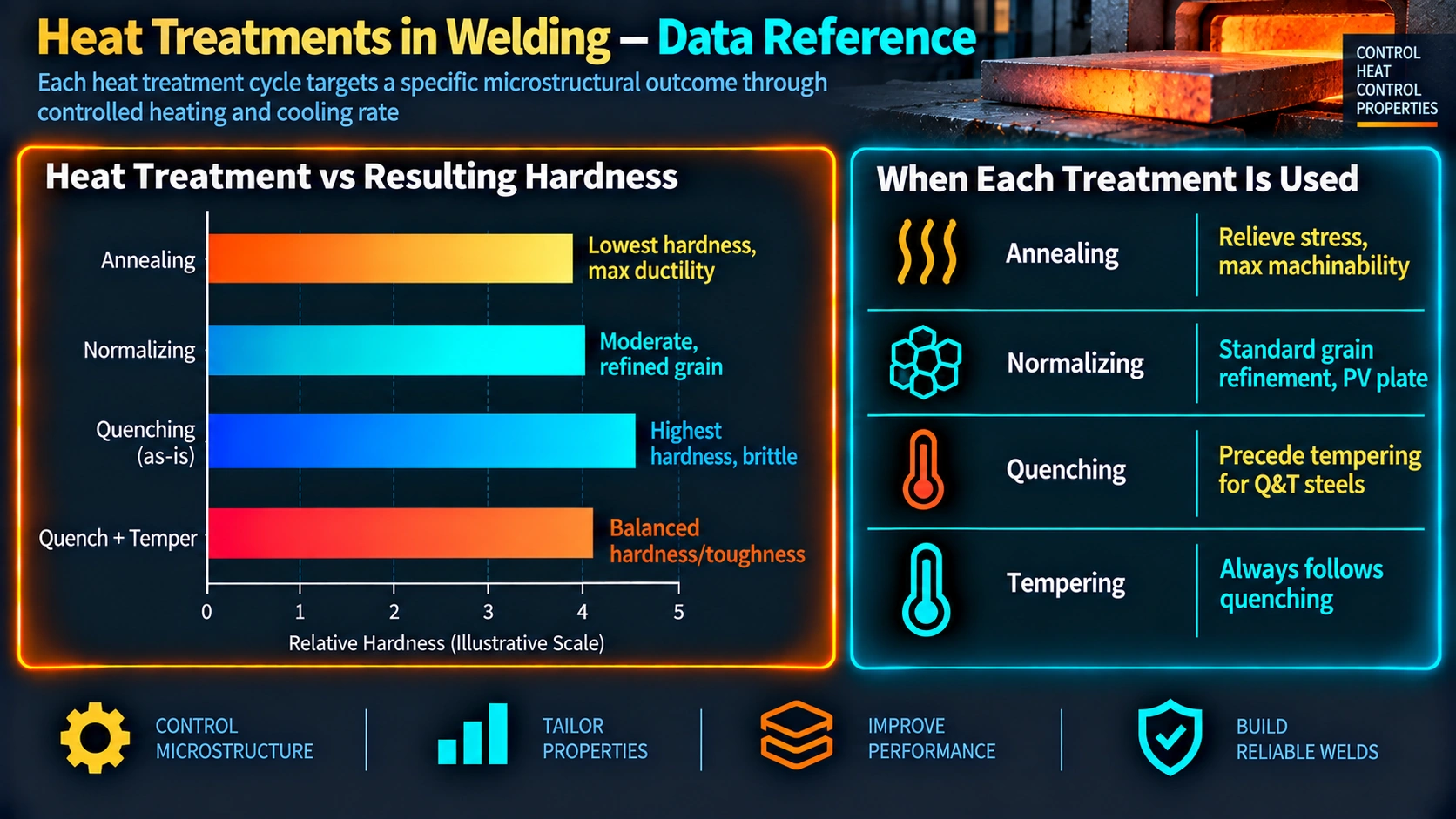
Post-weld heat treatment (PWHT) is the most broadly specified post-welding thermal operation in pressure equipment and structural fabrication. In many codes and standards it is mandatory above certain thickness thresholds. PWHT for carbon and low-alloy steels is a sub-critical treatment — the temperature never reaches A₁ — so no phase transformation occurs. Its effects are achieved purely through temperature-activated diffusion and stress relaxation mechanisms.
What PWHT Achieves
- Residual stress reduction: Welding residual stresses can approach the yield strength of the material. At PWHT temperatures (593–760 °C for carbon steel), the yield strength drops dramatically, allowing plastic flow to equalise stresses. On cooling, residual stresses are reduced to typically 20–30% of their as-welded magnitude.
- Tempering of HAZ martensite: Any untempered martensite formed in the HAZ during welding is tempered at the PWHT temperature, restoring ductility and toughness. This is the post-weld equivalent of the Q&T tempering cycle.
- Hydrogen out-diffusion: The elevated temperature accelerates hydrogen diffusion, reducing retained hydrogen concentration in the weld and HAZ below the critical level for cold cracking. This benefit overlaps with that of a dedicated postheat hold.
- Dimensional stability: Components that will be precision-machined after fabrication are PWHT-treated to ensure subsequent machining does not release residual stresses and cause distortion.
ASME Section VIII PWHT Requirements (P-No. 1 Carbon Steels)
For P-No. 1 carbon steels, PWHT is mandatory when the governing thickness (essentially the weld throat or base metal thickness, as defined by UCS-56) exceeds 38 mm (1.5 in) for most carbon steel grades, though the threshold is 32 mm (1.25 in) for some. PWHT is also required regardless of thickness for: lethal service vessels, vessels requiring full radiography with minimum thickness relief, and whenever the design specification mandates it. The minimum holding temperature is 593 °C (1100 °F) with a hold time of 1 hour per 25 mm (1 hour per inch) of weld thickness, minimum 15 minutes.
Inspector Monitoring of PWHT
Monitoring PWHT is one of the most important inspection activities in pressure vessel fabrication. The inspector must verify all of the following, supported by calibrated instrumentation records:
- Thermocouple type, calibration certificate, and attachment method (contact, weld-on, or ceramic-pad)
- Number and location of thermocouples sufficient to confirm temperature uniformity across the weld and adjacent zones
- Chart recorder trace (or data logger record) confirming that the minimum soak temperature was reached and maintained for the full required hold time at every thermocouple location
- Heating and cooling rate compliance per the applicable code
- Maximum temperature not exceeded (to avoid over-tempering Q&T base material or entering the sensitisation range for stainless steel)
- Thermal gradient between any two adjacent thermocouples within limits (for local PWHT)
Worked Example: Heat Treatment Selection for a Pressure Vessel Nozzle Weld
Consider a carbon steel pressure vessel with the following parameters:
Comparing All Heat Treatments Side by Side
| Treatment | Crosses A₁/A₃? | Phase Transformation? | Destroys Prior Q&T? | Reduces Residual Stress? | Code-Mandated? |
|---|---|---|---|---|---|
| Full Annealing | Yes (>A₃) | Yes — fully austenitises | Yes | Yes (fully) | Rarely |
| Normalizing | Yes (>A₃) | Yes — austenitises + air cools | Yes | Partially | Occasionally |
| Quenching | Yes (>A₃) | Yes — austenite to martensite | N/A (creates Q&T) | No (adds stress) | No (mill process) |
| Tempering | No (<A₁) | No — carbide precipitation only | Modifies (see TME note) | Partially | Follows quenching |
| Preheat | No | No | No | Indirect (slows cooling) | Yes (above CE threshold) |
| PWHT | No (<A₁) | No — tempering only | Can over-temper | Yes (primary purpose) | Yes (above thickness) |
Heat Treatment for Special Applications
P91 and Creep-Resistant Steels
Creep-resistant Cr-Mo steels such as P91 (9Cr-1Mo-V) have highly specific and unforgiving heat treatment requirements. P91 must be welded in the pre-heat range of 200–300 °C, cooled to below 80 °C (the martensite finish temperature Mƒ) before PWHT, and then PWHT-treated at 730–780 °C for a minimum of 1 hour per inch. Failure to complete the martensite transformation before PWHT — or PWHT at too low a temperature — can leave retained austenite in the weld microstructure, dramatically reducing creep strength. P91 is one of the most demanding materials for heat treatment procedure control.
Duplex Stainless Steels
Duplex stainless steels do not benefit from conventional PWHT — in fact, PWHT can cause formation of harmful intermetallic phases (sigma, chi) and reduce corrosion resistance. The appropriate post-weld treatment for duplex is a full solution anneal at 1050–1100 °C followed by rapid water quench, which dissolves all intermetallic phases and restores the balanced austenite-ferrite microstructure. This is a fundamentally different approach from carbon steel PWHT.
Austenitic Stainless Steels and Weld Decay
Austenitic stainless steels are susceptible to sensitisation — chromium carbide precipitation at grain boundaries — if held in the range 425–870 °C during welding or PWHT. This reduces corrosion resistance in the HAZ sensitisation zone (weld decay). For these materials, stabilised grades (321, 347 with Ti or Nb), low-carbon grades (304L, 316L), or solution annealing followed by rapid quench are the preferred mitigation strategies. Conventional PWHT in the sensitisation range is contraindicated.
Frequently Asked Questions
What is the difference between annealing and normalizing?
Why is tempering always applied after quenching?
What is PWHT and when is it required by ASME?
How is preheat temperature determined for welding?
What PWHT temperatures are used for carbon steel pressure vessels under ASME?
Can quenched and tempered steels be welded?
What is the inspector’s role during PWHT monitoring?
What is the difference between thermal stress relief (PWHT) and solution annealing?
Recommended Books on Heat Treatment and Welding Metallurgy
Disclosure: WeldFabWorld participates in the Amazon Associates programme (StoreID: neha0fe8-21). If you purchase through these links, we may earn a small commission at no extra cost to you. This helps support free technical content on this site.