What is Stainless Steel and Its Types — A Complete Technical Guide
Stainless steel — also known as inox, corrosion-resistant steel (CRES), or rustless steel — is an iron-based alloy whose defining property is resistance to corrosion and oxidation. That resistance stems directly from a minimum chromium content of 10.5% by mass, which allows a thin, self-repairing chromium oxide (Cr2O3) passive film to form on the surface. The film is only 2–3 nanometres thick, yet it is extraordinarily effective at shielding the underlying iron from moisture, acids, and atmospheric oxygen. Whenever the film is mechanically damaged, fresh chromium at the surface re-oxidises almost instantaneously in air or water, restoring the protective barrier without any human intervention.
Beyond chromium, stainless steel grades may contain nickel, molybdenum, nitrogen, manganese, titanium, niobium, and carbon in varying proportions to achieve specific combinations of corrosion resistance, mechanical strength, weldability, and formability. The result is a remarkably diverse family of alloys — classified by five crystalline microstructure families — spanning everything from kitchen cookware and surgical instruments to offshore pressure vessels, chemical reactors, and aerospace turbine components. This guide covers the composition, passive film mechanism, key mechanical properties, all five major families, common grades, weldability characteristics, and preheat/PWHT requirements for each type.
What is Stainless Steel
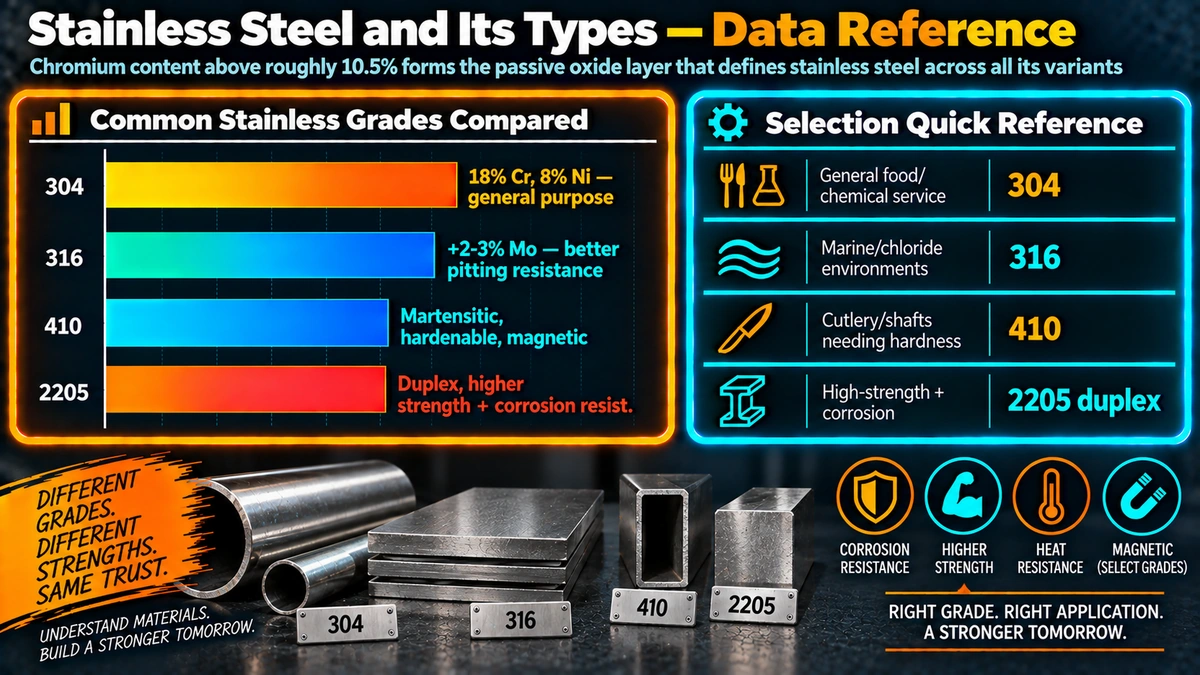
Stainless steel is an iron-based alloy containing at least 10.5% chromium by mass, with an upper chromium limit that can reach 32% in certain duplex and ferritic super-grades. The chromium-rich passive oxide layer that forms on the surface is the defining feature: without it, the alloy behaves like any other iron alloy and rusts freely. The rate at which the passive film forms and how robustly it resists breakdown depend on chromium content — higher chromium content means a more stable, more quickly repaired passive layer.
Corrosion resistance is improved by the following alloying strategies:
- Increasing chromium above 11% improves general corrosion resistance and oxidation resistance at elevated temperatures.
- Adding molybdenum (1–6%) enhances resistance to pitting and crevice corrosion, particularly in chloride-containing media. Molybdenum is the reason PREN calculations weight it at 3.3× relative to chromium.
- Adding nickel to at least 8% stabilises the austenitic phase, improves toughness at cryogenic temperatures, and enhances corrosion resistance in reducing acid environments.
- Adding nitrogen improves resistance to pitting corrosion and increases tensile and yield strength, particularly important in lean-alloyed duplex grades where nickel savings are desired.
The alloy’s combination of corrosion resistance, aesthetics, and mechanical performance makes it indispensable across industries: food processing and catering equipment, pharmaceutical and chemical reactors, oil and gas pipelines, architectural cladding, surgical instruments, water treatment infrastructure, and power generation components.
Mechanical Properties Overview
Mechanical properties span a wide range depending on family and grade. Key data for common types is summarised below:
| Property | 304 Austenitic (Annealed) | 430 Ferritic (Annealed) | 410 Martensitic (Tempered) | 2205 Duplex (Annealed) | 17-4 PH (H900) |
|---|---|---|---|---|---|
| 0.2% Proof Stress (MPa) | 210 | 205 | 275 | 450 | 1,170 |
| Ultimate Tensile Strength (MPa) | 515 | 430 | 520 | 620 | 1,310 |
| Elongation at Break (%) | 40 | 22 | 20 | 25 | 10 |
| Hardness (HRB / HRC) | 70 HRB | 80 HRB | 96 HRB | 31 HRC | 38 HRC |
| Magnetic | No (weakly in cold work) | Yes | Yes | Slightly | Yes |
| Max Service Temp. (°C) | 870 | 815 | 650 | 300 | 370 |
Types of Stainless Steel — The Five Families
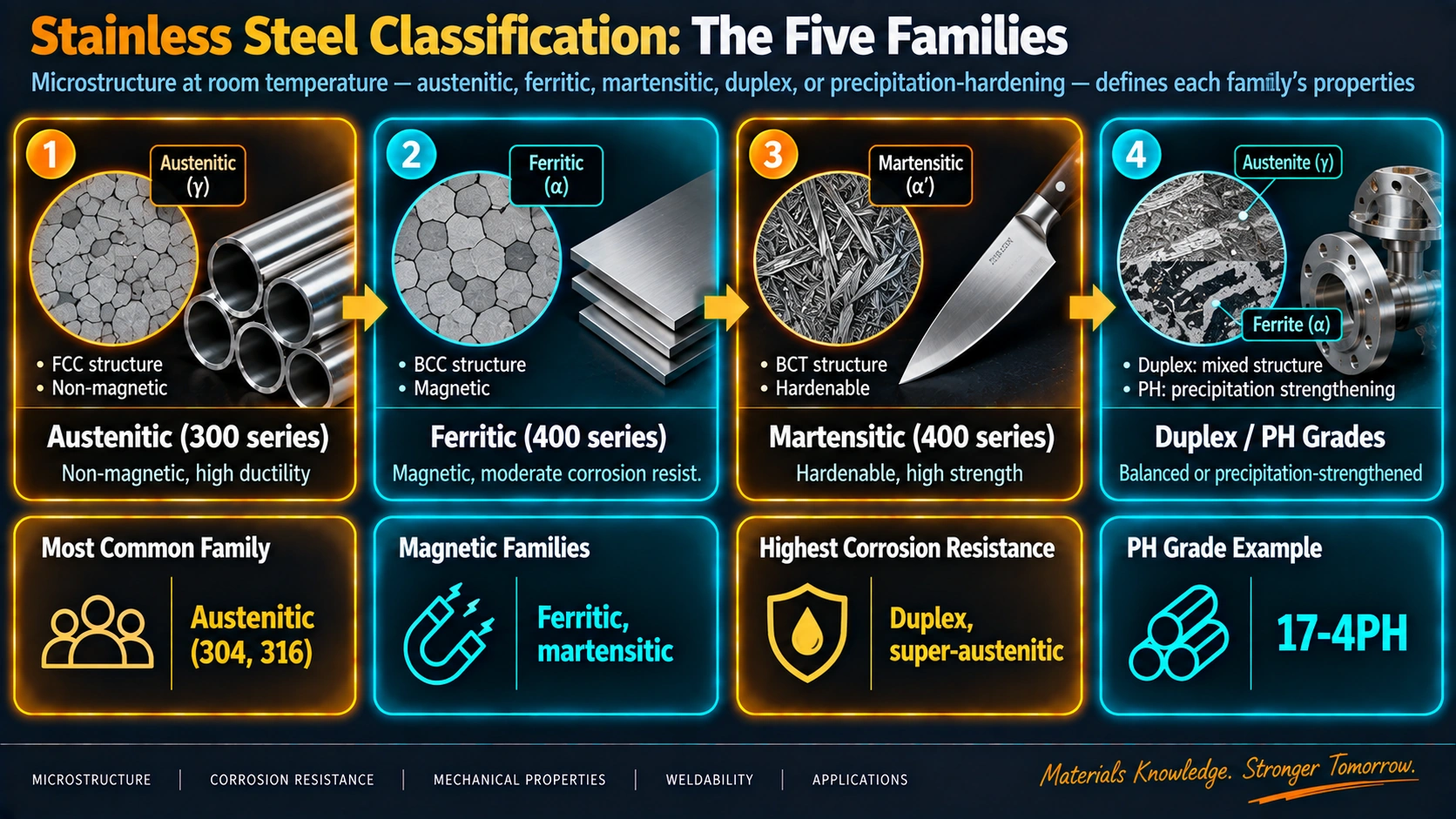
Stainless steels are classified into five families based on their crystalline microstructure. The first four families are defined by crystal structure; the fifth (precipitation-hardening) can be applied to any structural family but is most commonly applied to martensitic or austenitic bases.
1. Austenitic Stainless Steel (200 & 300 Series)
Austenitic stainless steels are the most widely produced family, accounting for approximately 70% of global stainless steel output. Their defining feature is an austenitic (FCC) microstructure that is stable at all temperatures from cryogenic to elevated service conditions. This stability is achieved by adding sufficient quantities of austenite stabilisers — primarily nickel, manganese, and nitrogen — to suppress the FCC-to-BCC phase transformation that occurs in carbon steel on cooling.
Because the microstructure does not transform with temperature, austenitic grades are not hardenable by heat treatment. Strengthening is achieved exclusively through cold working, which introduces dislocations and, in metastable grades, strain-induced martensite transformation. Austenitic grades generally do not require post-weld heat treatment (PWHT) for service, though solution annealing is performed after hot forming or welding of sensitisation-prone grades.
200 Series — Chromium-Manganese-Nickel Grades
200 series grades substitute manganese and nitrogen for part of the nickel content, reducing cost. Nitrogen additions give approximately 50% higher yield strength than equivalent 300-series grades. However, the reduced nickel and higher carbon content reduces corrosion resistance compared to 300-series equivalents, making them more suited to benign, low-chloride environments.
| Grade | Cr (%) | Ni (%) | Mn (%) | N (%) | Notes |
|---|---|---|---|---|---|
| 201 | 16–18 | 3.5–5.5 | 5.5–7.5 | 0.25 max | Hardenable by cold work — Cutlery, kitchenware |
| 202 | 17–19 | 4–6 | 7.5–10 | 0.25 max | General purpose — Lower corrosion resistance than 304 |
| 216 | 17.5–22 | 5–7 | 7.5–9 | 0.35 max | Mo added — Improved pitting resistance |
300 Series — Chromium-Nickel Grades
The 300 series is the largest and most widely used group of stainless steels. Austenitic microstructure is achieved primarily through nickel alloying. These grades offer excellent formability, toughness at cryogenic temperatures, good weldability, and broad corrosion resistance.
| Grade | Cr (%) | Ni (%) | Mo (%) | C (max %) | Key Application |
|---|---|---|---|---|---|
| 304 | 18–20 | 8–10.5 | — | 0.08 | Most widely used. Food equipment, architecture, pressure vessels. |
| 304L | 18–20 | 8–12 | — | 0.03 | Low carbon — reduces sensitisation risk. Heavy welded fabrication. |
| 316 | 16–18 | 10–14 | 2–3 | 0.08 | Marine, chemical, offshore. Mo improves pitting resistance. |
| 316L | 16–18 | 10–14 | 2–3 | 0.03 | Low carbon 316. Standard for welded chemical process equipment. |
| 321 | 17–19 | 9–12 | — | 0.08 | Ti-stabilised. Resists sensitisation in 400–900 °C range. |
| 347 | 17–19 | 9–13 | — | 0.08 | Nb+Ta stabilised. Aerospace, nuclear, elevated temp service. |
| 310/310S | 24–26 | 19–22 | — | 0.25/0.08 | High-temperature oxidation resistance to 1,100 °C. |
Weldability of Austenitic Stainless Steel
Austenitic grades are generally considered weldable by all common processes (GTAW, GMAW, SMAW, SAW, FCAW), but several metallurgical hazards require attention:
- Hot cracking (solidification and liquation cracking) is the primary concern. Fully austenitic weld deposits are most susceptible. A small fraction of delta ferrite (typically 4–8 FN) in the weld metal greatly reduces susceptibility by absorbing harmful impurities (S, P) at grain boundaries.
- Sensitisation occurs when the weld HAZ is held between 425 and 815 °C, causing chromium carbide precipitation at grain boundaries and depleting the adjacent matrix of chromium. This leads to weld decay (intergranular corrosion). Use L-grade or stabilised grades (321, 347) to mitigate.
- Distortion is more severe than in carbon steel due to the combination of high thermal expansion coefficient (17 × 10-6/°C vs 12 × 10-6/°C for carbon steel) and low thermal conductivity. Use appropriate back-stepping, balanced welding sequences, and fixturing.
- SAW limitations: Submerged arc welding is not recommended when a fully austenitic or very low ferrite weld deposit is required, because the high heat input and dilution can push the weld metal into the fully austenitic solidification mode, greatly increasing hot cracking susceptibility.
2. Ferritic Stainless Steel (400 Series)
Ferritic stainless steels contain 10.5–27% chromium and very little or no nickel, giving them a body-centred cubic (BCC) microstructure that is stable at all temperatures — analogous to the ferritic microstructure of plain carbon steels below the Ac1 temperature. Because no phase transformation occurs on heating or cooling, they cannot be hardened by quenching. They are inherently magnetic.
Ferritic grades are grouped into generations based on alloying approach and property level:
| Generation | Grades | Cr Content | C Content | Key Characteristic | PWHT Required? |
|---|---|---|---|---|---|
| 1st Generation | 430, 442, 446 | 16–27% | Relatively high | Low toughness. PWHT needed to restore ductility and corrosion resistance after welding. | Yes — typically |
| 2nd Generation | 405, 409 | 10.5–14% | Lower | Contain additional ferrite formers (Al in 405, Ti in 409). Better fabricability. Lower cost. | Sometimes |
| 3rd Generation | 444, 446 (ELI) | 17–28% | Very low (ELI) | Ultra-low C+N (“extra-low interstitials”) — excellent toughness, good weldability, near-immunity to intergranular corrosion. | Usually not |
Weldability of Ferritic Stainless Steel
Fewer precautions are required for ferritic grades compared to martensitic grades because quench hardening does not occur. However, several hazards still apply:
- Grain coarsening in HAZ: Unlike austenitic grades, ferritic stainless steels undergo grain coarsening whenever the HAZ exceeds approximately 900 °C. This coarsening is irreversible and reduces toughness. Low heat input welding is preferred.
- Hydrogen-induced cracking: Hydrogen embrittlement risk increases when martensite forms along ferrite grain boundaries in the weld metal or HAZ. This is more likely in first-generation grades with higher chromium and carbon. Preheat of 150 °C (300 °F) or higher reduces residual stresses and aids hydrogen diffusion.
- Intergranular corrosion (sensitisation): First-generation grades with high carbon are susceptible. PWHT at 700–840 °C (1,300–1,550 °F) restores corrosion resistance by allowing carbides to dissolve.
- Solidification cracking: Relatively low risk because the primary solidification mode is ferritic. However, alloys with high titanium, niobium, or impurity levels require attention.
Preheat and PWHT Requirements for Ferritic SS
| Grade Group | Preheat Temperature | PWHT Temperature | Purpose |
|---|---|---|---|
| 1st Gen (430, 442, 446) — high C+Cr | 150–230 °C (300–450 °F) | 700–840 °C (1,300–1,550 °F) | Prevent grain coarsening; restore corrosion resistance |
| 2nd Gen (405, 409) — lower C | Often not required | Up to 1,040 °C (1,900 °F) | Full annealing; improved toughness |
| 3rd Gen (444, ELI grades) | Not normally required | Not normally required | Near immunity to sensitisation |
3. Martensitic Stainless Steel (400 Series)
Martensitic stainless steels contain 11.5–18% chromium and a significant carbon content (0.08–1.2%). At elevated temperatures, they transform to austenite; on rapid cooling, the austenite transforms to a hard, brittle body-centred tetragonal (BCT) martensite phase. This is the same hardening mechanism used in high-strength tool steels. The resulting microstructure can be tempered to achieve a wide range of hardness-toughness combinations.
The trade-off for hardenability is reduced corrosion resistance compared to austenitic or ferritic grades: the higher carbon content reduces the chromium available for the passive film, and the BCT martensite structure is less corrosion resistant than FCC austenite. Martensitic grades are magnetic at all conditions.
Common Martensitic Grade Applications
| Grade | Cr (%) | C (%) | Typical Condition | Application |
|---|---|---|---|---|
| 410 | 11.5–13.5 | 0.15 max | Tempered | Pump shafts, bolts, steam turbine blades |
| 410S | 11.5–13.5 | 0.08 max | Annealed | High-temperature service; petroleum refinery equipment |
| 420 | 12–14 | 0.15 min | Hardened & Tempered | Cutlery, surgical instruments, dental tools |
| 440A/B/C | 16–18 | 0.60–1.20 | Hardened & Tempered | Ball bearings, races, valves, gears (highest hardness) |
| CA6NM | 11.5–14 | 0.06 max | Q+T | Hydraulic turbine runners, large castings |
Weldability of Martensitic Stainless Steel
Martensitic grades are the most challenging stainless family to weld. The HAZ invariably transforms to hard martensite on cooling, regardless of preheat, because the transformation is driven by composition rather than cooling rate. This hardened HAZ is susceptible to hydrogen-induced cracking (HIC). PWHT is almost always required to temper the HAZ martensite and restore toughness.
Preheat and PWHT for Martensitic Stainless Steel
| Carbon Content (%) | Preheat Minimum (°C) | Preheat Minimum (°F) | PWHT Requirement |
|---|---|---|---|
| < 0.05 | 121 | 250 | Optional |
| 0.05 – 0.15 | 204 | 400 | Recommended |
| > 0.15 | 316 | 600 | Mandatory |
4. Duplex Stainless Steel
Duplex stainless steels (DSS) have a mixed microstructure of approximately 50% austenite and 50% ferrite, though commercial alloys may range from 40:60 to 60:40 in either direction. This dual-phase microstructure is achieved through a carefully balanced chemistry — typically high chromium (19–32%), moderate molybdenum (up to 5%), moderate nickel (3–9%), and elevated nitrogen — combined with solution annealing followed by rapid quenching.
The mixed microstructure delivers a uniquely attractive combination of properties:
- Strength: Yield strength roughly double that of austenitic grades (450–650 MPa vs 210 MPa for annealed 304).
- Corrosion resistance: PREN values typically 25–45+, depending on sub-group. Resistance to pitting, crevice corrosion, and chloride stress corrosion cracking (SCC) significantly exceeds austenitic 304 and 316.
- Cost efficiency: High strength means thinner wall sections can be used, reducing material weight and cost. Nickel content is lower than equivalent super-austenitic grades.
Duplex Sub-Groups by PREN
Duplex grades are classified by their Pitting Resistance Equivalence Number (PREN), calculated as: PREN = %Cr + 3.3 × (%Mo + 0.5 × %W) + 16 × %N.
| Sub-Group | PREN Range | Representative Grades | EN / UNS | Primary Applications |
|---|---|---|---|---|
| Lean Duplex | 22 – 27 | 2101, 2304 | EN 1.4162 / S32101 EN 1.4362 / S32304 | Building & construction, bridges, storage tanks. Low Ni content = cost advantage. |
| Standard Duplex | 28 – 38 | 2205 | EN 1.4462 / S31803 / S32205 | Chemical process equipment, heat exchangers, seawater handling, offshore structural members. |
| Super Duplex | 38 – 45 | 2507, Zeron 100 | EN 1.4410 / S32750 S32760 | Subsea manifolds, desalination plants, high-chloride chemical reactors, FGD systems. |
| Hyper Duplex | > 45 | SAF 2707 HD | S32707 | Extreme chloride/acid environments in oil, gas, and chemical industries. |
Weldability of Duplex Stainless Steel
Welding duplex stainless steel requires strict control of heat input, interpass temperature, and filler metal chemistry. The target is to reproduce the 50:50 austenite/ferrite balance in both the weld metal and HAZ. Deviations toward excessive ferrite reduce toughness and corrosion resistance; deviations toward excessive austenite can compromise SCC resistance and strength.
- Filler metal: Never use matching composition filler or weld autogenously. Most duplex filler metals contain 3–4% more nickel than the base metal to promote austenite reformation. Minimum Ni in filler: 8% for standard duplex, 9% for super duplex.
- Heat input: Control within qualified range, typically 0.5–2.5 kJ/mm for standard duplex. Excessive heat input prolongs time in the 700–950 °C sigma phase formation range; insufficient heat input produces an excessively ferritic HAZ.
- Interpass temperature: Maximum 150 °C for standard duplex, 100 °C for super duplex. Higher interpass temperatures increase sigma phase precipitation risk.
- Shielding gas: Back purging with nitrogen-containing gas (e.g., 90% Ar + 10% N2) during root pass welding helps maintain nitrogen content and austenite balance in the root.
- PWHT: Full solution annealing (1,020–1,100 °C, rapid water quench) is the only acceptable PWHT for duplex grades. Stress relief in the sensitisation range must be avoided. For most structural applications, PWHT is not required if WPS is followed correctly.
For a comprehensive treatment of duplex welding procedures, qualification requirements, and intermetallic phase control, see our dedicated article: Complete Guide to Welding Duplex Stainless Steels.
5. Precipitation-Hardening (PH) Stainless Steel
Precipitation-hardening stainless steels are a special category that can be applied to austenitic, semi-austenitic, or martensitic base structures. Their defining characteristic is the ability to achieve very high strength levels through a controlled ageing heat treatment that causes fine, coherent precipitates to form within the steel matrix, blocking dislocation movement and dramatically increasing strength without significantly reducing corrosion resistance.
| Grade | Type | Condition | Yield Strength (MPa) | UTS (MPa) | Application |
|---|---|---|---|---|---|
| 17-4 PH (630) | Martensitic PH | H900 | 1,170 | 1,310 | Aerospace structures, shafts, gears, pump components |
| 17-4 PH (630) | Martensitic PH | H1150 | 725 | 930 | Higher toughness applications |
| 15-5 PH (631) | Martensitic PH | H900 | 1,170 | 1,310 | Aerospace, nuclear, high-performance valves |
| 17-7 PH | Semi-austenitic PH | CH900 | 1,380 | 1,450 | Springs, diaphragms, high-fatigue components |
| Custom 465 | Martensitic PH | H950 | 1,585 | 1,655 | Highest strength SS; landing gear, structural aerospace |
Side-by-Side Comparison of All Five Families
| Property | Austenitic | Ferritic | Martensitic | Duplex | PH |
|---|---|---|---|---|---|
| Crystal Structure | FCC | BCC | BCT | FCC + BCC | Variable |
| Magnetic? | No (usually) | Yes | Yes | Slightly | Yes |
| Heat-treatable for hardness? | No | No | Yes | No | Yes (ageing) |
| Corrosion resistance | Good–Excellent | Good | Moderate | Very Good–Excellent | Good |
| Chloride SCC resistance | Moderate | Good | Moderate | Very Good | Moderate |
| Yield strength range (MPa) | 170–700 (cold work) | 170–300 | 275–1,500+ | 450–650 | 725–1,580 |
| Cryogenic toughness | Excellent | Poor | Poor | Good | Good–Moderate |
| Weldability | Good (watch sensitisation) | Moderate (grain growth) | Difficult (preheat + PWHT) | Moderate (phase balance) | Moderate (ageing after) |
| Relative Material Cost | Medium | Low | Low–Medium | Medium–High | High–Very High |
| AISI Series | 200, 300 | 400 | 400 | — | 600 series / custom |
Recommended Books on Stainless Steel & Corrosion Engineering
Disclosure: WeldFabWorld participates in the Amazon Associates programme (StoreID: neha0fe8-21). If you purchase through these links, we may earn a small commission at no extra cost to you. This helps support free technical content on this site.