Pitting Corrosion: Mechanism, Pitting Potential, and Prevention Methods
Pitting corrosion is one of the most destructive and insidious forms of localised corrosion affecting metallic engineering structures. Unlike uniform corrosion — which removes material evenly and can be estimated from simple weight-loss measurements — pitting concentrates attack into discrete, deep cavities that can perforate a pipe wall or pressure vessel shell while the surrounding surface appears almost unaffected. The result is that catastrophic through-wall failure can occur with minimal measurable weight loss, making pitting notoriously difficult to detect, predict, and design against through conventional corrosion-rate methods.
Pitting is predominantly a problem for metals that rely on a passive oxide film for their corrosion resistance: stainless steels, aluminium and aluminium alloys, nickel alloys, titanium, and passive carbon steel in certain environments. In the oil, gas, chemical, power generation, desalination, and marine industries, pitting is a leading cause of premature equipment failure and unplanned shutdowns. This guide covers the complete technical picture: the electrochemistry of passive film breakdown, pit initiation and propagation mechanics, the electrochemical parameters that characterise pitting susceptibility (pitting potential Epit and repassivation potential Erp), the Pitting Resistance Equivalent Number (PREN) as a materials selection tool, standardised test methods including ASTM G48, and the engineering prevention strategies available at design, fabrication, and operational stages.
For engineers working with duplex stainless steels or sensitisation-affected austenitic grades, understanding pitting corrosion science is directly connected to understanding why welding practices and post-weld treatments have such a large impact on in-service reliability.
What is Pitting Corrosion?
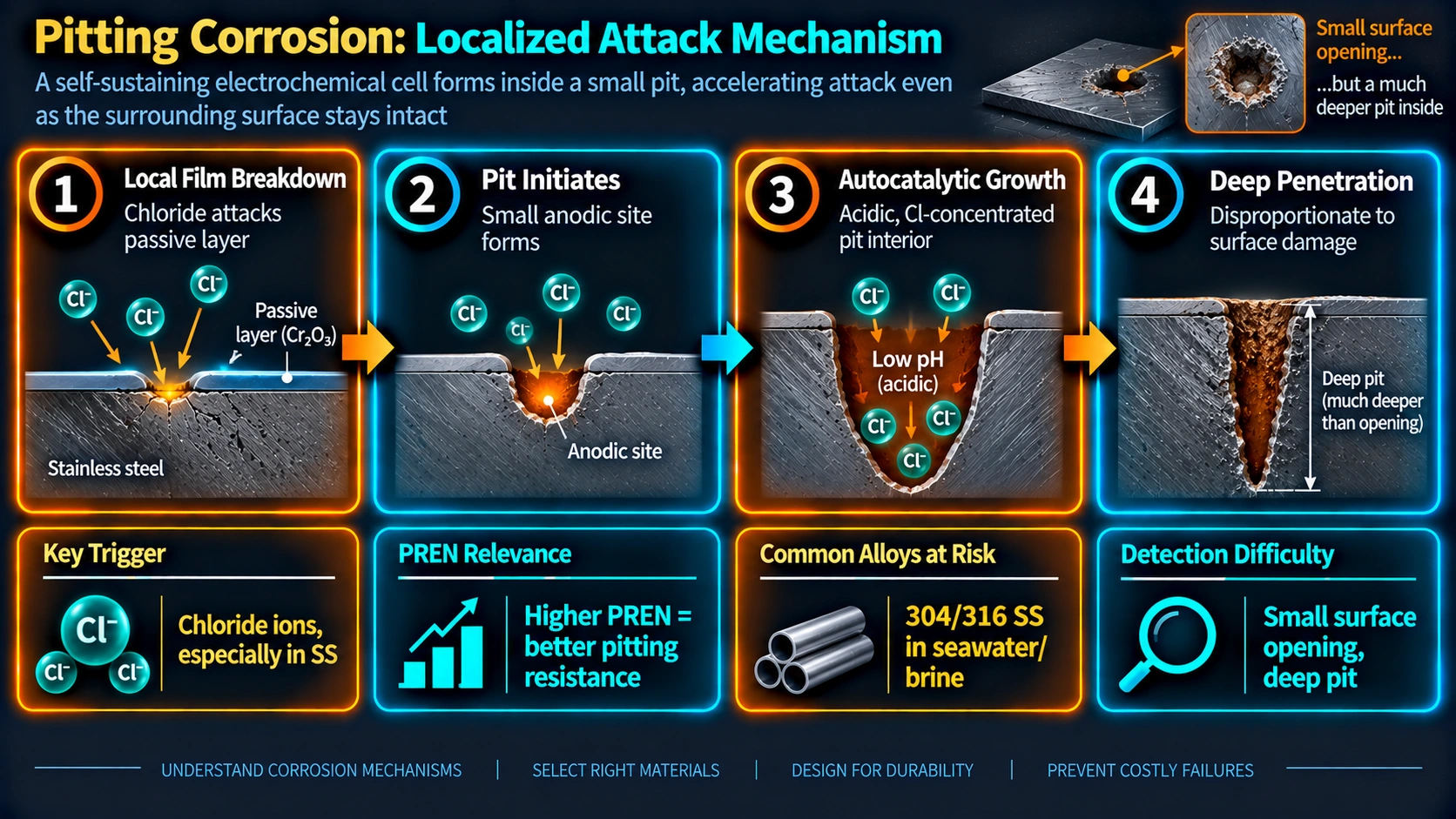
Pitting corrosion is a form of extremely localised electrochemical dissolution that creates small cavities — pits — in the metal surface. Each pit acts as a micro-anode, while the surrounding intact passive surface acts as a large cathode. The large cathode-to-anode area ratio drives a high current density at the pit, causing rapid metal loss concentrated in a small area. The depth of penetration can be 10 to 100 times greater than the equivalent loss from uniform corrosion with the same total weight loss, meaning the structural integrity implications are far more severe.
Metals Susceptible to Pitting
All metals that form a passive film are potentially susceptible to pitting. The order of general susceptibility, from most to least prone, is approximately:
| Metal / Alloy Family | Susceptibility | Primary Trigger | Notes |
|---|---|---|---|
| Aluminium alloys | High | Cl−, Cu ions, mercury | Pits initiate at MgSi or CuAl intermetallic inclusions |
| Carbon and low-alloy steel | High | Cl−, O2, stagnant water | Passive film is weak; readily attacked in aerated NaCl |
| Austenitic stainless steel (304, 316) | Moderate | Cl−, elevated temperature | 316 significantly better than 304 due to Mo addition |
| Duplex stainless steel (2205) | Low–Moderate | Cl−, high temperature | Higher PREN (35+) than austenitic grades |
| Super duplex / super austenitic (2507, 254SMO) | Low | Very high Cl−, high T | PREN > 40; suitable for seawater full immersion |
| Nickel alloys (C-276, 625) | Very Low | Extreme Cl− + oxidising acids | PREN > 50; used for most severe chloride service |
| Titanium | Very Low | Reducing acids, fluorides | Essentially immune to Cl− pitting at ambient temperature |
The Passive Film — Foundation of Pitting Susceptibility
Pitting corrosion is, fundamentally, a passive film failure event. To understand pitting, you must first understand why passive films form and why they fail locally.
Stainless steels owe their corrosion resistance to a thin (2–10 nm) self-healing chromium-rich oxide film that forms spontaneously when chromium content exceeds approximately 10.5% in the presence of oxygen. This film — predominantly Cr2O3 with contributions from Fe2O3, NiO, and MoO3 in alloys that contain these elements — acts as a physical barrier between the metal and the environment. When mechanically damaged, the film re-forms (repassivates) spontaneously within milliseconds in oxidising environments. This combination of barrier protection and self-healing capability is what makes stainless steel “stainless” under most conditions.
Pitting Corrosion Mechanism — Initiation and Propagation
Stage 1: Passive Film Breakdown (Pit Initiation)
The passive film is not perfectly uniform. Defects exist at grain boundaries, MnS inclusions, oxide inclusions, surface scratches, cold-worked zones, and areas where chromium has been depleted by sensitisation during welding. Chloride ions (Cl−) are particularly aggressive at initiating breakdown because they are small, highly mobile, and carry a negative charge that allows them to migrate through the passive film electric field. Several competing theories describe the precise mechanism:
- Adsorption and displacement: Cl− ions competitively adsorb onto the passive film surface, replacing oxide anions (O2−) at specific sites, thinning and weakening the film locally until a conductive pathway through the film is established.
- Penetration theory: Cl− ions migrate through the passive film under the influence of the electric field (the Mott-Schottky field across the film), reaching the metal/film interface where they form soluble metal chloride complexes, dissolving the film from within.
- Breakdown at inclusions: MnS inclusions in stainless steel are particularly weak points. MnS dissolves in acidic environments, leaving a cavity in the passive film through which aggressive chloride solution contacts the bare metal surface, initiating a pit. Higher-purity steels with lower S content (ELI grades, remelted steels) have fewer MnS inclusions and better pitting resistance.
Regardless of the exact micro-mechanism, the result is the same: a metastable pit nucleates when the passive film ruptures. Most metastable pits quickly repassivate (the film re-forms). Only when electrochemical and chemical conditions inside the pit are sufficiently aggressive to prevent repassivation does the pit transition to stable growth.
Stage 2: Pit Propagation — The Autocatalytic Mechanism
Once a stable pit is established, it becomes self-sustaining through a process called the autocatalytic pit growth mechanism. The chemistry inside the growing pit is radically different from the bulk electrolyte, and progressively more aggressive:
- Metal dissolution: Iron (Fe) at the pit base oxidises to Fe2+ and Fe3+, releasing electrons that travel through the metal to the cathode (the passive surface). In stainless steels, chromium (Cr) and nickel (Ni) also dissolve.
- Charge balance and Cl− migration: The accumulation of positively charged metal cations (Fe2+, Cr3+) inside the pit creates a charge imbalance. To maintain electrical neutrality, negatively charged chloride anions migrate from the bulk electrolyte into the pit. The pit therefore accumulates a concentrated metal chloride solution (FeCl2, FeCl3, CrCl3).
- Hydrolysis and acid generation: Metal chlorides hydrolyse with water: Fe2+ + 2H2O → Fe(OH)2 + 2H+. This produces hydrochloric acid, dropping the local pH inside an active pit to below 1 — sometimes below 0. The resulting acid and chloride environment is far more corrosive than the bulk electrolyte and prevents repassivation.
- Oxygen depletion: The geometry of the pit restricts diffusion of oxygen into the pit interior. The cathode reaction (O2 + 2H2O + 4e− → 4OH−) consumes oxygen near the pit mouth. The pit base is therefore oxygen-starved, confirming its role as the anode of a differential aeration cell.
- Lacy cover formation: In many systems, particularly stainless steels, the pit initially grows beneath the intact passive film, forming a lacy or perforated cover. This thin cover restricts ion diffusion out of the pit, maintaining the aggressive local chemistry and promoting deeper growth before the cover eventually ruptures.
Pit Morphology
Pits are not all the same shape. Their geometry depends on the metal, the alloy microstructure, the environment, and the orientation of the surface. Understanding pit morphology helps interpret inspection findings and failure analysis results.
Electrochemical Parameters: Pitting Potential and Repassivation Potential
The susceptibility of a metal to pitting in a given environment is characterised by two critical electrochemical potentials, measured by cyclic potentiodynamic polarisation (CPP) in a standard electrochemical cell.
Pitting Potential (Epit)
The pitting potential, Epit, is the potential at which stable pits nucleate on the metal surface. During an anodic polarisation sweep, the current remains low (passive region) while the potential is below Epit. When Epit is exceeded, a sharp current increase marks the onset of pitting. Epit is not a fixed material constant — it depends strongly on:
- Chloride concentration: Higher [Cl−] lowers Epit (pitting initiates more easily).
- Temperature: Increasing temperature decreases Epit. The Critical Pitting Temperature (CPT) is the temperature above which stable pitting occurs in a specific test solution at a given potential.
- pH: Reducing pH (more acidic) generally lowers Epit.
- Alloy composition: Higher Cr, Mo, and N contents raise Epit (better resistance), as captured by the PREN formula.
- Surface condition: Mechanically polished surfaces typically have higher Epit than as-welded or oxide-scaled surfaces.
Repassivation Potential (Erp)
When the polarisation direction is reversed (the scan reversed from anodic back toward cathodic), existing pits continue to grow for a while before they repassivate. The potential at which existing pits stop growing and repassivation occurs is the repassivation potential, Erp (also called the protection potential, Eprot). Erp is always more negative (less noble) than Epit.
Pitting Resistance Equivalent Number (PREN)
The PREN is a compositional index that provides a first-principles ranking of pitting corrosion resistance for stainless steels and nickel alloys in chloride environments. It quantifies the combined contribution of chromium, molybdenum, and nitrogen to the stability of the passive film against chloride attack. The PREN calculator on WeldFabWorld lets you compute PREN from actual mill test certificate compositions.
PREN Values for Common Stainless Steels
| Grade | UNS / EN | %Cr (typ.) | %Mo (typ.) | %N (typ.) | PREN (typ.) | Service Category |
|---|---|---|---|---|---|---|
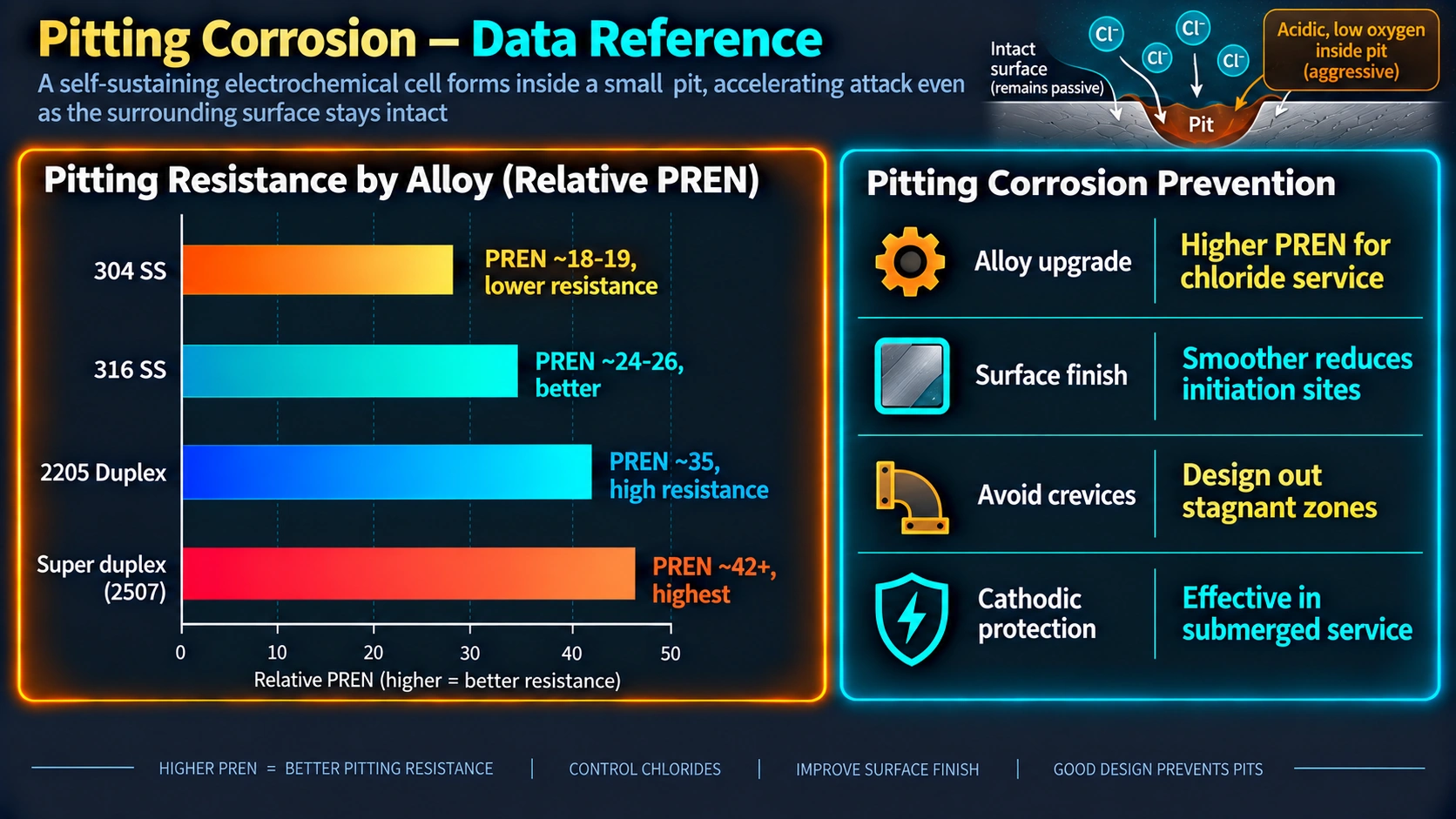
| 304 / 304L | S30400 / 1.4301 | 18.0 | 0.0 | 0.05 | ~18–19 | Indoor, dilute Cl−; NOT seawater |
| 316 / 316L | S31600 / 1.4404 | 17.0 | 2.1 | 0.05 | ~24–26 | Moderate Cl−; splash zone with care |
| 317L | S31703 / 1.4438 | 18.5 | 3.1 | 0.05 | ~28–30 | Better than 316 in chloride |
| Duplex 2205 | S32205 / 1.4462 | 22.5 | 3.1 | 0.17 | ~34–36 | General offshore; moderate seawater |
| 254 SMO | S31254 / 1.4547 | 20.0 | 6.1 | 0.20 | ~43–45 | Seawater; desalination; bleach plant |
| Super Duplex 2507 | S32750 / 1.4410 | 25.0 | 4.0 | 0.27 | ~42–44 | Subsea, offshore; aggressive seawater |
| Alloy 625 (Ni alloy) | N06625 | 21.5 | 9.0 | 0.02 | ~50–52 | Most severe Cl−; sour service |
| Hastelloy C-276 | N10276 | 16.0 | 16.0 | 0.01 | ~65–70 | Extreme environments; flue gas desulphurisation |
PREN > 24: required for moderate chloride service (316L).
PREN > 32: minimum for seawater splash zone or concentrated NaCl service. Often specified by NORSOK and oil and gas standards.
PREN > 40: required for fully submerged seawater service, desalination, offshore process piping (super duplex, 6Mo austenitic).
PREN is a ranking tool, not a guarantee. Actual qualification requires ASTM G48 testing at the service temperature.
PREN and Welding
Welding does not change the bulk chemical composition of the base metal and therefore does not alter the nominal PREN. However, the local PREN of the weld metal and heat-affected zone (HAZ) can be substantially lower than the base metal value for several reasons:
- Sensitisation in austenitic grades: Chromium depletion at grain boundaries (caused by M23C6 carbide precipitation during slow cooling through 450–850°C) reduces local Cr content and therefore local PREN. This makes sensitised grain boundaries susceptible to pitting and intergranular attack even when the bulk PREN appears adequate. See the article on stainless steel weld decay (sensitisation) for full details.
- Phase imbalance in duplex grades: Incorrect heat input in duplex stainless steel welding can shift the ferrite-austenite balance (excess ferrite from rapid cooling; excess austenite from excessive heat input) and precipitate sigma, chi, and Cr2N phases — all of which deplete chromium and molybdenum from the adjacent matrix, lowering local PREN. The weld HAZ and weld metal of improperly welded duplex steel can have PREN values 5–10 points below the base metal specification.
- Nitrogen loss in weld metal: Nitrogen loss during GTAW (TIG welding) of high-nitrogen grades (duplex, super duplex) reduces the N contribution to PREN in the weld deposit. Back-purging with nitrogen-supplemented argon (typically 2–5% N2 in Ar) and using nitrogen-bearing consumables mitigates this.
ASTM G48 — Pitting Corrosion Test Methods
ASTM G48 is the standard test method for evaluating pitting and crevice corrosion resistance of stainless steels and related alloys. It is widely referenced by NACE, NORSOK, and EFC specifications for material qualification in oil, gas, marine, and chemical service. Key practices under G48 are:
| Practice | Test Type | Test Solution | Output |
|---|---|---|---|
| A | Pitting corrosion — fixed temperature | 6% FeCl3 at 22°C or 50°C for 72 h | Pass/fail: pit depth and weight loss |
| B | Crevice corrosion — fixed temperature | 6% FeCl3 at 22°C or 50°C for 72 h | Pass/fail: crevice attack and weight loss |
| E | Critical Pitting Temperature (CPT) | 6% FeCl3, increasing temperature | CPT in °C |
| F | Critical Crevice Temperature (CCT) | 6% FeCl3, increasing temperature | CCT in °C |
The FeCl3 solution in ASTM G48 is highly oxidising and aggressively acidic — it drives the metal’s potential to a very high value, well above Epit for most standard grades, making it a stringent qualification test. Typical CPT (Critical Pitting Temperature) benchmarks by grade in ASTM G48 Practice A (6% FeCl3) are:
| Grade | CPT (°C) — ASTM G48-A (approx.) | Qualification Suitability |
|---|---|---|
| 304L | < 0°C | Fails even at 0°C |
| 316L | ~15–20°C | Limited Cl− service |
| Duplex 2205 | ~25–35°C | Offshore / moderate service |
| Super Duplex 2507 | ~50–65°C | Seawater / aggressive Cl− |
| 254 SMO (6Mo) | ~50°C | Equivalent to super duplex |
| Alloy 625 | > 85°C | Extreme service |
Prevention Methods for Pitting Corrosion
1. Material Selection — PREN-Based Approach
The first line of defence against pitting is selecting a material with sufficient PREN for the service environment. The severity of the service environment is characterised by the chloride concentration, temperature, pH, and the presence of oxidising species (dissolved O2, Fe3+, H2O2). The PREN requirements increase with all of these factors. Use the PREN calculator to verify candidate materials against your service conditions and project-specific minimum PREN specifications.
2. Surface Finish and Cleanliness
Surface condition has a large effect on pitting initiation. Rough surfaces (mill finish, as-welded weld caps, flame-cut edges) provide more sites for passive film defects and for chloride accumulation in surface crevices. Mechanically polished surfaces (Ra < 0.8 μm) and electropolished surfaces have the best pitting resistance for a given alloy, because:
- MnS inclusions that intersect the surface are removed, eliminating the primary pit initiation sites in austenitic steels.
- The surface chromium-to-iron ratio is higher after polishing, producing a more Cr-rich and protective passive film.
- There are fewer surface stress concentration sites that could compromise the passive film under mechanical load.
3. Passivation and Pickling
Post-fabrication acid passivation (using nitric acid or citric acid per ASTM A380 and ASTM A967) removes free iron, weld heat tints, and surface contamination, restoring the chromium-rich passive film to its optimal condition. Pickling with hydrofluoric/nitric acid mixtures dissolves heat-affected oxide scale from weld zones where chromium depletion would otherwise persist. Both treatments are standard practice for stainless steel process piping, heat exchangers, and vessels before commissioning.
4. Cathodic Protection
Cathodic protection (CP) is effective against pitting and crevice corrosion because it shifts the operating potential of the structure to below Erp — the repassivation potential. Both impressed current CP (ICCP) and sacrificial anode CP are used for stainless steel structures in seawater, including offshore risers, subsea manifolds, and jetty piping. The target potential range for most stainless steels in seawater is −500 to −700 mV vs. Ag/AgCl. Critically, over-protection (excessively negative potential) must be avoided for high-strength steels and titanium alloys, as hydrogen embrittlement can result.
Below −500 mV: pitting and crevice corrosion reliably prevented; existing pits repassivate.
Below −800 mV: risk of calcareous scale deposit formation; check for hydrogen absorption in highly cold-worked zones.
Never rely on CP alone without confirming that the applied potential is below Erp for the specific alloy and environment.
5. Environmental Control
Where pitting is driven by environmental factors, controlling the environment is often the most cost-effective mitigation. Key interventions include:
- Chloride removal or dilution: In cooling water systems, limiting chloride concentration through water treatment or use of low-chloride water prevents passive film breakdown on 316L or standard austenitic grades.
- pH control: Maintaining slightly alkaline pH (pH 7–9) raises Epit and inhibits active pit propagation. Acidic environments dramatically lower Epit and accelerate pitting.
- Oxygen and oxidant control: In boiler and condensate systems, deaeration to below 10 ppb dissolved O2 eliminates the cathode reaction driving force for pitting — a well-established strategy for carbon steel and copper alloy systems.
- Temperature minimisation: Keeping the service temperature below the CPT of the selected material ensures the metal remains in the stable passive region at all times.
- Corrosion inhibitors: Molybdate, tungstate, and silicate-based inhibitors promote passive film formation and can raise Epit. Organic inhibitors are used in closed systems. They are less practical for open, flowing systems.
6. Design Measures
Good design eliminates or reduces conditions that promote pitting:
- Avoid stagnant flow zones where chloride can concentrate and oxygen can become depleted. Ensure drain points at all low points in liquid-containing stainless steel lines.
- Minimise crevices at flanged joints, under gaskets, beneath pipe supports, and at lap welds — all potential crevice corrosion sites that initiate at lower potentials than open-surface pitting.
- Ensure complete drainage and drying during shutdowns — chloride concentration during evaporation of water in idle equipment is a primary cause of pitting failures during commissioning and layup periods.
- Use full-penetration butt welds rather than fillet lap joints for corrosion-critical stainless piping and vessels, eliminating the crevice geometry inherent in lap designs.
Recommended References
Corrosion Engineering (Fontana)
Classic comprehensive text on corrosion types including pitting, crevice, galvanic, and SCC — essential reference for any metallurgist or corrosion engineer.
View on AmazonCorrosion of Stainless Steels (Sedriks)
Authoritative guide to stainless steel corrosion mechanisms including pitting, crevice, sensitisation, and stress corrosion cracking in industrial environments.
View on AmazonUhlig’s Corrosion Handbook
The definitive reference on all forms of corrosion — pitting, galvanic, stress corrosion cracking, and prevention strategies across all alloy systems.
View on AmazonElectrochemical Methods in Corrosion
Covers polarisation techniques, EIS, cyclic voltammetry, and electrochemical testing methods used to measure pitting potential, passivation, and corrosion rates.
View on AmazonDisclosure: WeldFabWorld participates in the Amazon Associates programme (StoreID: neha0fe8-21). If you purchase through these links, we may earn a small commission at no extra cost to you. This helps support free technical content on this site.
Frequently Asked Questions
What causes pitting corrosion in stainless steel?
Pitting corrosion in stainless steel is caused by local breakdown of the passive chromium oxide film, most commonly triggered by chloride ions. Chlorides competitively adsorb onto the passive film surface, displacing oxygen and weakening the oxide at discontinuities such as MnS inclusions, grain boundaries, surface defects, and areas of chromium depletion caused by sensitisation during welding.
Once the passive film ruptures, the exposed metal dissolves rapidly as an anode while the surrounding intact passive surface acts as a large cathode — creating an aggressive local environment that deepens the pit rapidly. Elevated temperature, high chloride concentration, and low pH all reduce the potential at which pitting initiates, making material selection based on PREN and ASTM G48 testing critical for service in aggressive environments.
What is pitting potential (Epit) and why does it matter?
Pitting potential (Epit), also called the critical pitting potential or breakdown potential, is the electrochemical potential above which stable pits nucleate and grow on a metal surface in a given environment. It is measured by anodic polarisation — sweeping the potential in the positive direction while monitoring current density. The passive film remains intact (low current) until Epit is reached, at which point current rises sharply as pits initiate.
A higher (more noble) Epit means better pitting resistance. Factors that lower Epit include higher chloride concentration, higher temperature, and lower pH. In cathodic protection design, the applied protection potential must be held below the repassivation potential Erp (always more negative than Epit) to both prevent new pits and arrest existing ones.
What is the PREN formula and how is it used?
PREN (Pitting Resistance Equivalent Number) is a compositional index ranking pitting resistance: PREN = %Cr + (3.3 × %Mo) + (16 × %N). For tungsten-bearing grades: PREN = %Cr + 3.3 × (%Mo + 0.5 × %W) + 16 × %N. A higher PREN indicates better chloride pitting resistance. PREN above 32 is commonly specified for seawater splash zone service; above 40 for fully submerged seawater or concentrated chloride service.
PREN is a ranking and screening tool, not an absolute guarantee. It must be validated by corrosion testing such as ASTM G48 under actual or simulated service conditions. Calculate PREN from your mill test certificate compositions using the PREN calculator on WeldFabWorld. Note that PREN values from minimum-composition limits will be lower than values from actual (typical) compositions, and project specifications often specify minimum PREN from actual heat compositions.
How does pit propagation work once a pit has initiated?
Once a stable pit initiates, it creates a self-sustaining, aggressive local environment that drives rapid propagation via the autocatalytic mechanism. Metal dissolution inside the pit releases metal cations (Fe2+, Cr3+) which attract chloride anions from the bulk electrolyte to maintain charge balance. Hydrolysis of metal chlorides produces hydrochloric acid, dropping the local pH below 1 inside active pits. The pit base becomes oxygen-starved (differential aeration cell), confirming its anodic role.
The large external cathode area (passive surface) relative to the tiny pit anode drives a very high current density at the pit, accelerating dissolution. This combination of acidic pH, high chloride, and high current density inside the pit makes repassivation impossible without external intervention (cathodic protection or environmental change). The pit therefore propagates until it perforates the wall or reaches a grain boundary that deflects it laterally.
What is the difference between pitting corrosion and crevice corrosion?
Both pitting and crevice corrosion are localised corrosion forms driven by passive film breakdown in chloride environments, sharing essentially the same propagation mechanism. The key difference is in initiation: pitting initiates on open surfaces when the potential exceeds Epit. Crevice corrosion initiates inside geometrically confined spaces (under gaskets, beneath bolt heads, inside lap joints) due to oxygen depletion and acid accumulation in the confined electrolyte, at potentials well below the open-surface pitting potential.
Crevice corrosion is generally a more severe hazard than pitting because it initiates at lower potentials and lower chloride concentrations. A material can resist open-surface pitting in a given environment and yet suffer crevice attack in the same environment at the same potential, simply due to the confinement geometry. Minimising crevices through design — using full-penetration welds, proper gasket selection, and eliminating under-deposit zones — is therefore just as important as material selection. See also the general corrosion types guide for comparison of all localised corrosion forms.
What is ASTM G48 and what does it measure?
ASTM G48 is a standard test method for evaluating pitting and crevice corrosion resistance of stainless steels and nickel alloys. Practice A immerses specimens in 6% ferric chloride (FeCl3) solution at a fixed temperature for 72 hours, then examines for pitting and measures weight loss. Practice E and F determine the Critical Pitting Temperature (CPT) and Critical Crevice Temperature (CCT) by incrementally raising temperature until corrosion initiates in the 6% FeCl3 test solution.
ASTM G48 is widely specified by NORSOK, EFC, and project specifications for duplex and super duplex stainless steel qualification in oil, gas, and marine service. Weld specimens must typically match within 10°C of the base metal CPT, making G48 a highly sensitive check on welding quality for high-PREN alloys. For more detail on ASTM G48 test procedures and acceptance criteria, see the dedicated WeldFabWorld guide.
Does welding reduce pitting corrosion resistance?
Yes — welding can significantly reduce the pitting corrosion resistance of stainless steels and nickel alloys if not controlled properly. In austenitic stainless steels, sensitisation (chromium depletion at grain boundaries due to M23C6 carbide precipitation during slow cooling through 450–850°C) reduces the local PREN at grain boundaries, making them susceptible to pitting and intergranular corrosion. Use of low-carbon grades (304L, 316L) and rapid cooling limit sensitisation; post-weld solution annealing eliminates it completely.
In duplex stainless steels, incorrect heat input can precipitate sigma, chi, and Cr2N phases that deplete chromium and molybdenum from the surrounding matrix, lowering PREN locally by 5–10 points. Nitrogen loss from high-nitrogen grades during GTAW welding also reduces the weld deposit PREN. Back-purging with nitrogen-supplemented argon and using nitrogen-bearing filler metals (e.g., ER2209 for 2205) mitigate these effects.
How is pitting corrosion detected and inspected in service?
Pitting is notoriously difficult to detect because pits are often sub-millimetre in diameter, covered by corrosion products, and produce minimal measurable weight loss relative to their depth. In service, ultrasonic testing (UT) thickness gauging using grid-based C-scan or B-scan survey maps localised wall thinning. Phased array UT (PAUT) images pit depth and distribution with better spatial resolution. Eddy current testing is effective for heat exchanger tubes. Pulsed eddy current (PEC) can detect wall thinning through insulation (CUI).
Visual examination under magnification after pickling removes surface deposits that may conceal pits. Pit counting and sizing per ASTM G46 provides a quantitative basis for pitting severity classification. For pressure vessels and piping, API 510 and API 570 inspection programmes provide the framework for pitting assessment frequency and fitness-for-service evaluation when pitting is found. Refer also to the mechanical testing guide for context on how pitting data feeds into fitness-for-service assessments.