Surface Preparation Standards: ISO 8501 vs SSPC vs NACE
Surface preparation standards such as ISO 8501, SSPC, and NACE (now part of AMPP) define how clean and how rough a steel surface must be before a protective coating is applied, and confusion between these three systems is one of the most common sources of coating failure claims and inspection disputes in fabrication and construction. A coating system can only perform to its design life if the substrate underneath meets the specified cleanliness grade and surface profile, and every major coating manufacturer ties its warranty directly to one of these standards.
This guide compares the ISO 8501-1 visual grading system, the SSPC-SP written specification series, and the legacy NACE No. system side by side, with a full equivalence table, surface profile measurement methods, contamination testing, and practical guidance for selecting the correct grade for your project. Whether you are writing a coating specification, reviewing a QA/QC procedure, or preparing for a coating inspector certification such as NACE CIP or FROSIO, this article gives you the reference tables and technical depth you need.
This article covers abrasive blast cleaning and hand/power tool cleaning grades for carbon and low-alloy steel. It does not cover wet abrasive blasting variants, ultra-high-pressure water jetting grades (defined separately in SSPC-SP WJ / NACE WJ standards), or surface preparation for non-ferrous substrates, which follow different grading logic.
Why Three Different Standards Exist
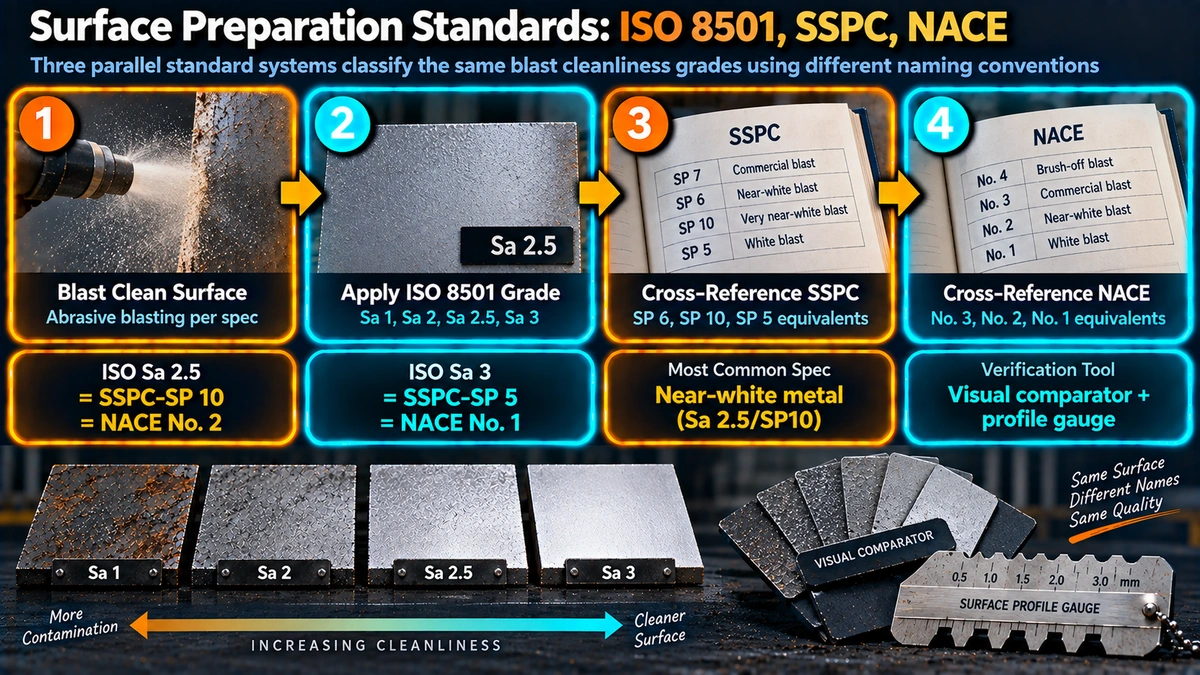
ISO 8501-1, titled Preparation of steel substrates before application of paints and related products, was developed by the International Organization for Standardization and is the dominant reference across Europe, the Middle East, and much of Asia, including India. It is a photographic standard: each grade is defined by a written description backed by reference photographs showing the rust grade of the uncleaned steel (A, B, C, or D) and the resulting condition after cleaning.
SSPC, the Society for Protective Coatings, developed its SP series in the United States. Rather than relying primarily on photographs, SSPC standards are written procedural specifications with supporting visual reference guides, and they are the default reference across North America and in many US-influenced specifications worldwide, including much of the oil and gas sector.
NACE International, historically focused on corrosion control, published its own No. 1 through No. 4 grades that closely parallel the SSPC-SP series and were jointly maintained with SSPC for the abrasive blast grades. In 2021, NACE and SSPC merged to form AMPP, the Association for Materials Protection and Performance, and the two organisations’ standards are being progressively reissued under the AMPP name, though the underlying technical content is unchanged. Because contracts, coating data sheets, and legacy drawings still reference all three naming conventions, engineers need a working knowledge of how they map to each other.
ISO 8501-1 Grading System
ISO 8501-1 first classifies the uncleaned steel by its initial rust condition, then classifies the cleaned surface by preparation method and cleanliness. This two-part logic is important: the same cleanliness grade can look slightly different depending on the starting rust grade, which is why the standard uses paired photographs for A, B, C, and D initial conditions.
Initial Rust Grades (Before Cleaning)
| Grade | Condition | Description |
|---|---|---|
| A | Intact mill scale | Steel surface largely covered with adherent mill scale, little or no rust |
| B | Rusting mill scale | Mill scale has begun to rust and/or flake away |
| C | Scale rusted away | Mill scale has rusted away or can be scraped off, slight pitting visible |
| D | Pitted and rusted | Mill scale rusted away with general pitting visible to the naked eye |
Preparation Grades (After Cleaning)
| Grade | Method | Result |
|---|---|---|
| Sa 1 | Light blast cleaning | Free of loose mill scale, rust, and foreign matter |
| Sa 2 | Thorough blast cleaning | Nearly all mill scale, rust, and foreign matter removed; remaining traces firmly adherent |
| Sa 2.5 | Near-white metal blast cleaning | Only slight traces remain as stains, covering at most 5% of the surface per 600 mm x 600 mm area |
| Sa 3 | White metal blast cleaning | Uniform metallic sheen; surface completely free of mill scale, rust, and foreign matter |
| St 2 | Hand tool cleaning (scraping, wire brushing) | Loose mill scale, rust, and foreign matter removed |
| St 3 | Power tool cleaning (grinding, power wire brushing) | Thorough hand/power tool cleaning with a pronounced metallic sheen |
A complete ISO 8501-1 callout combines the initial rust grade with the preparation grade, for example C Sa 2.5, meaning the steel started with mill scale that had rusted away and was blast cleaned to near-white metal condition. Specifications that state only “Sa 2.5” without the letter prefix are technically incomplete, though this shorthand is common in field practice.
SSPC-SP Series
The SSPC system is broader than ISO 8501, covering solvent cleaning, hand and power tool cleaning, and multiple blast profile grades, plus specialised methods such as waterjetting. The core surface preparation numbers relevant to structural and process steel work are summarised below.
| Designation | Common Name | Typical Application |
|---|---|---|
| SSPC-SP1 | Solvent Cleaning | Removes oil, grease, and soluble contaminants; always a precursor step, never a standalone finish |
| SSPC-SP2 | Hand Tool Cleaning | Touch-up and maintenance painting; approximate ISO St 2 |
| SSPC-SP3 | Power Tool Cleaning | Maintenance painting, weld seam cleaning; approximate ISO St 3 |
| SSPC-SP6 | Commercial Blast Cleaning | General industrial coatings, atmospheric exposure; approximate ISO Sa 2 |
| SSPC-SP7 | Brush-Off Blast Cleaning | Light-duty coatings over galvanised or mildly corroded steel; approximate ISO Sa 1 |
| SSPC-SP10 | Near-White Metal Blast Cleaning | High-performance coatings, immersion service; approximate ISO Sa 2.5 |
| SSPC-SP5 | White Metal Blast Cleaning | Critical immersion, storage tank interiors, splash zone; approximate ISO Sa 3 |
| SSPC-SP11 | Power Tool Cleaning to Bare Metal | Requires a minimum 1 mil (25 micron) surface profile, unlike SP3 |
| SSPC-SP12 | Waterjetting | Uses WJ-1 through WJ-4 cleanliness grades, does not generate profile on its own |
NACE No. Series and the AMPP Transition
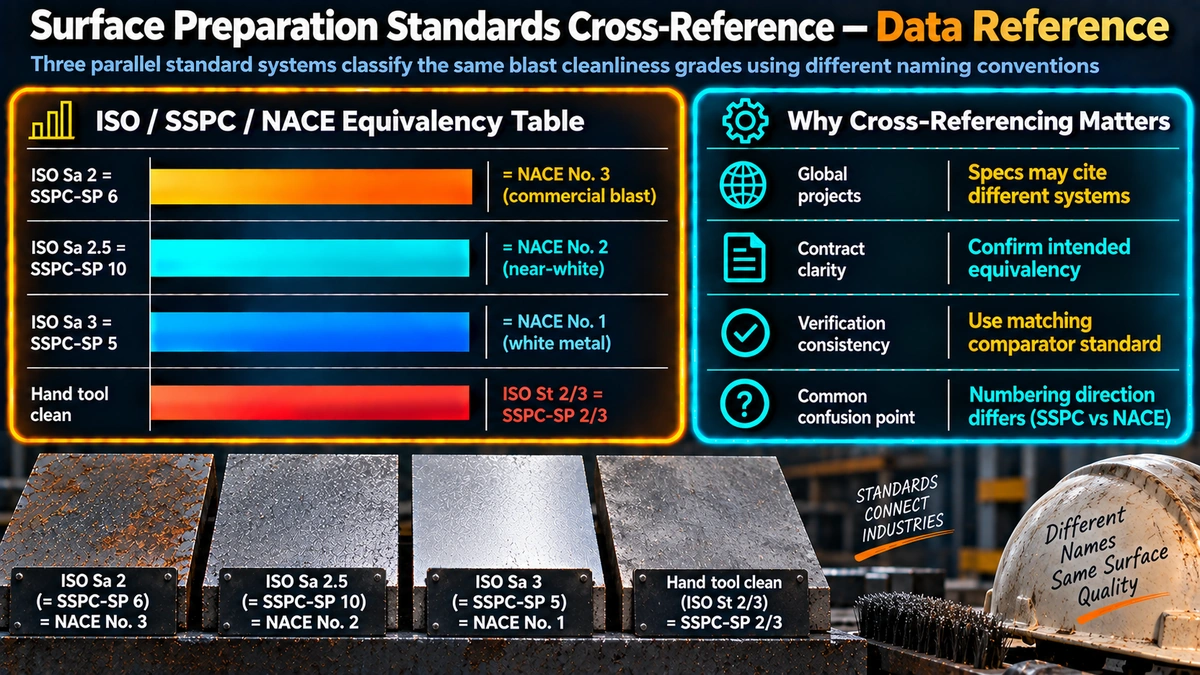
NACE’s four blast cleaning grades, No. 1 through No. 4, were defined jointly with SSPC to be technically identical to SP5, SP10, SP6, and SP7 respectively, so a specification calling for “NACE No. 2” and one calling for “SSPC-SP10” describe exactly the same near-white metal blast condition. Since the 2021 merger, AMPP has begun reissuing these documents under joint AMPP/SSPC numbering, but project specifications, coating data sheets, and older drawings will continue to reference the legacy NACE numbers for years, so QA/QC personnel need to recognise both.
| ISO 8501-1 | SSPC-SP | NACE No. | Common Name | Typical Use |
|---|---|---|---|---|
| Sa 3 | SP5 | No. 1 | White Metal Blast | Immersion, storage tanks, splash zone |
| Sa 2.5 | SP10 | No. 2 | Near-White Metal Blast | High-performance industrial coatings, offshore structures |
| Sa 2 | SP6 | No. 3 | Commercial Blast | General atmospheric exposure, structural steel |
| Sa 1 | SP7 | No. 4 | Brush-Off Blast | Light coatings, galvanised touch-up |
| St 2 | SP2 | — | Hand Tool Cleaning | Maintenance, touch-up |
| St 3 | SP3 | — | Power Tool Cleaning | Weld seam cleaning, maintenance |
ISO 8501-1 and SSPC/NACE grades were developed independently and calibrated against different photographic references, so treating them as perfectly interchangeable can create disputes during coating inspection. Where a project references ISO 8501-1, use ISO reference photographs for visual comparison; where it references SSPC or NACE, use the corresponding SSPC visual standard (SSPC-VIS 1). Never mix reference photograph sets from different standards during acceptance inspection.
Surface Profile and Anchor Pattern
Cleanliness grade alone does not fully define a coating-ready surface. The abrasive blasting process also creates a roughened texture, called surface profile or anchor pattern, that mechanically keys the coating to the steel. Too shallow a profile reduces adhesion; too deep a profile can leave peaks that are not fully covered by the coating film, leading to premature rust-through at high points.
Profile Measurement Methods
| Method | Standard | Output |
|---|---|---|
| Replica tape (Press-O-Film) | ASTM D4417 Method C | Compressible foam tape burnished onto the surface, read with a spring micrometer |
| Digital profile gauge | ASTM D4417 Method B | Needle-contact stylus gives direct peak-to-valley reading on the surface |
| Comparator (Keane-Tator / RUGOTEST) | ASTM D4417 Method A | Visual/tactile comparison against reference discs, fast field check only |
Always calibrate the spring micrometer on the supplied zero plate before taking readings, and take a minimum of ten replica tape readings per inspection area, averaging the results per ASTM D4417 rather than reporting a single spot reading. Report profile in both microns and mils, since specifications may reference either unit depending on their country of origin.
Contamination Testing: Chlorides, Sulfates, and Dust
A blasted surface can meet the visual cleanliness grade and still fail in service if soluble salts remain embedded in the profile, since chlorides under a coating film accelerate osmotic blistering and undercutting corrosion. This is especially critical for tank linings, offshore structures, and any sour or marine service application.
Residual blasting dust is assessed using pressure-sensitive tape pressed onto the surface and compared against reference plates, rated on a dust quantity scale of 0-5 and a dust size scale of 1-5. A rating of dust quantity 2 or lower is typically required before coating application on high-performance systems.
Selecting the Right Grade for the Job
The correct surface preparation grade is always dictated by the coating manufacturer’s technical data sheet, not by a generic rule of thumb, but the following guidance reflects common industry practice across structural, process, and marine fabrication work.
| Service Condition | Recommended Grade | Typical Profile |
|---|---|---|
| Atmospheric exposure, structural steel | Sa 2 / SP6 / No. 3 | 25-50 microns |
| Industrial and marine atmospheric | Sa 2.5 / SP10 / No. 2 | 40-75 microns |
| Immersion, tank lining, splash zone | Sa 3 / SP5 / No. 1 | 50-100 microns |
| Buried pipeline, cathodic protection compatible | Sa 2.5 minimum | 50-75 microns |
| Maintenance touch-up, small areas | St 3 / SP3 | Not always achievable; verify with coating data sheet |
Surface preparation and coating should always follow completion of mechanical testing and NDT sign-off, since blast cleaning removes the ability to visually re-inspect weld surfaces and grinding marks can mask surface-breaking indications. Confirm the hold point sequence in the project ITP before releasing joints for blasting.
Documentation and Inspection Records
A complete surface preparation inspection record should capture the initial rust grade, ambient conditions (temperature, relative humidity, dew point margin per ASTM D3276 or ISO 8502-4 blotter test), abrasive type and size, achieved cleanliness grade with reference photograph comparison, surface profile readings, and soluble salt test results, all traceable to the specific joint or panel number. This traceability becomes critical when a coating failure investigation occurs months or years after application, since it is often the only evidence of substrate condition at the time of coating.
Never blast or coat steel when the surface temperature is within 3°C of the dew point, and re-verify dew point margin at intervals through the shift, since ambient conditions can change faster than the work sequence, particularly in coastal or humid environments common across Indian fabrication yards.
Recommended Reference Material
NACE/SSPC Surface Preparation Reference Guide
Combined visual and procedural reference covering SP and NACE No. grades with photographic comparison plates.
View on AmazonCorrosion Control and Protective Coatings Handbook
Covers coating selection, surface preparation, and failure analysis for industrial and marine service.
View on AmazonDigital Surface Profile Gauge
Needle-contact profile gauge for ASTM D4417 Method B field measurement of blast profile depth.
View on AmazonPaint Inspection Kit (Bresle Patch + DFT Gauge)
Field kit for soluble salt testing and dry film thickness verification during coating inspection.
View on AmazonDisclosure: WeldFabWorld participates in the Amazon Associates programme (StoreID: neha0fe8-21). If you purchase through these links, we may earn a small commission at no extra cost to you. This helps support free technical content on this site.
Frequently Asked Questions
What is the difference between ISO 8501 and SSPC surface preparation standards?
ISO 8501-1 is a visual, photographic reference standard used mainly outside North America that grades rust condition (A, B, C, D) and cleanliness (Sa, St grades). SSPC standards, developed in the United States, define surface preparation methods with written procedures and visual guides (SP grades). Both systems describe comparable end conditions, but ISO grades are photograph-based while SSPC/NACE grades combine written specification with pictorial reference, so specifiers must confirm which standard governs a given contract.
Is NACE the same as AMPP now?
NACE International merged with SSPC in 2021 to form AMPP, the Association for Materials Protection and Performance. Legacy NACE No. and SSPC-SP designations are still referenced in specifications and are being progressively re-issued under the AMPP name, but the technical content and grade definitions have not changed.
What is Sa 2.5 near-white blast cleaning?
Sa 2.5 under ISO 8501-1 is near-white metal blast cleaning, where the surface is free of visible oil, grease, dirt, and nearly all mill scale, rust, and old coating, with only slight staining permitted covering no more than 5 percent of any 600 mm x 600 mm area. It is the equivalent of SSPC-SP10 / NACE No. 2 and is commonly specified for immersion service and high-performance coating systems.
How is surface profile measured after blast cleaning?
Surface profile, also called anchor pattern, is measured using a replica tape method such as Testex Press-O-Film read with a spring micrometer, or with a needle-type profile gauge that contacts the surface directly. Results are reported as Ra (average roughness) or as peak-to-valley height, and must fall within the range specified by the coating manufacturer, typically 25 to 100 microns for industrial coatings.
What does the Bresle test measure?
The Bresle test measures soluble salt contamination, mainly chlorides, remaining on a blasted steel surface before coating. A patch is sealed to the surface, filled with deionised water, agitated, and the extracted solution is tested with a conductivity meter or chloride ion strips. Results are reported in micrograms per square centimetre and compared against the coating specification limit, often 20 to 50 microgram per square centimetre for critical service.
Which surface preparation grade should I specify for offshore or immersion service?
Offshore structures and immersion service typically require Sa 2.5 / SP10 / NACE No. 2 near-white metal blast as a minimum, and some coating systems for splash-zone or buried pipeline service call for Sa 3 / SP5 / NACE No. 1 white metal blast. The exact grade should always follow the coating manufacturer’s data sheet rather than a generic assumption, since profile and cleanliness requirements vary by product chemistry.
Can hand and power tool cleaning replace abrasive blasting?
Hand tool cleaning (SSPC-SP2 / ISO St 2) and power tool cleaning (SSPC-SP3 / ISO St 3) can be used for touch-up, maintenance painting, or where blasting is impractical, but they cannot achieve the surface cleanliness or profile consistency of abrasive blasting. They are not acceptable substitutes for Sa 2.5 or Sa 3 requirements in new-build immersion or high-performance coating specifications.