Tank Lining Coatings: Selection and Application
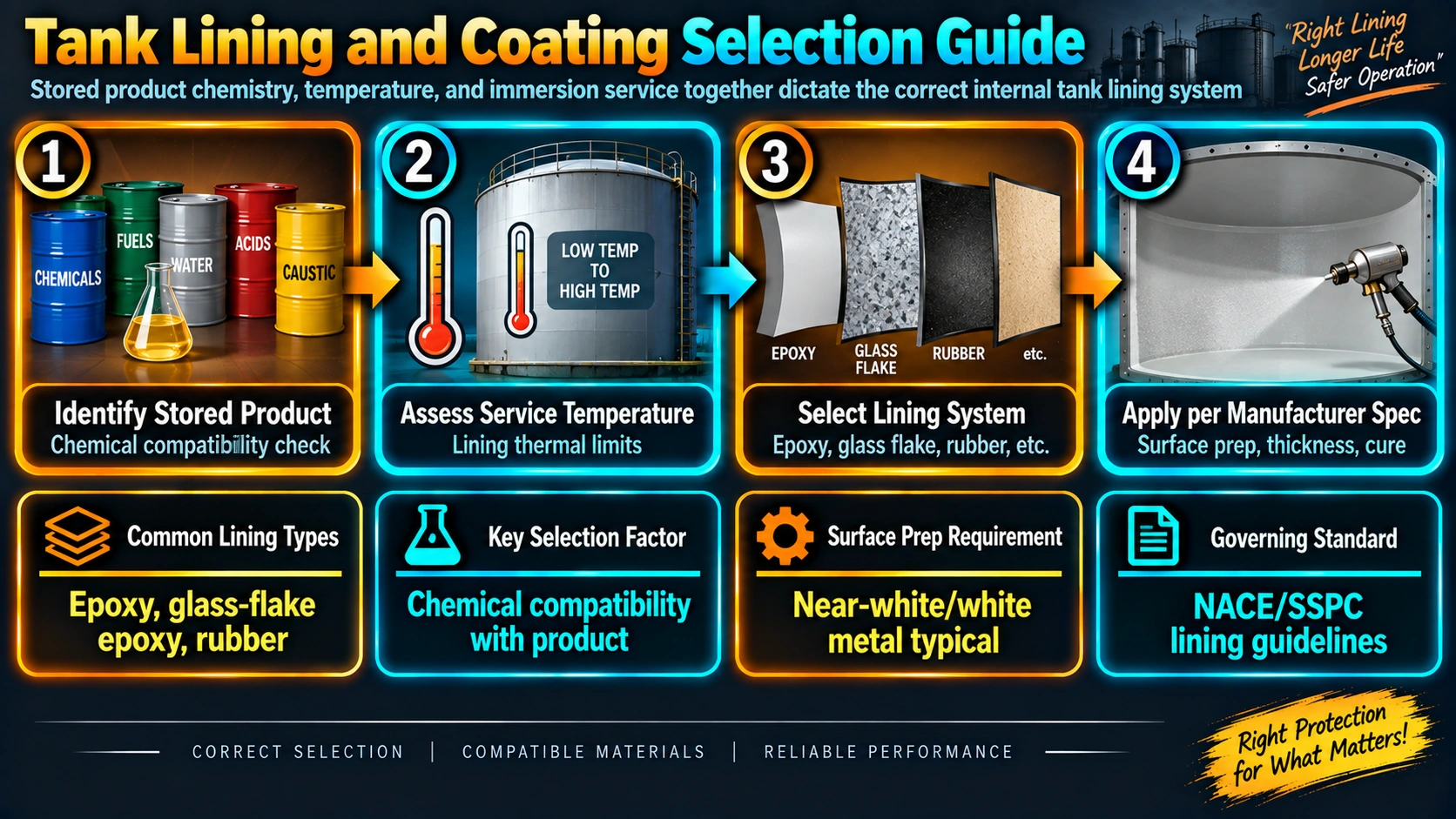
Tank lining coating selection is one of the highest-consequence decisions in industrial coating work, because the lining is in constant, direct contact with the stored product rather than an intermittent atmosphere, and a failure means product contamination, tank bottom corrosion, or a costly emergency shutdown to strip and reline. Unlike an external atmospheric coating, an internal tank lining has to resist immersion, chemical attack from the specific product stored, and often elevated temperature, all while being applied and cured inside a confined space with restricted access.
This guide covers how to select the right lining chemistry by stored product and service condition, the major lining families in use today (epoxy phenolic and novolac, glass flake epoxy, vinyl ester, and rubber lining), application and cure considerations specific to confined tank interiors, and the standards that govern lining specification and inspection. You will also find a free service-based lining selector tool to help frame the chemistry discussion for a specific tank.
Whether you are a QA/QC engineer specifying a lining for a new storage tank, an inspector reviewing a relining scope during a tank outage, or an engineer trying to understand why the produced water tank next door uses a completely different lining than the adjacent crude tank, this guide gives you the selection logic behind the specification.
Tank Lining Selector by Stored Product
Why Tank Linings Need a Different Selection Logic Than Atmospheric Coatings
An external atmospheric coating deals with an intermittent, relatively dilute exposure — rain, humidity, and airborne pollutants. A tank lining is in constant contact with a concentrated product, often for years without a break, and frequently at an elevated temperature that accelerates whatever chemical attack the product chemistry is capable of. This is a fundamentally different design problem from the atmospheric coating selection covered in our anti-corrosive coating selection guide, which is why tank linings are selected primarily by product chemistry compatibility rather than by an ISO 12944-style corrosivity category.
Major Lining Families
Epoxy Phenolic and Epoxy Novolac
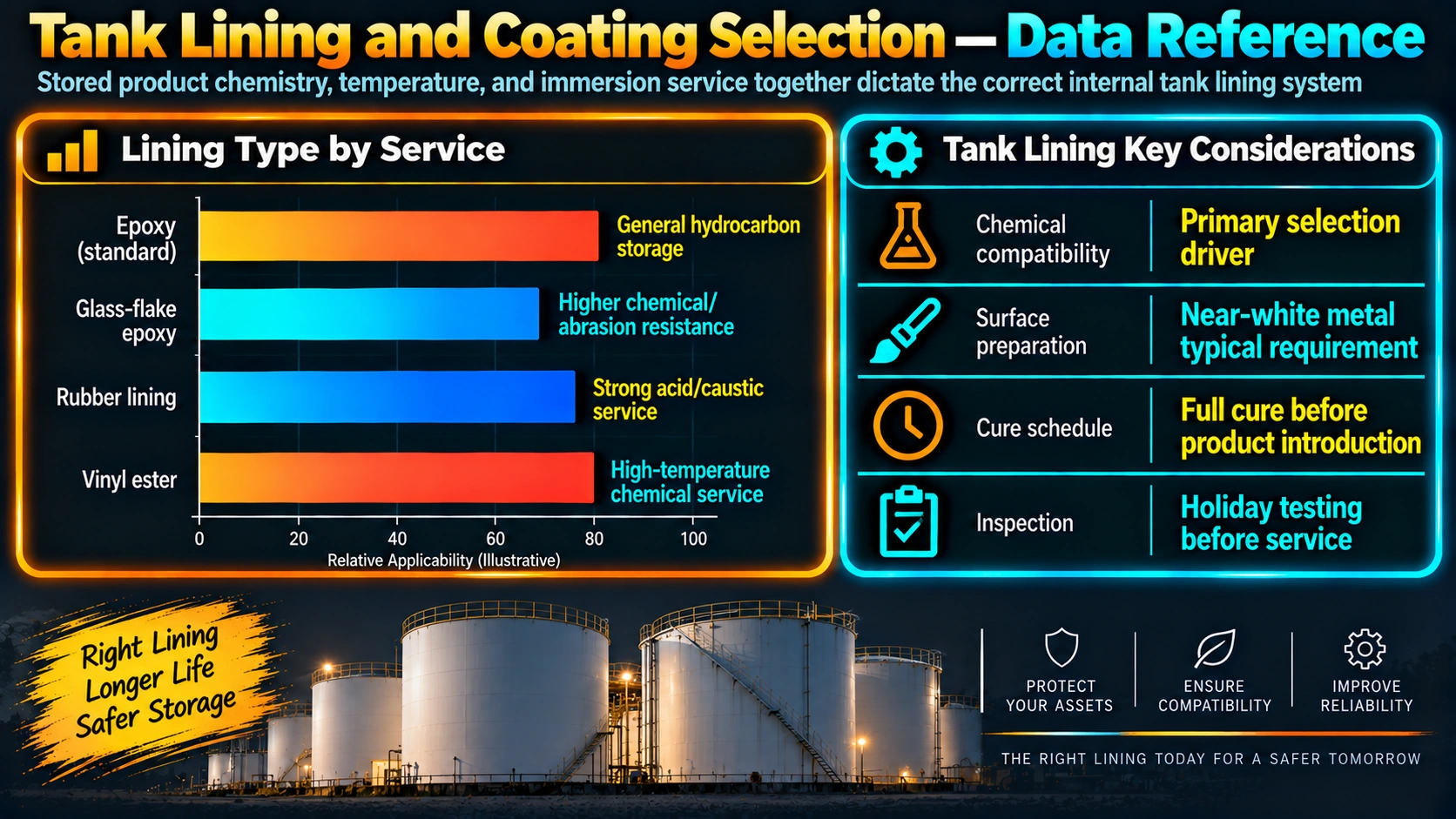
These cross-linked epoxy systems offer strong resistance to hydrocarbons and moderate elevated temperature, and are among the most widely specified linings for crude oil and refined product storage tanks. Novolac-modified epoxies generally push the useful temperature and chemical resistance range higher than standard bisphenol-A epoxies, at some cost to application ease, typically requiring more careful surface preparation and cure control.
Glass Flake Epoxy
Glass flake epoxy linings incorporate flat glass flake particles that align parallel to the substrate as the coating cures, creating a tortuous permeation path that slows moisture and chemical ingress and adds mechanical toughness and abrasion resistance. These are commonly specified for produced water tanks and tank bottoms exposed to sediment or sand abrasion, often applied at a higher single-coat film build than conventional epoxy systems.
Vinyl Ester
Vinyl ester linings generally offer higher chemical resistance than standard epoxies, particularly against stronger acids and oxidizing chemicals, making them a common choice for wastewater, effluent, and certain chemical storage services where epoxy alone would not hold up long-term.
Rubber Lining
Rubber linings, whether natural or synthetic elastomer, are typically specified for the most aggressive chemical services, such as strong acid storage and handling, offering excellent chemical resistance and good abrasion and impact tolerance, though application requires specialized skilled labor, vulcanization or curing equipment, and generally a longer installation timeline than liquid-applied coatings.
| Lining Type | Typical Best Fit | Relative Chemical Resistance | Relative Application Complexity |
|---|---|---|---|
| Epoxy phenolic / novolac | Crude oil, refined products | Good hydrocarbon resistance | Moderate |
| Glass flake epoxy | Produced water, abrasive service tank bottoms | Good, plus mechanical toughness | Moderate-high (thick single coat) |
| Vinyl ester | Wastewater, effluent, moderate chemical service | High, especially acids/oxidizers | Moderate-high |
| Rubber lining | Strong acids, most aggressive chemical service | Very high | High (specialized labor, vulcanization) |
| Coal tar epoxy (legacy) | Older tanks (repair/inspection encountered) | Good historically | Largely phased out for new work |
Application and Cure Considerations Specific to Tank Interiors
Confined Space and Ventilation
Solvent-based tank linings release flammable vapours during application and cure, which can build up to dangerous concentrations inside an enclosed tank without forced ventilation. Confined space entry procedures, continuous forced-air ventilation, continuous gas monitoring for flammable atmosphere and oxygen level, and appropriate respiratory protection are standard requirements for tank lining work, managed through the confined space entry permit alongside the coating specification itself.
Stripe Coating and Detailing
Welds, nozzle connections, roof-to-shell junctions, and internal structural attachments inside a tank are all higher-risk locations for thin film build, similar to the flange and weld issues seen in offshore coating work. Stripe coating these details before the full lining system is applied is standard practice to ensure adequate film thickness is achieved at every geometric transition, not just on flat plate.
Cure Schedule and Return to Service
Lining manufacturers typically publish two separate cure milestones: a minimum cure time before holiday testing can be performed without damaging the still-curing film, and a longer minimum cure time before the tank can safely be filled with product. Returning a tank to service before full chemical cure is reached risks solvent or amine blush entrapment, softening under product contact, and significantly shortened lining life.
Holiday Testing on Thick Lining Films
Because tank linings are commonly applied well beyond 500 microns dry film thickness, they fall outside the effective range of the low-voltage wet sponge method and require high-voltage spark testing instead, using an appropriately calculated voltage for the actual film thickness. Industry guidance commonly cited for tank linings suggests roughly 100 to 125 volts per 25 microns of DFT as a general planning figure, though this differs somewhat from the DuPont formula approach used for structural coating film thickness selection covered in our pinhole detector testing guide. Different guidance exists across the industry for different film thickness ranges and lining types, so the coating manufacturer’s specific recommended test voltage for the exact product and thickness applied should always be the governing figure, not a generic rule of thumb.
Governing Standards
| Standard | Scope |
|---|---|
| API 652 | Lining of aboveground petroleum storage tank bottoms for corrosion protection |
| API 653 | Aboveground storage tank inspection, repair, alteration, and reconstruction |
| NACE SP0288 | Inspection of linings on steel and concrete |
| SSPC / NACE joint standards | Surface preparation and coating application practice generally applicable to tank interiors |
Common Field Mistakes
- Selecting a lining based on the generic product category (for example “hydrocarbon service”) without confirming compatibility with the specific composition, concentration, and operating temperature of the actual stored product.
- Under-specifying stripe coating on welds and details, leading to premature localized failure at these higher-risk locations well before the general coating area shows distress.
- Applying high-voltage holiday testing at a voltage not confirmed against the manufacturer’s data for the specific product and measured film thickness.
- Returning the tank to service before the full chemical cure time is reached, rather than only the shorter holiday-testing cure milestone.
- Overlooking confined space ventilation and gas monitoring requirements as a coating quality issue rather than treating them purely as a safety permit formality.