Anti-Corrosive Coating Selection Guide by Environment
By WeldFabWorldAugust 21, 2026Updated: September 28, 2026
20 min read
Anti-Corrosive Coating Selection Guide by Environment | WeldFabWorld
Anti-Corrosive Coating Selection Guide by Environment
Painting & Coatings | By WeldFabWorld | Updated August 2026 | 16 min read
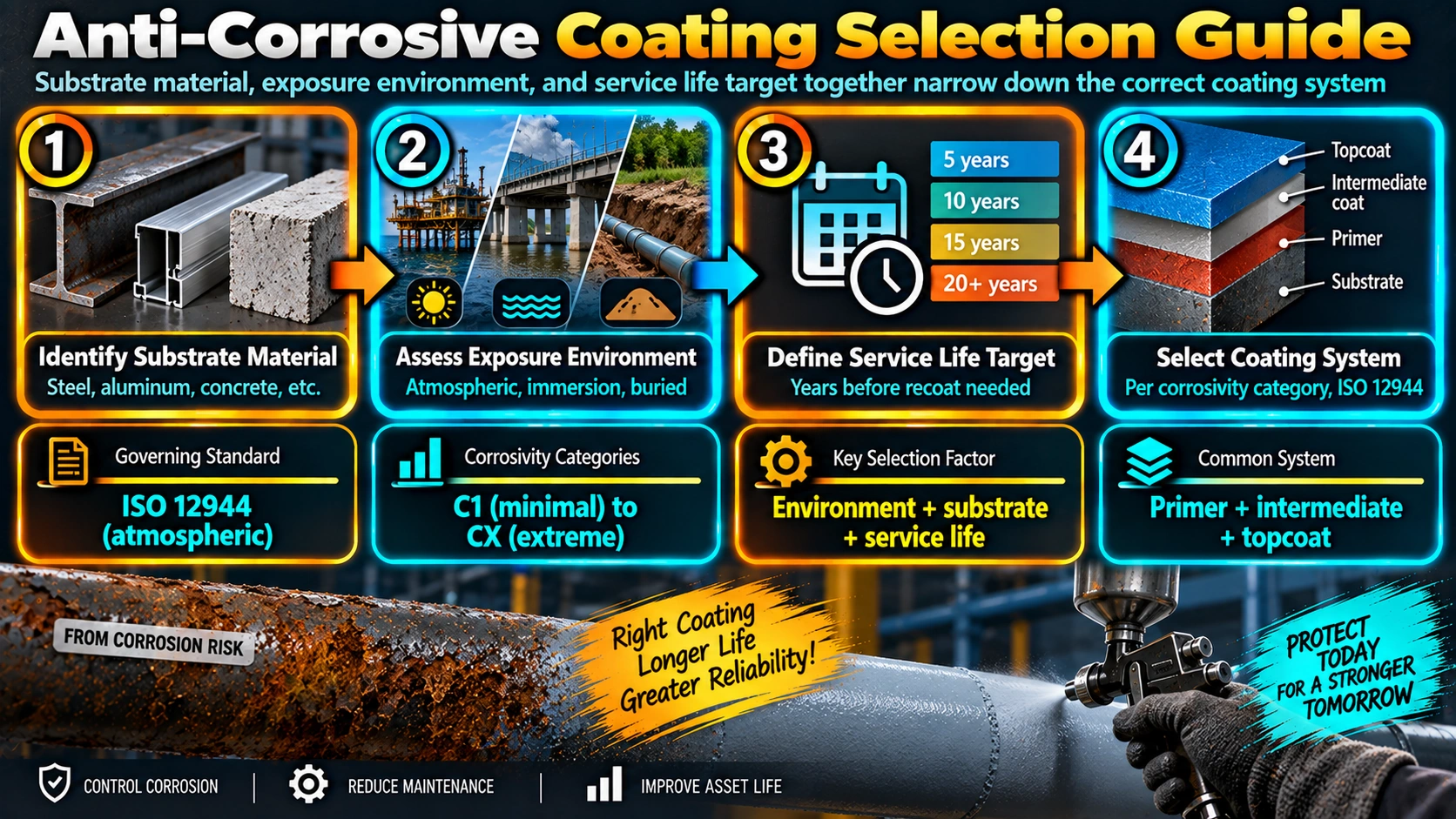
Anti-corrosive coating selection by environment comes down to matching a coating system to two things: how aggressive the surrounding environment actually is, and how long you need the system to last before it needs major maintenance. ISO 12944, the primary international standard for corrosion protection of steel structures by paint systems, gives engineers a shared language for both, using corrosivity categories from C1 (very low) to CX (extreme offshore), combined with durability ranges from Low to Very High.
This guide walks through each corrosivity category with real-world environment examples, the durability range concept, typical generic coating systems and film thickness for each combination, and how immersion and offshore categories differ from standard atmospheric exposure. You will also find a free coating system estimator that gives planning-level dry film thickness and system type based on your selected category and durability target.
Whether you are a coating engineer writing a project specification, a QA/QC inspector verifying DFT against the correct system, or a facility engineer trying to understand why a coastal tank farm needs a fundamentally different system than an indoor warehouse frame, this guide gives you the classification logic and the system tables behind the specification.
ISO 12944 Coating System Estimator
—
Typical Total DFT
—
Typical Coat Count
—
Typical Generic System
Scope note
This estimator gives planning-level dry film thickness and system type ranges drawn from generally published ISO 12944-5 examples, for early specification discussions and cross-checking. It is not a substitute for the actual ISO 12944-5 system tables or the coating manufacturer’s certified system data sheet, which govern final specification.
ISO 12944 Corrosivity Categories
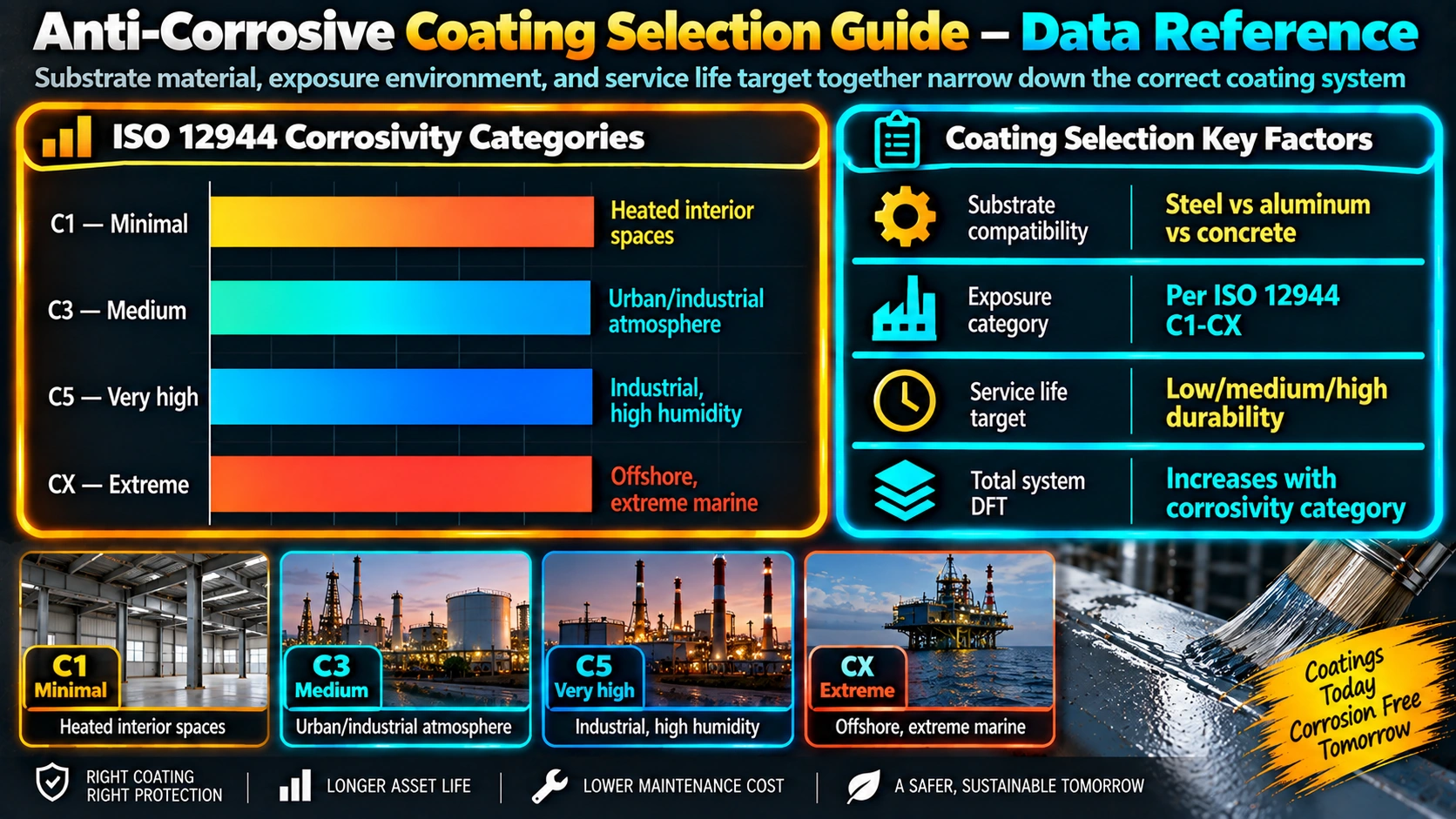
ISO 12944-2 defines six atmospheric corrosivity categories, ranging from very low indoor exposure through to extreme offshore conditions. Each category is described by representative indoor and outdoor environment examples rather than a single numeric corrosion rate alone, making it easier for engineers to classify a real structure by comparison.
Category
Level
Typical Interior Examples
Typical Exterior Examples
C1
Very Low
Heated buildings with clean atmospheres: offices, shops, schools, hotels
Not applicable (interior only)
C2
Low
Unheated buildings where condensation can occur: depots, sports halls
Atmospheres with low pollution, mostly rural areas
C3
Medium
Production rooms with high humidity and some air pollution: food processing, breweries, dairies
Urban and industrial atmospheres, moderate sulfur dioxide pollution; coastal areas with low salinity
C4
High
Chemical plants, swimming pools, coastal ship and boatyards
Industrial areas and coastal areas with moderate salinity
C5
Very High
Buildings or areas with almost permanent condensation and high pollution
Industrial areas with high humidity and aggressive atmosphere; coastal and offshore areas with high salinity
CX
Extreme
Not applicable (offshore atmospheric only)
Offshore structures exposed to permanent high salinity and near-constant wetting
Beyond atmospheric exposure
ISO 12944-6 additionally defines immersion categories: Im1 (fresh water), Im2 (seawater or brackish water), Im3 (buried in soil), and Im4 (seawater or brackish water with cathodic protection, typically used for offshore splash and tidal zones). These are separate from the atmospheric C-categories and use their own system tables.
Figure 1 — ISO 12944 corrosivity categories arranged from C1 (very low, heated indoor) through CX (extreme offshore atmospheric exposure).
Durability Ranges
Durability, under the current ISO 12944-1 terminology, describes the expected time to first major maintenance of the coating system, not a guarantee or warranty period. It is a planning parameter that lets an owner balance upfront coating cost against how often re-access and repainting will be needed over the asset’s life.
Durability Range
Expected Time to First Major Maintenance
Low (L)
Up to 7 years
Medium (M)
7 to 15 years
High (H)
15 to 25 years
Very High (VH)
More than 25 years
A useful rule of thumb
Stepping up one corrosivity category while stepping down one durability range often lands on a very similar total film thickness. A C3-High system, for example, commonly ends up close to a C4-Medium system in total DFT. This is a useful sanity check when comparing quotations or specifications that express the same underlying protection level differently.
Typical Coating Systems by Category
The tables below give commonly published planning-level examples of generic coating system type and total dry film thickness (DFT) by category and durability range. These are illustrative; ISO 12944-5 itself, and each coating manufacturer’s specific certified system, remain the governing references for an actual project specification.
Category
Typical Durability Shown
Typical Generic System
Typical Total DFT
C1
Low
Single coat acrylic or alkyd
60-100 microns
C2
Low-Medium
Alkyd or epoxy, 2 coats
120-160 microns
C3
Medium
Epoxy primer + epoxy/PU topcoat, 2 coats
160-200 microns
C3
High
Epoxy primer + epoxy intermediate + PU topcoat
200-240 microns
C4
Medium
Epoxy or zinc-rich primer + epoxy + PU topcoat
220-260 microns
C4
High
Zinc-rich epoxy primer + epoxy intermediate + PU topcoat, 3 coats
260-320 microns
C5
High
Zinc-rich epoxy primer + epoxy intermediate + PU/fluoropolymer topcoat
320-380 microns
C5
Very High
Zinc-rich epoxy primer + high-build epoxy + PU topcoat
350-450 microns
CX
High / Very High only
Zinc-rich epoxy primer + high-build epoxy intermediate + PU topcoat
320-450+ microns
CX and offshore work often reference NORSOK M-501 too
Many offshore projects reference both ISO 12944 (CX category) and NORSOK M-501, which requires pre-qualified coating systems tested in accredited laboratories. Always confirm in the project specification whether ISO 12944 CX, NORSOK M-501, or both apply, since qualification requirements can differ even where film thickness ranges look similar.
Figure 2 — A typical three-coat C4/C5 system: zinc-rich primer for galvanic protection, an epoxy intermediate for barrier film build, and a polyurethane topcoat for UV and color stability.
Surface Preparation Requirements by Category
Coating system durability depends as much on surface preparation as on the coating chosen. ISO 12944-4 references the ISO 8501-1 blast-cleaning grades, and the required grade typically rises with corrosivity category.
Category
Typical Minimum Preparation
C1-C2
St 2/St 3 hand or power tool cleaning may be acceptable for some systems
C3-C5
Sa 2 1/2 (very thorough blast cleaning) commonly the minimum
CX / zinc silicate primers
Sa 3 (blast cleaning to visually clean steel) frequently required
Selecting the Right Category — Practical Considerations
Distance from the coast and prevailing wind: Airborne salinity drops off with distance inland, but coastal fog and prevailing onshore winds can push higher salinity further inland than distance alone would suggest.
Chemical exposure beyond general atmospheric pollution: Process areas with specific chemical fumes or spillage risk may need a coating chemistry selected for that specific chemical resistance in addition to the base corrosivity category.
UV exposure: Exterior topcoats need UV-stable chemistry (typically polyurethane, polysiloxane, or fluoropolymer) regardless of corrosivity category, since epoxy topcoats chalk under direct sunlight even where their corrosion protection is otherwise adequate. See our coating defects guide for more on chalking and other UV-related failure modes.
Immersion, insulation, or fireproofing overlays: Surfaces going into immersion service, beneath insulation, or under passive fireproofing need their own dedicated system logic rather than a standard atmospheric C-category system; see our guides on CUI coating systems and passive fireproofing coatings.
Maintenance access and asset criticality: Structures that are difficult or expensive to re-access, such as offshore platforms or tall stacks, generally justify a higher durability range even where the raw corrosivity category alone might not strictly require it.
Recommended Reference Reading
ISO 12944 Standard Reference Series
Reference material covering corrosivity categories, durability ranges, and protective paint system tables for steel structures.
Disclosure: WeldFabWorld participates in the Amazon Associates programme (StoreID: neha0fe8-21). If you purchase through these links, we may earn a small commission at no extra cost to you. This helps support free technical content on this site.
Frequently Asked Questions
What is the difference between an ISO 12944 corrosivity category and a durability range?
The corrosivity category (C1 to C5, plus CX for offshore atmospheric exposure) describes how aggressive the surrounding environment is, based on factors like pollution level, salinity, and humidity. The durability range (Low, Medium, High, or Very High) describes how long the coating system is expected to perform before first major maintenance is needed, independent of how aggressive the environment is. The two are combined, such as C4-High, to select a specific coating system from ISO 12944-5.
How do I know which ISO 12944 corrosivity category applies to my project?
Corrosivity category is determined by site-specific environmental assessment, generally covering atmospheric pollution level, proximity to the coast and typical airborne salinity, and whether the structure is indoors or outdoors, sometimes supported by corrosion rate coupon data per ISO 9223. In practice, most industrial and EPC projects specify the corrosivity category directly in the project coating specification based on the facility type and location.
Why do C4 and C5 systems usually include a zinc-rich primer while C1-C3 often do not?
Zinc-rich primers provide galvanic (sacrificial) protection, actively protecting the steel even where the coating film has minor defects or holidays, which becomes increasingly important as the environment becomes more corrosive. In lower corrosivity categories such as C1-C3, a barrier-type epoxy or alkyd system without zinc-rich primer is often adequate, but as corrosivity rises into C4, C5, and CX, the added active protection of a zinc-rich primer is commonly specified.
What is the CX corrosivity category and how is it different from C5?
CX is an extreme offshore atmospheric corrosivity category added in the 2017-2018 revision of ISO 12944, covering environments such as offshore platforms and structures in the splash zone influence with very high salinity and near-constant wetting. It is more severe than C5 and typically only High or Very High durability systems are defined for CX, since a shorter-lived coating system is rarely acceptable given the cost and difficulty of re-access for offshore maintenance.
How does surface preparation grade change with corrosivity category?
Higher corrosivity categories generally require a more thorough surface preparation standard to achieve the coating system’s rated durability. Sa 2 1/2 (very thorough blast cleaning per ISO 8501-1) is commonly the minimum for C3 through C5 systems, while Sa 3 (blast cleaning to visually clean steel) is frequently specified for CX environments and for zinc-rich or zinc silicate primers.
Can I use an immersion (Im) rated coating system for atmospheric (C) service instead of a C-rated system?
Immersion-rated systems (Im1 through Im4) are tested and formulated specifically for continuous submersion, and while they are often robust, higher-cost systems, they are not automatically interchangeable with atmospheric C-category systems, since the two exposure conditions test different failure modes. The project specification should state which category applies to which surface, and coating selection should follow the category that matches the actual service condition.