Noise hearing protection for welding means measuring shop noise, reducing it at the source and fitting rated hearing protection that works with a welding helmet, because grinding, gouging and plasma cutting damage hearing long before the welding arc does.
For noise hearing protection in welding, measure the noise first, because protection is needed when the shift average reaches 85 dB(A). Reduce noise at the source with damping, enclosures and quieter tools, then give workers fitted earplugs or helmet-compatible earmuffs, train them to use them correctly, and test their hearing every year.
This guide goes deeper on noise than the hearing protection section of our PPE for welding guide. It covers the noisiest shop tasks, legal limits, exposure calculations, noise controls, protector selection and a hearing conservation program.
Noise is one of the hazards covered in the wider welding hazards and safety precautions guide, but it is often the least visible, because hearing loss builds up slowly and painlessly over years.
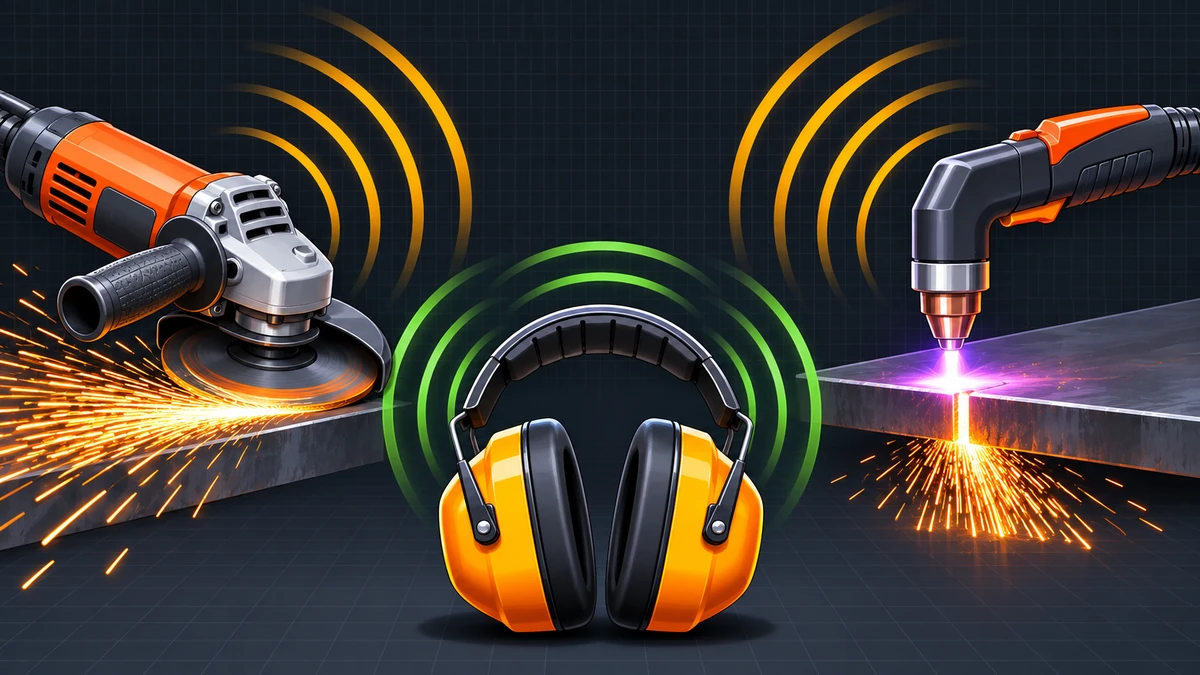
- Noise-induced hearing loss is permanent, so prevention is the only effective approach.
- In fabrication shops, grinding, chipping, gouging, plasma cutting and plate hammering are usually louder than the welding arc.
- Typical action level is 85 dB(A) over 8 hours; OSHA’s limit is 90 dB(A) with a 5 dB exchange rate, while the EU, UK and NIOSH use a 3 dB rate.
- Control noise at the source first; hearing protection is the last line of defence and its label rating overstates real-world protection.
- Earplugs usually suit work under a welding helmet; check fit in use, not just on the label.
- A hearing conservation program adds measurement, training and yearly hearing tests; legal requirements depend on your jurisdiction.
What Is Noise-Induced Hearing Loss and Why Does It Matter in Fabrication?
Noise-induced hearing loss is permanent damage to the inner ear caused by prolonged or intense sound exposure.
Loud sound damages the sensory hair cells in the cochlea, and these cells do not regrow. Early loss usually affects high frequencies around 3 to 6 kHz, so speech starts to sound muffled, especially in noisy places, and many people develop tinnitus, a constant ringing in the ears. Because the damage is gradual and painless, workers often notice it only after years of exposure.
Hearing loss also affects safety. A worker who cannot hear a crane horn, forklift alarm or a colleague’s warning is at higher risk of injury, which links noise directly to the lifting and traffic hazards in a yard.
This guide covers occupational noise in fabrication and welding shops, including hearing protection selection and conservation programs. For helmets, gloves and respirators, see the Safety & Compliance section and the PPE guide linked above.
Which Fabrication Shop Tasks Are the Noisiest?
The noisiest fabrication tasks are usually the ones around the weld, such as grinding, chipping, gouging, plasma cutting and hammering, not the arc itself. Arc welding by SMAW, GMAW or GTAW is moderate, but preparation and finishing push the daily exposure up.
| Task | Indicative level, dB(A) | Typical control options |
|---|---|---|
| Arc welding (GMAW, SMAW) | 75 to 90 | Distance, screens, hearing protection where levels are elevated |
| Angle grinding | 90 to 105 | Quieter tools and discs, enclosures for repeat work, hearing protection |
| Plasma cutting | 90 to 110 | Water-table cutting, enclosures, hearing protection |
| Chipping and slag removal | 95 to 110 | Controlled-flux or low-slag consumables, powered scrapers, hearing protection |
| Hammering and straightening plate | 100 to 115 | Fixtures or presses, damping pads, soft-faced hammers |
| Air carbon arc gouging | 100 to 120 | Alternative preparation methods, enclosures, double protection if measured |
| Compressed-air blow-off | 90 to 105 | Silenced nozzles, vacuum or brush cleaning |
| Press brake and shearing | 85 to 100 | Guards with damping, maintenance, isolated mounts |
Impulse noise from hammering, chipping and dropped plate is especially harmful, because short peaks can exceed 140 dB. Enclosed spaces make everything worse; in tanks and vessels, sound reflects from steel walls and exposure rises, as covered in our confined space welding safety guide.
What Are the Noise Exposure Limits?
Most rules use 85 dB(A) averaged over 8 hours as the level at which hearing protection and a conservation program begin, but the exchange rate differs. OSHA uses a 5 dB exchange rate and a 90 dBA limit, while the EU, UK and NIOSH use a 3 dB rate, which is more protective.
| Rule | Action level | Limit | Exchange rate | Peak sound |
|---|---|---|---|---|
| OSHA 29 CFR 1910.95 (USA) | 85 dBA TWA (conservation program) | 90 dBA TWA, 8 h | 5 dB | 140 dB peak (impulse) |
| EU Directive 2003/10/EC and UK 2005 Regulations | Lower 80 dB(A); upper 85 dB(A) | 87 dB(A) at the ear, with protectors | 3 dB | 135, 137 and 140 dB(C) peak |
| NIOSH recommended limit | 85 dBA, 8 h | 85 dBA, 8 h | 3 dB | 140 dB peak maximum |
| India (state factory rules) | Permissible exposure limits are set by state rules under the Factories Act, 1948; confirm the current value for your state and site. | |||
The exchange rate sets how fast the permitted time falls as noise rises. Under the 3 dB rule, 91 dB(A) is allowed for 2 hours, while under the OSHA 5 dB rule the same 2 hours is allowed at 100 dBA. Applying the less protective rule can understate real risk, so many companies adopt the 3 dB approach as policy.
Limits come from OSHA 29 CFR 1910.95, the EU noise Directive 2003/10/EC, the UK Control of Noise at Work Regulations 2005 and NIOSH criteria. Requirements depend on the regulation and contract applicable to your project.
How Do You Measure and Calculate Noise Exposure?
Measure noise with a calibrated sound level meter for task levels and a personal dosimeter for a worker’s full shift, then convert the readings into a shift-average level or dose. The result decides whether hearing protection and a conservation program are required.
Calibrate the instrument with an acoustic calibrator before and after each measurement session, and keep its calibration certificates, as explained in the guide to calibration of welding and inspection equipment. Dosimeters must be set to the criteria of the rule being applied: for OSHA compliance, a 90 dBA criterion, 5 dB exchange rate and 80 dBA threshold; for 3 dB rules, an 85 dB criterion with a 3 dB exchange rate.
The same shift gives 89.5 dB(A) under the 3 dB method and 87.1 dBA under the OSHA method. Both are above the 85 dB level, so hearing protection and a conservation program apply, but the 3 dB result is almost 2.5 dB higher. A shift with only 2 hours of grinding can already be above the action level.
How Do You Reduce Noise at the Source?
Reduce noise by applying the hierarchy of controls: eliminate the noisy step, substitute quieter tools or methods, add engineering controls, then use administrative measures and hearing protection for the remaining exposure. Controls at the source protect everyone nearby, not just the person wearing a protector.
- Elimination and substitution: use fixtures, clamps or presses instead of hammering; pick quieter grinders and discs; adopt buy-quiet purchasing so new tools are chosen partly on noise data.
- Engineering controls: add damping pads or sheets to workbenches and plate, enclose repeat noisy operations such as gouging or plasma cutting, fit silencers to air exhausts and blow guns, and use acoustic curtains or screens to protect nearby workers.
- Maintenance: worn bearings, loose guards and leaking air lines add noise, so fix them promptly.
- Administrative controls: mark noise zones, schedule the noisiest work when fewer people are present, rotate tasks where it reduces dose, and train workers on the hazard.
Be careful that fixes for one hazard do not add another. Fume extraction fans, for example, add noise while reducing exposure to fume, so check the sound level when specifying equipment, as discussed in our guide to welding ventilation requirements indoor and outdoor.
How Do You Choose Hearing Protection for Welding and Fabrication?
Choose hearing protection by matching the attenuation to the measured noise, then checking comfort, compatibility with other PPE and communication needs. The aim is enough protection to bring the level at the ear well below the action level without isolating the wearer.
| Type | Typical labelled NRR, dB | Strengths | Limits |
|---|---|---|---|
| Foam disposable plugs | Up to about 33 | High attenuation, low cost, fits under a helmet | Fit depends on insertion technique, hygiene |
| Pre-moulded reusable plugs | About 20 to 28 | Easy to insert, washable | Size must suit the ear canal |
| Custom-moulded plugs | About 20 to 30 | Consistent fit, comfortable for long shifts | Higher cost, lead time |
| Banded plugs (canal caps) | About 17 to 25 | Quick on and off for intermittent work | Lower attenuation, band may interfere with headgear |
| Earmuffs | About 20 to 31 | Easy to fit, visible to supervisors | Can conflict with helmets and glasses, hot, seal can break |
| Level-dependent or electronic muffs | Similar to muffs | Allow speech and warnings, limit loud peaks | Cost, batteries, maintenance |
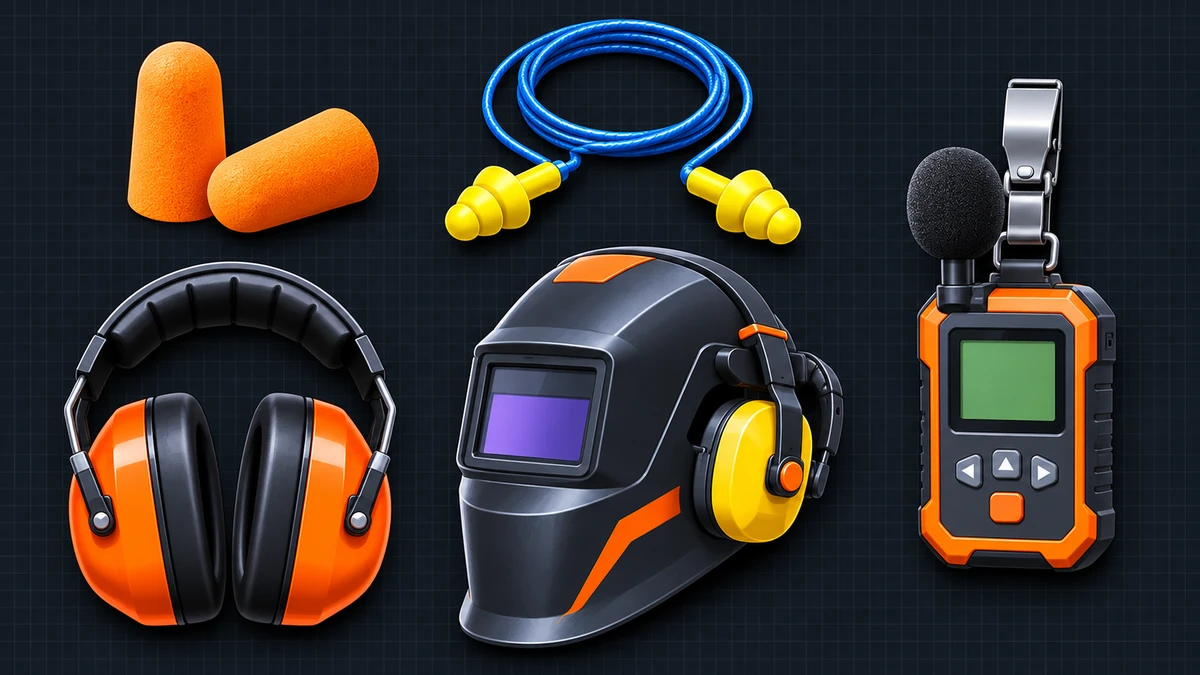
Label ratings are measured in a laboratory under ideal fit, and real-world protection is usually lower. To allow for this, OSHA’s recommended method for A-weighted measurements subtracts 7 dB from the NRR and then takes half of the result. The method used by your regulator or procedure controls.
A target of roughly 70 to 80 dB(A) at the ear is commonly used. Much lower levels can isolate the wearer from alarms and conversation. Where tasks vary, use level-dependent muffs or choose different protectors for different tasks. Double protection (plugs plus muffs) adds only a few decibels, commonly assumed to be about 5 dB over the better device, and should be used only where measurement shows it is needed.
How Do You Use Hearing Protection With a Welding Helmet?
Earplugs are usually the easiest option under a welding helmet because they do not touch the helmet headgear or break the seal that earmuffs need. Earmuffs can work when the helmet is designed for them or when welding is intermittent.
- Plugs: insert them fully before putting on the helmet, and check that they stay in place when the head moves.
- Muffs: check that headgear, glasses arms and hair do not break the seal. Use helmet-mounted or low-profile muffs where the manufacturer allows.
- Spatter: hot spatter near the ear is a burn hazard, especially overhead. Use a flame-resistant hood or cap, and follow the manufacturer’s guidance on protector materials. See the welding positions guide for how position affects spatter direction.
- Awareness: fire watchers and crane workers must still hear alarms, so coordinate protectors with the hot work permit system and the lifting plan.
- Compatibility: check protectors alongside eye protection and the helmet, as discussed in the guide to welding arc flash and eye injury prevention.
What Does a Hearing Conservation Program Include?
A hearing conservation program combines noise measurement, controls, hearing protection, training, audiometric testing and records. OSHA 1910.95 requires one when employees are exposed at or above an 8-hour TWA of 85 dBA, and many employers apply the same approach elsewhere.
- Measure the noise. Survey the shop with a calibrated sound level meter and use personal dosimeters on workers who move between tasks. Check the meter’s calibration before and after use; see our guide to calibration of welding and inspection equipment.
- Calculate exposure and mark noise zones. Convert measurements into a shift-average level or dose, compare it with the 85 and 90 dB(A) limits, and mark hearing protection zones on a plan with signs at the entrances.
- Reduce noise at the source. Apply the hierarchy of controls: remove noisy steps, substitute quieter tools, then add damping, enclosures, silencers and acoustic screens. Include noise controls in each task analysis, as described in our JSA welding guide.
- Provide fitted hearing protection and training in its use. Offer a choice of suitable protectors, show workers how to insert or fit them, and check the fit in use. Choose protectors that work with helmets, glasses and other PPE.
- Arrange baseline and periodic hearing tests. Give exposed workers a baseline audiogram and repeat it at least yearly, so early hearing changes are caught while further loss can still be stopped.
- Follow up any hearing change. When a test shows a significant shift, refit or upgrade the protector, retrain the worker, review the exposure and refer for medical advice as the rules require.
- Train workers and supervisors. Explain the hazard, the effects of hearing loss, how protectors work and why they must be worn at all times in noise zones. Repeat the training at least yearly.
- Keep records and review the program. Keep measurements, audiograms, protector issue and training records, and review the program after any process, tool or layout change. The welding documentation and record-keeping guide explains how records are controlled.
Under OSHA 1910.95, a baseline audiogram is required within 6 months of first exposure at or above the action level, and annual audiograms follow. A standard threshold shift is an average change of 10 dB or more at 2,000, 3,000 and 4,000 Hz compared with the baseline, and it triggers follow-up. Protectors must be available at no cost to the worker, and must be worn at 90 dBA or more, or at 85 dBA or more by a worker with a threshold shift or no baseline.
Some chemicals can add to hearing damage, including some solvents and carbon monoxide, so include chemical exposures in the review where they exist.
What Practical Notes Apply in India and the Gulf?
Heat, client standards and state rules shape noise control in India and the Gulf. These notes are general practice; local law and client requirements govern.
- Indian rules: permissible noise limits are set by state factory rules under the Factories Act, 1948. Confirm the current limit and the testing requirements for your state.
- Client standards: many international EPC and oil and gas clients apply an 85 dB(A) action level and require hearing conservation programs. Follow the contract if it is stricter than local law.
- Heat and sweat: earmuffs get hot and uncomfortable in high temperatures, which reduces wearing time. Offer plugs and keep them clean, as sweat and dust can cause ear irritation.
- Offshore: platform noise from compressors and turbines adds to fabrication noise; see welding in offshore oil and gas platforms.
What Are the Most Common Hearing Protection Mistakes?
The most common mistakes are relying on the label rating, poor fit, measuring only the welding arc, and treating hearing protection as the only control. Each one leaves workers more exposed than the paperwork suggests.
- Trusting the label. Real-world protection is usually lower than the laboratory value, so derate it.
- Poorly inserted plugs. Foam plugs inserted shallowly give a fraction of their rated protection.
- Broken muff seals. Glasses arms, hair, beards and helmet headgear can lift the cushion off the skin.
- Measuring only the arc. Grinding, gouging and hammering usually dominate the dose.
- One survey, never repeated. New tools, layouts and processes change noise, so measure again after change.
- No hearing tests. Without audiometry, nobody sees damage in time to stop it.
- Over-protection. Very high attenuation isolates workers from alarms and speech, which is a safety risk.
- Using an uncalibrated meter. Measurements without calibration are not reliable evidence.
Requirements depend on the regulation and contract applicable to your project and on the employer’s procedure.
Quick Reference: Noise Hearing Protection Welding Checklist
Use the checklist and table below to test a noise program. Each item should be answerable with a clear yes.
- Has the shop been measured with a calibrated meter or dosimeters, including grinding, gouging and hammering?
- Are noise zones marked and are signs visible at entrances?
- Were noise controls considered before hearing protection, and are they recorded in task analyses?
- Is a choice of protectors available, and is it compatible with helmets and glasses?
- Have workers been trained to fit protectors, and is fit checked in use?
- Do exposed workers have baseline and yearly audiograms, with follow-up of any change?
- Are measurements, audiograms and training records kept and reviewed?
| Topic | Rule of thumb |
|---|---|
| Action level | 85 dB(A) averaged over 8 hours; protectors available from 80 dB(A) in the EU and UK |
| Quick field test | If you must shout to be understood at 2 m, measure the noise |
| Noisiest tasks | Gouging, hammering, chipping, plasma cutting and grinding |
| Target at the ear | About 70 to 80 dB(A); avoid over-protection |
| Label ratings | Derate them; real protection is lower |
| Under a helmet | Plugs are usually easiest; check the fit in use |
| Hearing tests | Baseline, then at least yearly for exposed workers |
Frequently Asked Questions
At what noise level do you need hearing protection?
Most rules require hearing protection to be available at an 8-hour average of 85 dB(A) and required at 90 dB(A) in the United States (OSHA), or at 85 dB(A) in the UK and EU, where protectors must also be available from 80 dB(A). A simple field test is that if you must shout to be understood by someone 2 metres away, the noise is probably at or above 85 dB(A). Measure to confirm, and follow the limit that applies to your site.
What is the difference between NRR and SNR?
Noise Reduction Rating (NRR) is the US label value, measured in decibels, and Single Number Rating (SNR) is the European label value. They come from different test methods and weightings, so the two numbers cannot be compared directly. Both are laboratory values that usually overstate the protection achieved in real use, so apply the derating method required by your regulator or procedure.
Are earplugs or earmuffs better for welders?
Earplugs usually work better under a welding helmet because they do not interfere with the headgear or break the seal of an earmuff. Earmuffs are quick to put on and suit intermittent work such as grinding without a helmet. The best protector is the one that fits properly and is worn all the time, so offer a choice and check the fit in use.
Is welding itself loud enough to damage hearing?
Arc welding is often moderately noisy, but the tasks around it are usually the problem. Grinding, chipping slag, hammering plate, air arc gouging and plasma cutting commonly produce levels well above 85 dB(A). Hearing damage depends on level and time, so a welder who also grinds and hammers can easily exceed the limit over a shift.
Can you wear earplugs and earmuffs together?
Yes, double protection can be used in very noisy tasks, but the extra protection is smaller than the sum of the two ratings. A common assumption is an increase of about 5 dB over the better of the two. Double protection also increases the risk of isolation from warnings, so use it only where measurement shows it is needed.
How often should welders have hearing tests?
Workers exposed at or above the action level should have a baseline audiogram when they start and a repeat test at least once a year under the OSHA rules. Some jurisdictions use different intervals, such as tests every one to three years depending on exposure. Compare each test with the baseline, so small changes are found early.
Can hearing loss from noise be reversed?
No. Noise-induced hearing loss is permanent because the damaged hair cells in the inner ear do not regrow. Hearing aids can help but do not restore normal hearing. Prevention through noise control, correct hearing protection and regular testing is the only effective approach.
Key Terms
- dB(A)
- Sound level in decibels weighted to match how the human ear responds to different frequencies.
- Exchange rate
- The increase in noise level, in decibels, that halves the permitted exposure time, such as 3 dB or 5 dB.
- TWA
- Time-weighted average: the shift-average noise level, normally over 8 hours.
- NRR
- Noise Reduction Rating: the US label value for hearing protector attenuation in decibels.
- SNR
- Single Number Rating: the European label value for hearing protector attenuation.
- Standard threshold shift (STS)
- A change in hearing thresholds of 10 dB or more, averaged at 2, 3 and 4 kHz, compared with the baseline audiogram.
- Dosimeter
- A wearable instrument that records a worker’s noise exposure over a shift and calculates dose or average level.
- Audiometry
- A hearing test that measures the quietest sounds a person can hear at different frequencies.
Conclusion
Noise hearing protection for welding starts with measurement, because grinding, gouging, plasma cutting and hammering usually matter more than the arc. Control noise at the source, choose protectors that fit under a helmet and give enough, but not too much, attenuation, and back it up with training and yearly hearing tests.
Hearing loss from noise cannot be reversed, so every year of unmanaged exposure is permanent. As a practical next step, add noise and hearing protection checks to your pre-work routine using the welding inspection checklist, and review noise after any change of tools, layout or process. Keep the measurements and hearing test records, because they show that the program works.
Standards and References
- 29 CFR 1910.95 – Occupational Noise Exposure (OSHA)
- Directive 2003/10/EC – Minimum health and safety requirements regarding the exposure of workers to the risks arising from physical agents (noise) (European Union)
- Control of Noise at Work Regulations 2005 – UK regulations on noise exposure and hearing protection (UK Government and HSE)
- DHHS (NIOSH) Publication 98-126 – Criteria for a Recommended Standard: Occupational Noise Exposure, Revised Criteria 1998 (NIOSH)
- ISO 9612 – Acoustics – Determination of occupational noise exposure – Engineering method (ISO)
- ISO 1999 – Acoustics – Estimation of noise-induced hearing loss (ISO)
- ISO 4869-2 – Acoustics – Hearing protectors – Part 2: Estimation of effective A-weighted sound pressure levels when hearing protectors are worn (ISO)
- EN 352 series – Hearing protectors – General requirements (CEN)
- EN 458 – Hearing protectors – Recommendations for selection, use, care and maintenance – Guidance document (CEN)
- IEC 61672-1 – Electroacoustics – Sound level meters – Part 1: Specifications (IEC)
- ANSI/ASA S12.6 – Methods for Measuring the Real-Ear Attenuation of Hearing Protectors (ANSI and ASA)
- ANSI Z49.1 – Safety in Welding, Cutting, and Allied Processes (American Welding Society (AWS))
Primary sources: Occupational Safety and Health Administration (OSHA), National Institute for Occupational Safety and Health (NIOSH), UK Health and Safety Executive (HSE) and International Organization for Standardization (ISO).
This guide was prepared by the WeldFabWorld technical team from the standards listed above. Verify all requirements against the regulations, client rules and company procedures applicable to your project.