CSWIP 3.2 Senior Welding Inspector: Full Certification Guide
The CSWIP 3.2 Senior Welding Inspector certificate is the qualification that separates a working welding inspector from a candidate who can independently interpret welding procedures, judge acceptance against a code, and sign off critical fabrication and pipeline work without supervision. Issued by TWI Certification (formerly The Welding Institute), CSWIP 3.2 sits directly above CSWIP 3.1 in the same inspector scheme and is recognised across the oil and gas, power generation, offshore, and heavy fabrication industries as evidence of senior-level inspection competence.
This guide walks through the CSWIP 3.2 prerequisites, the structure of the exam itself, the difference between the Plant and Pipeline routes, the syllabus you need to study, typical pass marks, and what the certificate actually qualifies you to do on a job site. If you are deciding whether to progress from CSWIP 3.1 or an ASME Section IX background into a senior inspection role, this is the reference to work from before you book an exam date.
What Is CSWIP 3.2 and Who Is It For
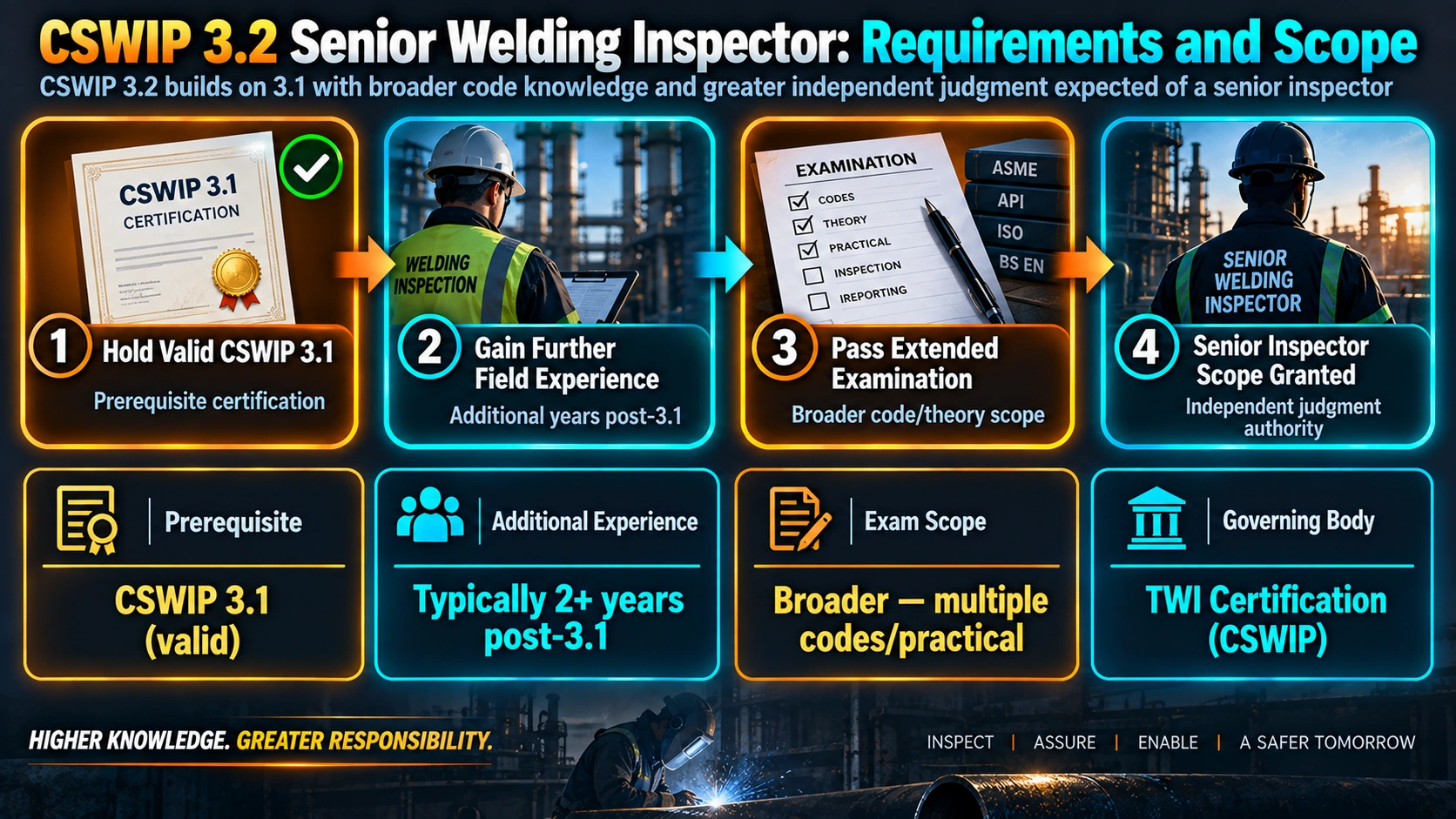
CSWIP 3.2 Senior Welding Inspector certification confirms that an individual can perform the full range of welding inspection duties expected on a fabrication site or pipeline project: reviewing welding symbols and engineering drawings, checking Welding Procedure Specifications (WPS) against Procedure Qualification Records (PQR), interpreting acceptance criteria from the governing code, supervising visual and dimensional inspection at every stage of a weld’s life, and making an informed accept/reject decision that carries technical weight.
The certificate is aimed at experienced inspectors who already hold CSWIP 3.1 (or an accepted equivalent) and who have accumulated verifiable, hands-on inspection experience. It is not an entry-level qualification. Employers on ASME, PED, and API-governed projects frequently list CSWIP 3.2 as a mandatory requirement for Senior Welding Inspector, Quality Control Inspector, or Third-Party Inspector positions, particularly in the Middle East, Europe, and Southeast Asia.
Prerequisites and Entry Requirements
Before you can even book the CSWIP 3.2 exam, TWI requires evidence of a defined inspection background. The exact entry route varies slightly depending on prior certification, but the core requirements are consistent:
- A valid CSWIP 3.1 Welding Inspector certificate, or an accepted equivalent qualification with supporting evidence.
- A minimum period of documented, verifiable welding inspection experience in industry, typically measured in years rather than months.
- Current colour vision testing (Ishihara or equivalent) and visual acuity confirmation, carried over from the 3.1 requirements.
- Formal training course attendance is strongly recommended, though not always mandatory, given the depth of the syllabus.
CSWIP 3.2 Exam Structure
The CSWIP 3.2 exam is built from several independently-marked sections rather than a single combined score. A candidate must pass every section on its own merit; a strong score in one part does not compensate for a fail in another. In broad terms, the exam covers:
1. General Theory Paper
A closed-book written paper covering welding processes, welding metallurgy, weldability, heat treatment, non-destructive testing principles, and destructive mechanical testing methods at a depth beyond CSWIP 3.1. This section assumes solid working knowledge of arc welding processes and their typical defect mechanisms.
2. Practical Macro Examination
Candidates are given a macro-etched weld cross-section (or several) and must identify features, measure dimensions, and assess conformance against the applicable acceptance standard, commonly BS EN ISO 5817 or an equivalent workmanship standard. This section tests hands-on visual and dimensional judgement rather than theory recall.
3. Main Technical Exam – Plant or Pipeline Route
This is the core differentiator of CSWIP 3.2. Candidates choose one of two routes based on their industry background, and the paper includes WPS/PQR cross-checking, engineering drawing interpretation, and an open-book code assessment.
| Route | Typical Governing Codes | Industry Context |
|---|---|---|
| Plant | BS EN 13445, ASME Section VIII, BS EN ISO 5817 | Pressure vessels, storage tanks, static process plant |
| Pipeline | API 1104, BS 4515, PD 8010 | Cross-country pipelines, onshore/offshore pipeline construction |
Choosing Between the Plant and Pipeline Route
Most candidates choose based on the sector they already work in, since the WPS/PQR review, drawing interpretation, and code exercises are all drawn from real-world documentation typical of that sector.
Plant Route
Suited to inspectors working on pressure vessels, heat exchangers, storage tanks, and static process equipment. Expect drawing sets and WPS packages referencing P-Number and F-Number groupings, carbon equivalent control on thicker sections, and acceptance criteria drawn from BS EN ISO 5817 or ASME Section VIII.
Pipeline Route
Suited to inspectors working on cross-country transmission pipelines and onshore or offshore pipeline construction. Expect API 1104-style acceptance criteria, girth weld documentation, and a stronger emphasis on field NDT correlation and repair procedures.
Core Syllabus Areas
Beyond the exam mechanics, candidates should build genuine working knowledge across the following technical areas, most of which extend directly from the CSWIP 3.1 syllabus:
| Syllabus Area | Depth Expected at 3.2 | Related Reference |
|---|---|---|
| Welding processes (SMAW, GMAW, GTAW, SAW) | Process variables, defect mechanisms, applicability | Core SMAW guide |
| Welding metallurgy | HAZ behaviour, hydrogen cracking, delta ferrite control | Delta ferrite article |
| WPS/PQR interpretation | Full cross-check against ASME IX or EN ISO 15614 | ASME Section IX quiz |
| Destructive testing | Tensile, bend, Charpy impact, hardness survey interpretation | UG-84 impact testing |
| Engineering drawings | Weld symbols, tolerancing, isometric and P&ID basics | Welding symbols guide |
| Code and standard navigation | Rapid, accurate open-book clause retrieval under time pressure | Route-specific code |
| Material selection and corrosion | Basic corrosion mechanisms and material limitations | Corrosion guide |
What a CSWIP 3.2 Inspector Actually Does on Site
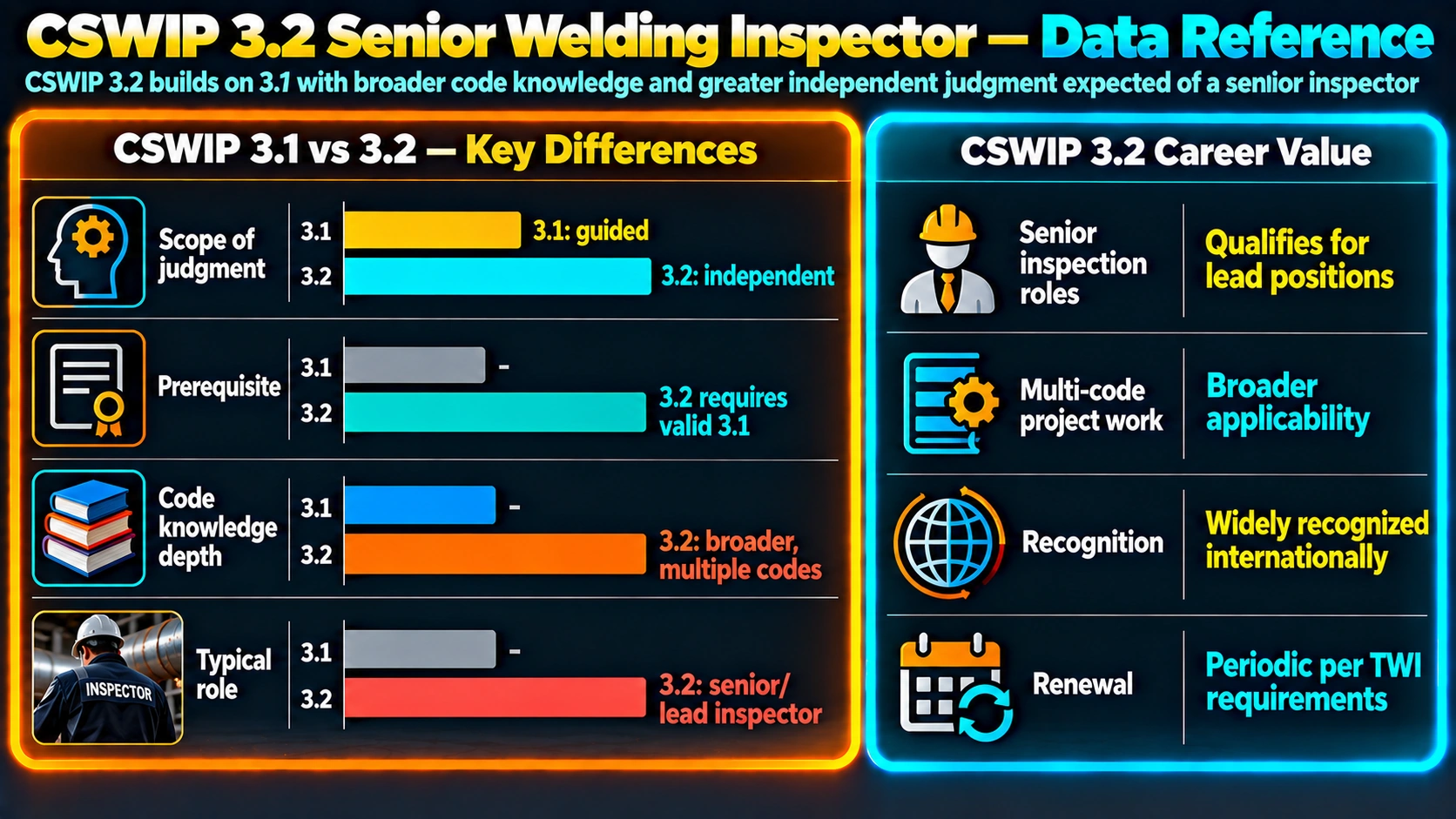
In practice, a Senior Welding Inspector holding CSWIP 3.2 is expected to operate with far less supervision than a 3.1-level inspector. Typical responsibilities include:
- Reviewing and approving WPS and PQR documentation before production welding starts.
- Auditing welding consumable traceability and storage against the qualified procedure.
- Witnessing and interpreting destructive test results from procedure and production qualification welds.
- Making final accept/reject decisions on weld visual and dimensional inspection, including tie-ins and repairs.
- Coordinating with NDT technicians on RT, UT, MT, and PT results, and correlating findings against the code’s acceptance criteria.
- Reviewing joint design and fit-up against the engineering drawing package before release to weld.
- Supervising or mentoring junior CSWIP 3.1 inspectors on site.
Preparing for the Exam
Because CSWIP 3.2 tests applied judgement rather than pure recall, effective preparation looks different from studying for a multiple-choice test:
Build genuine WPS/PQR review speed
Practice cross-checking real WPS and PQR pairs against ASME Section IX or EN ISO 15614 essential variables until identifying a mismatch becomes fast and automatic, not a slow line-by-line search.
Drill macro interpretation
Work through as many macro-etch photographs as you can find, measuring throat thickness, leg length, penetration, and identifying porosity, lack of fusion, and undercut against BS EN ISO 5817 quality levels.
Practice open-book navigation under a timer
Open-book does not mean easy. Time yourself finding specific clauses in your chosen code, since the exam format rewards speed and precision, not just eventual correctness.
Review drawing conventions thoroughly
Revisit welding position conventions and standard drawing symbols so that interpreting an unfamiliar isometric or fabrication drawing under exam conditions does not cost you time.
| Exam Section | Format | Typical Focus |
|---|---|---|
| General Theory | Closed book, written | Metallurgy, processes, NDT/testing theory |
| Practical Macro | Closed book, hands-on | Macro-etch specimen assessment |
| Main Technical (Plant or Pipeline) | Open book, code + documents | WPS/PQR review, drawings, code application |
Recommended Study Resources
The affiliate selections below cover welding inspection, metallurgy, and code-reading references that candidates commonly use alongside official TWI training material when preparing for CSWIP 3.2.
Welding Inspection Handbook
Reference text covering visual inspection, WPS/PQR review, and acceptance criteria relevant to senior inspector exams.
View on AmazonWelding Metallurgy Reference
Covers HAZ behaviour, hydrogen cracking, and microstructure topics tested in the CSWIP 3.2 general theory paper.
View on AmazonNDT Methods for Welding Guide
Practical guide to radiographic, ultrasonic, and surface NDT methods used to correlate inspection findings against code.
View on AmazonEngineering Drawing Interpretation
Refresher on reading fabrication and piping drawings, symbols, and tolerancing relevant to inspection exams.
View on AmazonDisclosure: WeldFabWorld participates in the Amazon Associates programme (StoreID: neha0fe8-21). If you purchase through these links, we may earn a small commission at no extra cost to you. This helps support free technical content on this site.