Welding Inspector Jobs in the Gulf — Salary, Visa, Requirements
Welding inspector jobs in the Gulf remain among the most sought-after career moves for QA/QC and inspection professionals worldwide, and 2026 is no exception. Saudi Arabia’s Vision 2030 build-out, ADNOC’s offshore expansion, and QatarEnergy’s LNG train additions have kept demand for CSWIP and AWS-certified inspectors running well ahead of local supply. If you are weighing a move to Dammam, Abu Dhabi, or Doha, the practical questions are rarely about welding theory — they are about which certificate actually opens doors, what the pay really looks like once you account for tax-free income and site allowances, and how the visa and sponsorship machinery actually works.
This guide walks through all three in one place: the certification landscape (CSWIP 3.1 versus 3.2 versus AWS CWI), realistic salary bands for Saudi Arabia and the UAE drawn from current job postings and salary survey data, the major employers and inspection agencies actively hiring, and a step-by-step breakdown of the Kafala and MOHRE sponsorship systems that govern how you actually get on a plane. Whether you are a fresh CSWIP 3.1 holder or a senior welding engineer weighing a jump to a Senior Welding Inspector role, the sections below are organized so you can jump straight to what you need.
Who this guide is for: Welders, QC inspectors, and welding engineers holding or pursuing CSWIP 3.1/3.2, AWS CWI, or equivalent qualifications, who are evaluating Gulf employment on Saudi Aramco, ADNOC, QatarEnergy, or EPC contractor projects. For exam-specific preparation, see our ASME Section IX practice quiz and P-Number/F-Number/A-Number reference guide.
Why Gulf Demand for Welding Inspectors Stays High
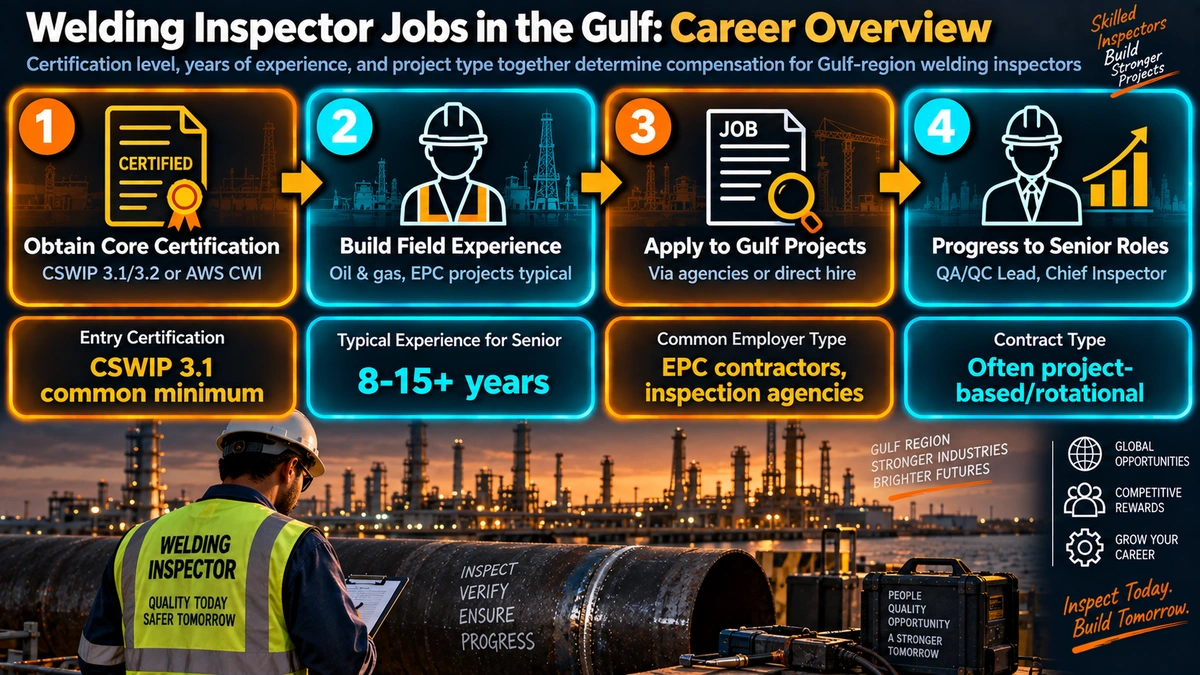
The Gulf’s welding inspector shortage is structural, not cyclical. Saudi Aramco’s upstream and gas expansion programs, ADNOC’s offshore platform and pipeline projects, and QatarEnergy’s North Field LNG expansion all run on fixed, code-driven inspection ratios — a project cannot commission a pressure system, structural module, or cross-country pipeline without a documented chain of certified inspection sign-offs under ASME Section IX, API 1104, or ISO 5817. Because these mega-projects run for years and constantly rotate expatriate staff, the pipeline of open welding inspector, QC inspector, and welding coordinator roles rarely closes. Add in ongoing petrochemical expansion at SABIC and refinery turnaround cycles across Kuwait Oil Company and PDO in Oman, and the result is a labor market where a valid CSWIP or AWS CWI certificate genuinely functions as a passport to work.
Common Job Titles and What They Actually Do
Recruiters in the Gulf are not always consistent with titles, so it helps to know what sits behind each one before you apply.
| Job Title | Typical Certification | Core Responsibility | Seniority |
|---|---|---|---|
| Welding QC Inspector | CSWIP 3.1 or AWS CWI | Visual inspection, WPS/PQR/WPQ review, weld map maintenance | Entry–Mid |
| Coating/Welding QC Inspector | CSWIP 3.1 + BGAS/NACE | Combined weld and coating inspection on the same package | Entry–Mid |
| Senior Welding Inspector | CSWIP 3.2 or Senior AWS CWI | Complex joint inspection, NDT liaison, repair disposition | Mid–Senior |
| Welding Coordinator (per ISO 14731) | CSWIP 3.2 / IWE-equivalent | WPS/PQR development, welder qualification programs, code compliance | Senior |
| Welding Engineer | CSWIP 3.2 + engineering degree | Procedure qualification, metallurgical review, root-cause investigation | Senior |
| QA/QC Lead / Manager | CSWIP 3.2 + management track record | Site QA/QC program ownership, client interface, audit response | Lead |
CSWIP vs AWS CWI: Which Certification Do You Need?
This is the single most common question from engineers planning a Gulf move, and the honest answer is that the region runs on both systems depending on which code governs the project.
CSWIP 3.1 and 3.2
CSWIP 3.1 is the entry-level welding inspector qualification issued through TWI-licensed centres and is one of the most frequently specified credentials on Saudi Aramco’s approved vendor and contractor lists, and is also recognized by SABIC, Saudi Electricity Company, and most major EPC contractors operating in the Kingdom. CSWIP 3.2 sits a level above it, requiring a valid 3.1 certificate plus a minimum of five years of post-certification inspection experience, and holders are typically placed into QA/QC Lead, Welding Coordinator, and Welding Engineer roles on Gulf megaprojects, with reported salary premiums of roughly 30 to 60 percent over 3.1-only inspectors on the same projects.
AWS Certified Welding Inspector (CWI)
The AWS CWI, issued by the American Welding Society, is the standard credential wherever a project follows US-origin codes — ASME pressure vessel work, structural steel under AWS D1.1 welding symbols and joint requirements, and API-governed pipeline work. It is especially valued in Saudi Arabia and the UAE on projects that mix ASME Section VIII vessels with API pipeline scope. To sit the exam, candidates generally need either a high school diploma plus five years of qualifying welding or inspection experience, or an engineering/technology degree plus one to three years of relevant experience.
| Factor | CSWIP 3.1 | CSWIP 3.2 | AWS CWI |
|---|---|---|---|
| Governing body | TWI (UK) | TWI (UK) | American Welding Society |
| Best fit for | ISO/EN codes, general fabrication | Senior QC, welding coordination | ASME, API, AWS D1.1 projects |
| Prerequisite experience | None fixed; entry-friendly | 5+ yrs post-3.1 | 0–5 yrs depending on education |
| Recognized heavily by | Saudi Aramco, SABIC, SEC | Aramco senior contracts, QatarEnergy | ADNOC, EPCs on ASME/API scope |
| Typical pass rate | ~55–65% (written+practical) | Lower; experience-dependent | Varies by Part A/B/C |
Practical tip: Most senior Gulf inspectors eventually hold both. If you can only sit one exam right now, check the specific vendor pre-qualification list for the employer you are targeting — Aramco vendor documentation, ADNOC contractor packs, and QatarEnergy tender documents all specify which certificate is mandatory for that scope of work.
Exam preparation notes
Both CSWIP and AWS CWI practical exams require accurate, timed identification of porosity, undercut, lack of fusion, cracks, and inclusions using a Cambridge weld gauge, Hi-Lo gauge, fillet weld gauge, and undercut gauge until the measurements become second nature — instrument fluency is what separates a comfortable pass from a rushed fail. For the written component, TWI-licensed centres across the UAE, Saudi Arabia, and Qatar run structured five- to seven-day prep courses, and candidates who work through multiple timed mock papers consistently outperform those who study the code book alone. If your background is stronger in metallurgy than in code navigation, our P-Number, F-Number, and A-Number reference guide and mechanical testing overview are worth reviewing before exam day.
Welding Inspector Salary in the Gulf: What the Data Shows
Salary figures for welding inspectors vary widely by employer tier, certification level, and whether the role sits directly with an owner-operator (Aramco, ADNOC) versus a subcontractor or manpower supplier. The figures below combine salary survey averages with live vacancy postings, so treat them as a realistic band rather than a guaranteed number for any single offer.
| Country | Reported Average (Annual) | Entry/Mid Vacancy Range (Monthly) | Notes |
|---|---|---|---|
| Saudi Arabia | ~SAR 92,900 / yr (~SAR 45/hr) | SAR 4,500–7,000/month | CSWIP 3.1 mandatory on most postings; Aramco CBT often required |
| United Arab Emirates | ~AED 123,000 / yr (~AED 59/hr) | Varies by free zone/mainland | ADNOC and free-zone EPC contracts pay above average for AWS CWI |
| CSWIP 3.2 premium | +30% to +60% over CSWIP 3.1 pay on the same project | Applies mainly to QA/QC Lead and Welding Coordinator roles | |
Read the fine print: Advertised monthly figures on job boards frequently exclude housing allowance, transport, and end-of-service gratuity, all of which materially change the real value of an offer. Always ask for the full package breakdown before comparing two offers side by side.
What actually moves your pay
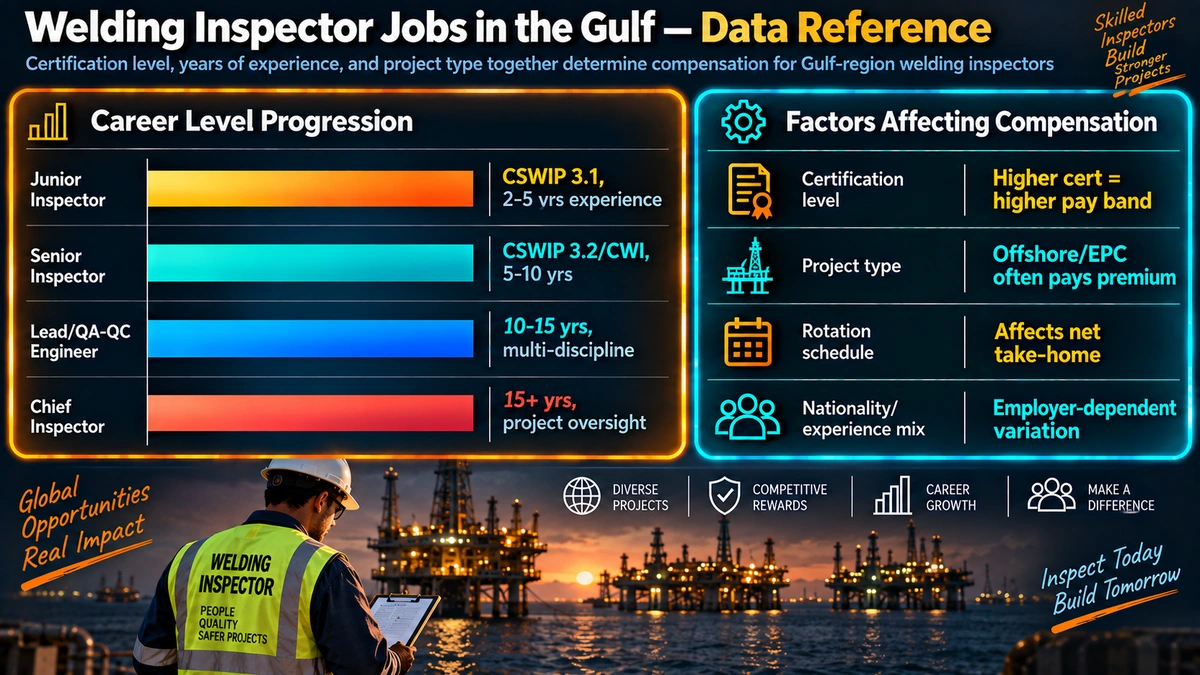
- Certification level: CSWIP 3.2, senior AWS CWI, or dual certification consistently commands the highest premium.
- Direct-hire vs manpower supply: Working directly for Aramco, ADNOC, or an EPC main contractor typically pays more than the same role through a labor supply agency.
- Scope of work: Offshore, sour-service, and high-pressure pipeline scope (see our sour service guide and ASTM G48 pitting corrosion testing overview) tends to carry hardship or offshore allowances on top of base salary.
- Nationality of past project experience: Prior Gulf megaproject experience, especially on Aramco or ADNOC-linked contracts, is weighted heavily by recruiters.
| Employer Type | Examples | Typical Focus Areas |
|---|---|---|
| National Oil Companies | Saudi Aramco, ADNOC, QatarEnergy/Qatargas, Kuwait Oil Company, PDO (Oman) | Upstream, offshore, refining, LNG |
| Petrochemical | SABIC | Petrochemical manufacturing and facilities |
| EPC Contractors | Bechtel, Fluor, Technip Energies, Wood Group, McDermott, Samsung E&A, Petrofac, Saipem, Lamprell, NPCC | Full project construction, turnaround, module fabrication |
| Third-Party Inspection | Bureau Veritas, SGS, TUV Rheinland, Intertek, APAVE | Independent QA/QC verification, vendor surveillance |
Visa and Sponsorship: How the Process Actually Works
Every Gulf work visa runs on employer sponsorship — there is no independent route for a welding inspector to arrange their own work authorization in either Saudi Arabia or the UAE. Understanding the mechanics before you accept an offer helps you spot a legitimate employer from a vague manpower broker.
Saudi Arabia: the Kafala system
Saudi Arabia operates a sponsorship (Kafala) system in which the employer is the legal sponsor, or kafeel, and bears responsibility for the worker’s legal status throughout employment, including visa procurement, Iqama renewal, and exit processing. In practice the sequence runs as follows:
- Job offer and contract: Signed employment contract, typically in Arabic, outlining role and salary.
- Employer applies for a block visa quota through the Qiwa platform, subject to the company’s Nitaqat (Saudization) compliance band.
- Documentation and embassy attestation: Passport valid 6+ months, educational certificates attested by the Saudi Cultural Attache, medical report, and photographs.
- Work Visit Visa (Type 18) issued for entry, medical exam, and documentation — valid 90 days, extendable once to a maximum of 180 days.
- Iqama issued after medical clearance, converting the entry visa into the ongoing residence and work authorization document, renewed annually.
Standard processing typically takes four to eight weeks from initiation to arrival. Recent labor reforms under the Qiwa platform now allow workers to change employers without the original sponsor’s consent once a contract expires, or in cases involving unpaid salary or contract violations.
United Arab Emirates: the MOHRE work permit route
The UAE process is coordinated through MOHRE (Ministry of Human Resources and Emiratisation) for the work permit, and ICP or GDRFA for the entry permit and residence visa stamping. The 2026 process, branded the MOHRE “Work Bundle,” follows five steps:
- Job offer and MOHRE approval: Employer submits contract, passport copy, and credentials; MOHRE typically reviews within two to five working days.
- Entry permit issuance through ICP or GDRFA once MOHRE approval is granted.
- Travel and medical test: Health screening at an approved clinic plus biometrics for the Emirates ID.
- Labor card issuance confirming the employment relationship with the sponsoring company.
- Residence visa stamping by ICP/GDRFA, completing the process.
End-to-end timelines run five to fourteen working days depending on company classification (A/B/C tier), though attestation of your CSWIP or AWS CWI certificate and educational documents from your home country can add extra lead time. Standard UAE work visas are typically valid for two years and renewable while you remain with the same sponsor.
| Item | Saudi Arabia | United Arab Emirates |
|---|---|---|
| Sponsoring body | Employer (Kafeel) via Qiwa | Employer via MOHRE |
| Residency document | Iqama (annual renewal) | Emirates ID + residence visa (2 yrs) |
| Typical processing time | 4–8 weeks | 5–14 working days |
| Employer transfer | Allowed post-contract via Qiwa | Transfer permit after contract/release |
| Family sponsorship | Allowed once Iqama is active | Allowed once residence visa is active |
Document Checklist Before You Apply
Standard documents requested by Gulf employers:
Passport valid 6+ months, CSWIP 3.1/3.2 or AWS CWI certificate (original + copy), NDT Level II certificates if applicable, educational certificates (attested for Saudi Arabia), updated CV with project references, passport-size photographs, medical fitness report, police clearance certificate, and, where relevant, an Aramco CBT pass confirmation.
Tips for Landing a Gulf Welding Inspector Role
Build a project-specific CV: List code exposure explicitly — ASME Section IX, API 1104, AWS D1.1, ISO 5817 — rather than a generic “welding inspection experience” line. Recruiters scan for exact code names.
Keep certificates current and verifiable: Expired or unverifiable CSWIP/AWS CWI numbers are the fastest way to get a CV rejected at the screening stage. Renew ahead of any application cycle.
Target the right channel: Direct applications to Bureau Veritas, SGS, TUV Rheinland, and Intertek often move faster than large manpower-agency postings, since these firms recruit continuously for rotating inspector pools.
Refresh core technical knowledge before interviews: Interview panels frequently probe joint design and symbol reading — review our welding symbols reference and welding positions guide — plus material-specific questions drawn from duplex stainless steel or carbon equivalent topics depending on the project’s material scope.
Recommended Reference Books
CSWIP 3.1 Exam Preparation Guide
Structured practice questions and code-reading drills for the CSWIP 3.1 written and practical exam.
View on AmazonAWS CWI Exam Prep Handbook
Covers Part A, B, and C exam structure with AWS D1.1 code navigation practice.
View on AmazonASME Section IX Code Book
Essential reference for welding procedure and performance qualification questions common in Gulf interviews.
View on AmazonWelding Inspection Handbook
Practical field reference covering weld defects, gauges, and inspection reporting formats used on Gulf projects.
View on AmazonDisclosure: WeldFabWorld participates in the Amazon Associates programme (StoreID: neha0fe8-21). If you purchase through these links, we may earn a small commission at no extra cost to you. This helps support free technical content on this site.
Frequently Asked Questions
Is CSWIP 3.1 or AWS CWI better for Gulf jobs?
Neither is universally better. CSWIP 3.1 is the default requirement on most Saudi Aramco, ADNOC, and SABIC vendor lists because the projects follow European and ISO-based codes. AWS CWI is preferred on ASME- and API-governed pressure vessel, pipeline, and structural steel work under AWS D1.1. Many senior inspectors in the Gulf eventually hold both.
Do I need a degree to work as a welding inspector in the Gulf?
A degree is not mandatory for entry-level roles. Most employers accept a high school diploma or ITI-level trade certificate combined with five or more years of hands-on welding or inspection experience, or an engineering/technology diploma with one to three years of relevant experience, provided it is paired with a valid CSWIP or AWS CWI certificate.
How much does a welding inspector earn in Saudi Arabia?
Reported averages place a general welding inspector role at roughly SAR 90,000 to SAR 95,000 per year, while live vacancy postings for CSWIP 3.1 or AWS-certified inspectors on EPC and Aramco-linked projects commonly advertise SAR 4,500 to SAR 7,000 per month for mid-level positions, with senior and CSWIP 3.2 holders earning well above that band.
Who sponsors my work visa in Saudi Arabia or the UAE?
In both countries the employer is the legal sponsor. In Saudi Arabia this runs through the Kafala system, where the employer applies for a visa quota via the Qiwa platform and later processes your Iqama. In the UAE, MOHRE approves the work permit and ICP or GDRFA issues the entry permit and residence visa, all initiated by the employer.
How long does the Gulf work visa process take for a welding inspector?
For Saudi Arabia, expect roughly four to eight weeks from job offer to arrival, covering the Qiwa block visa quota, embassy attestation, and the Work Visit visa, followed by Iqama conversion after arrival. In the UAE, the 2026 MOHRE Work Bundle targets five to fourteen working days from offer acceptance to a stamped residence visa, though attestation of educational and CSWIP or CWI certificates can add extra time depending on your home country.
Can I switch employers once I am on a Gulf work visa?
Yes, though conditions apply. Saudi Arabia allows employer transfers through Qiwa once a contract expires or in cases of salary delay or contract violation, without needing the original sponsor’s consent. In the UAE, transfer work permits are available once you have completed your current contract term or have your employer’s release, and a 30-day grace period applies after any visa cancellation.
Which companies hire the most welding inspectors in the Gulf?
The largest direct employers are national oil companies such as Saudi Aramco, ADNOC, QatarEnergy, Kuwait Oil Company, and PDO, alongside EPC contractors like Bechtel, Fluor, Technip Energies, Saipem, and McDermott. Independent third-party inspection agencies including Bureau Veritas, SGS, TUV Rheinland, Intertek, and APAVE also recruit welding inspectors continuously to service these projects.
Do I need to pass a CBT before working on Aramco projects?
Most Saudi Aramco-linked contracts require inspectors to pass an Aramco-approved computer-based test, commonly referred to as the CBT, in addition to holding a valid CSWIP or AWS certificate. Vacancy postings frequently specify Aramco CBT passed as a mandatory pre-qualification alongside standard certification and experience requirements.