CSWIP 3.1 vs AWS CWI — Which Welding Inspector Certification Should You Choose
Choosing between CSWIP 3.1 and AWS CWI is one of the most consequential decisions a welder, NDT technician, or QA/QC engineer will make when moving into welding inspection. Both credentials open the door to the same profession, but they are governed by different bodies, built around different codes, tested in different formats, and recognised unevenly across regions. Get the choice right and you walk straight into the job market your target industry actually hires from. Get it wrong and you may spend a year of study and a meaningful sum of money on a credential your target employer barely recognises.
This guide puts the two certifications side by side across every dimension that actually matters for a career decision: governing body and code alignment, exam structure and pass rates, eligibility requirements, total cost, renewal cycles, regional acceptance, and salary. It also covers the career pathway from entry-level to senior inspector under each scheme, and closes with a direct framework for deciding which one to sit first — or whether you should plan to hold both.
Quick answer: If your career is anchored to the United States, Canada, or American-code projects in the Middle East, start with AWS CWI. If you are targeting the UK, Europe, North Sea offshore, or ISO/EN-governed projects, start with CSWIP 3.1. If you want maximum global mobility as a senior inspector, plan to hold both — the knowledge base overlaps enough that the second certification is far less work than the first.
What Is AWS CWI
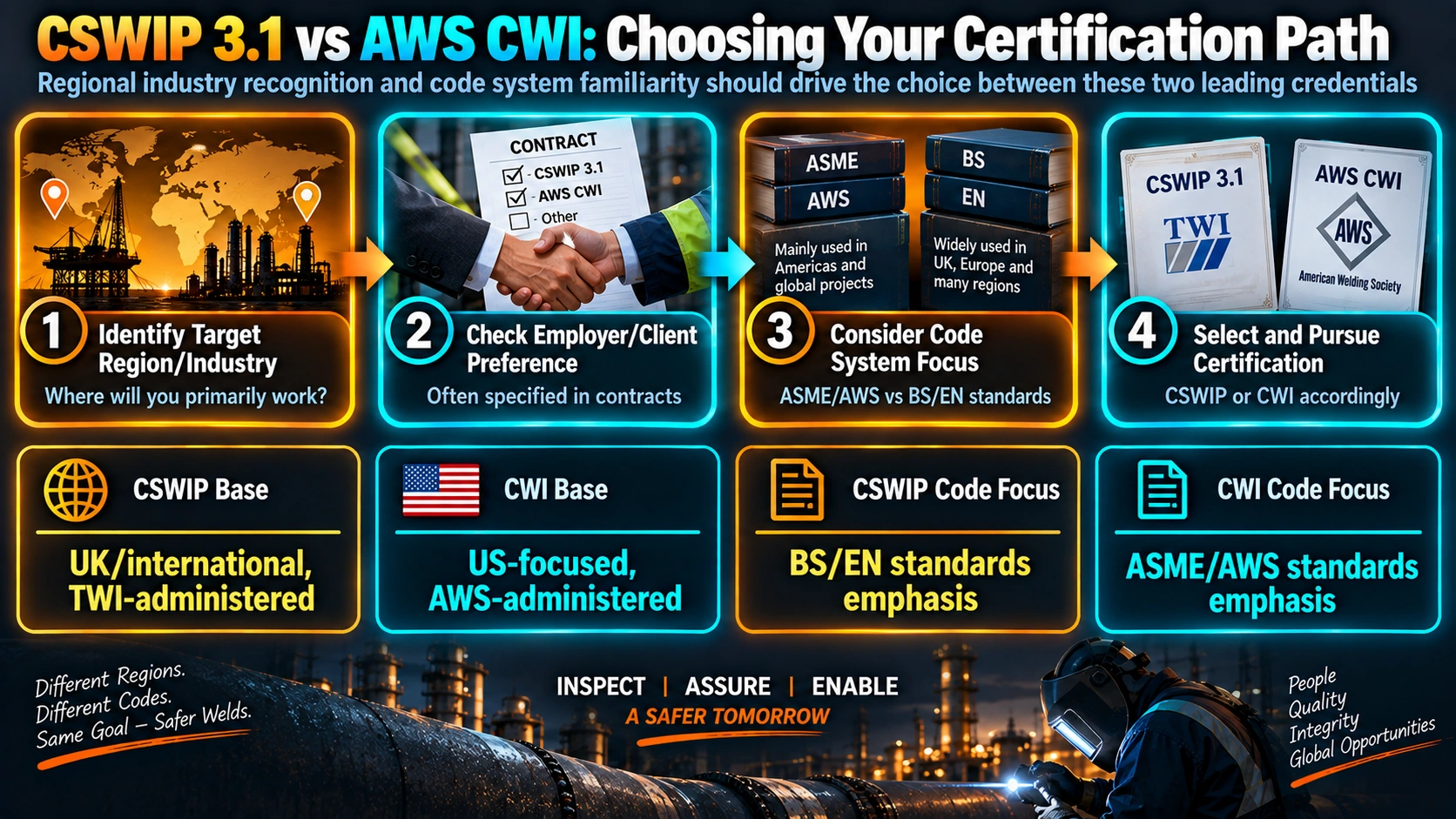
The AWS Certified Welding Inspector (CWI) credential is administered by the American Welding Society under the AWS QC1 specification and the AWS B5.1 qualification standard. A CWI is qualified to judge whether completed and in-process welds conform to the applicable code or project specification — reviewing welding procedure specifications and consumable requirements, monitoring preheat and interpass temperature, verifying welder qualification records, and performing visual inspection against defined acceptance criteria. CWI is the dominant credential across structural steel fabrication, pressure vessel manufacture, pipeline construction, shipbuilding, and power generation projects that reference American codes such as ASME Section IX, AWS D1.1, and API 1104.
What Is CSWIP 3.1
CSWIP stands for the Certification Scheme for Welding and Inspection Personnel, administered by TWI Certification Ltd in the United Kingdom and accredited by UKAS under ISO/IEC 17024. CSWIP 3.1 is the standard Welding Inspector level, sitting above the entry-level CSWIP 3.0 Visual Welding Inspector and below the CSWIP 3.2 Senior Welding Inspector level. The scheme is aligned with ISO and EN standards, most notably BS EN ISO 5817 for weld imperfection quality levels and ISO 2553 for welding symbols, rather than the American code set that governs CWI. CSWIP 3.1 is the credential most commonly specified on UK, European, North Sea offshore, and Commonwealth projects, and is also widely accepted across Gulf offshore energy work.
Head-to-Head Comparison
| Factor | AWS CWI | CSWIP 3.1 |
|---|---|---|
| Governing body | American Welding Society (AWS) | TWI Certification Ltd (UK), UKAS-accredited |
| Code alignment | ASME Section IX, AWS D1.1, API 1104 | ISO/EN standards, BS EN ISO 5817, ISO 2553 |
| Exam format | 3 parts — Fundamentals, Practical, Codebook Open book Part C | General, Practical (specimen), Fundamentals Hands-on macro exam |
| Typical first-attempt pass rate | ~25–30% | Varies by centre; practical module is the common failure point |
| Renewal cycle | 3 years | 5 years |
| Dominant regions | USA, Canada, Middle East pipeline/refinery | UK, Europe, North Sea, Commonwealth, Gulf offshore |
| Entry-level tier | Certified Associate Welding Inspector (CAWI) | CSWIP 3.0 Visual Welding Inspector |
| Senior tier | Senior Certified Welding Inspector (SCWI) | CSWIP 3.2 Senior Welding Inspector |
| Vision test required | Yes — near-vision acuity and colour perception | Yes — near-vision acuity and colour perception |
Exam Structure in Detail
AWS CWI — Three-Part Exam
The CWI exam runs across roughly six hours in a single sitting, split into three distinct parts. Part A (Fundamentals) is a closed-book, 150-question multiple choice exam on general welding inspection knowledge, drawing heavily on joint types and groove designs, welding positions, and welding symbol interpretation under AWS A2.4. Part B (Practical) tests hands-on measurement and visual inspection skills using inspection tools such as fillet weld gauges and calipers. Part C (Codebook) is open-book and based on a single code the candidate selects in advance, most commonly ASME Section IX, AWS D1.1, or API 1104, and rewards speed and accuracy at navigating the codebook rather than memorised recall.
CSWIP 3.1 — General, Practical, and Fundamentals
CSWIP 3.1 also splits into three components, but the emphasis differs sharply from CWI. The General module covers broad welding technology, destructive testing methods, and non-destructive testing awareness. The Practical module is a physical specimen inspection exam — candidates are handed real welded macro sections and test pieces and must identify defects, measure dimensions, and record findings exactly as they would on a real job. This hands-on module is widely regarded as the hardest part of CSWIP 3.1 for candidates without prior shop-floor inspection experience. The Fundamentals paper focuses on materials, safety, and welding process theory.
Eligibility Requirements
| Education level | AWS CWI — minimum experience | CSWIP 3.1 — minimum experience |
|---|---|---|
| No formal qualification | 5 years documented welding-related experience | 3 years welding inspection experience, or equivalent trade background |
| Relevant trade certificate / diploma | 2–3 years documented experience | 1–3 years depending on qualification level |
| Engineering degree | 1 year documented experience | Reduced experience requirement, case-by-case review |
| Vision and colour test | Mandatory, Jaeger J2 or equivalent | Mandatory, near-vision and colour perception |
No experience yet? AWS offers the CAWI (Certified Associate Welding Inspector) pathway — pass all three exam parts at 72% and receive CAWI status immediately, then upgrade to full CWI once you document the required experience, with no re-sit needed. CSWIP’s equivalent entry point is the CSWIP 3.0 Visual Welding Inspector level.
Cost Breakdown
| Item | AWS CWI (approx., USD) | CSWIP 3.1 (approx., GBP) |
|---|---|---|
| Exam fee | $1,300–$1,600 | £1,400–£1,800 |
| Preparation course / seminar | $1,800–$2,500 (optional but common) | £800–£1,200 (widely taken) |
| Codebook (Part C) | $150–$300 per code | Included / specified by centre |
| Renewal | Every 3 years, fee + continued activity or exam | Every 5 years, fee + evidence of activity |
| Annual membership | Recommended AWS membership discount on renewal | Not required but some employers request it |
Career Pathway Under Each Scheme
Salary and Regional Demand
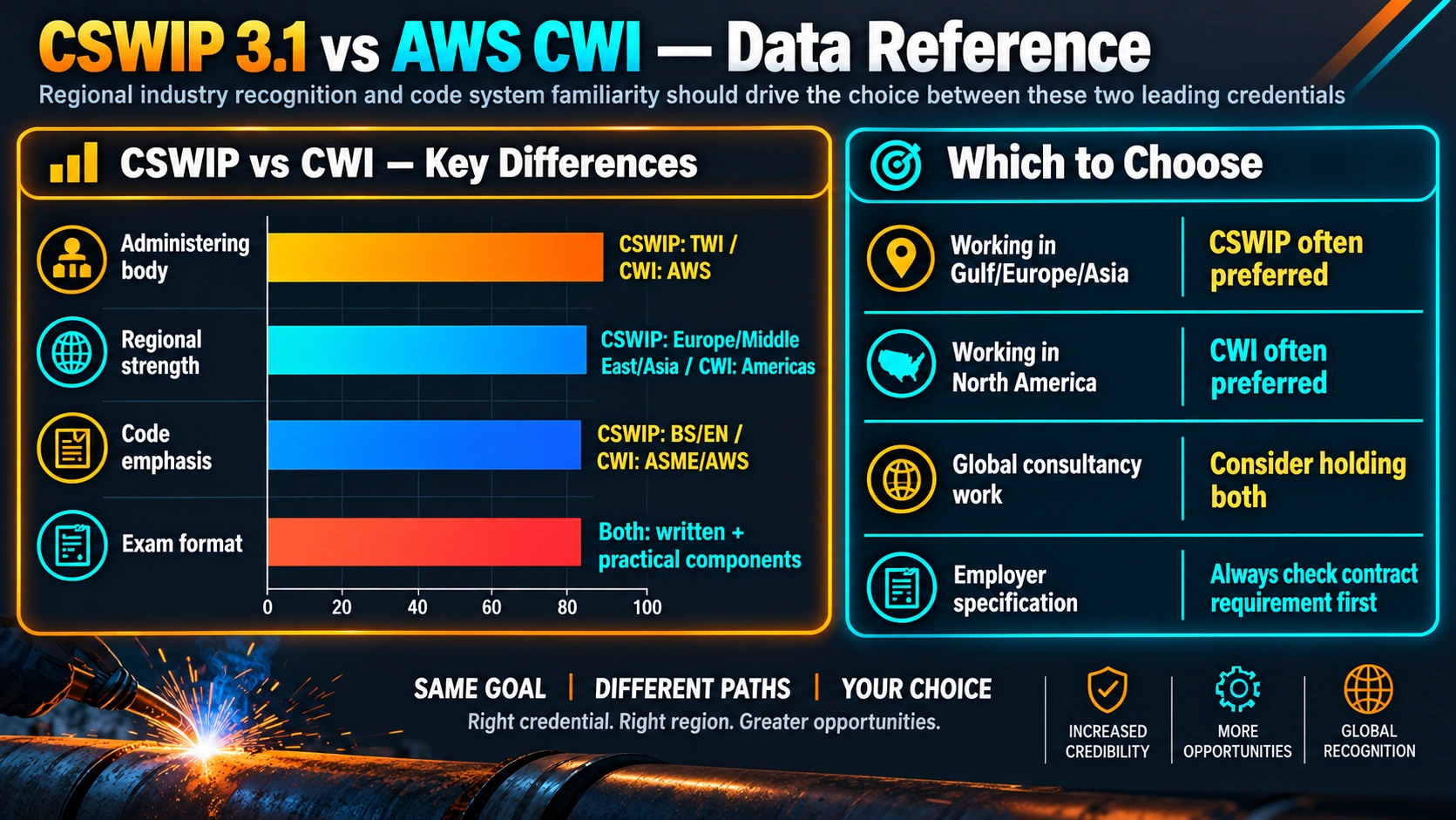
Compensation depends far more on industry sector, region, and years of experience than on which certification is held. In the United States, CWI holders typically earn between $35 and $90 per hour depending on sector, with pipeline and nuclear work at the top of that range. In the Gulf and North Sea, CSWIP 3.1 and 3.2 holders on offshore EPC day-rate contracts frequently out-earn equivalent onshore CWI roles, reflecting the offshore premium rather than a difference in certification value.
| Region / sector | Preferred certification | Notes |
|---|---|---|
| USA / Canada structural & pipeline | AWS CWI Primary | API 1104 and AWS D1.1 modules give a direct edge |
| UK / Europe construction | CSWIP 3.1 Primary | Aligned to BS EN ISO 5817 and local specifications |
| North Sea / Gulf offshore EPC | CSWIP 3.1/3.2 Preferred | Historically favoured for offshore energy scopes |
| Middle East refinery / LNG | Both accepted Dual advantage | Vendor-specific approval (e.g. Aramco CBT) often required regardless |
| Australia / Commonwealth | CSWIP 3.1 Common | AWS CWI also widely recognised |
Which One Should You Choose
Choose AWS CWI if:
You are targeting work in the USA, Canada, or American-code projects in the Middle East; your employer references ASME Section IX, AWS D1.1, or API 1104; or you are already comfortable with US codebook navigation.
Choose CSWIP 3.1 if:
You are targeting the UK, Europe, North Sea, or Commonwealth markets; your project specifications reference ISO/EN standards; or you have strong hands-on shop-floor inspection experience that will help with the practical module.
Practical tip: Ask the question the other way round first — where do you want to be working in five years? The market you are targeting should decide the order you sit these exams in, not the other way round.
Worked Decision Example
Dual Certification Strategy
The formal bridging agreement between AWS and TWI ended in 2012, so holding one no longer grants automatic credit toward the other — each must be earned on its own eligibility and exam requirements. Despite that, the underlying destructive and non-destructive testing knowledge, symbol interpretation, and joint geometry fundamentals overlap heavily between the two schemes, which is why most inspectors who already hold one credential find the second noticeably faster to prepare for. Senior inspectors and Lead Quality Engineers on multi-region giga-projects increasingly treat dual certification as the baseline expectation rather than a differentiator.
Preparation Strategy
Regardless of which certification you sit first, a structured 10 to 12 week study plan built around the exam’s actual weighting outperforms unstructured reading. Build your plan around three pillars: codebook navigation speed (practice locating clauses under a timer, not just reading them), destructive and mechanical testing fundamentals (tensile, bend, Charpy impact, and hardness testing recur across every level of both schemes), and welding process and position fundamentals which underpin nearly every scenario-based question in either exam.
Common mistake: Candidates who over-invest in memorising theory and under-invest in codebook navigation speed consistently underperform on both AWS CWI Part C and the CSWIP practical module, where time pressure — not knowledge — is the real constraint.
Amazon Affiliate Picks — Welding Inspector Exam Preparation
AWS CWI Exam Prep Guide
A structured question bank and study companion covering Parts A, B, and C of the CWI exam.
View on AmazonCSWIP 3.1 Welding Inspector Handbook
Reference material aligned to the CSWIP 3.1 General, Practical, and Fundamentals syllabus.
View on AmazonVisual Inspection Fit-Up Gauge Set
Fillet weld gauges, calipers, and undercut gauges used in the CWI Part B practical module.
View on AmazonASME Section IX Codebook
The official codebook most CWI candidates select for the open-book Part C exam.
View on AmazonDisclosure: WeldFabWorld participates in the Amazon Associates programme (StoreID: neha0fe8-21). If you purchase through these links, we may earn a small commission at no extra cost to you. This helps support free technical content on this site.
Frequently Asked Questions
Is CSWIP 3.1 equivalent to AWS CWI?
They are broadly equivalent in professional standing, but not identical in scope. CSWIP 3.1 is built around ISO/EN standards such as BS EN ISO 5817 and ISO 2553, while AWS CWI is built around ASME Section IX, AWS D1.1, and API 1104. Most major EPC contractors accept either, but check the client’s inspection and test plan before assuming interchangeability.
Which certification pays more, CWI or CSWIP 3.1?
Pay is driven far more by industry, region, and experience than by which certification you hold. AWS CWI holders often see a slight edge on US pipeline and refinery work, while CSWIP 3.1 holders frequently command higher day rates on Gulf and North Sea offshore EPC contracts. Inspectors holding both are generally the most employable across regions.
Can I hold both AWS CWI and CSWIP 3.1 at the same time?
Yes, and many senior inspectors do exactly that. The schemes are administered independently, so holding one has no bearing on eligibility for the other beyond each body’s own experience and education requirements. The formal AWS-TWI bridging agreement ended in 2012, so each credential must now be earned on its own merits.
What is the difference between CSWIP 3.0, 3.1, and 3.2?
CSWIP 3.0 is the Visual Welding Inspector level for entry-level shop floor work. CSWIP 3.1 is the standard Welding Inspector level most employers require. CSWIP 3.2 is the Senior Welding Inspector level, which requires holding 3.1 first and adds weld drawing interpretation and procedure qualification review.
Do I need a mechanical or engineering degree to sit the CWI exam?
No degree is mandatory, but your education level changes how much documented experience you need under the AWS QC1 eligibility matrix. Candidates who pass the exam but lack sufficient documented experience are issued the CAWI credential instead of full CWI status until they can verify it.
How difficult is the CSWIP 3.1 exam compared to AWS CWI Part C?
CSWIP 3.1’s practical macro and specimen inspection module is often the hardest part for candidates without shop-floor experience. AWS CWI Part C is open-book on a single selected code and rewards fast, accurate codebook navigation under time pressure rather than memorised recall.
Does CSWIP 3.1 or AWS CWI expire?
Both require periodic renewal. AWS CWI is valid for three years, after which recertification requires a renewal exam or continued CWI activity plus a fee. CSWIP 3.1 typically runs on a five-year cycle, requiring evidence of continued relevant industry activity through the TWI Certification portal.
Which certification is better for pipeline welding inspection?
AWS CWI has a practical edge for pipeline work because candidates can select API 1104 as their codebook exam, and it is widely specified on US and Middle East cross-country pipeline projects. CSWIP 3.1 inspectors on ISO/British-spec pipelines are equally capable, but the certification lacks a dedicated pipeline codebook module.