Butt Weld vs Socket Weld Fittings — Complete Comparison Guide
Every piping engineer and QA/QC inspector eventually has to answer the same fitting-selection question on a new line: butt weld vs socket weld — which one actually belongs on this joint? The two fitting families look similar in a catalogue, both move filler metal between a fitting and a pipe, but the underlying joint geometry, the governing standards, the achievable nondestructive examination, and the long-term failure modes are completely different. Getting the choice wrong does not usually show up at hydrotest; it shows up months or years later as a crevice corrosion leak or a fatigue crack at a fillet toe that nobody was watching.
This guide puts butt weld fittings (governed by ASME B16.9 and ASME B16.25) side by side with socket weld fittings (governed by ASME B16.11), and walks through every dimension that actually drives a real specification decision: size range, how each fitting is pressure-rated, joint geometry and the stress concentration that comes with it, what nondestructive examination can and cannot detect in each joint, the expansion gap and crevice corrosion mechanism unique to socket welds, and the severe cyclic service restriction that ASME B31.3 places on socket welds above NPS 2. A worked example ties the pressure design calculation for a real line size directly to the fitting class selected.
By the end of this guide you will be able to explain, with code references in hand, exactly why a refinery hydrocarbon header is built entirely from butt welds while the instrument tubing branching off it is almost always socket welded, and where the line between those two worlds actually sits.
On This Page
- What Is a Butt Weld Fitting?
- What Is a Socket Weld Fitting?
- Governing Codes at a Glance
- Size Range and Pressure Rating
- Worked Example: Choosing Schedule and Fitting Class
- Joint Geometry and Stress Concentration
- Nondestructive Examination Considerations
- The Expansion Gap and Crevice Corrosion
- Severe Cyclic Service Restrictions
- Cost and Fabrication Considerations
- Master Comparison Table
- Selection Guidelines
- Common Mistakes in the Field
- Applications and Industry Context
- FAQ
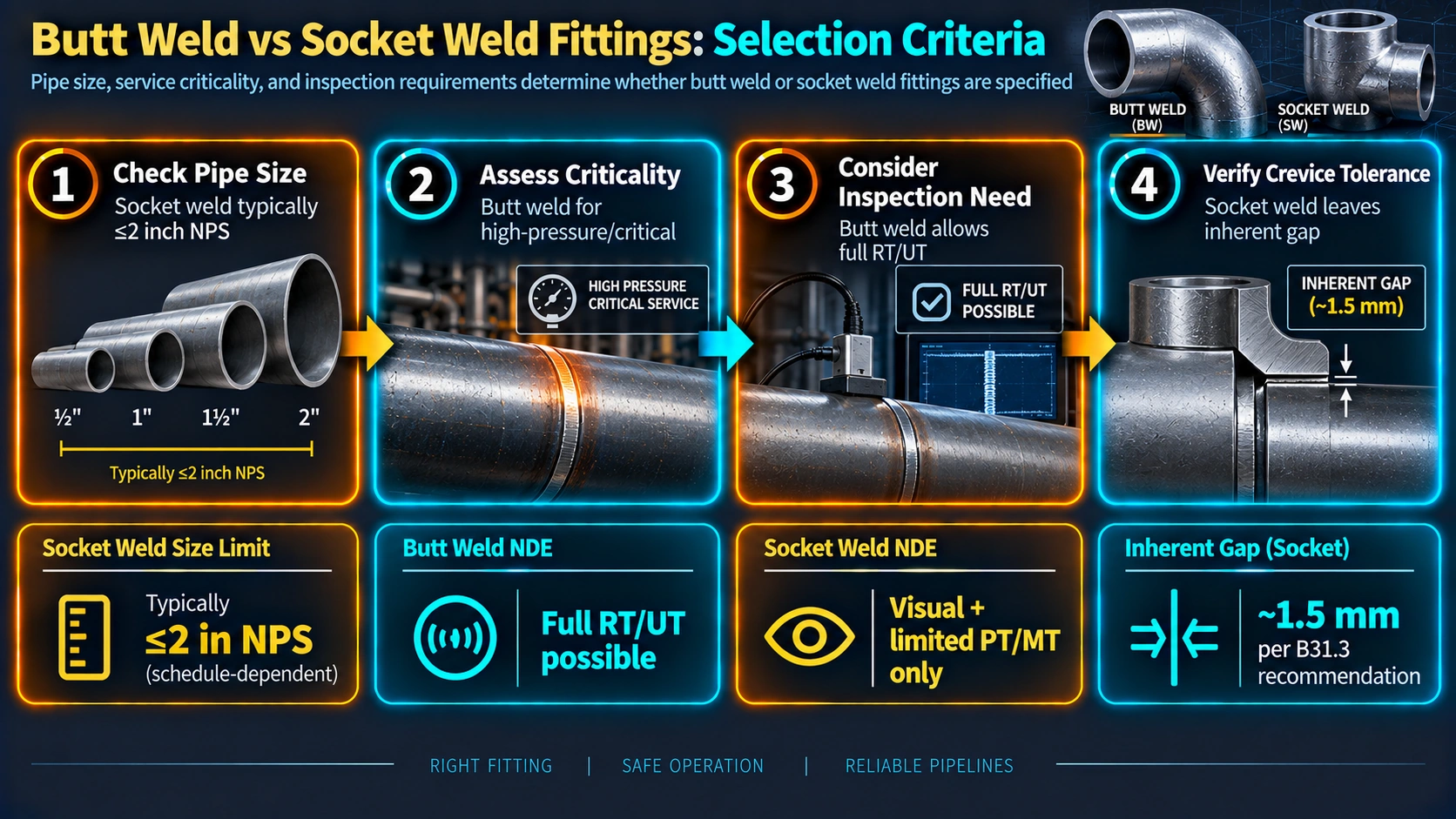
Butt weld (BW) fittings join to the pipe end-to-end through a full-penetration groove weld across the complete wall thickness, dimensioned under ASME B16.9 with bevel ends per ASME B16.25. Socket weld (SW) fittings have a machined bore that the pipe slides into, closed with a single fillet weld around the outside, dimensioned under ASME B16.11. The two are not interchangeable substitutes — they serve different size ranges, different pressure classes, and different service conditions, and the governing piping code (most commonly ASME B31.3) places real restrictions on where each can be used.
What Is a Butt Weld Fitting?
A butt weld fitting is manufactured with a beveled, through-wall end designed to be welded directly to a matching beveled pipe end using a full-penetration groove weld. The weld metal fills the entire wall thickness from the outside surface to the inside surface, producing a joint that is, in principle, as strong as the parent pipe wall itself. Dimensions, tolerances, and pressure-temperature ratings for these fittings are standardized in ASME B16.9 (Factory-Made Wrought Buttwelding Fittings), which covers elbows, tees, reducers, caps, and lap-joint stub ends across the full size range from NPS 1/2 through NPS 48. The actual end bevel geometry — included angle, root face, and the transition into the fitting body — is defined separately in ASME B16.25 (Buttwelding Ends), which both B16.9 fittings and field-cut pipe ends are prepared to match.
Because a butt weld fitting is wrought from pipe, tubing, plate, or forged stock and machined to the same wall profile as the connecting pipe, its pressure rating is not an independent number stamped on the fitting. Instead, B16.9 ties the fitting’s allowable pressure directly to whatever schedule or nominal wall thickness the fitting is ordered in, using the same design equations found in the governing piping code. A Schedule 80 elbow carries the same pressure capability as Schedule 80 straight pipe of the same material; there is no separate “Class” number to look up the way there is for socket weld fittings or flanges.
Butt weld fittings are wrought rather than cast, made from pipe, tubing, plate, or forgings under material specifications such as ASTM A234 (carbon and low-alloy steel), A403 (austenitic stainless), or A815 (duplex and ferritic stainless). Because the joint is full penetration through the entire wall, it can carry pressure, bending, and axial loads with essentially the same load path as the unbroken pipe — which is exactly why butt welds dominate large-bore and high-criticality piping.
What Is a Socket Weld Fitting?
A socket weld fitting is forged with a recessed bore — the socket — machined to a close fit around the pipe outside diameter. The pipe is inserted into this bore, and the joint is sealed with a single fillet weld deposited around the circumference where the pipe OD meets the face of the fitting. Unlike a butt weld, no part of the weld penetrates through the pipe wall; the entire connection relies on the fillet weld’s shear and bending capacity at the surface. Dimensions, tolerances, and pressure class ratings for these fittings are standardized in ASME B16.11 (Forged Fittings, Socket-Welding and Threaded), which covers the same family of elbows, tees, couplings, and caps found in B16.9 but in a size range limited to NPS 1/8 through NPS 4.
Socket weld fittings are pressure-rated by Class designation — 3000, 6000, or 9000 — rather than by the schedule of the connecting pipe directly. Each class corresponds to a specific bore diameter matched to a standard pipe schedule: Class 3000 fittings are bored to fit Schedule 80 pipe, Class 6000 fittings to Schedule 160, and Class 9000 fittings to XXS (double extra strong) pipe. This is the socket weld equivalent of the flange Class system discussed in the pipe class vs schedule rating guide: the class number is a bore-matching index, not a literal psi value, and the bore schedule on the purchase order must exactly match the actual pipe schedule being installed or the fit-up geometry will be wrong.
Like B16.9 fittings, B16.11 fittings are made from forged carbon, alloy, or stainless steel under specifications such as ASTM A105, A182, or A350. Their compact size and forgiving fit-up made them the default choice for small-bore connections — branch outlets, instrument take-offs, drain and vent points, and utility headers — anywhere a full bevel-and-align butt weld would be disproportionate to the size and criticality of the line.
Governing Codes at a Glance
ASME B16.9 — dimensions, tolerances, and ratings for wrought buttwelding fittings, NPS 1/2 through NPS 48.
ASME B16.25 — buttwelding end preparation (bevel geometry) used by B16.9 fittings and field-cut pipe alike.
ASME B16.11 — dimensions and pressure class ratings for socket-welding and threaded forged fittings, NPS 1/8 through NPS 4.
ASME B31.3 / B31.1 — the piping codes that actually govern welding, examination, and service restrictions for both fitting types once installed; see the full ASME B31.3 process piping guide for the broader design framework these fittings sit inside.
Size Range and Pressure Rating
The single cleanest way to remember which fitting belongs where is that butt weld fittings are rated through the pipe schedule, while socket weld fittings are rated through a Class number that is matched to a schedule on the manufacturer’s behalf.
Butt Weld Size and Rating
ASME B16.9 covers the full commercial size range, NPS 1/2 through NPS 48, with no upper Class ceiling beyond what the connecting pipe schedule and material allow. A butt weld fitting’s pressure capability is calculated exactly as if it were a piece of straight pipe of the same nominal wall thickness, using the design equation in the governing piping code — there is no separate fitting-specific pressure table to consult.
Socket Weld Size and Rating
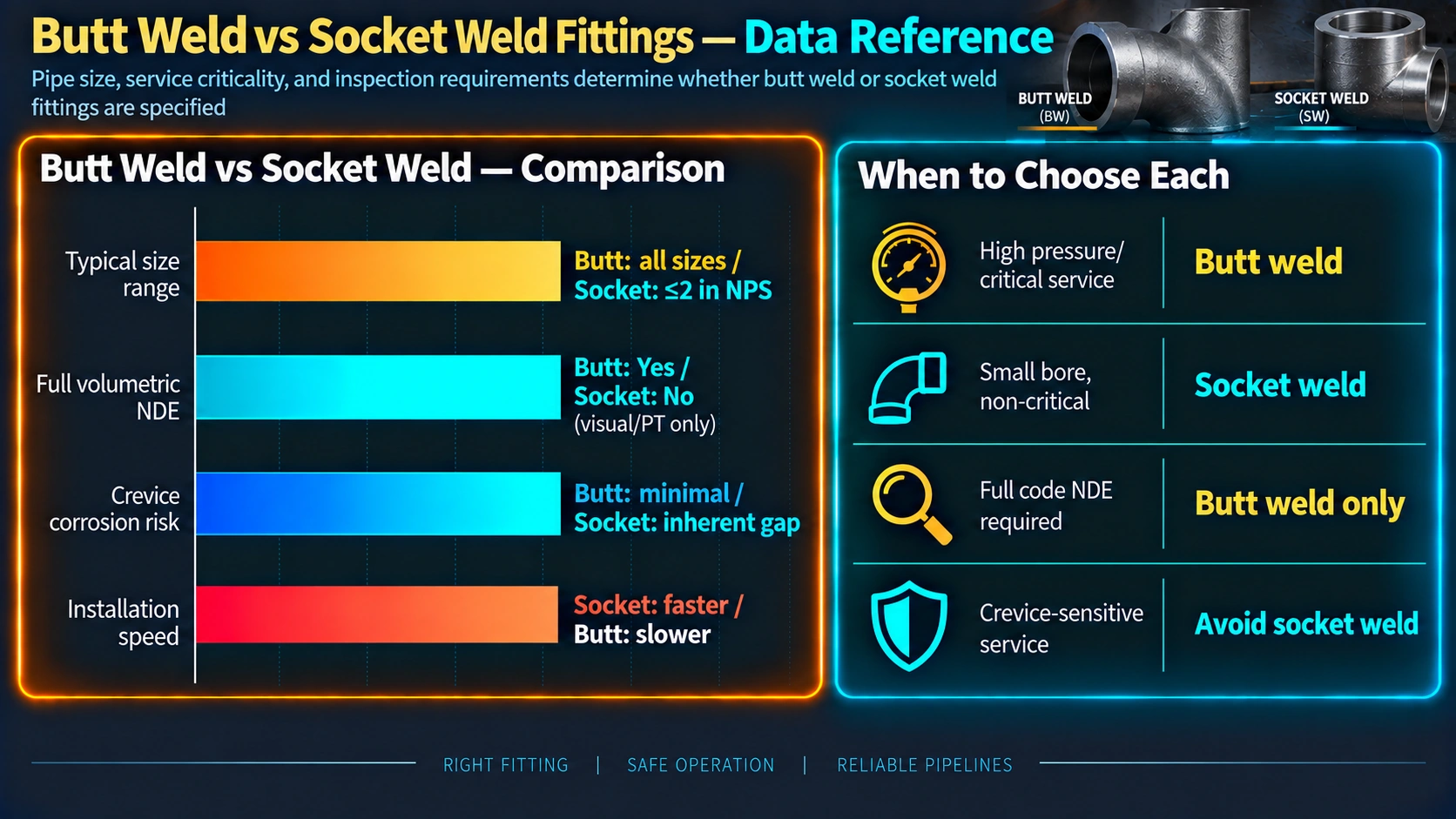
ASME B16.11 stops at NPS 4, and most piping specifications draw the practical socket weld cutoff even lower, at NPS 2, because of the cyclic service restriction covered later in this guide. The class-to-schedule correlation is fixed by the standard itself:
| Socket Weld Class | Matched Pipe Schedule | NPS Range (B16.11) | Typical Service Tier |
|---|---|---|---|
| Class 3000 | Schedule 80 | 1/8 – 4 | SW General process, moderate pressure |
| Class 6000 | Schedule 160 | 1/8 – 4 | SW High pressure, instrument headers |
| Class 9000 | XXS (double extra strong) | 1/8 – 2 (typ.) | SW Severe service, high-pressure hydraulics |
A socket weld fitting’s class describes the bore it was machined for, not a pressure number you can read directly off the fitting. Ordering a Class 6000 fitting and trying to insert Schedule 80 pipe leaves the bore too large for a proper fillet weld root condition; ordering Class 3000 and trying to force Schedule 160 pipe in will not fit at all. Always specify class and bore schedule together on the purchase order, exactly as you would record both halves of a piping class entry per the class vs schedule rating guide.
Worked Example: Choosing Schedule and Fitting Class Together
Consider an NPS 2 (DN50) carbon steel line in ASTM A106 Grade B seamless pipe, designed for 600 psig (4.14 MPa) at 200°C design temperature, routed through a small-bore instrument header.
The result is a useful, slightly counter-intuitive lesson: for small-bore lines like this one, the pressure design calculation almost never drives schedule selection. What actually drives it is either a minimum practical wall thickness for mechanical robustness, or — once a socket weld fitting enters the picture — the bore-matching requirement of ASME B16.11 itself. A butt weld fitting on the same line could legitimately be ordered in Schedule 40, since B16.9 has no equivalent bore-matching constraint forcing a heavier wall.
Joint Geometry and Stress Concentration
A butt weld joint, when made correctly, presents a smooth, continuous load path from one pipe section through the weld metal into the next. Stress flows through the joint much as it would through an unbroken section of pipe, which is why the stress intensification factor (SIF) used in flexibility and fatigue analysis for an as-welded girth butt weld is relatively low — typically around 1.2 in the tables referenced by ASME B31.3 and B31.1 Appendix D.
A socket weld joint concentrates load transfer entirely at the fillet weld toe, where the geometry changes abruptly from the pipe OD to the fitting face. This geometric discontinuity is exactly where stress lines bend sharply rather than flowing smoothly, and the resulting SIF for an unfinished socket weld fillet is commonly cited at approximately 2.1 — nearly double that of a butt weld. Under static loading this difference rarely matters; under cyclic loading, it is the entire reason socket welds carry the service restrictions discussed in the next two sections.
Nondestructive Examination Considerations
Butt welds are fully compatible with volumetric examination. Because the joint presents one uniform through-wall thickness to a radiographic source or an ultrasonic beam, both radiography (RT) and ultrasonic testing (UT) can reliably detect lack of fusion, porosity, slag inclusions, and cracking anywhere through the weld cross-section, in addition to surface methods like visual examination (VT) and magnetic particle or liquid penetrant testing.
Socket welds cannot be meaningfully radiographed. The pipe wall sitting inside the socket and the fitting wall surrounding it overlap in the direction the beam travels, so the resulting film superimposes two separate thicknesses and cannot distinguish a sound root condition from a lack-of-fusion defect at the bottom of the gap. For this reason, essentially every piping specification limits socket weld examination to visual inspection combined with magnetic particle (MT) or liquid penetrant (PT) testing — methods that can confirm surface soundness and detect toe cracking, but cannot see inside the joint the way RT or UT can on a butt weld. This single limitation is one of the most consistent reasons project specifications push higher-criticality service toward butt welds even within the size range where a socket weld would otherwise fit.
The Expansion Gap and Crevice Corrosion
ASME B31.3 paragraph 328.5.2 and the accompanying figure require that the pipe end be withdrawn approximately 1.6 mm (1/16 in.) from the base of the socket before welding. The reasoning is purely thermal: as the joint heats up during welding, the pipe end expands axially. If the pipe had been bottomed out flush against the socket shoulder, that expansion would have nowhere to go, driving the pipe end into the shoulder and overstressing — or cracking — the fillet weld as the joint cools and contracts. Pulling the pipe back by roughly 1/16 in. before welding gives that expansion somewhere to occur safely.
The code is explicit that this gap is checked at fit-up, not after the weld is complete. Weld shrinkage typically closes most or all of the gap as the joint cools, and recent editions of ASME B31.3 state outright that a gap is not required to be present or verified after welding. Specifying post-weld radiographic gap verification on a project specification — something inspectors occasionally still request — goes beyond what the code actually requires and has led to unnecessary weld rejections on otherwise sound joints.
The same gap that protects the weld from thermal stress also becomes a permanent, stagnant crevice once the system is in service. Process fluid that finds its way into this small annular space sits there largely undisturbed by the bulk flow, concentrating chlorides, oxygen, or other aggressive species over time. In chloride-bearing water, sour service, or any environment prone to crevice corrosion, this geometry is a known weak point — which is exactly why socket welds are generally avoided in such services. The corrosion-related fluid service rules in ASME B31.3 reflect this directly: socket welds are not recommended where crevice corrosion or severe erosion at the gap is a realistic concern, pointing the specification back toward butt welds for those services regardless of pipe size.
Severe Cyclic Service Restrictions
ASME B31.3 does not permit socket-welded joints larger than NPS 2 to be used under conditions the code defines as severe cyclic — broadly, situations where the computed displacement stress range and cycle count exceed defined thresholds, or where the owner or designer determines that more fatigue-resistant construction is warranted. The restriction exists because of the stress concentration discussed earlier: at roughly double the SIF of a butt weld, the socket weld fillet toe accumulates fatigue damage far faster than a smooth through-wall joint under the same displacement cycling. ASME B31.1 carries similar, though more advisory, language recommending further restriction of socket-welded joints wherever temperature or pressure cycling, mechanical vibration, or crevice corrosion risk is expected.
In practice this means a socket weld at exactly NPS 2 remains permitted even in severe cyclic service — the restriction applies above that size — but most piping specifications treat NPS 2 as the de facto ceiling for socket welds across the board, severe cyclic or not, simply because the failure consequences of getting this judgment wrong are disproportionate to the cost saved by avoiding a butt weld on a small connection.
Cost and Fabrication Considerations
Socket weld fit-up requires no beveling and is far more tolerant of minor misalignment than a butt joint — the pipe simply has to seat in the bore and be pulled back the required gap. This typically means faster welder cycle time and a lower skill threshold for a sound joint, which is the real driver behind socket welds dominating small-bore, high-connection-count work like instrument headers and utility skids.
Butt weld fabrication carries more overhead per joint: precise bevel preparation per ASME B16.25, careful root gap and alignment control, frequently a backing ring or controlled open-root technique, and — on thicker sections — postweld heat treatment requirements that a thin-wall socket weld joint would never trigger. None of this makes butt welding more expensive in absolute terms once pipe size grows beyond what a socket weld fitting can physically accommodate; at NPS 6 and above there simply is no socket weld alternative to compare against. The cost comparison only becomes meaningful in the NPS 1/2 through NPS 4 overlap zone, where both fitting types are technically available and the choice genuinely comes down to service conditions rather than size.
Master Comparison Table
| Feature | Butt Weld (BW) | Socket Weld (SW) |
|---|---|---|
| Governing standard | ASME B16.9 + B16.25 (ends) | ASME B16.11 |
| Size range | NPS 1/2 – NPS 48 | NPS 1/8 – NPS 4 (practical limit often NPS 2) |
| Pressure rating method | Follows pipe schedule directly | Class 3000/6000/9000, matched to Sch 80/160/XXS bore |
| Weld type | Full-penetration groove weld, through wall | Single fillet weld, surface only |
| Approx. SIF | ~1.2 (as-welded girth weld) | ~2.1 (fillet toe, unfinished) |
| Volumetric NDE (RT/UT) | Possible — single uniform thickness | Not practical — overlapping wall sections |
| Practical NDE | VT, RT, UT, MT/PT | VT, MT/PT only |
| Crevice corrosion risk | None — fully fused joint | Present — gap creates a stagnant crevice |
| Severe cyclic service | Permitted at all sizes per design | Not permitted above NPS 2 per B31.3 |
| Fit-up demand | Higher — bevel, alignment, root control | Lower — forgiving insertion fit |
| Typical service | Process headers, hydrocarbon lines, large bore, high criticality | Instrument tubing, drains/vents, small utility branches |
Selection Guidelines
- Check the size first. Above NPS 4, butt weld is the only option under B16.9/B16.11 — the decision is already made.
- Confirm the service is not severe cyclic. If the line is above NPS 2 and falls under the severe cyclic definition in ASME B31.3, socket weld is excluded regardless of size eligibility under B16.11.
- Screen for crevice corrosion risk. Chloride-bearing fluids, sour service, or any environment where stagnant fluid accelerates attack should default to butt weld even at small bore.
- Decide what NDE the service demands. If the specification or code case requires volumetric examination (RT/UT) on this joint, it must be a butt weld — socket welds cannot be radiographed meaningfully.
- Weigh connection density against fabrication time. High-density small-bore runs (instrument racks, utility skids) favor socket weld for fit-up speed; isolated large or critical connections favor the added reliability of a butt weld even at smaller sizes.
- Match the fitting class to the bore schedule exactly if socket weld is selected, per the correlation table in this guide and in ASME B16.11.
Common Mistakes in the Field
- Bottoming the pipe out in the socket. Skipping the 1.6 mm withdrawal before welding removes the thermal expansion allowance entirely and is a well-documented cause of fillet weld cracking during the first thermal cycle in service.
- Specifying RT on socket welds. A radiograph of a socket weld cannot be interpreted the way a butt weld film can; requiring it usually reflects a misunderstanding of the joint geometry rather than a genuine inspection need.
- Mismatching fitting class and pipe schedule. Ordering Class 6000 fittings against Schedule 80 pipe (or the reverse) produces a bore that does not match the pipe OD correctly, leading to an irregular fillet profile at fit-up.
- Using socket welds above NPS 2 in cyclic service without a documented exception. This is precisely the configuration ASME B31.3 restricts, and it is one of the most common findings in fatigue-related root cause investigations on small-bore piping.
- Assuming socket weld is always cheaper. Below NPS 2 in non-cyclic, non-corrosive service this generally holds; above that, or in the wrong fluid service, the long-term cost of an undetected fatigue or corrosion failure outweighs the fit-up time saved.
Applications and Industry Context
Refineries, petrochemical plants, and power stations rely on both fitting families simultaneously, but in clearly separated roles. Main process headers, hydrocarbon transfer lines, and any large-bore piping above NPS 4 are built entirely from butt weld fittings, with full radiographic or ultrasonic examination coverage written into the inspection plan from the design stage. The same units are dense with small-bore socket weld connections wherever instrumentation, sample points, drains, and vents branch off those larger lines — exactly the high-connection-count, lower-criticality role socket welds are suited for.
The dividing line rarely sits at a single fixed pipe size across every project; it is set by the project’s piping material specification, which combines size, service classification, and fluid corrosivity into a single rule for each piping class. A QA/QC inspector verifying a spool against the specification is really checking the same two things discussed throughout this guide: does the installed joint type match what the line’s service classification calls for, and — if it is a socket weld — does the fitting class match the bore schedule actually installed. Both checks trace back to the same underlying engineering logic covered here, and both are exactly the kind of detail a welding procedure qualification review or a field walk-down should be catching before the line goes into service.
ASME B16.9 — Factory-Made Wrought Buttwelding Fittings
The authoritative dimensional and ratings standard for butt weld fittings — essential desk reference for specifying elbows, tees, reducers, and caps by schedule.
View on AmazonASME B16.11 — Forged Fittings, Socket-Welding and Threaded
The companion standard covering socket weld and threaded forged fittings, pressure classes, and the bore-to-schedule correlation tables referenced throughout this guide.
View on AmazonProcess Piping: The Complete Guide to ASME B31.3
A practical, code-clause-referenced treatment of B31.3 design, fabrication, and examination rules — including the severe cyclic and socket weld restrictions covered here.
View on AmazonPiping Handbook (Nayyar)
A comprehensive single-volume reference covering piping codes, fitting standards, materials, and design practice used widely by piping and QA/QC engineers.
View on AmazonDisclosure: WeldFabWorld participates in the Amazon Associates programme (StoreID: neha0fe8-21). If you purchase through these links, we may earn a small commission at no extra cost to you. This helps support free technical content on this site.
Frequently Asked Questions
What is the main difference between a butt weld and a socket weld fitting?
A butt weld fitting connects end-to-end with the pipe through a full-penetration groove weld across the entire wall thickness, governed by ASME B16.9 and the bevel preparation in ASME B16.25. A socket weld fitting has a recessed bore that the pipe slides into, and the joint is closed with a fillet weld around the outside, governed by ASME B16.11. The butt weld is a through-wall joint suitable for any size from NPS 1/2 to NPS 48; the socket weld is a surface fillet joint limited to NPS 1/8 through NPS 4.
Up to what pipe size can socket weld fittings be used?
ASME B16.11 covers socket-welding fittings only from NPS 1/8 through NPS 4. In practice, most piping specifications restrict socket welds to NPS 2 and smaller, reserving NPS 3 and NPS 4 socket weld fittings for specific low-criticality utility or instrument applications. Beyond NPS 4, butt weld fittings under ASME B16.9 are the only option, and many project specifications switch to butt welds well before that limit for reliability reasons.
Why does a socket weld need a 1/16 inch gap before welding?
ASME B31.3 paragraph 328.5.2 and the companion figure require an approximate 1.6 mm (1/16 in.) gap between the pipe end and the base of the socket before welding. This gap exists so the pipe end can expand axially into the socket as it heats up during welding without bottoming out and overstressing the fillet weld. The code explicitly states the gap is checked before welding only; it is not required to be present or verified after the weld has cooled, since shrinkage typically closes most of it.
Can socket welds be radiographed?
Not meaningfully. A socket weld fillet has the pipe wall and the fitting wall overlapping in the direction the radiographic beam travels, so the resulting film superimposes both thicknesses and cannot reliably distinguish a sound weld from one with lack of fusion at the root. For this reason, socket welds are normally examined by visual examination together with magnetic particle or liquid penetrant testing rather than radiography. Butt welds, by contrast, present a single through-wall thickness to the beam and are fully compatible with RT or UT.
Why are socket welds restricted in severe cyclic service?
ASME B31.3 does not permit socket-welded joints larger than NPS 2 to be used under severe cyclic conditions. The fillet weld toe at a socket weld carries a stress intensification factor of roughly 2.1, compared with about 1.2 for an as-welded girth butt weld, so the same displacement stress range produces a noticeably higher local stress at the socket weld toe. Under repeated thermal or mechanical cycling, that concentration point is where fatigue cracks initiate first.
Is a socket weld fitting cheaper than a butt weld fitting?
For small-bore piping, yes, when total installed cost is considered. Socket weld fit-up does not require beveling, and alignment tolerance is far more forgiving than a butt joint, which usually means a faster, lower-skill weld. Butt welds need precise bevel preparation, root gap control, and often more passes for the same wall thickness. The fitting itself is typically a small forged piece either way, so the main cost driver is welder time and NDT method, not the raw fitting price.
Which code governs butt weld and socket weld fittings?
Butt weld fittings are covered dimensionally by ASME B16.9, with the end bevel preparation defined in ASME B16.25. Socket weld fittings are covered by ASME B16.11, which also includes threaded fittings in the same standard. Both fitting families are then installed and welded under the rules of the governing piping code, most commonly ASME B31.3 for process piping or ASME B31.1 for power piping, which set the actual welding, examination, and service restrictions discussed throughout this guide.
Can I weld a Schedule 40 pipe into a Class 3000 socket weld fitting?
Dimensionally a Class 3000 socket weld fitting is bored to match Schedule 80 pipe, not Schedule 40. Inserting Schedule 40 pipe into a Class 3000 socket leaves an oversized annular gap around the pipe OD rather than a close-fitting bore, which produces an irregular fillet weld profile and a poor root condition. Always match the fitting class to the bore schedule actually being used: Class 3000 for Schedule 80, Class 6000 for Schedule 160, and Class 9000 for XXS, per the correlation table published in ASME B16.11.