AC vs DC Welding: Which Current Type to Use and When
The choice between AC and DC welding current is one of the most fundamental decisions in arc welding, yet it is frequently misunderstood by both apprentices and experienced fabricators who have always used whichever machine was on the shop floor. AC (alternating current) and DC (direct current) produce fundamentally different arc behaviours, heat distributions, and material compatibility profiles. Getting this choice wrong does not just produce an inferior weld — in some cases, such as attempting to TIG weld aluminium on the wrong polarity, it makes fusion impossible altogether. This guide explains exactly how each current type works, what polarity options DC provides, when to use AC versus DC for every major welding process and material, and how code requirements such as ASME Section IX treat current type as part of WPS qualification.
How AC and DC Welding Current Work
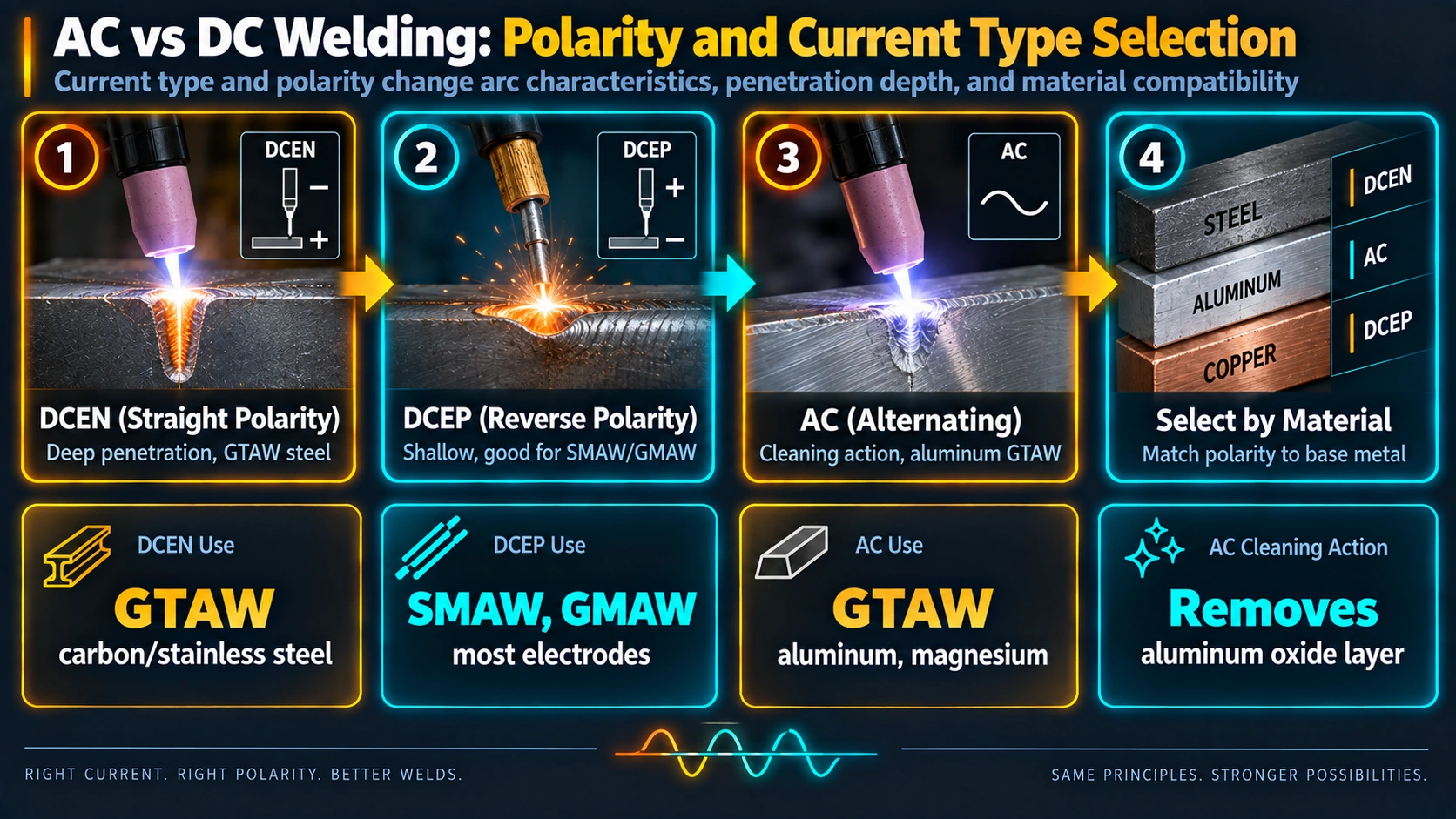
Direct Current (DC)
Direct current flows continuously in a single direction around the welding circuit — from the power source, through the welding cable, through the electrode, across the arc, into the workpiece, back through the earth clamp and return cable, and into the power source. This unidirectional flow gives DC its defining characteristic: a stable, consistent arc. Because the current never reverses, there is no zero crossing, no arc extinction between cycles, and no re-ignition requirement. The result is a smooth, controllable arc with minimal spatter and reliable fusion.
Because DC flows in one direction, the question of which direction matters. The two DC polarity configurations — electrode positive (DCEP) and electrode negative (DCEN) — create significantly different heat distributions between the electrode and the workpiece.
Alternating Current (AC)
Alternating current reverses direction at the supply frequency. On a 50 Hz system (standard in India and most of Europe), the current completes 50 full cycles per second, reversing polarity 100 times per second. On 60 Hz systems (North America), it reverses 120 times per second. This means the arc extinguishes and must re-ignite at every zero crossing — 100 or 120 times per second. Traditional sine-wave AC machines rely on the residual ionisation of the arc plasma to allow natural re-ignition; if the arc gap cools too quickly between half-cycles, the arc will extinguish permanently. Modern inverter-based machines use high-frequency square-wave AC, which crosses zero rapidly and sharply, improving re-ignition reliability and reducing tungsten erosion.
The consequence of polarity reversal is that each AC cycle contains one electrode-positive half-cycle and one electrode-negative half-cycle. This creates an average heat distribution that is between DCEP and DCEN, and — critically — provides cathodic cleaning action during the electrode-positive portion, which is the physical mechanism that makes AC essential for welding aluminium and magnesium.
DC Polarity: DCEP and DCEN Explained
The direction of DC current flow determines which conductor — electrode or workpiece — receives the greater share of arc heat. This heat distribution is the most practically significant variable controlled by polarity selection, because it governs penetration depth, deposition rate, electrode life, and whether a given electrode type can function at all.
DCEP — DC Electrode Positive (Reverse Polarity)
In DCEP, the electrode is connected to the positive terminal of the power source and the workpiece to the negative terminal. Electrons flow from the workpiece (negative) toward the electrode (positive). Since the positive electrode end of the arc receives the bulk of the electron bombardment energy, approximately two-thirds of the arc heat is directed into the electrode side. This has two main effects:
- Deep penetration: The high-energy plasma column at the electrode-positive end drives a forceful, deeply penetrating arc into the workpiece, producing narrow, deep weld profiles.
- Faster electrode melting: With more heat at the electrode tip, covered electrodes (SMAW) melt rapidly, increasing deposition rate.
DCEP is the standard polarity for SMAW with low-hydrogen electrodes (E7016, E7018), GMAW (MIG) on steel and stainless, and SAW lead-wire applications. In GTAW (TIG), DCEP is not used for manual welding because the concentrated heat on the small tungsten electrode tip causes it to erode rapidly — the tungsten simply cannot dissipate the heat load.
DCEN — DC Electrode Negative (Straight Polarity)
In DCEN, the electrode is at the negative terminal and the workpiece is at the positive terminal. Electrons now flow from the electrode toward the workpiece, and the positive workpiece end receives approximately two-thirds of the arc heat. The consequences are the reverse of DCEP:
- Efficient workpiece heating: The majority of arc energy goes directly into the fusion zone, producing deep penetration on most materials with efficient energy use.
- Lower electrode temperature: With only one-third of the arc heat at the electrode, tungsten electrodes in TIG welding operate well within their rated current capacity and maintain their prepared tip geometry far longer.
- No cathodic cleaning: The workpiece is positive but the surface oxide removal mechanism requires electrode-positive bombardment on the workpiece surface, which DCEN does not provide. This is why DCEN TIG cannot be used on aluminium.
DCEN is the standard polarity for GTAW (TIG) on steel, stainless steel, titanium, nickel alloys, and copper. It is also used as the trailing wire polarity in tandem SAW configurations to control bead shape while the DCEP lead wire provides penetration.
Arc Stability: Why DC Produces a Better Arc in Most Situations
For the majority of arc welding applications, DC produces a superior arc to AC. The reasons are directly traceable to the absence of zero crossings. A DC arc, once established, remains ionised and conductive without interruption. The plasma column sustains itself continuously, delivering consistent heat to the weld pool and producing:
- A stable, controllable arc that responds predictably to changes in arc length
- Minimal spatter, because the arc force on the weld pool is steady rather than pulsating
- Better out-of-position performance, since the arc force can be directed with precision
- Compatibility with a wider range of electrode types, including cellulosic E6010 which cannot sustain an arc on AC
An AC arc, by contrast, must re-ignite at each zero crossing. On older sine-wave machines, the current approaches zero gradually, allowing the arc column to cool. If the residual ionisation drops below the threshold needed for re-ignition, the arc collapses. This risk of extinction makes AC arc welding inherently more demanding on electrode coating chemistry: coatings must contain ionisation agents (typically potassium compounds, which ionise at lower voltage than sodium) to sustain the arc through each zero crossing. This is precisely why E6011 can run on AC while the sodium-stabilised E6010 cannot — the addition of potassium to E6011’s coating maintains sufficient ionisation at zero crossing for arc continuity.
Arc Blow: The DC Problem AC Eliminates
Arc blow is the deflection of a welding arc from its normal path due to magnetic forces. It is one of the most disruptive problems in DC arc welding on ferromagnetic materials and can cause irregular bead profiles, lack of fusion, porosity, and excessive spatter. Understanding arc blow — and how switching to AC resolves it — is one of the most compelling reasons to have an AC/DC machine available even if DC is preferred for most work.
The mechanism
When DC flows through a ferromagnetic workpiece such as carbon steel, it sets up a persistent magnetic field that interacts with the magnetic field of the arc itself. Near the ends of a joint, where the return current path changes abruptly, the magnetic field concentrations are asymmetric. The arc deflects toward the lower-field region. Forward arc blow deflects the arc in the direction of travel; backward arc blow deflects it opposite to travel. Both cause the arc to melt the wrong part of the joint, leading to undercut, incomplete fusion, and inconsistent penetration.
Why AC is immune to arc blow
Because AC reverses polarity 100 or 120 times per second, the magnetic field in the workpiece reverses with it. The sustained magnetic bias that causes arc deflection with DC never has time to build up. As a result, AC welding is essentially free from arc blow, which is why switching from DC to AC is the most reliable corrective action for severe arc blow that cannot be eliminated by repositioning the earth clamp or using back-step welding technique.
Conditions that worsen arc blow
| Condition | Effect on Arc Blow | Corrective Action |
|---|---|---|
| Earth clamp at same end as arc start | Forward blow — arc deflects ahead of travel | Move earth to far end of joint |
| Welding near end of joint | Severe backward blow as current path changes | Run a runout tab; back-step approach |
| Residual magnetism in workpiece | Erratic arc, both directions | Demagnetise before welding |
| High current / high amperage DC | Stronger magnetic field, more deflection | Reduce current; switch to AC if code permits |
| Multiple earth connections on same part | Competing fields, unpredictable blow | Use single, correctly positioned earth |
| DC SAW on thick plate | Severe blow at high currents common in SAW | Use AC trailing wire in tandem SAW configuration |
Cathodic Cleaning: Why AC is Mandatory for Aluminium TIG Welding
Aluminium and its alloys present a unique metallurgical challenge for welding: the surface instantly oxidises in air to form aluminium oxide (Al₂O₃), a ceramic material with a melting point of approximately 2050°C. The aluminium base metal beneath this layer melts at only 660°C. If the oxide layer is not disrupted before or during welding, it acts as a physical barrier between the heat source and the base metal, preventing fusion entirely and trapping solid oxide fragments in the weld pool as non-metallic inclusions.
During the electrode-positive (EP) half-cycle of AC TIG welding, heavy positive ions from the arc plasma bombard the negatively charged workpiece surface with sufficient energy to physically break up and disperse the oxide layer in a process called cathodic cleaning. The cleaned zone is visible as a bright, shiny band on either side of the weld bead — if this clean band is absent or very narrow after a weld pass, insufficient cleaning action is occurring. Increasing the EP percentage using the AC balance control on the machine widens the cleaned zone.
DC electrode negative provides no cleaning action and cannot remove the oxide. DC electrode positive provides cleaning action but concentrates two-thirds of the arc heat in the small tungsten electrode, which erodes and contaminates the weld pool with tungsten inclusions at currents above a few amperes. AC provides the necessary cathodic cleaning during the EP half-cycle while the EN half-cycle drives the majority of welding heat into the workpiece, maintaining an acceptable tungsten temperature.
Process-by-Process Current Selection Guide
SMAW (Stick Welding)
Most SMAW on structural and pressure-vessel work uses DC — specifically DCEP — because it provides the most stable arc, best penetration, and compatibility with low-hydrogen electrodes (E7016, E7018) that are mandatory on medium- and high-carbon steels and for applications requiring control of diffusible hydrogen. AC SMAW is used when only transformer-based equipment is available, when arc blow on DC is uncontrollable, or when the electrode selected (E6011, E6013) is formulated for AC compatibility. Refer to the SMAW welding guide for full electrode selection guidance.
GTAW / TIG Welding
Current selection in TIG welding is a function of the base material, not process preference. DCEN is standard for carbon steel, low-alloy steel, stainless steel, titanium, nickel alloys, and copper. AC is mandatory for aluminium and magnesium. DCEP is not used for manual TIG. For detailed TIG settings by material and thickness, see the TIG welding settings calculator and the complete GTAW process guide.
GMAW / MIG Welding
Standard GMAW on steel and stainless steel uses DCEP throughout. The positive electrode polarity produces a stable arc with axial spray, globular, or short-circuit metal transfer depending on the current and voltage settings. DCEN MIG is possible on certain flux-cored wire types (self-shielded FCAW in particular) where the electrode formulation is designed for EN polarity, producing higher deposition rates with a softer, lower-penetration arc suited to sheet metal. The GMAW welding guide covers the full process setup.
SAW (Submerged Arc Welding)
Single-wire SAW uses DCEP as the standard, delivering the deep penetration that makes SAW the process of choice for thick plate fabrication. In tandem or multi-wire SAW, the lead wire typically runs DCEP for penetration while the trailing wire runs AC or DCEN to control bead shape, reduce magnetic interference between adjacent arc columns, and increase deposition rate without deepening penetration excessively. See the complete SAW guide for multi-wire setup details.
| Process | Material | Current / Polarity | Reason | Notes |
|---|---|---|---|---|
| SMAW | Carbon / low-alloy steel | DCEP | Stable arc, best with E7018 | E6010 requires DCEP only |
| SMAW | General (AC machine only) | AC | Transformer-only site; arc blow control | Use E6011, E6013, or AC-rated E7018 |
| GTAW / TIG | Steel, SS, Ti, Ni, Cu | DCEN | ~⅔ heat to workpiece; cool tungsten | Standard for all ferrous and exotic metals |
| GTAW / TIG | Aluminium, magnesium | AC | Cathodic cleaning removes Al₂O₃ | Inverter square-wave AC preferred |
| GMAW / MIG | Steel, stainless, aluminium | DCEP | Stable metal transfer, good fusion | Aluminium MIG also uses DCEP |
| FCAW-S (self-shielded) | Carbon steel | DCEN | Wire formulated for EN; higher deposition | Always check wire manufacturer data sheet |
| SAW (single wire) | Carbon / low-alloy steel | DCEP | Deep penetration on thick plate | Standard for pressure vessel fabrication |
| SAW (tandem, trailing wire) | Carbon / low-alloy steel | AC | Prevents arc interference; controls bead | Eliminates magnetic arc blow between arcs |
| SMAW — arc blow corrective | Ferromagnetic steels | AC | AC immune to electromagnetic arc blow | After repositioning earth fails to resolve |
Power Source Selection: Transformer, Rectifier, or Inverter
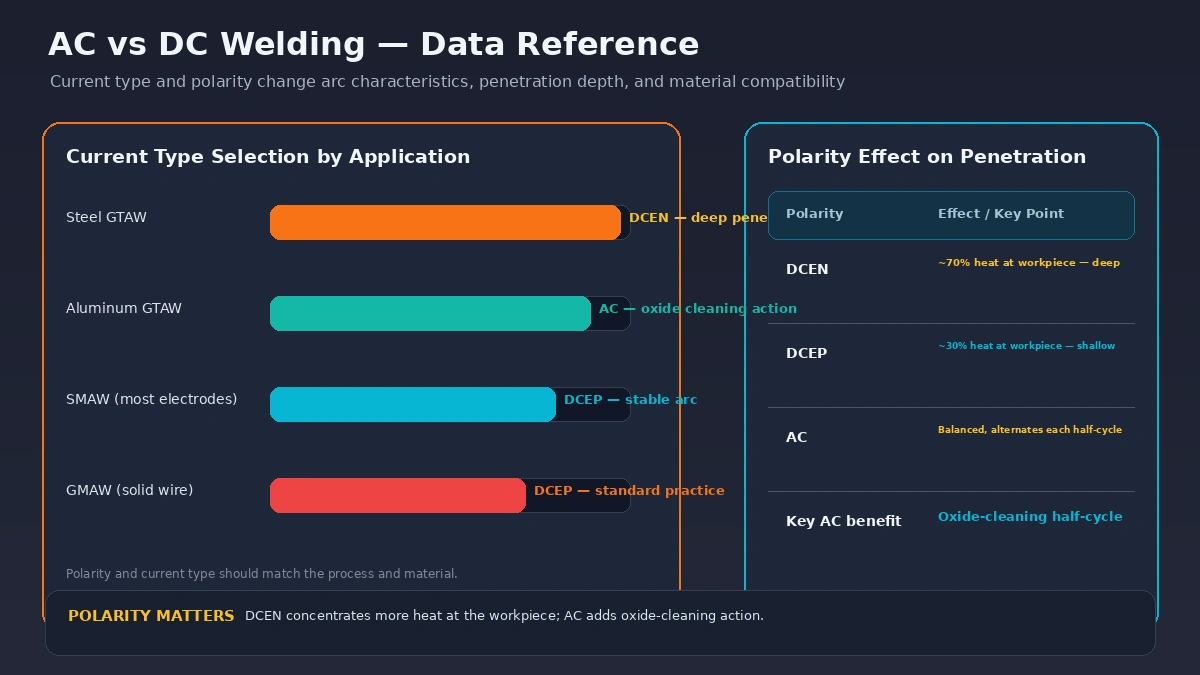
The power source converts mains supply electricity into the welding current. The choice of power source type determines whether AC, DC, or both are available, how stable the output is, and what auxiliary features (such as adjustable AC frequency and balance) are accessible.
Transformer-based machines
Transformer machines take mains AC and step it down to welding voltage without converting it to DC. They produce pure AC output — reliable, robust, and inexpensive to manufacture. They are well suited to SMAW with AC-compatible electrodes (E6011, E6013) on mild steel and structural applications. Their limitations are significant: no DC output, limited current control (typically stepped taps rather than continuously variable), and no adjustable AC waveform parameters. Open-circuit voltage on older units can exceed 100 V, which presents a safety concern in restricted conductive environments under IEC 60974-1. For the vast majority of industrial and code work, transformer-only machines have been replaced by rectifiers or inverters.
Rectifier-based machines
Rectifier machines add a diode bridge after the transformer, converting the stepped-down AC to DC. They produce smooth DC output and are used for SMAW, SAW, and DC TIG applications. Most offer adjustable output with either a continuously variable control or a tapped output. They do not produce AC welding output. Older designs are large, heavy, and relatively inefficient, but are extremely reliable with minimal maintenance requirements.
Inverter machines
Modern inverter power sources convert mains AC to high-frequency AC (typically 20–100 kHz) before stepping down and rectifying to produce stable DC or synthesised AC welding output. The high switching frequency allows the output transformer to be much smaller, producing machines that are lightweight, energy-efficient, and capable of very fast response to arc disturbances. For AC TIG welding, inverter machines can produce adjustable-frequency square-wave AC — the standard for professional aluminium TIG work — with adjustable AC balance and, on higher-specification units, adjustable AC frequency. An inverter machine with square-wave AC output maintains the arc through zero crossing far more reliably than a sine-wave transformer because the current drops to zero and recovers almost instantaneously, leaving less time for the arc column to cool below re-ignition threshold.
Transformer (AC)
- AC output only
- Low cost, high durability
- No polarity selection
- OCV can exceed 100 V
- No adjustable waveform
- Best for basic SMAW (E6011, E6013)
Inverter (AC/DC)
- AC and DC output
- Lightweight, portable
- Adjustable AC frequency & balance
- VRD standard on modern units
- Square-wave AC for Al TIG
- Best for professional SMAW, TIG, MMA
ASME Section IX and Current Type as an Essential Variable
In code-governed welding — pressure vessels, piping systems, power plant components — current type and polarity are not merely practical settings; they are documented essential or supplementary essential variables on the Welding Procedure Specification (WPS) and must be qualified through testing on a Procedure Qualification Record (PQR).
Under ASME BPVC Section IX, variable QW-409.4 addresses current type for most arc welding processes. This variable is classified as a supplementary essential variable — meaning it becomes an additional essential variable whenever the WPS must be qualified with impact toughness testing. A change from AC to DC (or vice versa) on a WPS qualified with Charpy impact testing therefore requires a new PQR to support the revised WPS, because the heat distribution difference between AC and DC affects the thermal cycle in the heat-affected zone and can change notch toughness results. When impact testing is not required, current type is generally a non-essential variable and may be revised on the WPS without requalification.
The P-Number and Group Number classification system interacts with current type requirements: materials requiring toughness testing by code (such as P-No. 1 Group 2 and Group 3 fine-grain steels, or P-No. 4 and P-No. 5 low-alloy steels) will trigger supplementary essential variable requirements when qualified at low temperature impact conditions.
Electrode Compatibility: Which Electrodes Require DC, AC, or Both
For SMAW electrode selection, the fourth digit of the AWS classification directly communicates current and polarity requirements. This information is also printed on the electrode packaging and must be confirmed before use.
| AWS Class | Coating Type | Current / Polarity | AC Compatible | Typical Application |
|---|---|---|---|---|
| E6010 | High-cellulosic sodium | DCEP only | No | Pipeline root, dirty/rusty steel |
| E6011 | High-cellulosic potassium | AC / DCEP | Yes | AC machine substitute for E6010 |
| E6013 | High-rutile potassium | AC / DC+/- | Yes | Light structural, thin sheet |
| E7016 | Low-hydrogen sodium | DCEP | No (sodium) | Structural, medium carbon steel |
| E7018 | Low-hydrogen potassium / iron powder | AC / DCEP | Yes | Structural, pressure vessel, all-position |
| E7024 | Iron powder rutile | AC / DC+/- | Yes | Flat/horizontal fillet, high deposition |
| E309L-16 | Rutile (stainless) | AC / DCEP | Yes | Stainless-to-carbon dissimilar joints |
| E308L-15 | Lime (stainless) | DCEP only | No | Austenitic stainless, low-hydrogen |
For TIG welding, tungsten electrode selection also depends on current type. Pure tungsten (EWP, green band) is suited to AC welding of aluminium on older sine-wave machines, where it naturally forms a stable hemispherical balled tip during the EP half-cycle. On modern inverter square-wave AC machines, ceriated (EWCe-2, grey band) or zirconiated (EWZr-8, brown/white band) electrodes perform more reliably, maintaining tip geometry and handling the higher instantaneous currents of square-wave waveforms. For all DC applications, thoriated (WT20, red) or ceriated (WC20, grey) electrodes are standard — ceriated is now preferred where thorium’s mild radioactivity is a concern. See the full tungsten electrode guide for the complete selection matrix.
Safety Considerations: OCV, VRD, and Electrical Hazard
The open-circuit voltage (OCV) — the voltage present at the electrode holder when no arc is being struck — represents the primary electrocution risk in manual arc welding. AC and DC sources have different OCV characteristics, and the physiological response to electric shock differs between the two current types.
For SMAW DC machines, OCV is typically 60–80 V. Some older transformer-based AC machines have OCV above 100 V — a significantly higher risk, particularly in restricted or conductive environments such as vessel interiors, pipe bore work, or confined spaces. IEC 60974-1 requires that a Voltage Reduction Device (VRD) be fitted to machines used in these environments, reducing OCV to below 35 V DC or 48 V AC RMS when the arc is not struck. Many modern inverter machines include VRD as standard or as a selectable option. AC at a given voltage level is considered more physiologically dangerous than DC at the same voltage because AC causes sustained muscular tetanus (inability to release the electrode), whereas DC tends to cause a single sharp convulsive jolt.