NDT Level 1, 2, and 3 Certification: Complete Comparison Guide
NDT certification levels define what a non-destructive testing technician is authorised to do — and what they are not. Whether you are beginning your career in inspection, advising on NDT contractor selection, or preparing a company written practice for ASME Section V compliance, understanding the distinction between Level I, Level II, and Level III is not optional: it is a basic requirement of any code-compliant quality assurance programme. The three levels are defined by ASNT Recommended Practice SNT-TC-1A, by the international standard ISO 9712, and by the employer-specific written practice that translates those documents into binding company procedure.
This guide explains each certification level in detail: what the holder is qualified to do, what they are specifically prohibited from doing without supervision, the minimum training hours and on-the-job experience required under SNT-TC-1A, how ISO 9712 differs in structure and portability, and how the levels map onto real inspection responsibilities in welding, pressure vessel, piping, and structural applications. A comparison of the major certification schemes — ASNT, ISO 9712, and PCN — is included, along with a career progression pathway and practical guidance for engineers and inspection coordinators who work alongside NDT contractors.
The Three-Level Framework: What It Is and Why It Exists
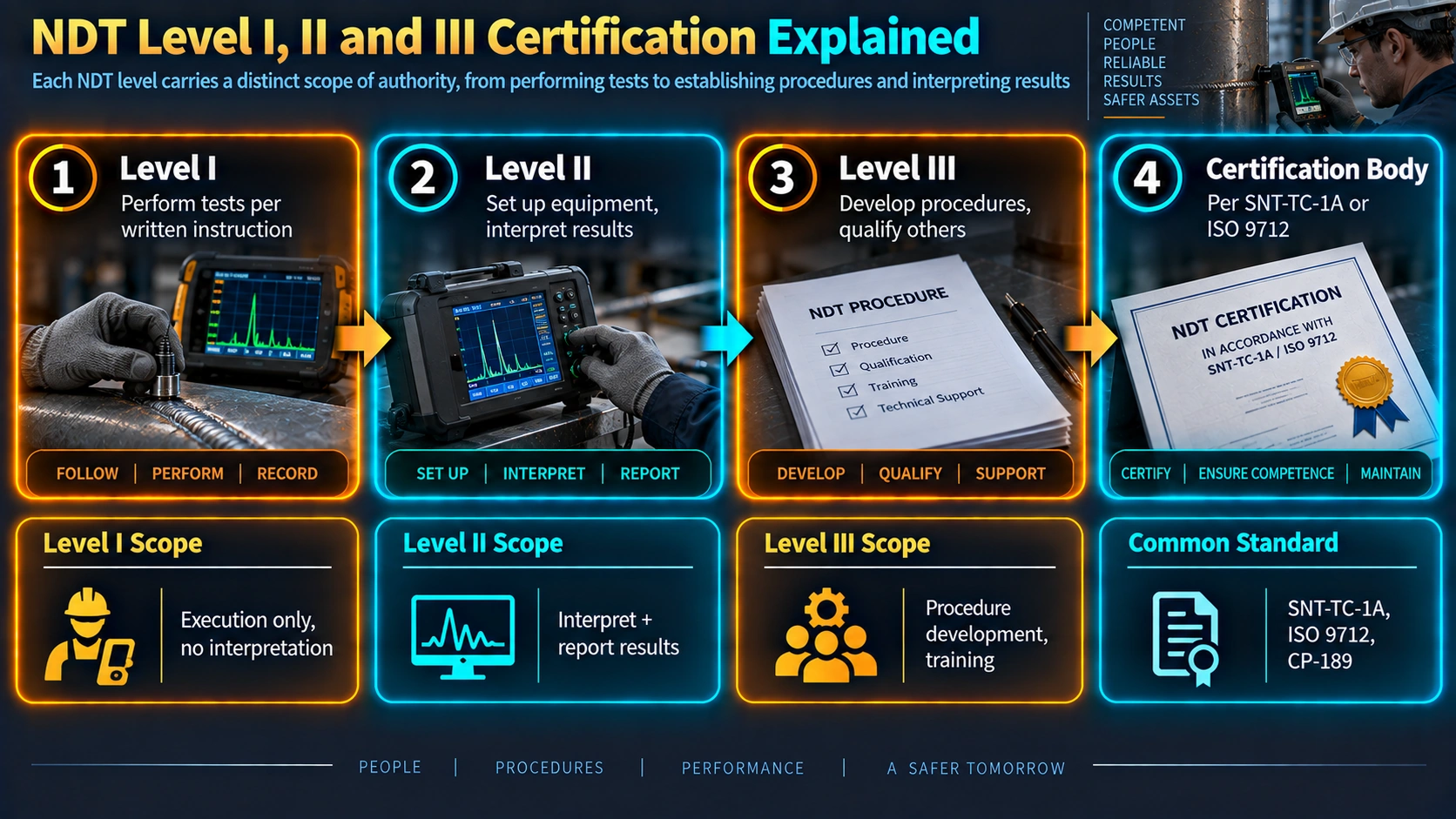
The three-level NDT qualification structure originated in the United States in 1966, when the American Society of Nondestructive Testing published the first edition of Recommended Practice No. SNT-TC-1A. The framework was designed to address a practical problem: NDT equipment was becoming more capable and more widely deployed, but there were no standardised criteria for assessing whether the person operating it actually understood the physics, limitations, and reporting requirements of the method being used.
The core philosophy of the three-level structure is that authority should match demonstrated competence. A technician who can set up a magnetic yoke and record indications is not automatically qualified to interpret what those indications mean in the context of a fitness-for-service code. A technician who can interpret results is not automatically qualified to write the procedure that defines how the test should be performed. Each level represents a distinct and documented threshold of knowledge, training, and verified experience — and the responsibilities assigned at each level match that threshold exactly.
Today, the same three-level structure (Level 1, 2, and 3) is used by ISO 9712, the international standard that underpins certification schemes in Europe, Australia, India, Canada, and most international project specifications. While SNT-TC-1A and ISO 9712 differ significantly in their administrative structure — employer-based versus central certification — the technical content and the hierarchy of responsibility are closely aligned.
Level I — Operator
- Equipment setup per written instruction
- Basic calibration checks
- Data collection and recording
- Works under Level II / III supervision
- No independent accept/reject authority
Level II — Inspector
- Full equipment setup and calibration
- Result interpretation and evaluation
- Accept/reject decisions per code
- Prepare written instructions
- Train and guide Level I personnel
- Compile and sign inspection reports
Level III — Technical Authority
- Develop and approve NDT procedures
- Approve written practices
- Interpret and apply codes and standards
- Designate NDT methods and techniques
- Train and examine Level I and II personnel
- Establish acceptance criteria
NDT Level I: Roles, Responsibilities, and Requirements
Level I is the entry point to the NDT profession. A Level I-certified technician is qualified to perform specific calibrations, conduct defined examinations, and record results — but only in accordance with pre-written instructions approved by a Level II or Level III. The crucial constraint is that a Level I may not independently determine whether an indication is acceptable or rejectable. That decision authority lies exclusively with Level II and above.
In practice, Level I technicians are deployed to carry out the operational aspects of an inspection programme under the direction of a certified Level II: setting up ultrasonic equipment to a specified reference block gain setting, applying magnetic particle suspension and scanning pre-defined areas with an electromagnetic yoke, or exposing radiographic film at calculated source-to-film distances. They collect data, log scan coverage, and flag indications for evaluation by the supervising Level II. Their work is valuable and necessary — it is the physical layer of any NDT programme — but it requires active oversight at all times.
PT: 8 hrs training, 70 hrs experience | MT: 12 hrs training, 70 hrs experience | RT: 40 hrs training, 250 hrs experience | UT: 40 hrs training, 210 hrs experience | VT: 8 hrs training, 70 hrs experience | ET: 40 hrs training, 210 hrs experience. These are minimum hours for initial certification. The total NDT hours figure represents all NDT methods combined.
The vision requirement is mandatory at all levels and must be checked annually. Near visual acuity to read a Jaeger J2 chart at 30 cm (or equivalent) is the minimum standard under SNT-TC-1A. Under ANSI/ASNT CP-189, the requirement is more stringent: J1 at 30 cm. Colour contrast differentiation is required for methods involving visual discrimination of indications (PT wet visible, MT colour contrast particles). A failing vision test suspends certification in those methods until corrected.
NDT Level II: Roles, Responsibilities, and Requirements
Level II is the operational backbone of most NDT programmes. A Level II-certified inspector works independently, without the continuous supervision required for Level I. They are responsible for the full chain of an inspection task: setting up and calibrating equipment, conducting the examination, interpreting the results, evaluating indications against the applicable code acceptance criteria, and compiling and signing the inspection report. Their signature on an NDT report is the document that formally accepts or rejects a weld or component for continued service or installation.
Beyond their own inspection work, Level II personnel are responsible for the on-the-job training and guidance of Level I technicians and trainees. They assign tasks, verify that examinations are conducted correctly, and countersign any data collected by Level I personnel before it enters the permanent inspection record. This supervisory responsibility means that a Level II’s competence affects not just their own work, but the reliability of every technician they oversee.
Level II is also the minimum qualification required under ASME Section V for an examiner who interprets examination results and makes accept/reject determinations. A Level I may assist in performing the physical examination, but the evaluation and the signature must come from a Level II or higher. Under most commercial NDT contractor arrangements, Level II inspectors are the standard deployable resource — they can be sent to a site independently, with a Level III available for procedure questions but not required on-site at all times.
Training hours for Level II are the sum of Level I and Level II hours. PT: 16 hrs total, 530 hrs OJT | MT: 20 hrs total, 530 hrs OJT | RT: 80 hrs total, 1,040 hrs OJT | UT: 80 hrs total, 800 hrs OJT | VT: 16 hrs total, 530 hrs OJT | ET: 80 hrs total, 800 hrs OJT. OJT hours must be documented separately by method.
Examination Requirements for Level II Certification
Under SNT-TC-1A, the employer’s written practice must specify the examination format for Level II certification. Minimum passing scores are typically 70% on each individual portion (general knowledge, specific knowledge, and practical) with a composite average of at least 80%. The general examination tests the physics, principles, and capabilities of the method. The specific examination tests knowledge of the employer’s written practice and the applicable codes and standards. The practical examination tests actual hands-on proficiency using representative specimens containing known discontinuities.
NDT Level III: Roles, Responsibilities, and Requirements
The Level III is the technical authority for all NDT operations within their certified methods. No NDT programme under SNT-TC-1A can function without a designated Level III, whose name and certification details are documented in the written practice. The Level III is responsible for developing, qualifying, and approving the procedures and techniques used by all lower-level personnel. They interpret the applicable codes, standards, and specifications, and translate them into practical examination procedures that Level II inspectors can execute.
A critical and often underappreciated responsibility of the Level III is establishing acceptance criteria when none are otherwise available in an applicable code. In this role, the Level III must draw on knowledge of materials, fabrication processes, failure mechanisms, and fracture mechanics to make technically defensible decisions that have direct implications for safety. This distinguishes Level III from a highly experienced Level II: it is not simply more practice — it is a different category of engineering judgement.
Under SNT-TC-1A, the Level III is also responsible for training and examining Level I and Level II personnel for certification. They administer and grade qualification examinations, evaluate practical competence, and make the formal certification decision. In companies where the NDT function is managed internally, the Level III is typically the NDT manager or chief inspector. In smaller companies, or where the NDT function is contracted out, an external Level III from an outside agency may fulfill this role on a consulting basis.
Level III Experience Requirements Under SNT-TC-1A
SNT-TC-1A does not specify training hours for Level III — instead, it specifies time-in-grade as Level II before the Level III examination can be attempted. The required Level II experience varies with formal education level: four years for candidates with a high school diploma, three years for candidates with a two-year technical degree, and two years for candidates with a four-year engineering or science degree. A Level III must also demonstrate general familiarity with other NDT methods, typically evidenced by passing an ASNT Level III Basic examination covering NDT fundamentals across all methods.
Training and Experience Requirements: Detailed Method Tables
The following table consolidates the minimum recommended training and experience requirements for Level I and Level II certification under ASNT SNT-TC-1A (2020 edition), for the six primary NDT methods. These are minimums: employer written practices may specify higher requirements. Education level may reduce training hour requirements for certain methods in some schemes, but the experience hour minimums are non-negotiable.
| Method | Level I — Training | Level I — OJT (Method) | Level I — OJT (Total NDT) | Level II — Training (Addl.) | Level II — OJT (Method) | Level II — OJT (Total NDT) |
|---|---|---|---|---|---|---|
| PT — Liquid Penetrant | 8 hrs | 70 hrs | 210 hrs | 8 hrs | 140 hrs | 530 hrs |
| MT — Magnetic Particle | 12 hrs | 70 hrs | 210 hrs | 8 hrs | 210 hrs | 530 hrs |
| RT — Radiographic | 40 hrs | 250 hrs | 500 hrs | 40 hrs | 540 hrs | 1,040 hrs |
| UT — Ultrasonic | 40 hrs | 210 hrs | 400 hrs | 40 hrs | 400 hrs | 800 hrs |
| VT — Visual Testing | 8 hrs | 70 hrs | 210 hrs | 8 hrs | 140 hrs | 530 hrs |
| ET — Eddy Current | 40 hrs | 210 hrs | 400 hrs | 40 hrs | 400 hrs | 800 hrs |
Level III Experience Requirements (Time-in-Grade as Level II)
| Education Level | Years as Level II Required (SNT-TC-1A) | Examination Required |
|---|---|---|
| High school diploma or equivalent | 4 years | Basic + Method + Practical exams |
| Two-year technical degree | 3 years | Basic + Method + Practical exams |
| Four-year engineering/science degree | 2 years | Basic + Method + Practical exams |
The Written Practice: The Document That Makes It Real
Under both SNT-TC-1A and ANSI/ASNT CP-189, the central compliance document is the Written Practice. This is the company-specific procedure that adapts the general recommendations of the standard to the employer’s actual operations: the NDT methods used, the products inspected, the applicable codes, and the specific roles and responsibilities of each certified level within that company. No one can be legally certified under SNT-TC-1A without a compliant written practice, and no written practice is compliant unless it has been reviewed and approved by the employer’s designated NDT Level III.
The Written Practice must address: applicable NDT methods and the applicable code or standard for each; the education, training, experience, and examination requirements for each certification level in each method; the vision test requirements and frequency; the minimum passing scores for qualification examinations; the recertification interval and process; the procedure for suspending or revoking certification; and the record retention requirements for all certification documentation.
ASNT SNT-TC-1A vs ISO 9712: Key Structural Differences
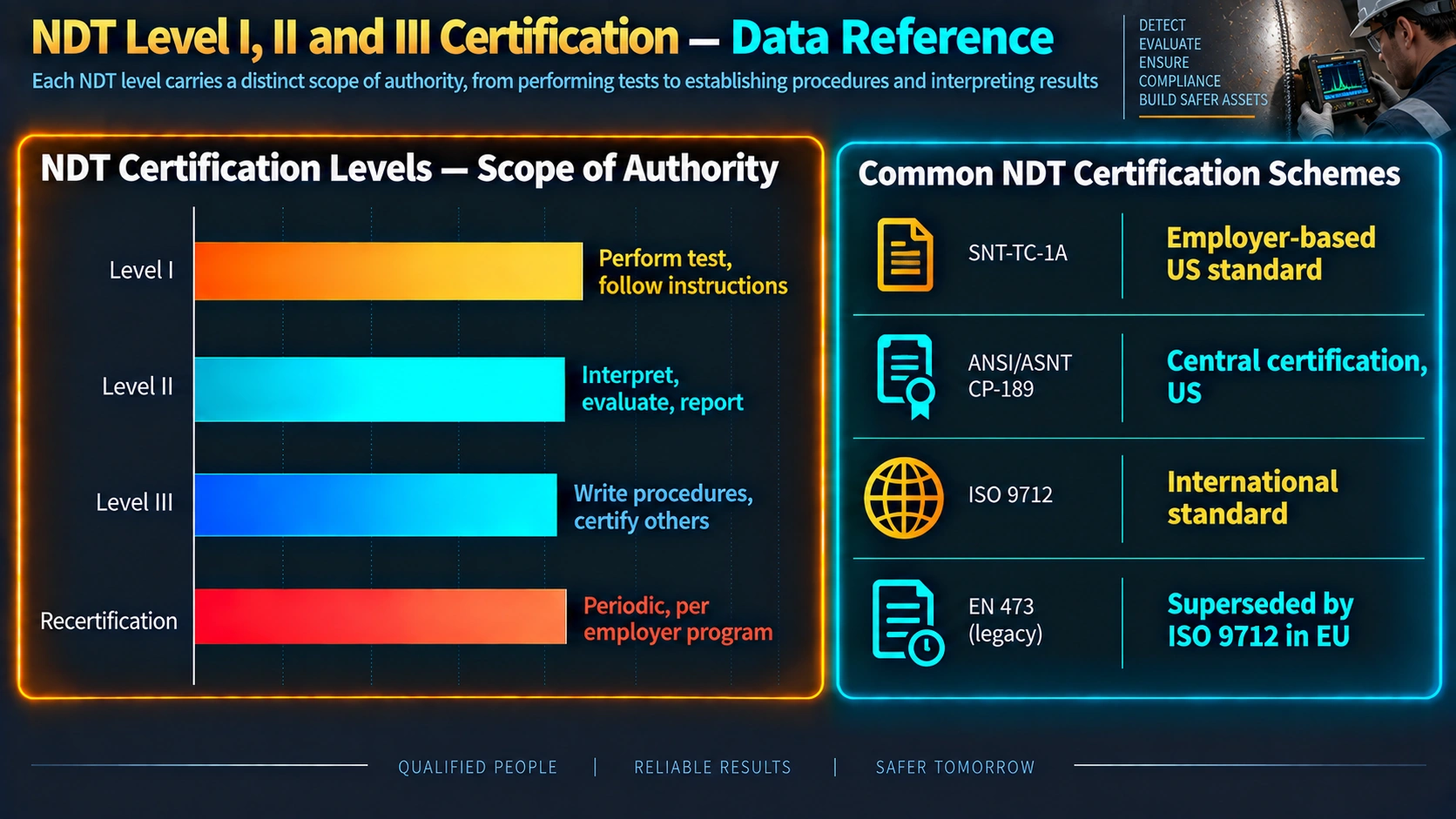
The most important practical distinction between ASNT SNT-TC-1A and ISO 9712 is not in the technical content — the responsibilities of each level are broadly similar — but in who issues and controls the certification, and what happens to that certification when a technician changes employer.
Under SNT-TC-1A, the employer is the certifying authority. When a technician is certified, the certificate is issued by the company, under the company’s Written Practice, and signed off by the company’s Level III. If the technician changes employer, that certification does not transfer: the new employer must evaluate the technician’s qualifications, and if their Written Practice differs from the previous employer’s, recertification under the new practice is required. This is described as an “employer-based” or “employer-sponsored” certification model.
Under ISO 9712, an independent, accredited certification body — not the employer — conducts the examinations and issues the certificates. The employer authorises the technician to operate within their organisation and provides the required experience, but the certificate itself belongs to the technician and remains valid across employers throughout its validity period. This “central certification” model is why ISO 9712 certificates are internationally portable and are preferred on international projects, offshore work, and in European regulatory environments.
| Feature | ASNT SNT-TC-1A | ISO 9712 | PCN (BINDT) |
|---|---|---|---|
| Certification model | Employer-based | Central / Third-party | Central / Third-party |
| Who issues the certificate | Employer | Accredited certification body | BINDT (UK) |
| Portability between employers | No — must recertify at new employer | Yes — certificate is portable | Yes — certificate is portable |
| International recognition | Wide in North America / Middle East | Global | Strong in UK, Europe, offshore |
| Governing document | SNT-TC-1A (recommended practice) | ISO 9712:2021 (standard) | PCN Gen / Method documents |
| Flexibility for employer | High — tailored via Written Practice | Low — requirements are fixed | Low — requirements are fixed |
| Recertification interval | 5 years | 5 years (then every 10 yrs) | 5 years |
| ASME Section V acceptance | Yes (2020 edition) | Yes | Via ISO 9712 equivalency |
India: The ISNT Hybrid System
In India, NDT personnel qualification follows a hybrid approach administered by the Indian Society for Non-Destructive Testing (ISNT). ISNT offers both employer-based certification pathways aligned with SNT-TC-1A and central certification programmes aligned with ISO 9712. For domestic industrial work — pressure vessels, pipelines, structural fabrication — SNT-TC-1A-aligned employer certification is prevalent. For export projects, nuclear applications, and international contracts, ISO 9712-aligned ISNT certification is increasingly specified. The ASNT designation remains widely recognised by ASME-stamped fabricators across India, particularly for ASME Section V compliance.
Certification Renewal and Recertification
NDT certification is not a permanent credential. The knowledge, physical condition, and practical competence of an inspector must be periodically reassessed to ensure continued fitness for the role. Under most schemes, initial certifications are valid for five years from the date of issue, with annual vision testing required throughout.
Under SNT-TC-1A, recertification at the end of the five-year period requires either a re-examination or documented evidence of continued satisfactory performance at the certified level. The employer’s written practice specifies which approach is used. A gap in active NDT work — typically six months or more in the method — triggers an interruption of certification: the individual must demonstrate current competence before returning to certification status, usually through a practical re-examination.
Under ISO 9712, the recertification path is more structured. At five years, renewal requires a visual acuity check and evidence of continued satisfactory work. At the ten-year mark, a practical examination is required for Level 1 and Level 2 holders. For Level 3, recertification at ten years may be achieved either by written examination or through an evidence-based credit system. This tiered approach ensures that long-tenured inspectors are not simply renewing on paperwork alone.
NDT Certification in the Context of ASME Section V
For fabrication shops manufacturing ASME-coded pressure vessels, heat exchangers, piping systems, or boilers, the NDT qualification requirements are not optional guidance — they are code requirements. ASME Section V, Article 1, General Requirements, mandates that NDT personnel performing examination under the ASME BPVC must be qualified and certified in accordance with a written practice. As of the 2023 edition, ASME Section V accepts written practices aligned with SNT-TC-1A (2020), ANSI/ASNT CP-189, or ISO 9712.
The practical implication is that every NDT report signed on an ASME-coded component must be signed by a Level II or Level III. The Authorised Inspector (AI) — the third-party inspector employed by the ASME-accredited inspection body — will check that all examination reports are signed by personnel with current, documented certification under the applicable written practice. Missing, expired, or improperly issued certifications are a non-conformance finding that can delay code stamp issuance.
For welding engineers and QC managers overseeing fabrication programmes, reviewing the NDT contractor’s current certification records — including the written practice, certification matrices, and individual qualification records — should be a standard pre-qualification step before mobilising any NDT crew. Verifying that the Level III who approved the written practice holds current third-party or employer certification in the relevant methods is equally important.
Practical Impact: What Level to Specify in Your ITP
When writing an Inspection and Test Plan (ITP) for a welding fabrication project, the NDT qualification level that you specify for each hold or witness point determines both the cost and the credibility of the inspection. Specifying “Level II minimum” for surface examination (MT or PT) and “Level II minimum” for volumetric examination (RT or UT) is the standard requirement for ASME- and AWS-coded work. Specifying “Level III” is unusual for routine production inspection and typically indicates that a procedure is being developed, a new technique is being qualified, or a specific code requires it.
For radiographic film interpretation on pressure vessel shell seams and nozzle welds, ASME Section VIII Division 1 references the qualified radiographic interpreter requirements of Section V. In practice, most fabricators specify Level II RT at a minimum for film interpretation, with Level III available for difficult interpretation decisions or dispute resolution. For PAUT and TOFD examinations — increasingly used in lieu of RT on heavy-section piping — the additional technique qualifications specified in SNT-TC-1A Table 6.3.1A or the relevant ISO 9712 technique qualification must be verified in the contractor’s certification records.
Recommended Books for NDT Certification Preparation
Disclosure: WeldFabWorld participates in the Amazon Associates programme (StoreID: neha0fe8-21). If you purchase through these links, we may earn a small commission at no extra cost to you. This helps support free technical content on this site.
Frequently Asked Questions
What is the difference between NDT Level I and Level II?
NDT Level I technicians work under direct supervision and perform specific calibrations and tests according to written instructions. They cannot make accept/reject decisions independently. Level II technicians are qualified to set up and calibrate equipment, interpret and evaluate results against codes and specifications, prepare written inspection instructions, and compile and sign inspection reports. Level II is the minimum qualification required to sign off on NDT reports in most commercial and code-regulated programmes. In practical terms, a Level I is a supervised operator; a Level II is a fully independent inspector.
How many hours of experience are required for NDT Level II under SNT-TC-1A?
Under ASNT SNT-TC-1A (2020 edition), the total NDT experience requirements for Level II are: PT — 530 hours total (140 hrs in method), MT — 530 hours total (210 hrs in method), UT — 800 hours total (400 hrs in method), RT — 1,040 hours total (540 hrs in method), VT — 530 hours total (140 hrs in method), ET — 800 hours total (400 hrs in method). These are cumulative figures including Level I experience. All hours must be documented by method — hours cannot be shared across methods on the same day.
What is an NDT Level III responsible for?
An NDT Level III is the technical authority for all NDT operations within their certified methods. Core responsibilities include developing and approving NDT procedures and the company’s written practice, interpreting applicable codes and standards, designating which NDT methods and techniques to use for specific applications, training and examining Level I and II personnel for certification, and establishing acceptance criteria when none are specified by code. Under SNT-TC-1A, no written practice is valid without Level III review and approval — and no certification issued under an invalid written practice is compliant. Level IIIs also provide the technical basis for fitness-for-service decisions when indication characterisation or acceptance criteria interpretation is required.
What is the difference between ASNT SNT-TC-1A and ISO 9712?
The primary difference is in the certification model. SNT-TC-1A is an employer-based recommended practice: the employer is the certifying authority, the certificate is issued under the company’s written practice, and it does not automatically transfer when the technician changes employer. ISO 9712 is a central certification standard: an accredited, independent third-party body conducts examinations and issues certificates that remain valid across employers and are recognised internationally. For projects in Europe, offshore, and on international EPC contracts, ISO 9712 or PCN is typically specified. For domestic North American work under ASME or AWS codes, SNT-TC-1A-based certification is the norm.
Can you skip directly to NDT Level II without obtaining Level I first?
Direct access to Level II is theoretically possible under both SNT-TC-1A and ISO 9712, provided the candidate fulfils the cumulative training and experience requirements for both Level I and Level II before the Level II examination is attempted. However, very few employers certify personnel directly to Level II without first certifying them at Level I, as the progressive certification reflects progressive competence development. The Level II training hours are explicitly calculated as the sum of Level I plus Level II hours — so the Level I experience cannot be bypassed.
How long does NDT certification remain valid, and when must it be renewed?
Under ASNT SNT-TC-1A and ANSI/ASNT CP-189, all certification levels are typically valid for five years and require renewal through re-examination or documented evidence of continued satisfactory performance at that level. A gap in NDT activity of six months or more typically suspends certification and triggers a competency re-evaluation requirement. Under ISO 9712, initial certification is valid for five years; renewal at five years requires a visual acuity check and satisfactory performance evidence. At the ten-year mark, a practical examination is required for Level 1 and Level 2 renewal. Annual vision tests are mandatory throughout the certification period under all schemes.
Which NDT certification is recognised internationally — ASNT or ISO 9712?
ISO 9712 is the internationally recognised standard, administered through accredited bodies worldwide — BINDT (UK/PCN), AINDT (Australia), CGSB (Canada), ISNT (India), and others. Because ISO 9712 follows a central certification model, the certificate remains valid regardless of which employer the technician works for, which is essential for international project mobility. ASNT SNT-TC-1A is dominant for domestic work in the USA, Canada, and the Middle East, but its employer-based nature means certificates may not be accepted by clients on international contracts without additional qualification. For technicians seeking the broadest international career mobility, ISO 9712 certification — or the PCN scheme in the UK — is the preferred credential.
What NDT certification level is required to sign off on inspection reports under ASME Section V?
Under ASME Section V (2023 edition), a minimum of NDT Level II is required to interpret and evaluate examination results and sign off on inspection reports. Level I technicians may perform physical examinations but cannot make independent accept/reject decisions or sign reports. The employer’s written practice must specify the minimum certification level for each NDT task and must be aligned with SNT-TC-1A (2020), ANSI/ASNT CP-189, or ISO 9712. The written practice itself must be reviewed and approved by the employer’s designated NDT Level III, whose current certification details must also be on file. For guidance on selecting the right NDT method for your application, see the WeldFabWorld NDT overview guide.