Schedule 40 vs Schedule 80 Pipe — What’s the Difference
Schedule 40 vs Schedule 80 pipe is one of the first dimensional questions every piping engineer, welding inspector, and fabricator has to get right, because the two schedules look identical from across the shop floor yet behave very differently once pressure, threading, or hydraulics enter the picture. Both terms describe a standardized wall thickness defined in ASME B36.10M for carbon and alloy steel pipe, and both are tied to the same nominal pipe size (NPS) system — but the wall thickness difference cascades into changes in bore, weight, pressure capacity, weld volume, and even how the pipe should be threaded or fitted.
This guide walks through every dimension that actually changes between Schedule 40 and Schedule 80 pipe of the same NPS, shows the ASME B31.3 pressure design calculation that determines which one a project actually needs, and flags the specific situations — threaded connections, NPS 10 and above, mixed-schedule butt welds — where engineers most often get the comparison wrong.
For the same nominal pipe size, Schedule 40 and Schedule 80 pipe have the same outside diameter. Schedule 80 has a thicker wall, which gives it a smaller inside diameter, roughly 35-55% more weight per foot, and a meaningfully higher allowable internal pressure for the same material and temperature. Schedule 40 is the economical default for low-to-moderate pressure service; Schedule 80 is specified when the calculated design pressure, threaded connections, or corrosion allowance demand the extra wall.
What “Schedule” Actually Means in Piping
A pipe “schedule” is a dimensionless number that designates wall thickness for a given nominal pipe size under ASME B36.10M (carbon and alloy steel) or its stainless-steel counterpart, ASME B36.19M. It is not a measurement in itself — it is an index into a standardized dimension table. The number was historically derived from an approximate formula relating the pipe’s design pressure to the allowable stress of the material:
Modern schedule numbers (5, 10, 20, 30, 40, 60, 80, 100, 120, 140, 160) are now fixed, tabulated values rather than a live calculation — you look up the schedule in the B36.10M table rather than computing it from scratch — but the underlying logic still explains why a thicker wall corresponds to a higher schedule number. Schedule 40 and Schedule 80 are simply the two most commonly stocked and specified schedules in industrial piping, occupying the middle of the wall-thickness range.
STD, XS, and XXS: The Older Naming System
Before the schedule numbering system existed, wall thickness was described using three weight classes: Standard (STD), Extra Strong (XS), and Double Extra Strong (XXS). These designations are still printed on mill certificates and used in everyday shop language, and for most common sizes they line up exactly with specific schedule numbers — but not always, which is a point covered in detail later in this guide.
ASME B36.10M governs dimensions for welded and seamless wrought carbon and alloy steel pipe. ASME B36.19M covers the equivalent stainless steel dimensions using an “S” suffix (5S, 10S, 40S, 80S). For NPS 12 and smaller, Schedule 40S and 80S generally match the carbon-steel Schedule 40 and 80 wall thicknesses; above that, the stainless series does not carry every heavier schedule that the carbon-steel series does. Plastic pipe (PVC, CPVC) uses the same Schedule 40/80 labels under ASTM D1785, but the dimensions and pressure ratings are governed by a completely separate standard and should never be cross-referenced against the steel chart in this article.
Dimensional Differences: OD, ID, and Wall Thickness
The single defining rule of the entire schedule system is this: outside diameter never changes with schedule. A 4 inch NPS pipe has a 4.500 inch OD whether it is Schedule 10, Schedule 40, Schedule 80, or Schedule 160. What changes is wall thickness, and because wall thickness eats into the bore from both sides, the inside diameter (ID) shrinks as the schedule number climbs.
Because OD is constant, Schedule 40 and Schedule 80 pipe of the same NPS use the same slip-on flanges, the same bolt circle, and largely the same body castings for socket-weld and threaded fittings — only the bore and, for weld-neck and butt-weld fittings, the schedule-matched end preparation differ. The table below gives the full dimensional comparison for the most commonly used sizes, drawn from the ASME/ANSI B36.10M standard.
| NPS | OD (in) | Sch 40 Wall | Sch 40 ID | Sch 40 Wt (lb/ft) | Sch 80 Wall | Sch 80 ID | Sch 80 Wt (lb/ft) |
|---|---|---|---|---|---|---|---|
| 1/2 | 0.840 | 0.109 | 0.622 | 0.85 | 0.147 | 0.546 | 1.09 |
| 3/4 | 1.050 | 0.113 | 0.824 | 1.13 | 0.154 | 0.742 | 1.47 |
| 1 | 1.315 | 0.133 | 1.049 | 1.68 | 0.179 | 0.957 | 2.17 |
| 1-1/4 | 1.660 | 0.140 | 1.380 | 2.27 | 0.191 | 1.278 | 3.00 |
| 1-1/2 | 1.900 | 0.145 | 1.610 | 2.72 | 0.200 | 1.500 | 3.63 |
| 2 | 2.375 | 0.154 | 2.067 | 3.65 | 0.218 | 1.939 | 5.02 |
| 2-1/2 | 2.875 | 0.203 | 2.469 | 5.79 | 0.276 | 2.323 | 7.66 |
| 3 | 3.500 | 0.216 | 3.068 | 7.58 | 0.300 | 2.900 | 10.25 |
| 4 | 4.500 | 0.237 | 4.026 | 10.79 | 0.337 | 3.826 | 14.98 |
| 6 | 6.625 | 0.280 | 6.065 | 18.97 | 0.432 | 5.761 | 28.57 |
| 8 | 8.625 | 0.322 | 7.981 | 28.55 | 0.500 | 7.625 | 43.39 |
| 10 | 10.750 | 0.365 | 10.020 | 40.48 | 0.594 | 9.562 | 64.43 |
| 12 | 12.750 | 0.406 | 11.938 | 53.52 | 0.688 | 11.374 | 88.63 |
Why the OD/ID Relationship Matters for Fit-Up
Because OD is fixed and ID shrinks with schedule, every increase in schedule number is, in effect, “growth from the outside in” on the bore side and a fixed boundary on the fit-up side. This is convenient for piping designers — a flange or coupling sized for the NPS works across schedules — but it means weld preparation, not the fitting body, is where the schedule difference has to be managed. See the welding joint types guide for how groove geometry changes when wall thickness changes at a joint.
Pressure Rating: Schedule 40 vs Schedule 80
Schedule alone does not define a pressure rating — pressure capacity is a function of wall thickness, outside diameter, material allowable stress, weld joint efficiency, and design temperature together. What schedule does is set the wall thickness input into that calculation, and a thicker wall directly increases the allowable internal pressure for any given material.
Barlow’s Formula: The Quick-Reference Version
The simplest relationship engineers reach for is Barlow’s Formula, which relates burst or working pressure to wall thickness, material strength, and diameter:
The ASME B31.3 Design Equation: The Code-Compliant Version
For actual piping design, ASME B31.3 (process piping) specifies the straight-pipe pressure design formula, which includes the allowable stress at temperature (S), the longitudinal weld joint efficiency (E), and a material/temperature coefficient (Y) that prevents the formula from understating required thickness on thick-wall pipe:
Worked Example: NPS 4 Schedule 40 vs Schedule 80, ASTM A106 Grade B
ASTM A106 Grade B seamless carbon steel pipe has a B31.3 Table A-1 allowable stress of S = 20,000 psi up to 400 deg F, with E = 1.0 for seamless pipe and Y = 0.4. Applying the standard -12.5% manufacturing under-tolerance permitted by ASTM A106 to the nominal wall thickness, and ignoring corrosion allowance for clarity:
Allowable stress values change between code editions and vary significantly by material grade and temperature. This worked example uses a single common material (A106 Grade B) at low temperature purely to illustrate how the formula responds to schedule. Never apply this S value to a different material, and always confirm the governing code edition with your project’s piping engineer before finalizing a wall thickness selection.
Weight, Cost, and Welding Effort
The weight increase from Schedule 40 to Schedule 80 is not a flat percentage — it grows with pipe size because wall thickness grows faster than OD in the larger schedules. At NPS 2, Schedule 80 is about 37% heavier than Schedule 40 (5.02 vs 3.65 lb/ft). At NPS 8, the gap widens to roughly 52% (43.39 vs 28.55 lb/ft). That weight difference flows directly into freight cost, support and hanger spacing, lifting requirements, and crane selection on larger bore lines.
Welding cost rises for a second, independent reason: weld volume scales with the square of wall thickness for a groove weld of similar geometry, so a Schedule 80 butt weld can require considerably more filler metal and pass count than the equivalent Schedule 40 joint, even though the wall is “only” 30-40% thicker. On thick-wall Schedule 80 and heavier sections, preheat requirements and multi-pass sequencing become more important — see the carbon equivalent calculator for working out preheat needs as section thickness increases.
When estimating total installed cost difference between schedules, do not stop at material price per foot. Add the heavier fitting and flange class that heavier-wall systems sometimes require, the additional weld passes and inspection time, and the heavier pipe support spacing calculation. On a long pipe run, these secondary costs frequently exceed the raw material price difference.
Threaded Connections: Why Codes Lean Toward Schedule 80
NPT (National Pipe Thread, taper) connections per ASME B1.20.1 cut a fixed thread depth into the pipe wall, set by the thread pitch and the standard taper, regardless of how thick the starting wall is. On a thin Schedule 40 wall, that fixed cut removes a much larger percentage of the available material than it does on a thick Schedule 80 wall, leaving a thinner remaining shell at the root of the thread and a correspondingly lower burst margin at exactly the point where the joint is most likely to leak or fail under vibration and cyclic loading.
This is the practical reason many piping specifications default to Schedule 80, or in some severe services Schedule 160, as the minimum for threaded connections even when an unthreaded Schedule 40 run would otherwise satisfy the calculated pressure design. It is not that Schedule 40 cannot be threaded — small-bore Schedule 40 NPT nipples are extremely common in low-pressure utility service — it is that the safety margin at the thread root drops faster than the nominal wall-thickness check alone suggests.
Never assume a threaded connection automatically meets a pressure rating just because the straight pipe wall passed the design equation. Thread engagement removes load-bearing cross-section locally. Check your project specification or the applicable code’s threaded-connection guidance separately from the straight-pipe pressure calculation.
Flow Capacity and Pressure Drop
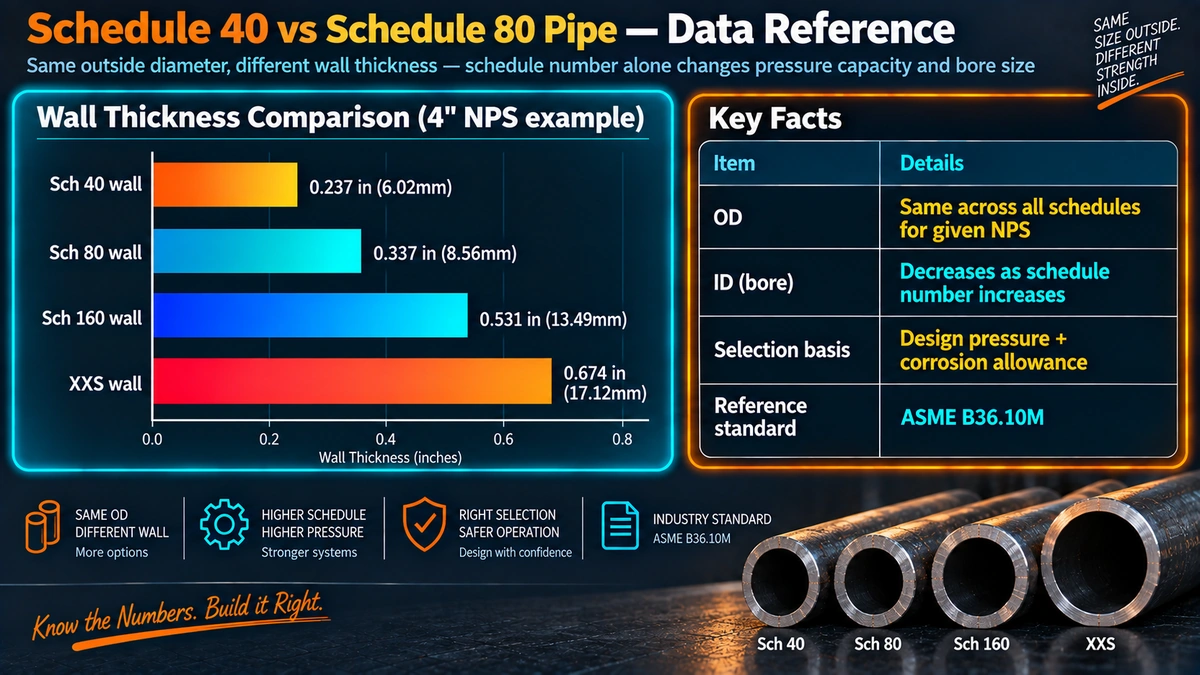
Because Schedule 80’s thicker wall reduces inside diameter, it also reduces internal flow area for the same NPS. At NPS 4, the bore drops from 4.026 in (Schedule 40) to 3.826 in (Schedule 80) — only a 5% reduction in diameter, but roughly a 10% reduction in cross-sectional flow area, since area scales with the square of the radius. Reduced flow area at constant volumetric flow rate means higher velocity, and head loss under the Darcy-Weisbach relationship scales with velocity squared, so the hydraulic penalty of upgrading to Schedule 80 compounds faster than the bore reduction alone implies.
On long pipe runs carrying high volumetric flow, the pressure-drop penalty of moving to a heavier schedule can outweigh the mechanical benefit if the actual operating pressure does not require it. For short, high-pressure segments — pump discharge headers, hydraulic lines, instrument connections — the mechanical benefit of Schedule 80 usually dominates and the flow penalty is secondary. Always check pump or compressor sizing margins if you are upgrading an existing line’s schedule.
When to Use Schedule 40 vs Schedule 80
The decision is ultimately a wall-thickness calculation against the project’s design pressure, temperature, corrosion allowance, and connection type — not a default habit. The guidance below reflects how the two schedules are typically applied across common industrial services.
| Consideration | Schedule 40 | Schedule 80 |
|---|---|---|
| Typical pressure range | Low to moderate general utility | Moderate to high process / hydraulic |
| Typical service examples | Plant air, water, condensate, low-pressure steam, general process | High-pressure steam, hydraulic lines, sour/corrosive service, threaded connections |
| Corrosion allowance margin | Lower — less spare wall for future corrosion loss | Higher — more spare wall, useful where corrosion rate is uncertain |
| Threaded (NPT) connections | Acceptable for light-duty, low-pressure utility threading | Preferred minimum for pressure-rated threaded joints |
| Weight, cost, weld volume | Lower on all three | Higher on all three, growing with NPS |
| Flow area for given NPS | Larger — lower velocity and pressure drop | Smaller — higher velocity for same flow rate |
Common Mistakes and Misconceptions
Assuming STD and XS Always Equal Schedule 40 and Schedule 80
This is true only up to a point, and the divergence catches out a surprising number of purchase orders on larger-bore piping. For NPS 10 and smaller, STD wall thickness equals Schedule 40. For NPS 8 and smaller, XS wall thickness equals Schedule 80. Above those sizes, “true” schedule numbers and the older STD/XS weight classes part ways, and the gap grows quickly with size.
| NPS | STD Wall | True Sch 40 Wall | XS Wall | True Sch 80 Wall |
|---|---|---|---|---|
| 8 | 0.322 | 0.322 (same) | 0.500 | 0.500 (same) |
| 10 | 0.365 | 0.365 (same) | 0.500 | 0.594 (diverges) |
| 12 | 0.375 (diverges) | 0.406 | 0.500 (diverges) | 0.688 |
| 14 | 0.375 (diverges) | 0.438 | 0.500 (diverges) | 0.750 |
At NPS 10 and above, ordering “XS” pipe when the design actually calls for “Schedule 80” can deliver pipe with significantly less wall than expected — at NPS 12, the difference is 0.500 in (XS) versus 0.688 in (true Schedule 80), nearly 27% less wall. Always specify the schedule number explicitly on purchase orders and drawings for NPS 10 and larger; do not rely on STD or XS shorthand.
Mixing Schedules at a Butt Weld
Butt-welding Schedule 40 pipe directly to a Schedule 80 fitting or pipe of the same NPS creates a wall-thickness step at the joint. If that step is not addressed with an internal taper or back-bevel on the heavier side, the resulting weld geometry can be difficult to interpret on radiographic film — the natural step can read as lack of fusion or incomplete penetration even on a sound weld. Socket-weld and threaded joints largely avoid this issue because the fitting bore, not a butt-weld groove, absorbs the wall mismatch. See the API 1104 pipeline welding guide for how transition welds are handled in cross-country pipeline practice, and the welding joint types guide for groove geometry fundamentals.
Treating Schedule as a Complete Pressure Rating
Schedule sets wall thickness; it does not by itself state a pressure rating. The same Schedule 80 wall thickness produces a different allowable pressure in ASTM A106 carbon steel than it does in a low-alloy or stainless grade, and the allowable pressure for any material drops as design temperature rises. Always run or verify the actual ASME B31.3 design calculation for the specific material, temperature, and corrosion allowance rather than treating “Schedule 80” as a universal pressure class.
Ignoring Corrosion and Sour Service Requirements
In corrosive or sour service, the calculated minimum wall thickness must include a corrosion allowance on top of the pressure-design thickness, which can push a borderline Schedule 40 design into Schedule 80 territory even at moderate pressures. Review the corrosion types guide and, for H2S-containing service, the sour service guide before finalizing schedule selection on any line with a known corrosion mechanism.
Recommended Reference Books
ASME B31.3 Process Piping Guide
The governing code for the pressure design equation used throughout this article, including allowable stress tables and joint efficiency rules.
View on AmazonPiping Handbook (Nayyar)
The classic, comprehensive piping engineering reference covering schedule selection, materials, fittings, and design practice across industries.
View on AmazonPipefitter’s Blue Book
A compact field reference for pipe dimensions, fittings, and shop formulas — useful for quick schedule and weight lookups on the floor.
View on AmazonPiping Calculations Manual
Worked calculations for pipe sizing, pressure drop, and wall thickness selection across a wide range of process piping scenarios.
View on AmazonFrequently Asked Questions
What is the main difference between Schedule 40 and Schedule 80 pipe?
The only thing that changes between Schedule 40 and Schedule 80 pipe of the same nominal pipe size (NPS) is wall thickness. The outside diameter (OD) is fixed by the NPS and stays identical for every schedule. Schedule 80 has a thicker wall than Schedule 40, which reduces the inside diameter (ID), increases weight per foot, and raises the allowable internal pressure when the material and temperature are the same.
Does Schedule 80 pipe have a different outside diameter than Schedule 40 for the same NPS?
No. Per ASME B36.10M, outside diameter is fixed by nominal pipe size and does not change with schedule. A 4 inch NPS pipe has a 4.500 inch OD whether it is Schedule 40, Schedule 80, or Schedule 160. Only the wall thickness, and therefore the inside diameter, changes between schedules. This is why Schedule 40 and Schedule 80 pipe of the same NPS use the same flanges, the same bolt circles, and largely the same socket-weld or slip-on fitting bodies.
Is Schedule 80 pipe always stronger and the better choice than Schedule 40?
Not automatically. Schedule 80 has a higher allowable pressure rating and more corrosion allowance margin for the same material, but it is heavier, more expensive, requires more weld metal and longer welding time, and has a smaller bore that increases velocity and pressure drop for a given flow rate. The correct schedule is the one that satisfies the calculated design pressure with margin, not simply the thicker option. Over-specifying Schedule 80 everywhere adds cost and weight without a corresponding engineering benefit.
Why do plumbing and process codes often require Schedule 80 for threaded NPT pipe?
NPT threads per ASME B1.20.1 cut away a fixed depth of material regardless of the starting wall thickness. On thin-wall Schedule 40 pipe, that fixed cut removes a much larger percentage of the remaining wall than it does on thick-wall Schedule 80 pipe, leaving less structural margin at the root of the thread. Many piping specifications and ASME B31.3 guidance therefore call for Schedule 80, or even Schedule 160, as the practical minimum for threaded connections in pressure service, even when straight Schedule 40 would pass a wall-thickness check for an unthreaded run.
Can I weld Schedule 80 fittings directly onto Schedule 40 pipe of the same NPS?
It is common, but the butt-weld end of a heavier-schedule fitting must be back-bevelled or internally tapered to match the thinner pipe wall, and the weld procedure must address the resulting taper. Mixing wall thicknesses at a butt weld without addressing the taper is a frequent cause of radiographic interpretation difficulty, since the natural geometric step can look like lack of fusion or incomplete penetration on the film. Socket-weld and threaded connections are less sensitive to this mismatch because the fitting bore, not the weld geometry, accommodates the wall difference.
Are STD and XS pipe the same as Schedule 40 and Schedule 80?
Only up to a point. For NPS 10 and smaller, Standard Weight (STD) wall thickness is identical to Schedule 40. For NPS 8 and smaller, Extra Strong (XS) wall thickness is identical to Schedule 80. Above those sizes the two naming systems diverge: at NPS 12, STD is 0.375 inch while true Schedule 40 is 0.406 inch, and XS is 0.500 inch while true Schedule 80 is 0.688 inch. Always specify the schedule number, not STD or XS, when ordering pipe NPS 10 and larger to avoid receiving the wrong wall thickness.
How much more does Schedule 80 pipe weigh and cost compared to Schedule 40?
The weight increase scales with size. At 2 inch NPS, Schedule 80 weighs about 5.02 lb/ft against 3.65 lb/ft for Schedule 40, roughly 37 percent more. At 8 inch NPS the gap widens to about 43.4 lb/ft versus 28.6 lb/ft, around 52 percent more. Material cost tracks weight closely, and total installed cost rises further because Schedule 80 needs more filler metal per weld, longer welding time, heavier supports, and in some cases heavier-rated fittings and flanges.
How do I determine which schedule I actually need for a given design pressure?
Calculate the minimum required wall thickness using the governing code formula, typically the ASME B31.3 straight-pipe design equation, with the correct allowable stress for your material and temperature, the manufacturing tolerance, and any corrosion allowance included. Then select the lightest standard schedule whose wall thickness equals or exceeds that calculated minimum. Picking a schedule by habit or by what is in stock without running this calculation is a common source of either unsafe under-design or wasteful over-design.