API 1104 Pipeline Welding Code Explained
API 1104 pipeline welding is the standard that governs how cross-country and related-facility pipelines are welded, qualified, inspected, and repaired across the oil and gas industry. Published by the American Petroleum Institute as Welding of Pipelines and Related Facilities, it is the single most referenced welding code in upstream and midstream construction, and it is unusual among major welding codes because it combines procedure and welder qualification, production inspection, and defect acceptance criteria into one document.
This guide walks through the full structure of API 1104 in plain engineering language: what it covers, how procedures and welders are qualified, how girth welds are inspected and accepted or rejected, what happens when a defect is found, and how in-service welding on a live pipeline is handled differently from new construction. It also lays out, point by point, where API 1104 diverges from ASME Section IX, since the two codes are frequently confused by engineers moving between pressure-piping and pipeline work.
Whether you are a welding engineer preparing a WPS for a new pipeline spread, a CWI candidate choosing a Part C code book, or a quality manager auditing a contractor’s qualification records, understanding exactly what API 1104 requires — and where it leaves room for project specifications to add stricter rules — is foundational to working competently in pipeline fabrication.
What Is API 1104? Scope and Purpose
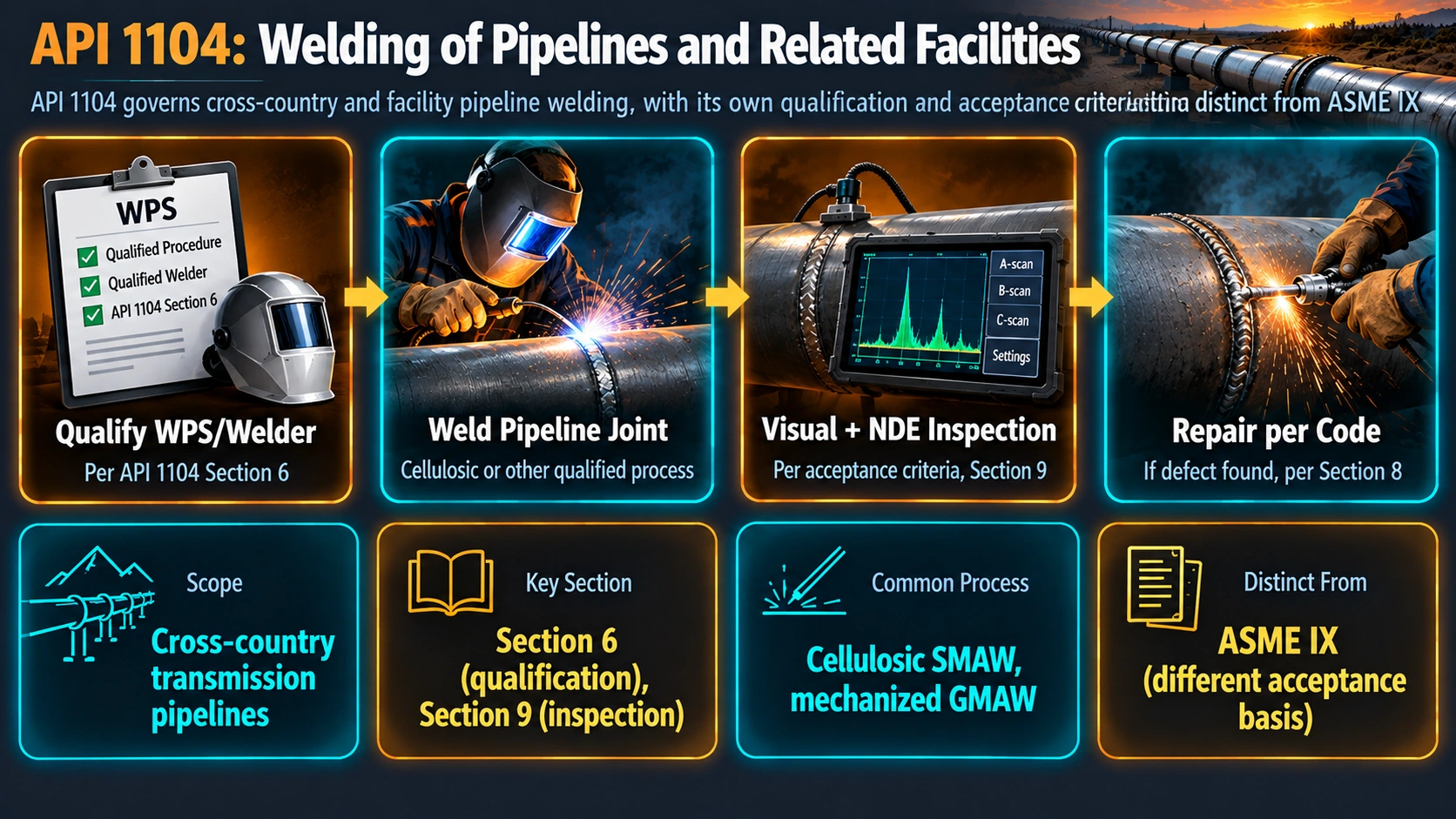
API 1104 covers the gas and arc welding of butt, fillet, and socket welds in carbon and low-alloy steel piping used for the compression, pumping, and transmission of crude petroleum, petroleum products, fuel gases, carbon dioxide, and nitrogen, and, where applicable, distribution systems. It applies to both new construction and in-service welding, and it covers onshore and offshore pipelines alike. The standard’s stated purpose is to provide a practical, field-tested framework for qualifying welding procedures and welders, executing production welds, and verifying weld quality through nondestructive testing and visual inspection.
Unlike a structural or pressure-vessel welding code, API 1104 is written specifically around the realities of pipeline construction: long, repetitive girth welds made under changing field conditions, by crews moving along a right-of-way rather than in a fixed shop, often at a production rate measured in welds per day rather than welds per project. That practical orientation shows up throughout the code — in its emphasis on workmanship-based acceptance criteria that field inspectors can apply quickly, and in its explicit accommodation of mechanized and automated welding for modern high-production mainline spreads.
Edition History and Current Status
The current edition is the 22nd edition, published in July 2021, with Errata 1 issued in September 2023. It replaced the 21st edition (September 2013, with five errata and two addenda issued through 2018), which itself replaced the 20th edition (2005) and the 19th edition (1999). Each revision cycle has tightened definitions around mechanized welding, in-service welding, and welder requalification, and updated the ultrasonic and radiographic inspection provisions to keep pace with higher-strength line-pipe grades such as API 5L X70 and X80.
API 1104 is API’s most widely used global standard, applied on pipeline projects in well over 100 countries. When specifying or auditing against the code, always confirm the exact edition and errata referenced in the project specification or governing regulation — older qualifications remain valid for continued production, but new qualifications must use the currently adopted edition.
Document Structure: Sections and Annexes of API 1104
API 1104, 22nd edition, is organized into 12 sections and 3 annexes. Knowing this map matters in practice: when a project specification cites “Section 9” or “Annex A,” you need to know immediately whether that is an acceptance-criteria reference, a qualification reference, or something else entirely.
| Section / Annex | Title | What It Covers |
|---|---|---|
| 1 | Scope | Applicability, permitted processes and techniques |
| 2 | Normative References | Other standards incorporated by reference |
| 3 | Terms, Definitions, Acronyms, Abbreviations | Code-specific terminology |
| 4 | Specifications | Equipment and materials requirements |
| 5 | Qualification of Welding Procedures | WPS/PQR development and testing for filler-metal processes |
| 6 | Qualification of Welders and Welding Operators | Welder/operator testing, essential variables, continuity |
| 7 | Design and Preparation of a Joint | Bevel, root gap, alignment and fit-up for production welding |
| 8 | Inspection and Testing of Production Welds | Required inspection coverage and methods |
| 9 | Acceptance Standards | Workmanship-based defect acceptance limits (default route) |
| 10 | Repair and Removal of Defects | Rules for repairing or cutting out unacceptable welds |
| 11 | Procedures for Nondestructive Testing | RT, MT, PT, UT and VT procedural requirements |
| 12 | Mechanized Welding with Filler-Metal Additions | Qualification rules specific to mechanized welding |
| Annex A | Alternative Acceptance Standards | Engineering critical assessment (ECA) route for girth welds |
| Annex B | In-Service Welding | Hot-tap, sleeve and repair welding on pressurized, in-service pipe |
| Annex C | Requests for Interpretation | Process for submitting code interpretation requests |
API 1104 recognizes seven processes: SMAW, SAW, GTAW, GMAW, FCAW, PAW, and OAW (oxyacetylene welding). Each may be used manually, semi-automatically, mechanized, or fully automatically, provided the technique is covered by a qualified procedure. On modern mainline spreads, a typical combination is a cellulosic E6010 root pass followed by low-hydrogen fill and cap passes, or fully mechanized GMAW for high-production large-diameter work — see the SMAW process guide and SAW process guide for process fundamentals.
Welding Procedure Qualification — Section 5
Section 5 governs how a Welding Procedure Specification is qualified for processes that use filler-metal additions. A test joint is welded under the conditions intended for production, then subjected to a defined set of mechanical and visual tests before the resulting Procedure Qualification Record supports a production WPS. This relationship between the test record and the production document is identical in concept to the PQR-to-WPS relationship under ASME Section IX, even though the specific essential variables and test requirements differ between the two codes — see the full walkthrough in our guide on how to prepare a WPS and PQR.
Essential Variables for Procedure Qualification
A change to an essential variable outside the qualified range invalidates the WPS and requires requalification. For API 1104, these variables include the welding process, base-metal grade and grouping, pipe diameter and wall-thickness category, joint design, filler-metal classification and group, shielding gas or flux, welding position, preheat, and post-weld heat treatment. Because API 1104 does not use the ASME P-Number / F-Number / A-Number system, base-metal and filler-metal grouping decisions have to be made against API 1104’s own tables rather than cross-referenced directly from an ASME-qualified procedure — review the P-Number, F-Number and A-Number guide for how that contrasts with the ASME approach.
Mechanical Testing of Test Joints
Test joints for butt welds are typically subjected to tensile tests, root and face (or side) bend tests, and nick-break tests to expose any internal discontinuities along the fracture surface. Some project specifications add Charpy V-notch impact testing and hardness surveys, particularly for sour-service pipelines governed by NACE MR0175/ISO 15156 or for higher-strength line-pipe grades. The mechanical testing requirements guide covers test-specimen geometry, acceptance criteria, and common reporting errors in detail.
Welder and Welding Operator Qualification — Section 6
Section 6 sets the rules for qualifying the individual welder or welding operator, separately from procedure qualification. A welder must demonstrate the ability to produce an acceptable weld using a qualified WPS, under conditions that simulate production.
Single vs. Multiple Qualification
A welder who successfully completes a butt weld test in a given position qualifies for production welding within a defined range of diameters, wall thicknesses, and positions related to that test. “Multiple qualification” extends coverage further, typically through a full-size branch connection or an additional position test, broadening the range of joint configurations the welder may produce without further testing. Diameter and wall-thickness qualification ranges are commonly broken into small, medium, and large categories rather than continuous ranges, so a welder qualified on a large-diameter, thick-wall test joint generally also covers smaller and thinner combinations within the same category structure. Welding position is itself an essential variable — see the welding positions guide for how 1G, 2G, 5G and 6G pipe positions map onto qualification coverage.
Continuity and Requalification
A welder’s qualification is only valid while continuity is maintained. The common interval, also reflected in US federal pipeline safety regulation, is that a welder must produce at least one acceptable weld under the qualifying process within roughly every six months; many operators tighten this to a documented quarterly or per-mobilization check. If continuity lapses beyond the allowed interval, the welder must requalify by welding and testing a new joint before resuming production work — a detail that is frequently missed during contractor audits and mobilization reviews.
Maintain a live welder continuity log tied to each welder’s qualification record (WPQ), not just a static qualification certificate. A welder whose WPQ has technically lapsed but who “feels” current is one of the most common nonconformances found during third-party pipeline audits.
Joint Design and Production Welding — Section 7
Section 7 addresses the design and preparation of the joint used in production welding: bevel angle, root face, root opening, and internal or external alignment (high-low) at the joint. Because almost all production welds under API 1104 are circumferential butt welds — girth welds — joint preparation tolerances directly drive weld quality, root-pass penetration, and the likelihood of common discontinuities such as incomplete penetration or internal concavity. Review welding joint types and geometry for the underlying groove-weld terminology used throughout this section.
Inspection and Nondestructive Testing — Sections 8 and 11
Section 8 sets out the inspection requirements applicable to production welds, and Section 11 gives the detailed procedures for each recognized NDT method. API 1104 recognizes five methods: radiographic testing (RT), magnetic particle testing (MT), liquid penetrant testing (PT), ultrasonic testing (UT), and visual testing (VT). Visual inspection of every weld is the universal baseline; the volumetric and surface methods are layered on top of that baseline according to the project specification, the service the pipeline carries, and applicable regulation.
| Method | Best Detects | Typical Role on Girth Welds | Key Limitation |
|---|---|---|---|
| RT Radiographic | Volumetric: porosity, slag, inadequate penetration | Long-standing default for cross-country mainline welds | Reduced sensitivity to tight planar defects unless angled correctly |
| UT / AUT Ultrasonic | Planar: lack of fusion, cracks; also volumetric | Increasingly the standard on large-diameter, AUT-qualified spreads | Requires highly trained operators and a qualified procedure |
| MT Magnetic Particle | Surface and near-surface cracks | Surface crack screening, repair verification | Ferromagnetic materials only |
| PT Liquid Penetrant | Surface-breaking defects | Screening on non-ferromagnetic welds | Surface-breaking defects only |
| VT Visual | Surface profile, undercut, overlap, surface porosity | Mandatory baseline on every weld | Cannot detect subsurface defects |
Automated ultrasonic testing has become the dominant inspection method on modern large-diameter, high-strength mainline construction, both because it gives faster cycle times than film radiography and because AUT data, when the procedure is properly qualified, is a prerequisite for using the Annex A alternative acceptance route described below.
Acceptance Criteria: Section 9 vs. Annex A
This is the area of API 1104 that most clearly sets it apart from ASME Section IX: API 1104 contains its own defect acceptance criteria, applied directly to production welds, rather than leaving acceptance entirely to a separate construction code.
Standard (Workmanship-Based) Acceptance — Section 9
Section 9 gives fixed, empirical limits for each defect category — cracks, inadequate penetration, incomplete fusion, porosity, slag inclusions, undercut, burn-through, and internal concavity — based on imperfection size, accumulated length, and, for some categories, pipe diameter. A practical detail that surprises many new inspectors: most aggregate-length criteria in Section 9 are evaluated within any 12 in. (300 mm) increment of the weld, rather than summed across the full 360-degree circumference of the girth weld. Cracks of any size are rejectable outright under Section 9; there is no minor-crack allowance. For a broader survey of how these defect types are detected and repaired across multiple codes, see the welding defects guide and the dedicated porosity acceptance criteria article.
Alternative Acceptance Criteria — Annex A (Engineering Critical Assessment)
Annex A allows an operator to replace the Section 9 workmanship limits with fitness-for-service limits derived from fracture-mechanics test data — typically Crack Tip Opening Displacement (CTOD) or J-integral results — combined with a failure assessment diagram. Because real flaw tolerance depends on the actual toughness of the weld metal and base metal rather than a fixed workmanship table, Annex A can permit larger acceptable flaw sizes than Section 9 on a project where the fracture toughness has been demonstrated by testing. This route is only available when the project specification, the qualified welding procedure, and an automated ultrasonic testing procedure together satisfy the prerequisites in the annex; it cannot simply be invoked in the field because a weld would otherwise fail Section 9.
Crack-like indications remain rejectable under either acceptance system. US federal pipeline safety regulation is explicit on this point for gas pipelines: the alternative, fracture-mechanics-based acceptance route may not be used to accept a crack. Annex A widens tolerance for non-planar and certain planar imperfections evaluated through the ECA process — it does not create a path to accept cracking.
Repair and Removal of Defects — Section 10
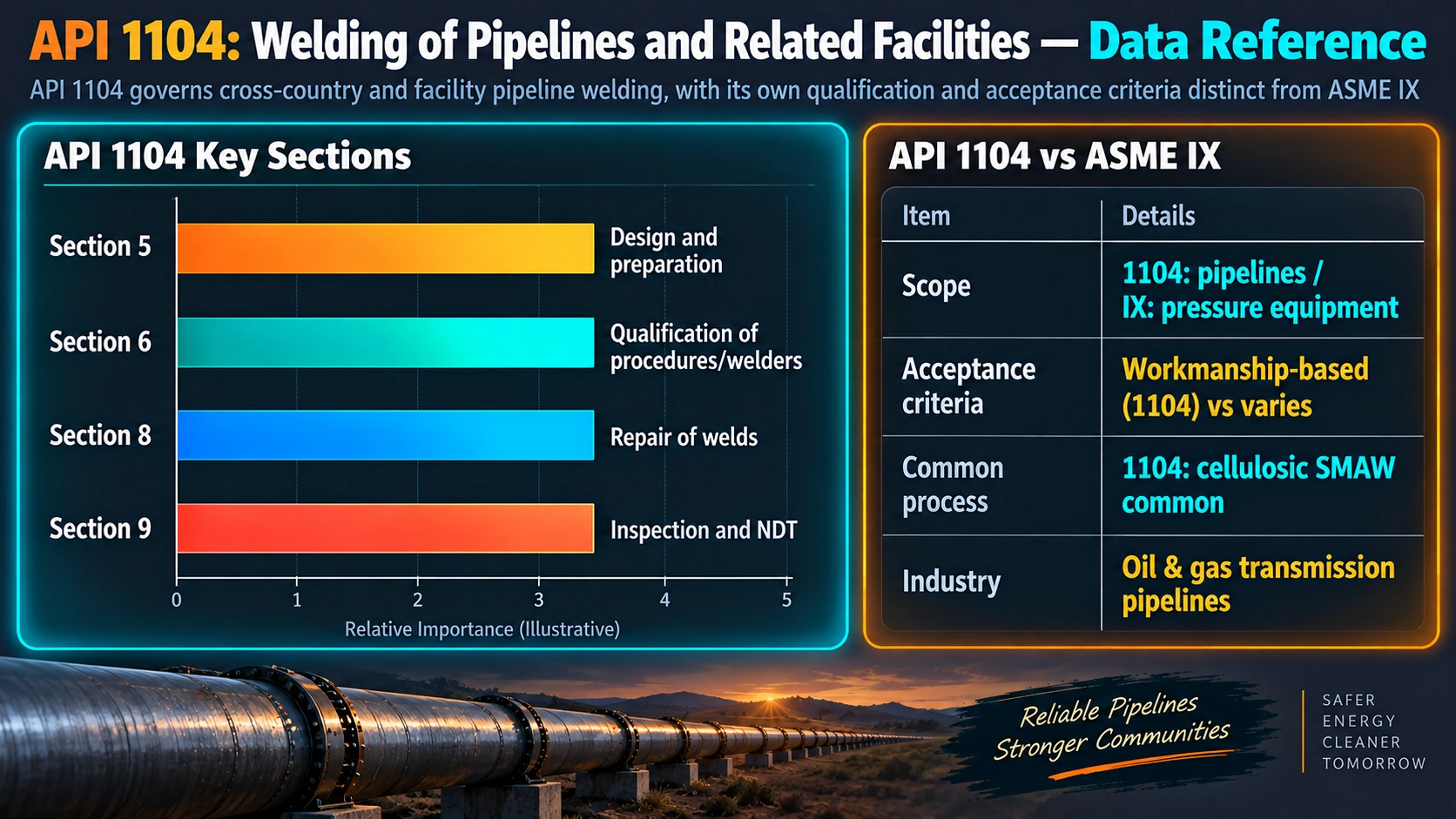
When inspection finds a weld that fails the applicable acceptance criteria, Section 10 governs what happens next. Defective material must be removed down to sound metal before any repair weld is made, and the repair itself must be executed under a qualified repair procedure — repair welding is not automatically covered by the original production WPS unless that WPS was specifically qualified to include repair. Preheat requirements often apply even more strictly to repair welds than to the original weld, because localized repair welding concentrates heat input into a smaller volume of material and increases the risk of hydrogen cracking in the surrounding heat-affected zone. After repair, the weld must be re-inspected using the same methods and criteria that applied to the original weld.
Limit the number of repair cycles permitted on a single weld location before requiring cut-out and replacement of the entire joint. Repeated localized reheating progressively coarsens the heat-affected zone microstructure and can reduce toughness, even when each individual repair passes its NDT.
In-Service Welding — Annex B
Annex B addresses welding performed directly on a pressurized, in-service pipeline — hot taps, sleeve installation, and certain repair techniques carried out without taking the line out of service. This is one of the more specialized and higher-risk activities covered anywhere in API 1104, because the welding arc is applied to a wall that is simultaneously being cooled internally by flowing product and loaded by internal pressure.
The two dominant hazards in in-service welding are burn-through (penetrating the remaining wall thickness while pressure is still applied) and hydrogen cracking from excessive cooling rate driven by the flowing product. Annex B imposes minimum remaining-wall-thickness requirements, restricts heat input and electrode size, and typically requires a project-specific procedure qualified specifically for in-service conditions rather than relying on a standard new-construction WPS.
API 1104 vs. ASME Section IX: Key Differences
Engineers moving between pipeline and pressure-equipment work often assume the two codes are interchangeable simply because both qualify welders and procedures. They are not, and the differences matter well beyond terminology.
| Aspect | API 1104 | ASME Section IX |
|---|---|---|
| Primary scope | Pipeline girth, fillet and branch welds: transmission, gathering, related facilities | Procedure and welder qualification for any product welded to an ASME construction code |
| Acceptance criteria included? | Yes — Section 9 (workmanship) and Annex A (ECA) are part of the same document | No — acceptance criteria come from the referencing construction code (e.g. Section VIII, B31.3) |
| Variable grouping system | API 1104-specific tables for base metal, filler metal, diameter and thickness categories | P-Number, F-Number, A-Number system (QW-420 / QW-432 / QW-442) |
| Repair and in-service welding | Built directly into the code (Section 10, Annex B) | Not addressed — governed by the construction code or jurisdiction |
| NDT methods specified | RT, MT, PT, UT, VT with procedures in Section 11 | Not specified — left to the construction code |
| US gas-pipeline recognition | Directly incorporated by reference (49 CFR Part 192) | Accepted as an alternative for welder qualification under the same regulation |
| Typical industry use | Upstream/midstream oil and gas pipeline construction | Pressure vessels, boilers, process and power piping |
The single most consequential practical difference is the first row: because API 1104 carries its own acceptance criteria, a pipeline inspector working strictly to API 1104 does not need to consult a separate construction code to decide whether a weld passes. An ASME Section IX-qualified inspector working on a pressure vessel, by contrast, always needs the governing Section (commonly Section VIII) for that decision, since Section IX itself is silent on it.
Regulatory Recognition in the United States
API 1104 carries legal weight in the US beyond its status as a voluntary industry consensus standard, because specific editions of it are incorporated by reference into the federal Pipeline Safety Regulations administered by PHMSA.
49 CFR Part 192 (gas pipelines) and Part 195 (hazardous liquid pipelines) both reference API 1104. Under 49 CFR §192.227, a welder or welding operator must be qualified under Section 6, Section 12, or Annex A of API 1104, or under ASME Section IX — both codes are explicitly accepted as alternatives for gas pipeline welder qualification. Under 49 CFR §192.241, weld acceptability for nondestructively tested or visually inspected production welds is determined under Section 9 or Annex A of API 1104; the regulation is explicit that the alternative criteria route may not be used to accept cracks. Because regulatory adoption of a new code edition often lags the code’s publication date by several years, always check the specific edition currently incorporated by reference at 49 CFR §192.7 and §195.3 before assuming the newest published edition automatically governs a given project.
Practical Engineering Notes and Common Pitfalls
A handful of recurring issues show up repeatedly in pipeline welding audits and CWI/CSWIP exam preparation alike:
- Confusing structural pipe with pressure pipeline. A pipe used as a structural support member is governed by a structural code, not API 1104. API 1104 applies specifically to piping that carries product under pressure as part of a transmission, gathering, or distribution system.
- Treating the 12 in. gauge length as a whole-weld total. Aggregate-length acceptance limits under Section 9 reset within each 12 in. (300 mm) segment of weld — summing every indication around the full 360-degree girth weld and comparing it to a single limit is a common and serious misapplication.
- Assuming Annex A is always available. The ECA route is conditional on the project specification, the AUT procedure, and the welding procedure jointly satisfying the annex’s prerequisites — it is not a fallback an inspector can invoke unilaterally when a weld fails Section 9.
- Overlooking preheat needs driven by carbon equivalent. Higher-strength line-pipe grades and thicker wall sections increase hydrogen-cracking risk; checking the carbon equivalent of the actual heat of pipe against the qualified preheat range avoids a common source of root-pass cracking on cold field joints.
- Letting welder continuity lapse unnoticed. Track WPQ continuity actively rather than relying on the original qualification date; for sour-service projects, also confirm NACE MR0175/ISO 15156 hardness requirements are layered correctly on top of the base API 1104 qualification.
Recommended References
The references below support deeper study of API 1104 and the surrounding qualification framework, useful for engineers building a project-specific quality plan and for candidates preparing for the AWS CWI Part C examination using API 1104 as their code book — see the full CWI/CSWIP certification guide for exam structure.
API Standard 1104 — Welding of Pipelines and Related Facilities
The current edition of the code itself. Essential for any engineer, inspector, or quality manager working on a project governed by API 1104.
View on AmazonAWS Certified Welding Inspector (CWI) Study Guide
Covers Part A fundamentals and Part C code-book navigation, including the API 1104 qualification and acceptance-criteria structure covered in this guide.
View on AmazonPipeline Welding Handbook
A field-oriented reference on pipeline welding practices, electrode selection, and joint preparation for cross-country and gathering-line construction.
View on AmazonProcedure Handbook of Arc Welding
A long-standing general arc-welding reference covering metallurgy, process selection, and qualification fundamentals that underpin API 1104 procedure work.
View on AmazonDisclosure: WeldFabWorld participates in the Amazon Associates programme (StoreID: neha0fe8-21). If you purchase through these links, we may earn a small commission at no extra cost to you. This helps support free technical content on this site.
Frequently Asked Questions
What is the current edition of API 1104?
The current edition is the 22nd edition, published in July 2021 with Errata 1 issued in September 2023. It replaced the 21st edition (September 2013) and revised welder requalification rules, mechanized and in-service welding definitions, and ultrasonic and radiographic inspection requirements for girth welds. Always confirm which edition a specific project specification or regulatory citation requires, since older qualifications remain valid for continued production even after a new edition is published.
What welding processes does API 1104 permit?
API 1104 recognizes seven welding processes: shielded metal arc welding (SMAW), submerged arc welding (SAW), gas tungsten arc welding (GTAW), gas metal arc welding (GMAW), flux-cored arc welding (FCAW), plasma arc welding (PAW), and oxyacetylene welding (OAW). Each process may be applied manually, semi-automatically, mechanized, or fully automatically. See the SMAW, GTAW, and SAW process guides for process fundamentals.
Does API 1104 apply outside the United States?
Yes. Although API 1104 is published by the American Petroleum Institute, it is referenced on pipeline projects in well over 100 countries and is frequently specified by international EPC contractors and operators alongside or instead of regional codes. Project specifications determine which code governs a given contract, and some jurisdictions mandate their own national standard in addition to API 1104.
What is the difference between Section 9 and Annex A acceptance criteria?
Section 9 applies fixed, empirical workmanship limits to imperfection size and aggregate length and is the default acceptance basis on most pipeline construction projects. Annex A allows an engineering critical assessment approach using fracture-mechanics test data to justify larger allowable flaw sizes than Section 9 permits, but only when the project specification, welding procedure, and automated ultrasonic testing procedure together satisfy the annex’s prerequisites. Crack-like indications remain rejectable under either system.
Can a welder qualified under ASME Section IX weld pipeline girth welds governed by API 1104?
In the United States, 49 CFR Part 192 permits welder qualification to either API 1104 or ASME Section IX as alternatives for gas pipeline welding, so a Section IX qualification can be acceptable depending on the operator’s program and the specific application. Outside that regulatory context, the controlling factor is always the project specification, and many pipeline owners require qualification specifically under API 1104 because its variables and joint rules are tailored to girth welds. Test your own command of the contrasting variable structure with the ASME Section IX practice quiz.
How often must a pipeline welder requalify under API 1104?
A welder’s qualification remains in effect only as long as continuity is maintained. Common practice, reflected in US federal pipeline safety regulation, is that a welder must produce at least one weld that passes the applicable acceptance criteria within roughly every six months, or requalify. If continuity lapses beyond the allowed interval, the welder must weld and successfully test a new test joint before resuming production welding.
What essential variables affect welder qualification under Section 6?
Section 6 essential variables include the welding process, welding direction, change of filler-metal group, pipe diameter category, wall-thickness category, welding position, joint design, and for some processes the electrical characteristics and shielding gas. A change outside the qualified range for any essential variable requires requalification. Diameter and wall-thickness ranges are broken into categories, so a welder qualified on a large-diameter, thick-wall joint generally also covers smaller, thinner combinations.
Is API 1104 mandatory in the United States?
API 1104 itself is a voluntary consensus standard, but specific editions of it are incorporated by reference into the US Pipeline Safety Regulations at 49 CFR Parts 192 and 195, which makes compliance with the referenced provisions a federal legal requirement for regulated pipelines. The specific edition required depends on which version PHMSA has currently adopted, so always verify the adopted edition rather than assuming the newest published edition automatically applies.