Welding Rods Compared: E6010, E6011, E6013, E7018 & E7024 — Complete Technical Guide
Choosing the right welding rod for a stick welding (SMAW) job is not a guess — it is a systematic engineering decision that affects weld strength, penetration, slag behaviour, joint cleanliness, and the risk of serious weld defects including hydrogen cracking, porosity, and incomplete fusion. The five electrodes covered in this guide — E6010, E6011, E6013, E7018, and E7024 — account for the vast majority of SMAW work done globally across structural fabrication, pipeline construction, pressure vessel manufacture, maintenance, and repair welding. Understanding exactly how each one works and when each one is appropriate is a foundational skill for any welder, inspector, or welding engineer.
This guide explains the AWS classification system from first principles, describes each electrode’s flux chemistry and how it controls arc behaviour, provides amperage setting reference data for every standard diameter, gives head-to-head comparisons for the most commonly confused pairs, and finishes with an interactive selection tool and a step-by-step selection methodology that you can apply to any SMAW job.
Understanding the AWS Electrode Classification System
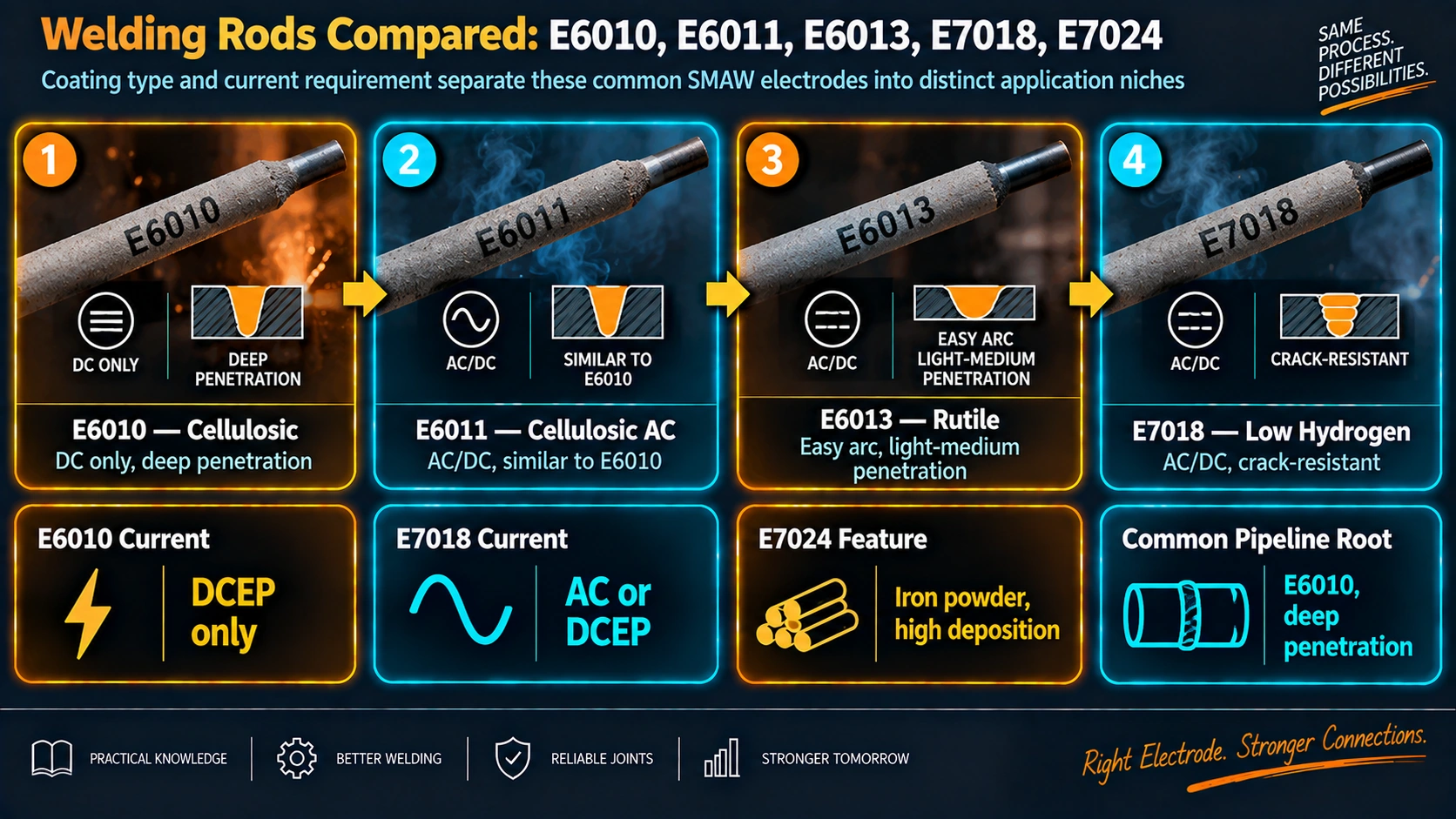
Every SMAW electrode sold in the United States and most international markets carries an AWS A5.1 or A5.5 classification code stamped on the coating near the grip end. This code is not arbitrary — every character carries a specific technical meaning that tells you the electrode’s mechanical properties, usable positions, and electrical requirements before you even strike an arc. Learning to read it fluently eliminates the most common source of electrode selection errors.
The Fourth Digit — Flux Coating and Current Type Explained
The fourth digit (and combined third-fourth digit) is the most nuanced part of the classification. It encodes flux type, polarity, and AC usability:
| 3rd & 4th Digits | Flux Coating Type | Current Type | Penetration | Example Rod |
|---|---|---|---|---|
| 10 | High cellulose sodium | DCEP only | Deep | E6010 |
| 11 | High cellulose potassium | DCEP or AC | Deep | E6011 |
| 12 | High titania sodium | DCEN or AC | Medium | E6012 |
| 13 | High titania potassium | DCEP, DCEN, or AC | Shallow | E6013 |
| 18 | Low hydrogen, iron powder (basic) | DCEP or AC | Medium | E7018 |
| 24 | Iron powder, titania (high iron powder %) | DCEN or AC | Shallow-Medium | E7024 |
| 28 | Low hydrogen, iron powder (flat/horiz.) | DCEP or AC | Medium | E7028 |
| 48 | Low hydrogen, iron powder (all positions, vertical down) | DCEP or AC | Medium | E7048 |
Electrode Behaviour Types: Fast-Freeze, Fast-Fill, and Fill-Freeze
Beyond the AWS classification digits, welding electrodes are usefully categorised by how their slag behaves in the weld pool. This categorisation directly determines which positions and joint configurations each electrode type is suited for.
| Behaviour Type | Slag Characteristics | Welding Positions | Penetration / Fill | Electrodes |
|---|---|---|---|---|
| Fast-Freeze | Slag solidifies rapidly behind the arc — provides support for the molten pool in out-of-position work | All positions including vertical and overhead | Deep penetration, narrow bead | E6010, E6011 |
| Fill-Freeze | Slag freezes moderately fast — balance between deposition and position versatility | All positions; some limitation overhead | Medium penetration, medium fill | E6012, E6013, E7018 |
| Fast-Fill | Slag is highly fluid — maximises deposition rate but cannot support the pool out of position | Flat and horizontal only | Shallow-medium penetration, wide bead, very high fill rate | E7024, E7028 |
E6010 — Deep Penetration, DC-Only Cellulosic Electrode
- Deepest penetration of all common SMAW electrodes
- Burns through rust, paint, mill scale, and galvanising
- Excellent for root pass welding in pipe and structural joints
- Fast-freeze slag supports the pool in all positions including overhead
- Light, easy-to-remove flaky slag (though somewhat papery)
- Industry standard for stovepipe and cross-country pipeline welding
- DCEP only — will not run on AC; requires a DC machine
- Arc is tight and erratic — demands more skill and a steady hand
- More spatter than rutile or low-hydrogen electrodes
- Whip-and-pause technique often required to control heat
- Higher hydrogen content than low-hydrogen rods — avoid on high-carbon steel without preheat
- Not suitable for critical structural or pressure vessel work where low hydrogen is mandated
E6011 — AC/DC Cellulosic Electrode
- Runs on both AC and DC — works with any transformer or inverter machine
- Deep penetration comparable to E6010
- Burns through surface contaminants (rust, paint, mill scale)
- AC arc is softer and slightly easier to control than E6010’s DC arc
- Good choice for home/hobbyist welders with AC-only machines
- Direct substitute for E6010 when DC power is unavailable
- Slightly more spatter than low-hydrogen electrodes
- Arc still somewhat erratic — more demanding than rutile rods
- Higher hydrogen content — use preheat on high-carbon steels
- Less aggressive penetration than E6010 on DCEP
- Not suitable for critical low-hydrogen applications
E6013 — General-Purpose Rutile Electrode
- Softest, most forgiving arc of all five rods — beginner-friendly
- Minimal spatter — clean bead appearance
- Slag removes with minimal effort (often self-releasing)
- Runs on AC, DCEP, or DCEN — maximum machine compatibility
- Good arc re-ignition — easy to restart after extinguishing
- Ideal for thin sheet metal where burn-through risk is high
- Shallow penetration — not suitable for root passes or thick sections
- Requires clean, prepared base metal — will not tolerate rust or paint
- 60,000 psi minimum tensile — lower strength than 70XX rods
- Not suitable for structural work requiring full-penetration joints
- Not appropriate for high-carbon or alloy steels
- Limited to lighter-duty fabrication and sheet metal work
E7018 — Low-Hydrogen Iron-Powder Electrode
- Highest tensile strength of all-position rods — 70,000 psi minimum
- Low hydrogen content prevents hydrogen-induced cold cracking (HIC)
- Smooth, stable arc with very low spatter — professional weld appearance
- Excellent mechanical properties including impact toughness at low temperatures
- Suitable for high-carbon, alloy, and high-strength low-alloy (HSLA) steels
- Iron powder in coating boosts deposition rate vs cellulosic rods
- The primary electrode specified in structural, pressure vessel, and code welding
- Heavy slag requires thorough chipping between passes
- Must be stored in sealed packets or a rod oven — moisture absorption destroys low-hydrogen integrity
- Requires rebaking (300–350°C for 1–2 hours) if exposed to atmosphere
- More expensive than rutile or cellulosic rods
- Cannot burn through contaminated surfaces — clean metal required
- Does not perform as well as E6010/E6011 for open root passes without backing
E7024 — High-Deposition Iron-Powder Electrode
- Highest deposition rate of all five electrodes — very fast fill
- Wide, slightly convex bead ideal for filling large flat-position groove welds
- 70,000 psi strength with good toughness at low temperature
- Can be dragged directly along the plate — very easy to use in flat position
- Suitable for thick plate fabrication in shipbuilding, bridges, structural steel
- Low hydrogen rating (when properly stored) — suitable for high-carbon steels
- Flat and horizontal positions only — cannot be used vertical or overhead
- Heavy, fluid slag that must be removed from all pockets and recesses
- Must be stored in moisture-free conditions like E7018
- Cannot penetrate contaminated surfaces — clean metal required
- Less suitable than E7018 for multi-pass out-of-position weld sequences
- Convex bead profile requires care to avoid trapped slag between passes
Master Comparison Table — All Five Electrodes
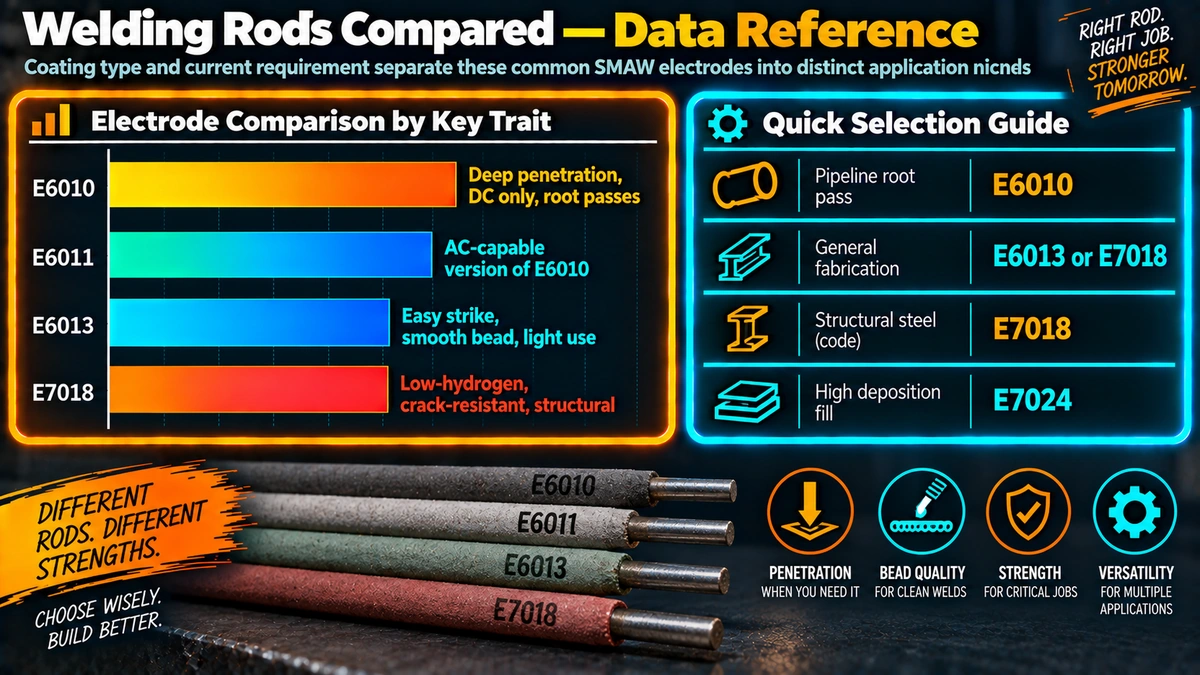
| Feature | E6010 | E6011 | E6013 | E7018 | E7024 |
|---|---|---|---|---|---|
| Tensile strength | 60,000 psi | 60,000 psi | 60,000 psi | 70,000 psi | 70,000 psi |
| Flux / Coating type | High cellulose sodium | High cellulose potassium | High titania potassium | Low hydrogen, iron powder (basic) | Iron powder, titania |
| Current type | DCEP only | DCEP or AC | AC, DCEP, or DCEN | DCEP (preferred) or AC | DCEN or AC |
| Welding positions | All positions | All positions | All positions | All positions | Flat & Horiz. only |
| Penetration | Deep | Deep | Shallow | Shallow–Medium | Shallow–Medium |
| Fill rate | Narrow | Narrow | Medium | Medium–Wide | Very wide / highest |
| Arc behaviour | Tight, forceful, erratic | Tight, slightly softer on AC | Soft, smooth, forgiving | Smooth, stable, quiet | Smooth, fluid puddle |
| Slag type | Light, flaky, papery | Light, flaky | Light, easy to remove | Heavy, thick | Heavy, fluid |
| Spatter level | Moderate–High | Moderate | Low | Low | Low |
| Hydrogen level | High (cellulosic) | High (cellulosic) | Medium | Low (<8 ml/100g) | Low (<8 ml/100g) |
| Surface tolerance | Excellent — burns through contamination | Excellent | Poor — clean metal only | Poor — clean metal only | Poor — clean metal only |
| Skill level required | Intermediate–Advanced | Beginner–Intermediate | Beginner | Intermediate | Beginner (flat position) |
| Special storage required? | No | No | No | Yes — rod oven required | Yes — rod oven required |
| Best for | Root passes, pipeline, dirty metal | Same as 6010 on AC machines | Sheet metal, learning, clean light fab | Structural, pressure vessel, all-position code work | Flat-position, thick plate, high-speed fill |
Head-to-Head Comparisons
E6010 vs E6011 — DC Specialist vs AC/DC Versatility
These two rods are functionally the closest pair on this list. Both use high-cellulose coatings, both produce deep-penetrating fast-freeze welds, and both can burn through surface contamination with equal effectiveness. The single defining difference is the addition of potassium to E6011’s flux, which stabilises the AC arc at the current zero-crossing — something that the sodium in E6010’s coating cannot do. On DC (DCEP), E6010 delivers a slightly more forceful, deeper-penetrating arc than E6011; on AC, E6011 has a softer, somewhat easier-to-control arc. If you have a DC machine, E6010 gives marginally better performance for root passes. If your machine only runs AC, E6011 is the only option in this family.
| Feature | E6010 | E6011 | Verdict |
|---|---|---|---|
| Current | DCEP only | DCEP or AC | 6011 is more versatile |
| Penetration (DCEP) | Slightly deeper | Deep (comparable) | 6010 marginally better on DC |
| Arc control | More demanding | Slightly softer on AC | 6011 easier for beginners on AC |
| Contaminated surfaces | Excellent | Excellent | Equal |
| Pipeline / root pass | Industry preferred | Acceptable substitute | 6010 preferred; 6011 when DC unavailable |
E6013 vs E7018 — Beginner Friendly vs Structural Standard
E6013 and E7018 are often confused by newcomers because both produce smooth arcs, low spatter, and clean-looking welds. The differences are significant: E7018 produces 70,000 psi minimum tensile strength versus E6013’s 60,000 psi; E7018 has a genuinely low-hydrogen deposit that prevents cold cracking in high-carbon and alloy steels; and E7018 is the electrode specified by virtually every structural, pressure vessel, and pipeline welding code for fill and cap passes. E6013 is limited to light fabrication on clean thin steel. Never substitute E6013 for E7018 on code-governed structural or pressure equipment welding — the resulting weld would be under-strength and potentially susceptible to cracking.
| Feature | E6013 | E7018 | Verdict |
|---|---|---|---|
| Tensile strength | 60,000 psi | 70,000 psi | 7018 significantly stronger |
| Hydrogen level | Medium | Low (<8 ml/100g) | 7018 for crack-sensitive steels |
| Arc ease | Softer, more forgiving | Smooth, slightly more demanding | 6013 for beginners |
| Code compliance | Not code-specified for structural | AWS D1.1, ASME IX qualified | 7018 for all code work |
| Slag removal | Easy — self-releasing | Requires effort | 6013 easier to clean |
| Application range | Thin, clean sheet only | Full range, any thickness | 7018 far broader scope |
E7018 vs E7024 — All-Position Workhorse vs Flat-Position Speed Machine
Both E7018 and E7024 produce 70,000 psi minimum tensile strength, both are low-hydrogen designs, and both are commonly used in structural and heavy fabrication. The critical difference is position capability: E7018 can be used in all positions including vertical and overhead; E7024 is strictly flat and horizontal only because its high iron-powder, fluid slag cannot be controlled out of position. In a flat-position production environment, E7024 offers measurably higher deposition rates and faster fill times — it is the production speed choice. For any work involving out-of-position passes, or for all-position structural certification, E7018 is the only option of the two.
| Feature | E7018 | E7024 | Verdict |
|---|---|---|---|
| Positions | All positions | Flat and horizontal only | 7018 far more versatile |
| Deposition rate | Medium–High | Highest | 7024 faster in flat position |
| Bead profile | Flat to slightly convex | Wide, convex | 7018 for multi-pass; 7024 for fill |
| Iron powder content | ~25% | Up to 50% | 7024 higher deposition |
| Production welding (flat) | Good | Excellent | 7024 preferred for speed |
| All-position code welding | Qualified for all positions | Not suitable | 7018 only option |
Amperage Reference Guide by Electrode and Diameter
Starting amperage is determined by electrode diameter and position. The ranges below represent typical manufacturer-recommended settings. Always consult the specific manufacturer’s data sheet for your electrode — actual ranges may vary by brand. For out-of-position welding (vertical or overhead), use the lower third of the range. For flat position fill passes, work toward the upper half. The correct setting produces a smooth, consistent crackling sound with minimal spatter and good pool control.
| Electrode | 2.0 mm (5/64″) | 2.5 mm (3/32″) | 3.2 mm (1/8″) | 4.0 mm (5/32″) | 4.8 mm (3/16″) | 5.0 mm (13/64″) |
|---|---|---|---|---|---|---|
| E6010 | — | 40–80 A | 75–125 A | 110–165 A | 140–200 A | 150–215 A |
| E6011 | — | 40–80 A | 75–125 A | 110–165 A | 140–200 A | 150–215 A |
| E6013 | 25–60 A | 40–85 A | 80–120 A | 110–160 A | 140–200 A | — |
| E7018 | — | 65–110 A | 90–150 A | 130–190 A | 170–250 A | 200–275 A |
| E7024 | — | — | 100–160 A | 150–220 A | 200–280 A | 230–310 A |
Interactive Electrode Selection Tool
Answer four questions about your job and we will recommend the best electrode from our five. This tool provides guidance — always verify against the applicable welding procedure specification (WPS) for code-governed work.
Step-by-Step Electrode Selection Guide
Use this systematic process for any SMAW job where you need to select an electrode from first principles — particularly useful when you encounter an unfamiliar material or application.
- Confirm the required weld strength. Check the design specification, welding procedure specification (WPS), or applicable code. If minimum 70,000 psi is required, immediately eliminate all E60XX electrodes and work from E70XX options only.
- Confirm the required welding positions. If the joint requires vertical or overhead passes, eliminate E7024 (flat and horizontal only). If the job is strictly flat-position production welding, E7024 is worth evaluating for speed.
- Assess the base metal for hydrogen cracking risk. Calculate or look up the carbon equivalent (CE). If CE > 0.40, or if the material is medium- or high-carbon steel, low-alloy steel, or any grade susceptible to cold cracking, a low-hydrogen electrode (E7018 or E7024 with proper storage) is mandatory. Cellulosic or rutile electrodes must not be used on these materials without preheat assessment and engineering approval.
- Inspect the base metal surface condition. If the metal is rusty, painted, galvanised, or has mill scale and full surface preparation is impractical, select a cellulosic electrode (E6010 or E6011). If the metal is clean and prepared, any electrode in the qualified class may be considered.
- Confirm the available power supply. If only AC is available, eliminate E6010 (DCEP only). E6011 (AC/DC) is the cellulosic substitute; E6013 and E7018 also run on AC.
- Consider material thickness and joint access. For thin sheet (below 3 mm), E6013 with low amperage reduces burn-through risk. For thick-section multi-pass welds, E7018 for all-position or E7024 for flat-position fill passes provides the needed deposition rate. For root passes in pipe, E6010 or E6011 are the standard choices.
- Check electrode diameter against plate thickness. A general rule: electrode diameter should not exceed the plate thickness for the root pass, and typically the first fill pass uses the same or next larger diameter. Over-sized electrodes on thin material cause burn-through; under-sized electrodes on thick material cause incomplete fusion and slow progress.
Frequently Asked Questions — Welding Rods
What do the numbers on a welding rod mean?
The AWS electrode designation follows the format E-XXYZ. The “E” stands for electrode. The first two digits indicate the minimum tensile strength of the deposited weld metal in thousands of psi — E60XX rods produce at least 60,000 psi, E70XX rods produce at least 70,000 psi. The third digit indicates usable welding positions: 1 = all positions; 2 = flat and horizontal only. The fourth digit — combined with the third — encodes the flux coating type, current type (AC, DCEP, or DCEN), and flux characteristics. For example, E7018 means: electrode, 70,000 psi minimum, all positions, low-hydrogen iron-powder coating usable on DCEP or AC.
What is the difference between E6010 and E6011?
E6010 and E6011 are closely related cellulosic electrodes with identical tensile strength, deep penetration, and fast-freeze characteristics. The key difference is current compatibility. E6010 uses a high-cellulose sodium coating and operates on DCEP only — it cannot run on AC. E6011 uses a high-cellulose potassium coating; the potassium stabilises the AC arc at the zero-crossing, allowing E6011 to run on both DCEP and AC. This makes E6011 the only cellulosic option when only a basic AC transformer machine is available. Both rods burn through surface contaminants and are used for root passes and pipeline welding. On DC, E6010 typically produces a marginally more forceful, deeper-penetrating arc.
Why does E7018 require special storage and baking?
E7018 is a low-hydrogen electrode — its basic flux coating limits the diffusible hydrogen content of the weld deposit to below 8 ml/100g. This low hydrogen level is critical for preventing hydrogen-induced cold cracking in carbon and low-alloy steel welds. The flux coating readily absorbs atmospheric moisture, and any absorbed moisture converts to diffusible hydrogen in the arc. To maintain low-hydrogen integrity, E7018 must be stored in sealed packets or a rod oven at 60–120°C and rebaked at 300–350°C for 1–2 hours if exposed to open air for more than 2 hours. Moisture-contaminated E7018 rods are a common cause of porosity and cold cracking in structural and pressure vessel fabrication.
What is E6013 best used for?
E6013 is best used for general-purpose welding on clean, thin-to-medium carbon steel. Its soft, easily controlled arc with shallow penetration makes it ideal for sheet metal fabrication, light structural work, hobbyist projects, and training environments. The slag cleans away easily, spatter is minimal, and the arc re-ignites smoothly on AC, DCEP, or DCEN. Its limitations are clear: it is not suitable for dirty, rusty, or painted surfaces; it produces lower-strength weld deposits than E7018; and its shallow penetration makes it unsuitable for thick sections or root pass welding. Never substitute it for E7018 on code-governed structural or pressure equipment work.
When should I use E7024 instead of E7018?
Use E7024 when maximum deposition rate is the priority and the joint is strictly flat or horizontal — E7024 cannot be used in vertical or overhead positions because its iron-powder-rich, fluid slag cannot be controlled out of position. E7024 is ideal for filling large groove welds in thick structural plate, shipbuilding, bridge fabrication, and heavy structural steel in flat-position production environments. E7018, by contrast, is an all-position electrode with full position capability and slightly better low-temperature toughness. Choose E7024 for flat/horizontal production welding on thick plate where speed matters; choose E7018 for all-position structural, pressure vessel, and code-governed work.
Can I use E6013 on rusty or painted metal?
No. E6013 is not designed for contaminated surfaces. Its rutile flux does not generate the aggressive, deep-penetrating arc needed to burn through rust, paint, galvanised coatings, or mill scale. Using E6013 on contaminated surfaces produces porosity, lack of fusion, and structurally compromised welds. For welding on dirty, rusty, painted, or galvanised metal, use E6010 or E6011 — their high-cellulose coatings generate a forceful, deep-penetrating arc that burns through surface contaminants and produces sound welds despite imperfect preparation.
What amperage should I use for a 3.2 mm (1/8 inch) E7018 electrode?
For a 3.2 mm E7018 electrode, the typical range is 90 to 150 amps on DCEP. The lower end (90–110 A) is appropriate for out-of-position welding (vertical, overhead) and root passes. The middle range (110–130 A) suits general flat and horizontal fabrication on 6–12 mm plate. The upper range (130–150 A) is used for flat position fill passes on thicker material. Always start at the middle of the range and adjust based on arc behaviour — a correct setting produces a smooth, even crackling sound with minimal spatter and good fusion into both sidewalls and the root.