Heliarc Welding — What It Is, History, How It Works & Complete GTAW Guide
Heliarc welding is one of the most significant technological developments in twentieth-century manufacturing — not a niche historical curiosity, but the foundational process that made modern aerospace, nuclear, pharmaceutical, and precision fabrication industries possible. When Russell Meredith patented the process in 1941, he solved a problem that had blocked welding engineers for decades: how do you create a clean, reliable, high-integrity fusion weld on aluminium, magnesium, and stainless steel without contamination from the atmosphere destroying the weld? His answer — envelope the tungsten arc and the weld pool in a continuous flow of inert gas — was elegant, and its consequences were profound.
Today, heliarc welding is universally known by two alternative names: TIG (Tungsten Inert Gas) welding and GTAW (Gas Tungsten Arc Welding), the latter being the formal AWS designation. All three names refer to exactly the same process. The “heliarc” label persists primarily among older welders and in historical references — but if a welding procedure specification (WPS), client document, or foreman on a job site says “heliarc,” they mean GTAW. The only practical question worth asking is whether they specifically require helium as the shielding gas, since the original process used helium but modern practice typically uses argon or argon blends.
This guide covers the complete technical picture: the history and invention, how the process works from first principles, the choice between helium and argon shielding, tungsten electrode types and preparation, current and polarity selection, advanced TIG techniques including pulse and AC balance control, the full range of industrial applications, and an honest comparison with MIG and stick for those deciding which process to use or learn.
What Is Heliarc Welding? — The Name Explained
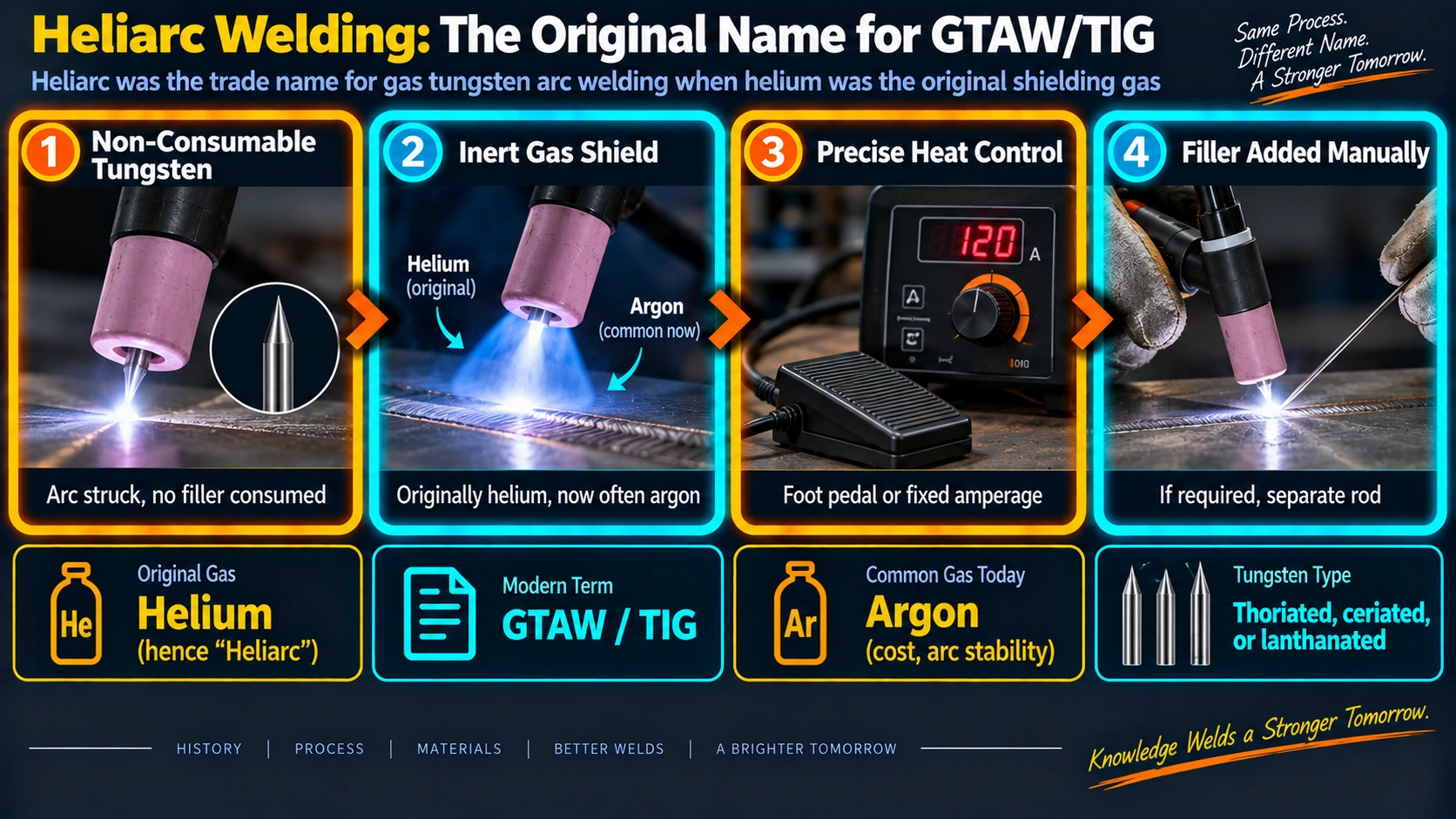
The name “heliarc” is a compound of two words that describe the two defining features of the original process: helium (the inert shielding gas) and arc (the electrical arc struck between a non-consumable tungsten electrode and the workpiece). Together, these two components solve the fundamental challenge of welding reactive metals — the arc provides the heat needed to fuse the base metal, and the inert gas blanket completely excludes oxygen, nitrogen, and water vapour from the weld pool, preventing oxide formation, nitrogen porosity, and other contamination mechanisms that would otherwise make the weld worthless.
History — From Northrop Aircraft to the Moon
The story of heliarc welding is inseparable from the story of twentieth-century aviation and the critical manufacturing challenges it created. To understand why the process was so revolutionary, you need to understand the problem it solved.
How Heliarc / GTAW Works — The Process Explained
The mechanics of GTAW are elegant in their simplicity. A non-consumable tungsten electrode — chosen for its extremely high melting point of approximately 3,422°C (6,192°F) — is mounted in a water-cooled or air-cooled torch. An electrical arc is struck between the tip of the tungsten electrode and the base metal workpiece. This arc generates temperatures at the arc column of 10,000 to 20,000 K — far in excess of the melting point of any structural metal. The base metal melts locally to form a weld pool. A continuous flow of inert shielding gas (typically argon, sometimes helium or an argon-helium blend) exits through the torch nozzle surrounding the electrode, enveloping the arc and the weld pool and completely preventing any contact with atmospheric oxygen, nitrogen, or water vapour.
Shielding Gases — Helium vs Argon
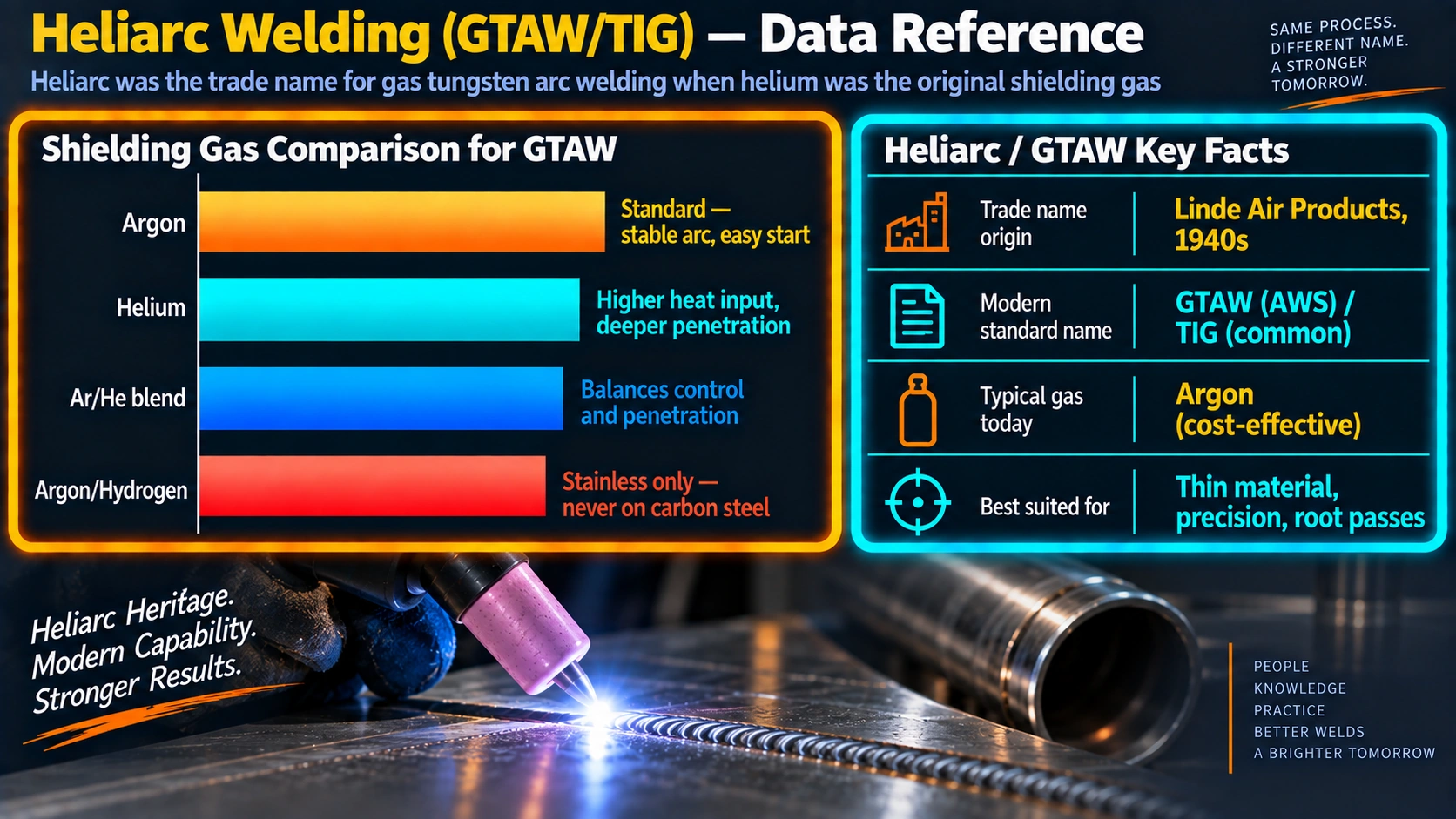
The choice between helium and argon as the shielding gas — the question that the “heliarc” name implicitly raises — is one of the most practically significant decisions in GTAW setup. Although both gases provide the inert protection required to prevent atmospheric contamination of the weld pool, they behave very differently in the arc and produce distinctly different weld bead profiles.
- Higher arc voltage produces a hotter, more energetic arc
- Greater thermal conductivity — more heat transferred to base metal
- Better penetration profile — wider, deeper weld bead
- Higher travel speeds achievable on aluminium and copper
- Better for automated orbital TIG on stainless — faster travel
- Significantly more expensive than argon (3 to 5 times the cost)
- Arc is less stable and harder to start compared to argon
- Higher flow rates required for equivalent shielding coverage
- Limited availability outside the United States
- Not suitable for beginners — more demanding arc management
- Stable, smooth arc — easiest to initiate and maintain
- Lower arc voltage — better control on thin material
- Significantly less expensive than helium
- Widely available globally in consistent supply
- Standard for nearly all manual GTAW work
- Better cleaning action in AC mode for aluminium
- Lower heat input than helium at the same current
- Slower travel speeds on thick aluminium and copper
- Not ideal for very thick sections where maximum penetration is needed
| Application | Recommended Shielding Gas | Notes |
|---|---|---|
| Carbon and low-alloy steel (manual) | 100% Argon | Standard for all manual GTAW on steel; excellent arc stability |
| Stainless steel (manual) | 100% Argon | Standard; some specifications add 2–5% H2 for hotter arc and improved penetration on austenitic SS |
| Aluminium (manual) | 100% Argon (AC) | Argon AC is the universal standard for manual aluminium TIG; helium blends used for thick sections |
| Aluminium (thick section or automated) | Ar/He blend (25–75% He) or 100% He | Helium addition increases heat input and travel speed; beneficial for sections >10 mm |
| Copper and copper alloys | 100% Helium or Ar/He blend | Copper’s high thermal conductivity requires the hotter arc of helium for adequate penetration |
| Titanium | 100% Argon with trailing shield | Titanium is extremely sensitive to oxygen and nitrogen; argon trailing shield and back purge are mandatory |
| Pipe root passes (back purge) | 100% Argon (purge) + 100% Argon (torch) | Back purge with argon prevents oxidation of the internal root bead on stainless steel and alloy steel piping |
Current and Polarity — DCEN, DCEP, and AC
Current type and polarity is the most consequential setup decision in GTAW after shielding gas selection. The three available options — DCEN, DCEP, and AC — are not interchangeable, and selecting the wrong one for a given material can prevent fusion, destroy the tungsten electrode, or produce structurally defective welds.
| Current / Polarity | Heat Distribution | Tungsten Wear | Cleaning Action | Best For |
|---|---|---|---|---|
| DCEN (DC Electrode Negative) Straight polarity | ~70% at workpiece, ~30% at tungsten | Minimal — good electrode life | None | Steel (carbon and alloy), stainless steel, titanium, nickel alloys, copper — all metals except aluminium and magnesium in normal service |
| DCEP (DC Electrode Positive) Reverse polarity | ~30% at workpiece, ~70% at tungsten | Severe — electrode overheats rapidly | Strong cathodic cleaning — breaks up oxide films | Rarely used today; historically for aluminium before AC became standard; very limited current (typically below 100 A) with large-diameter tungsten |
| AC (Alternating Current) | Alternates each half-cycle — balanced between EN and EP half-cycles | Moderate — balled electrode tip forms | Cleaning during EP half-cycle; penetration during EN half-cycle | Aluminium, magnesium, and their alloys — the standard for all aluminium TIG welding because the cleaning action breaks up the tenacious Al2O3 oxide layer |
Tungsten Electrode Types and Selection
The tungsten electrode is the heart of the GTAW process. Its choice, preparation, and condition directly affect arc stability, weld bead width, penetration, and contamination risk. Tungsten is used because its melting point of 3,422°C (the highest of all metallic elements) allows it to maintain its geometry and remain effectively non-consumable under normal GTAW arc conditions. Small quantities of oxide additives are alloyed into commercial welding tungstens to improve electron emission, arc starting, and arc stability.
Tungsten Preparation — Grinding the Tip
For DCEN welding (steel, stainless, titanium), the tungsten tip should be ground to a tapered point. The included angle of the taper affects arc stiffness and bead width — a more acute angle (10 to 15 degrees) produces a stiffer, more concentrated arc with narrower penetration, preferred for thin material and root passes. A blunter angle (30 to 45 degrees) spreads the arc and is used for thicker material where wider penetration is needed. Grinding must be done with the electrode axis parallel to the grinding wheel rotation direction — grinding circumferentially (across the electrode) creates grinding marks perpendicular to the arc direction that cause the arc to wander erratically.
Equipment — Torch, Power Source, and Accessories
A complete GTAW system consists of five main components, each of which must be correctly specified and maintained for consistent weld quality.
| Component | Function | Key Selection Criteria |
|---|---|---|
| TIG Torch | Holds the tungsten electrode, delivers shielding gas, and transmits welding current to the arc | Air-cooled (up to ~200 A, lighter, simpler) vs water-cooled (up to 500+ A, required for high-current and sustained welding); torch size matched to current range; flexible or rigid neck |
| Power Source | Provides controlled AC or DC welding current with HF arc starting, pre-flow, post-flow, and optional pulse functions | AC capability required for aluminium; inverter-based units offer pulse, AC balance, AC frequency, and waveform control; must provide stable output at the lowest currents used for thin material (<10 A for very thin stainless) |
| Foot Pedal / Finger Control | Allows continuous, real-time amperage adjustment during welding — the key to TIG heat control precision | Foot pedal for bench or flat work; finger control thumb slider for pipe and out-of-position work where a foot pedal is not accessible |
| Gas Regulator and Flowmeter | Controls the shielding gas flow rate from the cylinder to the torch | Flow rates: 6–12 L/min (argon) for most manual work; higher flows needed for larger torch cup diameters and for helium (which is lighter than air and rises rather than covering the weld pool as effectively at low flow rates) |
| Back Purge System | Delivers inert gas (argon) to the back face of a weld to prevent oxidation of the root bead | Mandatory for stainless steel, duplex SS, titanium, and other reactive metal pipe joints; purge dams or plug bags seal the pipe bore on either side of the joint; purge flow rate and oxygen content monitoring (below 50 ppm O2) are critical for quality |
Advanced Techniques — Pulse TIG, AC Balance, and Waveform
Modern inverter-based TIG power sources offer a range of advanced process controls that go far beyond the simple current level available on the original heliarc equipment. Mastering these controls is what separates competent TIG welders from truly skilled practitioners — and what commands the salary premium that experienced GTAW welders earn in the market.
Pulse TIG
Pulsed GTAW alternates between a high peak current and a low background current at a defined frequency (measured in hertz). The peak current provides the heat and penetration needed for fusion; the background current keeps the arc alive and maintains heat but allows the weld pool to partially solidify and cool. Benefits of pulse TIG include reduced average heat input (less distortion, smaller HAZ, better sensitisation control in stainless steel), improved control on thin material, and better puddle control in out-of-position welding. High-frequency pulse (above 100 Hz) produces a stiffer, narrower arc that improves penetration and bead appearance on stainless steel.
AC Balance Control
In AC TIG welding for aluminium, the “balance” control adjusts the proportion of time the current spends in the electrode-negative (EN) half-cycle versus the electrode-positive (EP) half-cycle. More EP time increases cleaning action (removing the oxide layer more aggressively) but generates more heat at the tungsten electrode, requiring a larger diameter or balled-type tungsten. More EN time increases penetration and reduces heat at the tungsten but provides less cleaning. Typical balance settings for aluminium are 65–70% EN and 30–35% EP. The balance must be adjusted based on the thickness of the oxide layer on the aluminium — heavily oxidised or anodised aluminium requires more EP for effective cleaning.
AC Frequency Control
Modern inverter TIG machines allow the operator to adjust the AC frequency from approximately 20 Hz to 250 Hz or higher. Lower frequencies (20–60 Hz) produce a wider, softer arc with more cleaning action — preferred for thick-section aluminium. Higher frequencies (100–200 Hz) concentrate the arc into a tight, stiff column that produces a narrower weld bead and better penetration for cosmetically precise aluminium welding. High-frequency AC TIG is the standard technique for producing the distinctive “stack of dimes” bead appearance seen in high-quality aluminium fabrication.
Industrial Applications
GTAW/TIG is the process of choice wherever weld quality, material versatility, and joint integrity take precedence over deposition speed. Its applications span essentially every sector of precision manufacturing.
| Industry | Application | Why TIG Is Specified |
|---|---|---|
| Aerospace | Aircraft frames, engine cowlings, fuel systems, landing gear, rocket structures (Saturn V, SpaceX Starship) | No contamination, highest fatigue resistance, weldable on aluminium and titanium alloys, x-ray quality joints mandated by design |
| Nuclear Power | Reactor pressure vessels, primary circuit piping (SS and Inconel), fuel rod assemblies | ASME III mandates GTAW for root passes on all Class 1 piping; zero tolerance for porosity, inclusions, or cracking in primary circuit welds |
| Oil and Gas / Petrochemical | Stainless steel and duplex SS piping root passes, alloy steel pressure vessel nozzle welds, subsea components | Root pass quality and corrosion resistance of the internal weld surface; back-purged TIG root passes are specified for all high-alloy process piping |
| Pharmaceutical / Food Processing | Hygienic stainless steel pipework, sanitary vessels, clean-room equipment | Orbital TIG produces smooth, crevice-free internal weld surfaces essential for CIP (clean-in-place) compliance; no slag or spatter contamination of product-contact surfaces |
| Motorsport and Automotive | Roll cages, chassis tubes, exhaust manifolds, suspension components, titanium brake lines | Minimum weight with maximum strength; visual bead quality as part of product aesthetics; aluminium and titanium component joining |
| Shipbuilding (Aluminium) | Aluminium superstructures, lightweight naval vessels, high-speed ferry hulls | Aluminium requires AC TIG for oxidise removal; TIG provides the precision needed for thinner aluminium structural sections |
| Semiconductor and Electronics | Ultra-clean stainless steel and Inconel process equipment, semiconductor fab tooling | Absolute cleanliness — no contamination of internal surfaces; electropolishable weld beads; orbital automated TIG for consistency |
Advantages and Disadvantages
| Advantage | Detail |
|---|---|
| Cleanest welds of any arc process | No slag, no flux, no spatter, no flux inclusions. The weld deposit is as clean as the process can produce, limited only by base metal and filler metal purity and surface preparation. TIG welds pass radiography and ultrasonic examination more reliably than any other arc welding process. |
| Widest material range | Virtually any metal can be TIG welded — all steels, stainless, aluminium, magnesium, copper, copper alloys, titanium, nickel alloys, cobalt alloys, gold, silver, and many exotic alloys. No other single arc welding process covers this range. |
| Precise heat control | The foot pedal amperage control and the independent torch/filler feeding technique give the welder more independent control over heat input and deposition than any other manual arc process. This is essential for thin material, complex joint geometries, and dissimilar metal joints. |
| Autogenous capability | TIG can fuse joints without any filler metal — an important capability for thin sheet metal and precision joints where filler addition would add unwanted volume or create a dissimilar material interface. |
| Root pass quality for pipe | The GTAW root pass produces the smoothest, most consistent internal root bead of any arc process — essential for piping systems where internal surface quality affects fluid flow, corrosion resistance, and hygiene. |
| Disadvantage | Detail |
|---|---|
| Low deposition rate | TIG is significantly slower than MIG and far slower than flux-cored or submerged arc welding. For high-volume production on thick carbon steel, TIG is rarely economical and is used only where its quality advantages justify the cost. |
| High skill requirement | Simultaneously managing torch position, filler rod feeding, foot pedal amperage, arc length, travel speed, and weld pool observation requires significant practice. New welders typically require months to achieve acceptable TIG welds; achieving professional certification-quality welds takes years. |
| Tungsten contamination sensitivity | Any contact of the tungsten with the weld pool, filler rod, or contaminated base metal immediately degrades arc quality and potentially contaminates the weld. The electrode must be reground and the weld inspected when contamination occurs. |
| Not suitable for windy outdoor conditions | Unlike SMAW (stick welding), the GTAW shielding gas can be dispersed by wind — even a light breeze can remove gas coverage from the weld pool, causing severe porosity and oxidation. Wind shielding or enclosed environments are required for outdoor TIG welding. |
| High equipment cost | A quality inverter TIG power source with AC capability, HF start, pulse, and waveform control costs significantly more than an equivalent MIG or stick machine. Water-cooled torch systems add further cost. The total investment in TIG equipment is higher than for simpler processes. |
Heliarc / TIG vs MIG vs Stick Welding
| Feature | TIG / Heliarc (GTAW) | MIG (GMAW) | Stick (SMAW) |
|---|---|---|---|
| Weld quality | Highest — no slag, clean | Good — low spatter with correct settings | Acceptable — slag removal required |
| Deposition rate | Slowest | High — continuous wire feed | Moderate — limited by electrode length |
| Material range | Widest — all metals | Carbon steel, SS, aluminium (MIG/pulse) | Carbon and low-alloy steel primarily |
| Skill required | Highest | Moderate | Moderate to high (position welding) |
| Aluminium welding | Excellent (AC TIG) | Good (pulse MIG) | Very limited — specialist electrodes only |
| Outdoor use (wind) | Poor — gas coverage disrupted | Poor — gas coverage disrupted | Excellent — self-shielded |
| Thin material (<2 mm) | Excellent — precise heat control | Moderate — short-circuit MIG | Poor — burn-through risk |
| Contaminated surfaces | Poor — requires clean metal | Moderate | Good (E6010/E6011 electrodes) |
| Equipment cost | High | Moderate–High | Low |
| Best for | Precision, aerospace, SS, Al, critical root passes, any metal | Production carbon and stainless steel fabrication | Site work, maintenance, contaminated surfaces, thick steel |
Materials Welded by GTAW
One of the defining advantages of GTAW is its breadth of material applicability. The following covers the most common base metals encountered in industrial GTAW practice.
| Material | Current / Polarity | Shielding Gas | Filler Metal | Special Notes |
|---|---|---|---|---|
| Carbon steel | DCEN | 100% Argon | ER70S-2 or ER70S-6 | Standard; back purge for pipe root passes |
| 304/304L Stainless | DCEN | 100% Argon | ER308L | Back purge mandatory for pipe; interpass temp <150°C |
| 316/316L Stainless | DCEN | 100% Argon | ER316L | Same as 304L; Mo content preserved in low-dilution TIG root |
| Duplex SS (2205) | DCEN | Argon + 2% N2 | ER2209 | Heat input 0.5–1.5 kJ/mm; interpass <150°C; back purge with Ar+N2 |
| Aluminium 6061 | AC | 100% Argon | ER4043 or ER5356 | Preheat for thick sections; clean oxide thoroughly before welding |
| Aluminium 5083 | AC | 100% Argon | ER5183 or ER5356 | Marine grade; no preheat required for standard thickness |
| Titanium | DCEN | 100% Argon + trailing shield | ERTi-2 (commercially pure) or matched grade | Trailing shield and back purge mandatory; titanium above 400°C is extremely reactive |
| Inconel 625 | DCEN | 100% Argon | ERNiCrMo-3 | Low heat input; very slow interpass cooling; crevice-free root pass for corrosion resistance |
| Copper | DCEN | 100% Helium or Ar/He | ERCu or ERCuSi-A | High preheat required (150–300°C) due to very high thermal conductivity |
Frequently Asked Questions — Heliarc / GTAW Welding
What is heliarc welding and is it different from TIG welding?
Heliarc welding and TIG welding are the same process — gas tungsten arc welding (GTAW). The name “heliarc” was coined by Russell Meredith of Northrop Aircraft when he patented the process in 1941 because the original technique used helium as the shielding gas and a tungsten arc electrode. As argon became the dominant shielding gas, the terms TIG (Tungsten Inert Gas) and GTAW became standard. Today, if someone specifies heliarc welding, they mean TIG/GTAW. The only practical question is whether they specifically want helium as the shielding gas — if it is not separately specified, ask for clarification.
Who invented heliarc welding and when?
Heliarc welding was invented by Russell Meredith, an engineer at Northrop Aircraft in California, who patented the process in 1941. Meredith developed the process to solve the critical challenge of welding aluminium and magnesium alloys for aircraft construction — materials that could not be reliably welded by any existing process because their molten weld pools reacted immediately with atmospheric oxygen. His solution was to envelope the tungsten arc and the weld pool in a continuous flow of inert helium gas, completely excluding the atmosphere. The process was immediately adopted across the US defence industrial base during World War II, transforming aircraft and military equipment manufacturing.
Why is helium used in heliarc welding instead of argon?
The original heliarc process used helium because it was the only commercially available inert gas in the US in 1941 in sufficient quantity for industrial use. Argon, though technically superior in most respects, was not yet produced commercially at scale. Today, argon is the standard shielding gas for most TIG applications because it is less expensive, produces a more stable arc, and is available globally. Helium or helium-argon blends are still used in specific applications where helium’s higher thermal conductivity and hotter arc profile are beneficial — particularly for thick-section aluminium and copper welding where maximum heat input and penetration are needed.
What current and polarity does TIG/heliarc welding use?
GTAW uses three current configurations. DCEN (direct current electrode negative) is the most common — used for steel, stainless, titanium, and most metals. It concentrates about 70% of arc heat at the workpiece for maximum penetration with minimal tungsten wear. DCEP (electrode positive) concentrates heat at the tungsten and provides cathodic cleaning — rarely used today because AC has replaced it for aluminium. AC (alternating current) is the standard for aluminium and magnesium because it alternates between the EN half-cycle (penetration) and the EP half-cycle (oxide cleaning action that removes the tenacious Al2O3 film that prevents fusion in aluminium).
What are the main advantages of heliarc/TIG welding over MIG and stick?
TIG/GTAW offers the cleanest welds of any arc process (no slag, no spatter, no flux contamination), the widest material range (all metals including aluminium, titanium, nickel alloys, and exotic materials), the most precise heat control via foot pedal, and autogenous (no-filler) welding capability for thin material. The main disadvantages are the slow deposition rate, high skill requirement, sensitivity to tungsten contamination, and poor performance in windy outdoor conditions where the shielding gas is disrupted. TIG is the process of choice wherever quality and material versatility take precedence over welding speed.
What industries use heliarc/TIG welding today?
GTAW/TIG is used across virtually every high-precision manufacturing and fabrication industry. Key sectors include aerospace (aircraft frames, rocket structures including SpaceX Starship), nuclear power (primary circuit piping and reactor pressure vessels), pharmaceutical and food processing (hygienic stainless steel pipework requiring orbital TIG), oil and gas (stainless and alloy steel piping root passes), motorsport (roll cages, titanium components), shipbuilding (aluminium superstructures), and semiconductor manufacturing (ultra-clean process equipment). TIG remains the process of choice wherever weld quality, material versatility, and joint appearance take precedence over welding speed.