Thermal Spray Welding: Complete Guide to Processes & Equipment
Thermal spray is not a single welding process — it is a family of surface engineering techniques united by one principle: a feedstock material is melted or softened, accelerated by a gas jet, and deposited as a coating on a substrate. Depending on the heat source, particle velocity, and feedstock form, the process can range from low-cost flame spraying to the highly engineered HVOF and plasma transferred arc (PTA) systems used in aerospace and energy sectors. This guide covers every major thermal spray process in technical depth, including arc spray, flame spray, HVOF, PTA, detonation gun, and cold spray — along with equipment requirements, substrate preparation, selection criteria, and a process comparison.
What is Thermal Spray Welding?
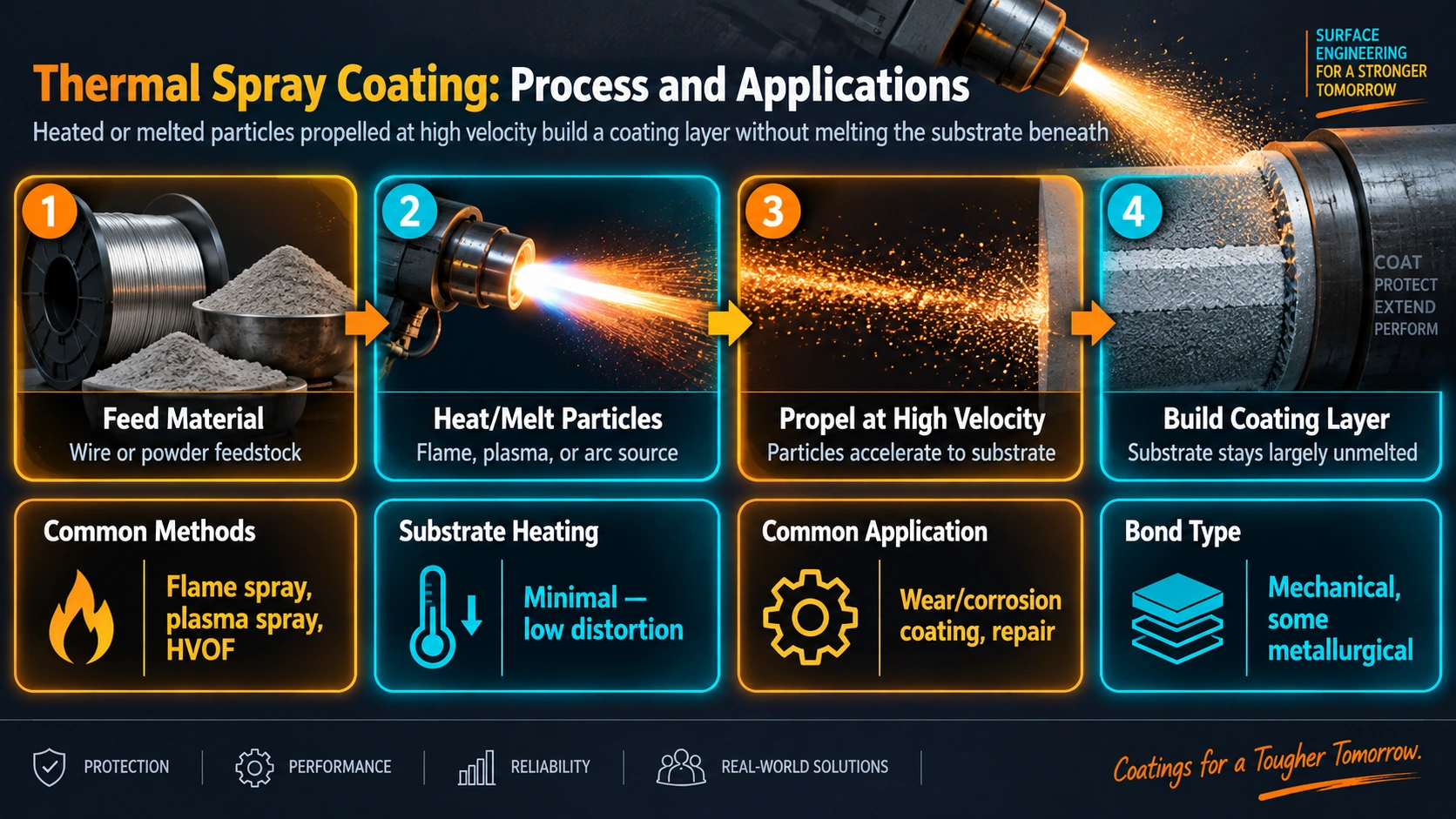
Thermal spray welding is an umbrella term for a group of surface coating processes in which a feedstock material — supplied as a wire, rod, or powder — is melted or softened by a heat source and then propelled onto a prepared substrate by a compressed gas or atomization jet. The arriving particles flatten (splat), interlock, and solidify in successive layers to form a dense, adherent coating.
Unlike conventional fusion welding, thermal spray does not form a metallurgical bond with the parent material in most process variants. The bond is primarily mechanical, achieved through surface anchoring in a rough, blasted substrate. The exception is the fused spray-and-fuse variant, where a self-fluxing alloy powder is applied and then re-fused with an oxyacetylene torch or furnace to create a true metallurgical bond.
The six principal thermal spray processes are:
How Thermal Spray Works — The Core Mechanism
Regardless of process variant, all thermal spray systems share a common sequence: feedstock heating → particle acceleration → impaction → coating formation. Understanding each stage is key to controlling coating quality.
Feedstock Heating
The heat source can be a combustion flame, DC electric arc, plasma arc, or supersonic combustion chamber, depending on the process. In most processes, the feedstock is fully melted; in cold spray, only the carrier gas is heated and the particles remain below their melting point.
Particle Acceleration
Molten or semi-molten particles are entrained in a high-velocity gas stream. Particle velocity at impact ranges from approximately 50 m/s for flame spray up to 1000 m/s for cold spray. Higher impact velocity generally produces denser, stronger coatings.
Impaction and Splat Formation
When a particle strikes the substrate, it flattens into a thin disc (splat) and cools rapidly — often at rates exceeding 106 °C/s. Successive splats interlock over the roughened substrate asperities to create the coating’s mechanical bond. Porosity arises when particles do not fully deform or when gases are trapped between splats.
Coating Buildup
Coating thickness is controlled by the number of passes, spray distance, and deposition rate. Thermal spray can produce coatings from 0.025 mm (25 µm) up to several millimetres in thickness, with the working range for most applications being 0.1 mm to 2.0 mm.
Arc Spray Process (TWAS / TSA)
Arc spray, also called Twin Wire Arc Spray (TWAS) or Thermal Spray Arc (TSA), is the most energy-efficient thermal spray process for metallic coatings. Two consumable wires of the coating material are fed through the spray gun and connected to opposite polarities of a DC power source. At the gun nozzle, the wires converge and create a sustained arc that melts the wire tips continuously.
Compressed air (or inert gas for oxidation-sensitive alloys) is then directed through the arc zone, atomising the molten metal into fine droplets and propelling them toward the substrate. The droplets interlock on the surface to form the coating.
Arc Spray — How the Arc Mode Works
Arc spray requires operation above the transition current level — the amperage at which the droplet transfer mode changes from globular to spray. Below this threshold, wire ends contact the substrate (short circuit transfer), producing coarse droplets and a rough, porous coating. At and above the transition level, the wire tip forms a conical point and very fine droplets are projected in a focused plume.
Arc Spray Equipment
- DC power source rated at 650 A minimum
- Positive and negative power lead connections (one per wire)
- Wire feed system with twin spool mounts (Zn, Zn/Al, Al, steel, stainless, bronze, etc.)
- Compressed air supply: dry, oil-free, at 4–6 bar
- Spray gun head with guide tubes and air cap
- Control unit for wire feed speed (ipm) and voltage
Arc Spray — Step-by-Step Process
- Preheat the substrate surface (do not preheat aluminium, copper, titanium, or manganese alloys — oxide films form rapidly and impair adhesion; keep these at or below ambient).
- Mount one wire to the positive terminal and one to the negative terminal of the DC supply.
- Feed both wires simultaneously through the spray gun at equal wire-feed speeds.
- The wires converge at the gun nozzle and strike an arc at approximately 25–35 V, generating temperatures around 6000 °C at the arc zone.
- Compressed dry air is directed through the air cap, atomising the molten wire tips into fine droplets (100–300 µm).
- Maintain a stand-off distance of 100–200 mm and traverse the gun perpendicularly to the surface at controlled speed for uniform layer buildup.
Typical Arc Spray Parameters
| Parameter | Typical Range |
|---|---|
| Voltage | 26 – 37 V |
| Current | 180 – 440 A |
| Wire diameter | 1.6 mm (0.063″) — 3.2 mm (0.125″) |
| Air pressure | 4 – 6 bar (60 – 90 psi) |
| Stand-off distance | 100 – 200 mm |
| Deposition rate | 3 – 20 kg/h (material dependent) |
| Coating porosity | 5 – 15% |
| Bond strength | 10 – 30 MPa |
Flame Spraying Process
Flame spraying is the oldest and most straightforward thermal spray process. An oxyacetylene, oxypropane, or oxypropylene flame melts a feedstock wire, rod, or powder, which is then propelled onto the substrate by a compressed gas stream. Ignition takes place outside the torch nozzle, and the combustion front is open to the atmosphere.
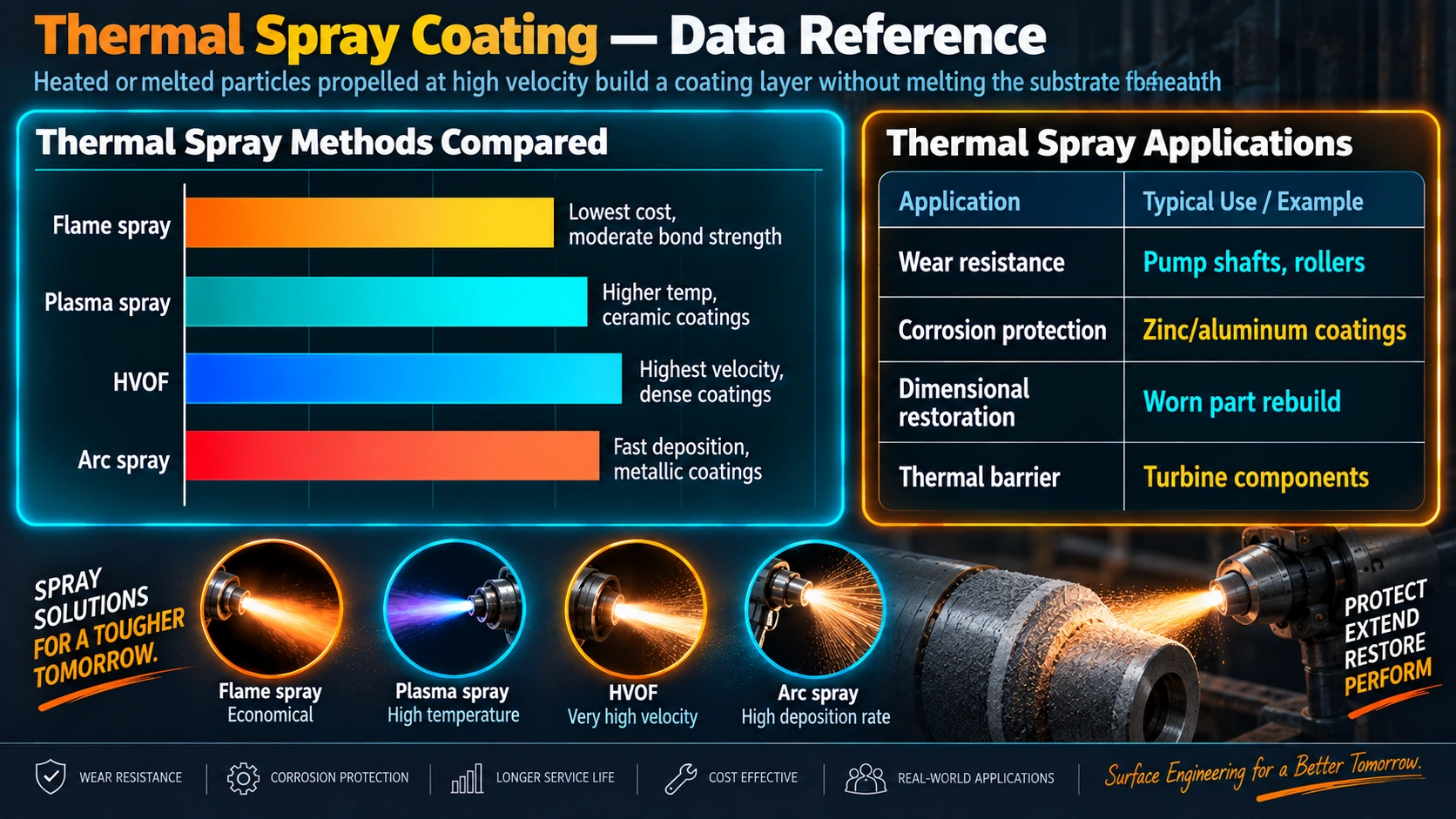
Because of its portability, low equipment cost, and versatility for on-site repairs, flame spraying remains widely used for corrosion protection (zinc, aluminium), anti-friction coatings (bronze, babbitt), and dimensional restoration of worn shafts and bearing housings.
Flame Spray Fuels
- Acetylene — highest flame temperature (~3150 °C), used for metals with higher melting points
- Propane — lower cost, slightly cooler flame; suitable for zinc, aluminium, most bronzes
- Propylene — intermediate temperature and cost; good deposition rate for steel wire
Flame Spray — Wire vs. Powder
Wire flame spray feeds a continuous metallic wire through a rotating-collet torch head. The wire melts at the flame tip and is atomised by a surrounding air or nitrogen annulus. Wire flame spray achieves deposition rates of 3–12 kg/h and is the preferred route for large-area corrosion coatings.
Powder flame spray injects a powder feedstock (metals, alloys, ceramics, cermets) into the flame via a hopper and carrier gas. Powder processes unlock a wider material range but produce higher porosity (10–20%) and lower bond strength compared to wire processes.
Flame Spray Advantages & Limitations
✅ Advantages
- Minimal equipment investment
- Fully portable — suitable for field/site work
- Relatively low surface heating (350–450 °C)
- High deposition efficiency (60–95% for wire)
- Wide range of wire and powder feedstocks available
❌ Limitations
- Higher porosity (10–20%) versus HVOF or plasma
- Lower bond strength (5–20 MPa)
- Cannot spray materials with melting point >2800 °C
- High porosity coatings require sealants for corrosion service
- Low thermal efficiency of the combustion process
| Parameter | Wire Flame Spray | Powder Flame Spray |
|---|---|---|
| Flame temperature | ~3150 °C (acetylene) | ~3150 °C (acetylene) |
| Stand-off distance | 100 – 200 mm | 120 – 200 mm |
| Coating porosity | 10 – 15% | 15 – 20% |
| Bond strength | 10 – 20 MPa | 5 – 15 MPa |
| Deposition rate | 3 – 12 kg/h | 1 – 5 kg/h |
| Typical materials | Zn, Al, Cu alloys, steel | Ceramics, cermets, self-fluxing alloys |
High-Velocity Oxyfuel (HVOF)
HVOF is the process of choice for dense, high-strength wear coatings. A fuel gas (hydrogen, propylene, propane) or liquid fuel (kerosene) is combined with high-pressure oxygen and ignited in a confined combustion chamber. The expanding gases exit through a convergent-divergent nozzle and accelerate to supersonic velocities — typically 1500 to 2000 m/s at the nozzle exit. Powder feedstock is injected axially or radially into the jet, reaching particle velocities of 400–700 m/s at impact.
Because particle temperatures are lower than in plasma spray (combustion temperature ~3000 °C versus plasma >10 000 °C) yet impact velocity is much higher, HVOF produces coatings with very low porosity (<1%), high bond strength (70–100 MPa), and excellent carbide retention. It is particularly suited to tungsten carbide–cobalt (WC-Co), chromium carbide–nickel chromium (Cr₃C₂-NiCr), and high-performance nickel superalloys (Inconel, Hastelloy, Triballoy).
HVOF Equipment Components
- High-pressure oxygen and fuel gas supply (or liquid fuel pump for kerosene systems)
- Combustion chamber and convergent-divergent nozzle (Laval nozzle)
- Powder feeder with carrier gas
- Cooling water supply for the gun body (HVOF guns run hot)
- Acoustic enclosure (mandatory — noise >130 dB)
- Robotic or CNC traversing system for consistent stand-off and traverse speed
HVOF Process Characteristics
| Parameter | Typical Value |
|---|---|
| Gas/flame temperature | 2500 – 3000 °C |
| Particle velocity at impact | 400 – 700 m/s |
| Stand-off distance | 380 – 400 mm |
| Coating porosity | <1% |
| Bond strength | 70 – 100 MPa |
| Coating hardness (WC-Co) | 1100 – 1400 HV |
| Deposition efficiency | 35 – 50% |
| Noise level | >130 dB — acoustic enclosure required |
| Typical thickness per pass | 25 – 75 µm |
Common HVOF Coating Materials
- WC-Co / WC-CoCr — hardface wear coatings for pump shafts, roll surfaces, landing gear
- Cr₃C₂-NiCr — high-temperature oxidation and wear resistance up to 900 °C
- Inconel 625 / 718 — corrosion-resistant overlays in oil & gas
- Hastelloy C-276 — chemical corrosion resistance in aggressive media
- Triballoy T-400 / T-800 — galling resistance in valve and bearing applications
Plasma Transferred Arc (PTA) / Plasma Spraying
Plasma spraying uses a non-transferred or transferred DC arc to ionise a gas (typically argon, with additions of hydrogen, helium, or nitrogen) into a plasma state. The plasma flame reaches temperatures exceeding 10 000 °C — far above the melting point of any known engineering material — making it the only thermal spray process capable of depositing refractory ceramics, ultra-high-temperature compounds, and a broad range of functional coatings.
In Plasma Transferred Arc (PTA) welding — a related but distinct process — the arc is transferred to the substrate through the powder cloud, producing a metallurgical fusion bond rather than a mechanical bond. PTA is therefore closer to fusion welding than to pure coating, and is widely used for hardfacing applications in the oil & gas, mining, and agricultural equipment industries.
Plasma Spray Process Steps
- Plasma gas (argon primary, hydrogen or helium secondary) flows through the torch between a tungsten cathode and copper nozzle anode.
- A high-frequency spark initiates the arc; the arc ionises the plasma gas, forming a plasma jet at 6000–15 000 °C.
- Powder feedstock is injected into the jet via a carrier gas (argon or nitrogen), where it melts within milliseconds.
- Molten particles are accelerated to 200–400 m/s and deposited on the substrate.
- For APS (Atmospheric Plasma Spray): coating forms in air — some oxidation is inevitable.
- For VPS/LPPS (Vacuum/Low Pressure Plasma Spray): operation in a controlled chamber eliminates oxidation, used for MCrAlY bond coats in TBC systems.
Plasma Spray Advantages & Limitations
✅ Advantages
- Widest material range — ceramics, cermets, polymers, metals
- Low porosity (2–5% APS; <0.5% VPS)
- Can apply thick coatings (>3 mm)
- Low substrate heating compared to GTAW hardfacing
- Process can be automated and precisely controlled
- Large cermet particle size possible, improving wear resistance
❌ Limitations
- Higher oxidation of sprayed material than HVOF or cold spray
- Minimum coating thickness ~1 mm — cannot produce ultra-thin coatings
- High equipment capital cost
- Requires skilled operators for parameter optimisation
- Noise level >120 dB
| Parameter | APS (Air) | VPS (Vacuum) |
|---|---|---|
| Plasma temperature | 10 000 – 15 000 °C | 10 000 – 15 000 °C |
| Particle velocity | 200 – 400 m/s | 400 – 600 m/s |
| Coating porosity | 2 – 5% | <0.5% |
| Bond strength | 20 – 50 MPa | 60 – 80 MPa |
| Oxide content | 2 – 8% | <0.5% |
| Typical materials | Al₂O₃, YSZ, Ni alloys | MCrAlY, Ti, Ta alloys |
Detonation Gun Spraying (D-Gun)
Detonation gun spraying is a ballistic process in which a measured charge of powder, oxygen, and acetylene is loaded into a long barrel (approximately 25 mm bore, 1 m length) and then ignited. The controlled detonation — rather than a simple combustion — generates a shock wave that accelerates the powder charge to extraordinarily high velocities (750–1000 m/s), producing some of the densest thermal spray coatings achievable.
After each detonation, nitrogen purges the barrel before the next charge is loaded. The process fires 4–8 detonations per second, giving a controlled feed rate of 0.5 to 12 kg/h. Stand-off distance is kept short — 50 to 200 mm — to preserve particle velocity at impact.
D-Gun Process Parameters
| Parameter | Value |
|---|---|
| Particle velocity at impact | 750 – 1000 m/s |
| Process temperature | ~4000 °C (detonation wave) |
| Stand-off distance | 50 – 200 mm |
| Coating porosity | <1% |
| Bond strength | 70 – 140 MPa |
| Feed rate | 0.5 – 12 kg/h |
| Noise level | >140 dB — sealed rooms required |
D-Gun Advantages & Limitations
✅ Advantages
- Extremely high bond strength (up to 140 MPa)
- Very low porosity (<1%)
- High carbide retention — superior to plasma and flame
- Excellent wear and erosion resistance
- High feed rate (up to 12 kg/h)
❌ Limitations
- Extreme noise (>140 dB) requires sealed blast room
- Cannot spray low-density materials (e.g., some polymers)
- High equipment and facility cost
- Not suitable for field deployment — fixed installation only
Cold Spray Process
Cold spray is fundamentally different from all other thermal spray processes: the feedstock is never melted. Instead, deformable powder particles (typically 1–50 µm in diameter) are introduced into a preheated supersonic gas jet — where the gas temperature may be 300–800 °C but the particles themselves remain below their melting point — and are accelerated to velocities of 500–1200 m/s through a converging-diverging (de Laval) nozzle.
When the particles strike the substrate, the kinetic energy causes extreme plastic deformation and adiabatic shear instability at the particle–substrate interface, generating enough heat to create a solid-state metallurgical-like bond. The process produces coatings with virtually zero oxidation, near-zero porosity, and compressive residual stresses — a significant advantage over thermally-deposited coatings, which tend to have tensile residual stresses and oxide inclusions.
Cold Spray Characteristics
- Only ductile metallic materials can be deposited (brittle ceramics will shatter on impact)
- Typical materials: copper, aluminium, titanium, nickel, tantalum, silver, gold, stellite
- Coating porosity: <0.5% (high-pressure systems)
- Bond strength: 30–80 MPa (substrate and particle dependent)
- No thermal distortion, no phase changes, no grain growth
- Gas: helium (high-pressure, highest velocity) or nitrogen (lower cost, lower velocity)
Substrate Preparation for Thermal Spray
Substrate preparation is arguably the most critical variable in thermal spray quality. Since the bond is mechanical in most processes, the substrate surface must be both chemically clean and physically rough to maximise coating adhesion. Inadequate preparation is the single most common cause of coating delamination in service.
Preparation Sequence
- Inspection & machining: Restore substrate geometry if needed. For worn shafts, undercut to a uniform diameter below minimum, with a slight undercut radius at shoulders to prevent edge lifting.
- Degreasing: Remove all oils, greases, and cutting fluids by solvent wipe (acetone, MEK), vapour degreasing, or ultrasonic cleaning in alkaline bath. Oils are the number one adhesion killer.
- Baking (porous substrates): Porous or contaminated materials (castings, sintered parts) are baked at 315–345 °C to drive out absorbed hydrocarbons before blasting.
- Abrasive grit blasting: Blast with angular aluminium oxide (Al₂O₃) grit — typically 16 to 30 mesh — at 4–6 bar to achieve a surface profile (Ra) of 6–12 µm. Chilled iron grit or steel shot produce rounded profiles and are not recommended for thermal spray.
- Inspection of blasted surface: Confirm surface profile with profilometer or comparator disc. Surface should appear matte white-grey with no shiny spots (unblasted areas).
- Spray within 2 hours: Begin thermal spraying within 2 hours of blasting. Re-contamination from handling or humidity will compromise adhesion; re-blast if delay exceeds this window.
Preparation Methods Summary
| Method | Purpose | Notes |
|---|---|---|
| Solvent degreasing | Remove oils & greases | Do before blasting, not after |
| Vapour degreasing | Deep cleaning of complex geometry | Most effective for blind holes |
| Ultrasonic cleaning | Dislodge particulate contamination | Use heated alkaline solution |
| Baking at 315–345 °C | Outgas porous materials | Castings, sintered parts |
| Dry grit blasting (Al₂O₃) | Create anchor profile Ra 6–12 µm | Angular grit — 16 to 30 mesh |
| Macro-roughening (knurling/threading) | Increase mechanical key | Used for thick overlay coatings |
Thermal Spray Process Comparison Table
| Process | Max Temp (°C) | Particle Velocity | Porosity | Bond Strength | Oxidation | Equipment Cost | Field Use |
|---|---|---|---|---|---|---|---|
| Arc Spray (TWAS) | ~6000 | 100–200 m/s | 5–15% | 10–30 MPa | Medium | Low | Yes |
| Flame Spray | ~3150 | 50–100 m/s | 10–20% | 5–20 MPa | High | Very Low | Yes |
| HVOF | ~3000 | 400–700 m/s | <1% | 70–100 MPa | Low | High | No |
| Plasma Spray (APS) | >10 000 | 200–400 m/s | 2–5% | 20–50 MPa | Medium | High | No |
| Detonation Gun | ~4000 | 750–1000 m/s | <1% | 70–140 MPa | Low | Very High | No |
| Cold Spray | 300–800 (gas) | 500–1200 m/s | <0.5% | 30–80 MPa | Nil | High | Limited |
Industrial Applications of Thermal Spray
The breadth of thermal spray processes makes it applicable across virtually every heavy industry. Common application categories include:
- Corrosion protection: Arc-sprayed zinc, aluminium, and Zn/Al alloys on structural steel (bridges, offshore platforms, pipelines) replace galvanising and painting for extended service lives of 20–40 years.
- Wear resistance: HVOF WC-Co on pump shafts, roll surfaces, mandrels, and cutting tools, replacing hard chrome plating (RoHS-compliant).
- Thermal barrier coatings (TBC): APS or VPS yttria-stabilised zirconia (YSZ) on turbine blades and combustion chamber components, with MCrAlY bond coat, enabling turbine inlet temperatures above 1500 °C.
- Dimensional restoration: Flame or arc spray to rebuild worn bearing journals, pump housings, and cylinder bores to original dimension at a fraction of replacement cost.
- Electrical conductivity / resistivity: Copper arc spray for EMI shielding; alumina plasma spray for electrically isolating coatings on heater mandrels.
- Biomedical: Plasma-sprayed hydroxyapatite (HA) on orthopaedic implants to promote osseointegration.
- Additive repair (cold spray): Titanium and nickel alloy deposits on aerospace structural components — no HAZ, preserves fatigue life.
Advantages & Disadvantages of Thermal Spray
✅ Advantages
- Smooth, controlled weld bead / coating surface
- Low heat input — coatings do not penetrate base material
- Most metals, ceramics, and plastics can be sprayed
- Broad thickness range: 0.025 mm to >25 mm
- High deposition rates: 3–60 kg/h (process-dependent)
- Reduced unit cost vs. full component replacement
- Substrate can remain in near-service condition during coating
- Components typically last 50–75% longer when treated
❌ Disadvantages
- Bond is mechanical, not metallurgical (most variants)
- Line-of-sight process — complex internal geometries are inaccessible
- Poor resistance to point-loading or impact
- Flat and horizontal positions preferred; overhead spraying is difficult
- Operator training required — parameters significantly affect coating quality
- High argon shielding gas cost for some processes (>85% Ar)
- Porosity in coating may require post-sealing for corrosion service
Equipment & Operating Requirements
General electrical and mechanical requirements that apply across thermal spray processes:
- Power source: High-voltage DC sources — typically 26 V to 37 V for arc spray; dedicated plasma and HVOF power packs for those processes. Small welding machines are incapable of sustaining the required spray arc mode.
- Shielding gas: Minimum 85% argon, remainder CO₂ where shielding is required. 92% Ar / 8% CO₂ (C8) is the most commonly specified mixture for spray-mode MIG. 100% argon or Ar/He blends are used for plasma.
- Machine duty cycle: Thermal spray is a continuous process; equipment must have an adequate duty cycle at the operating current. Exceeding duty cycle causes thermal shutdown and inconsistent coatings.
- Machine settings: Begin at the manufacturer’s suggested volts/ipm, then adjust voltage until the audio signature is half “crackle” and half “whoosh” — the characteristic sound of spray-mode transfer.
- Wire/electrode size: Typically 0.045″ (1.1 mm) or larger. Smaller wires cannot sustain the high amperages (180–440 A) required for stable spray arc operation.
- Noise control: HVOF (>130 dB) and detonation gun (>140 dB) processes require acoustic enclosures or sealed spray booths with interlocked access doors.
- Ventilation: Fume extraction is mandatory. Thermal spray generates metal fumes and fine particulate that must be captured at the source.
How to Select the Right Thermal Spray Process
Process selection depends on the required coating performance, available equipment, substrate geometry, and budget. Use the following decision logic:
- Large-area corrosion protection on structural steel or storage tanks → Arc Spray (Zn, Al, ZnAl). Fastest deposition, lowest cost, fully portable for site work.
- Wear-resistant carbide coating (<1% porosity required) → HVOF. Best carbide retention, highest bond strength for hard chrome replacement on pump shafts, rotors, and landing gear.
- Ceramic or thermal barrier coating → Plasma Spray (APS/VPS). Only process capable of depositing ceramics such as alumina, YSZ, and hydroxyapatite in production volumes.
- Ultra-high-performance wear or repair, no budget constraint → Detonation Gun. Maximum bond strength and density, but restricted to specialist facilities.
- Temperature-sensitive or oxidation-critical repair → Cold Spray. No heat input, zero oxidation; suitable for copper bus bars, titanium aerospace components, and electronics.
- Low-budget, on-site repair of worn shafts or bearing seats → Flame Spray. Self-fluxing Ni-Cr-B-Si powder spray-and-fuse provides a metallurgical bond for bearing journals and pump housings.
Recommended Equipment on Amazon
📢 Affiliate disclosure: WeldFabWorld is a participant in the Amazon Associates Program. As an Amazon Associate, we earn from qualifying purchases at no additional cost to you (tag: neha0fe8-21).
More Welding Process Guides on WeldFabWorld
Frequently Asked Questions
Thermal spray welding is an umbrella term for surface coating processes where a feedstock material (wire, rod, or powder) is melted by a heat source and propelled onto a substrate by a gas jet, building up a protective or functional coating layer. The coating bonds primarily through mechanical interlocking with a roughened substrate surface, not through metallurgical fusion — except in the spray-and-fuse variant where a self-fluxing alloy is subsequently re-fused with a torch or furnace.
HVOF uses supersonic combustion gas jets and operates at lower temperatures (around 3000 °C), producing denser coatings with less than 1% porosity and high bond strength (70–100 MPa). Plasma spray operates above 10 000 °C using ionised gas, offering greater material versatility including ceramics, but can result in higher oxidation of the sprayed material and porosity of 2–5% for APS. HVOF is preferred for carbide wear coatings; plasma spray is necessary for ceramic thermal barrier coatings and refractory materials.
Thermal spray is technically a coating process. Unlike fusion welding, the bond between the coating and substrate is primarily mechanical, not metallurgical. However, when self-fluxing alloy powders are applied and then post-fused with a torch or furnace (the spray-and-fuse process), or in Plasma Transferred Arc (PTA) welding where the arc is transferred to the workpiece, a true metallurgical bond is achieved and the process bridges into welding territory.
Most metals (steel, stainless, nickel alloys, titanium, copper, zinc, aluminium), ceramics (alumina, yttria-stabilised zirconia, chromia), cermets (tungsten carbide, chromium carbide), and some polymers can be deposited by thermal spray, depending on the specific process selected. Plasma spray handles the widest material range including refractory ceramics; cold spray is limited to ductile metallic powders.
The substrate must be clean and rough. Preparation includes degreasing (solvent, chemical, or vapour), baking porous materials at 315–345 °C, ultrasonic cleaning for complex geometry, and abrasive grit blasting with angular aluminium oxide (16–30 mesh) to achieve a surface profile (Ra) of 6–12 µm. Spraying should begin within 2 hours of blasting to prevent recontamination from humidity or handling.
HVOF coatings have less than 1% porosity, making them among the densest coatings achievable by thermal spray. This low porosity gives HVOF coatings excellent corrosion and wear resistance, and is the primary reason HVOF has become the standard process for replacing hard chrome plating on hydraulic cylinders, pump shafts, and aerospace landing gear components.
Cold spray does not melt the feedstock particles. Instead, deformable particles are accelerated to supersonic velocities (500–1200 m/s) in a preheated gas stream and bond to the substrate through kinetic energy and plastic deformation. Only ductile metallic materials can be cold sprayed, and it produces virtually zero oxidation, no thermal stress, and no phase changes — unlike all other thermal spray processes where the feedstock is melted before deposition.
Components treated with thermal spray coatings typically last 50% to 75% longer than uncoated equivalents. Service life depends on the coating type, thickness, substrate preparation quality, and operating environment. Arc-sprayed zinc/aluminium coatings on structural steel can provide corrosion protection for 20–40 years in aggressive marine environments with no maintenance.