Lamellar Tearing — Causes and Prevention in Welded Fabrication
Lamellar tearing is a fracture mechanism unique to the welded fabrication of rolled steel plate. Unlike most weld defects — which occur within or immediately adjacent to the weld — lamellar tearing occurs in the base metal itself, away from the weld fusion zone, driven by through-thickness tensile stress generated by weld thermal contraction. It is particularly treacherous in fabrication because it can occur during or after welding in joints that are visually acceptable, pass radiographic examination, and even survive initial hydrostatic testing, only to be discovered later by ultrasonic examination or to propagate to failure under service loading.
The defect is characterised by its distinctive stepped or terraced appearance in cross-section — a series of planar separations running parallel to the plate surface, connected by short shear steps running through the plate thickness. This morphology directly reflects the underlying cause: the fracture path follows arrays of non-metallic inclusions, primarily elongated manganese sulfide (MnS) stringers, that lie parallel to the rolling plane in the base metal. The through-thickness tensile stress from weld shrinkage progressively debonds these inclusions from the matrix, links the micro-voids by local shear, and produces the characteristic lamellar appearance.
This guide provides a complete technical treatment of lamellar tearing for fabrication engineers, welding inspectors, and anyone preparing for the CSWIP 3.1 or 3.2 examination: the micro-mechanical fracture mechanism, the role of MnS inclusions and steel cleanliness, the joint configurations that generate the critical stress state, the through-thickness tensile testing methodology of EN 10164 and Z-grade steel specification, NDE detection approaches, and a systematic prevention framework covering joint redesign, material selection, buttering, and preheat practice.
What Is Lamellar Tearing?
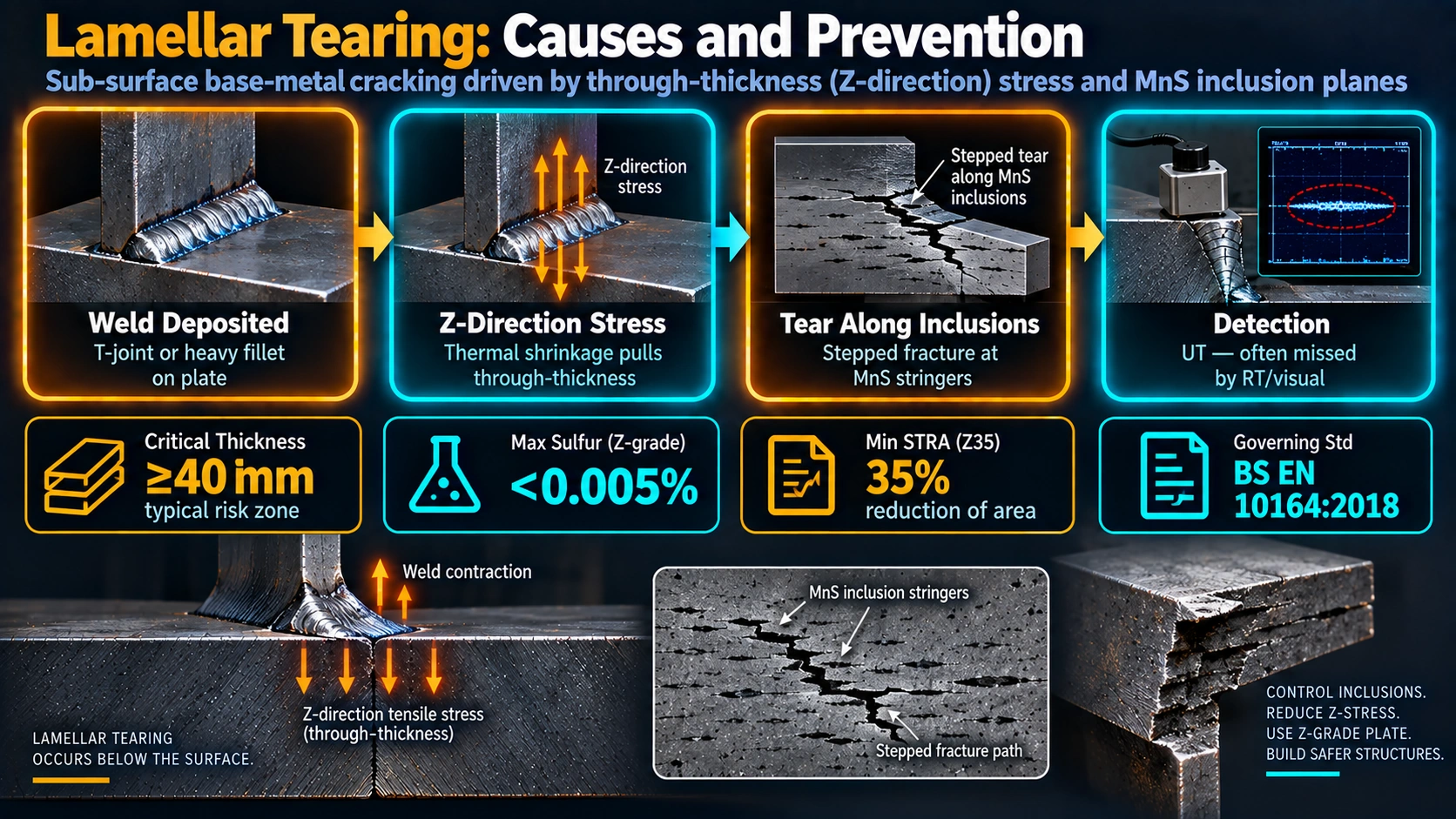
Lamellar tearing is a sub-surface fracture that occurs in the base metal of rolled steel plate during or after welding, characterised by a stepped crack morphology running approximately parallel to the plate surface. The term “lamellar” refers to the plate-like or shelf-like appearance of the fracture surfaces — each “shelf” represents a separation along a planar non-metallic inclusion array, and the connecting “risers” represent short shear failures between adjacent inclusion planes. The overall fracture path is therefore perpendicular to the plate surface in aggregate (the through-thickness direction), but locally follows the inclusion planes horizontally.
Several features distinguish lamellar tearing from other weld-related cracking mechanisms:
- The crack occurs in the parent plate material, not in the weld metal or heat-affected zone — typically 2 to 10 mm below the plate surface
- The fracture surface has a wood-grain or terraced appearance characteristic of propagation along inclusion planes
- The driving force is through-thickness tensile stress from weld thermal contraction, not hydrogen diffusion or solidification effects
- The susceptibility is governed by plate through-thickness ductility, not the weld procedure itself — a change of weld procedure will not prevent lamellar tearing if the steel and joint geometry are susceptible
- Lamellar tearing does not require hydrogen to initiate and can occur in low-hydrogen welding processes
The Fracture Mechanism — How It Forms
Lamellar tearing is a ductile fracture mechanism, which is initially counterintuitive — most engineers associate ductile fracture with safety rather than failure risk. The key is that the local through-thickness ductility of the plate is extremely low because of the planar inclusion arrays, even though the plate’s in-plane (X-Y direction) tensile properties meet specification fully. The fracture mechanism proceeds through three stages:
Stage 1 — Inclusion Debonding
As welding progresses and the weld metal cools and contracts, it develops a complex three-dimensional shrinkage strain. In joint configurations where one plate’s through-thickness direction is loaded by the weld shrinkage of the adjacent member, the through-thickness tensile stress builds at and below the fusion boundary. At relatively low strain levels — typically 1% to 3% — the elongated MnS inclusions begin to debond from the surrounding ferrite matrix at their ends and along their length, forming micro-voids aligned with the inclusion planes.
Stage 2 — Micro-Void Coalescence
The micro-voids at adjacent inclusions within the same plane grow and extend towards each other as the through-thickness strain increases. The thin ligaments of steel between adjacent voids are subjected to concentrated shear stress and fail by ductile micro-fracture, allowing adjacent voids to link up into a planar crack running along the inclusion plane. This produces the horizontal “shelf” of the lamellar tear fracture surface.
Stage 3 — Step Formation and Propagation
Once a planar tear has formed on one inclusion plane, the stress concentration at its tip drives fracture in the through-thickness direction to the next adjacent inclusion plane, where the horizontal propagation resumes. This step-wise advance — horizontal crack along inclusion plane, vertical step to next inclusion plane, horizontal crack again — repeats until the tear has propagated through the full zone of elevated through-thickness stress. The result is the characteristic stepped fracture morphology that distinguishes lamellar tearing from all other weld-related damage.
MnS Inclusions and Steel Cleanliness
Manganese sulfide (MnS) inclusions form during steel solidification when sulfur — always present to some degree in steel — combines with manganese to precipitate as a second phase. In the liquid state, MnS has a low melting point and forms as globular droplets that, during subsequent hot rolling of the steel plate, are deformed into thin, elongated stringers running parallel to the rolling direction. It is these elongated stringers that are responsible for lamellar tearing susceptibility.
The geometry of MnS stringers in rolled plate is critical to understanding lamellar tearing risk. A stringer that is 10 to 50 microns long and 1 to 3 microns thick represents a planar weakness in the through-thickness direction of the plate that is many times more severe than the same volume of sulfide in a spherical morphology. Arrays of such stringers spaced 50 to 200 microns apart in the through-thickness direction create the inclusion planes that lamellar tears follow.
Effect of Sulfur Content
| Sulfur Content (mass %) | Inclusion Density | Through-Thickness Ductility | Lamellar Tearing Risk |
|---|---|---|---|
| > 0.030% S | High — dense stringer arrays | Very Low | High in susceptible joints |
| 0.015 – 0.030% S | Moderate | Low to Moderate | Moderate — assess joint config. |
| 0.008 – 0.015% S | Low | Moderate | Low — standard Z15 range |
| 0.005 – 0.008% S | Very low | Good | Low — Z25 achievable |
| < 0.005% S (Ca-treated) | Negligible stringers — spheroidal CaS/Ca(Mn)S | High — Z35 achievable | Negligible |
The Role of Calcium Treatment
Calcium treatment (Ca injection or Ca-Si wire addition to the liquid steel during secondary metallurgy) is the most effective steelmaking intervention for lamellar tearing prevention. Calcium reacts preferentially with sulfur and oxygen in the melt to form calcium sulfide (CaS) or mixed calcium-manganese sulfides Ca(Mn)S. These calcium-modified sulfides remain as approximately spheroidal particles after rolling rather than elongating into stringers. A spheroidal inclusion offers far less planar debonding area per unit volume than a stringer and does not preferentially align in the through-thickness weakness direction.
Steel produced with effective calcium treatment to achieve a Ca/S ratio of approximately 1.5 or greater can achieve Z35 class through-thickness ductility even at sulfur contents that would normally produce susceptible stringer morphology. This is why sulfur content alone is not a reliable predictor of lamellar tearing susceptibility — the morphology of the sulfide inclusions, and hence the Ca treatment status of the steel, must also be considered.
Susceptible Joint Configurations
Not all welded joints are equally susceptible to lamellar tearing. The configuration must be such that weld thermal contraction generates a significant through-thickness tensile stress component in the plate whose through-thickness direction is vulnerable. The following joint types represent the principal risk configurations encountered in structural and pressure vessel fabrication.
Contributing Factors and Risk Multipliers
Beyond the primary requirement of a susceptible steel microstructure and a joint configuration generating through-thickness stress, several fabrication variables amplify or reduce lamellar tearing risk. Understanding these factors allows practical risk management even when steel quality or joint geometry cannot be changed.
| Factor | Higher Risk Condition | Lower Risk Condition | Mechanism |
|---|---|---|---|
| Plate thickness | >30 mm (more restraint, larger weld volume) | <20 mm | Thicker plates constrain thermal movement more effectively, increasing the through-thickness stress from weld contraction |
| Weld volume / number of passes | Large multi-pass welds, full penetration | Small fillet welds, single-pass where possible | Larger weld volume means greater total contraction force applied in through-thickness direction |
| Heat input | High heat input (wider HAZ, more distortion, higher stress) | Controlled lower heat input | Higher heat input increases thermal gradient and resulting residual stress, though very low heat input increases cooling rate and may concentrate strain |
| Joint restraint | High structural restraint — jigs, fixtures, stiff surrounding structure | Free to move during welding | External restraint prevents thermal contraction from manifesting as distortion; the strain must instead be accommodated locally in the plate — increasing through-thickness stress |
| Welding sequence | One side completed before the other (unbalanced) | Balanced welding sequence, alternating sides | Completing one side fully before starting the other maximises bending and through-thickness stress before the joint can redistribute strain |
| Preheat temperature | Low preheat (faster cooling, higher thermal gradient) | Elevated preheat (slower cooling, more uniform temperature distribution) | Higher preheat reduces the temperature gradient between weld and base metal, reducing the differential contraction and hence the through-thickness stress component |
| Plate rolling direction relative to joint | Plate through-thickness direction aligned with weld contraction direction | Plate in-plane direction aligned with weld contraction direction | The MnS inclusion planes are parallel to the rolling surface; only when stress acts perpendicular to these planes (in the Z-direction) does lamellar tearing occur |
Lamellar Tearing vs HIC vs Cold Cracking
Three fracture mechanisms involving the base metal or HAZ of steel structures are frequently confused in both examination and practice: lamellar tearing, hydrogen-induced cracking (HIC / cold cracking), and in-service hydrogen-induced cracking (wet H2S service). Each has a distinct cause, location, morphology, and prevention strategy. Distinguishing them clearly is essential for root cause analysis and effective prevention.
| Feature | Lamellar Tearing | HIC / Cold Cracking (Welding) | HIC (Sour Service) |
|---|---|---|---|
| Location | Sub-surface in base metal — 2–10 mm below plate surface, parallel to surface | HAZ — immediately adjacent to fusion line; weld toe and root | Mid-thickness of base metal plate — along MnS inclusion planes |
| Driving force | Through-thickness tensile stress from weld thermal contraction | Residual/transformation tensile stress + diffusible hydrogen in hard HAZ | Internal H2 gas pressure at MnS inclusions (from H2S corrosion reaction) |
| Hydrogen role | None — not a hydrogen cracking mechanism | Essential — cracking requires sufficient diffusible hydrogen | Essential — H from H2S dissociation drives the mechanism |
| Morphology | Stepped / terraced — horizontal shelves along inclusion planes, vertical risers between planes | Branched or transgranular cracks at weld toe, root, or underbead | Planar blisters or step-wise cracks parallel to plate surface (similar appearance to lamellar tearing) |
| Timing | During or immediately after welding; may be found during or after NDT | Delayed — hours to days after welding at or below ambient temperature | In service — months to years of H2S exposure required |
| Prevention | Z-grade steel, joint redesign, buttering, preheat (secondary) | Low-hydrogen consumables, preheat, PWHT, reduce HAZ hardness | HIC-resistant steel (Ca-treated, low S), PWHT for HAZ hardness, NACE MR0175 |
| Key NDE method | PAUT / contact UT for sub-surface planar flaws; RT ineffective | WFMT (surface), PAUT / TOFD for subsurface HAZ cracks | Contact UT, PAUT; C-scan for blister mapping |
Z-Grade Steel — Through-Thickness Quality
Z-grade steel (sometimes called TT-quality or through-thickness quality steel) is structural or pressure vessel steel that has been manufactured and tested to ensure a minimum level of through-thickness ductility, providing reliable resistance to lamellar tearing. The “Z” designation refers to the Z-axis (through-thickness direction) of the plate. Z-grade steels are specified by the purchaser when susceptible joint configurations cannot be avoided or when the consequences of lamellar tearing failure are unacceptable.
EN 10164 Through-Thickness Tensile Testing
EN 10164 (formerly BS 6399) is the European standard that specifies the through-thickness tensile test method and the acceptance criteria for Z-grade steel. It defines the test specimen geometry, sampling requirements, test procedure, and the classification system (Z15, Z25, Z35) based on the measured reduction of area (RA).
Through-Thickness Tensile Test Procedure
The through-thickness tensile specimen is a cylindrical or flat bar specimen machined from the plate such that its tensile loading axis is perpendicular to the plate surface — the Z-direction. This is fundamentally different from the standard tensile tests performed on plate material, which load the specimen in the rolling direction (X) or transverse to rolling (Y). The Z-direction specimen therefore directly stresses the inclusion planes in the mode responsible for lamellar tearing.
Specimen Sampling Requirements
EN 10164 specifies that through-thickness test specimens must be taken in the Z-direction from the full thickness of the plate, or from representative sub-thickness locations when the plate thickness exceeds approximately 40 mm. For thick plates, specimens are typically taken from the quarter-thickness and mid-thickness positions where inclusion density may differ from the surface regions. The test report must record individual RA values and the computed mean, and identify the sampling location within the plate thickness.
NDE Detection Methods
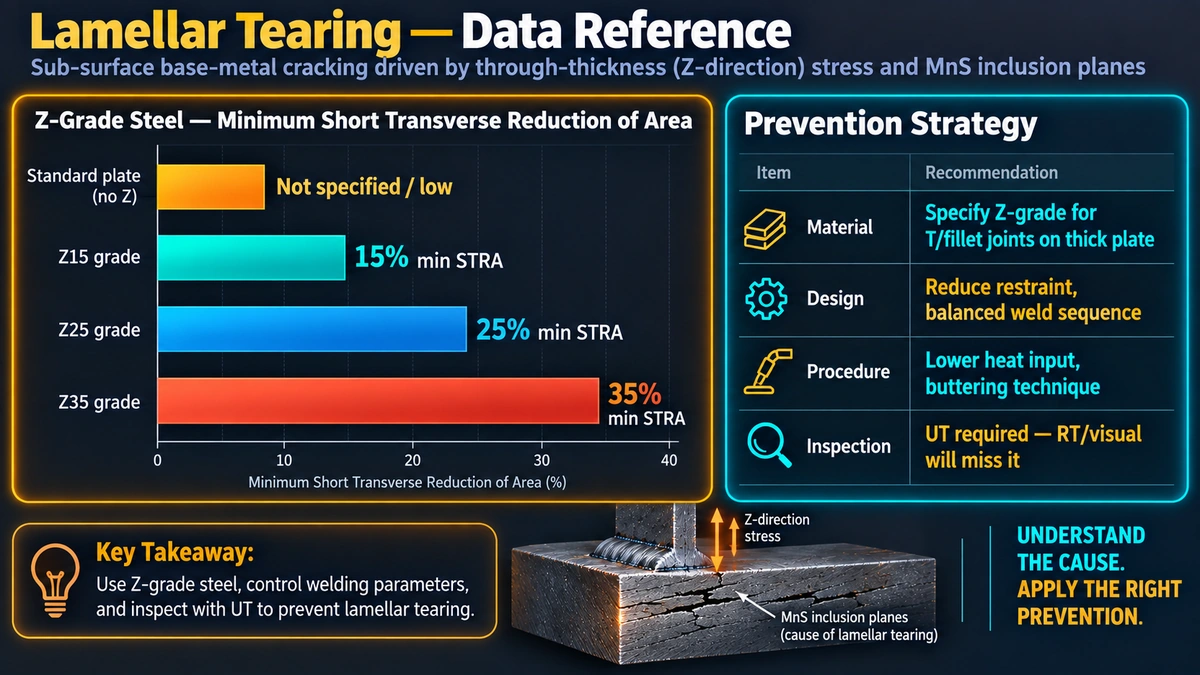
Lamellar tearing presents a significant NDE challenge because the cracks are subsurface, planar (horizontal), and oriented parallel to the plate surface — a geometry that is poorly revealed by most standard NDE techniques used for weld inspection. Choosing the right method and technique is critical to achieving reliable detection.
| NDE Method | Effectiveness for Lamellar Tearing | Reason | Recommended Application |
|---|---|---|---|
| Phased Array UT (PAUT) | Best — primary method | Beam steering and focusing allows optimisation of detection angle; can image the full depth range in the plate; S-scan provides comprehensive coverage | First-choice method for detecting and sizing lamellar tearing in plate and weld HAZ regions; can distinguish tearing from laminations |
| Contact UT — 0-degree compression (A-scan) | Good — widely used | Compression beam travels in Z-direction — directly interrogates the inclusion planes responsible for tearing; planar horizontal reflectors produce strong echoes | Grid scanning of suspect plate areas; rapid screening of large plate areas before or after welding; measuring tear depth and extent |
| TOFD (Time-of-Flight Diffraction) | Good for sizing | Detects diffracted signals from crack tips; effective for measuring the through-thickness extent of confirmed tears | Characterisation of confirmed lamellar tears — depth, extent, and severity assessment for fitness-for-service evaluation |
| Radiographic Testing (RT) | Poor — generally ineffective | RT detects changes in material density projected onto a plane perpendicular to the beam. Horizontal planar cracks parallel to the beam direction produce minimal density change and are rarely detected reliably | Not recommended as the primary method for lamellar tearing detection; may detect severe tearing incidentally but should not be relied upon |
| Magnetic Particle Testing (MT) | Limited — surface-breaking only | MT detects surface and near-surface (up to ~3 mm) defects by magnetic flux leakage; cannot detect sub-surface lamellar tearing | Detection of lamellar tears that have propagated to the plate surface; verification that excavation of sub-surface tearing has reached clean metal before repair welding |
| Visual Examination (VT) | Limited — severe cases only | Can detect surface-breaking tears or gross separation of the plate surface in severe cases; most lamellar tearing is sub-surface and not visible | First-pass examination of completed joints; detection of obvious severe tearing; not suitable as the sole detection method |
Prevention Strategies
Lamellar tearing prevention is most cost-effective when addressed at the design stage — before material procurement, before joint preparation, and before welding commences. Prevention strategies are ranked below in order of effectiveness, with joint redesign being universally preferable to all material or process workarounds.
Strategy 1 — Joint Redesign (Most Effective)
The most reliable prevention measure is redesigning the joint to eliminate the through-thickness stress loading on the susceptible plate. The following redesign principles are available:
- Reorient the joint preparation: For T-joints, using a double-bevel (double-V) preparation balanced about the joint centreline rather than a single-V reduces the net angular distortion and the through-thickness component of contraction force
- Use a forged or extruded nozzle: For pressure vessel nozzle connections, replacing a plate-cut nozzle with a forged nozzle eliminates lamellar tearing risk in the nozzle material entirely, since forgings have a three-dimensional grain structure without the planar inclusion arrays of rolled plate
- Relocate the weld: Where possible, position the weld such that the through-thickness direction of the susceptible plate is not the primary direction of weld contraction — for example, by introducing a transition piece or connection geometry that reorients the stress
- Reduce weld size: If the design permits, reducing from a full-penetration T-joint to a partial-penetration T-joint or a large fillet weld reduces the weld volume and therefore the total contraction force applied in the through-thickness direction
- Split the joint: For large, highly restrained joints, dividing the joint into two separate connections with a deliberate gap or flexible element between them reduces the restraint and the through-thickness stress concentration
Strategy 2 — Specify Z-Grade Steel
When joint redesign is not practicable, specifying Z-grade steel to EN 10164 for the susceptible plate member is the next most reliable prevention measure. Z35 essentially eliminates lamellar tearing susceptibility by requiring a through-thickness ductility level that can only be achieved by effective calcium treatment, which converts MnS stringers to spheroidal inclusions. Z25 provides a high level of assurance for moderate-risk configurations. Specify the required Z-class in the material procurement specification and verify compliance against the EN 10164 test results on the mill certificate.
Strategy 3 — Buttering (Described Separately Below)
Buttering is a weld metal deposition technique that relocates the high-stress zone from the susceptible base metal into the ductile weld metal. It is described in full in the next section.
Strategy 4 — Controlled Welding Practice
Where neither redesign nor material upgrade is available, welding practice modifications can reduce (but not eliminate) lamellar tearing risk:
- Elevated preheat: Preheat reduces the thermal gradient and hence the differential contraction, lowering through-thickness stress. A preheat 50–75°C above the minimum required for hydrogen cracking prevention reduces lamellar tearing risk meaningfully in moderate-risk joints
- Balanced welding sequence: Alternating weld deposits between the two sides of a T-joint rather than completing one side fully before starting the other reduces angular distortion and the maximum through-thickness stress at any stage of the weld sequence
- Controlled heat input: Using moderate heat input (avoiding excessive multi-pass bead sequences with very high heat input) limits the temperature gradient and shrinkage forces
- Low-restraint fixturing: Avoiding over-constrained jigs and fixtures during welding allows the joint some freedom to move and redistribute strain, reducing the peak through-thickness stress
Buttering — Technique and Application
Buttering (also called a butter layer, transition layer, or build-up layer) is one of the most practically useful tools available to the fabrication engineer for preventing lamellar tearing when joint redesign or Z-grade material specification is not feasible or economical. The technique works by interposing a layer of weld metal — which has inherently isotropic ductility and contains no planar MnS stringer inclusions — between the joint preparation surface of the susceptible plate and the main joint weld. The shrinkage strain from the main weld is then absorbed by this ductile butter layer rather than applied directly to the susceptible base metal.
How Buttering Works
Without buttering, the fusion line of the main joint weld contacts the base metal directly, and weld thermal contraction applies through-thickness tensile strain to the susceptible plate immediately below the fusion line. With buttering, the fusion line of the main weld is in contact with previously deposited weld metal (the butter layer), and the main joint weld’s contraction strains the butter layer — which deforms ductilely — rather than the susceptible base metal below. The base metal is effectively shielded from the direct through-thickness strain of the main weld.
Buttering Procedure
- Prepare the joint surface of the susceptible plate as specified (typically a flat or slightly recessed surface to accept the butter layers)
- Deposit butter weld metal in thin layers (typically 5–8 mm total build-up) using a low-heat-input welding process — SMAW with basic low-hydrogen electrodes or GTAW are preferred to minimise the heat input and the resulting through-thickness contraction from the buttering passes themselves
- Allow to cool and inspect the butter layer surface by visual examination and MT/PT for surface cracks
- Machine or grind the butter layer surface to the required joint preparation profile for the main weld
- Complete the main joint weld in the usual manner — the fusion line now lies within the deposited weld metal, not in the susceptible base metal
Limitations of Buttering
Buttering is not a universal solution. Its effectiveness depends on: the butter layer being thick enough to fully isolate the susceptible base metal from the main joint weld’s fusion zone (insufficient butter thickness is the most common error); the butter layer itself being free of lamellar tearing (the buttering passes also apply some through-thickness strain, so preheat and low heat input during buttering are important); and the butter layer having adequate bond to the base metal. Buttering adds cost and time to the fabrication sequence and requires careful NDE of the butter layer before the main weld is made. Where joint redesign or Z-grade material is practicable, these approaches remain preferable.
Repair of Confirmed Lamellar Tearing
When lamellar tearing is discovered during or after fabrication — by UT, by radiography (in severe cases), or by visual observation of surface-breaking tears — the repair strategy depends on the severity, location, and extent of the tearing.
Assessment Before Repair
Before committing to a repair, a fitness-for-service assessment under API 579 Part 9 (crack-like flaws) or equivalent should be considered to determine whether the lamellar tear, in its current extent, represents an unacceptable structural flaw or whether it can be accepted under reduced load or monitoring conditions. This assessment requires characterisation of the tear by UT — specifically its depth below the surface, its lateral extent, and its distance from the nearest weld fusion line or stress concentration. Not all confirmed lamellar tearing requires repair; small, subsurface tears remote from high-stress regions may be accepted under fitness-for-service analysis.
Repair Procedure
For tears that require repair, the procedure is:
- Excavate the tear by gouging or grinding to clean metal — confirm complete removal by MT or PT at every stage of excavation
- Inspect the excavated cavity by UT to confirm no remaining tear planes in the surrounding plate
- Assess whether the remaining plate thickness after excavation is sufficient to maintain structural integrity — if not, a plate insert or overlay repair is required
- Apply preheat (typically 100–150°C for carbon steel) and deposit repair weld metal in the cavity using low-hydrogen consumables with careful attention to sequence to minimise re-introduction of through-thickness stress
- NDT of the completed repair: UT (for sub-surface flaws), MT (for surface cracks), and dimensional check
- Consider PWHT of the repair zone to relieve residual stress and reduce the risk of re-tearing from the repair weld’s own contraction
Lamellar Tearing Risk Assessment Tool
Enter your joint parameters to receive a preliminary lamellar tearing risk rating and prevention recommendations. This tool provides engineering guidance only — formal assessment by a welding engineer is required for critical applications.
Frequently Asked Questions — Lamellar Tearing
What causes lamellar tearing in welded joints?
Lamellar tearing is caused by the simultaneous presence of a susceptible steel microstructure containing planar MnS stringer inclusions parallel to the plate rolling surface, and a significant through-thickness tensile stress component acting perpendicular to the plate surface. Weld thermal contraction in joint configurations such as full-penetration T-joints and corner welds generates this through-thickness stress. The MnS inclusions debond from the matrix at low strain levels, forming micro-voids that link up along the inclusion planes to create the characteristic stepped fracture morphology.
Which joint configurations are most susceptible to lamellar tearing?
The most susceptible configurations are those where weld thermal contraction applies stress perpendicular to the rolling plane of one of the plates. Full-penetration T-joints (cruciform joints) carry the highest risk — both flanges are welded to the same web location and large weld volumes apply high through-thickness contraction force. Corner joints, set-on nozzle-to-plate connections, and heavily restrained thick-plate butt welds are also high-risk. Risk increases with plate thickness (more restraint), higher weld volume (more shrinkage force), higher sulfur content, and greater structural restraint from surrounding members.
What is Z-grade steel and how does EN 10164 define it?
Z-grade steel is structural or pressure vessel steel tested to demonstrate adequate through-thickness ductility, providing resistance to lamellar tearing. EN 10164 defines three classes based on minimum reduction of area (RA) in a through-thickness tensile test: Z15 (RA ≥ 15%), Z25 (RA ≥ 25%), and Z35 (RA ≥ 35%). Z35 requires very low sulfur and effective calcium treatment to convert elongated MnS stringers to spheroidal inclusions, essentially eliminating lamellar tearing susceptibility. The class must be specified in the procurement order and verified on the mill certificate against actual EN 10164 test results.
Can lamellar tearing be detected by non-destructive examination?
Lamellar tearing is difficult to detect because the cracks are subsurface and planar, oriented parallel to the plate surface. Radiographic testing (RT) generally cannot detect it reliably because the cracks are parallel to the beam direction. Ultrasonic testing — particularly phased array UT (PAUT) with appropriate beam angle configuration and conventional 0-degree compression UT — is the most reliable NDE method. TOFD is effective for sizing confirmed tears. Surface-breaking tears can be found by MT or PT, but these cannot detect the far more common subsurface lamellar tearing. Pre-weld UT screening of plate in susceptible joint zones is strongly recommended for critical applications.
What is the buttering technique and how does it prevent lamellar tearing?
Buttering involves depositing layers of weld metal on the susceptible face of the plate before the main joint weld. The main joint is then completed into this butter layer rather than directly into the parent plate. Since weld metal has isotropic ductility and contains no planar MnS inclusion arrays, the shrinkage strain from the main weld is absorbed by the ductile butter layer rather than applied to the susceptible base metal below. The base metal is effectively shielded from direct through-thickness strain. Buttering is most commonly applied when joint redesign or Z-grade specification is not practicable, and requires careful procedure control and NDE of the butter layer before the main weld is made.
How does joint redesign prevent lamellar tearing?
Joint redesign prevents lamellar tearing by eliminating or significantly reducing the through-thickness stress component acting on the susceptible plate. Effective strategies include: using balanced double-V preparation instead of single-V to reduce angular distortion; using a forged nozzle instead of a plate-cut nozzle for pressure vessel connections; repositioning the weld so the plate rolling direction rather than its through-thickness direction carries the primary stress; reducing from full-penetration to partial-penetration or fillet weld where design loading permits; and splitting the joint to reduce simultaneous shrinkage. Redesign is always preferable because it eliminates the driving force for tearing rather than improving the steel’s resistance to it.
What sulfur content level makes steel susceptible to lamellar tearing?
Conventional structural steels typically have sulfur contents of 0.010% to 0.050% S. At sulfur levels above approximately 0.015–0.020%, the risk of lamellar tearing in susceptible joint configurations increases measurably. Z-grade steels produced to EN 10164 typically have sulfur contents of 0.005% or below for Z35 class. However, sulfur content alone does not fully predict susceptibility — calcium treatment converts elongated MnS stringers to spheroidal particles that do not debond preferentially in the through-thickness direction, greatly improving through-thickness ductility even at similar total sulfur content. Always consider both the sulfur content and the calcium treatment status when assessing lamellar tearing risk.