TIG Welding Stainless Steel: Complete Guide for Engineers & Fabricators
TIG welding (Gas Tungsten Arc Welding, GTAW) is the process of choice for high-quality stainless steel fabrication. Its precise, low-heat-input arc gives the welder direct control over penetration, puddle shape, and deposition — qualities that matter enormously when welding a material as heat-sensitive and oxidation-prone as stainless steel. This guide covers everything from selecting the right tungsten electrode and shielding gas, through filler metal matching, polarity, back purging, torch angles, and distortion control, to interpreting weld colour as a real-time quality indicator.
Challenges of TIG Welding Stainless Steel
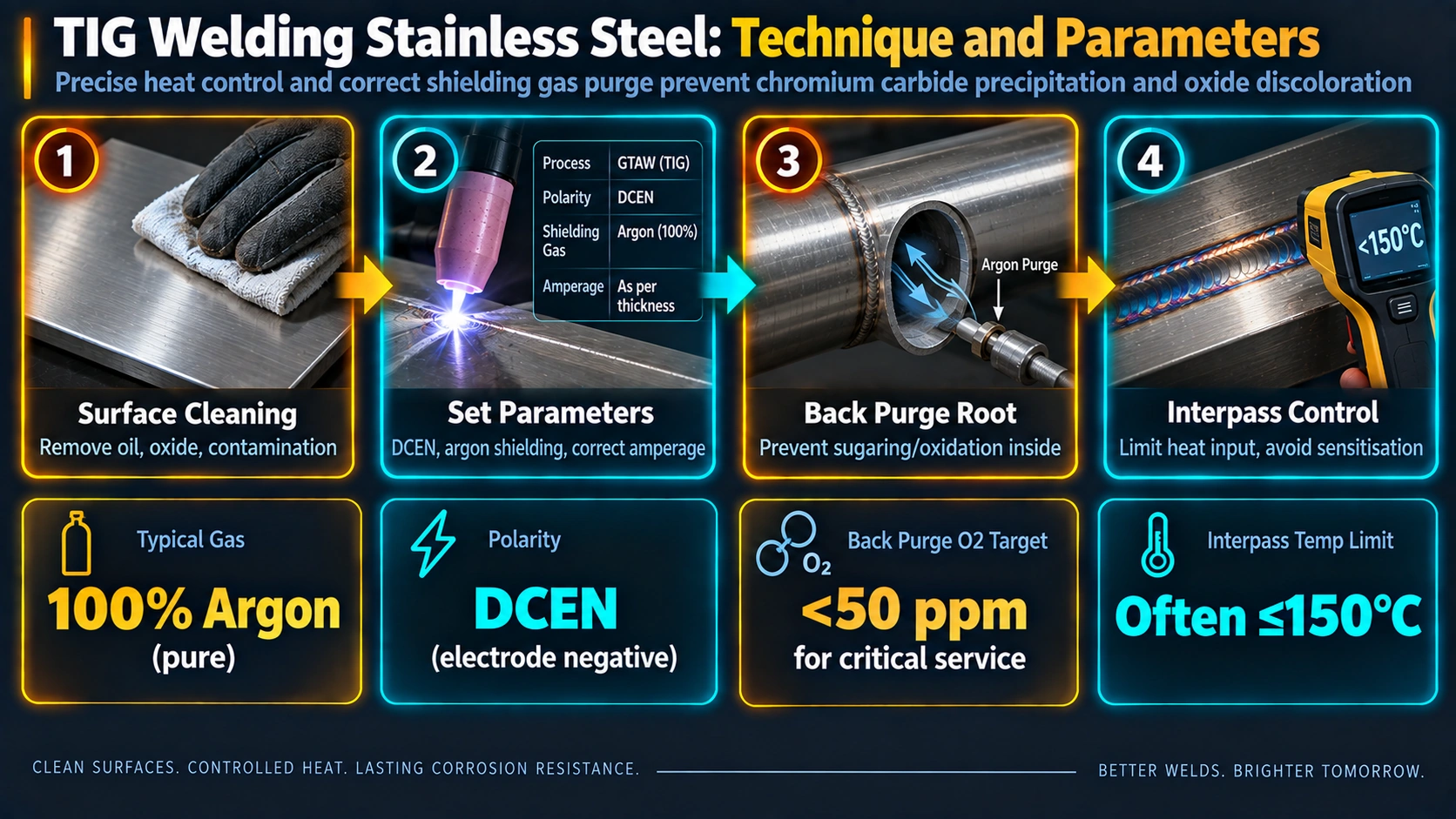
TIG welding is one of the most demanding arc welding processes to master, and stainless steel amplifies every challenge. Understanding these difficulties before you strike an arc is the first step toward producing welds that meet code requirements and look the part.
Process Complexity
In MIG welding you control gun angle and travel speed. In TIG welding you simultaneously manage arc length, travel speed, torch angle, filler rod dip rate, and amperage — often with your foot on a pedal at the same time. Building the muscle memory for this four-handed coordination takes dedicated practice before it becomes instinctive.
Heat Management
Stainless steel has approximately one-third the thermal conductivity of carbon steel, meaning heat stays concentrated in the weld zone and dissipates slowly. Combined with a coefficient of thermal expansion roughly 50% higher than carbon steel, this makes stainless steel significantly more prone to distortion and warping. TIG welding is also inherently slower than MIG or FCAW, increasing total heat input per unit length of weld.
Sensitisation Risk
When austenitic stainless steel is held in the temperature range of 450–850 °C for extended periods — a condition common in multi-pass welding or slow travel — chromium carbides precipitate at grain boundaries. This depletes the surrounding matrix of chromium, removing the corrosion resistance in a narrow band adjacent to the weld. The result is sensitisation, which makes the material vulnerable to intergranular corrosion in service. Low-carbon grades (308L, 316L) and correct interpass temperature control are the primary defences.
Equipment Cost
A capable TIG welding machine costs more than a comparable MIG unit. Add to that the recurring cost of tungsten electrodes, gas lenses, collets, cups, filler rods, and shielding gas, and TIG welding represents a higher ongoing investment than other processes.
Types of Stainless Steel for TIG Welding
Stainless steel is a family of iron alloys containing a minimum of 10.5% chromium by mass. The chromium reacts with oxygen to form a stable, self-repairing chromium oxide passive layer that gives stainless steel its corrosion resistance. Different alloying systems produce distinct microstructures with very different weldability characteristics.
Austenitic Stainless Steel
Austenitic grades are the most widely TIG welded stainless steels. They contain 16–26% chromium and 6–22% nickel, with possible additions of molybdenum, manganese, and nitrogen. The austenitic microstructure is face-centred cubic (FCC), giving excellent ductility, toughness, and weldability. They are non-magnetic and non-hardenable by heat treatment.
Common grades: 304, 304L, 316, 316L, 310, 321, 347. Grade 304 is the workhorse of the family; 316L adds molybdenum for improved pitting resistance in chloride environments.
Ferritic Stainless Steel
Ferritic grades contain 10.5–30% chromium with low nickel (<1%). Their body-centred cubic (BCC) structure is magnetic and similar to carbon steel. Weldability is limited compared to austenitic grades — grain coarsening in the HAZ reduces toughness, and the risk of sensitisation is higher. Pre-heat and post-weld heat treatment may be needed for thicker sections.
Common grades: 409, 430, 439, 444. Used extensively in automotive exhaust systems and architectural trim.
Martensitic Stainless Steel
Martensitic grades (10–14% Cr, <1% Ni, 0.1–1.0% C) can be hardened by heat treatment. They have the lowest weldability of the three main families — hydrogen cracking in the HAZ is a real risk, pre-heat of 200–300 °C is typically required, and post-weld heat treatment is mandatory for service applications.
Common grades: 410, 420, 440A. Seen in turbine blades, valve components, and cutlery.
Duplex & Precipitation Hardening
Duplex grades (e.g., 2205) have a two-phase austenite/ferrite microstructure, offering higher strength and excellent stress corrosion cracking resistance. TIG welding duplex requires careful heat input control to maintain the phase balance. Precipitation hardening grades (e.g., 17-4 PH) achieve very high strength through an ageing heat treatment; weldability is moderate and post-weld solution annealing plus ageing is usually specified.
| Family | Common Grades | Weldability | Ductility | Corrosion Resist. | Magnetic |
|---|---|---|---|---|---|
| Austenitic | 304, 316, 310 | High | High | Excellent | No |
| Ferritic | 409, 430, 444 | Medium | Medium | Good | Yes |
| Martensitic | 410, 420, 440A | Low | Low | Moderate | Yes |
| Duplex | 2205, 2507 | High | Medium | Excellent | Partial |
| Precipitation Hardening | 17-4 PH (630) | Low–Med | Medium | Good | Partial |
Choosing & Preparing the Tungsten Electrode
The tungsten electrode is the heart of the TIG torch. It carries the welding current to sustain the arc without itself being consumed (unlike MIG or Stick). For stainless steel, the tungsten must maintain a stable, pointed geometry throughout the weld — a contaminated or balled tungsten produces an erratic arc and risks tungsten inclusions in the weld metal.
Three electrode types are recommended for stainless steel TIG welding:
tungsten inclusions
How to Prepare the Tungsten
- Identify the painted end — this is the classification colour-code. Never grind the painted end.
- Set up your bench grinder or dedicated tungsten sharpener with a fine-grit aluminium oxide or diamond wheel.
- Grind longitudinally (along the length of the electrode, not in a circular motion). Circular grinding produces circumferential scratches that cause the arc to spiral erratically.
- Create a taper of 2 to 2.5 times the electrode diameter. For a 2.4 mm (3/32″) electrode the tapered length should be 4.8–6.0 mm.
- For very low amperage work (<20 A), leave a small flat (truncation) at the point equal to about 10% of the electrode diameter to prevent tip erosion.
- Wipe the electrode clean with a lint-free cloth dampened with acetone. Re-sharpen whenever the tip becomes dull, balled, or shows discolouration from contamination.
| Electrode Diameter | Amperage Range (DCEN) | Cup Size (mm) |
|---|---|---|
| 1.0 mm (0.040″) | 15 – 70 A | 6.4 – 9.5 |
| 1.6 mm (1/16″) | 70 – 150 A | 6.4 – 12.7 |
| 2.4 mm (3/32″) | 150 – 250 A | 9.5 – 12.7 |
| 3.2 mm (1/8″) | 250 – 400 A | 12.7 – 19.0 |
| 4.0 mm (5/32″) | 400 – 500 A | 19.0 – 25.4 |
Shielding Gas Selection & Flow Rate
Stainless steel is highly susceptible to oxidation at welding temperatures. A chromium-depleted, oxidised surface in and around the weld can compromise corrosion resistance even before the weld cools. The shielding gas must completely exclude atmospheric oxygen and nitrogen from the arc zone, weld puddle, and the solidifying weld bead.
100% Argon
Pure argon is the standard shielding gas for TIG welding stainless steel and will serve the vast majority of applications. It produces a smooth, stable arc, minimal spatter, and adequate penetration for most sheet and pipe thicknesses up to about 6 mm in a single pass. Its inert nature prevents oxidation of the weld and tungsten.
Argon + Helium (Ar/He)
Adding helium (typically 25–75% He) increases arc voltage and energy density, improving penetration and enabling faster travel speeds on heavy sections (>6 mm). The hotter arc also reduces the risk of lack of fusion on thick-walled pipe. The trade-off is higher gas cost — helium is significantly more expensive than argon.
Argon + Hydrogen (Ar/H₂)
Small additions of hydrogen (2–5%, occasionally up to 10%) act as a reducing agent, improving the cleaning action of the arc and producing brighter, more visually appealing welds. This mixture is commonly used for cosmetically critical stainless pipe welds in food processing and pharmaceutical pipework. Never use Ar/H₂ on ferritic or martensitic stainless steels — hydrogen absorption can cause cold cracking.
| Gas Mixture | Benefits | Best For | Do NOT Use On |
|---|---|---|---|
| 100% Ar | Stable arc, low cost, universal | All austenitic, duplex, ferritic grades | — |
| Ar / He (25–75% He) | Higher penetration, faster travel | Heavy sections >6 mm, automated | — |
| Ar / H₂ (2–5% H₂) | Cleaner weld, brighter appearance | Austenitic pipe, food/pharma | Ferritic, martensitic, duplex |
Selecting the Right Filler Metal
Filler metal selection follows the principle of matching or slightly overalloying relative to the base metal. For austenitic stainless steels, the three filler rods you will use for the majority of work are ER308L, ER316L, and ER309L. The “L” designation is critical: it indicates low carbon content (≤0.03% C), which minimises carbide precipitation and sensitisation in the HAZ.
ER308L
The standard filler for Grade 304 and 304L stainless. Also suitable for the 200-series and most other 300-series austenitic grades where molybdenum is not required. ER308L deposits a weld with approximately 19% Cr, 10% Ni, giving a small ferrite content that helps prevent solidification hot cracking.
ER316L
Designed for Grade 316 and 316L base metals. The addition of 2–3% molybdenum in the deposit improves pitting and crevice corrosion resistance in chloride-bearing environments. Use ER316L whenever the base metal is 316 or 316L to maintain the corrosion properties through the weld metal.
ER309L
The dissimilar metal filler for joining stainless steel to carbon or low-alloy steel. The higher chromium and nickel content of 309L compensates for dilution from the carbon steel side, maintaining adequate corrosion resistance and ductility in the weld deposit.
Other Filler Rods for Less Common Grades
- ER347 — for Grade 321 and 347 stabilised stainless; contains columbium (niobium) to prevent sensitisation.
- ER310 — for Grade 310 high-temperature stainless; very high Cr/Ni content.
- ER2209 — for duplex Grade 2205; maintains the austenite/ferrite phase balance in the deposit.
| Filler Rod | Base Metal | Carbon Content | Key Property |
|---|---|---|---|
| ER308L | 304, 304L, most 300-series | ≤0.03% | General austenitic — workhorse filler |
| ER316L | 316, 316L | ≤0.03% | Molybdenum for pitting resistance |
| ER309L | SS to carbon steel (dissimilar) | ≤0.03% | High Cr/Ni to offset dilution |
| ER347 | 321, 347 | ≤0.08% | Niobium stabilised — high temp service |
| ER2209 | 2205 duplex | ≤0.03% | Maintains austenite/ferrite balance |
Filler Rod Diameter vs. Material Thickness
| Material Thickness | Filler Rod Diameter |
|---|---|
| 1.6 mm (1/16″) | 1.0–1.6 mm (0.040″ – 1/16″) |
| 2.4 mm (3/32″) | 1.6–2.4 mm (1/16″ – 3/32″) |
| 3.2 mm (1/8″) | 1.6–2.4 mm (1/16″ – 3/32″) |
| 4.8 mm (3/16″) | 3.2 mm (1/8″) |
| 6.4 mm (1/4″) | 4.8 mm (3/16″) |
| 12.7 mm (1/2″) | 6.4 mm (1/4″) |
Power Source & Polarity (DCEN)
TIG welding stainless steel requires a constant current (CC) DC power source with electrode negative polarity (DCEN), also written as DCSP (Direct Current Straight Polarity). The TIG torch lead connects to the negative terminal, and the work clamp to the positive terminal.
Under DCEN, electrons flow from the tungsten (cathode) through the arc plasma to the work (anode). This concentrates approximately 70% of arc energy at the workpiece, delivering deep, narrow penetration and leaving the tungsten relatively cool. DCEP (electrode positive) is never used for stainless TIG — it would overheat and melt the tungsten. AC is only used for aluminium and magnesium where the oxide-breaking cleaning action is needed.
Amperage Settings & Foot Pedal Control
Stainless steel requires the minimum amperage that achieves full fusion. Excess heat causes distortion, sensitisation, discolouration, and loss of corrosion resistance. A commonly used rule of thumb is approximately 1 A per 0.001″ (0.025 mm) of material thickness, though this is a starting point — verify with a test piece on the actual joint geometry.
If your machine includes a foot pedal, set the machine’s maximum output about 10–15% above the expected working current, then modulate with the pedal throughout the weld. As the weld zone heats up over successive passes or on thinner material, reduce the pedal pressure to maintain consistent puddle size and prevent burn-through.
Gas Lens — Why It Matters for Stainless Steel
The standard collet body that comes with most TIG torches delivers shielding gas in a turbulent, swirling pattern. For most mild steel welding this is adequate, but for stainless steel — where any atmospheric contamination shows up immediately as discolouration or porosity — a gas lens kit is strongly recommended.
A gas lens replaces the standard collet body with a stainless steel mesh diffuser (one or more layers) that converts the turbulent gas flow into laminar (smooth, parallel) flow. The laminar column extends further from the cup and maintains shielding over a wider area of the hot weld metal, including the filler rod dip zone. Practical benefits include:
- Noticeably brighter, more consistent weld colour (less oxidation)
- More stable arc at longer tungsten extension, useful in restricted access joints
- Reduced gas consumption — equivalent shielding quality at lower flow rates
- Improved shielding when the torch is angled away from 90°
Gas lens kits are available for all standard torch sizes (9, 17, 18, 26 series) and cost very little relative to the improvement they deliver. Use a larger cup (size 7–12 Pyrex or ceramic) with a gas lens to maximise the shielded area.
Metal Surface Preparation
TIG welding is unforgiving of surface contamination. Oil, grease, moisture, mill scale, and even fingerprints on the joint faces will produce porosity, inclusions, and discolouration. A disciplined pre-weld cleaning routine is non-negotiable for quality stainless TIG work.
- Dedicate your tools. Use brushes, grinding discs, and clamps that have never touched carbon steel. Iron particles from shared tools embed in stainless steel and cause rust spots in service. Mark stainless-only tools clearly.
- Remove heavy mill scale or oxidation with a dedicated stainless steel flap disc or wire brush. Never use abrasives that contain iron or were used on carbon steel.
- Solvent wipe. Wipe all joint surfaces and adjacent areas with acetone or MEK using a lint-free cloth, working from the joint outward. Allow to fully evaporate before welding (typically 30–60 seconds in a ventilated area).
- Do not touch the cleaned surface with bare hands. Oil from skin is sufficient to contaminate a TIG weld on thin stainless. Use clean gloves after cleaning.
- Blow off any remaining dust with dry, oil-free compressed air.
- Inspect joint fit-up. Root gaps must be consistent and within WPS tolerance. Excessive root gap on thin material causes burn-through; insufficient gap causes lack of root fusion.
TIG Welding Technique & Arc Starting Methods
Good TIG technique on stainless steel requires consistent arc length, smooth filler rod dip timing, and steady travel speed — three variables that must be coordinated simultaneously. Start with flat position practice on scrap before attempting fixed-position pipe or critical fabrications.
Arc Starting: Scratch Start vs. High-Frequency
There are two methods of initiating the TIG arc, and for stainless steel work the difference matters:
Scratch Start
The tungsten tip is dragged lightly across the base metal in a scratching motion to initiate the arc. Available on virtually all TIG machines, including low-cost units. The problem: the tungsten briefly contacts and contaminates the workpiece, transferring tungsten particles into the weld zone. For code-quality stainless welds (ASME IX, AWS D1.6), tungsten inclusions are a rejectable defect. Scratch starting should be avoided on critical joints.
High-Frequency (HF) Start
HF start uses a high-voltage, high-frequency spark to ionise the air gap between the tungsten and workpiece, creating a conductive plasma channel through which the welding current can flow. Press the foot pedal with the tungsten held 1–2 mm from the surface — the arc jumps the gap without any tungsten-workpiece contact. Benefits:
- Zero tungsten contamination of the weld
- Cleaner, more stable arc from the first moment
- Mandatory for the highest quality stainless steel TIG welds
- Required by most WPS documents for stainless pressure-retaining welds
Controlling Heat Input on Stainless Steel
Heat input management is the defining skill difference between a mediocre and an excellent stainless steel TIG welder. Three tools are available:
Foot Pedal Amperage Control
A rocker-style foot pedal gives real-time control over welding current, functioning like the accelerator of a car. Press harder to increase amperage and melt more material; ease off to let the puddle cool and firm up. On thinning sections, pipe root passes, and areas where heat has already accumulated, easing the pedal is the primary heat management technique.
Travel Speed Adjustment
For machines without foot pedals, travel speed is the primary heat control variable. Watch the puddle width — if it begins to grow wider, increase travel speed to deliver less energy per unit length of weld. Maintaining a uniform puddle width produces a uniform heat input and consistent weld profile.
Pulse TIG Settings
Pulse TIG is arguably the most effective distortion control technique available. Key settings include:
- Peak amperage: Set at 100–120% of the amperage needed for a conventional (non-pulse) weld.
- Background amperage: 20–40% of peak. This maintains the arc without adding significant heat.
- Pulse frequency: 0.5–2 Hz for manual welding. Higher frequencies (up to 500 Hz) are used in automated orbital welding for very fine control over bead geometry.
- Peak time: 30–50% of the pulse cycle.
Inter-pass Temperature
For multi-pass welds on austenitic stainless, keep inter-pass temperature below 150 °C to avoid sensitisation. Use a contact thermometer or temperature-indicating crayons to verify before depositing the next pass. Allow natural air cooling — do not quench with water.
Torch Angle by Joint Type
Torch angle affects penetration profile, puddle shape, shielding gas coverage, and your ability to dip the filler rod cleanly into the weld pool. The correct angle varies by joint configuration.
| Joint Type | Work Angle | Travel Angle (drag) | Notes |
|---|---|---|---|
| Butt weld (flat) | 90° to joint (perpendicular) | 5–15° toward direction of travel | Gives equal penetration to both plates; narrow puddle, deep penetration |
| Fillet weld (T-joint) | 45° into the joint (bisecting the angle) | 5–15° toward direction of travel | Equal leg lengths on both plates; may need to split angle toward thicker member |
| Lap joint | 30–45° toward lower plate | 5–15° toward travel | Direct more heat to the heavier / lower member |
| Pipe (orbital) | Varies by clock position | 5–15° toward travel | Maintain consistent electrode-to-work distance as torch traverses the pipe |
Back Purging for Contamination Prevention
When welding stainless steel with full penetration — particularly pipe, tube, and thin plate — the reverse side of the weld root is exposed to air and reaches temperatures where oxidation is severe. Without back purging, the root weld shows heavy oxidation (known as “sugaring” in the trade), which destroys corrosion resistance and creates a rough, pitted root surface that is unacceptable for food, pharmaceutical, and most pressure-retaining applications.
Back purging displaces the oxygen on the reverse side of the joint with an inert gas (argon for most applications; nitrogen is sometimes used for duplex grades) before the arc is struck and throughout the entire welding sequence.
Purging Pipe Joints
- Fit inflatable purge plugs or fabricated end caps to both ends of the pipe section being welded. Use water-soluble tape or paper dams within 300–600 mm of the joint to localise the purge volume and reduce gas consumption.
- Connect argon supply to one end through a purge port. Allow a vent port at the opposite end (or at the highest point) for gas to escape and atmospheric air to be displaced.
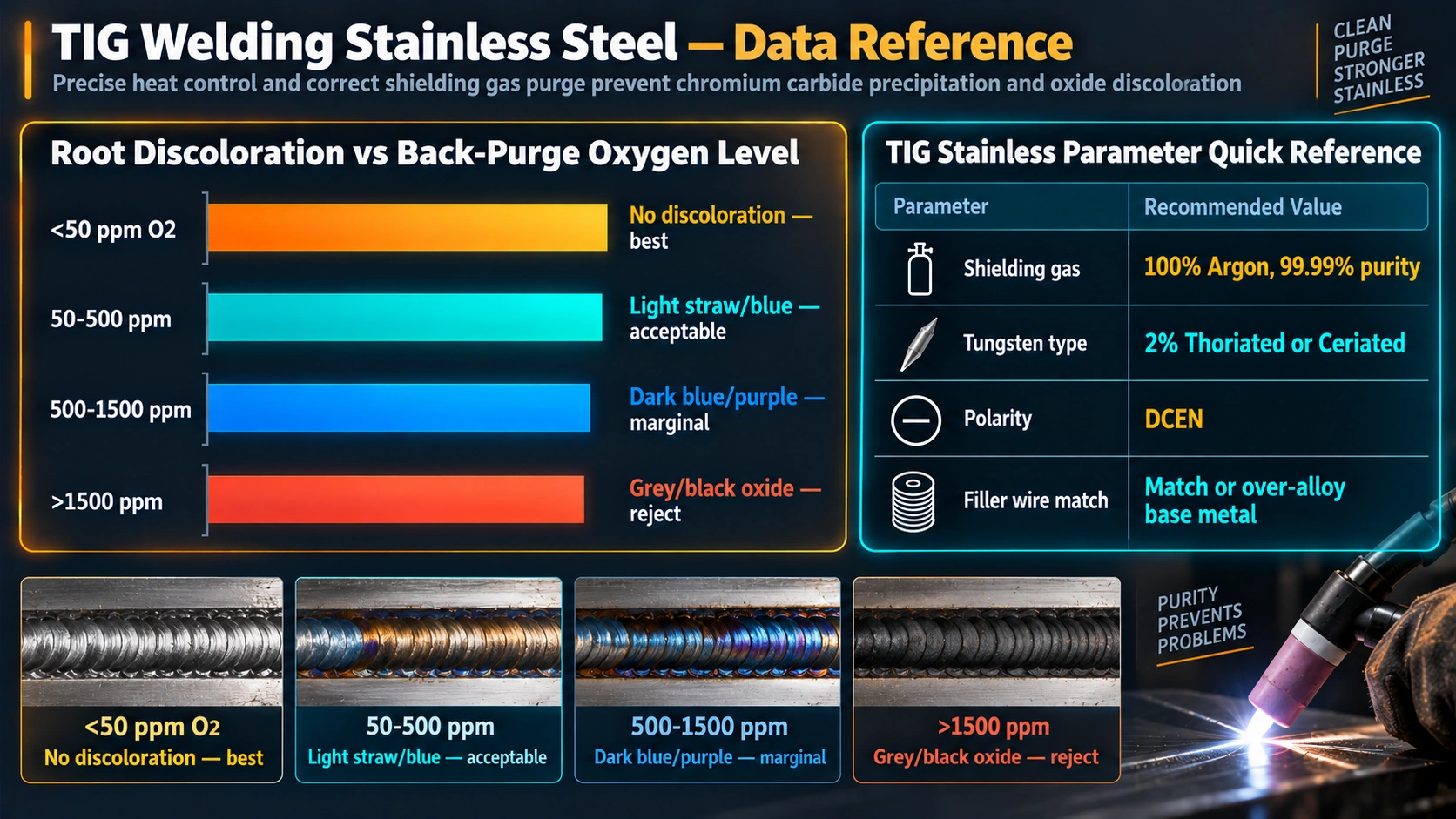
- Purge at 5–15 CFH until an oxygen meter confirms the concentration is below 50 ppm (0.005%). For critical pharmaceutical or ultra-high-purity applications, purge to below 10 ppm.
- Maintain the purge flow throughout the root pass and until the completed weld has cooled below 300 °C on the root side.
- Inspect the root: it should appear bright silver-gold, with no black, brown, or “sugary” texture.
Purging Flat Plate Joints
Proprietary back purge bars — aluminium extrusions with a series of small holes along their length — clamp to the underside of the joint and deliver a curtain of argon across the root. These are available in fixed and adjustable widths and are widely used in structural stainless fabrication.
Pre-Flow & Post-Flow Shielding Gas
Most TIG welding machines include independently adjustable pre-flow and post-flow timers. On stainless steel, both are important:
Pre-Flow
Pre-flow starts the shielding gas flowing before the arc is struck, purging air from the torch cup and gas hose. This prevents the first moments of the arc from being exposed to air. A pre-flow of 0.5 – 2 seconds is sufficient for most applications. Increase pre-flow if the torch has been idle for more than a few minutes (stagnant gas in the hose may have absorbed moisture).
Post-Flow
Post-flow continues shielding gas delivery after the arc is extinguished, protecting the hot weld crater and adjacent HAZ as they cool below the oxidation temperature of stainless steel (~300 °C). The rule of thumb is 1 second of post-flow per 10 A of welding current. At 150 A, set 15 seconds minimum.
Hold the torch cup over the end of the weld and do not lift it away until the post-flow cycle is complete. The weld area will be visibly discoloured if you move the torch too soon — a diagnostic the inspector will notice on the weld surface.
Weld Colour Grading — What Each Colour Means
One of the unique diagnostic features of TIG welding stainless steel is the colour that the weld bead develops as it cools. These colours are caused by thin-film interference effects as a chromium oxide layer grows on the cooling weld surface — thicker oxides shift the colour toward longer wavelengths. The colour is a direct, real-time indicator of shielding quality, heat input, and travel speed.
Factors That Affect Weld Colour
- Shielding gas flow rate: Too high → turbulence draws in air; too low → inadequate coverage.
- Torch angle: Angles beyond 30–45° reduce trailing shielding.
- Travel speed: Slow travel leaves the bead exposed and hot for longer.
- Amperage: Higher amperage = higher peak temperature = more oxidation risk.
- Post-flow duration: Insufficient post-flow allows oxidation of the still-hot crater.
- Draught: Even a gentle cross-draught can deflect the shielding gas envelope.
Preventing Distortion When TIG Welding Stainless Steel
Distortion is the most common fabrication problem in stainless steel TIG work, especially on thin sheet (below 3 mm). Stainless steel has low thermal conductivity (about ⅓ that of carbon steel) and a high coefficient of thermal expansion (about 1.5× carbon steel), making it store heat locally and expand/contract significantly with temperature changes. A disciplined approach to distortion control is essential from the very first tack weld.
Distortion Control Methods
- Minimise heat input. Use the lowest amperage that achieves full fusion, combined with the fastest travel speed that produces a sound bead. Every joule of unnecessary heat adds to distortion.
- Pulse TIG. Engage pulse mode if available. The reduced average heat input from pulse welding is the single most effective distortion reduction technique available on a TIG machine.
- Tack weld thoroughly. Before running any continuous weld pass, tack the joint at close intervals (typically 50–100 mm on thin sheet, 100–200 mm on heavier section). Well-placed tacks resist the joint opening or closing as the continuous weld is deposited.
- Use clamping jigs and fixtures. Rigid fixturing prevents movement during welding and cooling. The fixture does not prevent the stresses from forming, but it controls where the distortion goes — into the fixture, not the workpiece.
- Copper or aluminium backing bars. Backing bars clamped to the reverse of the joint draw heat away from the weld zone (acting as a heat sink) and prevent burn-through on thin material. Copper is preferred for its higher thermal conductivity.
- Stitch welding & back-step sequencing. Instead of one continuous weld pass, stitch weld in segments, leaving gaps to cool. Backstep sequencing (welding each stitch in the opposite direction to the overall weld progression) distributes cumulative heat more evenly.
- Control inter-pass temperature. Allow the weld to cool to below 150 °C between passes. Use a contact thermometer or temp sticks to confirm before restarting.
- Weld in balanced sequence. For symmetrical structures, alternate weld passes on opposite sides of the neutral axis. This balances shrinkage forces and minimises net angular distortion.
✅ Effective distortion controls
- Pulse TIG — reduces average heat input 30–50%
- Clamping fixtures for thin sheet
- Copper backing bars as heat sinks
- Close interval tack welds
- Backstep / balanced welding sequence
- Inter-pass cooling to <150 °C
❌ Practices that worsen distortion
- Excessive amperage relative to thickness
- Slow travel speed / long arc dwell
- Welding continuously without inter-pass cooling
- Insufficient tack welds before full pass
- Flame straightening on sensitisation-sensitive grades
- Poor fit-up with excessive root gaps
Recommended Equipment on Amazon
📢 Affiliate disclosure: WeldFabWorld participates in the Amazon Associates Program. As an Amazon Associate we earn from qualifying purchases at no additional cost to you (tag: neha0fe8-21).
More TIG & Stainless Steel Guides on WeldFabWorld
Frequently Asked Questions
100% argon is the standard choice and will serve the majority of stainless steel TIG welding applications well. For thicker sections requiring deeper penetration or faster travel speed, an argon/helium blend (25–75% He) provides more arc energy. Argon/hydrogen (2–5% H₂) improves cleaning action and produces brighter, more cosmetically appealing welds — it is popular in food processing and pharmaceutical pipework. Recommended flow rate: 15–35 CFH (7–16 L/min).
Ceriated (grey, 2% CeO₂) and lanthanated (gold/black/blue, 1–2% La₂O₃) tungstens are the preferred choices for stainless steel TIG welding. Both are non-radioactive, offer excellent arc starting, good current-carrying capacity, and minimal tungsten contamination of the weld pool. Thoriated tungstens (red or yellow band) also perform well but carry a minor radioactive grinding dust risk. For all three types, grind the working end to a taper of 2–2.5× the electrode diameter, always grinding longitudinally.
TIG welding stainless steel uses Direct Current Electrode Negative (DCEN). The TIG torch connects to the negative terminal and the work clamp to the positive terminal. Under DCEN, approximately 70% of arc energy is directed to the workpiece, giving good penetration with a narrow weld profile and minimal tungsten wear. DCEP is never used for stainless TIG as it would overheat and destroy the tungsten. AC is reserved for aluminium and magnesium only.
ER308L is the correct filler rod for welding Grade 304 and 304L stainless steel. The “L” (low carbon) designation is essential — it limits carbon content to ≤0.03%, which minimises the risk of sensitisation and intergranular corrosion in the HAZ during and after welding. ER308L is also suitable for most other 200 and 300-series austenitic grades. For Grade 316 or 316L, use ER316L; for joining stainless to carbon steel, use ER309L.
Weld colour is caused by thin-film interference in the chromium oxide layer that grows on the hot weld surface. The thicker the oxide film, the longer the wavelength of light reflected, shifting the colour toward blue and black. Silver/chrome = no oxidation (optimal — full corrosion resistance). Gold/straw = minimal oxidation (generally acceptable). Red = excessive heat input. Blue/purple = significant atmospheric exposure while hot — reduced corrosion resistance. Black/grey = severe oxidation, corrosion resistance lost, weld must be rejected and remade. Target silver or gold for code-quality stainless work.
Back purging displaces oxygen from the reverse side of a weld joint using inert gas (argon) before and during welding. It is mandatory for full-penetration welds in stainless steel pipe, tube, and thin plate where the root side is exposed to air. Without back purging, the root oxidises severely (“sugaring”), destroying corrosion resistance and creating a rough, pitted surface that is a reject condition for food-grade, pharmaceutical, and pressure-retaining applications. Purge until oxygen drops below 50 ppm and maintain flow throughout root welding.
Use the minimum amperage that achieves full fusion, apply pulse TIG if available (reduces average heat input by 30–50%), tack weld the joint at close intervals (50–100 mm on thin sheet), use clamping jigs and copper backing bars, stitch weld with backstep sequencing, and allow inter-pass cooling below 150 °C. Stainless steel has low thermal conductivity and high thermal expansion, making distortion more severe than for the same heat input on carbon steel.
A practical starting rule is approximately 1 ampere per 0.001″ (0.025 mm) of material thickness on stainless steel. For example, 1.6 mm (1/16″) sheet starts around 60–80 A DCEN; 3.2 mm (1/8″) plate around 120–140 A. Always set the machine to the minimum that achieves full fusion — lower heat input means less distortion and reduced sensitisation risk. If using a foot pedal, set the machine 10–15% above expected working current and modulate with the pedal.