Stick Welding Aluminum — Can You Do It? Complete Technical Guide
The short answer is yes — you can stick weld aluminum. But the process is genuinely more demanding than almost any other combination of welding process and base material you will encounter. Aluminum’s unique physical and chemical properties create a set of overlapping challenges that punish imprecise technique, inadequate surface preparation, wrong electrode choice, and poorly calibrated settings simultaneously. Many welders try it once, struggle, and conclude it cannot be done. They are wrong — but they are not entirely to blame, because the gap between stick welding mild steel and stick welding aluminum is wider than for almost any other material transition.
This guide gives you the complete technical picture: why aluminum behaves differently under the arc, how the aluminum oxide layer creates a welding challenge unlike anything in steel work, which electrodes to use and why, how to calculate and set your amperage and polarity, when and how to apply preheat, the specific technique demands that differ from steel stick welding, all the major defect types you will encounter and their root causes, and the critical post-weld cleaning procedure that most guides overlook. We also give you a clear-eyed comparison with MIG and TIG so you can decide when stick welding is genuinely the right tool for the job.
Can You Stick Weld Aluminum? — The Honest Answer
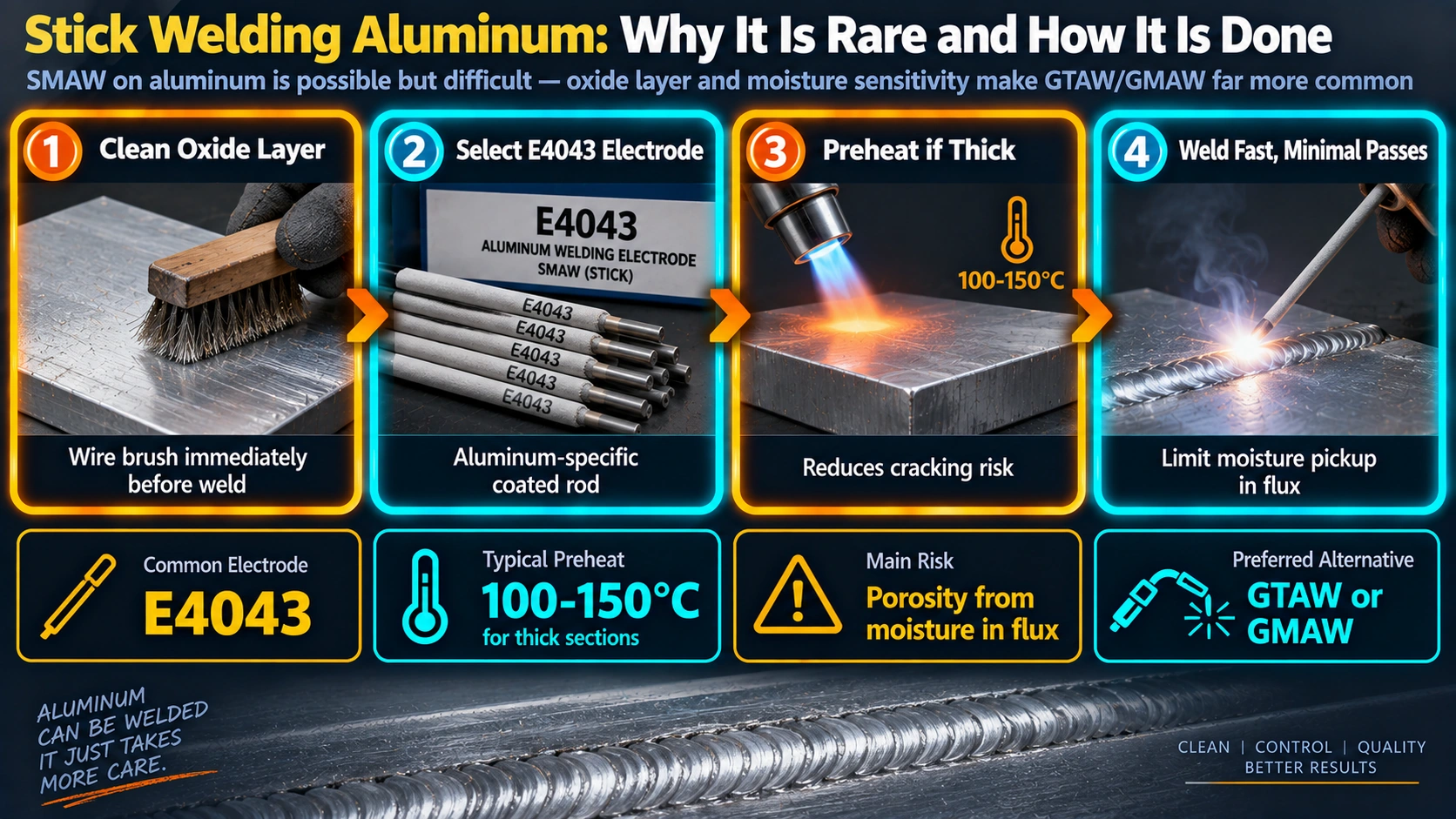
Yes — and it is worth being specific about what “yes” means here. You can produce structurally sound, weld-procedure-qualifiable aluminum welds using the SMAW process with the correct electrodes, settings, and technique. The SMAW process is a recognised welding process for aluminum in applicable codes including AWS D1.2 (Structural Welding — Aluminum). It is not a hack, a workaround, or a last resort — it is a legitimate process for specific applications.
What you cannot expect is the bead appearance, HAZ precision, thin-material capability, or ease of welding that TIG (GTAW with AC current) delivers on aluminum. TIG welding aluminum produces the iconic clean, shiny, tightly rippled weld bead that has become synonymous with quality aluminum fabrication. Stick welding aluminum produces a rougher, wider bead with more spatter, a very tenacious slag that requires special cleaning procedures, and a higher probability of defects including porosity and cracking if technique is not carefully controlled. Those are the honest limitations — and accepting them is the precondition for using the process effectively.
Why Stick Welding Aluminum Is More Demanding Than Steel
The challenges of stick welding aluminum are not arbitrary — they are direct consequences of aluminum’s physical and chemical properties, which differ fundamentally from carbon steel. Understanding why each problem exists is the most direct path to controlling it. There are five interconnected challenges that make SMAW aluminum demanding.
The Aluminum Oxide Problem — Why Surface Prep Is Critical
Of all the challenges in stick welding aluminum, the aluminum oxide layer is the most frequently underestimated. Every aluminum surface exposed to air — regardless of how new or polished it appears — is covered by a thin but extremely tenacious layer of aluminum oxide (Al2O3). This oxide forms spontaneously and continuously whenever aluminum contacts oxygen. It is, in fact, what makes aluminum corrosion-resistant — it is an excellent chemical barrier that protects the base metal. But for welding, it is an obstacle.
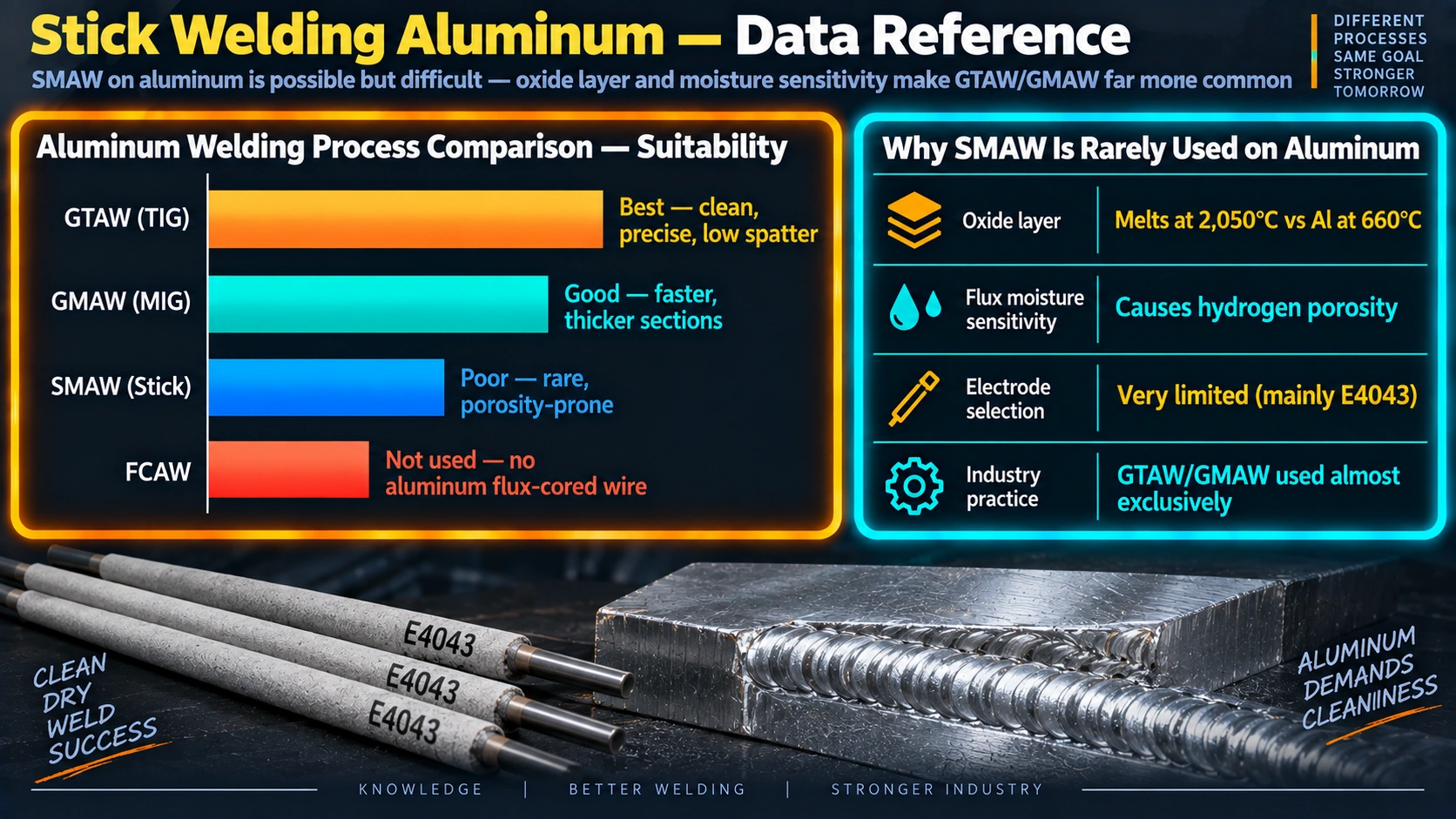
The problem is a mismatch of properties: aluminum melts at 660°C, but aluminum oxide has a melting point of approximately 2,050°C. When the arc heats the joint to welding temperature, the base metal liquefies but the oxide remains solid, floating on top of the weld pool as a refractory skin. This skin prevents the two pieces from fusing together, creates oxide inclusions in the completed weld, and degrades both mechanical properties and corrosion resistance. With TIG welding using AC current, the electrode-positive half-cycle provides cathodic cleaning action that physically shatters and disperses this oxide. With SMAW, the special flux on aluminum electrodes performs a chemical oxide removal function — but only if the oxide layer is thin and the surface is otherwise clean.
How to Remove the Aluminum Oxide Before Welding
Correct oxide removal follows a specific sequence. Each step has a purpose and the sequence matters:
- Degrease first: Before any mechanical cleaning, remove all oils, cutting fluids, release agents, and fingerprint oils with acetone or isopropyl alcohol on a clean lint-free cloth. If you wire-brush before degreasing, the brush simply works the contamination deeper into the surface. Allow the solvent to fully evaporate (minimum 5 minutes) before proceeding.
- Mechanical cleaning — use a dedicated stainless steel wire brush: Brush the joint area vigorously with a stainless steel wire brush that has never been used on any other metal. Carbon steel brushes deposit iron particles that create rust staining and corrosion initiation sites. Ordinary aluminium brushes are too soft to break through the oxide effectively. Stainless steel is the correct choice.
- Do not grind: Conventional abrasive grinding discs smear and fold the oxide layer into the aluminum surface rather than removing it — the opposite of what you need. If you need to reduce the section thickness or remove a defect, use carbide burrs or dedicated aluminium flap discs with open-coat abrasive, followed immediately by stainless wire brushing.
- Chemical cleaning (optional but beneficial for critical joints): A 5–10% solution of sodium hydroxide (caustic soda) applied for 30 seconds followed by a thorough water rinse and immediate drying is an effective chemical oxide removal treatment. Alternatively, a commercial aluminium etching solution or pickling compound achieves similar results. Chemical cleaning is more thorough than brushing alone for complex geometries.
- Weld immediately: Aluminum oxide begins reforming within minutes of cleaning. Weld within 30 minutes of final cleaning for best results. If you must delay, keep the prepared surfaces dry and protected from dust and contamination.
Electrode Selection — E4043, E4047, and Specialty Grades
Dedicated aluminum SMAW electrodes are the first non-negotiable requirement for stick welding aluminum. Standard steel electrodes will not work — they do not have the flux chemistry needed to manage aluminum oxide, and their deposited metal is incompatible with aluminum base metal. Aluminum stick electrodes are available from specialist welding suppliers but are not as widely stocked as steel electrodes, so plan ahead and order in advance for any planned aluminum SMAW work.
E4043 — The Standard Aluminum Stick Electrode
The E4043 electrode deposits an aluminium-silicon alloy (4.5–6% Si) that is compatible with the widest range of aluminium base alloys. The silicon addition improves weld pool fluidity, reduces the tendency for hot cracking, and lowers the melting point of the deposited weld metal slightly — making it more tolerant of dilution from the base metal. E4043 is the default choice for most SMAW aluminium applications and should be your starting point unless a specific reason requires otherwise.
E4047 — Higher Silicon, Better Crack Resistance
E4047 contains a higher silicon content (11–13% Si) and produces a more fluid weld pool with even better resistance to hot cracking. It is particularly suited to welding crack-sensitive aluminium alloys and dissimilar aluminium alloy combinations. The higher silicon produces a weld deposit with slightly lower ductility than E4043 but better crack resistance — a worthwhile trade in applications where cracking risk is high.
| Electrode | Si Content | Compatible Base Alloys | Strength | Best Application |
|---|---|---|---|---|
| E4043 | 4.5–6% | 1xxx, 3xxx, 5xxx (≤3% Mg), 6xxx series | 145–165 MPa min. UTS deposit | General-purpose SMAW aluminium; widest base alloy compatibility |
| E4047 | 11–13% | 1xxx, 3xxx, 6xxx; crack-sensitive alloy joints | Slightly lower than E4043 | Crack-sensitive applications; fluidity-critical joints; dissimilar Al alloys |
| E1100 | Trace only | 1100 commercially pure aluminium only | Lower than E4043 | Commercially pure aluminium repair and fabrication |
| E3003 | Trace only | 3003 and 3004 series | Moderate | 3xxx series sheet and plate repair and fabrication |
Current, Polarity, and Amperage Settings
Almost all aluminium SMAW electrodes are designed for use on DCEP (direct current electrode positive), also known as reverse polarity. This is not optional — running aluminium electrodes on AC or DCEN will produce arc instability, poor fusion, and an unworkable process. Set your machine to DC and verify that the electrode is connected to the positive terminal before striking an arc.
Quick-Reference Starting Amperage — DCEP (E4043 Electrode)
Always verify against the specific electrode manufacturer’s data sheet — brand-to-brand ranges vary. Start at the midpoint of the stated range and adjust based on arc behaviour. If the electrode sticks frequently, increase amperage by 5 A. If burning through, reduce by 5 A.
Unlike steel electrodes where you can often tolerate a wider range of arc lengths, aluminium electrodes demand a consistently very short arc. The arc length should be so short that you can feel and hear the flux coating of the electrode lightly dragging along the aluminium surface. This is often described as keeping the arc length approximately equal to the electrode diameter — but in practice, for aluminium, even shorter is better. A longer arc on aluminium produces an erratic, spitting discharge that causes porosity, instability, and risk of electrode sticking in the rapidly freezing puddle.
Preheat — When, Why, and How Much
Preheat serves two critical functions when stick welding aluminium that are distinct from its role in steel welding. In steel, preheat primarily reduces hydrogen cracking risk by slowing the HAZ cooling rate. In aluminium, there is no hydrogen cracking mechanism in the same sense — the benefits of preheat in aluminium welding are thermal:
- Counteracts rapid heat wicking: By raising the temperature of the surrounding base metal before welding, preheat reduces the temperature gradient between the weld zone and the cool surrounding material. This slows the rate at which heat is conducted away from the joint, allowing the weld pool to form more readily and penetrate more consistently without requiring excessively high arc energy.
- Reduces distortion and cracking: A more uniform temperature distribution across the workpiece reduces the differential thermal expansion and contraction between the weld zone and the surrounding material. This lowers residual stress and the probability of hot cracking as the weld solidifies.
- Improves porosity resistance: A warmer base metal allows any residual surface moisture to evaporate before the arc reaches it, reducing porosity driven by moisture contamination.
| Material Thickness | Preheat Required? | Preheat Temperature | Application Method |
|---|---|---|---|
| Below 6 mm (1/4 in) | Generally not required | Ambient | — |
| 6 – 12 mm (1/4 – 1/2 in) | Recommended | 80 – 120°C (175 – 250°F) | Propane torch; uniform heat across joint area |
| 12 – 25 mm (1/2 – 1 in) | Strongly recommended | 120 – 150°C (250 – 300°F) | Oven or torch preheat; verify with contact thermometer |
| Above 25 mm (1 in) | Required | 150 – 180°C (300 – 350°F) | Oven preheat preferred; maintain temperature throughout welding |
Step-by-Step: How to Stick Weld Aluminum
- Verify Your Machine OutputConfirm your stick welder has variable DC output and can reach the upper end of the amperage range required for your electrode diameter. Aluminium welding requires more current than steel of equivalent thickness because of its high thermal conductivity. Verify you have DCEP capability — the electrode must be connected to the positive terminal. If your machine is AC-only, you cannot effectively stick weld aluminium with standard aluminium electrodes. A minimum machine output of 130–150 A is needed for the most common 3.2 mm (1/8 in) electrode diameter.
- Select and Prepare Your ElectrodesChoose E4043 for general work on 1xxx, 3xxx, 5xxx, and 6xxx series aluminium. Select E4047 for crack-sensitive alloys or dissimilar alloy joints. Match electrode diameter to base metal thickness — as a guide, do not use an electrode whose diameter exceeds the base metal thickness. Remove electrodes from sealed packaging only immediately before welding. If your electrodes have been in an opened packet for more than 4 hours, redry at 100–120°C for 1 hour before use. Plan to use more electrodes than you think — aluminium electrodes burn faster than steel electrodes and produce shorter usable runs per rod.
- Confirm Minimum Material ThicknessStick welding aluminium works reliably on material 4 mm (5/32 in) and above. It becomes increasingly difficult below 4 mm and essentially unreliable below 3 mm for most welders. The combination of high heat conductivity (requiring high arc energy) and low melting point (extreme burn-through sensitivity) on thin material creates a very narrow operating window. If you need to weld material below 3 mm, do a series of practice welds on scrap of the same thickness before committing to the production joint — and seriously evaluate whether TIG or pulse MIG would be a better process choice.
- Surface Preparation — Degrease and Wire BrushThis step is the single most impactful factor in weld quality. First, wipe the joint area and 25 mm (1 in) back from each edge with acetone or isopropyl alcohol on a clean cloth. Allow to fully evaporate. Then brush vigorously with a dedicated stainless steel wire brush (never used on any other metal). Brush in one direction only — back-and-forth scrubbing can fold the oxide layer rather than removing it. Do not grind with standard abrasive discs. For thick oxide or anodised aluminium, chemical etching with a 5–10% NaOH solution for 30 seconds followed by thorough water rinse and drying is strongly recommended. Weld within 30 minutes of cleaning.
- Fit Up the Joint — Tight, with Minimal GapAluminium stick welding is sufficiently demanding without adding the challenge of bridging large root gaps. Fit your pieces so root gaps are minimal — ideally zero to 1 mm for butt joints in thicker material. Unlike TIG welding where precise root gap control gives you control over root penetration, in SMAW aluminium, gaps simply represent metal that must be filled with extra electrode passes, adding heat, distortion, and defect risk. Tack weld at regular intervals using the same electrode and settings you will use for the main weld — aluminium tacks should be small, widely spaced, and fully fused.
- Apply Preheat If RequiredFor sections above 6 mm, apply preheat using a propane or MAP gas torch with a wide flame tip. Heat the base metal uniformly across the joint zone — not just directly at the weld line. Measure temperature with a calibrated contact thermometer or temperature-indicating crayon. Maintain preheat throughout the welding operation. Do not allow the interpass temperature to drop significantly below preheat temperature between passes, and do not allow it to exceed 200°C. On very thick sections, an oven preheat allows more uniform heating than a hand torch.
- Set Machine to DCEP at Mid-Range AmperageSet your machine to DC, connect the electrode holder to the positive terminal (DCEP/reverse polarity). Set amperage to the midpoint of your electrode’s stated range. Run a practice bead on a scrap piece of the same alloy and thickness. Observe: if the electrode sticks in the puddle immediately on contact, increase amperage by 5–10 A. If the arc is very spitting and erratic with excessive spatter, reduce by 5 A. The correct setting produces a short, concentrated arc that moves the puddle forward smoothly. Trust the scrap bead — do not go straight to the production joint with untested settings.
- Strike the Arc and Maintain a Very Short Arc LengthStrike the arc using a scratch or touch-and-lift technique (HF start is not available on most stick machines). As soon as the arc is established, immediately reduce the arc length to its working position — almost touching the surface, with the flux coating of the electrode lightly grazing the work. If you hear a loud crackle and see large amounts of spatter shooting outward, your arc is too long. The correct sound is a tight, rapid, consistent buzzing or crackling. The short arc is one of the most important adjustments for aluminium SMAW and one of the hardest to get right initially.
- Travel Along the Joint — Faster Than You ThinkMove along the joint at a noticeably faster travel speed than you would for steel of equivalent thickness. The fast heat wicking of aluminium means the puddle solidifies quickly behind the arc — if you travel at normal steel speed, you will overheat the already-deposited weld metal and the surrounding HAZ, producing excessive spatter, porosity, and burn-through. The correct speed leaves a neat, consistently wide puddle behind you. If the puddle is growing wider as you travel, you are moving too slowly. Keep the electrode angle at approximately 10–15 degrees from vertical, tipped toward the direction of travel.
- Fill the Crater at the Weld End — No ExceptionsNever extinguish the arc abruptly at full power at the weld termination point. An aluminium weld crater is a concentrated hot spot that, if left unfilled, becomes a stress concentration and a cracking initiation site. Hot cracks that form in aluminium weld craters can run the full length of the weld bead during cooling. At the end of each pass, reduce travel speed slightly, pause momentarily, then back-track 10–15 mm along the weld before extinguishing the arc — this back-fills the crater and leaves a smooth, filled termination. If a crater crack forms despite this technique, stop immediately, grind out the crack completely, and re-weld the affected zone before it propagates.
Technique — Arc Length, Travel Speed, and Electrode Angle
Three technique variables control most of the outcome quality in aluminium stick welding. Getting all three right simultaneously is what makes this process challenging to learn — each variable interacts with the others, and a mistake in any one cascades into problems in the others.
Arc Length — Keep It Shorter Than Feels Natural
The arc length for aluminium SMAW should be shorter than for steel of comparable section. The arc gap should be approximately equal to the electrode diameter — which for a 3.2 mm electrode means roughly 3 mm from the tip to the work surface. Many instructors describe the correct feel as sensing the flux coating of the electrode “dragging” lightly along the aluminium surface. This short arc concentrates the arc energy tightly at the joint root, prevents the arc from wandering, and minimises the atmospheric exposure of the weld pool edges. A long arc on aluminium produces arc wander, heavy spatter, porosity, and an erratic puddle that is nearly impossible to control.
Travel Speed — Faster Than Steel, Consistent Throughout
Travel speed must be noticeably faster than what you would use on an equivalent steel joint. A common mistake is to use steel welding travel speed and then increase amperage when the puddle looks sluggish — this compounds the heat input problem rather than solving it. The correct approach is to maintain appropriate amperage and increase travel speed instead. A useful mental adjustment: if you think you are moving fast enough, try moving 20–30% faster and observe whether the bead width becomes more consistent and the spatter decreases. Consistent travel speed throughout the pass is as important as the speed itself — variations in travel speed produce variable bead width and penetration that create stress concentrations in the completed weld.
Electrode Angle — Work Angle and Travel Angle
For flat position butt welds, hold the electrode perpendicular to the joint (90 degrees work angle) with a travel angle of 10–15 degrees tipped toward the direction of welding. This forward lean (push angle) directs the arc energy ahead of the puddle and assists the fast travel speed needed for aluminium. For T-joints, bisect the angle between the two members (typically 45 degrees work angle) with the same 10–15 degree travel angle. Avoid steep backhand (drag) angles on aluminium — directing the arc force into the solidifying weld behind the puddle increases porosity and slows the effective travel speed.
Common Defects and How to Prevent Them
Post-Weld Cleaning — The Non-Negotiable Final Step
Post-weld cleaning of aluminium stick welds is one of the most critical and most frequently neglected steps in the entire SMAW aluminium process. The flux coating on aluminium stick electrodes contains fluoride and chloride compounds that, once deposited as slag on the weld surface, remain chemically active. If left on the aluminium surface, these ionic compounds absorb moisture from the air and form corrosive acids that attack the base metal and degrade both corrosion resistance and weld appearance over time. This is fundamentally different from steel electrode slag, which is inert once cool and can be left in place temporarily without chemical damage.
The Correct Post-Weld Cleaning Sequence
- Allow the weld to cool to below 100°C before beginning cleaning. Do not quench with water while hot — the thermal shock can induce cracking.
- Chip off the bulk slag with a dedicated aluminium chipping hammer. Note that aluminium electrode slag is harder and more tenacious than most steel electrode slags and may require more effort to remove. Wear eye protection — the slag fragments can be sharp.
- Hot water wash: The single most effective step for aluminium electrode slag removal is washing the weld area with hot water (as hot as you can comfortably handle, or hotter with gloves — 60°C or above is ideal). Hot water dissolves the soluble fluoride and chloride salts in the slag more effectively than any other single action. This step is not optional — dry chipping alone will not remove chemically active slag residues.
- Scrub with a stainless steel wire brush while the hot water is still wet on the surface, working the brush into weld toes and any recesses where slag could be trapped.
- Rinse thoroughly with clean water to remove all dissolved flux residue. For structural or pressure-containing components, a second hot water wash followed by a clean water rinse is recommended.
- Dry thoroughly: Dry the weld area immediately after rinsing — trapped moisture accelerates corrosion particularly at weld toes. Use compressed air for recesses and complex geometries.
- Visual inspection: Examine the cleaned weld under good lighting. Any remaining slag appears as a white or grey residue. Any areas with residue must be re-cleaned. The final weld surface should be clean aluminium colour throughout.
Stick vs MIG vs TIG for Aluminum — Which Should You Use?
- No shielding gas required
- Works in wind and outdoors
- Simple portable equipment
- No spool gun or wire feed needed
- Good for field repair on thick sections
- Rough bead appearance
- Tenacious slag — complex cleaning
- Limited to > 3–4 mm thickness
- High skill requirement
- Expensive specialty electrodes
- Lower deposit quality than TIG/MIG
- High deposition rate
- Good for thick-section production
- Better bead appearance than stick
- Suitable for 3 mm and above
- Spool gun handles soft Al wire
- Requires argon gas cylinder
- Poor in wind (gas disrupted)
- Spool gun less maneuverable than TIG
- Less precise than TIG on thin material
- More spatter than TIG
- Best weld quality and appearance
- Works down to 1 mm and below
- Precise heat control (foot pedal)
- No slag — minimal post-weld cleaning
- AC cleaning removes oxide in-process
- Autogenous welds possible
- Requires argon gas + AC-capable machine
- Slowest deposition rate
- Highest skill requirement
- Sensitive to wind outdoors
- Higher equipment cost
| Scenario | Best Process | Reason |
|---|---|---|
| Remote field repair, no gas available, >5 mm thick | Stick (SMAW) | Only option without gas supply; thick sections tolerate appearance |
| Outdoor repair in wind, structural aluminium, >4 mm | Stick (SMAW) | Gas coverage impossible to maintain in wind; SMAW self-shielded |
| Shop fabrication, 3–15 mm aluminium plate or extrusions | MIG + spool gun | Speed, consistent appearance, suitable for structural and fabrication |
| Precision work, aerospace, automotive, thin sheet <3 mm | TIG (GTAW AC) | Best quality, thinnest material capability, finest bead appearance |
| Hobby, learning, mixed-use workshop | MIG or TIG | Both provide better results than stick for lower skill investment |
| Only have a stick welder, need to repair aluminium boat | Stick (SMAW) | Viable with proper technique; manage expectations on appearance |
Frequently Asked Questions — Stick Welding Aluminum
Can you stick weld aluminum?
Yes, aluminum can be stick welded using SMAW with dedicated aluminum electrodes such as E4043. It is significantly more challenging than stick welding steel due to aluminum’s high thermal conductivity, low melting point, and tenacious aluminum oxide surface layer. The resulting weld appearance is generally rougher than TIG or MIG, the slag is very difficult to remove, and the technique demands are high. That said, stick welding aluminum is genuinely useful for field repairs, remote locations where gas cylinders are impractical, and thicker sections where MIG or TIG speed advantages matter less. With the right electrode, settings, surface preparation, and technique, structurally sound aluminum welds can be produced.
What electrode do I use for stick welding aluminum?
The most common electrode for stick welding aluminum is E4043, which deposits an aluminium-silicon alloy compatible with a wide range of aluminium base alloys including 1100, 3003, 5052, 6061, and 6063. E4047 is an alternative with higher silicon content that provides better fluidity and crack resistance for crack-sensitive alloys. Aluminum stick electrodes must be stored in sealed packaging or a heated oven and used within 4 hours of opening — the flux coating is extremely hygroscopic and moisture absorption causes heavy porosity in the weld. Never use standard steel electrodes on aluminum.
What settings should I use for stick welding aluminum?
Almost all aluminum SMAW electrodes require DCEP (direct current electrode positive — reverse polarity). Amperage ranges by electrode diameter: 3/32 in (2.4 mm) requires approximately 50–80 A; 1/8 in (3.2 mm) requires 80–130 A; 5/32 in (4.0 mm) requires 100–160 A. Always consult the specific electrode manufacturer’s data sheet. Start at the midpoint of the range and adjust based on arc behaviour — if the electrode sticks, increase amperage; if burning through, reduce. Maintain a very short arc (nearly touching the surface), travel faster than you would for steel, and fill all craters at weld terminations.
Why is aluminum oxide a problem when stick welding aluminum?
Aluminum forms a tenacious aluminum oxide (Al2O3) layer on its surface with a melting point of approximately 2,050°C — nearly three times higher than aluminum’s melting point of 660°C. If not removed before welding, this oxide floats on the weld pool as a refractory skin, preventing fusion and creating oxide inclusions. It must be physically removed by stainless steel wire brushing or chemical etching before welding. Grinding with conventional abrasive discs embeds and smears the oxide rather than removing it. The surface should be welded within 30 minutes of cleaning before the oxide layer rebuilds.
Why does the slag on aluminum stick welds need special treatment?
The flux coating on aluminum SMAW electrodes produces slag containing fluoride and chloride compounds that are chemically active and corrosive to aluminum if left on the surface. Unlike steel electrode slag which is inert once cool, aluminum electrode slag absorbs moisture and forms corrosive acids that attack the base metal over time. The slag must be removed by hot water washing (which dissolves the ionic flux residues), stainless wire brushing, and thorough clean water rinsing. Dry chipping alone is insufficient. This post-weld cleaning step is not optional for any aluminum stick weld that will be in service.
Is stick welding aluminum better than TIG or MIG for aluminum?
For most shop applications, TIG (GTAW with AC current) is the superior choice for aluminum — clean welds, best appearance, most precise heat control, and no corrosive slag. MIG (GMAW with argon and a spool gun) offers higher deposition rates for thicker structural aluminum. Stick welding aluminum is the practical choice when working in remote field locations where argon cylinders are impractical, performing emergency repairs in windy outdoor conditions where shielding gas would be disrupted, or when only a stick welder is available on thick material (>4 mm). For anything involving thin material, visible appearance, precision, or regular shop work, use TIG or MIG.