ASME vs ASTM vs API: Understanding the Three Code Bodies
ASME vs ASTM vs API confusion is extremely common among engineers, fabricators, and QA/QC personnel early in their careers, because all three acronyms show up on the same drawing, the same material certificate, and the same project specification, yet they answer three completely different questions. ASME tells you how a pressure-retaining component must be designed, fabricated, and qualified. ASTM tells you what the material itself is — its chemistry, mechanical properties, and how it must be tested. API tells you how an asset is operated, inspected, and maintained once it is in industrial service, and in some cases also provides original design rules for storage tanks and pipelines.
This guide untangles the three bodies one at a time, then shows exactly how their documents interlock on a real project — a pressure vessel built from a specific steel plate, fabricated under a construction code, and later inspected under an industry mechanical integrity program. Along the way you will see why a single line item like “SA-516 Grade 70” on a drawing is actually a handoff between all three organizations at once.
By the end, you will be able to look at any code reference on a drawing or specification and immediately identify whether it governs what the material is, how the component must be built, or how the asset must be run — the three distinct jobs that ASTM, ASME, and API each exist to do.
Quick Overview: Three Different Jobs
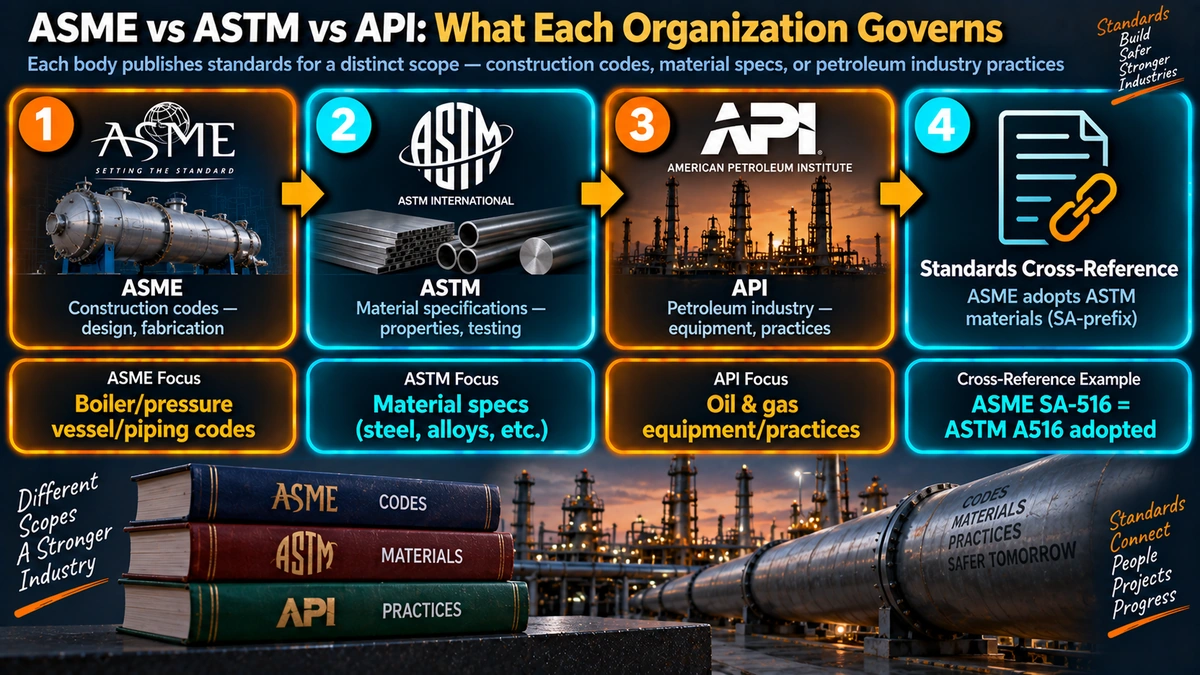
The fastest way to stop confusing the three bodies is to stop thinking of them as competitors and start thinking of them as specialists who each own one layer of the same stack. A finished, code-compliant pressure vessel did not come from just one of these organizations — it came from all three, layered on top of each other, each one solving a different engineering question.
| Aspect | ASME | ASTM | API |
|---|---|---|---|
| Full name | American Society of Mechanical Engineers | American Society for Testing and Materials (now ASTM International) | American Petroleum Institute |
| Core question answered | How must this component be designed, built, and qualified? | What is this material, and how is it tested? | How is this asset operated, inspected, and maintained? |
| Primary document type | Construction/qualification codes (Section VIII, B31.3, Section IX) | Material specifications and test methods (A516, A370, E8) | Industry recommended practices and standards (API 510, API 650) |
| Document scope | Cross-industry, pressure equipment focused | Cross-industry, virtually every material and product type | Primarily petroleum, petrochemical, and natural gas industries |
| Used independently? | Rarely — usually requires ASTM materials and may layer with API | YES — can stand alone for general material supply | Partly — design standards stand alone, inspection standards build on ASME-built assets |
What Is ASME — Design, Construction, and Qualification Codes
ASME, the American Society of Mechanical Engineers, publishes the Boiler and Pressure Vessel Code (BPVC) along with the B31 series of piping codes. These are construction codes: they define allowable stresses, design margins, required wall thickness calculations, fabrication tolerances, nondestructive examination extent, and — through ASME Section IX — how welding and brazing procedures and personnel must be qualified before they touch a pressure-retaining joint.
Crucially, ASME does not invent its own steel grades or write its own tensile-testing method from scratch. Section II Part D of the BPVC is essentially a giant cross-reference: it lists which material specifications are permitted for pressure-part construction and assigns each one an allowable stress at temperature. Almost every one of those listed specifications is, underneath an “SA-” prefix, an ASTM specification that ASME has formally adopted for use inside its own code.
What Is ASTM — Material Specifications and Test Methods
ASTM International publishes thousands of voluntary consensus standards covering materials, products, systems, and services across nearly every industry, not just pressure equipment. For a welding engineer, the two categories that matter most are material specifications — documents like ASTM A516 (pressure vessel plates) or A106 (seamless carbon steel pipe) that define chemistry, mechanical property minimums, heat treatment condition, and required certification — and test methods, documents like ASTM E8 (tension testing of metallic materials) or A370 (mechanical testing of steel products) that define exactly how a property must be measured so results are comparable between labs.
ASTM specifications are written to be usable entirely on their own. A structural fabricator buying plate for a non-pressure application can specify “ASTM A516 Grade 70” and receive a fully defined, traceable material with no need to reference ASME or API at all. It is only when that same plate is destined for ASME-code construction that a second layer gets added.
What Is API — Industry Practice, Tanks, and Mechanical Integrity
The American Petroleum Institute represents the oil, gas, and petrochemical industry, and its standards fall into two distinct families that are easy to conflate. The first family is original design and construction standards for equipment specific to that industry — API 650 for welded steel atmospheric storage tanks and API 620 for large, low-pressure welded storage tanks are full design-and-build standards, playing a role similar to an ASME code but scoped to tankage rather than pressure vessels or boilers.
The second, arguably more widely cited, family is in-service inspection and mechanical integrity practice — API 510 for pressure vessel inspection, repair, alteration, and rerating, and API 570 for piping inspection, are not construction codes at all. They assume the vessel or pipe was already built correctly under an ASME code and instead define how that asset should be periodically inspected, how corrosion and remaining life should be calculated, and when a repair, rerate, or replacement decision is required years into its service life.
How the Three Bodies Interlock on a Real Project
Consider a carbon steel pressure vessel fabricated for a refinery process unit. The plate is purchased to ASTM A516 Grade 70, certified with chemistry and tensile results traceable to ASTM A370 and E8 test methods. The vessel itself is designed and fabricated under ASME Section VIII Division 1, which accepts that plate because Section II Part D lists SA-516 Grade 70 with an assigned allowable stress at the design temperature. The welding procedures used to join the shell and heads are qualified under ASME Section IX. Once the vessel is installed and in service, the refinery’s mechanical integrity program applies API 510 to schedule periodic inspections, calculate corrosion rates, and determine remaining life — all without touching the original ASME design basis.
Worked Example: Tracing One Line Item Through All Three Bodies
Side-by-Side Comparison Table
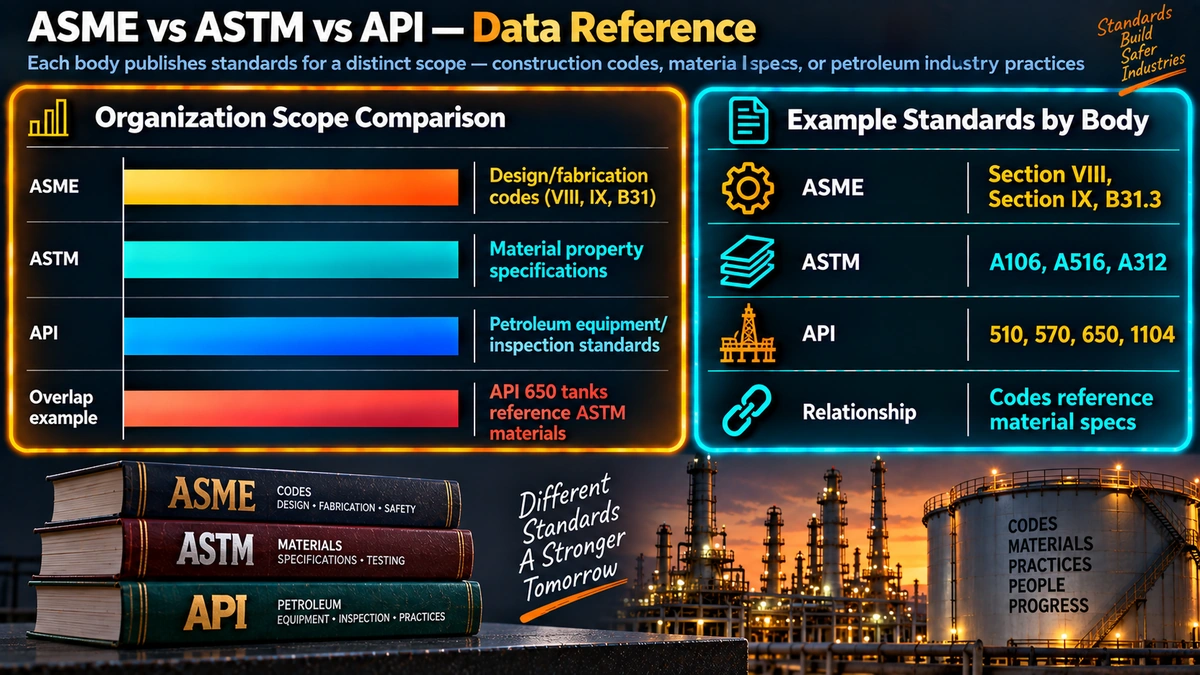
| Function | ASME | ASTM | API |
|---|---|---|---|
| Original design rules | Core function | Not applicable | Yes, for tanks/pipelines (API 650, 620) |
| Material chemistry/properties | References ASTM | Core function | References ASTM/ASME |
| Welding qualification | Core function (Section IX) | Not applicable | References ASME Section IX |
| In-service inspection/fitness-for-service | Limited (in-service codes exist but narrower) | Not applicable | Core function (API 510, 570, 579) |
| Stands alone without the others | Rarely | YES | Depends on document |
Are These Documents Legally Mandatory?
None of the three bodies has independent legal authority; all three are private-sector, consensus-based standards organizations. Their documents become enforceable only when adopted by a government regulation, a jurisdictional boiler and pressure vessel law, or a contract and project specification. In practice, the ASME BPVC has been adopted into law by most U.S. states and many countries worldwide, which is why pressure equipment compliance feels mandatory in a way that a general ASTM specification, used purely by contractual reference, may not. API standards typically gain enforceability through company mechanical integrity programs, insurance requirements, or, in some jurisdictions, regulatory adoption such as OSHA’s Process Safety Management standard referencing recognized and generally accepted good engineering practice.
Frequently Asked Questions
Is ASME a law, like a government regulation?
Why does an ASME code call out an ASTM material instead of just describing the material itself?
What is the difference between an ASTM A-number and an ASME SA-number for the same material?
Does API write design rules like ASME, or only inspection rules?
Can a fabricator use an ASTM specification on its own without referencing ASME or API?
Which document should a welding engineer check first when starting a new pressure vessel job?
Do ASTM specifications cover welding consumables too, or only base metals?
Why do API 510 and API 570 matter if the vessel or pipe was already built to ASME?
Recommended Reference Books
ASME Boiler and Pressure Vessel Code Section VIII Div. 1
The construction code that ultimately invokes ASTM/SA materials and ASME Section IX welding qualification.
View on AmazonASTM A370 — Mechanical Testing of Steel Products
The core ASTM test-method standard referenced by nearly every material specification used in pressure equipment.
View on AmazonAPI 510 Pressure Vessel Inspector Certification Guide
A practical study and reference guide for API’s pressure vessel in-service inspection standard.
View on AmazonPressure Vessel Design Manual
A widely used engineering reference that ties ASME design rules to real ASTM/SA material selection decisions.
View on AmazonDisclosure: WeldFabWorld participates in the Amazon Associates programme (StoreID: neha0fe8-21). If you purchase through these links, we may earn a small commission at no extra cost to you. This helps support free technical content on this site.