AWS D1.1 Structural Welding Code — Complete Technical Overview
Key Takeaways
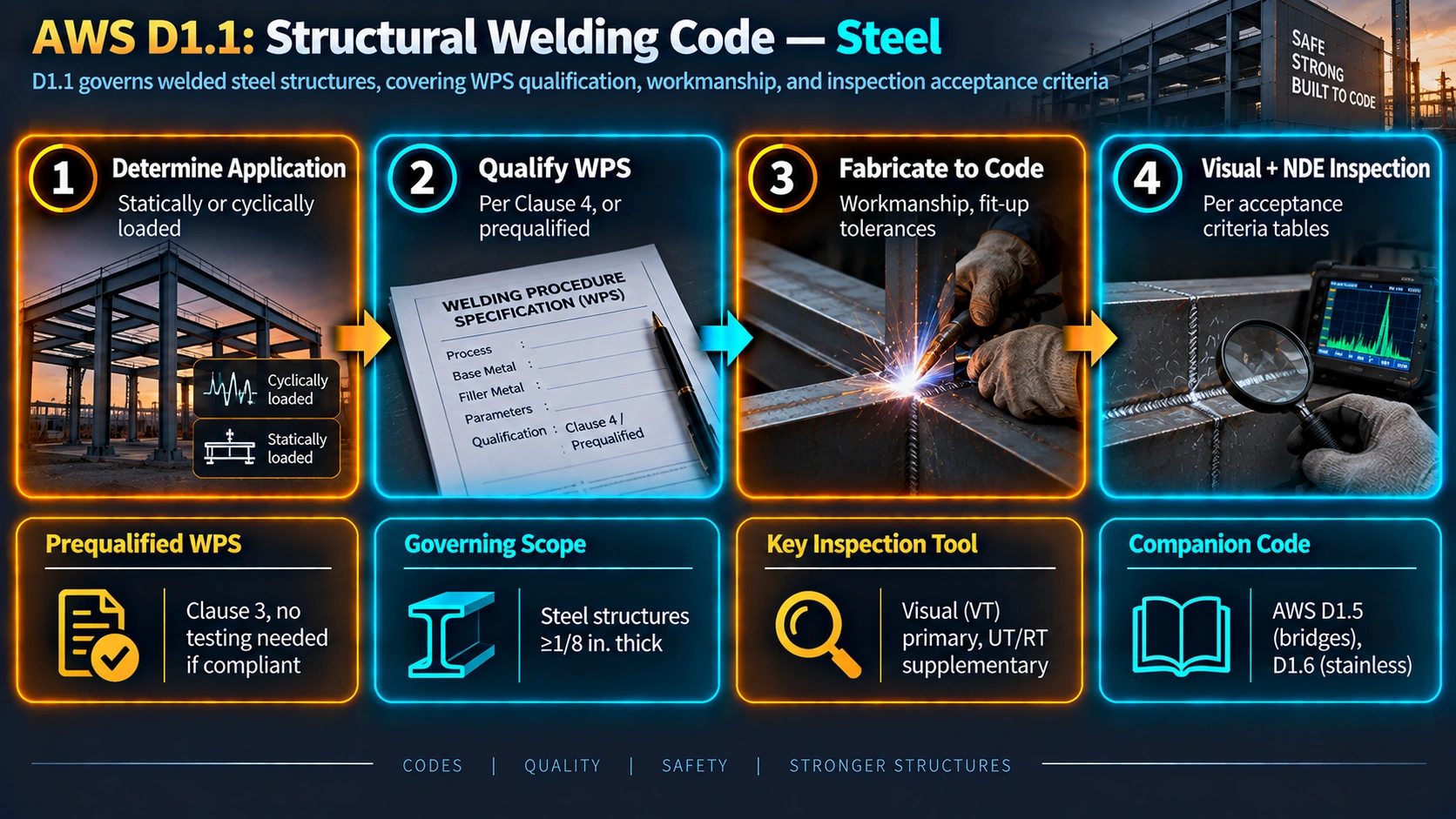
- AWS D1.1 is the primary structural welding code for carbon and low-alloy steel in buildings, offshore platforms, and industrial structures.
- Prequalified WPSs (Clause 3) eliminate the need for PQR testing when all prequalification conditions are met.
- Four base metal categories (I–IV) drive preheat requirements based on chemistry and section thickness.
- Cyclically loaded structures have stricter weld category requirements (B, C, D, E, E’, F, G, K) under Clause 2.
- Visual inspection (Clause 6) is mandatory for all welds; UT or RT is required for CJP groove welds in tension.
- The Engineer retains authority to impose requirements beyond code minimums and to approve non-prequalified joints.
AWS D1.1, Structural Welding Code — Steel, is the most widely referenced welding code in North American construction and fabrication. Published by the American Welding Society (AWS), it establishes minimum requirements for the design, qualification, fabrication, and inspection of welded joints in structural steel applications — from multi-storey buildings and industrial platforms to offshore jackets and crane structures. Any structural steel project where the contract documents cite D1.1 must comply with its requirements from base metal selection through final inspection.
The code has been continuously updated since its first edition in 1972, with the current edition incorporating advances in filler metal classification, ultrasonic testing techniques, and software-based WPS management. Understanding D1.1 is essential not only for welding engineers and CWI-certified inspectors, but for structural engineers, project managers, and procurement teams who specify, procure, or oversee structural steel fabrication. This guide walks through every major clause — from joint design and prequalification to NDT acceptance criteria — so you can apply the code confidently on real projects.
D1.1 does not cover pressure vessels, piping, or railway bridges (which fall under ASME Section IX and AWS D1.5, respectively). It is explicitly written for statically and cyclically loaded structures fabricated from wrought structural steels with a minimum specified yield strength (MSYS) not exceeding 690 MPa (100 ksi). Stainless steel and aluminium structures have their own AWS codes (D1.6 and D1.2).
Clause 1 — General Requirements and Scope
Clause 1 defines the scope and applicability of the code. AWS D1.1 applies to welded joints in structural steels with a minimum specified yield strength (MSYS) not exceeding 690 MPa (100 ksi). Steels listed in Table 3.1 (Approved Base Metals) are preapproved for use under the code; others require Engineer approval and qualification testing.
The code defines several key roles. The Engineer is the authority who establishes requirements, approves departures, and resolves issues not explicitly covered by the code. The Contractor is responsible for executing work in compliance with the code. The Inspector — typically a Certified Welding Inspector (CWI) — verifies conformance on behalf of the owner. The code also distinguishes between fabrication inspection (contractor’s own QC) and verification inspection (third-party QA on behalf of the owner).
Base Metal Categories
D1.1 groups structural steels into four base metal categories (I through IV) for preheat and interpass temperature purposes. This grouping is based on the steel’s chemical composition — particularly carbon equivalent (CE) — and its susceptibility to hydrogen-induced cracking (HIC).
| Category | Representative Steels | CE Range (approx.) | HIC Risk |
|---|---|---|---|
| I | A36, A53 Gr. B, A500, A501 | < 0.40 | Low |
| II | A572 Gr. 42/50, A992, A709 Gr. 50 | 0.40 – 0.45 | Moderate |
| III | A514, A709 Gr. 100, A852 | 0.45 – 0.55 | High |
| IV | High-CE quenched & tempered steels | > 0.55 | Very High |
The carbon equivalent (CE) is the primary driver of preheat selection. For D1.1, the most commonly used formula is the IIW formula: CE = C + Mn/6 + (Cr + Mo + V)/5 + (Ni + Cu)/15. Higher CE values signal greater hydrogen cracking risk, requiring higher preheat temperatures to slow the cooling rate and allow hydrogen to diffuse out of the weld zone.
Clause 2 — Design of Welded Connections
Clause 2 governs the design of welded connections including allowable stresses, effective weld areas, and fatigue considerations for cyclically loaded structures. It is the structural engineer’s primary reference within D1.1. A key concept in Clause 2 is the distinction between statically loaded structures and cyclically loaded (dynamic/fatigue) structures, since acceptance criteria, weld category requirements, and NDT requirements differ significantly between the two.
Fillet Weld Design
Fillet welds must be designed based on the effective throat area resisting the applied force. The effective throat of a fillet weld is 0.707 times the leg size for equal-leg fillets. AWS D1.1 Table 2.4 specifies minimum fillet weld sizes based on the thicker part joined, ranging from 3 mm (1/8 in.) for material up to 6 mm (1/4 in.) thick, up to 8 mm (5/16 in.) for material over 19 mm (3/4 in.) thick. Maximum fillet weld size along edges is the material thickness minus 1.5 mm (1/16 in.) for material 6 mm (1/4 in.) and thicker.
Groove Weld Types: CJP and PJP
AWS D1.1 distinguishes two fundamental groove weld types:
Complete Joint Penetration (CJP) groove welds extend through the full thickness of the joint. They are designed to develop the full strength of the base metal and require specific joint preparations listed in the prequalified joint tables (B-U-4, B-L-1, etc.). CJP welds in tension on cyclically loaded structures require mandatory UT or RT.
Partial Joint Penetration (PJP) groove welds penetrate only part of the joint thickness. Their effective throat depends on the process and groove angle; for most processes at groove angles of 60° or greater, the effective throat equals the depth of groove minus 3 mm (1/8 in.). PJP welds are not permitted in certain tension-loaded fatigue-critical applications.
Fatigue Categories (Cyclically Loaded Structures)
For structures subject to cyclic loading (Category C, D, or E fatigue), Clause 2 assigns stress categories A through K2 to different connection details. Category A (plain material away from any weld) has the highest fatigue life; Category E’ (certain fillet-welded attachments) has the lowest. The allowable stress range for each category decreases with the number of load cycles. Engineers designing crane girders, bridges not covered by D1.5, or dynamically loaded industrial structures must determine the applicable stress category for each connection.
Clause 3 — Prequalification of WPSs
Clause 3 is the backbone of most structural welding operations. It defines the conditions under which a Welding Procedure Specification (WPS) is prequalified — meaning it can be used without the supporting procedure qualification test (PQR) that would otherwise be required under Clause 4.
Prequalified Processes
Only the following four processes are eligible for prequalified status under Clause 3:
- SMAW — Shielded Metal Arc Welding
- SAW — Submerged Arc Welding (single and multiple arc)
- GMAW — Gas Metal Arc Welding (excluding short-circuit transfer mode)
- FCAW — Flux-Cored Arc Welding (self-shielded and gas-shielded)
ESW, EGW, and short-circuit GMAW require qualification under Clause 4 regardless of all other conditions.
Prequalified Joint Configurations
Clause 3 provides detailed joint configuration tables covering groove angles, root openings, root face dimensions, and backing requirements for both CJP and PJP groove welds, as well as fillet welds. These are designated by alphanumeric codes (e.g., B-U-4a, TC-U-4a, C-U-4) indicating: weld type (B = butt, C = corner, T = T-joint), groove type (U = single U, L = single bevel, etc.), and figure number.
Any variation outside the tabulated ranges — such as a groove angle of 58° on a joint requiring 60° minimum — disqualifies prequalified status and requires Clause 4 qualification. The Engineer may approve alternate configurations if supported by engineering analysis, but this is not prequalification.
Preheat and Interpass Temperature
Preheat and minimum interpass temperature requirements for prequalified WPSs are given in D1.1 Table 3.2, indexed by base metal category (I–IV), base metal thickness, and filler metal hydrogen designation (H4, H8, H16). Lower-hydrogen filler metals (H4, H8) allow lower preheat temperatures, reflecting their reduced risk of introducing hydrogen into the weld metal.
Filler Metal Prequalification
Filler metals must be classified under current AWS A5.x specifications to qualify for use in prequalified WPSs. D1.1 Clause 3.3 lists approved filler metal classifications for each process. Use of a filler metal not appearing in the approved list — including older or unlisted classifications — requires Clause 4 qualification. Low-hydrogen electrodes (E7018, E7016, E8018-C3, etc.) are strongly preferred for structural applications because they reduce HIC risk and often permit lower preheat temperatures.
Clause 4 — Qualification of WPSs and Welding Personnel
When a WPS cannot be prequalified — because the process, base metal, filler metal, or joint geometry falls outside Clause 3 limits — it must be qualified by test under Clause 4. The qualification pathway requires preparing test weldments, subjecting them to mechanical testing, and documenting results in a Procedure Qualification Record (PQR).
Procedure Qualification Testing (PQR)
The test assembly for a groove weld PQR consists of a butt joint in the base metal to be used, welded to the minimum thickness qualified. Standard tests required from the PQR coupon include:
- Bend tests — side bend or face/root bend depending on base metal thickness
- Tensile test — to verify tensile strength equals or exceeds base metal minimum
- Charpy V-notch (CVN) impact tests — required for dynamically loaded structures
- Macro examination — for some processes, to verify fusion and root penetration
A PQR is a permanent record of the actual parameters used during qualification testing, the test results, and the range of variables qualified. Each WPS must be supported by at least one PQR. One PQR may support multiple WPSs if the qualified ranges cover all variables in each WPS.
Essential Variables for WPS Qualification
A change beyond the permitted range of any essential variable requires re-qualification. D1.1 Clause 4 lists essential variables for each process. Common essential variables include:
Typical Essential Variables (Clause 4)
- Change in base metal P-Number or group (e.g., from Group I to Group II)
- Change in filler metal F-Number or A-Number classification
- Change in welding process (e.g., SMAW to FCAW)
- Change in PWHT condition (e.g., adding or deleting PWHT)
- Decrease in preheat or interpass temperature below qualified values
- Change in position beyond qualified range
- Increase in base metal thickness beyond qualified range (for groove welds)
- Change in shielding gas composition (for GMAW/FCAW-G)
- Addition or deletion of backing
Welder Qualification (WQT / WPQ)
Clause 4 also governs the qualification of welders and welding operators. Each welder must demonstrate ability to produce sound welds by testing in the process and position(s) applicable to the production work. Test results are recorded on a Welder Performance Qualification (WPQ) record. Welder qualification is position-specific: a welder qualified in the flat position (1G/1F) is not automatically qualified for vertical (3G/3F) or overhead (4G/4F) welding.
Welder qualification under AWS D1.1 is not equivalent to ASME Section IX welder qualification — they are separate codes with different test requirements. A welder qualified under one code must be separately qualified under the other if both codes are applicable to their work. For more on the ASME approach, see our guide on tube-to-tubesheet qualification under ASME IX.
Clause 5 — Fabrication Requirements
Clause 5 addresses the physical requirements of fabrication, covering base metal preparation, assembly, fit-up, welding sequence, distortion control, PWHT, and repair procedures. These requirements apply to all welds produced under D1.1, whether the WPS is prequalified or qualified by test.
Base Metal Preparation
Surfaces to be welded must be free of mill scale (in areas where it impairs bonding), rust, moisture, oil, paint, and other contaminants. D1.1 Clause 5.15 specifies that mill scale that withstands vigorous wire brushing may remain, unless the WPS specifically requires removal. Thermal cutting (oxyfuel, plasma, or laser) is an acceptable method for edge preparation; thermally cut edges must meet the surface roughness and profile tolerances in Table 5.3.
Assembly and Fit-Up Tolerances
Root opening tolerances for prequalified groove welds are specified in the applicable joint tables in Clause 3. If the actual root opening exceeds the maximum prequalified value, the joint may still be used after consultation with the Engineer, provided the opening does not exceed the base metal thickness for the thinner part joined or 16 mm (5/8 in.), whichever is less. Excessive root openings beyond these limits require joint modification or rejection and repair.
Distortion Control and Welding Sequence
Distortion is an inherent byproduct of welding thermal cycles. D1.1 Clause 5.22 requires the contractor to account for weld shrinkage and distortion through balanced welding sequences, back-step sequences, presetting/precambering of members, and controlled heat input. For large weldments, a documented welding sequence approved by the Engineer may be required.
Post-Weld Heat Treatment (PWHT)
PWHT is not a mandatory requirement for most structural applications under D1.1. However, when specified by the Engineer or required for weld repair, PWHT must be performed per the requirements of Clause 5.8 and applicable material standards. Typical stress-relief temperatures for structural carbon steel are 595–650°C (1100–1200°F), held for 1 hour per 25 mm (1 in.) of thickness, minimum 1 hour. For P91 or other alloy steels, refer to our dedicated guide on P91 welding and heat treatment requirements.
Repair Welds
Repair welds must use a WPS qualified for the same process and base metal as the production weld. The defect must be fully removed by grinding, gouging, or machining to sound metal, verified by MT or PT before repair welding begins. Repair welding is subject to the same inspection requirements as original production welds.
Clause 6 — Inspection
Clause 6 is the most frequently referenced section for inspection personnel and quality engineers. It covers the inspector’s responsibilities, NDT methods, inspection frequencies, and acceptance criteria for weld quality.
Inspector Responsibilities and Authority
The Inspector has authority to reject any weld that does not conform to the code requirements. The Inspector does not have authority to approve a WPS or waive Engineer-specified requirements. Where an inspector and contractor disagree on a weld acceptance decision, the Engineer is the final authority under D1.1.
D1.1 recommends that inspection personnel hold AWS CWI (Certified Welding Inspector) certification or equivalent qualification. The code distinguishes between the Contractor’s Inspector (performing QC) and the Owner’s Inspector (performing QA/verification). Both may be present simultaneously; they have independent authority within their respective roles.
Visual Testing (VT) — Clause 6.9
Visual testing is mandatory for all welds before, during, and after welding. Pre-weld VT verifies joint preparation, fit-up, preheat compliance, and cleanliness. In-process VT verifies interpass cleaning, bead profile, and absence of visible defects. Post-weld VT checks final weld profile against the acceptance criteria in Table 6.1. Key VT acceptance criteria for statically loaded structures include:
| Discontinuity | Statically Loaded | Cyclically Loaded (Tension) |
|---|---|---|
| Cracks | Not Permitted | Not Permitted |
| Undercut (max depth) | 1 mm (1/32 in.) | 0.25 mm (0.01 in.) — tension members |
| Weld Reinforcement (groove) | 3 mm (1/8 in.) max | 3 mm (1/8 in.) max (flush for fatigue) |
| Overlap | Not Permitted | Not Permitted |
| Root Concavity | Smooth transition required | Flush required in tension |
| Arc Strikes | Prohibited outside weld area | Prohibited outside weld area |
Arc strikes outside the weld area are a common fabrication defect that must be ground smooth and inspected by MT or PT. The base metal at and around the arc strike must meet the hardness and crack-free requirements of the code. For more on arc strike defects and their consequences, see our article on weld joint types and quality requirements.
Ultrasonic Testing (UT) — Clause 6.13
Ultrasonic testing is the primary volumetric NDT method under D1.1 for most structural applications and is generally preferred over RT for thick-section welds. UT is required for all CJP groove welds in tension-loaded statically loaded structures of thickness 8 mm (5/16 in.) and greater. For cyclically loaded structures, the UT requirement is more extensive.
D1.1 provides detailed UT acceptance criteria in Table 6.3, expressed as the dB rating (attenuation relative to a reference reflector) versus reflector length. Larger reflectors must exhibit lower indication amplitudes to be accepted. D1.1 Annex S provides additional requirements for phased-array UT (PAUT), recognising the increasing use of this technology in structural inspection.
Radiographic Testing (RT) — Clause 6.12
RT remains an option under D1.1, particularly for thinner materials where UT sensitivity is limited. Radiographic acceptance criteria are given in Table 6.2 and include limits on porosity count, porosity area, elongated slag inclusions, and incomplete fusion. D1.1 RT acceptance criteria are broadly similar in concept to ASME Section VIII but differ in specific details — always verify against the applicable edition of D1.1 rather than transferring ASME criteria directly.
Magnetic Particle Testing (MT) and Penetrant Testing (PT)
MT and PT are used for surface and near-surface inspection, typically for repair weld root areas, arc strike areas, and confirmation of crack removal. Acceptance criteria require that no linear indications exceeding 1.6 mm (1/16 in.) are permitted, and no rounded indications exceeding 5 mm (3/16 in.) are acceptable. For stainless steel or non-ferromagnetic materials, PT is used in lieu of MT. Our guide to mechanical and NDT testing methods provides further background on these techniques.
Clause 7 — Stud Welding
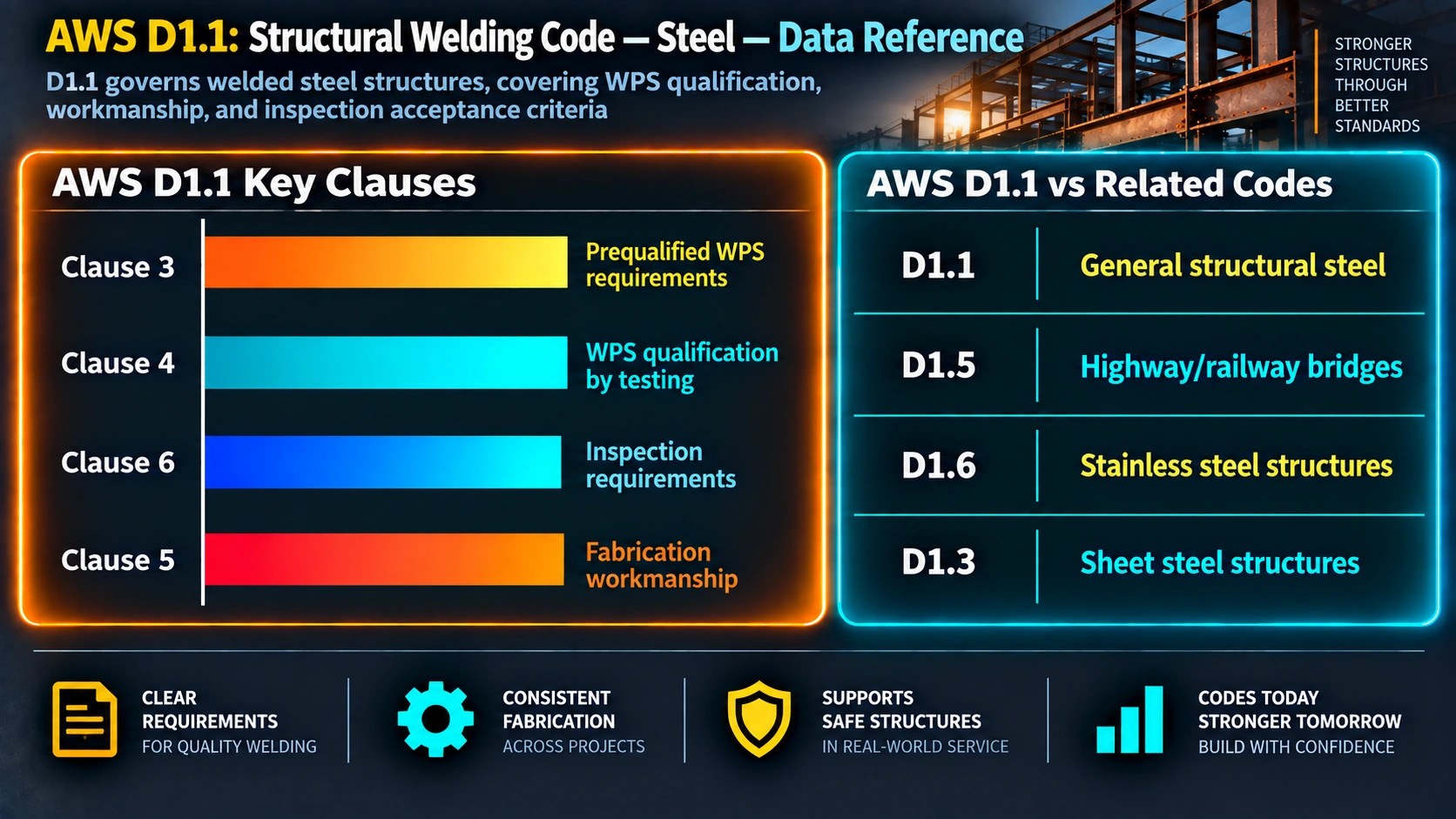
Clause 7 governs the arc stud welding of headed studs to structural steel for composite construction (steel-concrete composite beams and slabs). Stud welding requirements include: approved stud materials, qualification testing (production verification and pre-production qualification), torque testing, and visual and bend inspection of production studs. Failed studs may be replaced adjacent to the original location provided the repair area is within code limits.
Annexes — Normative and Informative Supplements
AWS D1.1 includes a series of annexes that extend or clarify the main clause requirements. Key annexes include:
| Annex | Status | Topic |
|---|---|---|
| A | Normative | Terms and definitions |
| B | Normative | Effective throat calculations for flare groove welds |
| C | Informative | Commentary — background to code provisions |
| D | Informative | Weld repairs — guidance beyond code minimum |
| E | Normative | AASHTO/AWS bridge welding — interface with D1.5 |
| F | Normative | Impact testing requirements for fracture-critical welds |
| K | Normative | UT reference block calibration requirements |
| S | Normative | Phased-array UT (PAUT) requirements |
AWS D1.1 vs. Other AWS Structural Codes
The AWS D1 family includes several codes covering different materials and applications. Understanding which code governs your project is the first step in compliance.
| Code | Material | Application |
|---|---|---|
| D1.1 | Carbon & low-alloy steel (MSYS ≤ 690 MPa) | Buildings, industrial structures, offshore, general structural |
| D1.2 | Aluminium | Structural aluminium |
| D1.3 | Sheet steel (< 5 mm) | Light-gauge steel, cold-formed sections |
| D1.5 | Carbon & low-alloy steel | Highway bridges (stricter fatigue/fracture requirements) |
| D1.6 | Stainless steel | Structural stainless applications |
| D1.8 | Carbon & low-alloy steel | Seismic provisions for structural steel buildings |
D1.8 is worth particular attention for engineers in seismic zones: it supplements D1.1 with significantly more stringent requirements for demand-critical welds in special moment frames (SMF) and other seismic force-resisting system connections.
Common WPS and WPQ Mistakes Under AWS D1.1
Inspection and audit findings on D1.1 projects frequently cluster around a small number of recurring issues:
- Incomplete WPS variables: A WPS missing the shielding gas composition, wire diameter, or polarity for a GMAW procedure is non-conforming even if the welding itself is sound.
- Preheat not verified before welding: Temperature sticks or contact thermometer readings must be documented, not assumed.
- Welder qualified in flat only, welding in vertical: Check that each welder’s current WPQ covers the position(s) actually being used on the job.
- Short-circuit GMAW treated as prequalified: Short-circuit transfer is explicitly excluded from prequalification — it requires a Clause 4 PQR.
- Using an expired or uncalibrated filler metal: Electrodes must be within their certified shelf life and, for low-hydrogen electrodes, within their allowable atmospheric exposure time after opening (D1.1 Table 5.1).
For those preparing for the CWI exam, understanding these common non-conformances can be as important as knowing the code provisions themselves. Our ASME Section IX quiz and ASME Section VIII quiz are good complementary resources for building code knowledge across standards.
Low-Hydrogen Electrode Storage and Reconditioning
AWS D1.1 Table 5.1 sets strict atmospheric exposure limits for low-hydrogen SMAW electrodes after the hermetically sealed container is opened. Exposure to moisture causes hydrogen absorption in the flux coating, which translates directly to elevated weld metal hydrogen and increased HIC risk. The exposure time limits depend on electrode classification and ambient humidity:
On structural projects in high-humidity environments (coastal sites, monsoon conditions in India), low-hydrogen electrode management is a critical quality control issue. Heated electrode quivers (holding ovens) must be used in the field, maintained at 120–150°C (250–300°F). Our guide on welding consumable nomenclature and classification provides more background on understanding AWS A5.x filler metal designators.
Recommended Technical References
AWS D1.1 Structural Welding Code — Steel
The primary reference. Authoritative code text with commentary and annexes. Essential for engineers, inspectors, and fabricators.
View on AmazonStructural Welding — A Practical Guide
Practical application guide covering WPS preparation, inspection, and D1.1 compliance for practicing engineers and inspectors.
View on AmazonWelding Inspection Technology (AWS WIT)
AWS’s official CWI study text. Covers inspection methods, code interpretation, NDT fundamentals, and weld quality assessment.
View on AmazonDesign of Welded Structures — Omer Blodgett
A classic engineering reference for structural weld design, joint efficiency, distortion control, and fatigue design of welded steel members.
View on AmazonFrequently Asked Questions — AWS D1.1
What is AWS D1.1 and who must follow it?
AWS D1.1 is the American Welding Society’s Structural Welding Code for Steel. It governs the welding of statically and dynamically loaded structures fabricated from carbon and low-alloy steels with a minimum specified yield strength up to 690 MPa (100 ksi). Engineers, fabricators, contractors, and inspectors working on structural steel buildings, offshore structures, crane structures, and similar applications must comply with its requirements when D1.1 is referenced in the project contract documents. It does not apply to pressure vessels, piping, or highway bridges (see AWS D1.5 for bridges).
What is a prequalified WPS under AWS D1.1?
A prequalified WPS is a Welding Procedure Specification that conforms to all the prequalification requirements listed in AWS D1.1 Clause 3, including approved base metals, filler metals, joint geometries, preheat, interpass temperature, and process restrictions. When all requirements are met, the fabricator is exempt from procedure qualification testing (PQR) for that WPS. Prequalified status applies only to SMAW, SAW, GMAW (excluding short-circuit transfer), and FCAW. A written WPS document is still required even for prequalified procedures.
Which welding processes are covered by AWS D1.1?
AWS D1.1 covers SMAW, SAW, GMAW, FCAW, Electroslag Welding (ESW), Electrogas Welding (EGW), and Stud Welding. GTAW (TIG welding) is not within the scope of D1.1 and must be covered by contract-specific requirements. Short-circuit GMAW transfer mode is within scope but is not eligible for prequalification — it requires a qualified WPS supported by a PQR under Clause 4. For structural GTAW applications, consult the engineer for the applicable qualification pathway.
What are the essential variables for WPS qualification under AWS D1.1?
Essential variables under AWS D1.1 Clause 4 include: base metal category or group, filler metal classification, welding process, preheat and interpass temperature, PWHT condition, position, and joint design. A change beyond the permitted range of any essential variable invalidates the existing WPS and requires re-qualification through a new PQR. Supplementary essential variables apply for CVN-tested welds on dynamically loaded structures and must also be controlled when impact properties are design requirements.
What NDT methods does AWS D1.1 require for structural welds?
AWS D1.1 Clause 6 specifies visual testing (VT) as mandatory for all welds. Ultrasonic Testing (UT) or Radiographic Testing (RT) is required for CJP groove welds in tension in statically loaded structures 8 mm (5/16 in.) and thicker. Cyclically loaded structures have more extensive UT/RT requirements. Magnetic Particle Testing (MT) and Liquid Penetrant Testing (PT) are used for surface inspection of repair areas, arc strikes, and confirmation of defect removal. The Inspector must verify that all NDT personnel hold appropriate qualifications per SNT-TC-1A or equivalent.
What are the preheat requirements in AWS D1.1?
Preheat requirements in D1.1 Table 3.2 depend on base metal category (I–IV), section thickness, and filler metal hydrogen designation. For Category I steels (e.g., A36) under 19 mm thick, minimum preheat is 10 deg C (50 deg F). A572 Gr. 50 over 19 mm with H8 electrodes requires 66 deg C (150 deg F). Higher-category or thicker steels require up to 200 deg C (400 deg F). The interpass temperature must not exceed 260 deg C (500 deg F) for most structural applications. Measure preheat at a distance of at least 75 mm from the weld edge on each side of the joint.
Does AWS D1.1 cover bridge welding?
Highway bridge welding is governed by AWS D1.5 (Bridge Welding Code), not D1.1. D1.5 imposes significantly stricter requirements for fatigue loading, fracture-critical members (FCM), Charpy V-notch certification for filler metals, and quality management. AWS D1.1 covers buildings, industrial structures, offshore platforms, and other non-bridge steel structures. Engineers working on highway bridges must reference D1.5; those on buildings and industrial structures typically reference D1.1. Some multi-use facilities or port structures may require both codes to be applied to different parts of the same project.
How does AWS D1.1 define the role of the Engineer?
The Engineer is the designated individual (or organisation) with authority to establish design requirements, approve departures from code requirements, and resolve questions not explicitly addressed by the code. The Engineer may impose requirements more stringent than code minimums but cannot waive mandatory provisions. Approval of non-prequalified joint configurations, designation of fracture-critical weld categories, specification of additional NDT, and resolution of inspector-contractor disputes on weld acceptance all fall within the Engineer’s authority under D1.1 Clause 1.4.