Welding Consumable Storage and Handling Best Practices
Good welding consumable storage and handling practice is one of the least glamorous parts of a quality system and one of the most consistently underestimated. A perfectly qualified WPS and a properly baked electrode can still produce a hydrogen-cracked weld if that electrode sat exposed on a bench overnight, and an otherwise sound stainless filler rod can carry embedded iron contamination into a corrosion-critical joint if it was stored on the wrong rack. This guide covers the practical storage and handling rules across SMAW electrodes, MIG and flux-cored wire, TIG filler rod, and SAW flux.
This complements the site’s electrode baking guide, which covers baking and reconditioning procedures in depth. Where that guide focuses on how to dry a consumable that has already picked up moisture, this one focuses on the storage and handling discipline that prevents moisture pickup and contamination from happening in the first place.
Whether you are setting up a new consumable storage room, auditing an existing shop’s practices, or training new welders and storekeepers, the sections below cover the practical rules that keep consumables in the condition they were certified in when they left the manufacturer.
Scope note: This article covers storage and handling practices across the common arc welding consumable types. For detailed baking temperatures, holding oven procedures, and rebaking cycle limits by electrode classification, see the dedicated electrode baking guide.
Why Storage and Handling Discipline Matters
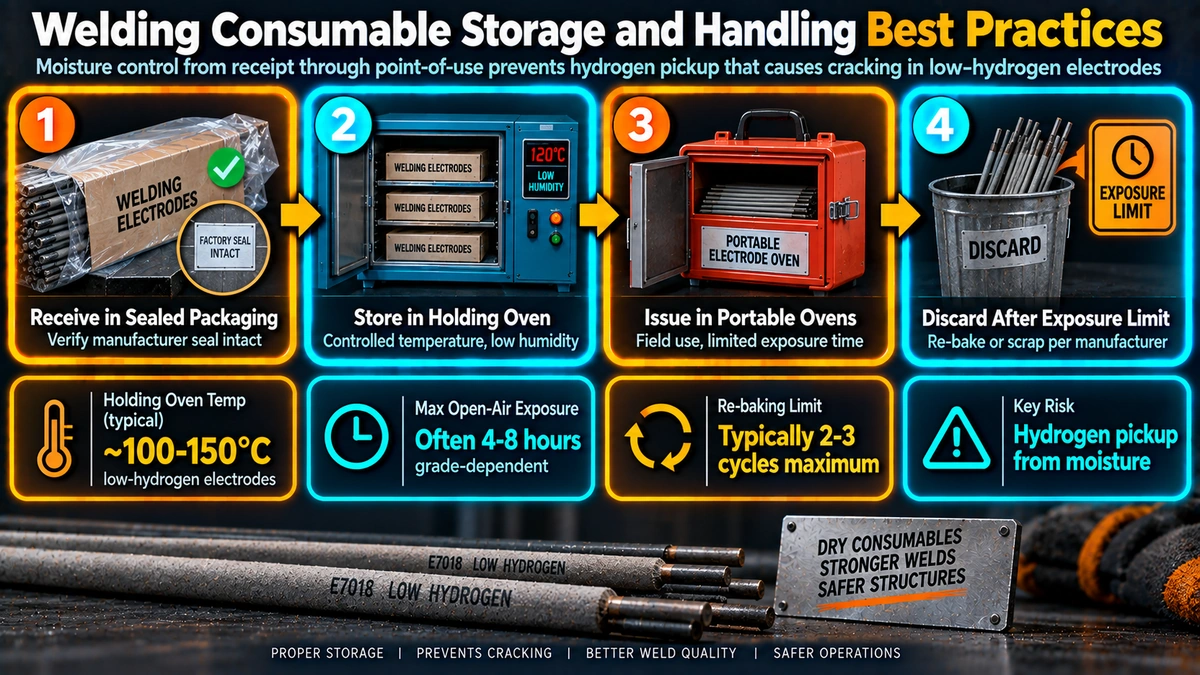
Most welding consumable failures traced back to storage are moisture-related, contamination-related, or both. Low-hydrogen electrode coatings and flux-cored wire cores are genuinely hygroscopic, meaning they actively absorb moisture from humid air, and that absorbed moisture becomes a source of diffusible hydrogen in the weld metal, increasing the risk of hydrogen-assisted cracking in susceptible base materials. Contamination, particularly cross-contamination between carbon steel and corrosion-resistant alloys, is a separate but equally serious risk that has nothing to do with moisture and everything to do with how consumables are physically stored, handled, and transported around a shop floor.
Both risks are almost entirely preventable through storage room design, packaging discipline, and consistent handling procedures, which is exactly why storage and handling deserves the same documented rigor as the baking and welding procedures downstream of it.
Storage Room Environment
A dedicated consumable storage area, separate from general shop floor storage, gives the most control over the two variables that matter most: humidity and temperature stability. Most manufacturers recommend keeping relative humidity below 60 percent, with many low-hydrogen electrode suppliers preferring 50 percent or lower, and a temperature that stays reasonably stable rather than swinging widely between shop opening and closing.
Counterintuitively, storage areas are often kept slightly warmer than surrounding ambient air rather than cooler, since moisture in humid air condenses preferentially on cooler surfaces. A storage room that runs cooler than the shop floor, perhaps because it sits against an exterior wall or under poor insulation, can actually accelerate moisture pickup on stored consumables even with reasonable humidity control elsewhere in the building.
SMAW Electrode Storage
Unopened low-hydrogen electrode containers should remain sealed in their original manufacturer packaging until needed, since that packaging is specifically designed to control moisture ingress during shipping and warehouse storage. Once a container is opened, the exposure clock effectively starts, and electrodes not immediately transferred to a heated holding oven should be tracked against the manufacturer’s stated exposure time limit.
Cellulosic electrodes such as E6010 and E6011 are a notable exception to nearly everything else in this section: they are formulated to contain moisture as part of their arc characteristics and must never be baked or stored in a heated holding oven, a distinction covered in more detail in the site’s electrode baking guide. Confirm electrode type before applying any low-hydrogen storage discipline to avoid mistakenly baking a cellulosic product.
Exposure Time Limits
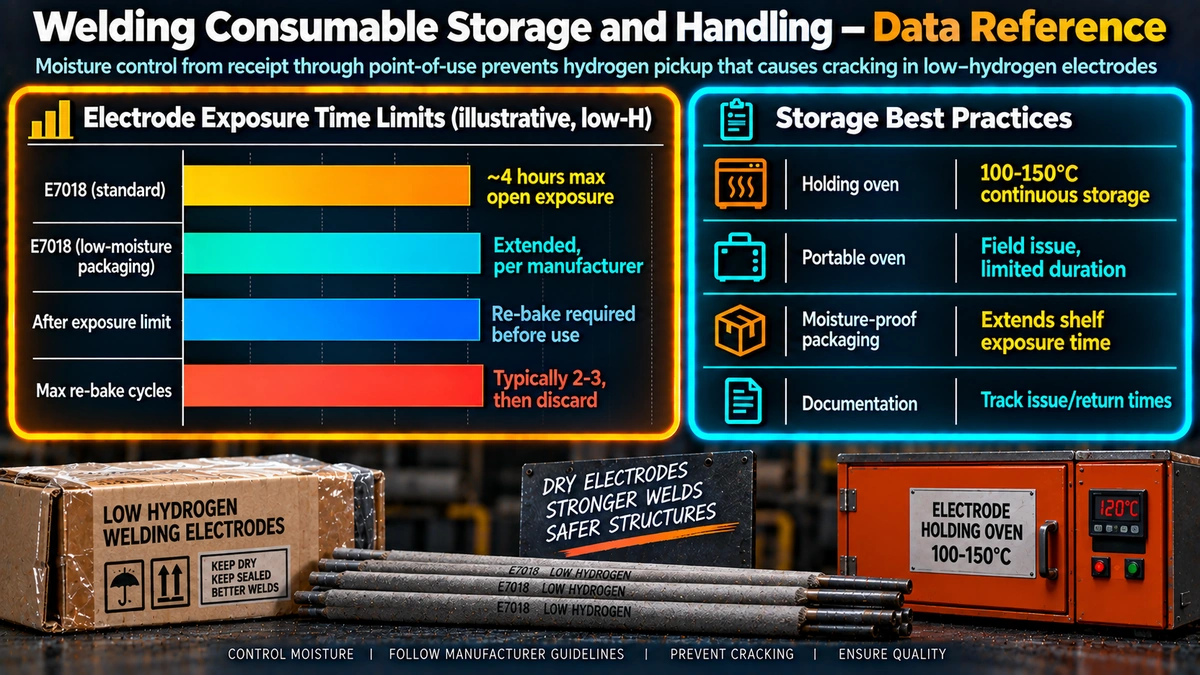
| Condition | Typical Exposure Limit (Opened, Low-Hydrogen) | Humidity Sensitivity |
|---|---|---|
| Normal shop conditions (moderate humidity) | Approx. 4 hours | Moderate |
| High-humidity or coastal environments | Approx. 1-2 hours | High |
| Premium/critical-service low-hydrogen grades | Often tighter than standard E7018 | High |
| Cellulosic electrodes (E6010/E6011) | Not baked or heat-controlled; different handling entirely | N/A – different rules |
Caution: These figures are general orientation only. Always confirm exposure limits against the specific electrode’s data sheet, since limits vary meaningfully by manufacturer, classification, and hydrogen designation (H4, H8, H16).
MIG and Flux-Cored Wire Storage
Solid MIG wire does not absorb moisture the way a flux coating does, but it is far from immune to storage-related problems. Surface rust from prolonged humid exposure, dust and grinding debris contamination, and physical damage to the spool from careless handling all degrade feed consistency and weld quality even though the wire itself is not hygroscopic in the way an electrode coating is.
Self-shielded flux-cored wire is the important exception within this category: its internal flux core behaves much like a low-hydrogen SMAW electrode coating and is genuinely moisture-sensitive. Gas-shielded flux-cored wire is somewhat less sensitive since the shielding gas itself provides some protection during welding, but the flux core inside the wire can still absorb moisture during storage regardless of shielding method used at the arc.
Practical rule: Treat self-shielded FCAW wire with the same storage discipline as low-hydrogen SMAW electrodes: sealed packaging until use, controlled humidity storage, and awareness of manufacturer exposure limits once opened.
TIG Filler Rod Storage
TIG filler rod carries a different set of handling risks than SMAW electrodes or MIG wire: contamination and physical damage matter more than moisture for most carbon and low-alloy steel rod, while stainless, nickel alloy, and reactive metal rod (titanium, zirconium) demand genuinely careful handling to avoid surface contamination that could compromise a precision weld. Rod should remain in its original tube packaging until use, handled with clean gloves rather than bare hands to avoid transferring skin oils, and never allowed to roll across a dirty bench surface where it can pick up grinding dust or oil.
Color-coded tip identification, standard across most manufacturers, should be checked against the rod’s actual classification before use, particularly in shops that stock multiple similar-looking alloy rods side by side. A mixed-up rod delivering the wrong filler metal chemistry into a critical joint is a real and avoidable quality escape.
SAW Flux Storage
Submerged arc welding flux is hygroscopic in the same way low-hydrogen electrode coatings are, and unopened flux bags should remain sealed until use, then stored in a dedicated flux oven at the manufacturer’s specified holding temperature once opened. Reclaimed flux, recovered and recycled from the unfused flux surrounding a completed SAW weld, requires additional attention: fines and contamination should be screened out before reuse, and reclaimed flux should never be mixed indefinitely with fresh flux without some quality control on the blend ratio, since flux chemistry drift over repeated recycling cycles can subtly affect weld metal composition.
Preventing Cross-Contamination Between Alloy Types
Storing stainless, duplex, or nickel alloy consumables anywhere near carbon steel consumables, storage racks, or handling tools creates a real risk of iron contamination transferring onto the corrosion-resistant material. This can happen through shared storage bins, a handling tool previously used on carbon steel, or even airborne dust from grinding carbon steel nearby settling onto exposed stainless rod or wire.
Embedded iron contamination on a stainless surface becomes a localized corrosion initiation site in service, undermining the very corrosion resistance the alloy was specified to provide, a risk covered from the base metal side in the site’s duplex stainless steel guide. Shops that regularly fabricate both carbon steel and corrosion-resistant alloys should maintain physically separate storage areas, dedicated handling tools, and ideally separate grinding and cleaning equipment for each material category.
Practical tip: Color-code or physically separate storage racks by alloy family, not just by consumable type. A shop that separates “electrodes” from “wire” but stores stainless and carbon steel electrodes on the same rack has not actually solved the contamination risk.
Stock Rotation and Traceability
FIFO, first-in-first-out, stock rotation ensures older consumable stock gets used before newer stock, preventing material from sitting in storage indefinitely and potentially degrading past its practical shelf life or original packaging integrity. This matters even for consumables without a hard expiration date, since packaging seals, labels, and container integrity can all degrade with extended storage time regardless of the consumable inside remaining chemically stable.
Tracking batch or heat numbers alongside FIFO rotation supports traceability if a quality issue is later traced back to a specific consumable lot, a documentation discipline that pairs directly with the certification and classification tracking covered in the site’s welding consumable selection guide.
Damaged and Rejected Consumable Disposition
Electrodes with cracked, chipped, or flaking coating should be discarded regardless of storage history or remaining rebake cycles, since coating integrity, not just moisture content, directly affects arc stability and shielding performance. Wire with visible rust, kinks, or contamination should not be fed into production welding even if the remainder of the spool appears usable, since a compromised section can pass through the weld before the problem becomes visually obvious to the welder.
A clear, documented disposition procedure for rejected consumables, distinct from the normal FIFO issue and return flow, prevents damaged material from accidentally re-entering usable stock through a simple bin mix-up.
Portable Rod Ovens
Heated quivers and portable holding ovens for maintaining electrode temperature at the weld station.
View on AmazonElectrode Storage Cabinets
Moisture-controlled storage cabinets for maintaining low-hydrogen electrode integrity in the shop.
View on AmazonDigital Hygrometers
Humidity and temperature monitors for tracking storage room conditions against manufacturer limits.
View on AmazonWelding Wire and Rod Storage Racks
Organized storage solutions to keep alloy families separated and reduce cross-contamination risk.
View on AmazonDisclosure: WeldFabWorld participates in the Amazon Associates programme (StoreID: neha0fe8-21). If you purchase through these links, we may earn a small commission at no extra cost to you. This helps support free technical content on this site.
Frequently Asked Questions
What humidity level should a welding consumable storage room maintain?
Most consumable manufacturers recommend keeping dedicated storage areas below 60 percent relative humidity, with many low-hydrogen electrode suppliers preferring 50 percent or lower, and a stable temperature that avoids condensation-causing swings. A storage room that is cooler than the surrounding shop floor air is actually a risk, since moisture in the air condenses on cooler surfaces, so storage areas are often kept slightly warmer than ambient rather than cooler.
How long can low-hydrogen electrodes stay outside a heated rod oven before they need rebaking?
Typical exposure limits for opened low-hydrogen electrodes range from about 4 hours in normal shop conditions down to as little as 1 to 2 hours in high-humidity environments, though exact limits vary by manufacturer, electrode classification, and hydrogen designation. Always follow the specific electrode’s data sheet rather than a generic rule of thumb, since premium low-hydrogen grades and certain alloy electrodes often carry tighter exposure limits than standard carbon steel E7018.
Can MIG and flux-cored welding wire absorb moisture the same way SMAW electrodes do?
Solid MIG wire itself does not absorb moisture the way a flux coating does, but surface rust or contamination from prolonged exposure to humid air still degrades weld quality and can contribute to porosity. Self-shielded flux-cored wire is more moisture-sensitive than solid MIG wire because its internal flux core behaves similarly to a low-hydrogen electrode coating, so it should be stored with the same care given to low-hydrogen SMAW electrodes.
Why should stainless steel and carbon steel consumables be stored separately?
Storing stainless, duplex, or nickel alloy consumables near carbon steel creates a real risk of iron contamination transferring to the corrosion-resistant material, whether through shared storage racks, handling tools, or airborne dust from grinding carbon steel nearby. Even trace iron contamination embedded in a stainless surface can become a corrosion initiation site in service, so dedicated storage areas and handling tools for corrosion-resistant alloys are standard practice in shops that fabricate both material types.
How many times can a low-hydrogen electrode be rebaked before it should be discarded?
Most manufacturers limit rebaking to a maximum of two cycles, though this varies by electrode type and should always be confirmed against the specific product’s data sheet rather than assumed. Repeated baking cycles can degrade coating integrity over time, and an electrode with cracked, flaking, or otherwise visibly damaged coating should be discarded regardless of how many bake cycles it has been through. See the site’s electrode baking guide for full rebaking procedures.
What is FIFO stock rotation and why does it matter for welding consumables?
FIFO, or first-in-first-out, means using the oldest stock of a given consumable before newer stock, which prevents material from sitting in storage indefinitely and degrading past its usable shelf life or original packaging integrity. Tracking batch or heat numbers alongside FIFO rotation also supports traceability back to a specific certified lot if a quality issue is later traced to a particular consumable batch.
Should hermetically sealed or vacuum-packed electrodes still be baked before use?
Properly hermetically sealed or vacuum-packed electrodes are generally certified moisture-free at the time of packaging and do not require baking before first use, provided the seal is confirmed intact when opened. Once that seal is broken, however, the electrode is exposed to ambient humidity just like any conventionally packaged electrode and should follow the same exposure time limits and rebaking rules from that point forward.