TIG Welding Shielding Gas: The Complete Selection Guide
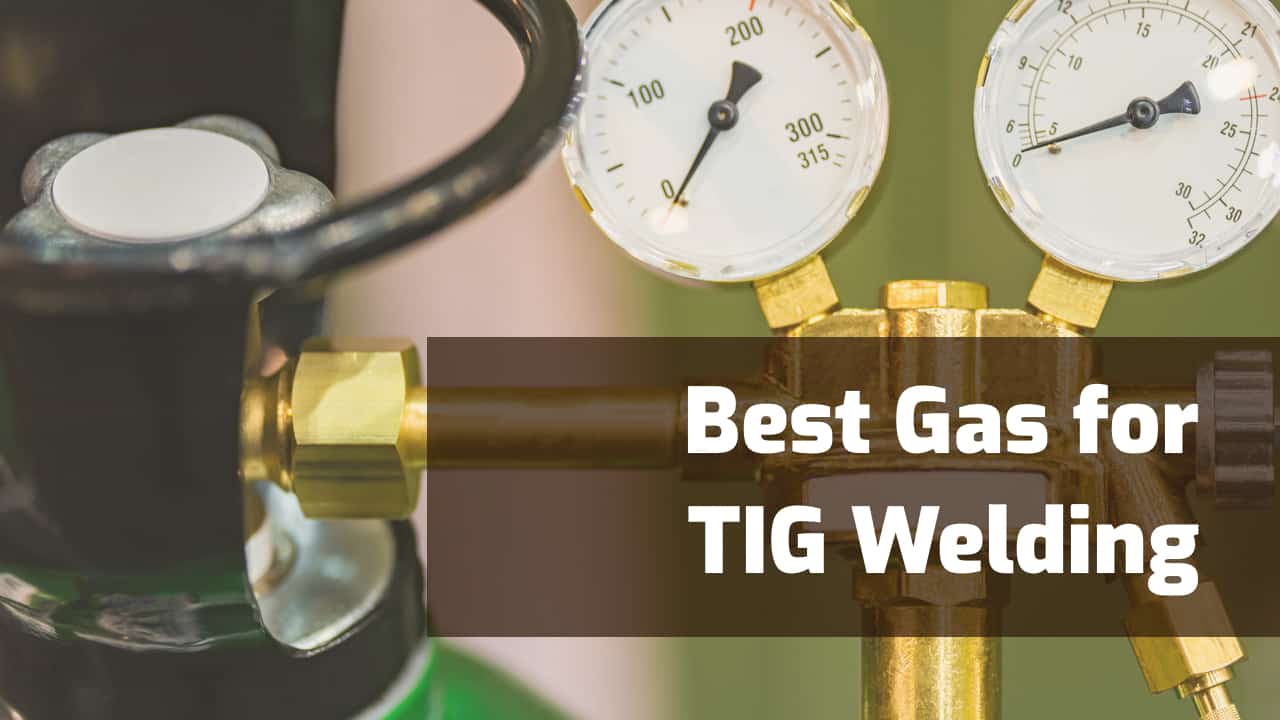
Choosing the correct TIG welding shielding gas is one of the most decisive variables in Gas Tungsten Arc Welding (GTAW). Select the wrong gas and you will deal with porous weld metal, tungsten contamination, erratic arc behaviour, and oxide inclusions — regardless of how skilled the welder is. Select the right gas and the arc stabilises, the weld pool behaves predictably, and the finished bead shows the clean, smooth profile that TIG welding is known for.
The options available — pure argon, pure helium, argon-helium blends, argon-hydrogen mixtures, and argon-nitrogen combinations — each have specific properties that make them suited to certain base metals, material thicknesses, and welding positions. This guide explains the metallurgical and physical reasons behind each choice, gives a practical quick-reference chart for the most common applications, and covers the critical mistakes that destroy welds, tungsten electrodes, and budgets.
Whether you are welding mild steel in a fabrication shop, qualifying a stainless steel procedure under ASME Section IX, or tackling thick aluminium pipe in the field, this guide will give you a confident, technically grounded answer to the question: what gas should I use?
Why Shielding Gas Matters in GTAW
In GTAW, the shielding gas serves three simultaneous roles. First, it displaces atmospheric oxygen and nitrogen from the weld zone, preventing oxidation and nitride formation in the hot weld pool and heat-affected zone (HAZ). Second, it creates the conductive medium through which the welding arc is established and maintained — the ionisation characteristics of the gas directly affect arc stability, starting ease, and voltage requirements. Third, in the case of argon on aluminium and magnesium, the gas participates in cathodic cleaning action under alternating current (AC), breaking up the refractory surface oxide that would otherwise contaminate the weld.
No other arc welding process is as sensitive to gas composition as GTAW. In Shielded Metal Arc Welding (SMAW), the flux coating generates its own shielding atmosphere. In GMAW/MIG welding, some gas reactivity is acceptable and even desirable for arc stability. But in GTAW, the tungsten electrode is non-consumable and operates at extremely high temperatures — any reactive gas contaminant rapidly oxidises the electrode tip, causing arc wander, tungsten inclusions in the weld, and loss of arc control.
The Main TIG Shielding Gases
Argon (Ar) — The Universal Standard
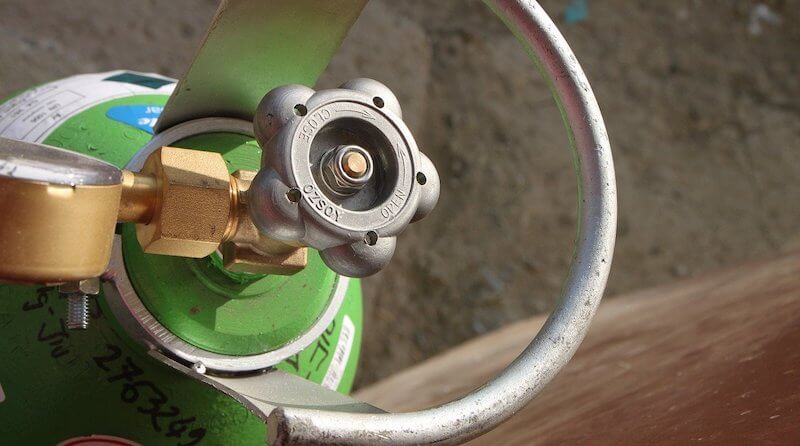
Argon is a noble gas — chemically inert, meaning it does not react with the tungsten electrode, weld pool, or filler material under any welding condition. It constitutes approximately 0.93% of the atmosphere and is extracted as a by-product of air separation during oxygen and nitrogen production, making it the most economically available shielding gas for welding.
Several physical properties make argon the default TIG shielding gas:
- Density: Argon is approximately 1.4 times denser than air (1.78 kg/m³ vs 1.29 kg/m³ for air at 0°C). In flat and horizontal welding positions, this density causes argon to settle over the weld pool under gravity, providing effective coverage at modest flow rates (typically 7–12 L/min).
- Low ionisation potential: At 15.76 eV, argon ionises relatively easily. This means arc initiation is reliable (especially with high-frequency HF start), the arc remains stable across a range of arc lengths, and cathodic cleaning action occurs effectively under AC.
- Low thermal conductivity: Argon transfers heat to the base metal primarily through the arc itself rather than through the gas column. This creates a focused, bell-shaped arc cone with a broad, shallow penetration profile.
The limitation of argon becomes apparent in out-of-position welding. In overhead positions, the heavy argon gas does not naturally rise to surround the weld pool. Higher flow rates compensate, but this adds cost. Helium — which is lighter than air — is inherently better for overhead work, though the cost penalty usually makes increased argon flow the practical solution.
Helium (He) — Higher Heat, Deeper Penetration
Helium is the second inert gas used in TIG welding. Its physical properties differ from argon in almost every respect relevant to welding, and those differences are the reason it is used as an additive rather than a direct replacement:
- Very high thermal conductivity: Helium transfers heat much more efficiently than argon. This increases heat input into the joint, raising penetration depth and welding speed — typically by 25–50% compared with argon at the same current.
- Higher ionisation potential: At 24.59 eV, helium requires significantly more energy to ionise. This makes arc starting harder and the arc shorter and more sensitive to electrode-to-workpiece distance. In manual welding, maintaining a consistent short arc while dabbing filler wire is difficult, making 100% helium impractical for most manual applications.
- Lower density than air: Helium (0.164 kg/m³) is lighter than air, so it rises away from the weld pool in flat welding. Approximately twice the flow rate is needed compared to argon to maintain adequate coverage in a flat position, increasing gas consumption and cost. However, in overhead welding, helium’s natural buoyancy is an advantage.
Pure helium is primarily used in automated TIG operations, where the arc length can be tightly controlled mechanically, and in DC TIG welding of copper, where the high thermal conductivity of the base metal demands the maximum possible heat input from the gas.
Hydrogen (H2) — Reactive Addition for Specific Applications
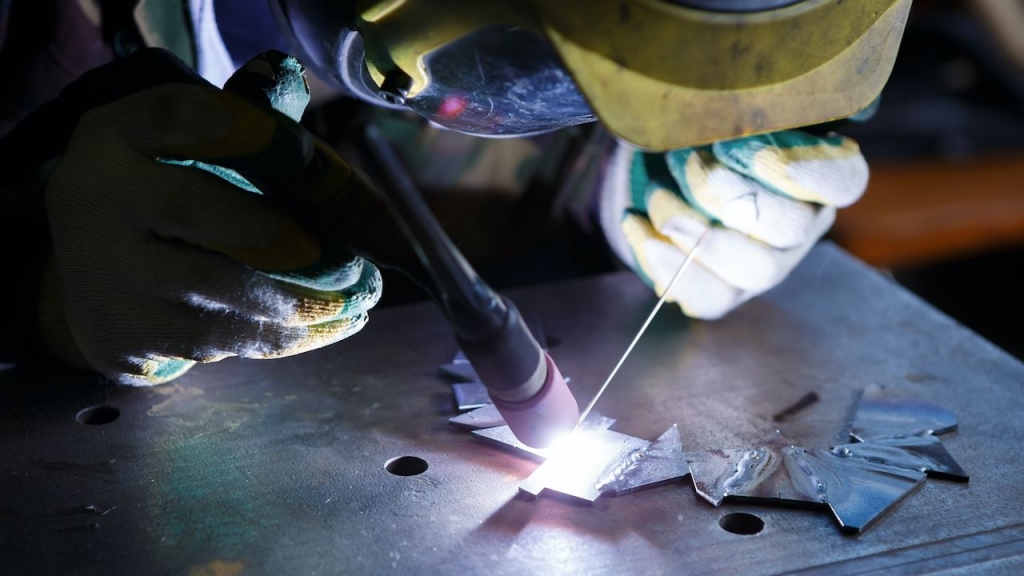
Hydrogen is not an inert gas. It reacts with the weld pool at elevated temperatures, which is exactly why its use is strictly limited to specific base metal families. When added to argon in controlled proportions (typically up to 5%), hydrogen:
- Increases arc voltage and heat input, improving penetration into thick sections
- Chemically reduces surface oxides on the stainless steel, producing cleaner weld toes with less post-weld cleaning
- Raises welding travel speed by 20–40% compared with pure argon on the same joint
- Creates a more constricted arc cone, which narrows the HAZ and reduces distortion on thin sections
Nitrogen (N2) — The Duplex Stainless Exception
Nitrogen is an austenite stabiliser used in duplex and super-duplex stainless steel alloys (e.g. UNS S31803, S32205, S32750) to maintain the correct 50:50 austenite-ferrite microstructure balance. During welding, nitrogen is lost from the weld metal by evaporation, which shifts the balance toward an undesirable ferrite-heavy microstructure with reduced toughness and corrosion resistance.
Adding 2% nitrogen to the argon shielding gas replenishes this loss and helps preserve the target phase balance in duplex stainless welds. Argon-nitrogen blends are not widely used outside the duplex/super-duplex family and austenitic stainless steel welding in specific applications. For general duplex welding guidance, see our full duplex stainless steel welding guide.
TIG Shielding Gas Blends
Argon-Helium (Ar/He) Mixtures
The most widely used blend in production TIG welding is 75% helium / 25% argon, though proportions vary from 25% He (minor heat boost, good arc stability) to 90% He (near-maximum penetration, difficult manual control). The argon component maintains arc stability and cathodic cleaning action; the helium component increases heat input and penetration.
Practical use cases for Ar/He blends include:
- Welding aluminium sections above 10 mm thick, where 100% argon lacks sufficient penetration
- Automated orbital TIG of thick-wall stainless or nickel alloy pipe, where maximising deposition rate matters
- Field welding in cold climates (arctic pipelines, winter construction), where heat loss to the environment reduces effective arc energy — helium compensates for this loss
- Copper and copper alloy fabrication requiring DC TIG with high heat input
Argon-Hydrogen (Ar/H2) — Austenitic and Nickel Alloy Welding
Standard blends are 97.5% Ar / 2.5% H2 and 95% Ar / 5% H2. The 5% hydrogen addition is the practical upper limit — above this, porosity risk rises rapidly, and the benefit in penetration diminishes. Some specialised applications use up to 15% H2 for automated TIG of austenitic pipe, but these require strict process controls.
The hydrogen acts as a mild fluxing agent and increases arc voltage, which raises heat input without requiring higher current. The resulting weld bead is narrower and deeper than a pure argon bead at equivalent parameters. This reduces distortion on thin austenitic sheet — a common requirement in chemical process plant fabrication.
Argon-Nitrogen (Ar/N2) — Duplex Stainless Steels
A blend of 98% Ar / 2% N2 is the standard shielding gas for TIG welding duplex stainless steels including 2205 (S31803/S32205) and super-duplex grades such as 2507 (S32750). The nitrogen addition partially offsets the nitrogen loss that occurs through arc evaporation during welding, helping to maintain the target austenite-ferrite phase balance (~50:50 by area) that gives duplex steels their combination of high strength, stress-corrosion cracking resistance, and elevated PREN number.
Note that the backing gas (purge gas) for duplex stainless root passes is equally important — a nitrogen-argon blend (typically 95% Ar / 5% N2, or even 100% N2 in some specifications) is used to protect the root side of the joint and preserve phase balance on the first-pass fusion face. See our guide to duplex stainless steel welding for full purging requirements.
Gas Selection by Base Metal
| Base Metal | Recommended Gas | Current | Notes |
|---|---|---|---|
| Carbon steel / mild steel | 100% Ar | DCEN | Ar/He blends rarely necessary; increases cost without meaningful benefit on standard thicknesses. |
| Low-alloy steel (P11, P22, P91) | 100% Ar | DCEN | Pure argon is mandatory. Never use H2 additions on any ferritic or low-alloy steel — HIC risk. |
| Austenitic stainless steel (304, 316, 321) | 100% Ar or 95Ar/5H2 | DCEN | H2 addition for thick sections or high-speed production. Increases penetration and travel speed. |
| Duplex stainless steel (2205, 2507) | 98Ar/2N2 | DCEN | Nitrogen critical to maintain austenite-ferrite balance. Never use H2 on duplex grades. |
| Aluminium and Al-alloys | 100% Ar or Ar/He blend | AC | Ar required for cathodic cleaning under AC. He additions for thicker sections (>10 mm). |
| Magnesium alloys | 100% Ar or Ar/He blend | AC | Refer to OSHA Mg welding hazard guidelines — fire risk is significant. |
| Copper and copper alloys | 100% He | DCEN | High thermal conductivity of Cu demands maximum heat input. He provides this. Ar/He also acceptable. |
| Nickel alloys (Alloy 625, 825, 276) | 100% Ar or 95Ar/5H2 | DCEN | 5% H2 reduces porosity in pure nickel and speeds up travel on thick Ni-alloy sections. |
| Chromoly (P11, P22, Cr-Mo steel) | 100% Ar | DCEN | Standard argon; preheat and PWHT requirements are the critical variables, not gas composition. |
| Titanium and zirconium | 100% Ar | DCEN | Titanium requires extensive trailing shield and purge gas coverage. Gas purity critical (>99.995%). |
Gases You Must Never Use in TIG Welding
Carbon Dioxide (CO2)
CO2 is widely used in MIG/GMAW welding as a cost-effective reactive addition to argon. In TIG welding it is destructive. CO2 is an oxidising gas at welding temperatures: it oxidises the tungsten electrode tip within seconds, causing a ball of tungsten oxide to form, destabilising the arc, and introducing tungsten inclusions into the weld. The arc becomes erratic and uncontrollable. The weld pool loses surface tension control, burning through unpredictably and producing porous, oxidised weld metal. There is no safe level of CO2 in a TIG shielding gas mixture.
Oxygen (O2)
Like CO2, oxygen is a reactive gas that destroys tungsten electrodes. In GMAW, small percentages of O2 (0.5–2%) are added to argon to improve arc stability and weld pool fluidity. In TIG welding, even fractions of a percent of O2 oxidise the tungsten tip rapidly. The only documented use of O2 in TIG gas mixtures is in specialised research-level automated TIG of stainless steel, where trace O2 additions in helium have been used to modify weld pool fluid dynamics. This has no bearing on standard industrial or site welding.
Shielding Gas and Welding Position
The position in which you weld affects the minimum gas flow rate needed for effective shielding, and in the case of helium-rich blends, it affects whether the gas will even cover the weld pool adequately.
| Welding Position | Argon Flow Rate | Helium Behaviour | Recommendation |
|---|---|---|---|
| Flat (1G / 1F) | 7–10 L/min | Rises away — needs double flow | Argon preferred; lowest cost. |
| Horizontal (2G / 2F) | 8–11 L/min | Rises — needs increased flow | Argon preferred; slight increase in flow vs. flat. |
| Vertical (3G / 3F) | 9–13 L/min | Variable; increase flow rate | Argon; use trailing shield on reactive metals. |
| Overhead (4G / 4F) | 11–16 L/min | Naturally rises into weld pool | He or Ar/He blend useful overhead; otherwise increase Ar flow. |
Flow rates above are for standard 2.4 mm diameter nozzles. Larger-bore gas lenses allow lower flow rates with better coverage by laminarising the gas flow. For critical applications such as titanium or reactive metal welding, a gas lens assembly is strongly recommended regardless of position.
Back Purging and Trailing Shields
Shielding gas selection does not end at the torch. For single-sided root welds in stainless steel, duplex stainless, titanium, and nickel alloys, the back face of the weld (root side) is equally susceptible to oxidation. A back purge using the same inert gas (argon, or the appropriate blend) is required to protect the root bead until it cools below the temperature at which oxidation occurs.
For stainless steel, the acceptable purge purity for critical service is typically less than 50 ppm O2 before welding commences, verified with an oxygen analyser. For titanium, less than 20 ppm O2 is required, and trailing shields extending 100–150 mm behind the arc are also needed to protect the cooling weld bead and HAZ, since titanium oxidises rapidly above 260°C. Purging requirements are typically specified on the WPS and form part of procedure qualification records under ASME or ISO 15614-1.
Gas Purity and Contamination
Industrial welding-grade argon is typically supplied at 99.995% purity (Grade 4.5). For reactive metals such as titanium, zirconium, and niobium, 99.999% purity (Grade 5.0) is specified. The difference matters: at 99.995% Ar, the residual 50 ppm contamination is primarily nitrogen and oxygen, which at standard stainless steel welding temperatures has negligible effect. But for titanium above 400°C, even this level of contamination produces visible surface discolouration — a reliable indicator of inadequate shielding.
Common sources of shielding gas contamination in practice include:
- Leaking or cracked gas hoses (especially at fittings and connections)
- Torch body O-ring failures allowing air ingress
- Moisture condensation inside the hose after cylinder changes in cold climates
- Residual air in the hose at job start (always purge for 10–15 seconds before striking the arc)
- Gas lens collet body contamination — clean or replace if arc behaviour changes
Flow Rate Selection and Optimisation
The correct gas flow rate is the minimum rate that provides consistent, defect-free shielding under the actual welding conditions. More gas is not always better. Excessive flow rates create turbulence at the nozzle exit, drawing ambient air into the shielding envelope and actually degrading coverage quality — the opposite of the intended effect. This is particularly common when welders increase flow as a first response to porosity rather than investigating the actual root cause.
A gas lens replaces the standard collet body and collet inside the torch, and uses a stacked wire mesh to laminarise the gas flow, producing a smooth, turbulence-free gas column. This increases effective shielding coverage at lower flow rates, allows the use of longer electrode stick-out (useful for access in restricted joints), and improves shielding consistency in crosswind conditions. Gas lens assemblies are a low-cost upgrade that is highly recommended for any critical-quality TIG application.
Practical Gas Cost Considerations
In high-volume fabrication, shielding gas cost is a real line item. Argon is the cheapest and most widely available TIG gas. Helium is significantly more expensive and, in some markets (including India and Southeast Asia), may require advance ordering from specialist industrial gas suppliers rather than being available from standard welding distributors.
When calculating whether a helium blend is economically justified, consider both the gas unit cost and the productivity gain. A 30% increase in travel speed on thick-section stainless pipe welding may reduce labour hours sufficiently to justify the higher gas cost. In low-volume repair or maintenance welding, 100% argon almost always offers the better cost-performance balance.
For budget-conscious operations, the single most effective investment is a properly set and calibrated gas flow regulator and a regular hose-leak check. Gas lost through leaking connections often exceeds the cost difference between argon and helium blends.
Recommended Reference Books
Disclosure: WeldFabWorld participates in the Amazon Associates programme (StoreID: neha0fe8-21). If you purchase through these links, we may earn a small commission at no extra cost to you. This helps support free technical content on this site.