Welding Arc Flash and Eye Injury Prevention
Welding arc flash is one of the most common, and most avoidable, injuries in the welding trade, yet it still happens constantly to welders and to bystanders who never touched a torch. The arc produces intense ultraviolet, visible, and infrared radiation, and even a fraction of a second of unprotected exposure is enough to injure the surface of the eye. Because the pain usually does not show up until hours later, many people do not connect the injury to the moment it actually happened, which makes prevention, not treatment, the entire point of this guide.
This article covers what arc flash actually does to the eye, how to select the correct filter shade for a given process and current, how to protect bystanders sharing the same work area, and what to do if an exposure has already occurred. It complements our broader PPE for Welding guide, which covers full-body protective equipment selection across processes.
What Arc Flash Actually Does to the Eye
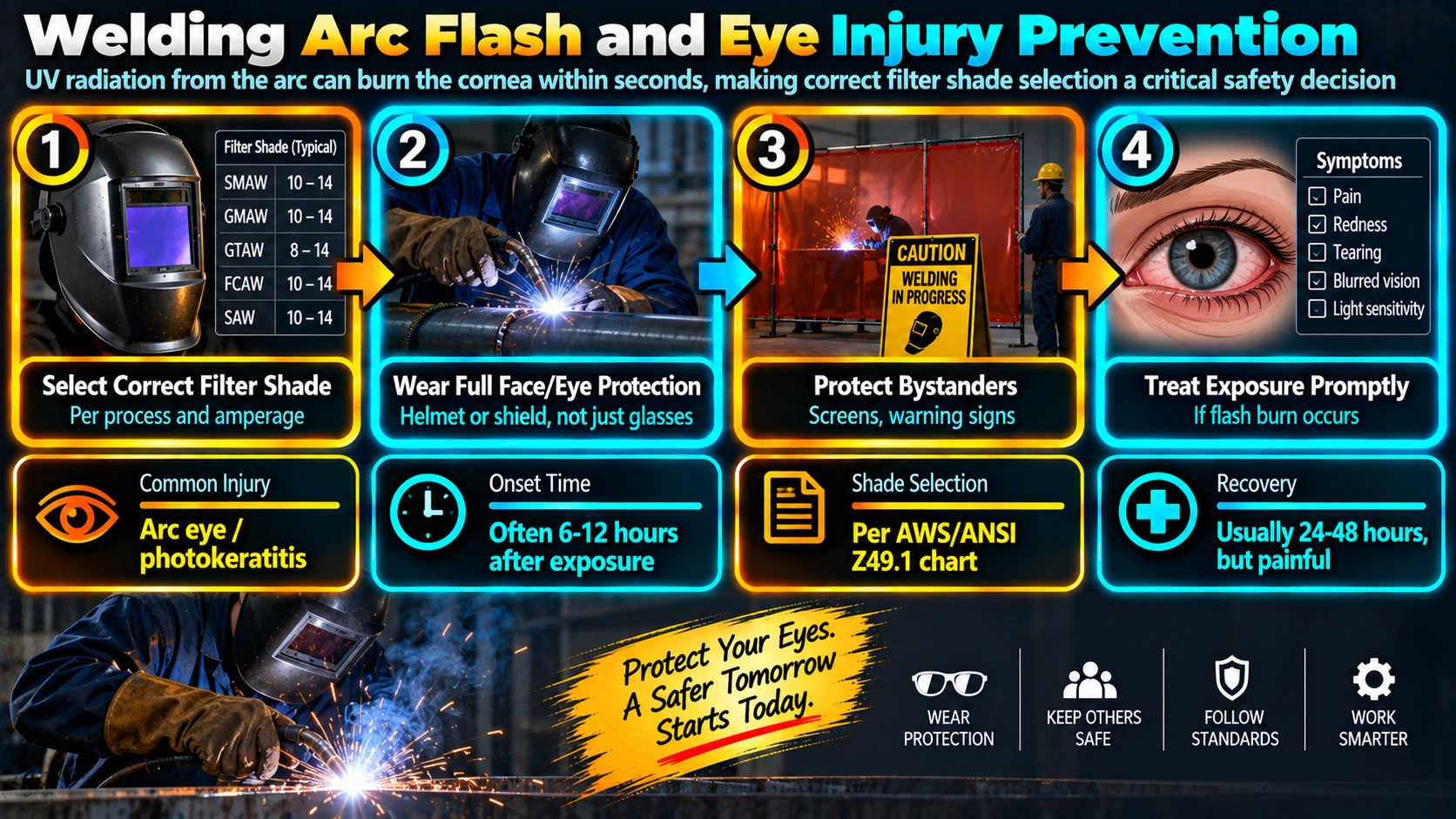
A welding arc emits radiation across three overlapping bands: ultraviolet (UV), visible light, and infrared (IR). Of these, UV radiation is the primary cause of the acute corneal injury known as arc eye, welder’s flash, or by its medical name, photokeratitis. The cornea, the clear surface layer of the eye, absorbs UV energy the same way skin absorbs sunlight, and an unprotected exposure produces a burn-like injury to that surface.
| Radiation Type | Primary Effect on the Eye | Typical Injury |
|---|---|---|
| Ultraviolet (UV) | Absorbed by the cornea and conjunctiva | Photokeratitis (arc eye / welder’s flash) Acute |
| Visible light | Intense brightness overwhelms normal pupil response | Temporary glare, discomfort, reduced night vision adaptation Cumulative risk |
| Infrared (IR) | Penetrates deeper structures with prolonged exposure | Long-term risk of cataract formation with repeated exposure Chronic risk |
Why the Pain Shows Up Hours Later
Unlike touching a hot surface, arc eye does not hurt at the moment of exposure. Symptoms including a gritty or sand-like sensation, tearing, redness, swelling, and sensitivity to light typically develop several hours afterward, often once the affected person is already at home. This delay is exactly why the injury is so often dismissed in the moment (“my eyes feel a little off, but I’ll be fine”) only to become genuinely painful later that evening.
Selecting the Correct Filter Shade
Filter shade number describes how much visible light and radiation a lens blocks, with higher numbers indicating darker, more protective lenses. The correct shade depends on the welding process, the amperage being used, and whether the process is gas-shielded, and this relationship is set out in shade selection tables within standards such as ANSI Z49.1. As a general pattern across processes, higher current requires a darker shade, and gas-shielded processes such as GMAW and GTAW generally need a darker shade than SMAW at a comparable current, because the arc itself burns brighter and produces more UV output under shielding gas.
| Process | Approximate Current Range | Typical Shade Guidance |
|---|---|---|
| SMAW (stick) | Under 100 A | Shade 9-10 Check process table |
| SMAW (stick) | 100-300 A | Shade 10-12 Check process table |
| GMAW / FCAW | 100-200 A | Shade 10-11 Gas-shielded, darker needed |
| GTAW | Under 100 A | Shade 10-12 Gas-shielded, darker needed |
| Plasma arc cutting | Process-dependent | Shade 9-13 depending on current Verify per job |
Auto-Darkening vs. Fixed-Shade Lenses
- Auto-darkening lenses switch from a light state to the selected dark shade within a fraction of a second of arc detection, allowing the welder to see the joint clearly before striking the arc.
- Fixed-shade lenses require the helmet to be lowered before striking the arc, since there is no automatic transition; this is more error-prone in high-tempo production work.
- Battery-powered auto-darkening lenses should be checked regularly, since a depleted battery can leave the lens in its light state at the moment an arc is struck.
- Any cracked, delaminated, or scratched lens should be replaced immediately rather than assumed to still provide full protection.
Protecting Bystanders, Not Just the Welder
Arc radiation travels outward from the arc in all directions and can injure anyone with an unobstructed line of sight to it, regardless of whether they are the one welding. This makes bystander protection a shared-space problem, not just a personal PPE issue for the welder.
- Use welding curtains or screens rated to block UV transmission around any open arc in a shared work area.
- Position welding stations so the open side of the arc does not face a walkway, break area, or adjacent workstation.
- Warn nearby workers before striking an arc in an open bay, particularly during setup or tack welding when helmets are more likely to be raised intermittently.
- Treat visitors and non-welding trades entering a welding bay the same as any other hazard area entry, with a warning and, where practical, safety glasses with side shields.
First Response If Exposure Has Already Occurred
| Step | Action |
|---|---|
| 1 | Move away from further UV exposure and remove contact lenses if worn |
| 2 | Avoid rubbing the eyes, which can worsen irritation to the corneal surface |
| 3 | Use a cool, damp compress or preservative-free artificial tears for comfort if available |
| 4 | Rest the eyes in a dim environment away from further bright light or screens |
| 5 | Seek medical evaluation if pain is severe, vision is significantly affected, or symptoms persist beyond a day or two |
Building Arc Flash Prevention Into a Site Safety Program
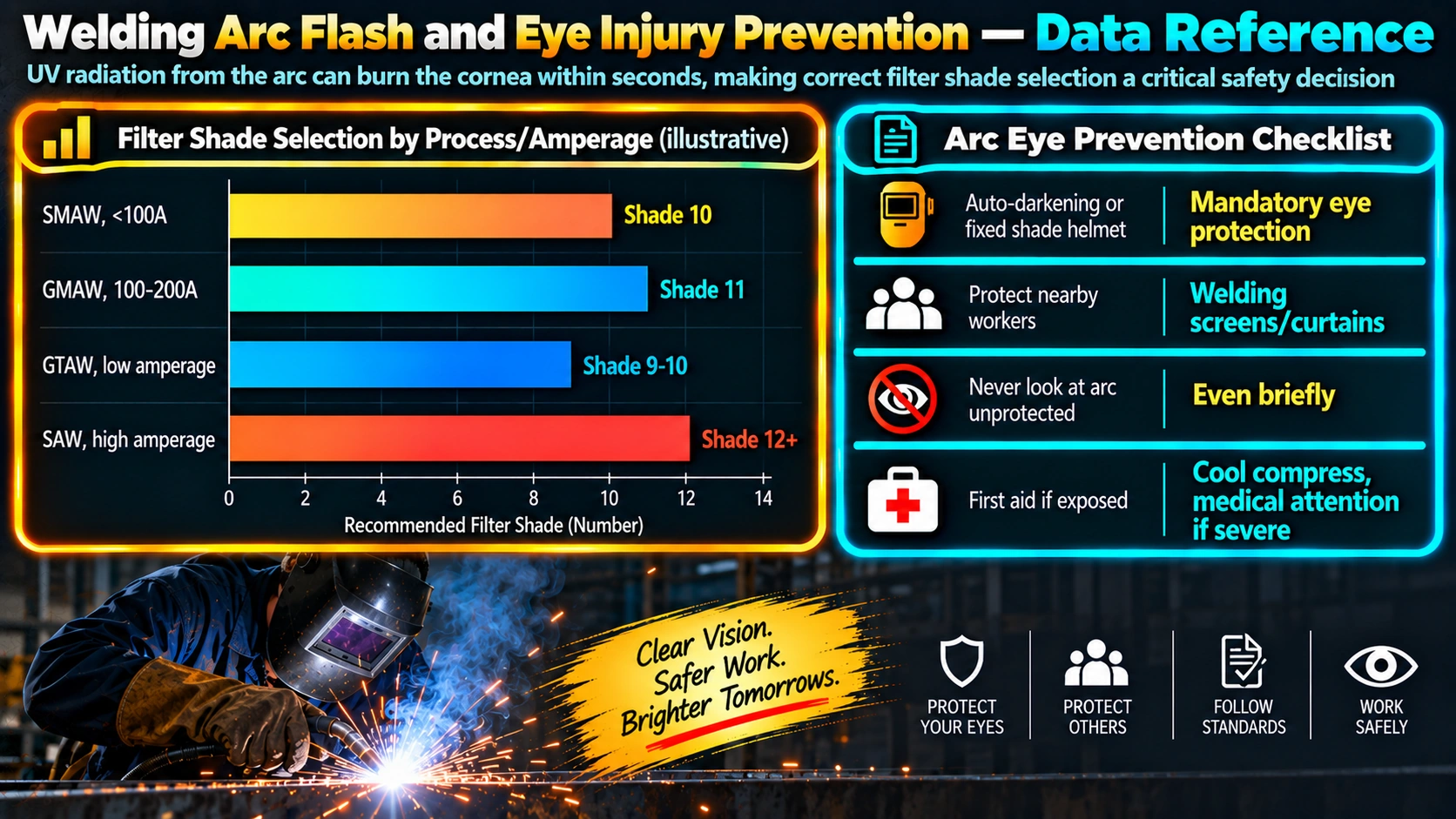
- Include filter shade verification as part of pre-job PPE checks, not just a one-time issue at onboarding.
- Inspect auto-darkening helmets periodically for sensor function, battery condition, and lens integrity.
- Include welding curtain placement in area setup for any open welding station, particularly in shared shop floors.
- Cover arc eye recognition and first response in toolbox talks alongside more commonly discussed hazards like confined space entry and hot work permitting, since eye injuries are far more frequent day-to-day even though they attract less attention than fire or asphyxiation risk.
Amazon Picks for Eye Protection and Welding Safety
Auto-Darkening Welding Helmet
A variable-shade auto-darkening helmet suited to multi-process work, allowing shade adjustment matched to amperage and process.
View on AmazonSafety Glasses with Side Shields
Secondary eye protection worn under a helmet or by bystanders in a shared welding bay, guarding against stray sparks and reflected UV.
View on AmazonWelding Safety Curtain / Screen
A UV-blocking welding curtain used to shield bystanders and adjacent workstations from arc flash in shared shop spaces.
View on AmazonWelding Safety Reference Handbook
A practical reference on welding hazard recognition, PPE selection, and safety program fundamentals for supervisors and safety officers.
View on AmazonDisclosure: WeldFabWorld participates in the Amazon Associates programme (StoreID: neha0fe8-21). If you purchase through these links, we may earn a small commission at no extra cost to you. This helps support free technical content on this site.
Frequently Asked Questions
What is arc eye and what causes it?
Arc eye, also called welder’s flash or photokeratitis, is inflammation of the cornea caused by unprotected exposure to the ultraviolet radiation produced by a welding arc, essentially a sunburn on the surface of the eye. It happens when the eye is exposed to the arc without an adequately shaded filter, whether from a raised helmet at the wrong moment or from a bystander with no eye protection nearby.
How soon do arc eye symptoms appear after exposure?
Symptoms typically do not appear immediately. Most people notice a gritty sensation, tearing, redness, and light sensitivity beginning several hours after exposure, often once they are already home. Pain can range from mild discomfort to intense pain depending on exposure severity.
Is arc eye permanent?
A single mild-to-moderate exposure is usually temporary, with the corneal surface healing within one to two days and most affected workers returning to normal activity within a week. Repeated exposure over a career increases the risk of longer-term effects, including cataracts and reduced light tolerance, so it should not be treated as consequence-free.
What is the correct filter shade number for a given welding process and current?
Filter shade selection depends on the process, the amperage, and whether the process is gas-shielded, following guidance in ANSI Z49.1 and similar standards. Higher current and gas-shielded processes such as GMAW and GTAW generally require a darker shade than lower-current SMAW at the same amperage, and shade should always be selected by checking the applicable table rather than reusing a single default shade across every job.
Can a bystander get arc eye without welding themselves?
Yes. Arc flash radiation travels in all directions and can injure the unprotected eyes of anyone within line of sight of an open arc, not just the welder. This is why welding curtains or physical barriers are required around open welding operations in shared work areas, and why anyone entering a welding bay should be warned before an arc is struck nearby.
What is the correct first aid response to arc eye?
Move the person away from further UV exposure, avoid rubbing the eyes, and use a cool, damp compress or artificial tears if available for comfort. Seek medical evaluation if pain is severe, vision is significantly affected, or symptoms do not improve within a day or two.
Does an auto-darkening helmet fully prevent arc eye?
An auto-darkening helmet in good working order, with the correct shade range set for the process, is highly effective at preventing arc eye during normal use. Risk remains if the sensor fails, the battery is depleted, the lens is cracked, or the welder removes protection at the wrong moment, so periodic inspection and secondary eye protection underneath remain good practice.