Temper Bead Welding per ASME Section IX: QW-290 Explained
Temper bead welding is a controlled welding technique that uses the heat of later weld beads to temper the heat-affected zone of earlier beads, so that some repairs can be completed without furnace post-weld heat treatment (PWHT). The American Society of Mechanical Engineers (ASME) Boiler and Pressure Vessel Code (BPVC) Section IX supplies the qualification rules for it in paragraph QW-290.
Quick Answer
Temper bead welding is a controlled multi-layer technique in which later weld beads temper and refine the heat-affected zone of earlier beads, allowing some repairs to avoid furnace post-weld heat treatment (PWHT). Under ASME Section IX, the procedure is qualified using QW-290 when the construction code requires it, with bend tests plus impact or hardness testing and strict control of preheat, interpass temperature and heat input.
The technique sits between two familiar controls. Preheat in welding slows cooling during welding, while the heat treatments used in welding are normally applied to the whole assembly. Temper bead welding builds the tempering effect into the weld sequence itself.
This guide explains the metallurgy, the situations where codes accept the method, what QW-290 requires, which variables to control, and which tests prove the procedure. It also includes a worked heat input example and a decision flowchart you can use before starting a repair.

Key Takeaways
- Temper bead welding tempers the heat-affected zone (HAZ) of earlier beads using the heat of later beads, instead of a furnace cycle.
- ASME Section IX does not decide when the technique may be used. The construction code or repair code decides, and QW-290 then applies.
- QW-290 adds temper bead qualification on top of a normal qualified WPS, using an extra test coupon with the same essential variables.
- The coupon is bend tested and then tested by impact or Vickers hardness, depending on the construction code.
- Preheat, interpass temperature, heat input and bead placement must stay inside the qualified limits during production.
- Requirements depend on the code edition and contract specification applicable to your project.
What Is Temper Bead Welding?
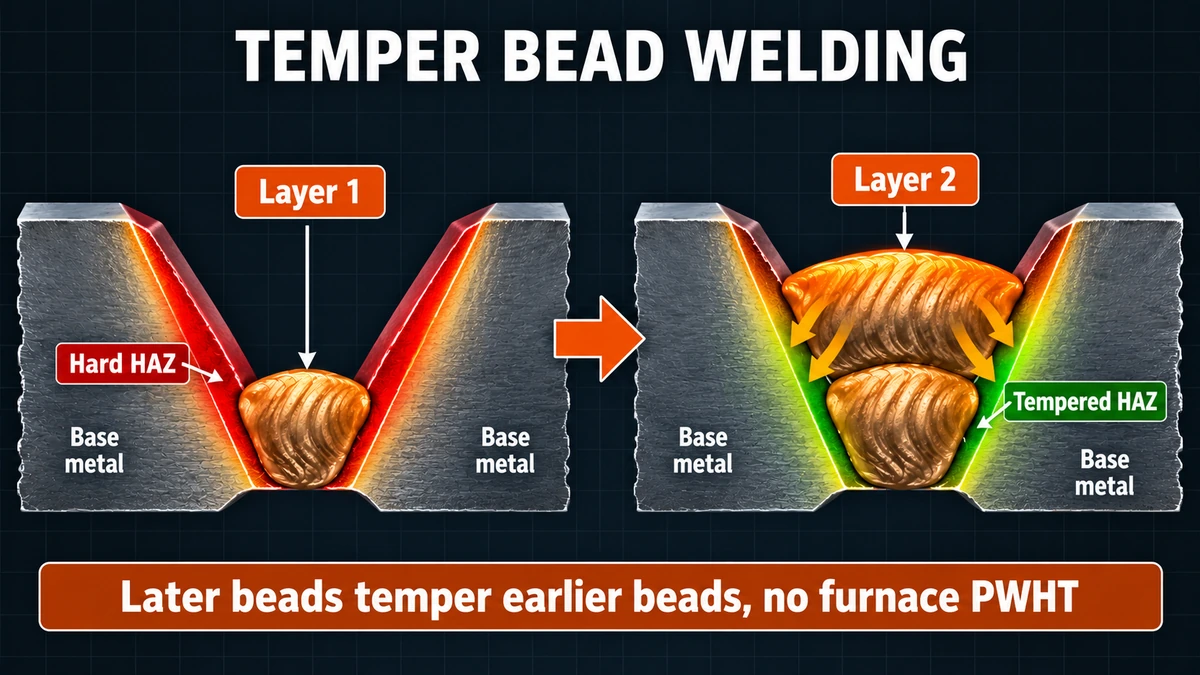
Temper bead welding is a multi-layer welding technique that uses controlled heat from later weld beads to temper the heat-affected zone of earlier beads without furnace PWHT.
Post-weld heat treatment (PWHT) is a controlled heating and cooling cycle applied after welding to temper hard microstructures and reduce residual stress. In a furnace or with local heaters, PWHT treats the whole weld region uniformly. Temper bead welding does the tempering bead by bead, using the arc itself.
The technique is an alternative to PWHT, not a waiver of it. A construction code must permit it for the material, thickness and service in question. Where the code does not, PWHT stays mandatory.
How Does Temper Bead Welding Temper the Heat-Affected Zone?
Each weld bead creates a heat-affected zone (HAZ) whose hardness depends on peak temperature and cooling rate. The next bead reheats part of that zone and changes its microstructure. Controlled placement of those beads is the whole method.
In carbon and low-alloy steels, the coarse-grained HAZ (CGHAZ) beside the fusion line is heated close to melting. On cooling it can form hard martensite and bainite, which has low toughness and a higher cracking risk. A later bead reheats this region in one of three ways:
- Above the upper critical temperature (Ac3): the steel re-austenitizes and the grain structure is refined on cooling.
- Between Ac1 and Ac3: the steel partly transforms, which breaks up the coarse structure.
- Below the lower critical temperature (Ac1): existing martensite is tempered, which lowers hardness and improves toughness.
Furnace PWHT tempers the whole weldment evenly. Temper bead welding only tempers the regions that later beads reheat enough, so bead placement and heat input must be deliberate. That is why Section IX demands a dedicated qualification. The technique is also a recognised prevention step in reheat cracking in Cr-Mo steels, where grain refinement of the CGHAZ is valuable.
When Is Temper Bead Welding Used Instead of PWHT?
Temper bead welding is used mainly for repairs and in-service work where furnace PWHT is impractical, and only when the governing code accepts it as an alternative. Typical cases include a local weld repair on a large vessel, or a repair where heating the whole item is unsafe or impossible.
- ASME Section VIII Division 1: paragraph UCS-56 recognises temper bead methods, including the half-bead and temper bead reinforcement techniques, as alternatives to PWHT in defined cases. See our ASME Section VIII Division 1 overview for how Part UCS fits into the code.
- National Board Inspection Code (NBIC) Part 3: repair methods that avoid PWHT by using a temper bead technique.
- ASME Section XI, IWA-4600: alternative welding methods for in-service nuclear components, including ambient temperature temper bead methods.
- ASME Section III, NB-4622: PWHT rules for nuclear construction that point to temper bead alternatives.
| Aspect | PWHT | Temper bead welding |
|---|---|---|
| Where tempering happens | Whole weld region, in a furnace or with local heaters | HAZ of earlier beads, reheated by later beads |
| Equipment | Furnace, heating elements and thermocouples | Normal welding equipment with tight parameter control |
| Main control | Temperature, hold time and heating and cooling rates | Bead placement, preheat, interpass and heat input |
| Qualification | PWHT condition recorded on the PQR | QW-290 qualification with bend and impact or hardness tests |
| Typical use | New construction and required heat treatment | Repairs and cases where PWHT is impractical and the code allows it |
For the furnace route, use the PWHT soak time calculator to check holding times by code and P-Number. Where PWHT is possible and required, temper bead welding is not a substitute.
What Does ASME Section IX QW-290 Cover?
QW-290 is the Section IX paragraph that adds temper bead qualification rules on top of normal procedure qualification, and it applies only when the construction code specifies it. When invoked, QW-290.1 through QW-290.6 apply together.
| Paragraph | Topic | What it means in practice |
|---|---|---|
| QW-290.1 | Basic qualification and upgrading existing WPSs | An existing qualified WPS can be upgraded with an extra coupon using the same essential variables |
| QW-290.2 | Welding process restrictions | Temper bead is limited to the arc welding processes the paragraph lists |
| Table QW-290.4 | Variables for temper bead qualification | Separate variable sets apply to impact-test, hardness-test and no-test bases |
| QW-290.5 | Test coupon preparation and testing | Bend tests plus impact or Vickers hardness tests, as the code requires |
QW-290 builds on the standard procedure rules, so the WPS must also meet the process variables in the QW-250 series. If you need a refresher on those documents, read Article II procedure qualification and how a WPS relates to a PQR and WPQ. The list of permitted processes has changed between editions, so check QW-290.2 in the edition your contract names.
Which Variables Control a Temper Bead Procedure?
A temper bead procedure is controlled by the normal Section IX variables plus the extra variables in Table QW-290.4. Which ones are essential depends on whether the construction code specifies impact testing, hardness testing or neither.
| Variable group | What to record and limit | Why it matters |
|---|---|---|
| Base metal | P-Number and Group Number (see the P-Number and Group Number guide) | Hardenability and tempering response differ by material |
| Preheat temperature | Minimum preheat achieved on the coupon | A decrease from the recorded value is controlled as an essential variable |
| Interpass temperature | Maximum and minimum between layers | Sets the thermal start point for each bead |
| Heat input per layer | Range for each layer, in kJ/mm (kJ/in) | Controls how far each bead reheats the HAZ below |
| Process and filler metal | Process, classification and diameter | Changes bead size, penetration and hydrogen level |
| PWHT condition | With or without PWHT, as qualified | PWHT is an essential variable under QW-407 |
| Bead placement and overlap | Sequence, overlap and number of layers as qualified | Decides which HAZ regions get reheated |
Take the exact list from Table QW-290.4 of your edition, because the variable set changes with the acceptance basis. Production welding must stay inside the ranges recorded on the PQR.
How Do You Qualify a Temper Bead Procedure?
Temper bead procedure qualification follows eight steps, from confirming the code basis to controlling production welding. The sequence builds on a normally qualified WPS.
- Confirm the code basis. Check that the construction code or repair code permits temper bead welding in place of PWHT and invokes QW-290, and note the Section IX edition.
- Check material and process limits. Confirm that the base metal P-Number, thickness and welding process fall within the limits of the construction code and QW-290.2.
- Start from a qualified WPS. Use an existing qualified WPS, or qualify a new one, and note the essential variables recorded on its PQR.
- Weld the temper bead coupon. Weld an additional test coupon with the same essential variables, long enough to cut the temper bead test specimens (QW-290.1).
- Record the temper bead variables. Record preheat, interpass temperature, heat input for each layer, bead placement and the PWHT condition on the PQR.
- Test the coupon. Run bend tests plus either impact tests or Vickers hardness tests, as the construction code specifies (QW-290.5).
- Evaluate the results. Compare results with the acceptance values of the construction code, since Section IX does not set the values itself.
- Issue the WPS and control production. Issue the temper bead WPS with its ranges, brief the welders, and keep production preheat and heat input inside the qualified limits with records.
The document workflow is the same as for any procedure, so the guide on preparing the WPS and PQR applies. The difference is the extra coupon and the extra variables recorded on the PQR.
What Are the Half-Bead and Reinforcement Techniques?
Half-bead and temper bead reinforcement are two named techniques that codes such as Section VIII Division 1 recognise for temper bead repair. Both aim to temper the HAZ at the fusion boundary and at the surface, where later layers would otherwise leave hard material behind.
- Half-bead technique: the first layer is partly ground back before later layers are deposited, so the later layers reheat the first layer HAZ.
- Temper bead reinforcement layer: an extra layer is deposited above the finished weld to temper the HAZ beneath it, and it is then removed by grinding.
Electrode diameter, grinding depth, bead overlap and layer heat input come from the construction code and the PQR. Do not carry values from one project to another.
What Tests Does QW-290 Require?
QW-290 requires a temper bead test coupon welded with the same essential variables as the base WPS, then bend tests plus either impact tests or Vickers hardness tests, depending on what the construction code specifies. The construction code, not Section IX, sets the acceptance values.
How Is Hardness Tested?
Hardness testing uses the Vickers method, with indents placed across the weld metal, HAZ and base metal. The traverse shows whether later beads actually softened the HAZ. Our hardness conversion calculator converts between HV, HB and HRC. For sour service limits, see the guide to sour service hardness limits.
How Is Toughness Tested?
When the code requires toughness, Charpy V-notch specimens are taken from the HAZ and weld metal and tested at the specified temperature. The method is covered in our guide to Charpy impact testing. Results are compared with the minimum energy the construction code requires.
What Do the Bend Tests Show?
Bend tests check ductility and soundness of the coupon, as in any procedure qualification. The principles are covered in guided bend testing, and wider specimen practice is in mechanical testing methods.
Worked Example: How Is Heat Input Compared Between Layers?
Heat input is arc energy divided by travel speed, and Section IX uses it as a controlled variable. The inputs below are assumed for illustration: a shielded metal arc welding (SMAW) repair where layer 1 uses a 3.2 mm electrode and layer 2 uses a 4.0 mm electrode.
The higher energy of layer 2 is what lets it reheat the HAZ of layer 1 enough to temper it. Whether this ratio is acceptable is decided by the PQR and the construction code, not by this example. Production welders must stay inside the heat input range recorded for each layer.
Quick Reference: Should You Use Temper Bead Welding?
This flowchart shows the decision path from the PWHT requirement to a temper bead qualification. Follow the code at each decision, because eligibility is set by the construction code and not by Section IX.
| Check | Confirm |
|---|---|
| Code basis | Construction or repair code permits temper bead and invokes QW-290 |
| Edition | Section IX edition named in the contract, and its QW-290 text |
| Material | P-Number, thickness and condition are within code limits |
| Process | Welding process is allowed by QW-290.2 |
| Coupon | Extra coupon welded with the same essential variables and enough length for specimens |
| Tests | Bend plus impact or Vickers hardness, as the code specifies |
| Production control | Preheat, interpass, heat input and bead sequence monitored and recorded |
What Are the Limits and Common Mistakes?
Temper bead welding fails most often when it is treated as a general shortcut for PWHT. It is a code-controlled alternative with narrow limits, and inspectors review the records closely.
Watch for these
- Using temper bead welding where the construction code does not allow it.
- Qualifying with a coupon that does not match production preheat, interpass or heat input ranges.
- Letting preheat fall below the qualified value during production.
- Skipping layer-by-layer heat input records, so compliance cannot be shown.
- Assuming bead sequence and overlap do not matter because they are not individually tested.
- Ignoring hydrogen control, which still matters for cold cracking in the HAZ.
- Copying hardness or toughness limits from another project instead of the construction code.
The method has limits. It depends on the hardness response of the steel, it tempers only the zones that later beads reheat, and it requires disciplined welders and monitoring. Requirements depend on the code edition and contract specification applicable to your project.
Frequently Asked Questions
What is temper bead welding?
Temper bead welding is a multi-layer technique in which controlled heat from later weld beads tempers the heat-affected zone of earlier beads. It is used where furnace PWHT is impractical, mainly for repairs. The technique works only when the governing code allows it as an alternative to PWHT. Success depends on bead placement, preheat and heat input control, which is why a qualified procedure is required.
Does ASME Section IX require temper bead welding?
No. Section IX does not decide whether PWHT or temper bead welding is needed. Paragraph QW-290 supplies the qualification rules, and it applies only when the construction code or repair code specifies it. Always read the referencing code first, such as the Section IX scope and structure, then apply QW-290.
What tests are required to qualify a temper bead procedure?
The test coupon is bend tested, and it is then tested by either impact (Charpy V-notch) tests or Vickers hardness tests, depending on the construction code. Where the code specifies neither, QW-290.4 provides a separate variable set in recent editions. Acceptance values come from the construction code. Specimen locations and counts follow QW-290.5 of your edition.
Can temper bead welding replace PWHT on any steel?
No. Codes limit temper bead alternatives to specific materials, thicknesses, processes and repair situations. Alloy steels with creep-resistant chemistry, such as P91, normally need PWHT regardless of thickness, as covered in the PWHT soak time code guide. Confirm eligibility in the construction code before developing a temper bead WPS.
What is the half-bead technique?
The half-bead technique is a named temper bead method in which the first layer is partly removed by grinding before later layers are deposited. The later layers then reheat and temper the heat-affected zone of the first layer. Exact electrode sizes, grinding depth and heat input limits come from the construction code and the PQR. Do not copy values from other projects.
Why does heat input matter in temper bead welding?
Heat input sets how far each bead reheats the heat-affected zone of the beads below it. Too little heat leaves hard microstructure untempered, and too much can soften or damage the base metal. Section IX therefore treats heat input as a controlled variable in the temper bead variable table. A simple calculation of arc energy for each layer is shown in the worked example above.
Is preheat still required with temper bead welding?
Usually yes. Preheat and interpass temperature are controlled variables, and a decrease in preheat from the qualified value can require requalification. Preheat also helps manage hydrogen cracking, as explained in our preheat guide for fabrication. Some ambient temperature methods used in nuclear repair are an exception, and they follow their own code rules.
Key Terms
- Temper bead welding
- A multi-layer welding technique in which later beads temper the heat-affected zone of earlier beads.
- Heat-affected zone (HAZ)
- The part of the base metal next to the weld whose microstructure is changed by welding heat but which does not melt.
- Coarse-grained HAZ (CGHAZ)
- The HAZ region nearest the fusion line, heated close to melting, which is often hard and low in toughness.
- Post-weld heat treatment (PWHT)
- A controlled heating and cooling cycle after welding that tempers hard microstructures and relieves stress.
- Half-bead technique
- A temper bead method in which the first layer is partly ground back before later layers are deposited.
- Heat input
- The arc energy delivered per unit length of weld, calculated from voltage, current and travel speed.
- Vickers hardness (HV)
- A hardness scale from a small diamond indent, widely used to survey weld metal, HAZ and base metal.
- Essential variable
- A variable whose change beyond the qualified range requires a new procedure qualification.
Conclusion
Temper bead welding lets qualified procedures achieve a tempered HAZ without furnace PWHT, but only where the construction code accepts it. ASME Section IX QW-290 then governs the qualification, through an extra coupon, bend tests and either impact or hardness testing.
Control preheat, interpass temperature, heat input and bead placement, and keep records for every layer. Confirm the code edition and contract specification before you start, because eligibility and acceptance values come from the construction code.
As a next step, test your knowledge of procedure qualification with the ASME Section IX quiz with 150 questions.
Standards and References
- ASME BPVC Section IX, Welding, Brazing, and Fusing Qualifications, 2025 Edition, paragraph QW-290, issued by ASME.
- ASME BPVC Section VIII Division 1, Rules for Construction of Pressure Vessels, paragraph UCS-56, issued by ASME.
- ASME BPVC Section XI, Rules for Inservice Inspection of Nuclear Power Plant Components, subsection IWA-4600, issued by ASME.
- ASME BPVC Section III, Rules for Construction of Nuclear Facility Components, paragraph NB-4622, issued by ASME.
- ANSI/NB-23, National Board Inspection Code, Part 3, issued by the National Board of Boiler and Pressure Vessel Inspectors.
About this guide. This guide was prepared by the WeldFabWorld technical team from the standards listed above. Verify every requirement against the code edition and specification applicable to your project.