ASME Section IX QB Brazing: Part QB Brazing Qualification Explained
ASME Section IX QB brazing rules decide whether a brazed joint on pressure equipment can be made by a qualified procedure and a qualified brazer. Part QB of the American Society of Mechanical Engineers (ASME) Boiler and Pressure Vessel Code (BPVC) Section IX sets those rules for brazing, in the same way Part QW does for welding.
Quick Answer
ASME Section IX QB brazing qualification requires a written Brazing Procedure Specification (BPS) backed by a Brazing Procedure Qualification Record (BPQR) from tested coupons, plus a performance qualification for each brazer or brazing operator. Part QB sets the variables, test coupons, mechanical tests and renewal rules used when a construction code such as ASME Section VIII Division 1 Part UB requires qualified brazing.
If you are new to the process itself, start with our comparison of welding, brazing and soldering. This guide assumes you know the basics and concentrates on qualification. For the wider code structure, see the ASME Section IX overview.
You will learn what Part QB contains, which documents it requires, how brazing variables control qualification, which tests apply to each joint type, and how brazers are qualified and renewed. The guide also covers the 2025 edition changes, includes a worked tension-test check and ends with a paragraph finder you can keep at your desk.
Key Takeaways
- ASME Section IX Part QB governs the qualification of brazing procedures and brazers. It is not a design or construction code.
- A Brazing Procedure Specification (BPS) must be supported by a Brazing Procedure Qualification Record (BPQR) before it is used on ASME-referenced work.
- Each brazer or brazing operator needs a separate performance qualification, normally by peel or section test.
- Required tests depend on joint type: butt and scarf (tension and bend), lap (tension and peel), rabbet (tension and section).
- Brazing base metals use their own P-Number numbering in Table QW/QB-422, distinct from welding P-Numbers.
- The 2025 edition revised several brazing tables, so always confirm the edition named in your contract.
What Is ASME Section IX Part QB?
Part QB is the section of ASME BPVC Section IX that sets the rules for qualifying brazing procedures, brazers and brazing operators for construction under referencing codes.
Brazing is a joining process in which a filler metal that melts above 450 °C (840 °F), but below the melting range of the base metals, flows into a close-fitting joint by capillary action. The base metals do not melt. That single difference is why brazing needs its own qualification rules instead of reusing the welding rules.
ASME Section IX, titled Welding, Brazing, and Fusing Qualifications, is a qualification standard and not a construction code. It becomes mandatory only when a construction code such as ASME Section VIII Division 1 or ASME B31.3 invokes it. The manufacturer or contractor stays responsible for the brazing it performs and for the qualification tests behind it.
Where Does Part QB Sit Inside Section IX?
Section IX has four parts: Part QG (General Requirements), Part QW (Welding), Part QB (Brazing) and Part QF (Plastic Fusing). Part QB follows the same logic as welding: qualify the procedure first, then qualify the person who will use it. Part QB itself is split into four articles.
| Article | Title | Paragraph series | What it covers |
|---|---|---|---|
| XI | General Brazing Requirements | QB-100 | Scope, responsibility, positions and general rules |
| XII | Brazing Procedure Qualifications | QB-200 | BPS and BPQR content, tests for procedure qualification |
| XIII | Brazing Performance Qualifications | QB-300 | Brazer and operator tests, limits and renewal |
| XIV | Brazing Data | QB-400 | Variables, P-Number and F-Number tables, specimen graphics |
Suggested forms for the BPS, BPQR and brazer record sit in Nonmandatory Appendix B. Paragraph numbers can move between editions, so confirm each reference against the edition your contract names. More brazing and welding code guides are collected in the ASME Codes & Standards category.
Which Codes Require Part QB Brazing Qualification?
Any construction code that permits brazing and refers to Section IX makes Part QB mandatory for that work. The qualification requirement follows the referencing code, not the brazing process itself.
- ASME BPVC Section VIII Division 1: Part UB covers brazed vessels, including brazing materials, procedure and performance qualification, and inspection of brazed joints. Our ASME Section VIII Division 1 overview shows where Part UB fits.
- ASME B31.3 Process Piping: brazed piping joints refer qualification of procedures and brazers to Section IX Part QB.
- Contract specifications: a purchaser may name AWS B2.2 or ISO 13585 instead. These frameworks are not interchangeable with Part QB unless the contract allows it.
What Are the BPS, BPQR and BPQ Documents?
Part QB uses three documents: the Brazing Procedure Specification (BPS), the Brazing Procedure Qualification Record (BPQR) and the Brazer Performance Qualification (BPQ) record. The BPS is the instruction, and the other two are evidence.
| Document | Purpose | Code reference | Suggested form |
|---|---|---|---|
| BPS Procedure | Written instruction listing the variables and ranges used in production | QB-200.1 | QB-482 |
| BPQR Record | Record of the actual variables used on the test coupon and the test results | QB-200.2 | QB-483 |
| BPQ Person | Record that a named brazer or operator passed a performance test | QB-300 series | QB-484 |
The relationship mirrors welding. The difference between WPS, PQR and WPQ maps directly onto BPS, BPQR and BPQ. For the document workflow, the guide on preparing a WPS and PQR applies in principle, although brazing uses its own forms and variables.
How Do Brazing Variables Control Qualification?
Brazing variables are the conditions listed in Part QB whose change may require a new procedure qualification or a new brazer test. Each brazing process has its own variable tables, listed in Tables QB-252 through QB-257. They cover torch (TB), furnace (FB), induction (IB), resistance (RB) and dip (DB) brazing, among other methods.
Variables are classed as essential or nonessential. A change to an essential variable beyond the qualified range needs a new BPQR. A nonessential variable can be changed in the BPS without requalifying, although the BPS should be revised and kept current.
| Variable group | What the BPS records | Why it matters |
|---|---|---|
| Base metal | P-Number grouping from Table QW/QB-422 | Wetting and flow of the filler change with the alloy |
| Filler metal | F-Number grouping (Table QB-432) and AWS A5.8 classification | Melting range and flow behaviour set the brazing temperature |
| Flux, fuel gas or atmosphere | Type and composition | Removes or prevents oxides so the filler can wet the joint |
| Joint design | Joint type, overlap and clearance | Controls capillary action and joint strength |
| Brazing temperature and time | Temperature range and time at temperature | Governs filler flow and interaction with the base metal |
| Post-braze heat treatment | Treatment applied after brazing, if any | Affects the condition of the base metal |
| Technique | Cleaning, flux application and filler placement | Keeps results repeatable between brazers |
Base metals are grouped by P-Number, and brazing uses a numbering system separate from welding, starting around P-101. For the welding side of the system, see our P-Number, Group Number, F-Number and A-Number guide and the complete ASME P-Number table. Brazing filler metals are grouped by F-Number and classified under AWS A5.8/A5.8M, which ASME adopts as SFA-5.8 in Section II Part C. Brazing has no A-Number.
How Do You Qualify a Brazing Procedure Under Part QB?
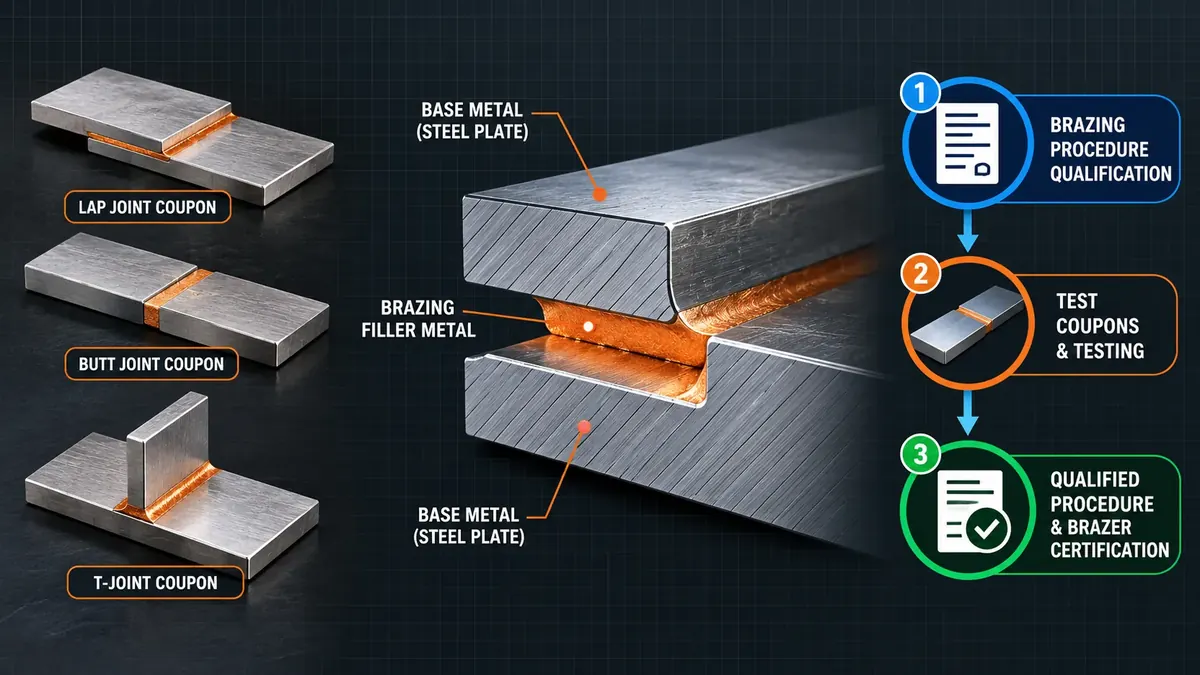
Brazing procedure qualification follows eight steps, from confirming the governing edition to qualifying the brazers who will use the released BPS.
- Confirm the governing edition. Identify the construction code, the Section IX edition and any contract specification that invokes Part QB before any testing starts.
- Select the process and joint. Choose the brazing process and the joint type (butt, scarf, lap or rabbet) that production will use.
- Draft the BPS. List base metals by P-Number, filler metal by F-Number and AWS A5.8 classification, flux or atmosphere, joint design, temperature, time and technique.
- Prepare the test coupons. Clean, fit up and assemble coupons exactly as the BPS describes, using the production joint design.
- Braze and record. Braze the coupons while the responsible person records the actual variables used on the BPQR form.
- Cut and test specimens. Prepare the specimens and run the tension, bend, peel or section tests that QB-202 and QB-451 require for the joint type.
- Evaluate the results. Compare each result with the acceptance criteria. If a specimen fails, follow the code retest rules or revise the BPS and braze new coupons.
- Certify and release. Certify the BPQR, issue the BPS that cites it, and then qualify each brazer or operator on the BPS.
What Tests Does Part QB Require?
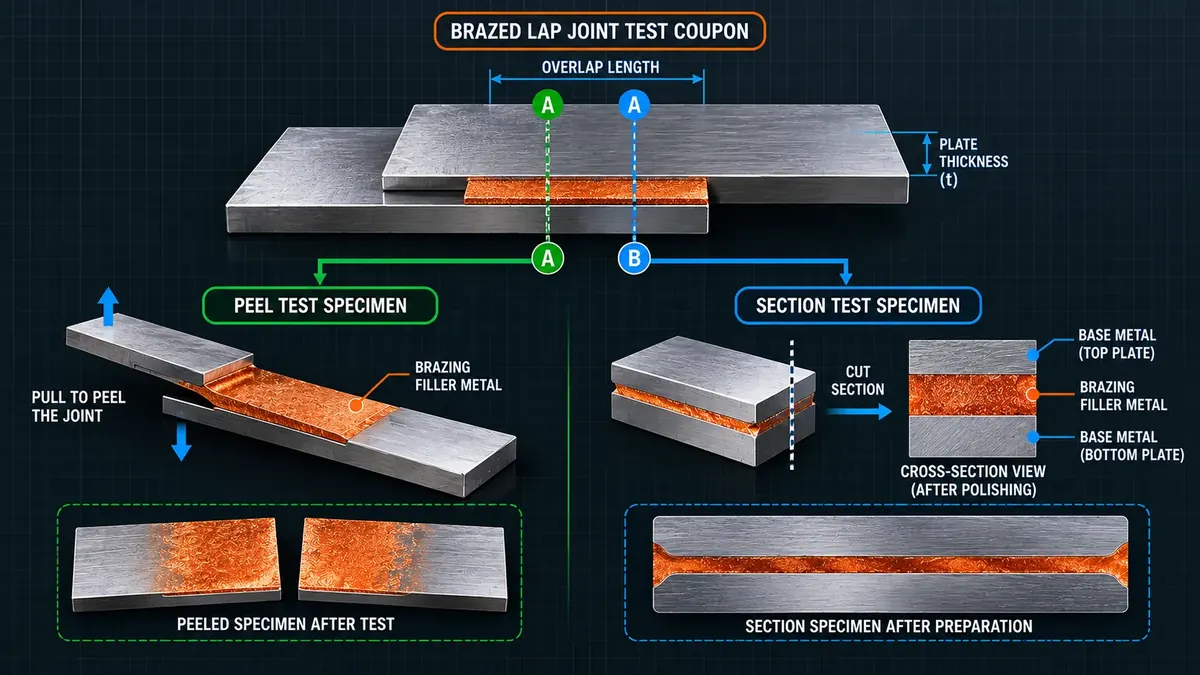
Part QB procedure qualification tests depend on joint type. Butt and scarf joints use tension and bend tests, lap joints use tension and peel tests, and rabbet joints use tension and section tests. Brazer performance coupons are examined by peel or section tests. Sectioning may replace peel testing where peel testing is impractical.
| Joint type | Procedure qualification tests | Procedure reference | Performance test |
|---|---|---|---|
| Butt and scarf | Tension and transverse bend, or tension and longitudinal bend | QB-451.1, QB-451.2 | Peel or section (QB-452.1) |
| Lap | Tension and peel | QB-451.3 | Peel or section (QB-452.1) |
| Rabbet | Tension and section | QB-451.4 | Peel or section (QB-452.1) |
| Workmanship coupon | Section tests | QB-451.5 | Not applicable |
How Are the Test Methods Used?
- Tension test (QB-150 series): loads a specimen to failure to measure the strength of the brazed joint.
- Guided-bend test (QB-160 series): bends a specimen around a former to expose lack of fill or cracking. The principles match those in our guided bend testing guide.
- Peel test (QB-170 series): pulls a lap joint apart so the separated faces show how completely the filler flowed.
- Section test (QB-180 series): cuts across the joint so the cross-section shows filler penetration, voids and bonding.
The general method of preparing and reading specimens is covered in mechanical testing of welds and joints.
How Are Test Results Accepted?
For tension tests, the specimen strength must not be less than the minimum specified tensile strength of the base metal, using the weaker metal where two differ. Bend, peel and section specimens are judged against the code limits for open defects and filler flow. Verify the exact wording and limits in the edition that applies to your project.
Worked Example: How Is a Brazed Tension Specimen Checked?
A tension result is checked by dividing the failure load by the original cross-sectional area and comparing the stress with the base metal minimum. The inputs below are assumed for illustration: a butt-joint specimen of SA-106 Grade B carbon steel pipe (minimum specified tensile strength 415 MPa, 60 ksi), 25 mm wide and 6 mm thick, failing at 66.0 kN.
Passing the tension criterion does not complete the qualification. The bend, peel or section specimens for the joint type must also be accepted before the BPQR can be certified. Real specimen dimensions come from the test paragraphs of the applicable edition, not from this example.
How Is a Brazer Qualified and Kept Qualified?
A brazer or brazing operator is qualified by brazing a test coupon to a BPS and passing the examination Part QB requires. The result is recorded on a brazer performance qualification record, such as the suggested format QB-484. Performance tests use peel or section examination, as shown in Table 4.
The qualification applies only within the performance variables of the code, such as the brazing process, base metal, filler metal and joint design. Welder qualification works differently, as explained in our guide to welder performance qualification under Section IX.
Qualification does not last forever. It expires when the brazer stops using the process for the period the code states, and renewal rules apply under QB-322 and the related Part QG continuity provisions. Confirm in your edition whether continuity requirements have moved to Part QG, and keep dated production records for each brazer.
What Changed for Brazing in the 2025 Edition?
The 2025 edition of Section IX, published by ASME on 1 July 2025, revised several tables that brazing procedures depend on. The brazing P-Number groupings were restructured, with new groupings taking effect in the 2023 edition and further adjustments made in 2025.
- Table QB-421 was added.
- QB-402.2 was revised in its entirety.
- Table QW/QB-421.2 was revised, and the ferrous and nonferrous parts of Table QW/QB-422 were combined into one table.
- API 5L grades with the L designation were added alongside the existing X grades in Table QW/QB-422.
Code edition note
Requirements depend on the code edition and contract specification applicable to your project. Before reusing an older BPS or BPQR, check whether the P-Number cited still matches the table in the edition your contract names. Our 150-question Section IX practice quiz includes a brazing and 2025 changes set for self-checking.
How Does Part QB Differ From Part QW?
Part QB covers brazing, where the filler metal flows into a joint without melting the base metals, while Part QW covers welding, where the base metals are fused. The structure is parallel, but documents, grouping tables, variables and tests differ.
| Item | Part QW (welding) | Part QB (brazing) |
|---|---|---|
| Procedure document | WPS | BPS |
| Procedure record | PQR | BPQR |
| Base metal grouping | P-Number and Group Number, Table QW-422 | Brazing P-Number, Table QW/QB-422 |
| Filler grouping | F-Number and A-Number | F-Number (QB-432); no A-Number |
| Typical procedure tests | Tension and bend tests | Tension with bend, peel or section tests, by joint type |
| Typical performance test | Bend tests, or volumetric examination | Peel or section test |
| Variable tables | QW-250 series | QB-252 to QB-257 |
For the process-level trade-offs, read brazing versus fusion welding principles. For the welding qualification structure, see Article II welding procedure qualification and the thickness qualification range for PQR and WPQ. Thickness range rules for brazing are different and are found in the QB-451 tables.
Quick Reference: Part QB Paragraph Finder
This paragraph finder lists where each Part QB requirement normally sits. Check each reference against your edition, because numbering can change.
| You need | Look in |
|---|---|
| BPS content | QB-200.1, suggested format QB-482 |
| BPQR content | QB-200.2, suggested format QB-483 |
| Procedure test requirements | QB-202 |
| Procedure specimen details by joint | QB-451 series |
| Brazer test requirements | QB-302 |
| Brazer specimen details | QB-452 series |
| Brazer record format | QB-484 |
| Variables by brazing process | Tables QB-252 to QB-257 |
| Base metal P-Numbers | Table QW/QB-422 |
| Filler metal F-Numbers | Table QB-432 |
| Test methods | QB-150 (tension), QB-160 (bend), QB-170 (peel), QB-180 (section) |
| Renewal of qualification | QB-322, with Part QG continuity provisions |
| Suggested forms | Nonmandatory Appendix B |
What Are Common Mistakes With Part QB Qualification?
The most common Part QB mistakes come from treating brazing like welding or from ignoring the edition and contract. Inspectors usually find these problems at the records review, not at the bench.
Watch for these
- Assuming a welding WPS or a welder qualification covers brazing work.
- Qualifying on a joint design that differs from the production joint.
- Recording planned values instead of the actual temperatures, times and fit-up on the BPQR.
- Skipping documentation of flux, fuel gas or atmosphere and of pre-braze cleaning.
- Using filler metal that does not match the F-Number and AWS A5.8 classification in the BPS.
- Letting a brazer qualification lapse without dated continuity records.
- Reusing older qualification records without checking restructured P-Number tables.
Part QB has limits. It qualifies the procedure and the person, but it does not set joint design rules, allowable stresses or inspection scope. Those come from the construction code. Requirements depend on the code edition and contract specification applicable to your project.
Frequently Asked Questions
What is Part QB in ASME Section IX?
Part QB is the brazing part of ASME BPVC Section IX. It defines how brazing procedures, brazers and brazing operators are qualified, including variables, test coupons, mechanical tests and forms. It does not set design rules or joint allowable stresses, which come from the construction code. Read it together with the construction code that invokes it, such as ASME Section VIII Division 1 Part UB.
Is a BPS the same as a WPS?
No. A WPS is the written procedure for welding under Part QW, while a BPS is the written procedure for brazing under Part QB. Both serve the same purpose, but their variables, tables and tests differ. A BPS is supported by a Brazing Procedure Qualification Record (BPQR), not by a welding PQR. For the welding equivalent, see how welding procedure documents are prepared.
What tests are required for brazing procedure qualification?
The tests depend on joint type. Butt and scarf joints use tension and bend tests, lap joints use tension and peel tests, and rabbet joints use tension and section tests. A workmanship coupon is examined by section tests. Peel testing may be replaced by sectioning where peel testing is impractical. Specimen counts and dimensions come from QB-451 and the QB-150 to QB-180 test paragraphs of your edition.
Does a brazer need a separate qualification from the procedure?
Yes. Procedure qualification proves that a BPS can produce sound joints. Performance qualification proves that a specific brazer or brazing operator can produce sound joints by following a BPS. Each person is tested on a coupon, and the result is recorded on a brazer performance qualification record such as the suggested format QB-484.
Do brazing P-Numbers match welding P-Numbers?
No. Table QW/QB-422 lists base metals for both processes, but brazing base metals use their own numbering, which starts around P-101 and does not share numbers with the welding P-Number system. Always take the brazing P-Number from the table in the edition named in your contract, because the groupings were restructured in recent editions. A P-Number reference chart helps with the welding side.
Can a qualified welder braze on ASME work?
No. Qualification under Part QW covers welding only. A person who brazes on ASME-referenced work needs a performance qualification under Part QB for the brazing process and joint. Some skills overlap, such as cleanliness and fit-up, but the tests and variables are different. A process-level comparison of brazing and welding explains the technical differences.
Which edition of Section IX applies to my project?
The edition named in the contract or the construction code applies. ASME issues Section IX every two years, and the 2025 edition was published on 1 July 2025. Many projects apply an edition six months after issue unless the contract says otherwise, so confirm with the purchaser. Check restructured tables, such as brazing P-Numbers, before reusing older qualification records.
Key Terms
- Brazing
- A joining process in which filler metal melting above 450 °C (840 °F) flows into a joint by capillary action without melting the base metals.
- Brazing Procedure Specification (BPS)
- The written document that lists the variables and ranges used to produce a brazed joint.
- Brazing Procedure Qualification Record (BPQR)
- The record of the actual variables used on a test coupon and the test results that support a BPS.
- Brazer Performance Qualification (BPQ)
- The record showing that a brazer or brazing operator passed the required performance test.
- Essential variable
- A variable whose change beyond the qualified range requires a new procedure qualification.
- Capillary action
- The force that draws molten filler metal into the narrow gap between close-fitting joint surfaces.
- Joint clearance
- The gap between the faying surfaces at brazing temperature, which controls how filler metal flows into the joint.
- Peel test
- A test that pulls a lap joint apart so the separated faces can be examined for filler coverage.
Conclusion
ASME Section IX QB brazing qualification comes down to two linked proofs: a qualified procedure and a qualified brazer. The BPS defines the process, the BPQR proves it on tested coupons, and each brazer then proves personal ability on a performance coupon.
Keep the variables, joint type, P-Numbers and filler F-Numbers consistent between the BPS and production, and always confirm the code edition in your contract. The 2025 edition changed several brazing tables, so older records deserve a second look.
As a next step, test your understanding with the ASME Section IX quiz with 150 questions, which includes a set on brazing and the 2025 changes.
Standards and References
- ASME BPVC Section IX, Welding, Brazing, and Fusing Qualifications, 2025 Edition, issued by ASME.
- ASME BPVC Section VIII Division 1, Rules for Construction of Pressure Vessels, Part UB, issued by ASME.
- ASME B31.3, Process Piping, issued by ASME.
- ASME BPVC Section II Part C, Specifications for Welding Rods, Electrodes, and Filler Metals (SFA-5.8), issued by ASME.
- AWS A5.8/A5.8M, Specification for Filler Metals for Brazing and Braze Welding, issued by the American Welding Society (AWS).
- AWS B2.2/B2.2M, Standard for Brazing Procedure and Performance Qualification, issued by AWS.
- ISO 13585, Brazing — Qualification test of brazers and brazing operators, issued by the International Organization for Standardization (ISO).
- ISO 17672, Brazing — Filler metals, issued by ISO.
About this guide. This guide was prepared by the WeldFabWorld technical team from the standards listed above. Verify every requirement against the code edition and specification applicable to your project.