Welding vs Brazing vs Soldering — Full Comparison Guide
Welding, brazing, and soldering are the three primary thermal metal-joining processes used across fabrication, manufacturing, electronics, HVAC, and aerospace. Of the three, welding vs brazing vs soldering is the most important comparison for engineers and fabricators to understand correctly — because the processes differ not just in temperature, but in their fundamental mechanism of joining, their effect on base metal properties, their suitability for dissimilar materials, and their regulatory requirements. Choosing the wrong process for an application can result in joint failure, base metal damage, or non-compliance with the governing code.
This guide covers the working principles of all three processes in technical depth: the 450°C threshold defined by AWS and ISO 857-2, the role of capillary action in brazing and soldering, the formation of the heat-affected zone in welding, filler metal classification for each process, joint design requirements, distortion behaviour, typical applications by industry, and a practical selection framework for real engineering decisions. Governing standards for each process are referenced throughout, including AWS C3, AWS A5.8, ASME Section IX Part QB, and ISO 17672.
Welding
- Base metal MELTED at fusion zone
- HAZ formed in adjacent base metal
- Temp: 1,400°C – 3,000°C+
- Highest joint strength
- Formal WPS/PQR qualification required
- Distortion risk on thin sections
Brazing
- Base metal NOT melted
- Filler liquidus >450°C (>840°F)
- Temp: 450°C – 1,200°C (filler)
- No HAZ formed
- Excellent for dissimilar metals
- ASME Section IX Part QB for pressure equip.
Soldering
- Base metal NOT melted
- Filler liquidus <450°C (<840°F)
- Temp: 150°C – 430°C typical
- Low to moderate joint strength
- Ideal for electronics, plumbing
- No formal procedure qualification
The 450°C Threshold: How the Three Processes Are Defined
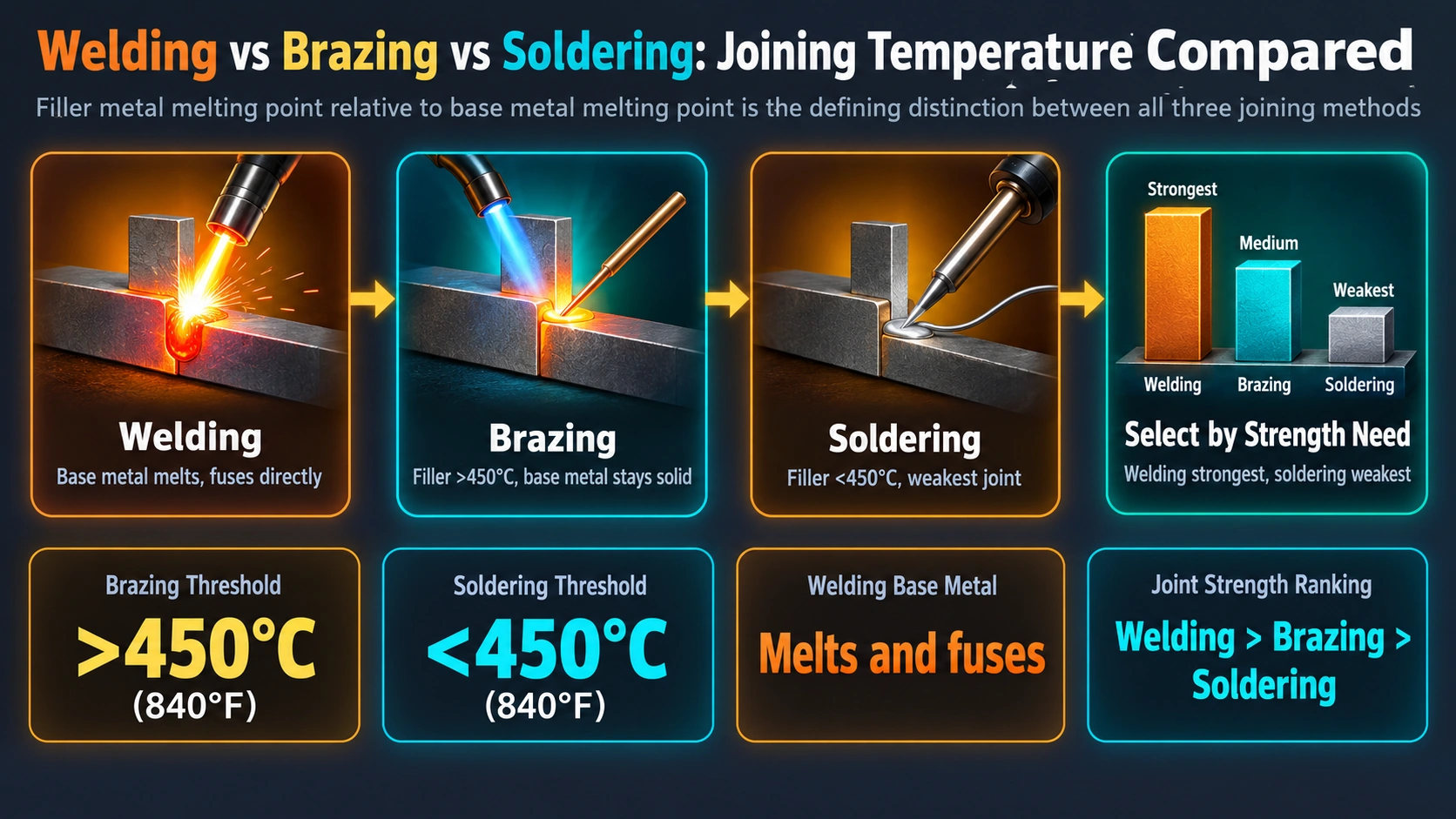
The classification of welding, brazing, and soldering is not arbitrary or informal. AWS (American Welding Society) and ISO 857-2 define the boundary between brazing and soldering by a single, measurable criterion: the liquidus temperature of the filler metal. A filler metal with a liquidus at or above 450°C (840°F) that is used to join metals without melting the base metal is a brazing filler. A filler metal with a liquidus below 450°C used in the same non-fusion manner is a solder. Welding is distinguished from both because it melts the base metal, regardless of the temperature involved.
This temperature boundary has engineering significance beyond classification. Brazed joints can withstand service temperatures closer to their brazing temperature than soldered joints can, because the filler retains mechanical integrity at higher temperatures. A tin-silver solder with a liquidus of 221°C begins to creep and lose strength at temperatures above approximately 100°C under sustained load. A silver brazing alloy (BAg-7) with a liquidus of 780°C retains adequate strength at service temperatures up to 300°C or higher depending on the alloy. This difference in high-temperature capability is a major factor in process selection for components operating in elevated-temperature environments.
What is Welding? Principles and the Heat-Affected Zone
Welding is a metal-joining process that achieves a permanent bond by melting and fusing the base metals together, with or without a filler metal, using a concentrated heat source. When the molten pool solidifies, the two base metals are joined in a continuous metallurgical union. The resulting weld zone comprises the fusion zone (where both base and filler metal have melted and resolidified) and the heat-affected zone (HAZ) — the region of base metal that was not melted but was heated to temperatures high enough to alter its microstructure.
Major fusion welding processes include SMAW (Shielded Metal Arc Welding), GMAW/MIG welding, GTAW/TIG welding, and Submerged Arc Welding (SAW). Each delivers heat through a different mechanism — electric arc, plasma, laser, or electron beam — but all achieve fusion of the base metal in the weld pool.
The Heat-Affected Zone: Why It Matters
The HAZ is one of the most consequential characteristics of fusion welding. The region of base metal immediately adjacent to the fusion zone is heated to temperatures that, while below the melting point, are high enough to cause metallurgical transformation. In carbon and low-alloy steels, the HAZ may experience grain coarsening (in the coarse-grain HAZ, immediately adjacent to the fusion line), hardening due to martensite formation on rapid cooling (in higher carbon steels), or softening (in the outer HAZ where the temperature cycle over-tempers pre-existing microstructure). For this reason, carbon equivalent (CE) calculations are a mandatory pre-welding check for carbon and low-alloy steels: high CE values indicate elevated HAZ hardening risk and susceptibility to hydrogen-induced cracking.
In austenitic stainless steels, the HAZ is the zone where chromium carbide sensitisation occurs if the carbon content is too high and the cooling rate through the sensitisation range (450°C to 850°C) is too slow. This is the mechanism behind stainless steel weld decay. In duplex stainless steels, the HAZ must be controlled to maintain the target ferrite-austenite phase balance; excessive heat input pushes the HAZ composition into problematic regions. See the complete guide to duplex stainless steel welding for detailed discussion.
What is Brazing? Principles, Capillary Action, and Standards
Brazing is a thermal metal-joining process in which a filler metal is melted and drawn into the joint gap between two base metals by capillary action, forming a metallurgical bond without melting the base metal. This single characteristic — that the base metal remains solid throughout — distinguishes brazing from all fusion welding processes and determines its unique combination of advantages and limitations.
The bond formed in brazing is metallurgical, not merely mechanical. At brazing temperature, the liquid filler metal wets the base metal surface, displacing oxides (assisted by flux or controlled atmosphere), and the filler atoms diffuse into the base metal surface layer while base metal atoms diffuse into the filler. Upon solidification, a transitional diffusion zone exists at the interface that provides the adhesion and shear strength of the joint. This is distinct from a soldered joint, where adhesion is the primary bonding mechanism rather than alloying and diffusion.
Capillary Action: The Engine of Brazing
Capillary action is the phenomenon by which a liquid is drawn into a narrow gap by surface tension and adhesion forces between the liquid filler and the solid base metal surfaces. It is the engine that distributes molten filler through the joint even against gravity, provided the conditions are correct. For effective capillary action in brazing, four conditions must be met simultaneously:
- Correct joint clearance: 0.025–0.13 mm (0.001–0.005 in) at brazing temperature for most silver and copper filler metals. Too tight and the filler cannot enter; too wide and capillary pressure is insufficient to draw the filler through the full joint length.
- Clean, oxide-free surfaces: Metal oxides prevent wetting. Flux (active chemical deoxidiser) or a controlled atmosphere (hydrogen, nitrogen, vacuum) is required to reduce or prevent oxide formation at brazing temperature.
- Adequate wetting: The filler metal must have lower surface tension than the base metal surface energy to spread rather than bead up. This is a function of filler chemistry and base metal composition.
- Uniform heating: Heat must be applied to draw the filler through the joint — the filler flows toward the heat source. If one side of the joint is hotter, the filler will flow to that side and may not fill the cooler regions.
Brazing Standards and Governing Documents
The principal standards governing brazing are:
- AWS C3.2: Standard Method for Evaluating the Strength of Brazed Joints in Shear
- AWS C3.3: Design, Manufacture, and Inspection of Critical Brazed Components
- AWS A5.8/A5.8M: Specification for Filler Metals for Brazing and Braze Welding
- ASME Section IX, Part QB: Brazing qualification for pressure equipment (BPS, BPQR, and brazer performance)
- ISO 17672: Brazing — Filler metals (European equivalent of AWS A5.8)
- ISO 13585: Brazing — Qualification test of brazers and brazing operators
What is Soldering? How It Differs from Brazing
Soldering is a capillary joining process that uses a filler metal (solder) with a liquidus below 450°C (840°F) to join metals without melting the base metal. Like brazing, molten solder flows into the joint by capillary action and wets the base metal surfaces to form a bond. Unlike brazing, the bond in soft soldering is primarily adhesive rather than metallurgical — the low-temperature solder does not drive significant alloying or diffusion into the base metal surface, so the bond is characterised as a mechanical interlocking and adhesion at the interface rather than a true diffusion zone.
This distinction is consequential for joint strength. Soft solder joints have tensile strengths in the range of 20–80 MPa, depending on the alloy and joint geometry. Silver brazed joints can achieve 200–500 MPa in shear, and properly designed brazed lap joints routinely develop strength equal to or exceeding the base metal. Soldered joints are therefore restricted to applications where loads are modest — electronics assembly, domestic plumbing (where water pressure is the only mechanical load), and instrument connections.
| Property | Soldering | Brazing | Fusion Welding |
|---|---|---|---|
| Base metal melted? | No | No | Yes |
| Filler liquidus | <450°C (<840°F) | >450°C (>840°F) | Similar to or above base metal |
| Process temperature (typical) | 150°C – 430°C | 450°C – 1,200°C | 1,400°C – 3,000°C+ |
| Bond type | Adhesive / mechanical | Metallurgical (diffusion) | Fusion (continuous metal) |
| Typical joint strength | 20–80 MPa | 100–500 MPa | Equals base metal (if sound) |
| HAZ formation | None | None | Yes — significant |
| Distortion risk | Very low | Low to moderate | Moderate to high |
| Dissimilar metal joining | Excellent | Excellent | Challenging |
| Procedure qualification required | No (general) | Yes (pressure equip.) | Yes (all codes) |
| Governing standard (filler) | IPC J-STD-006 | AWS A5.8 / ISO 17672 | AWS A5 series / ASME SFA |
Common Solder Alloys and Their Applications
Solder alloys are specified by composition. The most widely used alloys are:
- Sn-Pb (tin-lead, 63/37 or 60/40): The original electronics solder, eutectic at 183°C. Still used in some aerospace and military applications where reliability data exists. Restricted or banned in consumer electronics under EU RoHS directive.
- Sn-Ag-Cu (SAC alloys, e.g., SAC305): The dominant lead-free solder in modern electronics. Liquidus ~219°C. Preferred for PCB assembly under RoHS compliance.
- Sn-Cu (tin-copper): Low-cost lead-free alternative for plumbing applications. Liquidus ~227°C.
- Sn-Sb (tin-antimony): Higher service temperature (solidus ~232°C), used for plumbing and refrigeration joints where soft solder is adequate but higher temperature resistance is needed.
- Bi-Sn (bismuth-tin): Very low melting point (<140°C), used for temperature-sensitive electronics assembly and step-soldering where a lower-temperature joint must not remelt during subsequent higher-temperature operations.
Filler Metals for Brazing: Classification and Selection
Brazing filler metals are classified under AWS A5.8/A5.8M by composition and application. The AWS classification uses letter prefixes (B for brazing) followed by the principal elements. The major brazing filler metal families, their temperature ranges, and typical applications are:
| AWS Class | Base Chemistry | Brazing Temp. Range | Typical Applications |
|---|---|---|---|
| BAg | Silver alloys (with Cu, Zn, Cd, Sn, Ni) | 620°C – 870°C | Stainless steel, copper, general engineering, HVAC/R, tooling |
| BCuP | Copper-phosphorus | 700°C – 820°C | Copper-to-copper (self-fluxing), refrigeration, HVAC piping |
| BCu | Pure copper (≥99.0% Cu) | 1,090°C – 1,150°C | Steel, furnace brazing in hydrogen atmosphere, high-strength joints |
| BAl / BAlSi | Aluminium-silicon | 570°C – 620°C | Aluminium heat exchangers, automotive radiators, aerospace structures |
| BNi | Nickel-based (Ni-Cr-B-Si, Ni-Pd) | 900°C – 1,200°C | Aerospace turbines, nuclear, high-temperature service, stainless steel |
| BAu | Gold-based | 890°C – 1,030°C | Aerospace, electronics hermetic seals, nuclear, high-vacuum applications |
| RBCuZn | Copper-zinc (brass) | 870°C – 980°C | Braze welding of cast iron, bronze fitting connections |
Joint Design for Brazing and Welding
Joint geometry has a fundamentally different effect on performance in brazing versus welding. Understanding this difference is essential for designing assemblies that achieve target strength in each process.
Brazing Joint Design Principles
Because brazing relies on a thin filler film rather than a fused metal mass, the strength of a brazed joint depends primarily on:
- Joint clearance at brazing temperature (not at room temperature — allow for differential thermal expansion)
- Overlap length for lap joints: minimum 3T where T is the thickness of the thinner member; 4T–5T for maximum strength
- Loading mode: brazed joints are strongest in shear (lap joints), weakest in peel and tension (butt joints)
- Surface area: more contact area (within limits) generally means higher total load capacity
The relationship between overlap length and joint efficiency in brazing is not linear. Beyond an optimal overlap length, the inner portions of the joint may not receive adequate filler (the “long joint effect”) unless the joint design accounts for filler ingress from both ends. AWS C3.2 provides the standard shear test geometry for evaluating brazed joint strength.
Welding Joint Design Principles
Welding joint design is governed by the applicable code — ASME Section VIII for pressure vessels, AWS D1.1 for structural steel, API 1104 for pipelines. Key design parameters include joint type and geometry, root gap, bevel angle, and the requirement for complete joint penetration (CJP) or partial joint penetration (PJP). CJP groove welds develop the full tensile strength of the thinner member. Fillet welds are sized based on the applied load and the leg size required to develop the specified minimum shear strength.
Applications by Industry
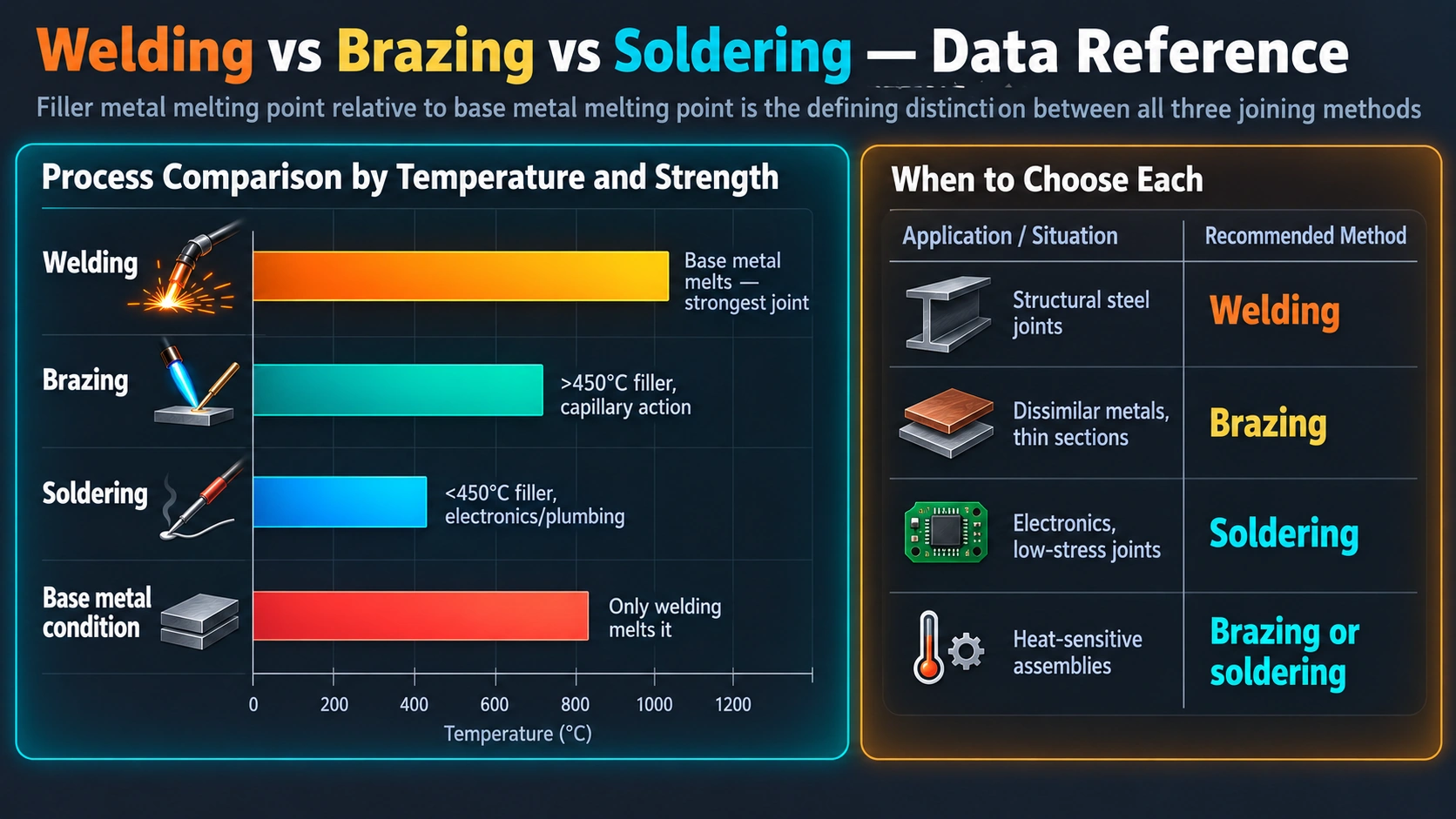
Where Welding Excels
- Structural steel: Moment frames, bridges, offshore structures — high tensile and bending strength required
- Pressure vessels and piping: ASME-coded vessels, B31.3 process piping, power plant boilers
- Heavy fabrication: Ship hulls, pressure reactor vessels, LNG storage tanks
- Pipeline construction: API 1104 girth welds, mainline and tie-in welds
- Repair welding: In-service repair of structural members, pressure equipment, machinery
Where Brazing Excels
- HVAC/R: BCuP filler metals for millions of copper-to-copper and copper-to-brass refrigeration joints globally
- Automotive: Aluminium heat exchangers, radiators, oil coolers, and fuel system components (furnace brazed in controlled atmosphere)
- Aerospace: Turbine blades, aircraft hydraulic fittings, satellite structures using BAg, BAu, and BNi fillers
- Cutting tools: Tungsten carbide inserts brazed to steel shanks — a classical dissimilar-metal application that welding cannot achieve without cracking
- Electronics: Hermetic package seals, vacuum tube construction, waveguide assemblies
- Jewellery: Silver brazing produces clean, strong joints with minimal heat distortion on precious metal assemblies
Where Soldering Excels
- PCB assembly: Component mounting, through-hole and surface-mount soldering, BGA rework
- Electrical connections: Wire terminations, connectors, bus bar connections
- Domestic plumbing: Copper pipe joints where water pressure is the only mechanical load
- Instrument assembly: Sensor leads, thermocouple junctions, fine gauge wire connections
- Step soldering: Where a subsequent solder operation must not remelt an earlier joint
Braze Welding: The Hybrid Process
Braze welding is often confused with brazing but is a distinct process. In braze welding, a filler metal with a liquidus above 450°C (meeting the brazing definition) is deposited into a prepared groove or fillet joint using a technique similar to fusion welding — but the filler is not drawn in by capillary action, and the joint clearance is large (similar to a weld preparation). The base metal is not melted.
The most common application of braze welding is the repair of cast iron components using RBCuZn (bronze) filler metal. Cast iron is highly susceptible to cracking from the thermal shock of fusion welding, which heats and cools the material rapidly. Braze welding at lower temperatures (870°C–980°C) with bronze filler significantly reduces the thermal gradient and eliminates the HAZ microstructure problems that make fusion welding of cast iron so difficult. The resulting joint has good machinability and adequate strength for most repair applications, though it will not have the same strength as the parent cast iron in tension.
Process Selection: A Practical Decision Framework
Selecting the correct joining process requires evaluating several competing factors simultaneously. The following matrix summarises the key decision criteria:
Recommended Books on Welding, Brazing, and Soldering
Disclosure: WeldFabWorld participates in the Amazon Associates programme (StoreID: neha0fe8-21). If you purchase through these links, we may earn a small commission at no extra cost to you. This helps support free technical content on this site.
Frequently Asked Questions
What is the key difference between welding, brazing, and soldering?
The fundamental distinction is whether the base metal melts. In fusion welding, the base metal is melted and fused together with or without a filler. In brazing and soldering, the base metal remains solid throughout — only the filler metal melts and flows into the joint by capillary action. The difference between brazing and soldering is purely the filler metal temperature: brazing uses fillers with a liquidus above 450°C (840°F); soldering uses fillers with a liquidus below 450°C. This threshold is defined by AWS C3 and ISO 857-2 and determines joint strength, service temperature capability, and the nature of the metallurgical bond formed.
Can a brazed joint be as strong as a welded joint?
Yes, a properly designed and executed brazed joint can match or even exceed the base metal strength. The joint geometry is critical: brazing relies on a thin filler film rather than a fused metal cross-section, so brazed joints perform best in shear loading (lap joints) rather than tension loading (butt joints). With adequate overlap length — typically 3 to 4 times the thinner member thickness — a brazed lap joint develops shear strength equal to or greater than the base metal tensile strength. The key variables are joint clearance (0.025–0.13 mm for most silver and copper fillers at temperature), surface cleanliness, filler selection, and heating uniformity. For load paths that involve bending or tension on the joint cross-section, welding is generally preferred because the fused metal section provides full strength in all loading directions.
What is capillary action and why is it important in brazing?
Capillary action is the phenomenon by which a liquid is drawn into a narrow gap by the combined effects of surface tension and adhesion between the liquid and the solid surfaces. In brazing, it is the mechanism that draws molten filler metal through the joint clearance — even against gravity — to produce a uniform, void-free joint. Effective capillary action requires: joint clearance in the range of 0.025–0.13 mm for most filler metals at brazing temperature; chemically clean, oxide-free surfaces (achieved by flux or controlled atmosphere such as hydrogen or vacuum); adequate wetting (the filler must have lower surface tension than the base metal surface energy); and uniform heating so the entire joint reaches brazing temperature simultaneously. If any of these conditions is not met, the filler will not flow correctly and the joint will contain voids or unbrazed areas that dramatically reduce joint strength.
Does brazing create a heat-affected zone like welding?
No. Because the base metal does not melt during brazing, the metallurgical transformation that creates a heat-affected zone (HAZ) in fusion welding does not occur. The base metal temperature is elevated above the filler liquidus but remains below the base metal solidus and, for most structural metals, below the transformation temperature range. Brazed joints in hardened steels, age-hardened aluminium alloys, and heat-treated materials do not experience the softening, grain coarsening, or sensitisation that fusion welding would impose. This is one of brazing’s most important practical advantages over fusion welding for heat-sensitive assemblies, and why tungsten carbide cutting tools are brazed rather than welded to steel shanks.
Which process is best for joining dissimilar metals?
Brazing is generally the most suitable process for joining dissimilar metals, particularly those with widely different melting points or coefficients of thermal expansion. Because the base metals do not melt, the formation of brittle intermetallic compounds — a major problem in dissimilar metal fusion welding — is avoided. Brazing can join copper to steel, carbide to steel, aluminium to copper (with appropriate fillers), stainless steel to carbon steel, and ceramic to metal. Soldering is used for low-strength electrical assemblies where thermal load is minimal. Fusion welding of dissimilar metals requires careful filler selection, often buttering layers, and sometimes post-weld heat treatment to manage intermetallic formation and HAZ cracking risk. See the corrosion guide for notes on galvanic corrosion risks in dissimilar metal joints.
What standards govern brazing qualification for pressure equipment?
For pressure equipment manufactured to ASME codes, brazing is governed by ASME BPVC Section IX, Part QB — Brazing. Part QB sets out the essential variables for brazing procedure qualification (BPS and BPQR), the test coupon requirements, and the performance qualification requirements for brazers. For filler metals, AWS A5.8/A5.8M classifies all brazing filler metal groups used in ASME-qualified procedures. For general engineering brazing, AWS C3.2 (shear strength evaluation), AWS C3.3 (critical brazed components), and AWS C3.4 (torch brazing) provide the relevant procedural requirements. In European applications, ISO 17672 governs filler metal classification and ISO 13585 governs brazer qualification.
What is the difference between brazing and braze welding?
In brazing, the filler metal flows into a close-fitting joint (0.025–0.13 mm clearance) by capillary action. In braze welding, a filler metal with a liquidus above 450°C is deposited into a prepared groove or fillet joint in a manner similar to fusion welding — but the base metal is not melted, and capillary action is not relied upon. The joint clearance in braze welding is much larger (similar to a weld preparation). RBCuZn (bronze) filler metals are the most common for braze welding and are used primarily for cast iron repair, where the lower heat input of braze welding (compared to fusion welding) avoids the thermal shock cracking that cast iron is prone to.
When should you choose soldering over brazing or welding?
Soldering is the appropriate choice when the joint will carry only low mechanical loads, when the primary function is electrical conductivity (circuit board assemblies, wire terminations), when base materials are heat-sensitive electronic components that cannot withstand brazing temperatures, or when the assembly will be subsequently soldered and a repeatable low-temperature process is needed. Soft solder joints have tensile strengths in the 20–80 MPa range, far below brazing or welding. Soldering is also used for domestic copper plumbing where water pressure is the only mechanical load. For any structural, pressure-retaining, or elevated-temperature application, brazing or welding must be used.