Class Rating vs Schedule Rating for Pipes and Flanges
Two numbers govern how a piping component handles pressure, and they are built on completely different logic. This guide untangles pipe class rating from schedule rating once and for all.
“Class rating” and “schedule rating” are two parallel designation systems used in piping engineering, and confusing one for the other is one of the most common mistakes made by junior engineers and QA/QC inspectors. Class rating (ASME B16.5 / B16.47) is a pressure-temperature rating system applied to flanges, flanged fittings, and valves. Schedule rating (ASME B36.10M / B36.19M) is a wall-thickness designation system applied to pipe. This article explains how each system works, how they are calculated, where they intersect in a real piping material specification, and the mistakes that show up most often in the field.
If you have ever heard someone say a “Class 150 line” or a “Schedule 80 system” and assumed both phrases describe the same kind of rating, you are not alone. Both terms describe how much pressure a component can withstand, both scale with a numerical designator, and both appear side by side on the same isometric drawing. But a flange class number and a pipe schedule number answer two structurally different engineering questions. A pipe class vs schedule rating comparison is not a matter of “which is bigger” — it is a matter of understanding that one system hands you a pressure rating directly from a published table, while the other hands you a wall thickness that you must convert into a pressure capacity yourself.
This distinction matters well beyond terminology. Misreading a Class designation as a literal psi value has caused real leak events in the field (a Class 150 flange is emphatically not “rated for 150 psi” at ambient conditions). Equally, treating a pipe’s schedule number as if it were a guaranteed pressure rating, independent of material grade and temperature, leads to under-designed piping systems that pass a casual review but fail a proper code check. By the end of this guide you will be able to explain, with confidence, exactly how a flange class and a pipe schedule are each derived, why they move independently of one another, and how both are reconciled inside a single piping material specification (PMS) for a real plant.
On this page
- What Is Pressure Class Rating?
- What Is Pipe Schedule Rating?
- The Core Difference: Rating System vs Dimensional System
- How a Flange Class Rating Is Determined
- How a Pipe Schedule Is Determined
- Reference Table: Flange Class Ratings (Group 1.1 Carbon Steel)
- Reference Table: Schedule Wall Thickness by NPS
- “Pipe Class” in a Piping Material Specification
- Worked Example: Selecting Schedule and Class Together
- Common Mistakes in the Field
- Applications and Industry Context
- FAQ
What Is Pressure Class Rating?
Pressure class is the designation system defined by ASME B16.5 (for flanges and flanged fittings, NPS ½ through NPS 24) and its companion standard ASME B16.47 (for large-diameter flanges, NPS 26 through NPS 60). It applies to forged and cast components — weld neck, slip-on, blind, and socket weld flanges, as well as flanged valves and fittings — rather than to straight pipe. The available class designations under B16.5 are 150, 300, 400, 600, 900, 1500, and 2500, sometimes still written with the legacy “#” suffix (150#, 300#) inherited from the old “pound rating” terminology.
The single most important fact about pressure class is this: the class number is not a pressure value. It is a non-dimensional index into a published pressure-temperature (P-T) table. ASME B16.5 contains dozens of these tables, one for every material group (Group 1.1 for plain carbon steel, Group 2.2 for 316 stainless, and so on), each listing the maximum allowable working pressure for every class at a range of temperatures from -29°C up to the practical limit of that material. Read the class number, find the material group, find the design temperature, and the table gives you the allowable pressure directly — no calculation required on the user’s part, because ASME has already done the calculation when the table was published.
This is why an experienced inspector never reads a class stamp on a flange and assumes a pressure value. The class is a key that unlocks a row in a table — the actual number you need (the allowable pressure at your specific design temperature) only appears once you cross-reference the material group and temperature. Two flanges stamped “Class 600” — one in carbon steel, one in 316L stainless — carry materially different pressure ratings at the same temperature, because each material group has its own table.
ASME B16.5 dimensional and rating scope covers NPS ½ to NPS 24. ASME B16.47 (Series A and Series B) extends flange dimensions and ratings to NPS 26 through NPS 60, but its scope under B16.47 stops at Class 900 — there is no B16.47 Class 1500 or 2500. Per ASME B31.3 paragraph 303, flanges built to either standard are deemed acceptable for the pressure-temperature limits the standard publishes, without further calculation by the piping engineer.
What Is Pipe Schedule Rating?
Schedule rating is the wall-thickness designation system defined by ASME B36.10M (welded and seamless wrought carbon and alloy steel pipe) and ASME B36.19M (stainless steel and high-alloy pipe, using the same schedule numbers with an “S” suffix — 5S, 10S, 40S, 80S). Schedule numbers in common use are 5, 10, 20, 30, 40, 60, 80, 100, 120, 140, and 160, along with the older weight-class names STD (standard), XS (extra strong), and XXS (double extra strong).
Unlike a flange class, a schedule number carries no published pressure rating at all. It is purely a dimensional callout for wall thickness. For a fixed nominal pipe size (NPS), the outside diameter (OD) stays exactly the same across every schedule — a 6-inch pipe has an OD of 168.3 mm whether it is Schedule 10 or Schedule 160. Only the wall thickness changes, and because OD is fixed, a thicker wall can only grow inward, shrinking the inside diameter (ID) as the schedule number rises.
Because the schedule number itself carries no pressure information, two different pipes both marked “Schedule 80” — one in ASTM A106 Grade B carbon steel, one in a low-strength alloy — will hold different pressures at the same temperature, purely because their allowable stress values differ. This is the mirror image of the flange class situation, and it is the second half of the core confusion this article exists to resolve: a schedule number describes geometry, not capability, until you bring material and temperature into the calculation.
“Schedule 80 is a high-pressure pipe” is a useful rule of thumb, not an engineering fact. A Schedule 80 pipe in a low-strength material at high temperature can have a lower pressure rating than a Schedule 40 pipe in a high-strength alloy at the same temperature. Schedule only tells you the wall thickness; the rest of the calculation is unavoidable.
The Core Difference: Rating System vs Dimensional System
Stripped to its essentials, the difference between these two systems is a difference in what gets published versus what gets calculated.
| Aspect | Class Rating | Schedule Rating |
|---|---|---|
| Governing standard | ASME B16.5 / B16.47 | ASME B36.10M / B36.19M |
| Applies to | Flanges Fittings Valves | Pipe |
| What is published | Maximum allowable pressure, by material group and temperature | Wall thickness only, by NPS |
| Pressure rating | Direct table lookup | Must be calculated separately (Barlow’s formula / code equation) |
| Designations | 150, 300, 400, 600, 900, 1500, 2500 | 5, 10, 20, 30, 40, 60, 80, 100–160, STD, XS, XXS |
| Effect of temperature | Rating decreases at higher temperature (built into the table) | No direct effect; temperature feeds into the separate stress calculation |
| Effect on geometry | Higher class increases bolt circle, flange thickness, hub size | Higher schedule keeps OD fixed, reduces ID |
| Engineer’s task | Look up the class that covers the design point | Calculate thickness, then round up to a standard schedule |
How a Flange Class Rating Is Determined
For Class 300 and above, ASME B16.5 Annex A establishes pressure ratings using a stress-based formula referenced to the class designation. In simplified form, the rated working pressure at a given temperature is proportional to the selected material stress and the class index:
Class 150 is the one exception to this clean proportionality — its table is established independently rather than by the Pt formula above, which is why Class 150’s ambient rating (285 psig) does not sit on the same straight-line relationship as Class 300 through Class 2500. This is also why experienced piping engineers treat Class 150 as its own special case when estimating ratings without the table in front of them.
How a Pipe Schedule Is Determined
Schedule selection works in the opposite direction: you start from the design pressure and the material’s allowable stress, calculate the minimum required wall thickness, and then round up to the nearest standard schedule that is thick enough. The originating relationship, sometimes shown as a simplified approximation, is:
Notice that nowhere in this process does a published “pressure rating for Schedule 80” appear. The schedule number falls out the other end of a calculation that starts with pressure and ends with a thickness value, which is then matched to the nearest standard wall thickness in the B36.10M or B36.19M tables. This is the single cleanest way to remember the difference discussed in the previous section: class is read forward (designation to pressure), schedule is read backward (pressure to designation, via thickness).
Reference Table: Flange Class Ratings (Group 1.1 Carbon Steel)
The table below summarizes representative ambient (38°C / 100°F) ratings for Group 1.1 carbon steel flanges (ASTM A105 forgings, A216 WCB castings) under ASME B16.5. These are reference values only — always verify against the current edition of ASME B16.5 for the governing material and temperature on your project.
| Class | Ambient Rating (psig) | Ambient Rating (bar) | Typical Service Tier |
|---|---|---|---|
| 150 | 285 | 19.6 | Low pressure |
| 300 | 740 | 51.0 | Moderate pressure |
| 600 | 1480 | 102.0 | High pressure |
| 900 | 2220 | 153.0 | High pressure |
| 1500 | 3705 | 255.4 | Severe service |
| 2500 | 6170 | 425.4 | Severe service |
Reference values at 38°C for Group 1.1 carbon steel. All classes derate as temperature rises — see Fig. 1 above for the trend.
Reference Table: Schedule Wall Thickness by NPS
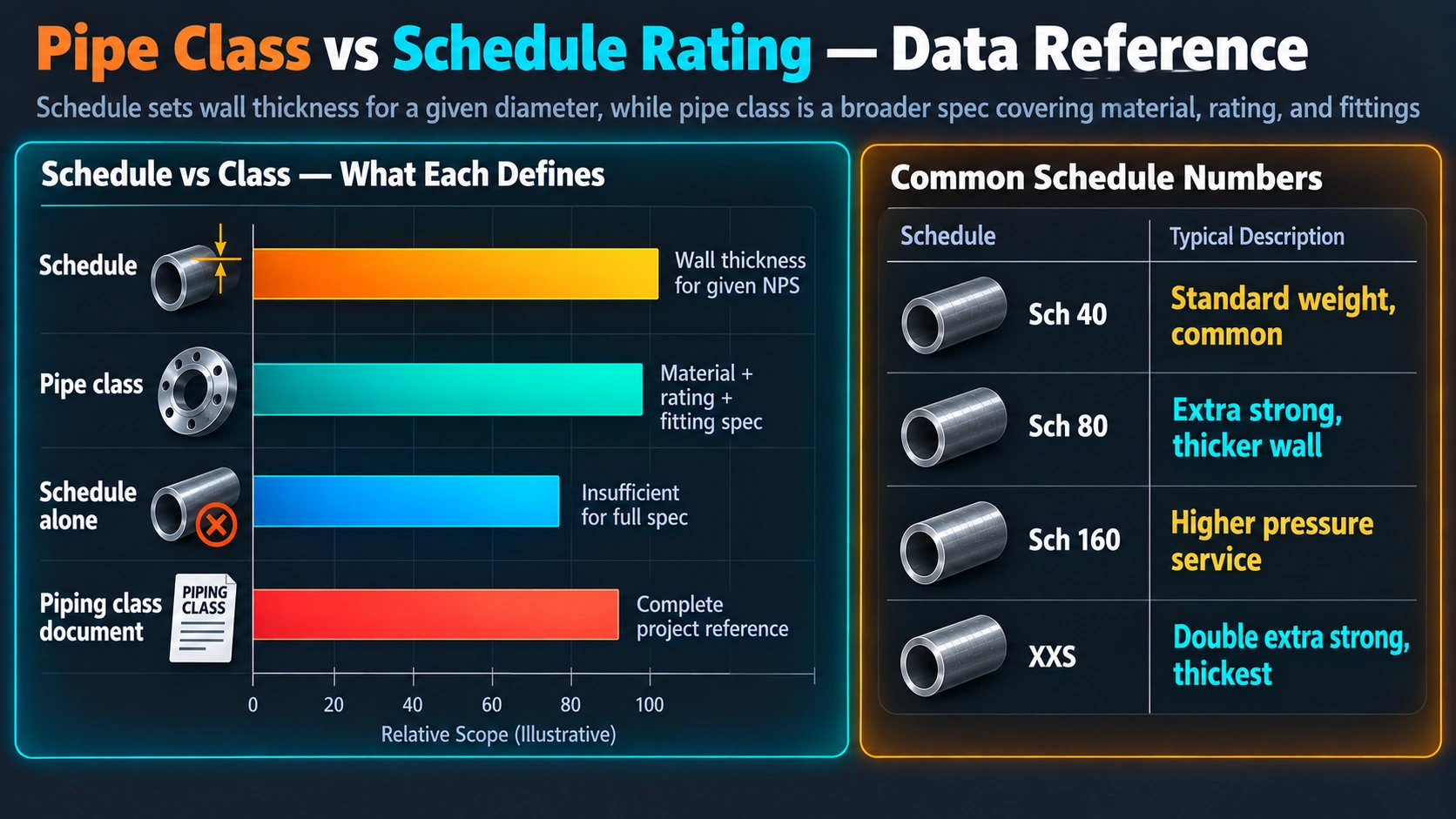
This table shows how wall thickness for the same schedule grows with pipe size, and how the OD stays fixed within each NPS row, per ASME B36.10M.
| NPS | OD (mm) | Sch 40 WT (mm) | Sch 80 WT (mm) | Sch 80 ID (mm) |
|---|---|---|---|---|
| 4 | 114.3 | 6.02 | 8.56 | 97.18 |
| 6 | 168.3 | 7.11 | 10.97 | 146.36 |
| 8 | 219.1 | 8.18 | 12.70 | 193.70 |
From NPS ½ through NPS 6, the XXS (double extra strong) wall is thicker than Schedule 160 at the same size. From NPS 8 and above, this relationship flips, and Schedule 160 becomes the thicker of the two. This is a well-known quirk of the B36.10M table and a frequent trap when specifying heavy-wall pipe by name rather than by checked thickness value. Always confirm the actual millimeter or inch value rather than assuming which designation is heavier at larger sizes.
“Pipe Class” in a Piping Material Specification
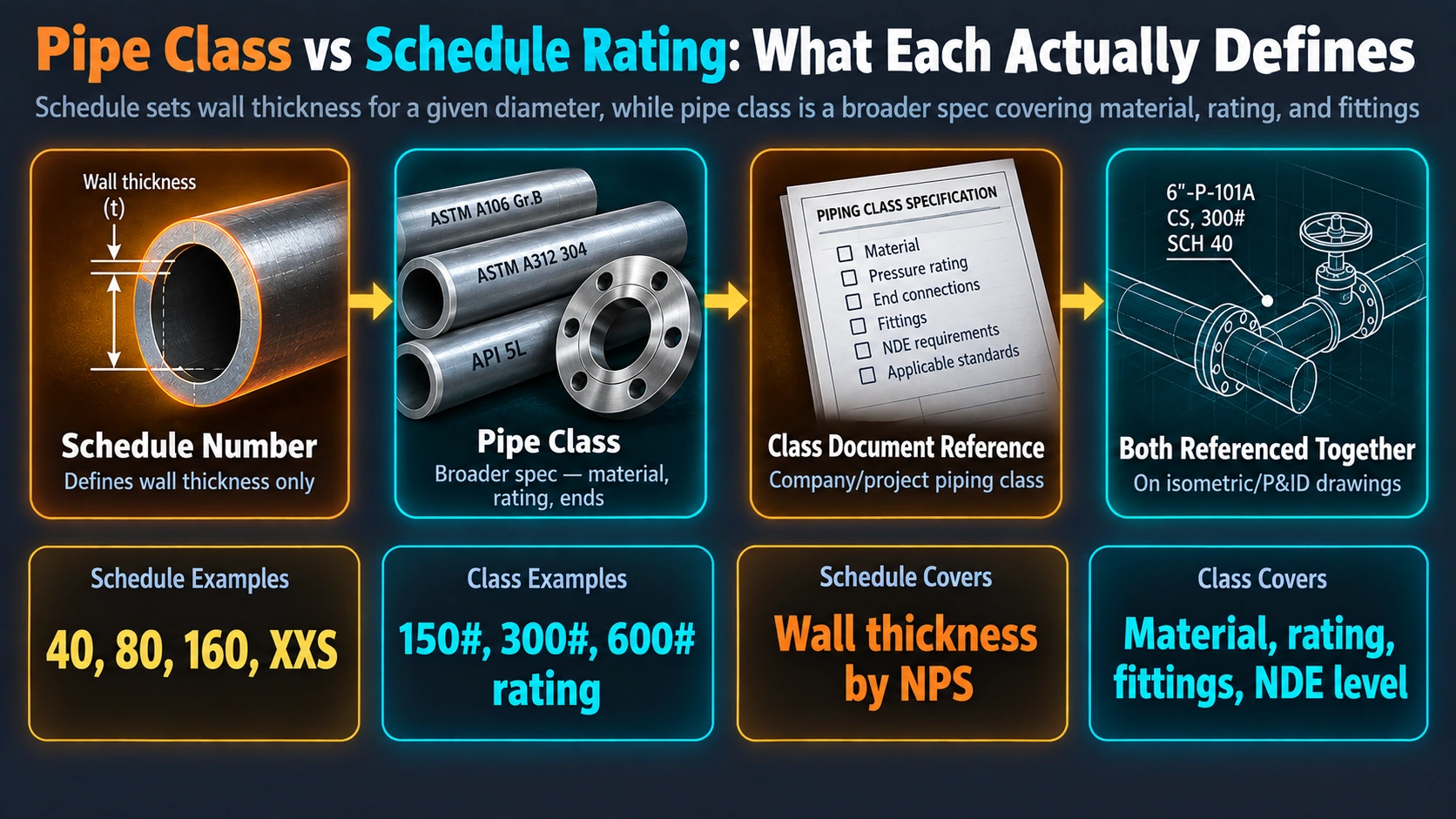
Here is where the terminology genuinely overlaps, and where most real confusion originates. In day-to-day plant engineering, the phrase pipe class or piping class almost never refers only to the ASME B16.5 flange class. Instead, it refers to a bundled designation inside a project’s Piping Material Specification (PMS), sometimes called a line class or spec sheet — for example, a code like 150-CS-1A.
A single piping class entry in a PMS typically locks together:
- An ASME B16.5 pressure class for all flanges and flanged valves on that line (in the example, Class 150)
- A base material group for pipe, fittings, and flanges (CS = carbon steel)
- A default schedule for the pipe itself, selected for the worst-case design pressure and temperature the class is intended to cover
- A corrosion allowance applied on top of the calculated minimum wall thickness
- Standard branch connection, reducer, and end-preparation rules for every fitting type used on that class
This is precisely why the calendar topic for this article is phrased as “pipe class vs schedule rating,” rather than narrowly as “B16.5 vs B36.10.” In practice, an engineer rarely chooses a schedule and a flange class independently for a one-off component; they select a piping class from the project PMS, and that single selection determines both the schedule and the flange class simultaneously, because the PMS author already did that reconciliation when the specification was written. The job of field QA/QC, then, is to verify that the installed schedule and flange class on a given line actually match what the assigned piping class in the PMS calls for — not to re-derive the rating from first principles every time.
When you are checking a Material Test Certificate against a line’s piping class, you are really checking two independent things at once: does the pipe’s actual wall thickness meet or exceed the schedule called out in the PMS, and does the flange’s class stamp meet or exceed the pressure class called out for that line. A passing check on one does not imply a passing check on the other — they are verified against two separate tables for two separate reasons. The guide to reading a Material Test Certificate walks through this verification step in detail.
Worked Example: Selecting Schedule and Class Together
Consider a new NPS 6 line in ASTM A106 Grade B seamless pipe with ASTM A105 flanges, designed for 10 MPa (100 bar, roughly 1450 psi) gauge pressure at 300°C design temperature. The schedule and the class must each be derived separately.
The result — Schedule 80 pipe paired with Class 900 flanges — illustrates the point of this entire article. Both answers were derived from the same design pressure and temperature, but through entirely separate processes: one a code calculation rounded up to a standard wall thickness, the other a direct lookup in a published derating table. A piping material specification for this service would record both results together as a single named piping class, such as 900-CS-2C, so that every drawing, MTO, and inspection record downstream references one designation instead of two.
Common Mistakes in the Field
When reviewing a line list or isometric, check the flange class and the pipe schedule against the project PMS separately, even though they appear together on the drawing. A drafting error that swaps one piping class’s schedule with another’s is far more common than people expect, especially on projects with many similar classes (150-CS-1A vs 150-CS-1B, for example) that differ only in corrosion allowance or branch table.
- Reading Class as a literal psi value. A Class 150 flange is not rated for 150 psi at ambient temperature — it is rated for roughly 285 psig. The error compounds badly at elevated temperature, where the derated value can drop well below what an inexperienced reviewer assumes from the class number alone.
- Assuming Schedule defines pressure capacity on its own. The same Schedule 80 designation produces different pressure capacities in different materials. A material substitution on a Schedule 80 line, even one that looks like an “upgrade” on paper, can silently invalidate the original pressure design if the new material’s allowable stress was not re-checked.
- Mixing flange classes within the same joint. Bolting a Class 300 flange to a Class 150 flange, even temporarily, mismatches bolt circle diameter and bolt hole spacing. This is a fabrication and assembly error distinct from the rating discussion, but it is frequently confused with a rating mismatch during root cause investigations.
- Confusing B36.10M and B36.19M schedules above NPS 10. Below NPS 10, many plain schedules and their “S” stainless equivalents share the same thickness. Above that size they can diverge — NPS 12 Schedule 40 (10.31 mm) is noticeably thicker than NPS 12 Schedule 40S (9.53 mm). Specifying the wrong standard on a stainless line can mean ordering pipe that is thinner than the design actually requires.
- Treating PMS “pipe class” and B16.5 “pressure class” as synonyms in conversation. This is harmless shorthand among engineers who already know the difference, but it actively confuses junior staff and should be avoided in training material and procedure documents.
Applications and Industry Context
Both rating systems exist because piping systems serve an enormous range of pressure and temperature combinations across industries, from atmospheric drain lines to supercritical steam headers. Refineries and petrochemical plants typically run the full span of classes from 150 through 2500 across different units on the same site, while power generation steam lines frequently push into Class 1500 and 2500 territory at elevated temperature, governed by ASME B31.1 rather than B31.3 for power piping scope. Pipeline and gathering systems, by contrast, often standardize heavily on Schedule 40 and Schedule 80 carbon steel for cost reasons, reserving heavier schedules for specific high-pressure segments.
Procurement and fabrication planning both depend on getting this distinction right early. A piping material take-off (MTO) needs the schedule to calculate pipe weight and freight tonnage, while the procurement package needs the flange class to specify the correct flange type, facing, and bolting. Getting either one wrong at the requisition stage cascades into costly rework once material has already been ordered or fabricated, which is why most EPC piping specifications dedicate an entire section purely to defining piping classes before any isometric is issued for fabrication.
ASME B16.5 — Pipe Flanges and Flanged Fittings
The authoritative source for flange pressure-temperature rating tables across all material groups. Essential desk reference for any engineer specifying flanges by class.
View on AmazonASME B36.10M / B36.19M Dimension Standards
The complete dimensional reference for pipe schedules, covering OD, wall thickness, and weight for every NPS and schedule combination in carbon, alloy, and stainless steel.
View on AmazonPiping Materials Selection and Application
A practical engineering text covering how piping classes, schedules, and flange ratings are reconciled into a working Piping Material Specification for real projects.
View on AmazonPiping Handbook (Nayyar)
A comprehensive single-volume reference covering piping codes, materials, flange standards, and design practice used widely by piping and QA/QC engineers.
View on AmazonDisclosure: WeldFabWorld participates in the Amazon Associates programme (StoreID: neha0fe8-21). If you purchase through these links, we may earn a small commission at no extra cost to you. This helps support free technical content on this site.
Frequently Asked Questions
What is the difference between Class rating and Schedule rating?
Class rating (per ASME B16.5 and B16.47) is a pressure-temperature rating system used for flanges, fittings, and valves. Each class has a published maximum allowable pressure for every material group at every temperature, so selecting a class is a direct table lookup. Schedule rating (per ASME B36.10M and B36.19M) is a wall thickness designator used for pipe. It does not directly state a pressure rating; the engineer must calculate the required wall thickness from the design pressure and material allowable stress, then select the schedule whose tabulated thickness meets or exceeds that calculated value.
Is a Class 150 flange rated for 150 psi?
No. The class number is a non-dimensional designator, not a literal pressure value. A Class 150 flange in Group 1.1 carbon steel (ASTM A105) is actually rated for approximately 285 psig at 38°C ambient temperature, derating to roughly 170 psig at 260°C and around 20 psig at 540°C. The flange only carries close to its nominal 150 psi rating at one specific elevated temperature on the derating curve, not at ambient.
Does pipe Schedule tell me the maximum pressure a pipe can handle?
Not directly. Schedule is purely a wall thickness designator standardized by ASME B36.10M and B36.19M. The actual allowable pressure for a given schedule depends on the pipe material, the design temperature, the outside diameter, and the applicable code design equation, such as B31.3 paragraph 304.1.2. Two pipes of the same schedule but different material grades will have different pressure capacities even though their wall thickness is identical.
Can I weld a Schedule 80 pipe to a Class 150 flange?
Dimensionally, yes, in the sense that a weld neck flange bore is machined to match the pipe schedule’s actual outside or inside diameter regardless of the flange’s pressure class. However, this is a design decision, not just a fit-up question. The flange class and pipe schedule must each independently satisfy the same design pressure and temperature for the line; pairing a heavy-wall pipe with an under-rated flange class, or vice versa, creates a weak point in the system and is normally flagged during piping material specification review.
What is pipe class in a Piping Material Specification, and how is it different from ASME B16.5 pressure class?
In a Piping Material Specification (PMS) or line list, the project term pipe class or piping class refers to a bundled specification, for example 150-CS-1A, that ties together a B16.5 pressure class, a specific pipe schedule, a material grade, a corrosion allowance, and standard branch and fitting rules for a defined service. This project-level pipe class is broader than the ASME B16.5 pressure class alone; it is the engineering document that tells a QA/QC inspector exactly which schedule and which flange class apply to a given line number.
Why does flange pressure rating decrease with temperature?
Flange pressure ratings are derived from the material’s allowable stress, and allowable stress falls as temperature rises because yield strength, tensile strength, and (for elevated temperature service) creep resistance all decrease with heat. ASME B16.5 builds this relationship directly into its pressure-temperature tables using a stress-based formula, so a single class designation carries a full curve of allowable pressures rather than one fixed number.
What is the difference between ASME B36.10M and B36.19M?
ASME B36.10M covers dimensions for welded and seamless wrought carbon and alloy steel pipe, using plain schedule numbers such as Sch 40 and Sch 80. ASME B36.19M covers stainless steel and high-alloy pipe and uses schedule designations with an S suffix, such as 10S, 40S, and 80S, which are generally thinner than their B36.10M counterparts at larger sizes because stainless steel typically needs less wall thickness for an equivalent pressure rating. Below about NPS 10, many B36.10M and B36.19M schedules share the same wall thickness; above that size they can diverge.
How do I determine the correct combination of flange class and pipe schedule for a new piping system?
Start from the design pressure and design temperature for the line. For the pipe, calculate the required wall thickness using the governing code equation (B31.3 304.1.2 or the equivalent B31.1 formula), add corrosion and mechanical allowances, account for mill under-tolerance, and select the next standard schedule that meets or exceeds the result. For the flanges and fittings, take the same design pressure and temperature directly into the ASME B16.5 pressure-temperature table for your material group and read off the minimum class that covers the point. The two processes are independent, and a piping material specification should record both results together for the line.