Article III — Welding Performance Qualifications
Training Module · 2025 Edition · QW-300 through QW-389
General Requirements & Types of Tests
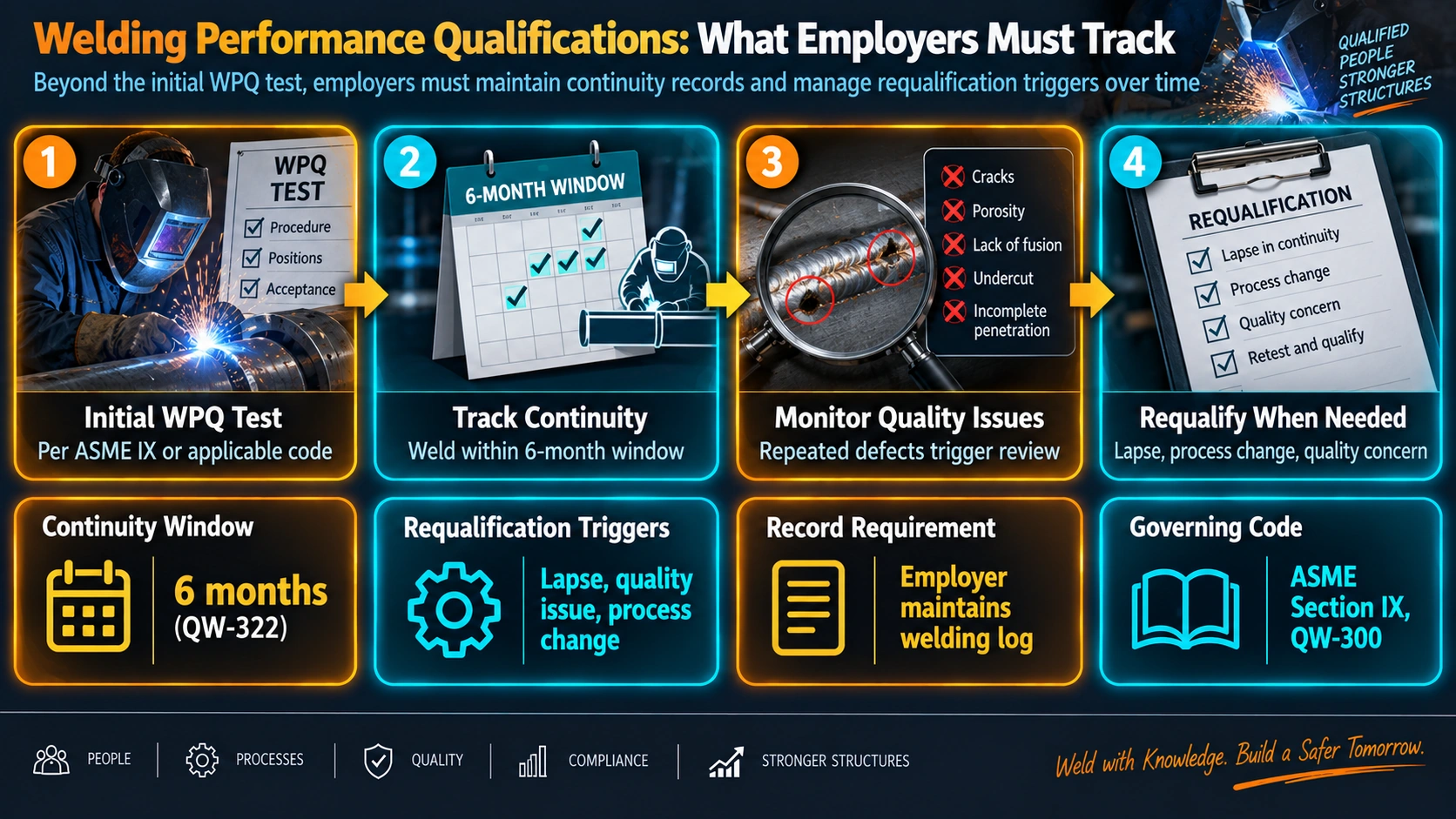
QW-300 · QW-301 · QW-302 · QW-303 · QW-304 · QW-305 · QW-306
What Article III Covers
Performance qualifications for welders (manual/semiautomatic) and welding operators (machine/automatic). Each welding process is listed separately with its essential variables. Variables are listed in QW-350 (welders) and QW-360 (welding operators) and defined in Article IV.
Qualification Continuity Start Date
For establishing continuity, the welder’s or welding operator’s qualification begins from the date welding of the test piece(s) was completed, provided the required testing was performed and the test results obtained were acceptable.
| Test Type | Clause | Key Rules |
|---|---|---|
| Mechanical Tests | QW-302.1 | Type and number per QW-452 (except special processes, see QW-380). Groove weld specimens removed per Figures QW-463.2(a)–(g). Fillet weld specimens per Figures QW-462.4(a)–(d) and QW-463.2(h). All shall meet QW-160 or QW-180 requirements. |
| Volumetric NDE | QW-302.2 | Minimum coupon length: 6 in. (150 mm). For pipe: entire weld circumference. Small diameter pipe: multiple coupons of same diameter, number need not exceed four consecutively made. Technique and acceptance per QW-191. |
| Test Coupons in Pipe (Bend) | QW-302.3 | 1G or 2G: 2 specimens removed (omit upper-right and lower-left quadrants; root bend in upper-left replaced by face bend). 5G or 6G: all four specimens per Figure QW-463.2(d) or (e) must pass. 2G + 5G combined: specimens per QW-463.2(f) or (g). |
| Visual Examination | QW-302.4 | Plate: all surfaces (except “discard” areas) examined per QW-194 before cutting bend specimens. Pipe: examined per QW-194 over entire circumference, inside and outside. |
Passing groove weld tests in positions per Table QW-461.9 qualifies for: groove welds, tack welds in joints to be groove or fillet welded, and fillet welds shown in Table QW-461.9.
In addition, groove weld qualification also qualifies for fillet welds in all thicknesses and pipe diameters of any size within the limits of welding variables of QW-350 or QW-360.
Passing fillet weld tests qualifies for fillet welds and tack welds in joints to be fillet welded shown in Table QW-461.9. Fillet weld qualification is limited to:
- Specified thicknesses, fillet sizes, and pipe/tube diameters 2-7/8 in. (73 mm) O.D. and over (per Table QW-452.5)
- For pipe/tube less than 2-7/8 in. (73 mm) O.D.: must pass the pipe fillet weld test per Table QW-452.4 or mechanical tests per QW-304/305
Special Positions (QW-303.3): Qualification valid for flat position AND for the special positions actually tested. Angular deviation of ±15 deg is permitted in inclination of weld axis and rotation of weld face.
Stud Positions (QW-303.4): Qualification in 4S qualifies for 1S. Qualification in 4S and 2S qualifies for all positions.
🔧 QW-304 — Welders
- Must pass mechanical + visual examinations (QW-302.1 + QW-302.4)
- May qualify by volumetric NDE per QW-191 for groove welds using: SMAW, SAW, GTAW, PAW, GMAW (except short-circuiting mode for RT) — or combinations
- Excluded P-Numbers for volumetric NDE: P-No. 21–26, 51–54, 61–62 — EXCEPT GTAW on these metals may use NDE
- Production weld NDE alternative: min. 6 in. (150 mm) of first production weld
- 5G, 6G, special positions: entire production weld circumference examined
⚙ QW-305 — Welding Operators
- Must pass mechanical + visual examinations (QW-302.1 + QW-302.4)
- May qualify by volumetric NDE per QW-191 for groove welds using: SMAW, SAW, GTAW, PAW, EGW, LLBW, GMAW (except short-circuiting for RT) — or combinations
- Same P-Number exclusions (P-No. 21–26, 51–54, 61–62) — EXCEPT GTAW
- Production weld NDE alternative: min. 3 ft (1 m) of first production weld
- 5G, 6G, special positions: entire production weld circumference examined
Consequence of Failing Production Weld NDE Test
If the selected production weld fails the examination standards: the welder/operator has failed the test. The entire production weld made by this person shall be examined and repaired by a qualified welder or welding operator. Alternatively, retests may be made as permitted in QW-320.
Key Rules for Combination Qualifications
- Each welder/operator qualified within limits of QW-301 for each process they will use
- May qualify with each process individually OR in a single groove-weld test coupon combining processes
- A single groove-weld test coupon may qualify two or more welders/operators using the same or different processes
- Thickness and bend specimen limits per QW-452 — considered individually for each person per process
- Qualified in combination = qualified to weld in production using any qualified processes individually or in different combinations
- Failure of any portion of a combination test constitutes failure of the entire combination
Acceptable Product Forms
Test coupons may be plate, pipe, or other product forms. The test position and weld type determine what qualifications are earned.
2G + 5G Combined Pipe Qualification
When all position qualifications for pipe are accomplished by welding one pipe assembly in both the 2G and 5G positions (Figure QW-461.4), the following pipe sizes shall be used:
- NPS 10 (DN 250) or larger: per Figure QW-463.2(f)
- NPS 6 (DN 150) or NPS 8 (DN 200): per Figure QW-463.2(g)
- NPS 6, 8, 10, or larger diameter pipe shall be employed
What Counts as “With Backing”
The groove dimensions shall be the same as those for any WPS qualified by the organization, or as shown in Figure QW-469.1. The following are all considered welding WITH backing:
- Single-welded groove-weld test coupon with backing
- Double-welded groove-weld test coupon
- Partial penetration groove welds
- Fillet welds
Single-Welded Groove Without Backing
The groove dimensions shall be the same as those for any WPS qualified by the organization, or as shown in Figure QW-469.2. This is the more restrictive test — qualifying without backing also qualifies for welding with backing, but NOT vice versa.
| Coupon Type | Qualifies For | Does NOT Qualify For |
|---|---|---|
| Groove weld test coupon (any position) | Groove welds, fillet welds (all thicknesses/diameters), tack welds | — |
| Fillet weld test coupon | Fillet welds in specified thicknesses/sizes/diameters per QW-452.5; tack welds in joints to be fillet welded | Groove welds; pipe/tube <2-7/8 in. O.D. unless pipe fillet test per QW-452.4 |
| Without backing coupon | With and without backing configurations | — |
| With backing coupon | Joints welded with backing | Without backing (open root) |
| Plate coupon | Pipe welding (and vice versa) | — |
| Failed Test Type | Retest Method | Retest Requirement | Specimen/Examiner Rule |
|---|---|---|---|
| Visual Examination (QW-321.1) | Visual examination first, then mechanical testing | Two consecutive test coupons for each position failed — all must pass visual exam | Examiner may select one successful coupon from each set that passes visual for mechanical testing |
| Mechanical Testing (QW-321.2) | Mechanical testing | Two consecutive test coupons for each position failed — all must pass test requirements | Both coupons must pass; no selection provision |
| Volumetric NDE (QW-321.3) | Same examination method (RT or UT) | Two 6 in. (150 mm) plate coupons; or for pipe: two or more of same diameter for total of 12 in. (300 mm) of weld (max. 8 consecutively made test coupons) | Production weld alternative retest: examine additional weld = twice the required length. Pass → welder qualified, previously failed area repaired. Fail → all production welds examined and repaired. |
| Further Training (QW-321.4) | New test after further training or practice | New test for each position that was failed | No special provision — standard qualification test |
QW-322.1 — Expiration
Qualification remains valid provided no more than 6 months have passed since the welder or welding operator last used that process. Continuity confirmed by qualifying or participating organization(s) (per QG-106.2 and QG-106.3).
Manual/semiautomatic use → prolongs both manual and semiautomatic for that process.
Machine use → prolongs machine AND automatic.
Automatic use → prolongs automatic only.
QW-322.2 — Revocation
When there is specific reason to question the welder’s or welding operator’s ability to make welds meeting the specification — the qualifications that support the welding being performed shall be revoked. All other qualifications not questioned remain in effect.
May be achieved for any process by welding a single test coupon of either plate or pipe, of any material, thickness or diameter, in any position, as required by QW-301 and successfully completing the testing required by QW-302.
Effect: This one successful test renews ALL previous qualifications for that process — materials, thicknesses, diameters, positions, and other variables for which the welder/operator was previously qualified.
Providing QW-304 and QW-305 requirements are satisfied, renewal may be done on production work.
Welders and welding operators whose qualifications have been revoked under QW-322.2 shall requalify. The qualification shall utilize a test coupon appropriate for the revoked qualification(s). Successful completion of the qualification test restores the revoked qualification(s).
Welding Variables for Welders — QW-350
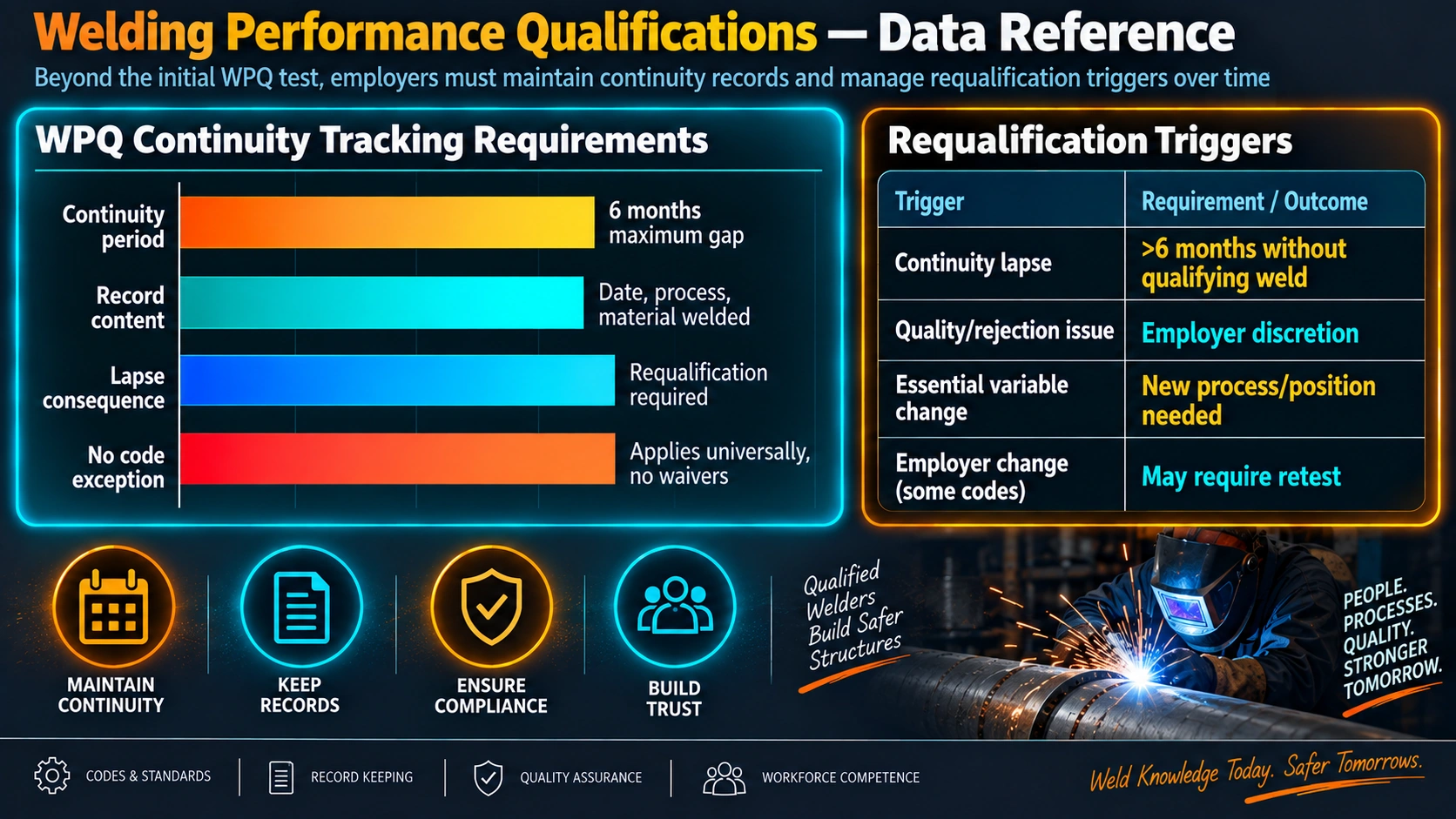
QW-351 General · Tables QW-352 through QW-358 — Essential variables by process
Requalification Triggers
A welder shall be requalified whenever a change is made in one or more of the essential variables listed for each welding process (Tables QW-352 through QW-358).
Weld Deposit Thickness Rule
The qualified thickness is the approximate thickness of weld metal the welder deposits in the test coupon with each process, exclusive of weld reinforcement. In any production weld, welders may NOT deposit a thickness greater than the thickness for which they are qualified using that process.
Automatic Welding Operator — 6 Essential Variables
- (a) A change from automatic to machine welding
- (b) A change in the welding process
- (c) For EBW and LBW: the addition or deletion of filler metal
- (d) For LBW and hybrid welding using lasers: a change in laser type (e.g., CO₂ to YAG)
- (e) For friction welding (excluding FSW): a change from continuous drive to inertia welding or vice versa
- (f) For EBW: a change from vacuum to out-of-vacuum equipment, and vice versa
Machine Welding Operator — 9 Essential Variables
- (a) A change in the welding process
- (b) A change from direct visual control to remote visual control and vice versa
- (c) For GTAW: the deletion of automatic arc voltage control system
- (d) The deletion of automatic joint tracking
- (e) The addition of welding positions other than those already qualified per QW-303
- (f) For GTAW, PAW, and LLBW: the deletion of consumable inserts (exception: qualification with consumable inserts also qualifies for fillet welds and welds with backing)
- (g) The deletion of backing (double-welded groove welds are considered welding with backing)
- (h) A change from single pass per side to multiple passes per side (but NOT vice versa)
- (i) For hybrid plasma-GMAW: essential variables per Table QW-357
| Variable | Automatic Operator | Machine Operator |
|---|---|---|
| Change in welding process | Essential | Essential |
| Automatic → Machine welding | Essential | Not applicable |
| Direct → Remote visual control | Not listed | Essential |
| Delete auto arc voltage control (GTAW) | Not listed | Essential |
| Delete automatic joint tracking | Not listed | Essential |
| Add welding positions | Not listed | Essential |
| Delete consumable inserts (GTAW/PAW/LLBW) | Not listed | Essential |
| Delete backing | Not listed | Essential |
| Single pass → multiple pass per side | Not listed | Essential |
| EBW/LBW add/delete filler metal | Essential | Not listed |
| LBW change laser type | Essential | Not listed |
Special Coupon Requirement
The performance qualification test coupon shall be production parts or test coupons that have joint designs permitted by any qualified WPS. Mechanically tested per QW-452. Alternatively, when the part or coupon does not lend itself to bend test specimens, the part may be cut so that at least two full-thickness weld cross sections are exposed — polished, etched (QW-470), examined for complete fusion and freedom from cracks. Essential variables per QW-361.
Qualification Requirements
Stud welding operators shall be performance qualified in accordance with the test requirements of QW-192.2 and the position requirements of QW-303.4.
- Plate coupon: base metal not less than 6 in. × 6 in. (150 × 150 mm); overlay min. 1-1/2 in. (38 mm) wide × ~6 in. (150 mm) long
- Pipe coupon: pipe length min. 6 in. (150 mm); deposited cladding ~6 in. long × min. 1-1/2 in. wide; continuous around circumference
- Processes depositing bead width >1/2 in. (13 mm): overlay shall consist of minimum three weld beads in first layer
- Test: Side-bend test specimens perpendicular to welding direction per QW-161
- Scope of Qualification: Welders/operators who pass CRO tests are only qualified to apply corrosion-resistant weld metal overlay (or cladding portion of groove welds joining clad/lined materials)
- No limit on maximum thickness of CRO that may be applied in production
- Alternative (QW-381.4): When chemical composition is NOT specified in WPS, a groove weld performance qualification test meeting CRO bend test requirements (QW-163) may qualify for CRO welding
- Plate: min. 6 in. (150 mm) wide × ~6 in. (150 mm) long; hard-faced layer min. 1-1/2 in. (38 mm) wide × 6 in. (150 mm) long
- Alternatively: test coupon representing the size of the production part
- Pipe: length min. 6 in. (150 mm); overlay continuous around circumference
- Tests required:
- (b) Transverse cross-section polished and etched — examined at 5× magnification for cracks in base metal or HAZ, lack of fusion, or linear defects
- (c) Liquid penetrant examination per QW-195.2 (at thickness ≥ minimum specified in WPS)
- Scope: Welders/operators who pass HFO tests are qualified for hard-facing overlay only
- No limit on maximum HFO thickness in production
- Welder F-Number rule (QW-382.1(g)): Qualification with one AWS classification within an SFA specification qualifies for all other AWS classifications in that SFA specification. Welding operators are NOT limited by AWS classification.
Clad Materials (QW-383.1)
- Base material portion: qualify per QW-301 (groove welding)
- Cladding portion: qualify per QW-381 (CRO)
- Alternative: Use clad material test coupon (≥3/8 in. / 10 mm thick). Four side-bend specimens tested. Groove weld portion evaluated per QW-163; overlay portion per QW-163 CRO criteria. Qualifies for both base metal (QW-301) and CRO (QW-381).
Applied Linings (QW-383.2)
- Qualify per groove or fillet weld rules of QW-301
- Plug welds for attaching applied linings = equivalent to fillet welds for performance qualification
- Alternative coupon: Geometry to be welded; base material thickness need not exceed 1 in. (25 mm). Coupon sectioned and etched — weld shall show penetration into base metal.
Each welding operator shall be tested on each machine type they will use. P-Number cross-qualifications:
| Qualified On | Qualifies For |
|---|---|
| Any P-No. 21–26 (aluminum) | All metals |
| Any P-No. 1–15F, 41–46, or 81 | All P-No. 1–15F, 41–46, and 81 metals |
| Any P-No. 51–54, 61, or 62 | All P-No. 51–54, 61, and 62 metals |
Spot/Projection welds: 10 consecutive welds; 5 mechanical shear or peel tests + 5 macro-examination per QW-196.
Seam welds: Per QW-286.3, except only one transverse cross section and one longitudinal cross section are required.
| Clause | Process | Qualification Method | Special Notes |
|---|---|---|---|
| QW-385 | Flash Welding Operator | Test coupon welded and tested per QW-199. Follow any WPS. | Qualification following ANY flash welding WPS qualifies for ALL flash welding WPSs. Production sampling tests from other Sections may be used. |
| QW-386 | Diffusion Welding Operator | Test a procedure qualification test coupon per QW-185.1. Metallographic examination per QW-185.3. | No special P-Number or position restrictions stated. |
| QW-387 | Tube-to-Tubesheet Welder & Operator | When Code Section requires QW-193: apply QW-193.2. Otherwise: use QW-193.2 mockup, groove weld per QW-303.1, or fillet weld per QW-303.2 (when joint is fillet weld). | Essential variables per QW-350/QW-360 PLUS Table QW-388 variables. For operators: hole pattern does NOT need to be duplicated; type/model of equipment IS an essential variable. |
| QW-388 | Tube-to-Tubesheet Essential Variables | QW-402.31 (≤ Ligament size); QW-402.32 (ϕ Joint configuration); QW-403.16 (ϕ Tube diameter); QW-403.32 (ϕ Tube thickness); QW-404.58 (± Preplaced filler metal); QW-409.10 (ϕ Amperage) | |
| QW-389 | Capacitor Discharge Operator | Welding operators using low-energy capacitor discharge welding per QW-289 are NOT required to be qualified. | |
1. Under QW-301.2, when a performance qualification test is welded using a WPS that requires preheat, what is permitted?
2. For the production weld NDE alternative, what is the minimum weld length requirement for a WELDER vs. a WELDING OPERATOR?
3. A welder qualified for groove welds — is this person also qualified to make fillet welds?
4. A welder’s qualification for SMAW expires after not using the process for 8 months. To renew ALL previously qualified SMAW qualifications (materials, positions, thicknesses), the welder must:
5. When a qualification coupon fails the volumetric NDE test, what is the immediate retest requirement?
6. For GTAW welder performance qualification (Table QW-356), which of the following is an essential variable that is NOT present in the SMAW welder essential variables table (Table QW-353)?
7. For a machine welding operator (QW-361.2), which change is an essential variable requiring requalification?
8. A welder’s qualifications are revoked because there is specific reason to question their ability on P-No. 1 SMAW welds. Which other qualifications are affected?
9. A welder is qualified on CRO (corrosion-resistant weld metal overlay). For which additional work are they automatically qualified?
10. For resistance welding operator qualification (QW-384), a welding operator tested on P-No. 22 (aluminum) qualifies for:
11. For a flash welding operator qualification (QW-385), qualification following one flash welding WPS qualifies the operator for:
12. For tube-to-tubesheet welding operator qualification (QW-387), which of the following is a key difference from welder qualification for the same joint?