WPS vs PQR vs WPQ — The Difference Explained
The three-letter codes WPS, PQR, and WPQ appear on every fabrication project that involves code-governed welding — yet they are routinely confused, combined, or misapplied even by experienced welding professionals. Understanding the precise difference between a Welding Procedure Specification, a Procedure Qualification Record, and a Welder Performance Qualification is not an academic exercise: mixing up these documents on a real project can result in non-conforming welds, failed audits, and in the worst case, complete weld removal and re-qualification. This article cuts through the confusion with a clear, side-by-side explanation of all three, the relationships between them, and the rules that govern each under ASME Section IX and AWS D1.1.
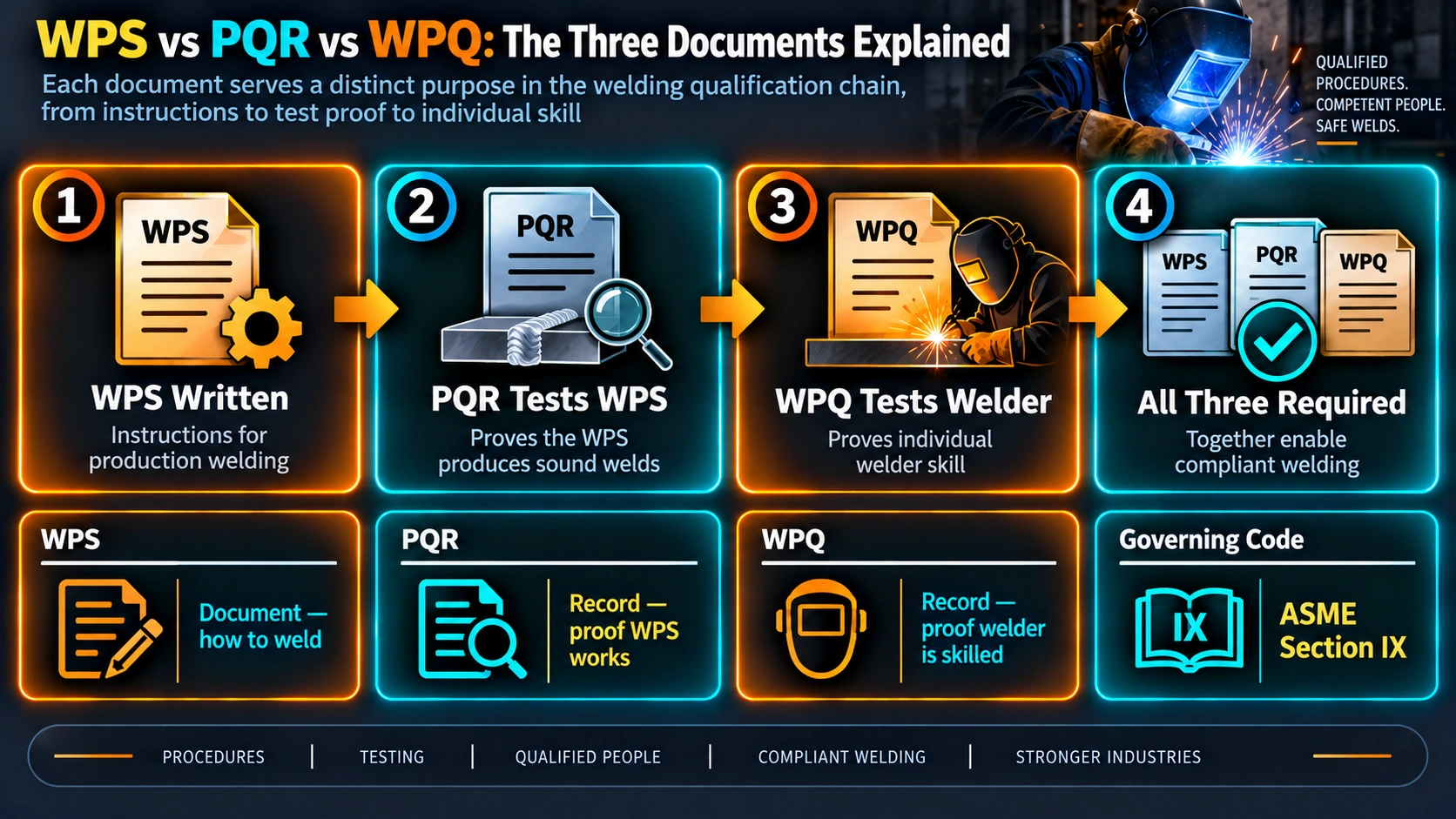
Each document serves a distinct purpose. The WPS tells the welder what to do. The PQR proves that what the WPS prescribes actually works. The WPQ proves that the individual welder can execute it. All three must be in place before code-compliant production welding can begin — but they cover fundamentally different questions, are owned by different parties, and are governed by different sets of essential variables. Getting this straight is essential for fabricators, welding inspectors, QC engineers, and anyone preparing for ASME or AWS certification exams.
WPS
The written instruction. Tells the welder how to produce a weld. References the PQR(s) that support it.
PQR
The test record. Proves the WPS parameters produce mechanically sound welds. Owned by the manufacturer.
WPQ
The individual qualification. Proves this specific welder has the skill to deposit sound weld metal.
What Is a WPS (Welding Procedure Specification)?
A Welding Procedure Specification (WPS) is the written document that specifies, in full detail, every welding variable required to produce a weld joint for a defined application. It is the instruction set handed to the welder at the work front. Under ASME Section IX QW-200.1, the WPS shall be available to the welder during production welding. It is not enough for the WPS to exist in the QC office — it must be accessible at the workstation.
The WPS defines both essential variables (those whose change requires a new PQR test) and non-essential variables (those that may be revised by WPS amendment without new testing). Supplementary essential variables additionally activate when the construction code mandates toughness testing. Every variable specified in the WPS must be within the range demonstrated and documented in the supporting PQR.
What a WPS Contains
A code-compliant WPS (per ASME Section IX Article II, or AWS D1.1 Clause 3) must address the following groups of variables:
| Variable Group | Typical Parameters | Variable Type |
|---|---|---|
| Welding Process | SMAW, GTAW, GMAW, SAW, FCAW, combination | Essential |
| Base Material | P-Number, Group Number, thickness range, pipe diameter | Essential |
| Filler Metal | F-Number, A-Number, classification, diameter | Essential |
| Joint Design | Groove type, root opening, bevel angle, backing | Non-essential |
| Position | 1G, 2G, 3G, 4G, 5G, 6G — plate or pipe | Non-essential for procedure |
| Preheat & PWHT | Min preheat, max interpass temperature, PWHT cycle | Essential |
| Electrical Characteristics | Current type, polarity, amperage range, voltage range | Non-essential |
| Technique | Stringer vs weave, cleaning method, travel speed | Non-essential |
| Shielding Gas | Gas type, composition, flow rate | Essential (GTAW/GMAW) |
Qualified vs Prequalified WPS
Under AWS D1.1, certain joint configurations and material combinations may be used under a Prequalified WPS (pWPS) without conducting a full qualification test, provided all prequalification conditions in Clause 3 are strictly met. ASME Section IX does not recognise the concept of prequalified WPSs — every ASME WPS must be supported by a PQR. This is one of the most significant differences between the two codes. If your project is governed by ASME BPVC, a PQR is always mandatory.
A WPS may be revised by amendment at any time, but only within the limits established by the supporting PQR. If a non-essential variable is revised, the WPS is amended and re-issued under a new revision number. If an essential variable is changed, a new PQR test must be conducted before the WPS can reflect that change. For a complete guide to WPS preparation, see our detailed article on how to prepare a WPS and PQR.
What Is a PQR (Procedure Qualification Record)?
The Procedure Qualification Record (PQR) is the test evidence that proves a given set of welding parameters — as specified in the supporting WPS — produces weld joints with acceptable mechanical properties. Under ASME Section IX QW-200.2, no WPS may be used for production welding unless it is supported by one or more valid PQRs demonstrating that the procedure produces welds meeting the code’s minimum mechanical requirements.
The PQR documents the actual welding parameters used during the qualification test weld, not the ranges that the WPS may later permit. Every PQR must record the exact amperage, voltage, travel speed, preheat, interpass temperature, and other parameters as they were run during the test — not nominal or target values. This distinction matters because the PQR is a legal, immutable document. Once signed and certified, it cannot be revised. If an error is found after certification, the manufacturer must weld a new test coupon and prepare a new PQR.
Who Owns the PQR?
The PQR is owned and certified by the manufacturer or contractor — the organisation building the pressure equipment or structural component. Under ASME Section IX, “manufacturer” means any organisation holding or applying for a Code stamp, not the raw material supplier. The certifying signature must be from a person legally authorised to sign on behalf of the manufacturer’s quality programme. The Authorised Inspector (AI) witnesses the qualification test and signs the PQR where ASME stamp rules apply.
The welder who welded the test coupon is identified on the PQR, but the welder does not certify it and does not own it. The PQR belongs to the manufacturer and must be retained for the full life of the WPS it supports. See our dedicated PQR guide for a field-by-field breakdown of every section on the qualification record.
Mechanical Tests Required for PQR Qualification
| Test Type | Applicable Weld Type | ASME Section IX Reference | Acceptance Basis |
|---|---|---|---|
| Transverse Tensile | Groove welds | QW-150 | Failure outside weld metal at ≥min. UTS of base material |
| Guided Bend (Face & Root) | Groove welds <19 mm | QW-160 | No crack >3 mm on tensile surface after bending |
| Side Bend | Groove welds ≥19 mm | QW-161 | No crack >3 mm in any direction after bending |
| Charpy Impact | When toughness required by construction code | QW-170 / QW-171 | Per construction code requirements (e.g. UG-84 for Div. 1) |
| Hardness | PWHT, sour service, CrMo alloys | QW-190 | Per applicable code or NACE MR0175 limit |
| Fillet Weld Break / Macroetch | Fillet weld PQR per QW-180 | QW-180 | Full fusion, no cracks, min specified throat achieved |
How Many PQRs Does One WPS Need?
A single PQR can support one or more WPSs, provided all essential and supplementary essential variables for each WPS fall within the range demonstrated by that PQR. Conversely, a single WPS may be supported by multiple PQRs — this is commonly done when a manufacturer wants to extend the variable coverage of an existing WPS (for example, combining a P-No.1 Group 1 PQR with a P-No.1 Group 2 PQR to cover dissimilar-group welds). ASME Section IX QW-200.2 permits the combination of PQRs, subject to the condition that each combined variable is individually qualified.
What Is a WPQ (Welder Performance Qualification)?
The Welder Performance Qualification (WPQ) — formally the Welder/Welding Operator Performance Qualification under ASME Section IX Article III — is the record that demonstrates an individual’s ability to deposit sound weld metal using a defined welding process under defined conditions. Where the PQR establishes that a procedure works, the WPQ establishes that this specific person can execute that procedure correctly.
A critical distinction: the WPQ test coupon is a test of manual skill, not of mechanical properties. This means the WPQ coupon does not need to meet the UTS, bend, or Charpy requirements of the PQR. The acceptance criterion for a WPQ test in ASME Section IX is primarily radiographic or ultrasonic testing (for groove welds), or a bend test and visual examination. The reduced test requirements reflect the fact that the WPQ is testing the person’s dexterity and control, not the metallurgical validity of the procedure. For a complete guide to welder qualification, see our WPQ qualification guide.
Essential Variables for WPQ
The essential variables for WPQ qualification are different from those for WPS/PQR qualification. For a welder, the key variables that limit qualification scope include:
| Essential Variable | Effect on Scope | ASME Reference |
|---|---|---|
| Welding Process | Qualification in SMAW does not qualify GTAW | QW-350 |
| Base Metal P-Number | Qualification on P-No.1 does not cover P-No.8 | QW-350 |
| Filler Metal F-Number | F-3 electrode qualifies F-3, F-2, F-1; not F-4 or F-5 | QW-350 / QW-432 |
| Backing (with/without) | Open root qualification covers both; backing-only does not cover open root | QW-350 |
| Welding Position | 6G pipe qualifies all positions; 1G plate qualifies 1G & 1F only | QW-350 / QW-461 |
| Base Metal Thickness | Deposit thickness on coupon limits production weld metal range | QW-452.1(b) |
| Pipe Diameter | Coupon OD limits minimum production pipe diameter qualified | QW-452.3 |
WPQ Validity and Continuity
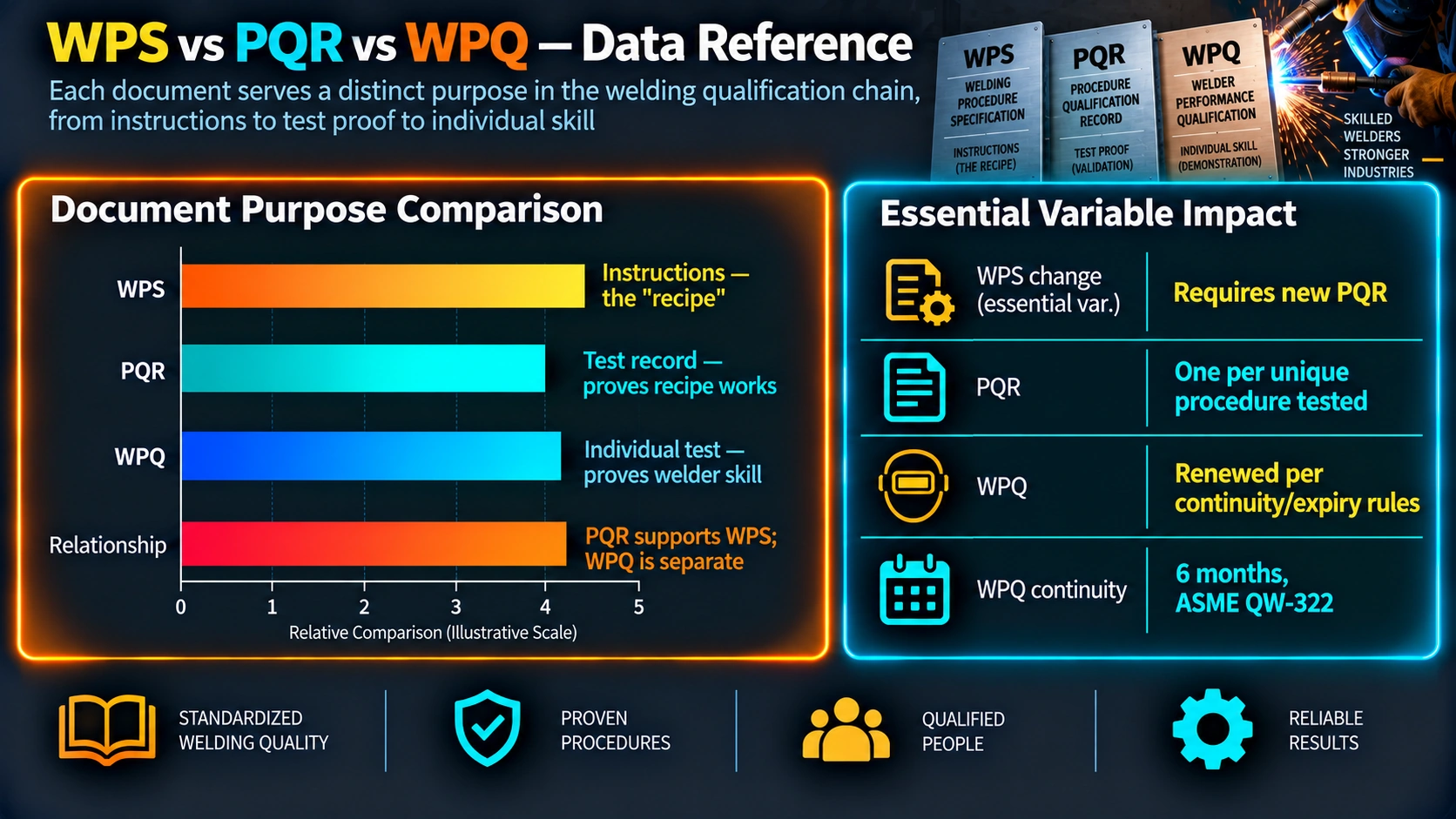
Under ASME Section IX QW-322, a welder’s performance qualification remains valid indefinitely, provided the welder has been continuously engaged with the applicable welding process. However, if a welder has not welded with a specific process for a period of six months or more, their qualification for that process lapses. Re-qualification requires either a new performance test, or documentary evidence of continuity from another employer showing the welder has maintained the process during the lapse period.
Critically, WPQ status is tied to the employer. A welder who transfers from one organisation to another must re-qualify under ASME rules, even if they have been continuously welding during the transition. The receiving organisation cannot inherit the welder’s previous WPQ record — they must either conduct a new test or use the previous employer’s continuity records in accordance with QW-322.
WPS vs PQR vs WPQ — Side-by-Side Comparison
The table below captures every major distinguishing attribute of the three documents.
| Attribute | WPS | PQR | WPQ |
|---|---|---|---|
| Full Name | Welding Procedure Specification | Procedure Qualification Record | Welder Performance Qualification |
| Purpose | Instructs welder on how to weld | Proves procedure produces acceptable welds | Proves individual can weld to an acceptable standard |
| What it qualifies | The procedure (parameters and ranges) | Nothing by itself — provides evidence for WPS | The individual welder or welding operator |
| Owned by | Manufacturer / Contractor | Manufacturer / Contractor | Employer (not the individual welder) |
| Can it be revised? | Yes — non-essential variables freely; essential variables require new PQR | No — immutable after certification | Not revised; new test required when essential variables change |
| ASME IX Reference | QW-200 (Article II) | QW-200 (Article II) | QW-300 (Article III) |
| AWS D1.1 Equivalent | WPS (Clause 3) | PQR (Clause 3) | WQTR — Welder Qualification Test Record (Clause 4) |
| Test coupon mech. properties required? | N/A | Yes — tensile, bend, impact as applicable | No — skill test only (RT/UT or bend) |
| Expiry | Valid indefinitely while supported by a valid PQR | Valid for life of supporting WPS | Lapses after 6 months without welding in that process (ASME QW-322) |
| Transfers between employers? | WPS can be adopted by another manufacturer only with new PQR tests | PQR is proprietary to the qualifying manufacturer | Does not transfer — re-qualification required at new employer |
| Certified by | Manufacturer QC Manager | Manufacturer + AI (for Code stamp work) | Employer QC representative |
| Available at work front? | Yes — mandatory (QW-200.1) | No — kept in QC records | Certificate held in QC file; welder ID stamp at work front |
How WPS, PQR, and WPQ Interlock in Practice
The three documents operate as an interlocking system. None is independently sufficient — each depends on and references the others. Here is how they connect on a real fabrication project:
Can the PQR Coupon Also Serve as the WPQ?
This is one of the most frequently misunderstood aspects of the qualification system. A welder who personally welds the PQR test coupon is not automatically qualified via the WPQ route. To use the PQR coupon weld as a WPQ test, the following additional conditions must be met per ASME Section IX:
- The required WPQ tests (radiography, UT, or bend as applicable) must be performed on the same coupon, in addition to the PQR mechanical tests.
- The results must be recorded on a separate WPQ certificate (QW-484A), referencing the welder’s identity and the applicable process and variables.
- The coupon dimensions must satisfy both PQR thickness requirements (QW-451) and WPQ thickness/diameter requirements (QW-452) simultaneously.
If all these conditions are met, one coupon may support both documents. In practice, many manufacturers perform separate WPQ tests on smaller, more economical coupons rather than relying on the PQR coupon, particularly where the PQR coupon dimensions do not match the target production weld configuration.
WPS vs PQR vs WPQ Under AWS D1.1 vs ASME Section IX
Both the AWS D1.1 Structural Welding Code and ASME BPVC Section IX use the three-document qualification system, but with important differences in terminology, essential variables, test methods, and scope.
| Feature | ASME Section IX | AWS D1.1 |
|---|---|---|
| Procedure document | WPS | WPS |
| Test evidence document | PQR | PQR |
| Welder qualification record | WPQ (QW-484A / 484B) | WQTR — Welder Qualification Test Record |
| Prequalified WPS? | No — PQR always required | Yes — Clause 3 prequalified WPS permitted for defined joints |
| Base metal grouping | P-Numbers (QW-422) | Material groups per Table 4.9 |
| Filler metal grouping | F-Numbers (QW-432) | Electrode classifications (not grouped by F-Number) |
| Welder expiry rule | 6 months without process use (QW-322) | 6 months without process use (Clause 4.31.1) |
| Employer portability | Re-qualification required at new employer | Re-qualification required, or evidence of continuity accepted |
| Applications | Pressure vessels, boilers, piping (ASME Codes) | Structural steel, buildings, bridges, offshore structures |
Essential Variables — The Rules That Govern When Re-Qualification Is Required
The essential variable system is the mechanism by which ASME and AWS define when a change to welding parameters requires a new test versus a simple document revision. Getting essential variables right is critical for maintaining a valid qualification programme without conducting unnecessary tests, and for ensuring non-conformances are caught before they reach production.
Essential Variables for WPS/PQR (Procedure Qualification)
A change to any essential variable beyond the limits established in the supporting PQR requires a new PQR test. Examples of common essential variable changes that trigger re-qualification include:
- Changing the welding process (e.g., from SMAW to GTAW), or adding a process not previously qualified
- Changing the base metal P-Number or Group Number outside the qualified range
- Changing the filler metal A-Number (weld metal composition class) for ferrous alloys
- Increasing the base metal thickness beyond the qualified maximum per QW-451
- Changing the PWHT condition (e.g., from no PWHT to PWHT, or changing the PWHT temperature range)
- When impact testing is required: any change to a supplementary essential variable per QW-401
Non-Essential Variables (WPS Revision Only)
Changes to non-essential variables may be made by revising the WPS without new testing. These changes are subject to the constraint that the WPS cannot claim ranges not supported by the PQR. Examples include joint design changes, groove angle changes (within reasonable limits), cleaning method changes, and most electrical parameter adjustments (within the PQR-established heat input envelope).
For a detailed reference on P-Numbers, F-Numbers, and A-Numbers and how they govern your qualification scope, see our P-Number, F-Number, and A-Number guide.
Recommended Books on WPS, PQR, and Welder Qualification
Disclosure: WeldFabWorld participates in the Amazon Associates programme (StoreID: neha0fe8-21). If you purchase through these links, we may earn a small commission at no extra cost to you. This helps support free technical content on this site.
Common Mistakes and Misconceptions
Mistake 1 — Treating the WPS as Proof of Qualification
A WPS alone does not prove that the welding parameters have been tested. If a PQR is missing, fraudulent, or expired, the WPS has no valid foundation. Never accept a WPS for production use without verifying that the supporting PQR exists, is within scope, and has been certified by the correct authority. This applies especially when inheriting qualification packages from other manufacturers.
Mistake 2 — Using One WPQ for All Positions and Thicknesses
A WPQ has defined limits on position, thickness, and pipe diameter. A welder qualified in position 2G (horizontal) is not qualified for 6G inclined pipe. A welder qualified on 10 mm plate is not qualified for 50 mm wall thickness pipe without checking the deposit thickness rules of QW-452. Always verify the exact scope of the WPQ before assigning a welder to a specific joint. For a detailed explanation of how position qualification works, see our guide on welding positions and qualification scope.
Mistake 3 — Changing Filler Metal Without Checking F-Number and A-Number
Substituting one filler metal for another without checking F-Number (for WPQ) and A-Number (for WPS/PQR) is a frequent source of qualification non-conformances. A change in A-Number — even within the same brand or product line — may be an essential variable change requiring a new PQR. Always check the A-Number classification of both the original and the replacement filler against the WPS and the supporting PQR before approving a substitution.
Mistake 4 — Assuming ISO 3834 Compliance Covers Qualification
ISO 3834 defines the quality management requirements for fusion welding but does not itself specify the qualification requirements for WPS, PQR, and WPQ. These remain governed by the applicable construction code (ASME, AWS, EN ISO 15614, etc.). ISO 3834 compliance means you have a system for managing your qualification programme — it does not replace the underlying code qualification tests.