ASME Section II Part A — Ferrous Material Specifications: Complete Reference Guide
ASME Section II Part A, formally titled BPVC Section II — Materials, Part A: Ferrous Material Specifications, is the material reference backbone of the entire ASME Boiler and Pressure Vessel Code. Every carbon steel plate, alloy steel pipe, stainless steel tube, iron casting, and forged fitting used in ASME Code construction must conform to a specification listed in this document. Section II Part A is published in two volumes — covering SA-specifications from SA-6 through to SA-1058M — and is updated with every biennial ASME BPVC edition. The current edition is ASME BPVC 2025; the 2023 edition remains widely used on projects that specified it at contract time.
Unlike the construction code sections (Section VIII for pressure vessels, Section III for nuclear, or B31.3 for process piping), Section II Part A does not tell you how to design or fabricate. It is a service section: a library of approved material specifications that the construction codes draw from by reference. When ASME Section VIII Division 1 clause UG-4 states that pressure vessel materials must conform to specifications listed in Section II Part A, it is pointing directly at this document. Understanding how Section II Part A is structured, how to read an SA specification, how the SA numbering system maps to ASTM, and how materials are assigned P-Numbers under Section IX is fundamental knowledge for any pressure vessel engineer, quality inspector, or fabrication engineer working within the ASME code framework.
This guide covers the full structure of Section II Part A, the SA-number system, key material categories and their most important specifications, the general requirements documents, material certification requirements under UG-93, and practical guidance on selecting the right ASME material for common pressure equipment applications. Whether you are selecting shell plate for a carbon steel process vessel, specifying high-temperature Cr-Mo alloy steel pipe, or verifying a Mill Test Certificate against code requirements, this reference will give you the technical grounding you need.
What Is ASME Section II Part A?
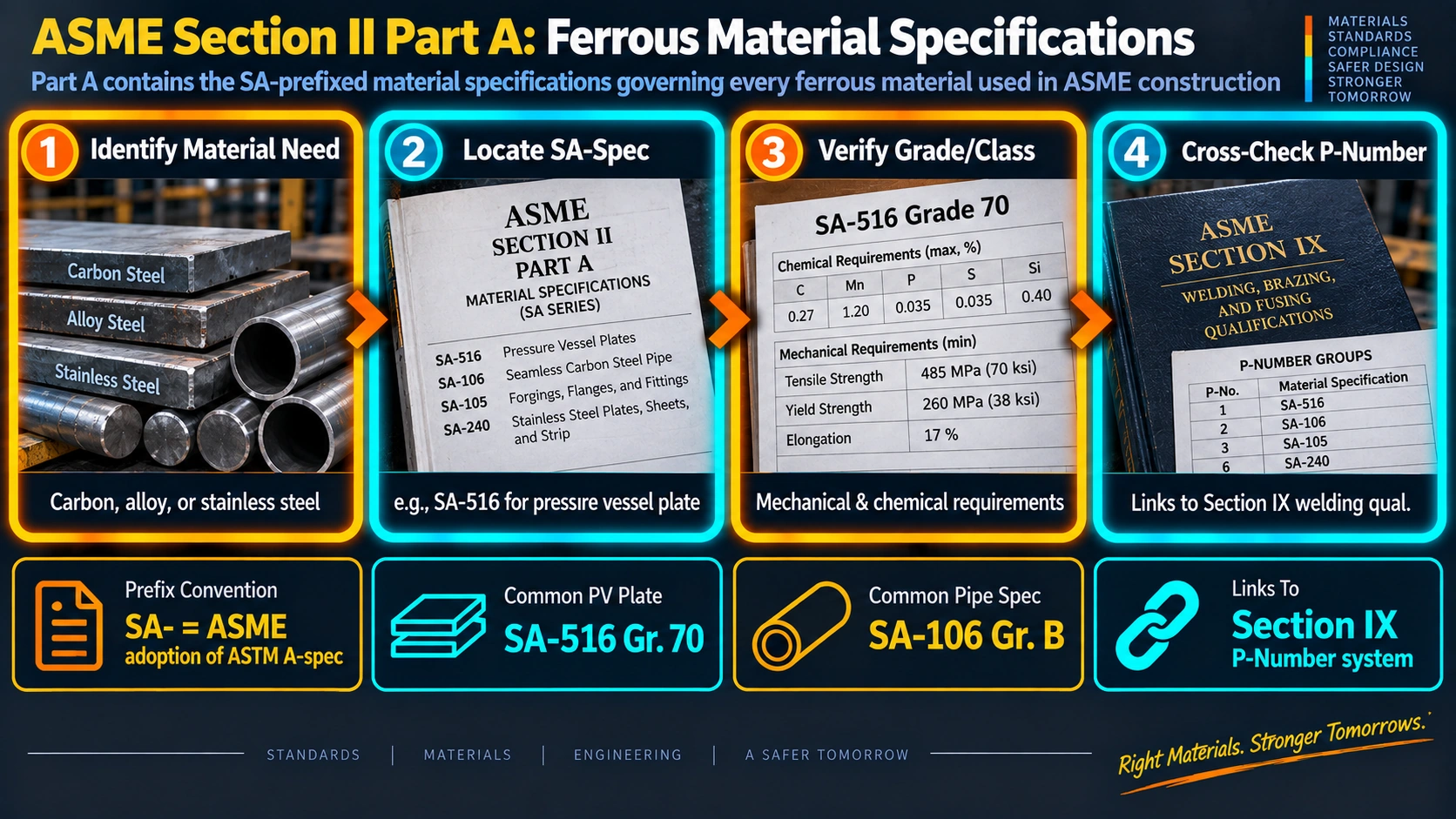
ASME BPVC Section II Part A is the authoritative collection of ferrous material specifications approved for use in ASME Code pressure equipment construction. It is a two-volume document containing over 150 individual specifications, each covering a specific material type, product form, and application. The specifications are designated with an SA-number prefix (SA standing for “ASME adopted”), and in most cases mirror an underlying ASTM A-number specification with the same technical requirements plus any ASME-specific additions.
Section II Part A is described by ASME as a “service section” — meaning it exists solely to be referenced by, and to serve, the construction code sections. A Section II Part A specification on its own carries no legal weight in a fabrication contract. It becomes mandatory when a construction code invokes it by reference. For example, ASME Section VIII Division 1 UG-4(a) states that pressure parts shall be made from materials conforming to SA or SB specifications listed in Section II. That single reference makes the entirety of Section II Part A mandatory for all pressure-containing parts in an ASME Section VIII vessel.
The SA-Number System: How ASME Adopts ASTM Specifications
The dominant feature of Section II Part A is the SA-number system. ASME does not, in general, write its own material specifications from scratch. Instead, the ASME Committee on Materials works alongside ASTM committees to adopt ASTM ferrous specifications into the BPVC. When ASME adopts an ASTM specification, it assigns an equivalent SA-number and publishes the full specification text in Section II Part A. In the majority of cases, the SA-specification is technically identical to the corresponding ASTM specification at the time of adoption.
SA vs A: The Key Differences
While the chemistry and mechanical property requirements are usually identical, ASME may add supplementary requirements or modify certain elements of the ASTM specification to suit pressure equipment construction. Common ASME-specific additions include:
- Mandatory impact testing — Some SA-specifications require Charpy V-notch impact tests as mandatory requirements where the underlying ASTM specification makes them supplementary or optional only. For example, low-temperature service specifications such as SA-333 (low-temperature pipe) and SA-350 (low-temperature forgings) mandate Charpy testing as a base requirement.
- Certification requirements — ASME requires that material test reports (MTRs or MTCs) certify compliance with SA requirements specifically, not just ASTM requirements. The certified mill test report must identify the SA specification number and edition.
- Restricted supplementary requirements — ASME periodically restricts which ASTM supplementary requirements may or may not be invoked on ASME Code materials, to ensure consistency in Code construction.
- Edition alignment — ASME adopts ASTM specifications as of a specific ASTM edition. The SA-specification text in a given BPVC edition reflects the ASTM edition current at the time ASME adopted it, which may lag behind the current ASTM edition.
Structure of Section II Part A
Section II Part A is organised as a collection of individual specifications, each identified by its SA-number and title. At the front of each volume there is a cross-reference index listing all specifications by product form category — plates, pipes, tubes, forgings, castings, bars, bolting, and so on — as well as a specification removal list noting specifications that have been withdrawn from the Code in recent editions. Within each individual specification, the typical structure is:
- Scope — defines the material, product form, size range, and any applicable restrictions
- Referenced documents — lists standards for testing methods, tolerances, and ancillary requirements
- Ordering information — designators required on purchase orders
- Materials and manufacture — melting practice, heat treatment, forming method restrictions
- Chemical requirements — heat analysis and product analysis limits
- Mechanical requirements — tensile, yield, elongation, hardness, and where applicable, impact energy requirements
- Dimensions, mass, and permissible variations — tolerances on thickness, diameter, width, straightness, etc.
- Workmanship, finish, and appearance
- Marking — required identification markings on each piece
- Certification — MTC / test report requirements
- Supplementary requirements — additional tests or restrictions that may be specified by the purchaser
General Requirements Specifications
Several SA-specifications function as “umbrella” general requirements documents that apply to an entire class of products. These are referenced by individual material specifications and need not be separately ordered — compliance is automatic when ordering a material to its individual SA-specification. Key general requirements specifications include:
| Specification | Scope | Applies To |
|---|---|---|
| SA-6 / SA-6M | General requirements for rolled structural steel bars, plates, shapes | All structural and pressure vessel plates, bars |
| SA-20 / SA-20M | General requirements for steel plates for pressure vessels | All carbon and alloy steel pressure vessel plate specs |
| SA-29 / SA-29M | General requirements for steel bars — carbon and alloy, hot wrought | All hot-wrought bar specifications |
| SA-450 / SA-450M | General requirements for carbon and low-alloy steel tubes | Carbon and low-alloy steel tube specifications |
| SA-480 / SA-480M | General requirements for flat-rolled stainless and heat-resisting steel plate, sheet, and strip | All stainless steel flat-rolled plate specifications |
| SA-484 / SA-484M | General requirements for stainless steel bars, billets, and forgings | Stainless steel bar and billet specifications |
| SA-530 / SA-530M | General requirements for specialised carbon and alloy steel pipe | Specialised carbon and alloy steel pipe specs |
| SA-703 / SA-703M | General requirements for steel castings for pressure-containing parts | All steel casting specifications |
| SA-781 / SA-781M | General requirements for castings, steel and alloy, for general industrial use | Steel and alloy casting specifications |
| SA-788 / SA-788M | General requirements for steel forgings | All carbon and alloy steel forging specifications |
| SA-960 / SA-960M | Common requirements for wrought steel piping fittings | All wrought steel piping fitting specifications |
| SA-961 / SA-961M | Common requirements for steel flanges, forged fittings, valves, and parts | All steel flange and forged fitting specifications |
| SA-999 / SA-999M | General requirements for alloy and stainless steel pipe | Alloy and stainless steel pipe specifications |
| SA-1016 / SA-1016M | General requirements for ferritic alloy, austenitic alloy, and stainless steel tubes | Alloy and stainless steel tube specifications |
Material Categories in Section II Part A
The specifications in Section II Part A cover a broad range of ferrous materials. For practical engineering use they are best understood by material category and intended service, as the construction codes reference specific material types for specific applications.
Carbon Steel Specifications — Key Materials
Carbon steels with a maximum specified carbon content not exceeding 0.30% are generally assigned P-Number 1 under ASME Section IX and represent the most common material family in pressure vessel fabrication. The dominant specifications are discussed below.
SA-516 — Pressure Vessel Plates, Carbon Steel, for Moderate and Lower Temperature Service
SA-516 is the single most widely used plate material in ASME pressure vessel fabrication. It is supplied in four grades based on minimum tensile strength:
| Grade | Min. Tensile (ksi / MPa) | Min. Yield (ksi / MPa) | Min. Elongation (%) | Typical Use |
|---|---|---|---|---|
| 55 | 55 / 380 | 30 / 205 | 27 | Low-stress applications, cladding base |
| 60 | 60 / 415 | 32 / 220 | 25 | Storage vessels, moderate pressure |
| 65 | 65 / 450 | 35 / 240 | 23 | General pressure vessels |
| 70 | 70 / 485 | 38 / 260 | 21 | Standard process vessel shell and head — most widely used |
SA-516 Grade 70 is the de facto standard for carbon steel pressure vessel shells, heads, and nozzle reinforcing pads operating at moderate temperatures (typically up to 400°C / 750°F) and at design temperatures above -29°C / -20°F without impact testing in many thickness ranges. Above 38 mm (1.5 in.) thickness, Charpy impact testing per UCS-66 and UG-84 may be required depending on the minimum design temperature and joint efficiency. It is weldable with any of the common welding processes and responds well to normalising and post-weld heat treatment. For an in-depth explanation of when SA-516 Grade 70 plate requires Charpy impact testing under UG-84, see our dedicated guide on that topic.
SA-515 — Pressure Vessel Plates, Carbon Steel, for Intermediate and Higher Temperature Service
SA-515 is similar to SA-516 in grade structure (Grades 55, 60, 65, 70) but is optimised for elevated temperature service. Compared to SA-516, SA-515 allows a higher carbon content, which improves high-temperature tensile strength at the cost of reduced low-temperature notch toughness. SA-515 Grade 70 is selected when the design temperature exceeds the range where SA-516 Grade 70’s allowable stress values remain competitive, particularly in the range 370–450°C (700–840°F).
SA-106 — Seamless Carbon Steel Pipe for High-Temperature Service
SA-106 is the standard specification for seamless carbon steel pipe intended for use at elevated temperatures. Three grades are covered:
| Grade | Min. Tensile (ksi / MPa) | Min. Yield (ksi / MPa) | Max. C (%) | Typical Application |
|---|---|---|---|---|
| A | 48 / 330 | 30 / 205 | 0.25 | Low-pressure, structural pipe |
| B | 60 / 415 | 35 / 240 | 0.30 | Standard process piping — by far the most common grade |
| C | 70 / 485 | 40 / 275 | 0.35 | Higher-pressure applications |
SA-106 Grade B is the workhorse of carbon steel process piping for ASME B31.3 applications. Its combination of mechanical properties, weldability (P-No. 1, carbon equivalent values typically 0.35–0.40), and widespread availability make it the default choice for plant piping up to approximately 425°C (800°F). Above this temperature, the allowable stress values in Section II Part D begin to favour alloy steel alternatives.
SA-105 and SA-266 — Carbon Steel Forgings
SA-105 covers carbon steel forgings for piping applications, including flanges, fittings, valves, and pressure parts. It is one of the most commonly specified forging specifications and is used for weld-neck flanges, slip-on flanges, socket-weld fittings, and nozzle forgings in carbon steel piping systems. SA-266 covers larger carbon steel forgings specifically for pressure vessel components such as nozzle necks, shell courses, heads, and vessel heads forged from thick plate. Both are P-No. 1 materials and weld directly to SA-106 pipe and SA-516 plate without preheat in most thickness ranges.
Chromium-Molybdenum Alloy Steel Specifications
For high-temperature pressure service above the carbon steel creep range (approximately 370°C / 700°F for carbon steel), Cr-Mo alloy steels offer superior elevated-temperature tensile strength, creep resistance, and oxidation resistance. Section II Part A covers the full range of conventional and advanced Cr-Mo grades.
SA-387 — Pressure Vessel Plates, Alloy Steel, Chromium-Molybdenum
SA-387 is the primary plate specification for Cr-Mo alloy steel pressure vessels. The most important grades and their P-Number assignments are:
| Grade | Composition | P-Number | Class | Typical Service |
|---|---|---|---|---|
| 2 | 0.5Cr-0.5Mo | 3 | 1, 2 | Hydrogen service up to 300°C |
| 11 | 1.25Cr-0.5Mo | 4 | 1, 2 | Refinery reactors, high-temp vessels to 540°C |
| 12 | 1.0Cr-0.5Mo | 4 | 1, 2 | Boiler drums, economisers |
| 22 | 2.25Cr-1.0Mo | 5A | 1, 2 | Hydrogen reactors, hydrocracking vessels, PWHT required |
| 91 | 9Cr-1Mo-V (P91) | 15E | 1, 2 | High-temp power gen; creep-resistant to 625°C |
SA-335 — Seamless Ferritic Alloy Steel Pipe for High-Temperature Service
SA-335 is the seamless alloy steel pipe equivalent of SA-106. It covers the complete range of ferritic Cr-Mo grades for high-temperature piping service and is one of the most referenced specifications in power generation and refinery construction. Major grades include:
- P1 — C-Mo (0.5Mo), P-No. 3, for temperatures up to 510°C
- P5 — 5Cr-0.5Mo, P-No. 5B, for refinery and petrochemical high-temperature service
- P9 — 9Cr-1Mo, P-No. 5B, predecessor to P91, still used in some applications
- P11 — 1.25Cr-0.5Mo, P-No. 4, widely used in superheater headers and steam piping
- P22 — 2.25Cr-1Mo, P-No. 5A, standard for hydrogen service piping and reactor piping
- P91 — 9Cr-1Mo-V, P-No. 15E, the modern high-strength creep-resistant grade for advanced power plant steam systems
- P92 — 9Cr-1.8W-0.5Mo-V-Nb, P-No. 15E, even higher creep strength than P91 for ultra-supercritical steam conditions
SA-213 — Seamless Ferritic and Austenitic Alloy Steel Boiler, Superheater, and Heat Exchanger Tubes
SA-213 is the tube counterpart to SA-335, covering both ferritic (Cr-Mo) grades (T5, T9, T11, T22, T91, T92) and austenitic stainless steel grades (TP304, TP316, TP321, TP347). It is the dominant specification for heat exchanger and boiler tubing in high-temperature service. The T-grade designators correspond directly to the P-grade pipe designators in SA-335: T11 pipe has the same composition as P11, and T22 corresponds to P22.
Stainless Steel Specifications
Austenitic stainless steels are assigned P-Number 8 under Section IX, duplex stainless steels are generally P-No. 10H, and ferritic and martensitic stainless steels are P-Nos. 6 and 7 respectively. Section II Part A covers all of these families. For more on the metallurgy and welding of stainless steels see our guides on duplex stainless steel and stainless steel weld decay.
SA-240 — Chromium and Chromium-Nickel Stainless Steel Plate, Sheet, and Strip for Pressure Vessels
SA-240 is the primary stainless steel plate specification for pressure vessels. It covers the full range of austenitic (Types 304, 304L, 316, 316L, 317, 317L, 321, 347, 309, 310), ferritic (Types 405, 409, 430), martensitic (Types 403, 410, 416), and duplex (2205, 2507) grades. The four-digit UNS designation (e.g., S31600 for Type 316) or the three-digit type number is used to identify the grade on purchase orders and MTCs.
SA-312 — Seamless, Welded, and Heavily Cold Worked Austenitic Stainless Steel Pipes
SA-312 is the standard specification for austenitic stainless steel pipe in pressure service. Grades mirror SA-240 (TP304, TP304L, TP316, TP316L, TP317L, TP321, TP347, etc.). Seamless and welded pipe are covered in the same specification, with welded pipe identified by the “W” suffix on the tube identification. ASME B31.3 Table A-1 lists both seamless and welded SA-312 pipe with different joint quality factors (E = 1.0 for seamless, E = 0.85 for welded unless 100% RT is performed, in which case E = 1.0).
Bolting Specifications
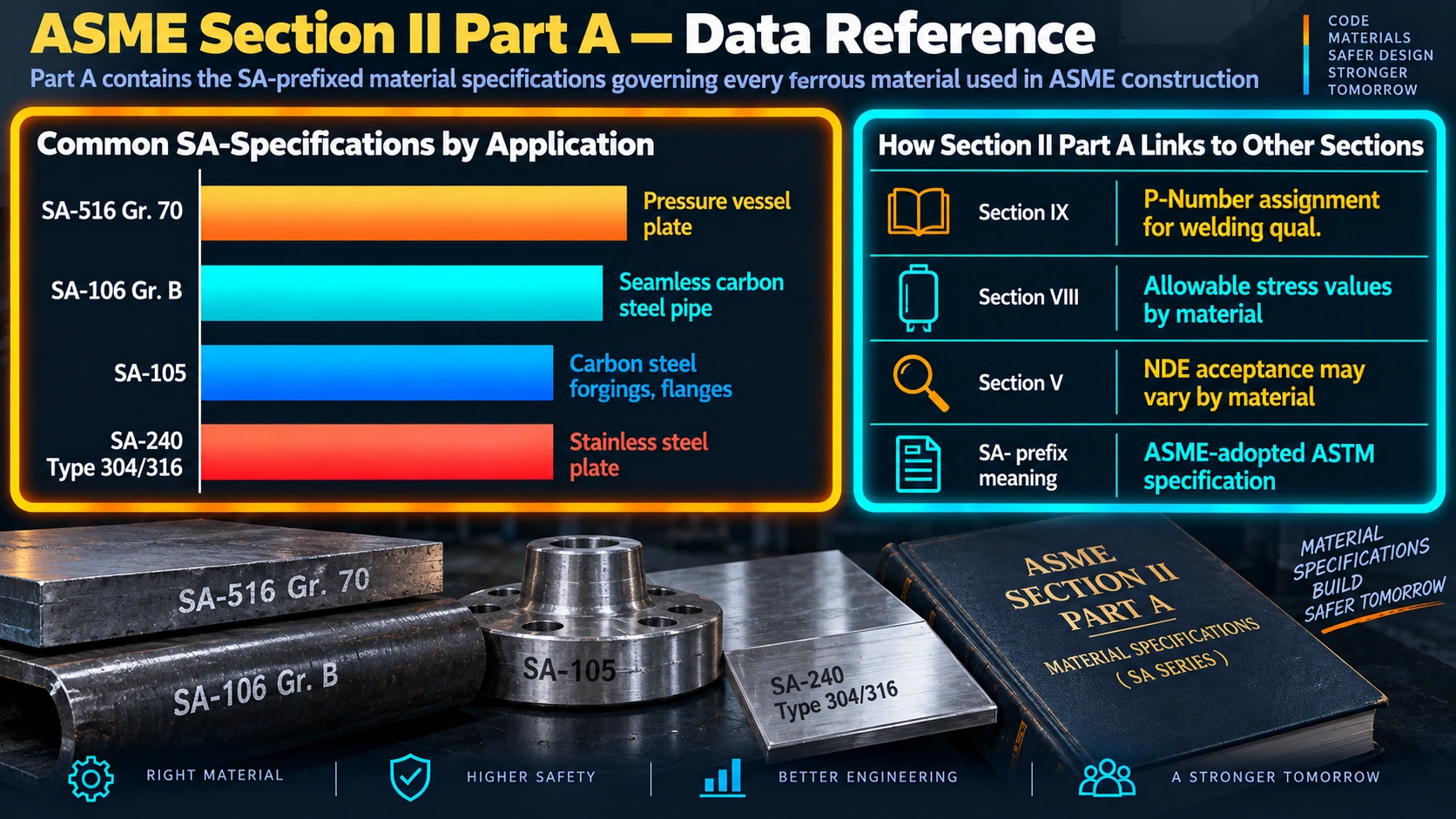
Pressure vessel and flange bolting requires materials listed in Section II Part A with specific mechanical properties for the temperature range. Two specifications cover virtually all Code bolting requirements:
| Specification | Scope | Common Grades | Typical Temperature Range |
|---|---|---|---|
| SA-193 | Alloy and SS bolting for high-temperature or high-pressure service | B7 (Cr-Mo alloy), B8 (304 SS), B8M (316 SS), B16 (Cr-Mo-V), L7 (low-temp grade of B7) | Up to 650°C (1200°F) for B7; up to 816°C for B8 |
| SA-320 | Alloy and SS bolting for low-temperature service | L7 (Cr-Mo alloy, -100°C), L7A, L7B, L43, B8 class (SS at cryogenic) | Down to -100°C (-150°F) for L7; down to -195°C for B8 grades |
| SA-194 | Carbon and alloy steel nuts for high-pressure or high-temperature service | Grade 2H (heavy hex nuts for B7 studs), Grade 8 (SS) | Matched to bolting specification |
P-Number Assignments for Section II Part A Materials
ASME Section IX assigns P-Numbers to the base metals listed in Section II (and other code sections) to group materials with similar composition, weldability, and mechanical properties. A welding procedure qualification on one material in a P-Number group qualifies the welding procedure for all materials within the same group (with some exceptions for impact-tested applications). Understanding P-Numbers is essential for reading and writing WPS/PQR documentation — see our full guide on P-Numbers, F-Numbers, and A-Numbers for a complete explanation. The most important P-Number groups drawn from Section II Part A materials are:
| P-Number | Material Group | Key SA Specifications | Typical Max C (%) |
|---|---|---|---|
| P-1 | Carbon steels | SA-106 B, SA-516 Gr.70, SA-105, SA-285, SA-299, SA-515 | 0.30 |
| P-3 | Half Cr, 0.5Mo, 1.5Ni steels | SA-204, SA-302, SA-387 Gr.2 | 0.15 |
| P-4 | 1–2% Cr, 0.5Mo steels | SA-387 Gr.11/12, SA-335 P11, SA-213 T11, SA-182 F11 | 0.15 |
| P-5A | 2.25Cr-1Mo steels | SA-387 Gr.22, SA-335 P22, SA-213 T22, SA-182 F22 | 0.15 |
| P-5B | 3–10% Cr, 0.5–1Mo steels | SA-335 P5/P9, SA-213 T5/T9, SA-182 F5/F9 | 0.15 |
| P-6 | Martensitic stainless steels | SA-240 Type 410, SA-182 F6a | 0.15 |
| P-7 | Ferritic stainless steels | SA-240 Type 405/430, SA-268 | 0.08 |
| P-8 | Austenitic stainless steels | SA-240 Gr.304/316/321/347, SA-312 TP304/316, SA-182 F304/316 | 0.08 (L = 0.030) |
| P-10H | Duplex stainless steels | SA-240 S32205/S32750, SA-790, SA-789 | 0.03 |
| P-15E | 9Cr-1Mo-V (Grade 91) and 9Cr-1.8W (Grade 92) | SA-387 Gr.91, SA-335 P91/P92, SA-213 T91/T92, SA-182 F91 | 0.15 |
Material Certification Requirements — UG-93 and MTC Content
ASME Section VIII Division 1 clause UG-93 establishes the material documentation requirements for all pressure-containing parts. The key requirements are:
What the MTC Must Include
- The SA-specification number and revision (edition) to which the material was produced
- Grade, class, type, or condition as applicable
- Heat number (the unique identifier for the melt from which the material was produced)
- Product analysis results where the specification requires or where the purchaser has invoked Supplementary Requirement S1
- Heat analysis (ladle analysis) results — elemental breakdown by percentage for each required element
- Mechanical test results: tensile strength, yield strength, elongation, reduction of area, and Charpy energy as applicable
- Heat treatment condition: as-rolled (AR), normalised (N), normalised and tempered (NT), quenched and tempered (QT), annealed (A), solution annealed (SA) as required by the specification
- Dimensional conformance statement or dimensional test results as required
- The manufacturer’s name and the certifying signature or electronic equivalent
Traceability and Marking
Each piece of Section II Part A material must be marked with the specification number, grade, heat number, and required size information. For plates, this is typically stencilled or stamped on the plate surface. For pipe and tube, it appears on the pipe itself at defined intervals. ASME UG-77 requires that material identification (heat number) be traceable from the material itself to the MTC throughout the fabrication process. Quality control procedures for ASME Code vessels must include a system for maintaining this traceability — any material that loses traceability to its MTC must be either reidentified (if the heat number can be recovered) or treated as unidentified and not used for Code construction without retesting.
Practical Material Selection Guide for Common ASME Applications
The following table summarises material selection logic for the most common ASME pressure vessel and piping application categories:
| Application | Temperature Range | Recommended SA Spec | Notes |
|---|---|---|---|
| Process vessel shell and heads (general service) | -29°C to 400°C | SA-516 Gr.70 | Most common choice; check impact exemption per UCS-66 |
| Process vessel shell (low-temperature, -46°C to -29°C) | -46°C to 0°C | SA-516 Gr.70 normalised + impact tested | Charpy testing mandatory; check UCS-66A curves |
| Process piping, general service | -29°C to 425°C | SA-106 Gr.B | Seamless only for ASME B31.3 severe cyclic conditions |
| Process piping, low-temperature service (-45°C) | -45°C to -29°C | SA-333 Gr.6 | Charpy tested; impact tested to -45°C standard |
| Nozzle flanges, carbon steel service | -29°C to 425°C | SA-105 | Standard for weld-neck and slip-on flanges in C-steel service |
| High-temperature vessel shell (refinery hydrogen service) | 400°C to 540°C | SA-387 Gr.22 (2.25Cr-1Mo) | PWHT mandatory; weld with matching ER90S-B3 or equivalent |
| High-temperature pipe (steam, power generation) | 370°C to 600°C | SA-335 P11 or P22 | Grade P91 for ultra-supercritical steam above 565°C |
| Heat exchanger tubes, carbon steel | Up to 370°C | SA-179 (seamless C-steel) | Cold-drawn; excellent surface finish for heat transfer |
| Heat exchanger tubes, high-temperature alloy | Up to 600°C | SA-213 T11/T22/T91 | Match grade to shell-side temperature and corrosion requirements |
| Austenitic stainless vessel shell (corrosive service) | -200°C to 500°C | SA-240 TP316L | L-grade mandatory for welded construction without PWSA |
| Stainless steel process piping | -200°C to 500°C | SA-312 TP316L | Seamless for Category M fluid service; welded + RT for standard service |
| Sour service, H2S environments | Ambient to 150°C | SA-516 Gr.70 + NACE MR0175 hardness limits | See NACE MR0175/ISO 15156 requirements; hardness ≤ 22 HRC |
| High-strength studs, high-temp flanges | Up to 540°C | SA-193 Gr.B7 studs + SA-194 Gr.2H nuts | Standard high-temperature carbon steel flange bolting |
Recommended Books on ASME Section II and Pressure Vessel Materials
ASME BPVC Section II Part A — Ferrous Material Specifications (2025 Edition)
The official ASME document. Essential for any pressure vessel fabrication shop, engineering office, or inspection organisation working under ASME Code.
View on AmazonCompanion Guide to the ASME Boiler & Pressure Vessel Code — K.R. Rao
A comprehensive technical commentary on all BPVC sections by ASME subject matter experts. Covers materials, design, fabrication, and inspection with engineering insight beyond the code text itself.
View on AmazonPressure Vessel Design Manual — Dennis R. Moss & Michael Basic
A practical engineering handbook covering ASME Section VIII pressure vessel design, material selection, and fabrication details with worked examples, charts, and design data tables.
View on AmazonSteel Heat Treatment: Metallurgy and Technologies — George Totten
A detailed metallurgical reference covering heat treatment processes for carbon and alloy steels, including the Cr-Mo grades used extensively in Section II Part A for high-temperature service.
View on AmazonDisclosure: WeldFabWorld participates in the Amazon Associates programme (StoreID: neha0fe8-21). If you purchase through these links, we may earn a small commission at no extra cost to you. This helps support free technical content on this site.
FAQ — ASME Section II Part A Ferrous Material Specifications
What is ASME Section II Part A and what does it cover?
ASME BPVC Section II Part A is the ferrous material specifications volume of the ASME Boiler and Pressure Vessel Code. It contains the ASME SA-designated specifications for carbon steels, alloy steels, stainless steels, and cast irons used in the construction of pressure vessels, boilers, and pressure-retaining components. The specifications are primarily adopted from ASTM standards with ASME-specific requirements added where necessary for pressure equipment safety. Section II Part A is a service section referenced by the construction codes (Section VIII, Section III, B31.1, B31.3) rather than a construction code in itself — it does not specify design rules or acceptance criteria.
What is the difference between an ASTM A number and an ASME SA number?
ASTM A-numbers (e.g., A-516, A-106) are specifications published by ASTM International. ASME SA-numbers (e.g., SA-516, SA-106) are the ASME-adopted versions of those same specifications, incorporated into Section II Part A with editorial modifications. In most cases the technical requirements are identical. However, ASME occasionally adds supplementary requirements — mandatory Charpy impact testing, additional heat treatment rules, more stringent marking requirements — beyond the base ASTM specification. ASME Code construction requires materials to be ordered and documented to the SA designation. In practice most major steel mills certify material to both A and SA designations simultaneously, making dual-certified material universally available.
What is a P-Number and how does it relate to ASME Section II Part A materials?
P-Numbers are groupings assigned in ASME Section IX to base metals with similar weldability, composition, and mechanical properties, so that welding procedure qualifications apply across an entire group rather than requiring separate qualifications for every individual material specification. P-Number assignments are based on the materials listed in Section II Parts A, B, C, and D. For example, carbon steels with a maximum specified carbon content not exceeding 0.30% are generally P-No. 1, while SA-335 Grade P91 (9Cr-1Mo-V) is P-No. 15E. Knowing a material’s P-Number is essential for determining which welding procedures are already qualified and which new qualifications are required when working with a new material. See our guide on P-Numbers, F-Numbers, and A-Numbers for the full explanation.
What is SA-516 Grade 70 and why is it so widely used in pressure vessel fabrication?
SA-516 is the specification for pressure vessel plates, carbon steel, for moderate and lower temperature service. Grade 70 denotes a minimum tensile strength of 70 ksi (485 MPa) with a minimum yield strength of 38 ksi (260 MPa). It is the most widely used plate material in ASME pressure vessel fabrication because it combines good notch toughness at moderate sub-ambient temperatures, excellent weldability, wide availability across a broad range of plate thicknesses, and competitive cost. The material is P-No. 1 and can be welded with most processes without mandatory preheat in thicknesses up to 25 mm for most applications. Above certain thicknesses or at sub-zero design temperatures, Charpy impact testing per UG-84 becomes mandatory.
What information must appear on a Mill Test Certificate (MTC) for ASME Section II Part A materials?
An MTC for ASME Section II Part A material must include: the SA specification number and grade; the heat number; the product form, size, and quantity; heat analysis results (and product analysis where required or specified); mechanical test results covering tensile strength, yield strength, elongation, and Charpy impact energy where applicable; heat treatment condition; and the manufacturer’s certification that the material conforms to the SA specification. ASME UG-93 requires that these records be maintained and available to the Authorised Inspector. The MTC must be certified by the material manufacturer. Any material that cannot be traced to an MTC meeting these requirements cannot be used for ASME Code pressure-containing components without re-identification and retesting.
What is the difference between SA-106 Grade B and SA-106 Grade C?
SA-106 covers seamless carbon steel pipe for high-temperature service. Grade B (minimum tensile 60 ksi / 415 MPa; minimum yield 35 ksi / 240 MPa; maximum carbon 0.30%) is by far the most widely specified grade and is the standard for process plant piping in carbon steel service. Grade C (minimum tensile 70 ksi / 485 MPa; minimum yield 40 ksi / 275 MPa; maximum carbon 0.35%) provides higher strength, achieved through tighter composition control including higher manganese, and is selected when higher-pressure or high-stress conditions require the additional tensile strength. Grade A (minimum tensile 48 ksi / 330 MPa) is the lowest strength and is rarely specified in pressure-containing applications — it is most often used for low-stress piping or structural applications. All three grades are P-No. 1 and weld in the same manner.
What SA materials are used for Cr-Mo alloy steel pressure equipment in high-temperature service?
Chromium-molybdenum alloy steels are the standard materials for high-temperature pressure equipment operating in the creep range. The primary ASME Section II Part A specifications covering Cr-Mo steels are: SA-387 for plates (Grades 11, 12, 22, and 91); SA-335 for seamless ferritic alloy steel pipe (Grades P11, P22, P91, P92); SA-182 for forged flanges and fittings (F11, F22, F91); SA-213 for boiler and heat exchanger tubes (T11, T22, T91, T92); and SA-336 for large alloy steel forgings. Grade P91 (9Cr-1Mo-V, P-Number 15E) is of particular importance in modern power generation but requires strict preheat, interpass temperature, and PWHT controls. See our dedicated guide on P91 material and welding requirements.
Can ASTM materials be substituted for ASME SA materials on ASME Code vessels?
Not directly. ASME Code construction requires materials to be ordered and certified to the SA specification listed in Section II Part A. However, ASME Section VIII Division 1 UG-10 permits the use of materials conforming to listed ASTM specifications provided the material simultaneously meets all requirements of the corresponding SA specification. In practice, when a major steel mill certifies material to both A-516 and SA-516 simultaneously — which is nearly universal for reputable mills supplying the pressure vessel market — the MTC will certify compliance with SA-516, making it fully acceptable. A bare ASTM A-516 MTC without explicit SA-516 certification is not sufficient for ASME Code construction without additional verification. Code Cases can also permit non-listed materials for specific applications where engineering justification supports their use.
What are the general requirements specifications such as SA-20 and SA-450 in Section II Part A?
Several specifications in Section II Part A serve as general requirements documents that apply to a class of materials rather than to a specific material. SA-20 covers general requirements for steel plates for pressure vessels and applies to all carbon and alloy steel plate specifications unless otherwise stated. SA-450 covers general requirements for carbon and low-alloy steel tubes. SA-530 covers general requirements for specialised carbon and alloy steel pipe. SA-788 covers general requirements for steel forgings. SA-960 and SA-961 cover common requirements for wrought steel piping fittings and flanges respectively. These general requirements specifications address testing methods, tolerances, marking, certification, supplementary requirements, and ordering information that would otherwise be repeated in every individual material specification. When ordering a material such as SA-516, the requirements of SA-20 automatically apply as well.