ASME Section V — Nondestructive Examination: Complete Code Overview
ASME Section V, formally titled BPVC Section V — Nondestructive Examination, is the foundational reference code that governs how NDE is performed on pressure vessels, boilers, pressure piping, and related components constructed to ASME standards. Unlike other code sections that specify design, material, or fabrication rules, Section V focuses exclusively on how to examine — defining procedures, equipment, calibration requirements, and personnel qualification for every major NDE method. Whether you work in a pressure vessel fabrication shop qualifying welds to ASME Section VIII, a nuclear facility referencing Section III, or a process plant subject to ASME B31.3, Section V is the document that tells you precisely how to apply radiographic, ultrasonic, liquid penetrant, magnetic particle, eddy current, and visual examination methods.
A critical point that many engineers and inspectors misunderstand: Section V deliberately contains no acceptance criteria. It tells you how to look; the referencing code — Section VIII Division 1, Section III, B31.1, B31.3, and so on — tells you what to do with what you find. This clean separation keeps examination procedures consistent across all construction codes while allowing each code to apply acceptance criteria calibrated to its specific design margins and safety requirements. This guide covers the full structure of Section V, all articles within Subsection A and Subsection B, personnel qualification requirements, how Section V interfaces with other ASME codes, and the practical implications for everyday inspection and fabrication work.
Purpose and Scope of ASME Section V
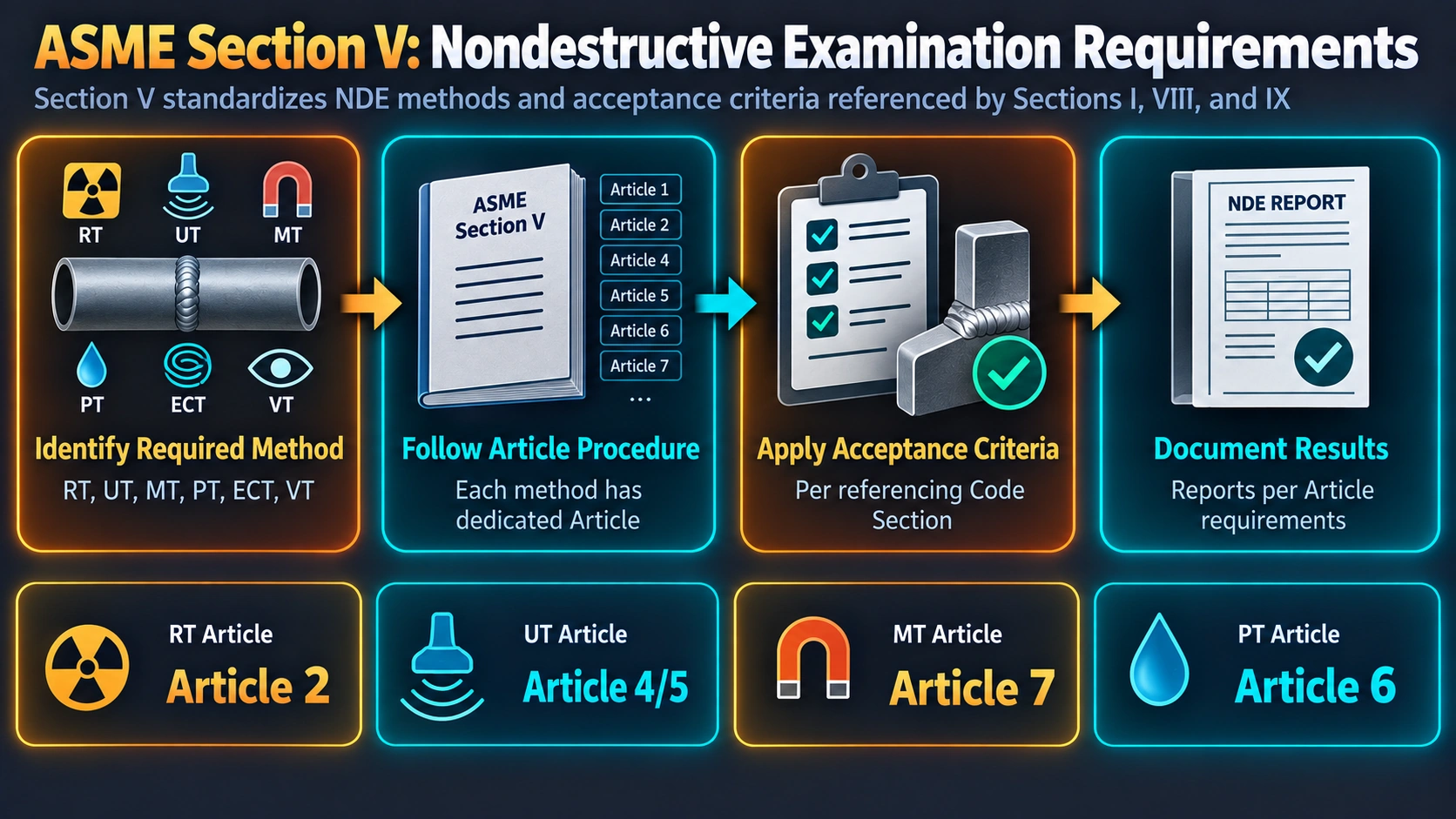
ASME Section V is a referenced code. It does not stand alone as a construction or design standard; instead, it provides the examination methods and procedures that other codes call up by reference. The scope of Section V, as stated in Article 1, is to establish requirements applicable to the extent specified and referenced by other ASME Code sections. Any NDE performed under the ASME BPVC umbrella — from pressure vessel manufacture to nuclear power plant construction — must follow Section V when it is invoked by the applicable construction or inspection code.
The first edition of what became ASME Section V was published in the late 1960s, growing out of a recognition that multiple ASME code sections were each developing their own NDE requirements, resulting in inconsistencies and duplication. The Subcommittee on Nondestructive Testing consolidated all NDE procedure requirements into a single, centrally maintained document — conceptually similar to how Section IX consolidated welding qualification requirements into one place. Since then, Section V has expanded steadily with new examination methods and digital technologies, reaching 21 articles in Subsection A by the 2021 edition.
Article 1 — General Requirements
Article 1 is the gateway to all of Subsection A. It establishes the overarching requirements that apply to every NDE method, regardless of which subsequent article covers the specific technique. Understanding Article 1 is foundational because it defines the obligations of both the manufacturer and the examination personnel.
Written Examination Procedures
Article 1 mandates that all NDE be performed in accordance with a written procedure. Each method-specific article then enumerates the essential variables that the procedure must address. Essential variables are those parameters whose change could affect examination results and therefore require requalification of the procedure. Typical essential variables for radiographic examination (Article 2) include source-to-film distance, source type, film type, penetrameter type and placement, and the type of radiation (X-ray or gamma ray). A procedure change to any essential variable without requalification is a code violation.
Personnel Qualification
Section V Article 1 requires NDE personnel to be qualified and certified in accordance with their employer’s written practice. The two primary qualification frameworks referenced are:
- ASNT SNT-TC-1A — Recommended Practice for Personnel Qualification and Certification in Nondestructive Testing. The most widely used framework for pressure vessel fabrication in the USA and internationally. Personnel are certified at Level I, Level II, or Level III by their employer following training hour and experience requirements set out in SNT-TC-1A.
- ANSI/ASNT CP-189 — Standard for Qualification and Certification of Nondestructive Testing Personnel. A more prescriptive standard often required for nuclear applications (ASME Section III and XI) where third-party oversight of the certification process is mandated.
Records and Documentation
Article 1 requires that records of examinations be retained for a period specified by the referencing code. Radiographic film, ultrasonic data recordings, and examination reports must identify the component examined, the procedure used, the calibration data, and the examiner’s identity and certification level. For pressure vessels under Section VIII, UG-93 requires examination records to be available to the Authorised Inspector at the time of construction.
Subsection A — NDE Method Articles
Subsection A contains all the ASME-written examination method articles. Each article covers the equipment, preparation, technique, calibration, and documentation requirements for its method. Acceptance criteria are intentionally excluded — these are always the responsibility of the referencing code.
Article 2 — Radiographic Examination (RT)
Radiographic testing remains the most widely specified volumetric examination method for pressure welds under the ASME code. Article 2 covers both X-ray and gamma-ray radiography and specifies requirements for source selection, film selection, intensifying screens, geometric unsharpness limits, IQI (penetrameter) placement, density ranges, and processing controls. The article’s appendices have expanded significantly in recent editions to accommodate computed radiography (CR) and digital radiography (DR), including ASME-specific image quality requirements for digital systems that differ from film-based requirements.
Image quality indicators (IQIs) may be wire type (preferred per ASME, per SE-747) or hole type (plaque IQI, per SE-1025). The essential image quality requirement is that the designated hole or wire must be discernible on the radiograph. The required IQI sensitivity is linked to the material thickness being examined via tables in Article 2.
Article 4 — Ultrasonic Examination of Welds
Article 4 covers the ultrasonic examination of welds using straight beam and angle beam contact methods. It is the most technically demanding article in Section V and has been substantially augmented by appendices covering phased array ultrasonics (PAUT), time-of-flight diffraction (TOFD), and full matrix capture (FMC). These advanced UT methods provide superior flaw sizing capability compared to conventional single-transducer pulse-echo UT and are increasingly used in lieu of radiography on pressure vessel seam welds where geometric constraints or material composition make RT impractical.
Article 4 calibration requirements establish reference reflectors (side-drilled holes at specific depths, notches, flat-bottomed holes) on a basic calibration block machined from material of the same nominal composition and thickness as the production weld. Calibration must be performed at the examination temperature and verified at defined intervals during the examination.
Article 5 — Ultrasonic Examination of Materials
Article 5 covers the ultrasonic examination of base material — plates, forgings, bar stock, and pipe — rather than welds. Straight beam immersion or contact techniques are typically used for lamination detection in pressure vessel shell plate and head material. ASME Section VIII Division 1 UG-93 references Article 5 for material examination requirements. The article specifies calibration procedures using flat-bottomed holes at various depths to establish distance-amplitude correction (DAC) curves for attenuation compensation.
Article 6 — Liquid Penetrant Examination (PT)
Article 6 governs liquid penetrant examination, a surface-detection method applicable to any non-porous material regardless of ferromagnetic properties. The method exploits capillary action to draw a low-viscosity, high-wetting penetrant into surface-breaking discontinuities; a developer then draws the entrapped penetrant back to the surface and renders the indication visible. Article 6 specifies three technique families: Type I (fluorescent penetrant, viewed under UV-A illumination), Type II (visible dye penetrant, viewed in white light), and their combinations with solvent-removable, water-washable, and post-emulsifiable removers. It directly governs the procedure for all PT performed on ASME pressure vessel joints and components.
The minimum penetrant dwell time is a critical procedure variable. Article 6 tables specify minimum dwell times by material form (casting, weld, wrought) and temperature range. Examination temperatures below 10°C (50°F) require a technique demonstration on a qualification block and are generally avoided in production work. For more detail on penetrant testing principles and procedure, see our guide to dye penetrant testing (DPT) procedures.
Article 7 — Magnetic Particle Examination (MT)
Article 7 covers magnetic particle examination, a surface and near-surface discontinuity detection method limited to ferromagnetic materials — carbon steels, low-alloy steels, and martensitic stainless steels. The article specifies magnetisation techniques (yoke, prod, central conductor, coil, direct contact), the use of wet and dry magnetic particles, and the lighting requirements for interpretation. A key code requirement is the performance of a lifting force check for yoke magnetisation using a standardised weight, and the use of a pie gauge or hall-effect gaussmeter to verify adequate field strength in the examination zone.
Article 8 — Eddy Current Examination (ET)
Article 8 covers eddy current testing, primarily used for the examination of heat exchanger tubing, weld surface examination, and material conductivity verification. The method induces electrical currents in electrically conductive materials through electromagnetic induction; changes in material properties, thickness, or the presence of discontinuities alter the eddy current response and are detected by the probe. Article 8 is widely used in conjunction with other NDT methods for in-service inspection of heat exchanger tube bundles in process plant environments.
Article 9 — Visual Examination (VT)
Visual examination is specified in Article 9 and is the most fundamental NDE method. Article 9 distinguishes between direct visual examination (unaided or with optical aids maintaining a minimum 610 mm distance and 30-degree angle), and remote visual examination using cameras, borescopes, and video systems. Minimum lighting requirements are specified (500 lux for general VT, 1000 lux for near VT). VT is always the first examination performed on any weld and is required by virtually every construction code as a minimum baseline. For pressure vessels, ASME Section VIII UW-35 and UW-37 specify VT requirements for welds in addition to any radiographic or UT requirements.
Article 10 — Leak Testing (LT)
Leak testing methods covered by Article 10 include pressure testing (hydrostatic and pneumatic — though the pressure test procedures are primarily in the referencing construction code), bubble testing, halogen diode detection, mass spectrometer (helium leak detection), pressure change measurement, and tracer gas techniques. Article 10 is referenced for final leak testing of pressure vessels and piping systems. ASME Section VIII Division 1 UG-99 (hydrostatic test) and UG-100 (pneumatic test) invoke Article 10 for the specific technique requirements when a leak test method other than hydrostatic pressure is used.
Advanced Methods — Articles 12–21
Section V has progressively incorporated advanced and emerging NDE methods as they achieved sufficient maturity for code application. These include:
| Article | Method | Primary Application | Status |
|---|---|---|---|
| 12 | Acoustic Emission Examination (AE) | Leak detection, crack monitoring during pressure test | Active |
| 13 | Continuous AE Monitoring | In-service monitoring of pressure vessels | Active |
| 14 | Examination System Qualification | Performance demonstration for UT systems | Active |
| 15 | Alternating Current Field Measurement (ACFM) | Crack sizing in ferromagnetic materials | Active |
| 16 | Magnetic Flux Leakage (MFL) | Storage tank floor inspection, pipeline corrosion | Active |
| 17 | Remote Field Testing (RFT) | Ferromagnetic tube inspection | Active |
| 18 | Acoustic Impact Testing | Structural integrity assessment | Limited use |
| 19 | Thermographic / Infrared Testing (IT) | Refractory, insulation, bond integrity | Emerging |
| 20 | Computed Tomography (CT) | Complex geometry volumetric examination (added 2021) | New (2021) |
| 21 | Pulsed Eddy Current (PEC) | Wall thickness through insulation / coating | New (2021) |
Subsection B — ASTM Reference Standards
Subsection B houses ASTM standards that ASME has formally adopted for use within the BPVC. These documents are incorporated by reference into Section V and are organised by NDE method across Articles 22 through 26. They are non-mandatory unless specifically called up by Subsection A or by a referencing code, but in practice they are used extensively as the technical backbone for procedure development and calibration.
| Article | Subject | Key ASTM Standards Included |
|---|---|---|
| 22 | Radiographic Standards | ASTM E94 (RT guide), ASTM E142 (penetrameter), ASTM E747 (wire IQI), ASTM E1025 (hole IQI), ASTM E1316 (terminology) |
| 23 | Ultrasonic Standards | ASTM E114 (contact UT), ASTM E164 (weld UT), ASTM E213 (pipe UT), ASTM E797 (thickness measurement), ASTM E2375 (forgings) |
| 24 | Liquid Penetrant Standards | ASTM E165 (PT standard practice), ASTM E1135 (penetrant comparator), ASTM E1210 (fluorescent background) |
| 25 | Magnetic Particle Standards | ASTM E709 (MT guide), ASTM E1135 (UV-A meter), ASTM E1444 (MT practice for aeronautical) |
| 26 | Eddy Current Standards | ASTM E215 (aluminium tubing ET), ASTM E243 (copper tubing ET), ASTM E309 (steel tubing ET), ASTM E376 (coating thickness) |
How Section V Interfaces With Other ASME Codes
The relationship between Section V and the construction codes it serves is the most practically important aspect of the standard for fabricators, inspectors, and engineers. Each referencing code invokes Section V in a specific, carefully defined way:
ASME Section VIII Division 1 — Pressure Vessels
Division 1 is the most common context in which fabricators encounter Section V. The key reference points are:
- UW-51 — Full radiographic examination of butt welds in the shell and heads. Examinations shall be performed in accordance with Section V Article 2.
- UW-52 — Spot radiographic examination. Same Article 2 reference; minimum one spot per 50 feet (15 m) of weld for each welder/welding operator.
- Appendix 4 — Acceptance standards for radiographic examination (RT), giving criteria for film density, geometric unsharpness, and indication types.
- Appendix 6 — Liquid penetrant examination, referencing Article 6 procedures and giving acceptance criteria for indications.
- Appendix 7 — Magnetic particle examination, referencing Article 7 procedures.
- Appendix 12 — UT examination of welds, referencing Article 4 or 5 as applicable.
ASME Section IX — Welding Qualification
Section IX does not directly reference Section V examination methods, but Section V is used to qualify the examination of test coupons produced during ASME Section IX procedure and performance qualifications. For example, groove weld test pieces may require RT examination in accordance with Section V Article 2 as the acceptance examination method, particularly when destructive tests have been replaced by RT per QW-142 provisions.
ASME Section III — Nuclear Components
Section III is the most demanding context for Section V application. Nuclear components are subject to mandatory pre-service examination requirements with enhanced documentation, third-party certification of NDE personnel (typically ANSI/ASNT CP-189 rather than SNT-TC-1A), and more stringent procedure qualification demonstrations. In many cases, a performance demonstration is required for UT procedures to show that the procedure can reliably detect and characterise flaws of a defined minimum size in representative specimens.
ASME B31.1 and B31.3 — Power and Process Piping
Both piping codes reference Section V for NDE procedure requirements. ASME B31.3, the Process Piping Code, is particularly detailed: Table 341.3.2 specifies examination requirements by fluid service category (normal fluid service, Category D, Category M, high-pressure fluid service), and the NDE methods referenced point directly to Section V articles for procedure requirements. For high-pressure fluid service under B31.3, 100% volumetric examination is required for all butt welds, typically using RT (Section V Article 2) or UT (Article 4 or 5).
NDE Personnel Qualification — Practical Requirements
Understanding the practical requirements for NDE personnel qualification under the ASME framework is essential for fabricators, inspection contractors, and QA managers. The key requirements under ASNT SNT-TC-1A for the five most common ASME pressure vessel NDE methods are summarised below:
| NDE Method | Level I Training Hours | Level II Training Hours | Level II Experience (months) | Vision Test Requirement |
|---|---|---|---|---|
| RT (Film) | 40 | 40 | 3 | Jaeger No. 2 @ 300 mm |
| UT (Contact) | 40 | 40 | 3 | Jaeger No. 2 @ 300 mm |
| PT | 8 | 16 | 1 | Jaeger No. 2 @ 300 mm + colour vision |
| MT | 8 | 16 | 1 | Jaeger No. 2 @ 300 mm + colour vision |
| VT | 8 | 16 | 1 | Jaeger No. 1 @ 300 mm + colour vision |
Written Examination Procedures — Essential Variables
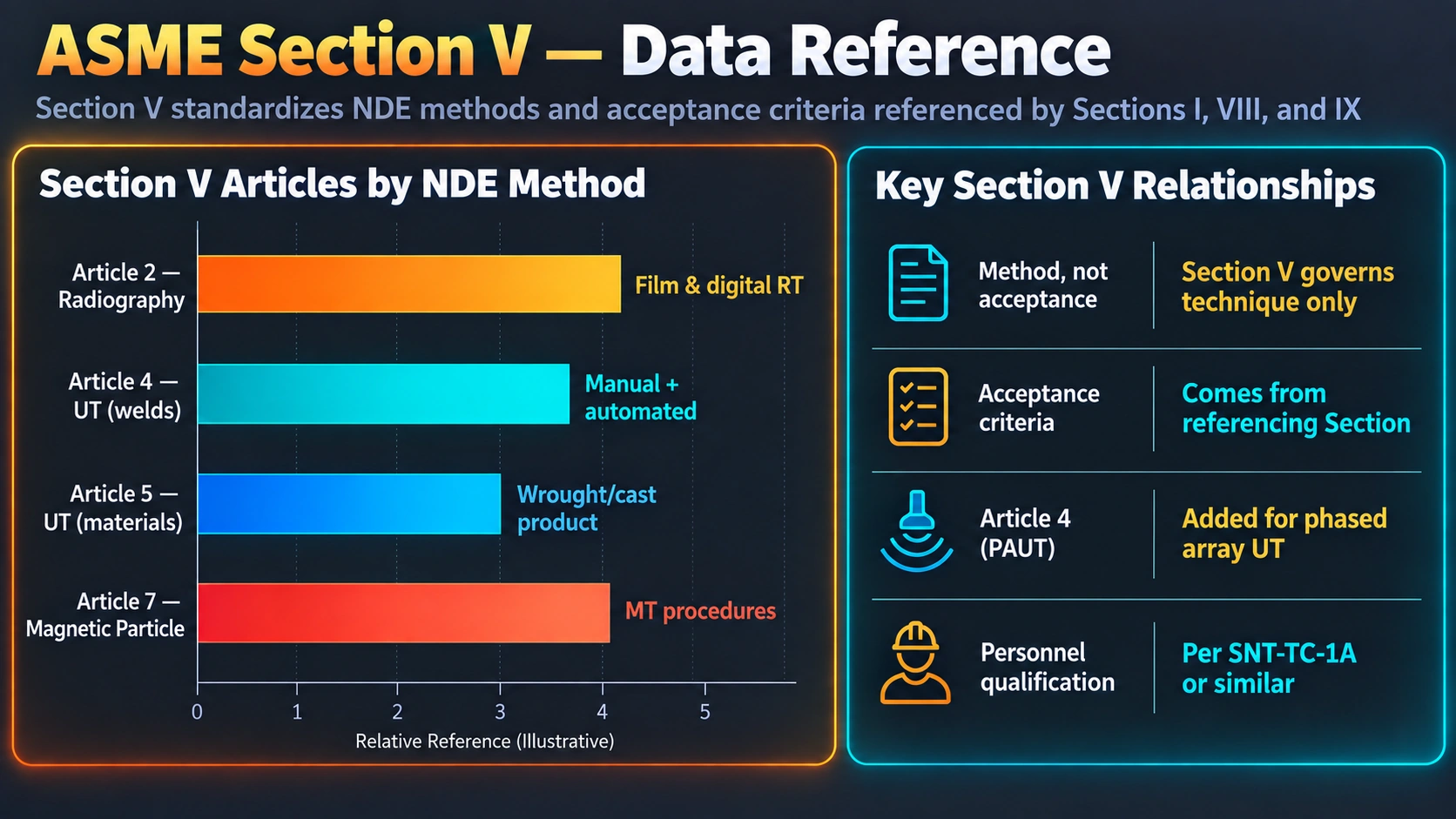
Every organisation performing NDE under ASME Section V must maintain a library of qualified written examination procedures. The essential variables that must be addressed — and that trigger procedure requalification when changed — differ by method. The following table summarises the key essential variables for the four most commonly invoked methods:
| Method | Key Essential Variables (sample) | Article Reference |
|---|---|---|
| RT | Source type (X-ray / gamma), source size, film brand/type, IQI type, screens, SFD range, radiation direction, filter | T-271 |
| UT (Contact) | Instrument type, transducer size/frequency/angle, couplant, calibration block, scanning pattern, temperature range | T-471 |
| PT | Penetrant type (I/II) and method (A/B/C/D), developer type, dwell times, temperature range, surface condition | T-671 |
| MT | Magnetisation technique, particle type (dry/wet, fluorescent/visible), field strength, AC/DC/HWDC, yoke or prod, overlap | T-771 |
Fabricators should review their written procedures against the current edition of Section V whenever the code edition applicable to their ASME Certificate of Authorisation is renewed. Non-essential variable changes (such as examining technician identity or examination shift) do not require requalification but must still be documented in the examination record.
Relationship Between Section V and Acceptance Criteria
The most important conceptual boundary in understanding Section V is the separation between examination (how you look) and acceptance (what you accept). Section V is entirely concerned with the former. When an NDE technician reports an indication on an RT film or a UT scan, the decision to accept or reject that indication is made by comparing it against the acceptance criteria in the referencing code, not Section V.
For pressure vessel fabrication to ASME Section VIII Division 1, the acceptance criteria are found in:
- Appendix 4 — Rounded indication charts and linear indication limits for RT
- Appendix 6 — Linear indication limits for PT (relevant indications > 1/16 in / 1.6 mm)
- Appendix 7 — Linear and rounded indication criteria for MT
- Appendix 12 — Amplitude-based and flaw-size-based criteria for UT
This also means that an NDE technician must be familiar with both Section V (how to perform and document the examination) and the acceptance criteria in the relevant Appendix. Quality plans for ASME vessels should explicitly identify both the Section V article governing the examination procedure and the Section VIII appendix governing acceptance for each weld joint type.
Practical Application: Setting Up an NDE Programme for an ASME Vessel
For a fabrication shop building a pressure vessel to ASME Section VIII Division 1, implementing a compliant NDE programme involves the following structured steps:
- Identify required examinations from the Design Specification and Section VIII requirements (UW-11, UW-51, UW-52, and applicable appendices).
- Establish the applicable edition of Section V specified in the contract or Manufacturer’s Design Report.
- Write or procure qualified written procedures for each method (RT, UT, PT, MT, VT) addressing all essential variables per the relevant Section V article.
- Verify NDE personnel qualifications — confirm ASNT SNT-TC-1A Level II (minimum) certification for each method, valid vision test records, and currency of certification.
- Calibrate equipment per Section V requirements and document calibration records.
- Perform examinations per written procedures; document in examination reports identifying technician, procedure reference, calibration block, IQIs used, and findings.
- Apply acceptance criteria from the relevant Section VIII appendix to each indication reported.
- Retain records per UG-93 and make available to the Authorised Inspector for review prior to Code stamping.
Recommended Books on ASME Section V and NDE
ASME BPVC Section V — Nondestructive Examination (2023 Edition)
The official ASME code book. Essential for any fabrication shop, inspection contractor, or engineer working under ASME pressure vessel and piping codes.
View on AmazonNondestructive Testing Handbook — ASNT (3rd Ed.)
The authoritative ASNT reference set covering all NDE methods in depth, widely used for Level II and Level III qualification study and procedure development.
View on AmazonIntroduction to Nondestructive Testing — Paul E. Mix
A comprehensive introduction covering all major NDT methods including RT, UT, PT, MT, and ET with practical worked examples. Ideal for engineers entering NDT.
View on AmazonNon-Destructive Testing — J. Prasad & C.G.K. Nair
A practical NDT guide popular with Indian engineering students and inspection professionals, covering PT, MPI, RT, and UT with ASME and IS code references.
View on AmazonDisclosure: WeldFabWorld participates in the Amazon Associates programme (StoreID: neha0fe8-21). If you purchase through these links, we may earn a small commission at no extra cost to you. This helps support free technical content on this site.
FAQ — ASME Section V Nondestructive Examination
What is ASME Section V and what does it cover?
ASME Section V (BPVC Section V — Nondestructive Examination) is a reference code within the ASME Boiler and Pressure Vessel Code that establishes requirements and procedures for all major NDE methods including radiography, ultrasonics, liquid penetrant, magnetic particle, eddy current, visual examination, and leak testing. It also covers personnel qualification requirements and calibration standards. Section V does not contain acceptance criteria; those are specified in the referencing code such as Section VIII Division 1 or Section III. It is mandatory to the extent it is invoked by these other codes or by a purchaser specification.
What is the difference between Subsection A and Subsection B of ASME Section V?
Subsection A contains NDE methods and procedures written directly by ASME. These are the primary mandatory requirements when invoked by a referencing code such as Section VIII or B31.3. Subsection B contains ASTM standards adopted by ASME as reference documents covering the same NDE methods. The Subsection B documents are informational and non-mandatory unless specifically referenced by Subsection A or by another code section. In practice, Subsection B documents (such as ASTM E165 for PT and ASTM E709 for MT) are used extensively as the technical reference for procedure development even when not strictly mandatory.
Does ASME Section V contain acceptance criteria for NDE indications?
No. ASME Section V deliberately does not contain acceptance criteria for any NDE method. The acceptance standards for indications found during examination are always provided by the referencing code — for example, ASME Section VIII Division 1 Appendix 4 for RT, Appendix 6 for PT, Appendix 7 for MT, and Appendix 12 for UT. ASME Section III provides its own acceptance criteria for nuclear components. This separation keeps the examination procedure standard independent from the construction code and allows each code to calibrate acceptance criteria to its specific design margins and safety requirements.
What personnel qualification requirements does ASME Section V impose?
Section V Article 1 requires NDE personnel to be qualified and certified in accordance with a written practice. The most widely used employer-based qualification framework is ASNT SNT-TC-1A, which defines Level I, Level II, and Level III certifications for each NDE method based on minimum training hours, work experience, written examinations, and practical demonstrations. Some referencing codes — particularly for nuclear applications under Section III and Section XI — require qualification to ANSI/ASNT CP-189, which imposes third-party oversight of the certification process. The employer is responsible for training, examination, and maintaining certification records for all NDE personnel. Annual vision checks and periodic recertification are required.
Which NDE methods are covered by ASME Section V Subsection A?
Subsection A covers Articles 1 through 21. Article 1 is General Requirements. Articles 2, 4, and 5 cover radiographic examination and ultrasonic examination (welds and materials respectively). Articles 6 and 7 cover liquid penetrant and magnetic particle examination. Article 8 covers eddy current, Article 9 covers visual examination, and Article 10 covers leak testing. Articles 12–19 cover advanced methods including acoustic emission, alternating current field measurement (ACFM), magnetic flux leakage (MFL), remote field testing, and thermographic examination. The 2021 edition added Article 20 for computed tomography (CT) and Article 21 for pulsed eddy current (PEC) examination.
How does ASME Section V relate to Section VIII Division 1 for pressure vessels?
ASME Section VIII Division 1 references Section V for all NDE examination procedures. Clause UW-51 requires full radiographic examination of butt welds to be performed per Section V Article 2, and UW-52 governs spot radiography by the same reference. For liquid penetrant and magnetic particle examination, Section VIII Appendices 6 and 7 reference Section V Articles 6 and 7 for procedural requirements. The fabricator must follow Section V procedures to conduct the examination; Section VIII provides the acceptance criteria for the resulting indications in its numbered appendices. Quality plans for ASME vessels should explicitly identify both the Section V article and the Section VIII appendix applicable to each weld category and NDE method.
What is a Written Examination Procedure (WEP) under ASME Section V?
A Written Examination Procedure (WEP) is a documented, organisation-specific document that defines exactly how a specific NDE method will be applied for a given scope of work. Article 1 of Section V mandates that all NDE be performed in accordance with a written procedure. Each method article (Article 2 for RT, Article 4 for UT, etc.) specifies the essential variables that must be addressed in the procedure. Any change to an essential variable without procedure requalification is a code violation. The written procedure must be readily available at the examination location and must be approved by a Level III examiner or an authorised inspector prior to use. Essential variable changes require procedure requalification; non-essential variable changes are documented but do not require requalification.
What new examination methods were added to ASME Section V in the 2021 edition?
The 2021 edition added Article 20 covering Computed Tomography (CT) Examination and Article 21 covering Pulsed Eddy Current (PEC) Examination. Computed tomography provides three-dimensional volumetric imaging of components and is particularly valuable for complex castings and additive-manufactured parts where conventional RT projections are insufficient. Pulsed eddy current is used for wall thickness measurement through insulation and coatings, making it valuable for in-service inspection of insulated piping and vessels without requiring insulation removal. The 2021 edition also expanded the Article 2 appendices for digital radiography (DR) and the Article 4 appendices for phased array ultrasonics (PAUT), time-of-flight diffraction (TOFD), and full matrix capture (FMC).
What are the key differences between ASME Section V and ISO 9712 for NDE personnel?
ASME Section V references employer-based certification frameworks (ASNT SNT-TC-1A or ANSI/ASNT CP-189) where the employer trains, examines, and certifies their own NDE personnel. ISO 9712 is a third-party certification scheme where an independent certification body — accredited to ISO 17024 — examines and certifies NDE technicians at Level 1, 2, or 3. ISO 9712 certification is mandatory in the European Union for most industrial NDE under EN standards (e.g., EN ISO 5817 weld quality acceptance), and is widely recognised internationally. For ASME pressure vessel fabrication within the USA, SNT-TC-1A remains the dominant framework. International projects may require ISO 9712 certificates alongside ASNT qualifications. The key practical difference is portability: ISO 9712 certificates are issued by independent bodies and transferable between employers; SNT-TC-1A certificates are employer-specific and lapse when a technician changes employer.