Epoxy Primer vs Zinc-Rich Primer: Selection Guide
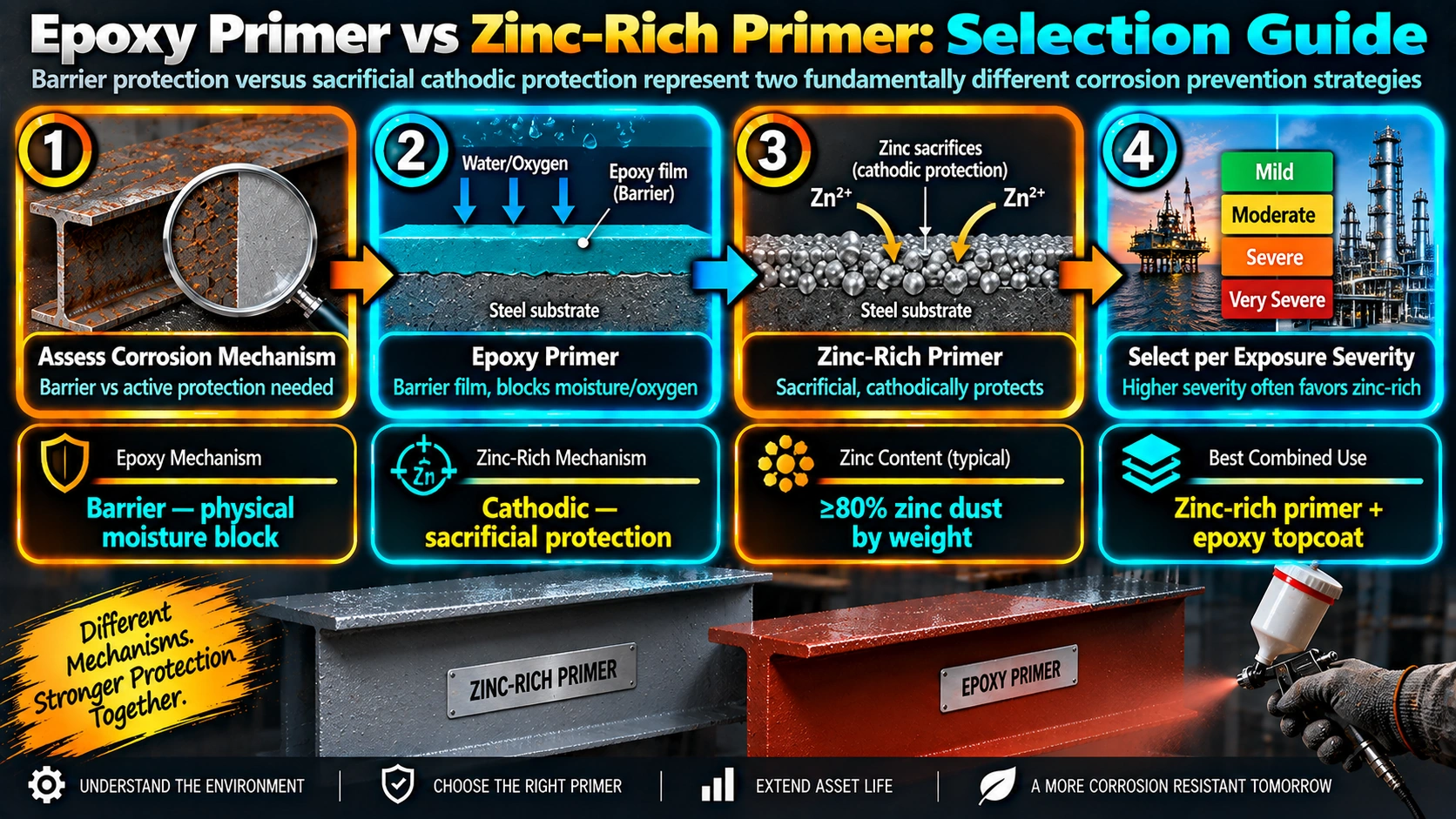
Choosing between epoxy primer and zinc-rich primer is one of the first and most consequential decisions in designing a coating system, because the two primer types protect steel through fundamentally different mechanisms. Epoxy primer relies on forming a dense, low-permeability barrier film that keeps moisture, oxygen, and ions away from the steel surface, while zinc-rich primer relies on galvanic sacrifice, where metallic zinc particles corrode preferentially in place of the substrate, actively protecting even small areas of exposed steel at coating damage points.
This guide compares how each primer type actually protects steel, the practical differences in application, surface preparation, and topcoat compatibility, and gives clear selection guidance by service condition. Understanding this distinction matters well beyond the paint shop, since the wrong primer choice for a given exposure category can mean the difference between a coating system that lasts 15 years and one that needs re-work within 3 to 5.
This article compares standard epoxy primers and zinc-rich (organic and inorganic) primers for carbon and low-alloy structural steel. It does not cover specialty primers such as moisture-cured urethane, wash primers, or shop-applied weldable primers, which follow separate selection logic.
How Each Primer Actually Protects Steel
Epoxy Primer: Barrier Protection
Standard epoxy primers work by forming a continuous, low-permeability polymer film over the steel surface. As long as the film remains intact and adequately thick, it slows the diffusion of water, oxygen, and chloride ions to a rate low enough that corrosion at the steel surface proceeds extremely slowly. The protection is entirely dependent on film integrity: at a scratch, pinhole, or coating holiday, bare steel is directly exposed and corrosion can initiate and undercut the surrounding intact film over time.
Zinc-Rich Primer: Galvanic (Cathodic) Protection
Zinc-rich primer contains a very high loading of metallic zinc dust, typically 65 to 95 percent by weight in the dry film, with enough particle-to-particle contact to form an electrically continuous zinc layer. Because zinc is more anodic (less noble) than steel in the galvanic series, the zinc corrodes preferentially, generating a small sacrificial current that actively protects the underlying steel, including at small coating breaks, exactly the same principle used in galvanic and cathodic protection systems more broadly.
Inorganic vs Organic Zinc Primer
| Property | Inorganic Zinc | Organic Zinc (Epoxy Zinc) |
|---|---|---|
| Binder type | Ethyl silicate / alkali silicate | Epoxy or similar organic resin |
| Typical zinc content | 80-95% by weight | 65-85% by weight |
| Cathodic protection level | Higher, longer-lasting | Good, generally lower than inorganic |
| Cure mechanism | Moisture/humidity cure, sensitive to conditions | Chemical cure, more forgiving |
| Application tolerance | Narrower film build window, mudcracking risk if too thick | Wider application tolerance |
| Topcoat recoat window | Can be narrower; follow data sheet closely | Generally easier to topcoat |
| Typical use | Offshore, marine, heavy industrial, tank exteriors | General industrial, structural, maintenance |
Most recognised zinc-rich primer specifications, including SSPC-Paint 20 and similar, require a minimum of roughly 65 to 80 percent metallic zinc by weight in the dry film for genuine sacrificial protection. Below this threshold, zinc particles may not maintain sufficient electrical continuity, and the coating behaves more like a pigmented barrier primer than a true galvanic system, even if “zinc” appears in the product name.
Comparison Summary
| Property | Epoxy Primer | Zinc-Rich Primer |
|---|---|---|
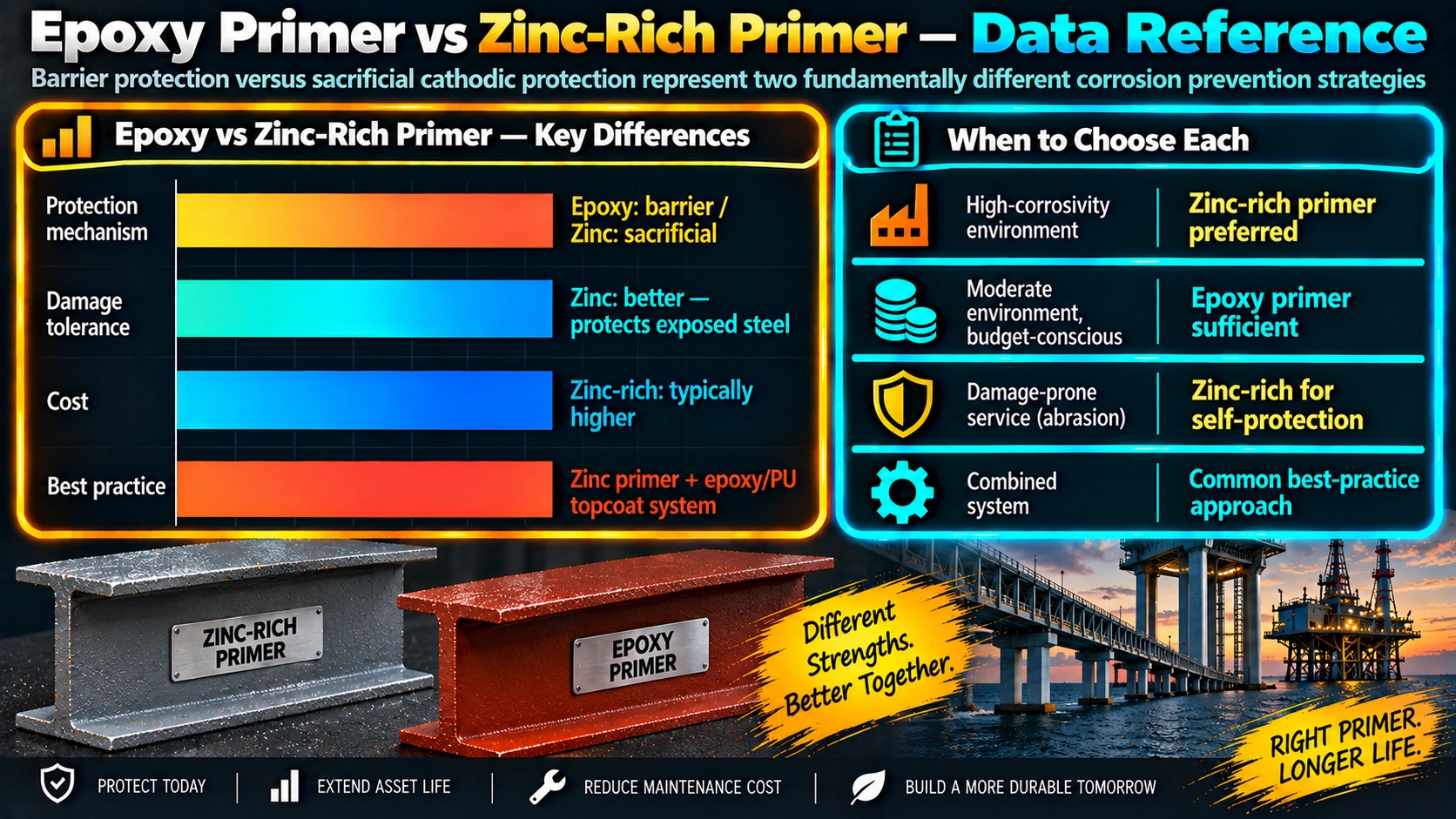
| Protection mechanism | Barrier (film integrity dependent) | Galvanic sacrifice (active at damage points) |
| Performance at coating holidays | No protection once breached | Continues protecting small exposed areas |
| Surface prep requirement | Sa 2.5 typical | Sa 2.5 to Sa 3, often more demanding |
| Application sensitivity | Moderate, wide film build tolerance | Higher, narrower film build tolerance |
| Typical relative cost | Lower | Higher (zinc dust content adds cost) |
| Best suited to | General atmospheric, indoor, moderate exposure | Marine, offshore, high-durability, long design life |
Full Coating System: Where Each Primer Fits
Many high-performance specifications do not force a choice between epoxy and zinc-rich primer at all — they combine both, using zinc-rich primer as the first coat for galvanic protection and an epoxy intermediate coat over it for additional barrier thickness and UV/mechanical protection ahead of the topcoat. This “zinc primer plus epoxy build coat plus polyurethane topcoat” structure is the standard high-durability system used across offshore, marine, and heavy industrial projects.
Selecting between an epoxy-only system and a zinc-primer system is largely driven by the ISO 12944 corrosivity category of the intended environment, from C1 (indoor, dry) through C5 (marine, industrial, or offshore) and Im (immersion), with the coating manufacturer’s system data sheet specifying the recommended build and expected durability range for each category.
Surface Preparation Requirements
Zinc-rich primer, particularly inorganic zinc, is generally more sensitive to surface preparation quality than epoxy primer, since good electrical contact between the primer and the steel (and between zinc particles) is essential for effective galvanic protection. Most zinc-rich primer data sheets call for Sa 2.5 minimum, and many specify Sa 3 for critical service, along with tighter soluble salt contamination limits than a typical epoxy-only system. See our companion guides on Sa blast cleanliness grades and surface profile measurement for the detailed acceptance procedures.
Applying zinc-rich primer over a surface with residual soluble salts or insufficient profile depth is one of the most common causes of premature coating system failure in marine and offshore projects, since it compromises both the mechanical anchoring and the electrical continuity the zinc layer depends on for sacrificial protection.
Welding Through Zinc-Rich Primer
Zinc-rich primers, particularly inorganic formulations, are more tolerant of welding through than most other primer or coating types, and shop-primed structural steel with zinc-rich primer is common in fabrication yards. However, welding still burns back the primer film near the joint, so the weld area and adjacent heat-affected zone require local re-blasting and re-priming after weld inspection and NDT sign-off is complete, and adequate fume extraction should always be used given zinc oxide fume generation during welding on zinc-primed steel.
Record the primer batch number, zinc content certification (if inorganic zinc, from the manufacturer’s certificate of analysis), applied dry film thickness, and surface preparation grade for every coated lot, since this traceability becomes critical if a coating system underperforms and the root cause needs to be isolated to material, application, or substrate preparation.
Quick Selection Guidance
| Application | Recommended Primer |
|---|---|
| Indoor equipment, mild atmospheric | Epoxy primer |
| General outdoor structural steel | Epoxy primer (zinc optional for extended life) |
| Marine atmospheric, coastal structures | Zinc-rich primer + epoxy build coat |
| Offshore platforms and structures | Zinc-rich primer + epoxy build coat + PU topcoat |
| Shop-primed structural steel (temporary protection) | Zinc-rich primer (weldable grade) |
| Tank/vessel interior immersion service | Epoxy primer/lining (zinc generally not used in immersion) |
Zinc-rich primer is generally unsuitable for continuous immersion service, since the galvanic reaction consumes zinc faster underwater and can generate hydrogen gas blistering under the topcoat. Immersion and tank lining systems almost always rely on epoxy or specialty lining barrier coatings instead of zinc-rich primer as the base coat.
Recommended Reference Material
Protective Coatings Handbook
Covers primer selection, coating system design, and corrosion protection mechanisms for industrial steel.
View on AmazonZinc-Rich Primer Application Reference Guide
Technical reference on inorganic and organic zinc-rich primer application and inspection practices.
View on AmazonISO 12944 Corrosion Protection Standards Set
Reference material on corrosivity categories and coating system durability requirements.
View on AmazonWet Film and Dry Film Thickness Gauge Kit
Combined WFT/DFT gauge kit for verifying primer and coating system film build during application.
View on AmazonDisclosure: WeldFabWorld participates in the Amazon Associates programme (StoreID: neha0fe8-21). If you purchase through these links, we may earn a small commission at no extra cost to you. This helps support free technical content on this site.
Frequently Asked Questions
What is the main difference between epoxy primer and zinc-rich primer?
Epoxy primer protects steel primarily through a barrier mechanism, forming a dense film that blocks moisture and oxygen from reaching the substrate, while zinc-rich primer protects primarily through galvanic (cathodic) sacrifice, where metallic zinc particles corrode preferentially in place of the underlying steel. Many high-performance coating systems use zinc-rich primer as the first coat specifically for its sacrificial protection, followed by an epoxy intermediate coat for barrier protection and a topcoat for UV and finish.
What is the difference between inorganic zinc and organic zinc primer?
Inorganic zinc primers use an ethyl silicate or similar inorganic binder and typically achieve higher zinc dust content by weight, giving superior long-term cathodic protection, but they require careful surface preparation and curing conditions and can be more prone to mudcracking if applied too thick. Organic zinc primers use an epoxy or similar organic resin binder, are more forgiving of application conditions and easier to topcoat, but generally offer somewhat lower galvanic protection than a comparable inorganic zinc system.
How much zinc dust content is needed for effective cathodic protection?
Most recognised zinc-rich primer specifications require a minimum of 65 to 80 percent metallic zinc by weight in the dry film for the primer to provide genuine sacrificial cathodic protection rather than acting merely as a pigmented barrier coating. Below roughly 65 percent zinc loading, the primer typically cannot sustain electrical continuity between zinc particles well enough to provide meaningful galvanic protection over time.
Can epoxy primer be used without a zinc-rich coat for steel structures?
Yes, epoxy primer alone is commonly used for general atmospheric structural steel, machinery, and equipment where barrier protection combined with correct surface preparation and adequate film thickness provides sufficient corrosion resistance for the design life required. Zinc-rich primer is typically added specifically where extended service life, damage tolerance at coating holidays, or marine/offshore exposure justifies the additional galvanic protection and cost.
Does zinc-rich primer need a topcoat?
Zinc-rich primer used alone is porous and will chalk and consume its zinc content faster when exposed directly to weathering, so most specifications require an epoxy intermediate coat and a polyurethane or similar topcoat over zinc primer for extended service life, UV resistance, and appearance. Zinc primer left uncoated is sometimes accepted for short-term construction protection or shop-primed steel awaiting field topcoat, but this is a temporary condition, not a final coating system.
Can epoxy zinc-rich primer be welded through without major coating damage?
Zinc-rich primers, particularly inorganic zinc formulations, are more weld-through tolerant than most other primer types because the zinc content limits porosity generation in the weld and reduces zinc fume compared to hot-dip galvanized steel, though welding still burns back the primer near the joint and requires local re-blasting and re-priming after welding. Always follow the coating manufacturer’s guidance and applicable ventilation and fume precautions when welding through any zinc-containing primer.