Coating Systems for Atmospheric vs Immersion vs Splash Zone Service
The same steel structure can face three completely different corrosion environments depending on where it sits relative to water, and coating systems for atmospheric, immersion, and splash zone service must be designed independently for each because a system that performs well in one zone can fail rapidly in another. This is most visible on offshore platforms, jetties, and ship hulls, where a single structure is deliberately coated with different systems, or different film thicknesses of the same system, zone by zone based on the exposure severity at each elevation.
This guide explains how atmospheric, splash zone, and immersion exposure differ in their corrosion mechanisms, walks through the ISO 12944 corrosivity category framework used to specify systems for each, and gives typical multi-coat system builds and material selection guidance for each zone.
This article focuses on liquid-applied organic coating systems for carbon and low-alloy steel across these three exposure zones. It does not cover cathodic protection system design for immersion and buried structures, which works alongside coatings but is a separate engineering discipline.
Why Zone Matters More Than Overall Location
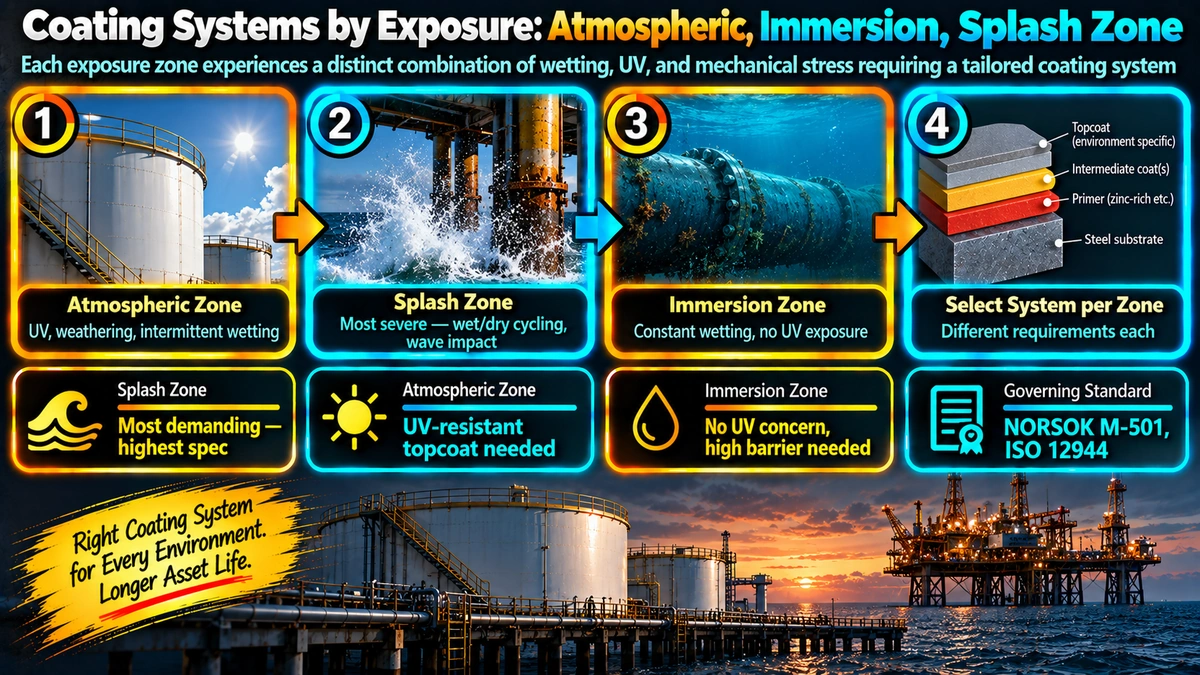
A single offshore jacket leg passes through three distinct corrosion regimes within just a few metres of vertical height: the atmospheric zone above high tide where the steel dries between wetting events, the splash/tidal zone where waves and tide create continuous wet-dry cycling, and the submerged zone below low tide where the steel is permanently wet and typically benefits from cathodic protection. Each zone has a measurably different corrosion rate on unprotected steel, with the splash zone consistently showing the highest rate of the three due to the combination of full oxygen availability, high moisture, and mechanical wear.
ISO 12944 Corrosivity Categories
| Category | Environment | Example |
|---|---|---|
| C1 | Very low (indoor, heated, dry) | Offices, dry warehouses |
| C2 | Low (indoor unheated, low pollution outdoor) | Storage areas, rural atmospheric |
| C3 | Medium (urban/industrial, moderate humidity) | General structural steel, most factories |
| C4 | High (industrial, coastal with moderate salinity) | Chemical plants, coastal structures |
| C5 | Very high (industrial, marine with high humidity/salinity) | Offshore atmospheric zones, heavy marine industry |
| CX | Extreme (offshore, subsea splash zone) | Offshore platform splash zones |
| Im1 | Immersion – fresh water | River structures, water treatment |
| Im2 | Immersion – sea/brackish water | Ship hulls, port structures |
| Im3 | Immersion – soil (buried) | Buried pipelines, foundations |
ISO 12944-2 defines the categories and ISO 12944-5 links each category to recommended generic coating system types and total system DFT ranges for different expected durability ranges (low, medium, high, very high). A coating manufacturer’s data sheet will typically state which ISO 12944 category and durability range its recommended system is qualified for.
Typical System Builds by Zone
| Zone | Typical System | Typical Total DFT |
|---|---|---|
| Atmospheric (C3-C4) | Epoxy primer + PU topcoat, or 2-coat epoxy | 150-200 microns |
| Atmospheric marine (C5) | Zinc-rich primer + epoxy intermediate + PU topcoat | 250-320 microns |
| Splash zone (CX) | Zinc/epoxy primer + glass-flake epoxy build coat(s) + PU/epoxy topcoat | 500-1000+ microns |
| Immersion, fresh water (Im1) | Multi-coat epoxy or vinyl ester lining system | 300-500 microns |
| Immersion, seawater (Im2) | Multi-coat epoxy, often glass-flake reinforced, with CP | 400-600 microns |
| Buried (Im3) | Fusion-bonded epoxy (FBE), tape wrap, or 3LPE, with CP | Varies significantly by system type |
Many standard atmospheric coatings are not formulated to resist continuous water contact and will blister, saponify (react with alkaline conditions from cathodic protection), or lose adhesion under sustained immersion even when they perform well atmospherically. Always confirm the coating manufacturer’s data sheet explicitly qualifies the product for immersion service before specifying it below the waterline.
Why Splash Zone Systems Are Different
The splash zone combines three punishing factors simultaneously: continuous wet-dry cycling that drives faster electrochemical corrosion than steady immersion or steady dry atmospheric exposure, mechanical abrasion and impact from wave action and floating debris, and full atmospheric oxygen availability alongside high chloride concentration from sea spray. Because splash zone access for maintenance is often difficult and expensive, requiring scaffolding, cofferdams, or specialist rope access, splash zone systems are typically designed with significant extra film thickness and abrasion resistance specifically to extend the maintenance interval, rather than accepting a thinner system and more frequent repair cycles.
Glass-Flake Reinforced Epoxy
Glass-flake reinforced epoxy is widely used in splash zone and immersion systems because the flat, overlapping glass flake particles dramatically increase the tortuosity of the path moisture must travel to reach the substrate, slowing water and ion diffusion compared to an unreinforced epoxy of the same thickness, while also adding significant mechanical toughness and abrasion resistance against wave and debris impact.
Immersion Service Considerations
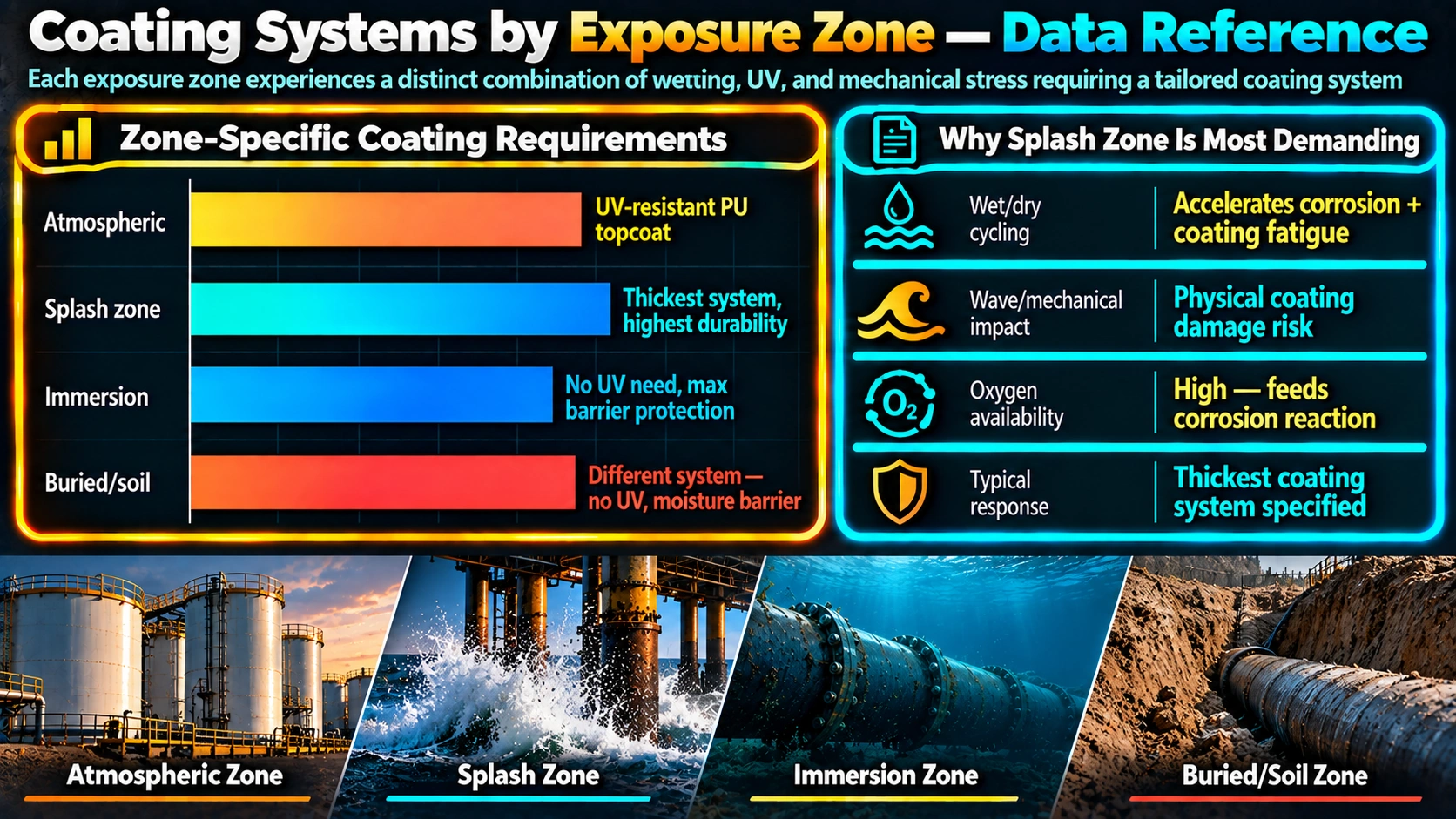
Immersion coatings must resist continuous water saturation without blistering (osmotic blistering being a common failure mode when soluble contaminants are trapped beneath the film) and are frequently used alongside cathodic protection systems, which requires the coating to also resist cathodic disbondment, a specific failure mode where the coating loses adhesion around a CP anode or damage point due to the alkaline environment generated by the CP current. Coating manufacturers publish immersion-specific product lines and typically require tighter surface preparation and holiday testing requirements for immersion-rated systems than atmospheric systems of similar generic type.
The harder and more expensive a zone is to access for future repair, the more rigorous the original application quality assurance should be, since the cost of a missed defect scales with inaccessibility. This is why buried pipeline and subsea immersion coatings typically carry the most stringent DFT verification and adhesion testing requirements of any coating category.
Zone Transition and Overlap
Because tide levels vary and wave splash extends unpredictably above the theoretical high-water mark, project specifications typically define the splash zone with a generous margin above the highest expected tide and wave run-up level, and the atmospheric and splash zone coating systems are usually overlapped and feathered at the transition rather than butted at a sharp line, ensuring no gap in protection at the boundary.
Maintain separate records of coating system, batch, DFT, and inspection results by zone on drawings or a coating zone map, since maintenance planning and future inspection intervals are typically set independently for each zone based on its distinct exposure severity and expected system life.
Zone-specific coating application should always follow completion of mechanical testing and structural NDT sign-off, with particular attention to weld areas at zone transition elevations, which often receive the thicker splash zone system extended slightly into the adjacent atmospheric zone as an added safety margin.
Recommended Reference Material
ISO 12944 Corrosion Protection Standards Reference
Reference material on corrosivity categories, system durability, and coating selection by exposure zone.
View on AmazonMarine and Offshore Coatings Handbook
Covers splash zone, immersion, and atmospheric coating system design for marine structures.
View on AmazonCathodic Protection and Coatings Reference
Technical reference on combined CP and coating system design for immersion and buried structures.
View on AmazonCoating Thickness and Adhesion Inspection Kit
Combined DFT gauge and adhesion tester kit for zone-specific coating QC verification.
View on AmazonDisclosure: WeldFabWorld participates in the Amazon Associates programme (StoreID: neha0fe8-21). If you purchase through these links, we may earn a small commission at no extra cost to you. This helps support free technical content on this site.
Frequently Asked Questions
Why is the splash zone the most demanding coating environment on an offshore structure?
The splash zone experiences continuous wet-dry cycling from wave action, high mechanical wear from wave impact and floating debris, full oxygen availability combined with high chloride concentration, and difficulty accessing the area for maintenance, all of which combine to make it the highest corrosion rate zone on most offshore structures, often specified with a thicker and more robust coating system than either the atmospheric or fully immersed zones on the same structure.
What are ISO 12944 corrosivity categories and how do they apply to coating selection?
ISO 12944 defines atmospheric corrosivity categories from C1 (very low, indoor dry) to C5 (very high, industrial or marine with high humidity and chloride) and CX (extreme, offshore), plus separate immersion categories Im1 (fresh water), Im2 (sea/brackish water), and Im3 (soil, buried structures). Each category corresponds to a recommended coating system generic type, minimum total dry film thickness, and expected durability range, giving specifiers a standardised starting point for system selection.
Can the same coating system be used for both atmospheric and immersion service?
Generally no. Immersion service requires coatings specifically formulated and tested for continuous water contact, since many standard atmospheric coatings will blister, saponify, or lose adhesion under sustained immersion even if they perform well in atmospheric exposure. Coating manufacturers publish separate immersion-grade products and system recommendations, and substituting an atmospheric-rated system into immersion service is a common and costly specification error.
Why do splash zone coating systems typically need more coats than atmospheric systems?
Splash zone systems need greater total dry film thickness and often an additional intermediate coat to withstand the combined mechanical abrasion from wave and debris impact and the accelerated corrosion driven by continuous wet-dry cycling, both of which degrade a thinner atmospheric-style system far faster than steady atmospheric exposure would. Many splash zone systems also use glass-flake reinforced epoxy specifically for its abrasion and impact resistance.
What is glass-flake reinforced epoxy and when is it used?
Glass-flake reinforced epoxy is a coating formulation containing flat glass flake particles dispersed through the resin, which increase the tortuosity of the moisture diffusion path through the film and add mechanical toughness and abrasion resistance. It is commonly specified for splash zone structural members, ballast tanks, and other high-wear, high-corrosion applications where standard epoxy would erode or lose barrier performance too quickly.
How does maintenance strategy differ between atmospheric, splash zone, and immersion coatings?
Atmospheric coatings are generally the most accessible for routine inspection and touch-up maintenance during normal operations. Splash zone coatings are the hardest to access safely and are often designed with extra thickness specifically to extend the interval between costly access-dependent maintenance campaigns. Immersion coatings, particularly on buried or subsea structures, may be effectively inaccessible for inspection or repair after installation, so they are typically specified with the highest quality assurance requirements and the largest design margin of any of the three categories.