Hydrogen Embrittlement vs Hydrogen Cracking: Key Differences
Hydrogen embrittlement and hydrogen cracking are two terms that get used almost interchangeably on the shop floor, and in most welding conversations that loose usage causes no real harm because weld hydrogen cracking genuinely is the most common form of hydrogen embrittlement an engineer will encounter. But the two terms are not actually synonyms, and the difference matters the moment a failure shows up somewhere other than a fresh weld HAZ — a plated fastener, a sour-service pipeline component, a hydrogen storage vessel — where “check the WPS preheat” is the wrong first question entirely.
This article draws the line between the general phenomenon and its weld-specific manifestation: what hydrogen embrittlement covers as a materials-science mechanism, what makes weld hydrogen cracking a distinct and narrower category within it, and where each term is the correct one to reach for. For the practical welding-shop causes, cures, and prevention of weld hydrogen cracking itself — preheat, consumable handling, electrode storage — see the dedicated Hydrogen Cracking in Steel Welding guide, which this article deliberately does not repeat.
What Hydrogen Embrittlement Actually Covers
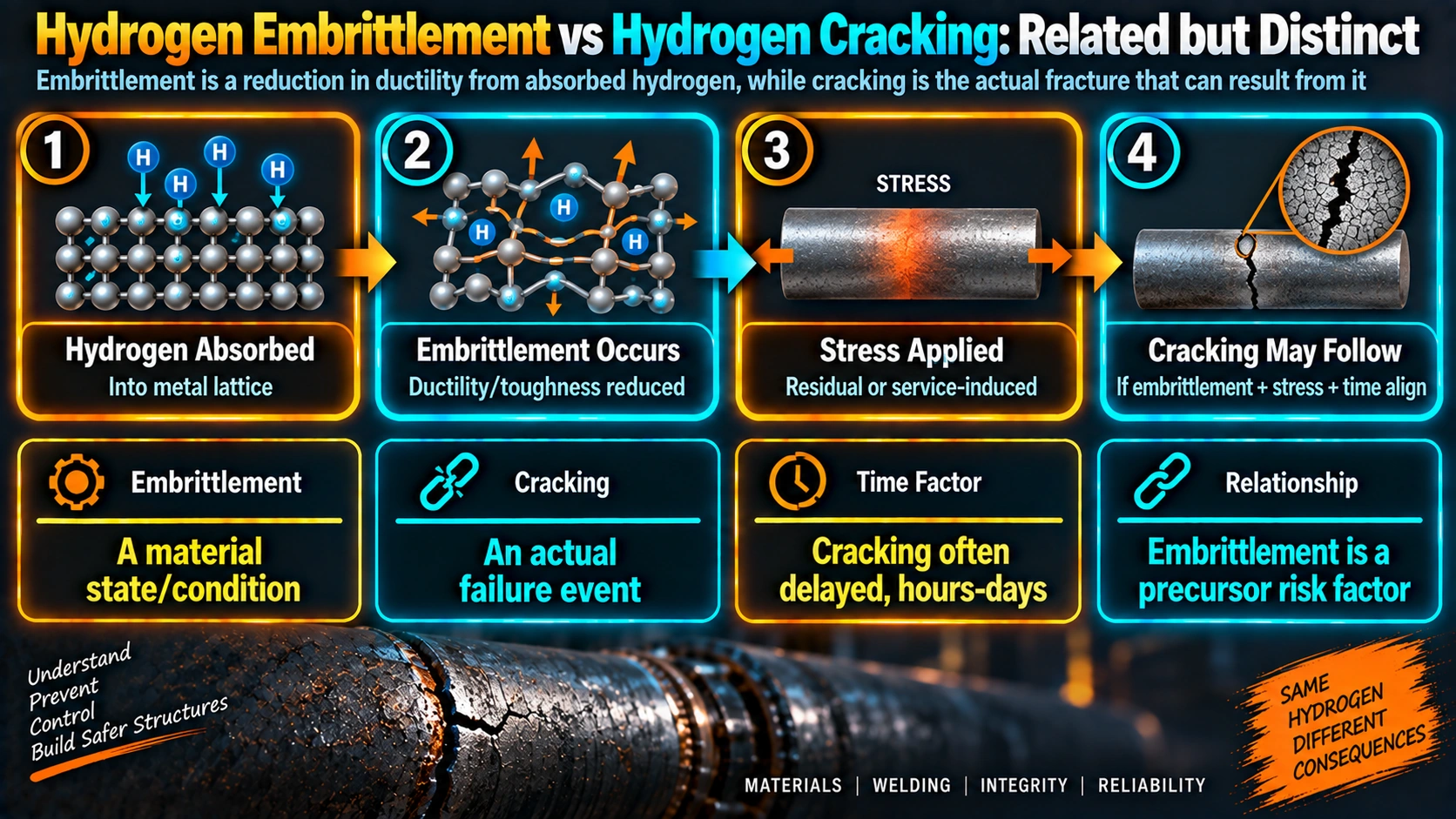
Hydrogen embrittlement (HE) is a broad materials degradation mechanism affecting steels, nickel alloys, titanium alloys, and several other metal systems, in which atomic hydrogen absorbed into the lattice lowers the stress required for crack initiation and propagation, sharply reducing measured ductility and fracture toughness under sustained or applied load. It is not tied to any particular process that introduces the hydrogen — welding is only one of several possible sources.
Common Non-Welding Sources of Hydrogen Embrittlement
- Electroplating — cadmium, zinc, and chrome plating baths generate atomic hydrogen at the part surface during the plating reaction; high-strength fasteners are especially vulnerable and require mandatory post-plate baking.
- Acid pickling and descaling — surface cleaning in acid solutions liberates atomic hydrogen that can diffuse into the part before it recombines into harmless molecular hydrogen gas at the surface.
- Cathodic protection — over-protected structures (impressed current or sacrificial anode systems run at excessively negative potentials) can generate hydrogen at the metal surface in the same way as electroplating.
- Sour (H2S) service corrosion — wet hydrogen sulfide environments generate atomic hydrogen as a corrosion by-product, which is absorbed into susceptible high-hardness material — this specific case is called sulfide stress cracking (SSC).
- High-pressure gaseous hydrogen service — hydrogen storage vessels, pipelines, and process equipment can absorb hydrogen directly from the service gas under pressure and temperature.
None of these sources involve a welding arc at all, which is exactly why “hydrogen embrittlement” as a term needs to stay broader than “hydrogen cracking.”
What Makes Weld Hydrogen Cracking a Distinct Category
Weld hydrogen cracking — also called cold cracking or delayed cracking — is the specific form of hydrogen embrittlement that occurs in the heat affected zone or weld metal of a welded joint, driven by diffusible hydrogen introduced during the welding process itself (damp electrode coatings, hydrocarbon contamination, moisture in shielding gas or flux) combined with the hard transformation microstructure and residual stress the weld thermal cycle itself creates. It is narrower than general HE in three specific ways: the hydrogen source is tied to the welding process, the susceptible microstructure is the as-welded HAZ or weld metal rather than a bulk-processed component, and the time frame is tied to the cooling and hydrogen diffusion behaviour immediately following welding rather than to a service exposure period that can run for years.
Side-by-Side Comparison
| Aspect | Hydrogen Embrittlement (general) | Weld Hydrogen Cracking |
|---|---|---|
| Hydrogen source | Plating, pickling, cathodic protection, sour corrosion, gaseous H2 service | Welding consumable moisture, arc atmosphere, contamination |
| Affected zone | Bulk component, fastener, or corroded surface — anywhere | Weld metal and heat affected zone specifically |
| Time frame | Can develop over months or years of service exposure | Typically hours to a few days after welding (delayed cracking) |
| Susceptible microstructure | Any high-strength/high-hardness condition (quenched, cold-worked, precipitation-hardened) | As-welded martensite or bainite in the HAZ or weld metal |
| Primary assessment tests | Sustained-load test (ASTM F519, ISO 15330), NACE TM0177 for SSC | Tekken test, CTS test, Implant test |
| Primary controls | Bake-out after plating, hydrogen barrier coatings, material selection for service | Preheat, low-hydrogen consumables, controlled heat input |
Mechanism: Why Hydrogen Embrittles Steel at All
Two mechanisms are generally cited to explain how absorbed hydrogen reduces fracture resistance, and both are relevant regardless of which sub-type of embrittlement is being discussed:
Hydrogen Enhanced Decohesion (HEDE)
Hydrogen atoms accumulate at regions of high triaxial stress ahead of a crack tip or at grain boundaries, weakening the interatomic (metal-metal) bonding force and lowering the stress needed to separate atomic planes — effectively reducing the cohesive strength of the lattice or grain boundary directly.
Hydrogen Enhanced Localised Plasticity (HELP)
Hydrogen increases dislocation mobility in a narrow zone immediately around the crack tip, concentrating plastic deformation into a very thin band rather than allowing it to spread through a larger volume, which produces a locally ductile-looking fracture mechanism that still results in an overall brittle, low-energy failure at the macroscopic scale.
In weld HAZ cracking, the martensitic or bainitic microstructure provides an especially high density of hydrogen trapping sites (lath boundaries, dislocations) alongside the residual tensile stress from weld shrinkage, which is why both mechanisms operate particularly aggressively in as-welded low-alloy steel compared to a stress-relieved or tempered structure with the same nominal hydrogen content.
Assessment and Testing: How the Two Fields Diverge
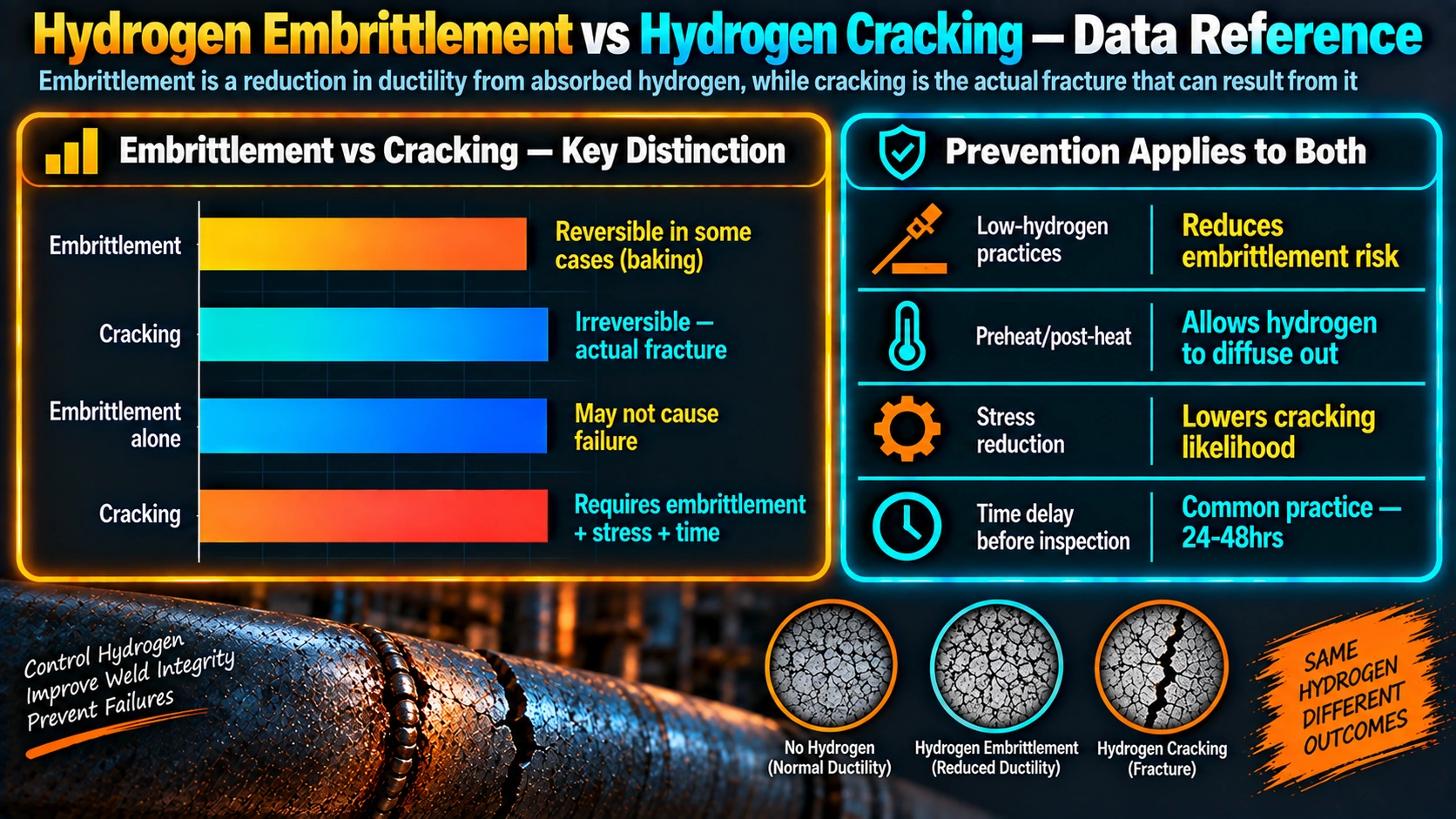
Because the hydrogen source and service context differ, the two fields have developed largely separate test methods.
General Hydrogen Embrittlement Testing
Fastener and coated-component hydrogen embrittlement is commonly assessed with a sustained-load test such as ASTM F519 or ISO 15330, where notched specimens plated under production conditions are loaded to a fixed percentage of their notch strength and held for a specified duration, commonly 200 hours, with any cracking or failure treated as a fail. Sulfide stress cracking resistance for sour service materials is assessed under NACE TM0177, which similarly applies sustained load in a defined H2S environment.
Weld Hydrogen Cracking Testing
Weld hydrogen cracking susceptibility is instead assessed with weldability tests built around the actual thermal cycle — the Tekken test, the Controlled Thermal Severity (CTS) test, and the Implant test all weld a specimen under controlled conditions and evaluate cracking as a function of preheat, hydrogen level, and restraint, rather than applying a static sustained load to an already-finished component.
Frequently Asked Questions
Is hydrogen cracking the same thing as hydrogen embrittlement?
No, though they are closely related and often used loosely as synonyms. Hydrogen embrittlement is the broad materials-science phenomenon of reduced ductility and fracture resistance in a metal due to absorbed hydrogen, from any source. Hydrogen cracking is the specific manifestation of that phenomenon that occurs in the heat affected zone or weld metal of a welded joint shortly after welding. Every hydrogen crack is a form of hydrogen embrittlement, but most hydrogen embrittlement failures — electroplated fasteners, sour service pipe, pickled wire — have nothing to do with welding at all.
Why do engineers use the two terms interchangeably?
Because in day-to-day welding shop practice, hydrogen cracking is by far the most commonly encountered form of hydrogen embrittlement, so the terms get used as if they cover the same ground. In broader materials engineering — fastener manufacturing, electroplating, sour service pipelines, high-pressure hydrogen storage — hydrogen embrittlement covers failure mechanisms that have nothing to do with a welding thermal cycle at all, which is where the distinction actually matters. See the weld hydrogen cracking guide for the welding-specific case in full detail.
What sources of hydrogen cause embrittlement outside of welding?
Common non-welding sources include electroplating (cadmium, zinc, or chrome plating baths generate atomic hydrogen at the part surface), acid pickling and descaling operations, cathodic protection systems that are over-protected, sour (H2S-containing) service environments, and high-pressure gaseous hydrogen service or storage. All of these can embrittle a susceptible high-strength steel component with no weld anywhere near the failure.
Does hydrogen embrittlement always need a hard microstructure to occur?
High-hardness, high-strength microstructures are far more susceptible, which is a shared feature between hydrogen cracking and most forms of hydrogen embrittlement, but susceptibility is not limited to martensite in a weld HAZ. High-strength fastener steels, precipitation-hardened alloys, and even some nickel-base alloys used in sour or high-pressure hydrogen service can embrittle without ever having been welded, because their strengthening mechanism creates the same kind of hydrogen trapping sites and reduced fracture resistance.
How is hydrogen embrittlement in fasteners tested differently from weld hydrogen cracking?
Fastener and general component hydrogen embrittlement is typically assessed with sustained-load tests such as ASTM F519 or ISO 15330, where a notched or full-size specimen is held under a fixed load for a specified period (commonly 200 hours) and checked for cracking or failure. Weld hydrogen cracking is instead assessed with weldability tests such as the Tekken test, the Controlled Thermal Severity (CTS) test, or the Implant test, which are built around the welding thermal cycle rather than a static sustained load on a finished part.
Can baking remove hydrogen in both cases?
Yes, low-temperature bake-out (typically 190-220 degC for several hours) is used to diffuse hydrogen out in both contexts, but the practical application differs. In welding, this appears as a post-weld hydrogen bake-out hold before final NDT on crack-sensitive joints. In electroplating, post-plate baking within a short window after plating is a standard specification requirement (e.g., ASTM B850) specifically because plating-introduced hydrogen embrittles high-strength fasteners if left untreated.
Is sulfide stress cracking a form of hydrogen embrittlement or hydrogen cracking?
Sulfide stress cracking (SSC) is a form of hydrogen embrittlement, not hydrogen cracking in the welding sense, because the hydrogen source is corrosion in a wet H2S service environment rather than a welding arc or consumable. However, if the affected component happens to be a weld HAZ, the local hardness and residual stress left over from welding can make that specific zone the most susceptible location for SSC to initiate, which is why NACE MR0175 hardness limits apply directly to weld metal and HAZ. See the sour service guide for more detail.
Which term should I use in a failure investigation report?
Use hydrogen cracking (or cold cracking / delayed cracking) only when the failure occurred in or near a weld shortly after welding and the hydrogen source is traceable to the welding process. Use hydrogen embrittlement as the general mechanism description, and name the specific sub-type (weld hydrogen cracking, sulfide stress cracking, plating-induced embrittlement) once the hydrogen source and affected zone are established, since a generic report label without that detail makes root cause tracing harder. See the fractography guide for identifying hydrogen-related fracture features during investigation.
Recommended Reading
Welding Metallurgy and Weldability (Lippold)
Covers weld hydrogen cracking mechanisms, testing, and prevention in depth, including the HAZ-specific three-factor model.
View on AmazonHydrogen Embrittlement: Prevention and Control (ASTM STP)
Reference covering hydrogen embrittlement mechanisms, testing methods, and prevention across fasteners, plating, and service environments.
View on AmazonCorrosion Engineering (Fontana)
Standard corrosion reference with strong coverage of sulfide stress cracking and hydrogen damage mechanisms in service environments.
View on AmazonMechanical Metallurgy (Dieter)
Fundamentals of fracture mechanics and embrittlement mechanisms underlying both weld cracking and general hydrogen damage.
View on AmazonDisclosure: WeldFabWorld participates in the Amazon Associates programme (StoreID: neha0fe8-21). If you purchase through these links, we may earn a small commission at no extra cost to you. This helps support free technical content on this site.