Stress Corrosion Cracking: Mechanisms and Prevention
Stress corrosion cracking (SCC) is one of the most dangerous failure modes an engineer can face, precisely because it strikes normally ductile alloys in environments that would otherwise be considered only mildly corrosive. A vessel or pipe can look bright and undamaged right up until fine, often branching cracks propagate to a critical size and it fails without warning. SCC is highly specific: a given alloy is usually vulnerable to only a handful of environments, which makes recognising the classic material-environment combinations the single most useful piece of knowledge an engineer can carry into a materials selection or failure investigation decision.
This guide covers the mechanisms behind SCC, the three conditions that must occur together for it to happen, the classic combinations engineers encounter in fabrication and process industries, how welding contributes to SCC risk, and the prevention and testing methods used to manage it. For the metallurgical process that makes stainless steel specifically vulnerable to one SCC sub-type, see the sensitization in stainless steel guide; for the related but distinct hydrogen-driven cracking mechanism in sour service, see the sour service guide.
What Makes SCC Distinct From Other Corrosion
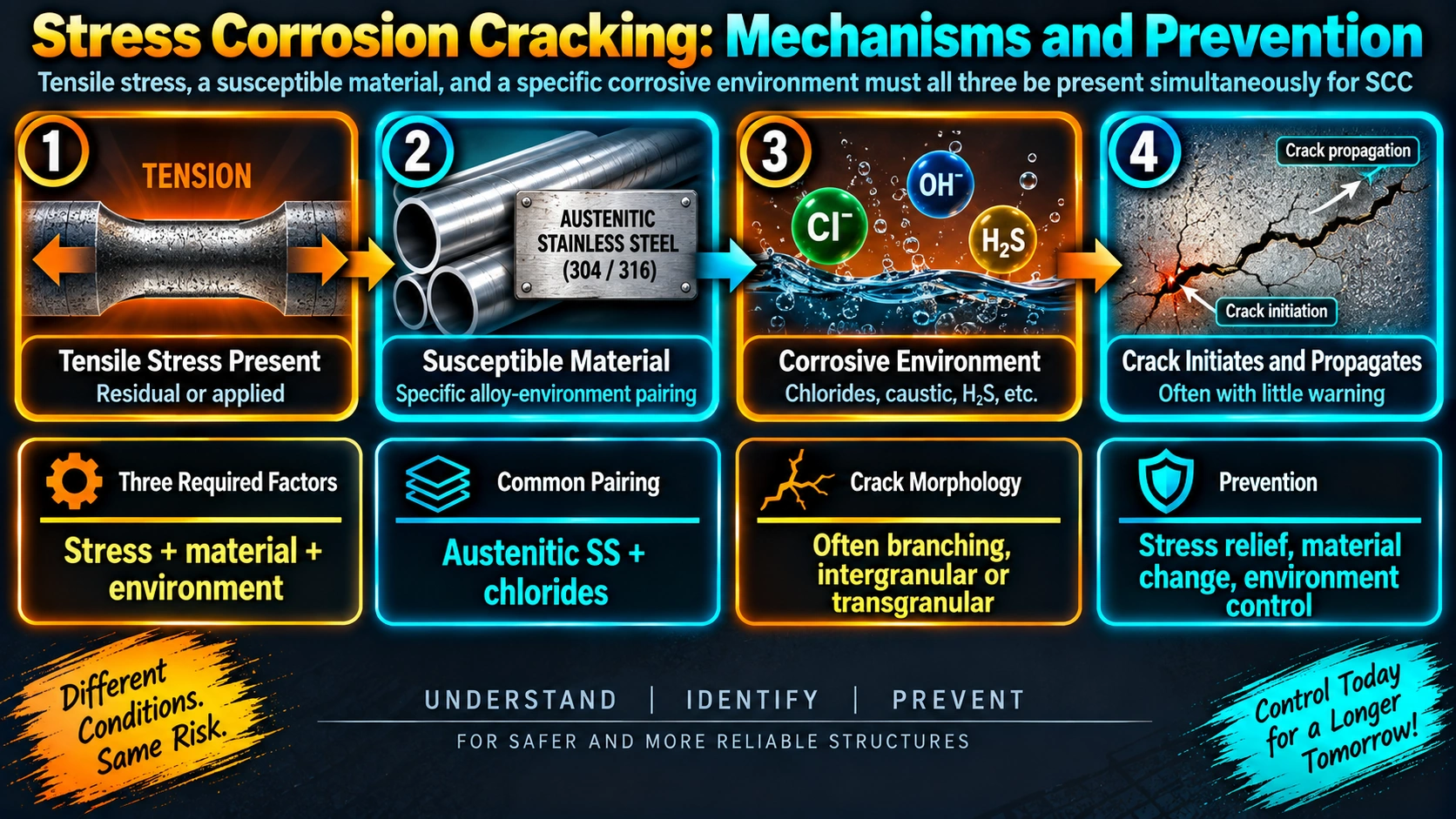
Three features set SCC apart from general or localised corrosion. First, it requires a specific combination of alloy and environment — the same steel that cracks readily in one chemical environment may be entirely immune in another. Second, the environment involved is often only mildly aggressive to the base material by normal corrosion standards, so general metal loss is minimal and easy to overlook during inspection. Third, the resulting cracks frequently propagate perpendicular to the applied or residual tensile stress and can branch extensively, producing a fracture surface with combined mechanical and environmental features rather than the smooth dissolution typical of general corrosion.
Mechanisms of Stress Corrosion Cracking
Anodic Dissolution (Slip-Dissolution / Film Rupture Model)
In this mechanism, a protective passive film covers the alloy surface, but localised plastic strain at the crack tip continuously ruptures the film, exposing bare, highly reactive metal that dissolves anodically before the film can re-form. Because the crack tip strains repeatedly while the crack walls behind it stay passivated, dissolution concentrates almost entirely at the tip, producing the sharp, penetrating crack characteristic of SCC rather than general surface attack. This mechanism dominates in chloride SCC of austenitic stainless steel and in caustic SCC of carbon steel.
Hydrogen-Assisted Cracking
In some SCC systems, particularly high-strength steels and certain environments that generate atomic hydrogen as a corrosion by-product (sulfide and some chloride environments), crack advance is driven by hydrogen embrittlement of the material ahead of the crack tip rather than by direct anodic dissolution. This overlaps significantly with the mechanisms covered in the WeldFabWorld hydrogen cracking guide, and in practice some failures involve both anodic dissolution and hydrogen-assisted mechanisms acting together.
Film-Induced Cleavage
A less common mechanism proposes that a brittle surface film (an oxide or dealloyed layer) cracks under stress, and that cleavage-type crack briefly propagates a short distance into the underlying ductile metal before arresting or blunting, repeating step by step as the film re-forms and cracks again. This mechanism has been proposed for some specific systems including certain brass-ammonia and stainless-chloride combinations, though it remains less broadly accepted than the slip-dissolution model.
Classic Material-Environment SCC Combinations
| Material | Environment | Crack Mode | Common Application |
|---|---|---|---|
| Austenitic stainless steel (304, 316) | Chlorides, elevated temperature | Transgranular, branching | Process piping, insulated vessels (CUI) |
| Sensitized austenitic stainless steel | Polythionic acid (sulfur + air + moisture) | Intergranular | Refinery/petrochemical shutdowns |
| Carbon and low-alloy steel | Concentrated caustic (NaOH), crevices | Intergranular | Boilers, caustic service vessels |
| Carbon steel | Anhydrous ammonia | Intergranular / mixed | Ammonia storage and transport |
| Brass and other copper alloys | Ammonia, moist air (“season cracking”) | Intergranular | Fittings, tubing, historically cartridge cases |
| High-strength steel | H2S, sour environments | Predominantly hydrogen-assisted | Oil and gas production, sour gathering lines |
| Ni-base alloys | High-temperature caustic, chlorides | Intergranular / transgranular | Nuclear steam generators, severe chloride service |
How Welding Contributes to SCC Risk
Welding contributes to SCC susceptibility through two separate mechanisms that often act together on the same joint:
Residual Tensile Stress
Weld shrinkage generates residual tensile stress that can approach the material’s yield strength near the weld toe and in the HAZ, supplying the “tensile stress” leg of the SCC triangle even where no external service load is applied. This is why SCC failures cluster so heavily around weld joints and heat affected zones in service, and why post-weld stress relief is a standard mitigation.
Sensitization
In austenitic stainless steel, the thermal cycle of welding can precipitate chromium carbides at grain boundaries in the HAZ, depleting adjacent chromium and creating a susceptible path for intergranular attack, including polythionic acid SCC. Low-carbon (L-grade) and stabilised (Ti or Nb-bearing) stainless grades are specified precisely to reduce this susceptibility — see the sensitization guide for the full mechanism and grade selection guidance.
Recognising SCC in Fractography
SCC fracture surfaces typically show branching cracks, often with both transgranular and intergranular features depending on the mechanism and system involved, combined with limited or no visible general corrosion on the surrounding surface. The fractography in metals guide covers how to distinguish SCC fracture features from fatigue, hydrogen cracking, and mechanical overload during a failure investigation.
Prevention and Mitigation Strategies
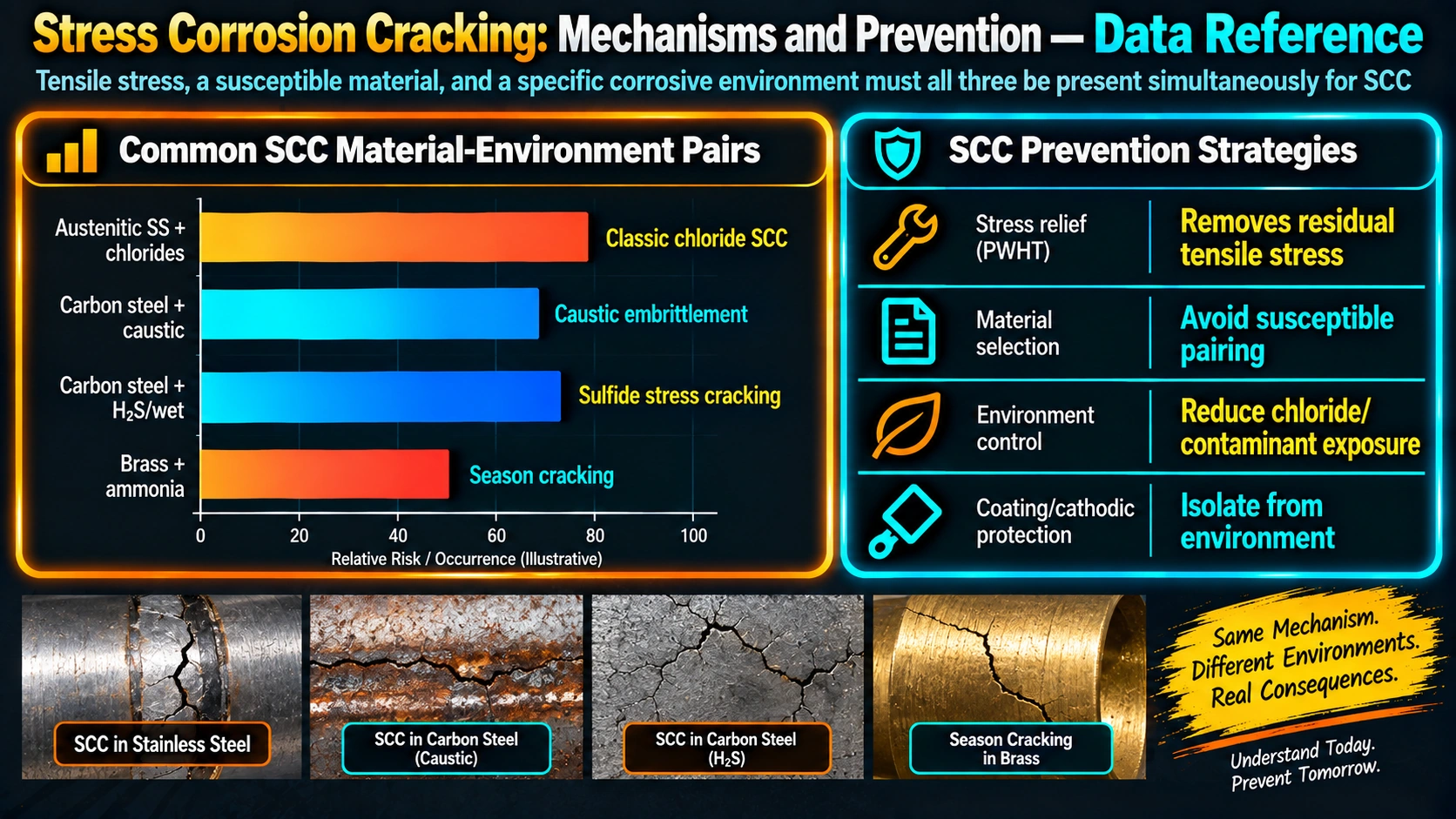
| Strategy | How It Works | Typical Application |
|---|---|---|
| Material selection | Choose an alloy not susceptible to the specific environment (e.g. duplex or Ni-alloy instead of 304/316 for hot chloride service) | New design, upgrade during revamp |
| Stress relief (PWHT) | Reduces residual tensile stress below the threshold needed for crack initiation | Carbon steel caustic service, some stainless applications |
| Environmental control | Limit chloride content, control pH, exclude oxygen, use corrosion inhibitors | Cooling water systems, process streams |
| Coatings and insulation practices | Prevent moisture and chloride contact; use CUI-resistant jacketing and sealed insulation systems | Insulated piping and vessels |
| Shot peening / surface cold working | Introduces beneficial compressive residual stress at the surface | High-value components, critical welds |
| Cathodic protection | Shifts electrochemical potential away from the SCC-susceptible range | Buried pipelines, submerged structures (used cautiously to avoid hydrogen embrittlement) |
Testing Methods for SCC Susceptibility
- U-bend test (ASTM G30) — a strip is bent into a U-shape under fixed strain and exposed to the test environment; simple and widely used for screening.
- C-ring test (ASTM G38) — a machined ring specimen loaded to a controlled stress level, useful for evaluating a specific stress level rather than just presence/absence of cracking.
- Constant load / constant strain tests — apply a fixed load or strain and monitor time to failure or crack initiation, often used to establish a threshold stress below which SCC does not initiate.
- Slow strain rate test (SSRT) — applies a very slow, continuous tensile strain in the test environment; accelerates crack initiation for comparative ranking of materials or environments within a practical test duration.
- Fracture mechanics (KIscc) testing — determines the threshold stress intensity factor below which a pre-existing crack will not propagate by SCC in a given environment, useful for fitness-for-service assessment of components with known flaws.
Frequently Asked Questions
What three conditions are needed for stress corrosion cracking to occur?
SCC requires a susceptible material, a specific corrosive environment for that material, and tensile stress (residual or applied) all present together. Removing any one of the three generally stops crack initiation or propagation, which is why prevention strategies focus on breaking whichever leg of that triangle is most practical to control — material selection, stress relief, or environmental control.
Why does SCC often go undetected before a sudden failure?
SCC frequently occurs in environments that are only mildly corrosive to the base material, so general corrosion and visible surface attack may be minimal or absent even while fine, often invisible cracks propagate beneath the surface. A component can look bright, clean, and undamaged right up until the crack reaches a critical size and fails suddenly, which is why SCC-prone systems rely on scheduled inspection and monitoring rather than visual condition alone.
What is the difference between chloride SCC and polythionic acid SCC in stainless steel?
Chloride SCC is transgranular cracking that occurs in austenitic stainless steel exposed to chloride-containing environments, typically at elevated temperature, and does not require prior sensitization. Polythionic acid SCC (PASCC) is intergranular cracking that requires the steel to already be sensitized — chromium carbides precipitated at grain boundaries during welding or heat treatment — and occurs when sulfur compounds in process residues combine with air and moisture during shutdowns to form polythionic acids that attack the chromium-depleted grain boundaries. See the sensitization guide for the underlying mechanism.
Can post-weld heat treatment prevent stress corrosion cracking?
Yes, in many cases. PWHT relieves the residual tensile stress left over from welding, which is one of the three required legs of the SCC triangle, and is a standard mitigation for caustic SCC and some forms of chloride SCC in carbon and low-alloy steel equipment. For austenitic stainless steel, PWHT can also help, but the heat treatment temperature must be chosen carefully to avoid re-sensitizing the material and increasing susceptibility to intergranular attack.
Does higher alloy content always make a material more resistant to SCC?
Not universally — resistance to SCC is highly specific to the material-environment combination, not a simple function of overall corrosion resistance. Standard austenitic grades like 304 and 316 are actually quite susceptible to chloride SCC despite being highly corrosion resistant in many other environments, while duplex and super-duplex stainless steels, or nickel alloys, resist chloride SCC far better due to their different microstructure and alloying balance. See the duplex stainless steels guide for more.
What testing methods are used to evaluate SCC susceptibility?
Common laboratory tests include the U-bend test (ASTM G30), the C-ring test (ASTM G38), constant load or constant strain tests, and the slow strain rate test (SSRT), which applies a very slow tensile strain rate in the test environment to accelerate crack initiation for comparison purposes. Fracture mechanics based tests can also determine a threshold stress intensity, KIscc, below which cracks will not propagate in that environment.
Is stress corrosion cracking always associated with welding?
No, but welding is a major contributing factor in many real-world SCC failures because it introduces both residual tensile stress from shrinkage and, in susceptible stainless grades, sensitization in the heat affected zone. SCC can and does occur in non-welded components too, wherever a susceptible material, a specific environment, and sufficient tensile stress from any source — forming, machining, service loading — come together.
How is caustic embrittlement different from other forms of SCC?
Caustic embrittlement is intergranular SCC of carbon and low-alloy steel in concentrated caustic (sodium hydroxide) solutions, historically associated with riveted boilers and now most often seen at crevices or under insulation where caustic can concentrate by evaporation. It is distinguished from other SCC types mainly by the environment (concentrated alkaline solution rather than chloride or sulfur compounds) and by the base material affected, since carbon steel is not normally susceptible to chloride SCC the way austenitic stainless is.
Recommended Reading
Corrosion Engineering (Fontana)
Classic corrosion engineering textbook with strong coverage of SCC mechanisms, testing, and case studies across major alloy systems.
View on AmazonStress Corrosion Cracking: Theory and Practice
Focused reference on SCC mechanisms, threshold stress concepts, and material-environment susceptibility across industries.
View on AmazonCorrosion of Weldments (Kotecki)
Directly addresses SCC, sensitization, and corrosion behaviour specific to welded joints and heat affected zones.
View on AmazonASM Handbook Vol. 13: Corrosion
Reference-grade coverage of all major corrosion forms including SCC, testing standards, and prevention strategies.
View on AmazonDisclosure: WeldFabWorld participates in the Amazon Associates programme (StoreID: neha0fe8-21). If you purchase through these links, we may earn a small commission at no extra cost to you. This helps support free technical content on this site.