Intergranular Corrosion in Welded Stainless Steel
Intergranular corrosion (IGC) in welded stainless steel shows up as selective attack along grain boundaries rather than across the grain faces, and in a welded joint it concentrates in two very specific, differently-located bands depending on whether the grade is stabilized or not. Recognising which band you are looking at, and knowing which ASTM A262 test practice actually confirms or clears a suspect microstructure, is the practical skill that separates a fast, defensible acceptance decision from an unnecessary reject or, worse, a missed susceptibility that fails in service.
This article focuses on identifying and testing for intergranular corrosion in the field and the lab: how to tell weld decay apart from knife-line attack, how each ASTM A262 practice works and when to use it, how to read an oxalic acid etch structure, and how acceptance decisions get made in practice. For the underlying metallurgical mechanism — chromium carbide precipitation and grain boundary chromium depletion — see the dedicated sensitization in stainless steel guide, which this article does not repeat.
Weld Decay vs Knife-Line Attack: Location Is the Key Differentiator
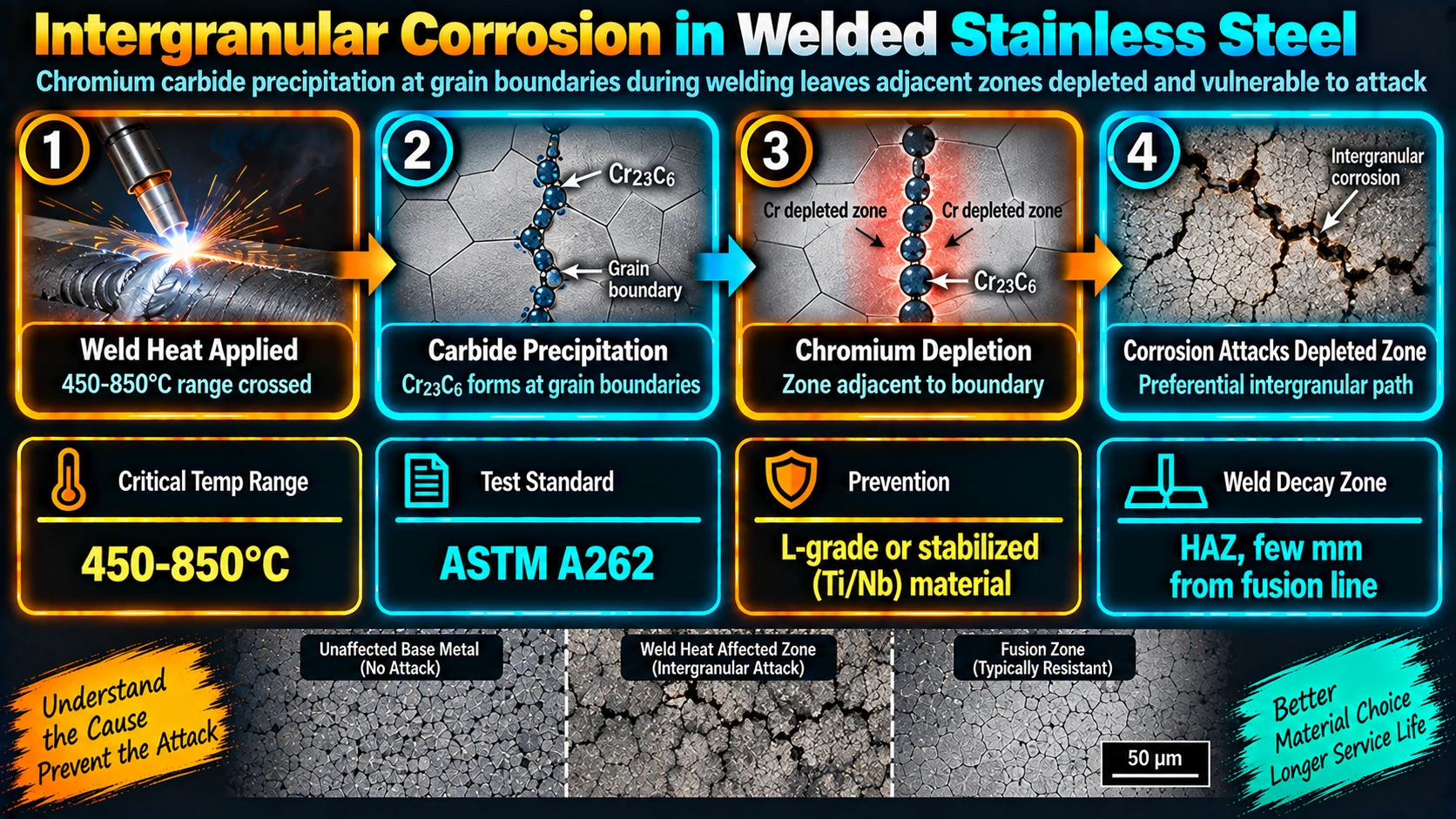
Both are forms of intergranular attack tied to welding, but they occur in different locations for different reasons, and telling them apart correctly changes both the root cause conclusion and the corrective action.
Weld Decay
Weld decay occurs in standard, unstabilized austenitic grades (304, 316) in a band of the HAZ that is set back slightly from the fusion line on both sides of the weld — the exact location that cooled through the classic sensitizing temperature range slowly enough for chromium carbides to precipitate, while the metal immediately at the fusion line reached too high a peak temperature and cooled too quickly through that range to sensitize.
Knife-Line Attack (KLA)
Knife-line attack occurs specifically in stabilized grades (321 with titanium, 347 with niobium) and appears as an extremely narrow band immediately adjacent to the fusion line rather than set back in the HAZ. The mechanism is different: peak temperature right at the fusion line is high enough to redissolve even the stabilizing titanium or niobium carbides back into solid solution. If that same narrow zone then experiences a second, lower-temperature thermal cycle — an adjacent weld pass, multi-pass welding, or a stress-relief PWHT in the sensitizing range — chromium carbides can reprecipitate there before the more slowly diffusing stabilizing element reforms its own carbides, leaving that specific narrow band susceptible even though the rest of the HAZ is protected by stabilization.
| Feature | Weld Decay | Knife-Line Attack |
|---|---|---|
| Affected grades | Unstabilized (304, 316, 304L, 316L) | Stabilized (321, 347) |
| Location | HAZ, set back from fusion line | Narrow band at fusion line |
| Requires second thermal cycle | No — occurs during initial weld cooling | Usually yes — multi-pass or subsequent PWHT |
| Mitigation | Low-carbon (L) grade, post-weld solution anneal | Stabilizing anneal after PWHT, control interpass |
ASTM A262 Test Practices
ASTM A262 provides the standard family of test methods used to detect susceptibility to intergranular attack in austenitic stainless steel. Different practices suit different situations, and several are commonly used together — a fast screening test followed by a quantitative confirmation test on suspect material.
| Practice | Common Name | Method | Best Suited For |
|---|---|---|---|
| A | Oxalic Acid Etch Test | Electrolytic etch, microscopic classification (step / dual / ditch) | Fast screening — 90% of specimens can be accepted or flagged from this alone |
| B | Streicher Test | Ferric sulfate-sulfuric acid, boiling, weight-loss corrosion rate | Quantitative confirmation, general service |
| C | Huey Test | Boiling nitric acid, multiple 48-hour periods, weight-loss | Equipment for highly oxidizing service (e.g. nitric acid plants) |
| E | Strauss Test | Copper-copper sulfate-sulfuric acid, bend test (pass/fail on cracking) | Quick confirmation, workshop-friendly bend test |
| F | Modified Strauss Test | Copper-copper sulfate-16% sulfuric acid, weight-loss | High-molybdenum grades where Practice E is less reliable |
Oxalic Acid Etch Structure Classification
Practice A produces one of three structure classifications, and the classification alone often determines whether further testing is needed:
Detecting IGC in the Field
Once material is in service, suspected intergranular attack is not always obvious from the outside. Watch for:
- Granular, “sugary” surface texture — grains that have been undermined by boundary attack can detach or stand slightly proud, giving a rough, granular feel distinct from general pitting or uniform corrosion.
- Loss of ring or unusual metal loss pattern at HAZ locations specifically, rather than uniform loss across the whole surface.
- Dye penetrant indications that trace along a band parallel to the weld, consistent with weld decay or knife-line attack geometry rather than a random defect pattern.
- Metallographic replication — a non-destructive surface replica taken in the field and examined under a microscope can reveal grain boundary ditching without cutting a sample from the component.
The electrochemical potentiokinetic reactivation (EPR) test is the most field-practical quantitative method, since it can be run on an as-welded or in-service surface without removing a specimen, and it produces a numerical degree-of-sensitization (DOS) value rather than a pass/fail classification alone.
Acceptance and Corrective Action
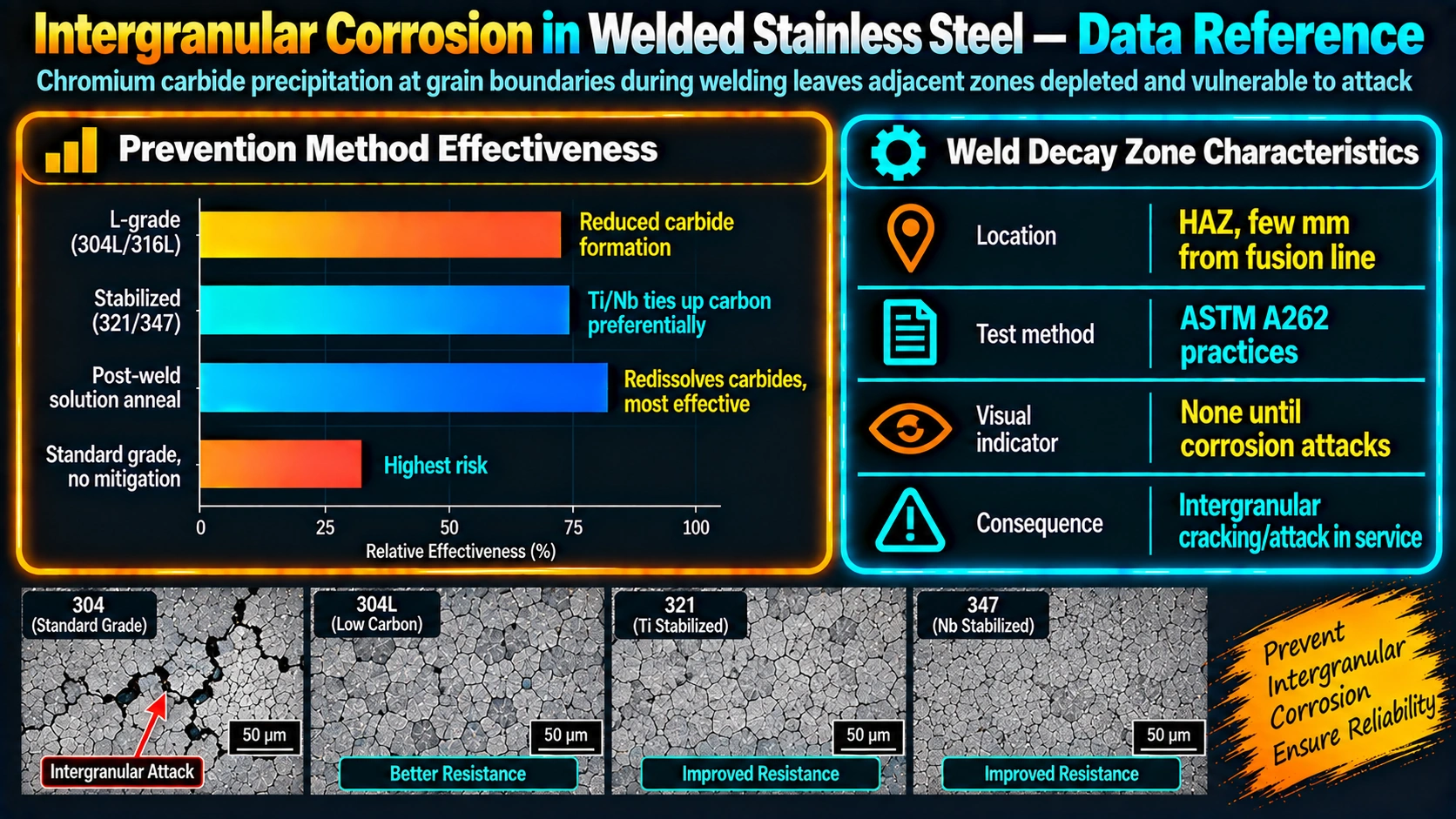
For equipment already fabricated with L-grade or stabilized material where sensitization risk was designed out from the start, routine A262 testing is often limited to procedure qualification rather than every production weld, but it remains standard practice for repair welds, field welds without full process control, and any joint destined for aggressive service such as nitric acid or polythionic-acid-exposed shutdown environments.
Frequently Asked Questions
What is the difference between weld decay and knife-line attack?
Weld decay is intergranular corrosion in a band of the HAZ set back slightly from the fusion line, at the location that experienced the classic sensitizing temperature range (approximately 425-870 degC) during welding, and it affects standard (unstabilized) austenitic grades like 304 and 316. Knife-line attack is a narrow band of attack immediately adjacent to the fusion line in stabilized grades like 321 and 347, caused by dissolution of the stabilizing titanium or niobium carbides at very high peak temperature near the fusion line, followed by reprecipitation of chromium carbides if the joint sees a second thermal cycle such as a multi-pass weld or a stress-relief heat treatment.
Which ASTM A262 practice should I use to test a stainless steel weld?
Practice A (oxalic acid etch test) is used first as a fast, low-cost screening test to classify the microstructure as step, dual, or ditch structure; a step structure typically allows the material to be accepted without further testing. If the etch test shows a dual or ditch structure, a follow-up quantitative test — commonly Practice B (Streicher, ferric sulfate) or Practice E (Strauss, copper-copper sulfate bend test) — is run to confirm actual susceptibility, since the oxalic etch test alone is a screen, not a final acceptance test.
What does a ditch structure in the oxalic acid etch test mean?
A ditch structure means the etch has revealed grain boundaries that are completely surrounded by attack, indicating one or more grains are fully encircled by a corroded boundary. This is the classification most strongly associated with susceptibility to intergranular corrosion and normally requires the material to undergo further quantitative testing (Practice B, C, E, or F depending on the applicable specification) before it can be accepted, rather than being accepted on the etch test result alone.
Why does knife-line attack occur even in stabilized stainless grades designed to resist sensitization?
Stabilized grades like 321 (titanium) and 347 (niobium) resist ordinary weld decay because the stabilizing element preferentially forms carbides, keeping chromium in solid solution. But immediately adjacent to the fusion line, peak temperature is high enough to dissolve even the stabilizing carbides back into solution. If that same narrow zone then experiences a second lower-temperature thermal cycle — a subsequent weld pass laid nearby, or a stress-relief PWHT in the sensitizing range — chromium carbides can reprecipitate there before the slower-diffusing stabilizing element has a chance to reform its own carbides, leaving that narrow band susceptible.
Can intergranular corrosion be detected without destructive testing?
Fully non-destructive detection of intergranular corrosion susceptibility (before actual corrosion damage exists) is limited — the electrochemical potentiokinetic reactivation (EPR) test can be performed on an in-service or as-welded surface without removing a full specimen and gives a quantitative degree-of-sensitization value, making it the closest option to field-deployable testing. Once actual intergranular attack has occurred in service, it can often be found by careful visual inspection for a granular, sugary surface appearance, dye penetrant testing, or metallographic replication at suspect locations.
Does PWHT always increase intergranular corrosion risk in stainless steel?
Not always — it depends on the PWHT temperature relative to the sensitizing range of roughly 425-870 degC. A PWHT held within that range, or one that cools slowly through it, increases sensitization risk in unstabilized grades. Solution annealing at a much higher temperature (typically above 1040 degC) followed by rapid cooling actually reverses sensitization by redissolving chromium carbides, which is why solution annealing rather than stress-relief PWHT is often specified for austenitic stainless equipment when sensitization must be corrected.
Is low-carbon (L-grade) stainless steel immune to intergranular corrosion?
No, L-grade material (304L, 316L) is far more resistant, not immune. Lower carbon content (0.03% max versus 0.08% max for standard grades) means less carbon is available to form chromium carbides at grain boundaries during a given thermal exposure, so the material can tolerate longer or hotter exposure in the sensitizing range before enough chromium depletion occurs to cause susceptibility. Extremely long or hot exposures, such as extended high-temperature service, can still sensitize L-grade material.
What is the difference between the Strauss test and the Huey test?
The Strauss test (ASTM A262 Practice E) uses a copper-copper sulfate-sulfuric acid solution and a bend test to detect susceptibility, giving a pass/fail result based on whether cracks appear after bending. The Huey test (Practice C) uses boiling nitric acid and measures corrosion rate by weight loss over multiple test periods, and is specifically relevant for equipment that will see highly oxidizing service such as nitric acid production, since it better represents that particular service environment than the Strauss or Streicher tests do.
Recommended Reading
Understanding Sensitization (Sedriks)
Authoritative text on the forms of corrosion affecting stainless steels, including intergranular attack and sensitization mechanisms.
View on AmazonCorrosion of Weldments (Kotecki)
Directly addresses weld decay, knife-line attack, and corrosion testing standards specific to welded joints.
View on AmazonASM Handbook Vol. 13: Corrosion
Reference-grade coverage of intergranular corrosion, A262 testing methods, and stainless steel corrosion forms.
View on AmazonCorrosion Engineering (Fontana)
Classic corrosion textbook with foundational coverage of intergranular corrosion mechanisms and detection methods.
View on AmazonDisclosure: WeldFabWorld participates in the Amazon Associates programme (StoreID: neha0fe8-21). If you purchase through these links, we may earn a small commission at no extra cost to you. This helps support free technical content on this site.