ISO 3834 Welding Quality System: Complete Overview and Implementation Guide
The ISO 3834 series — formally titled Quality Requirements for Fusion Welding of Metallic Materials — is the international benchmark for demonstrating that a manufacturer controls the welding process end-to-end, from contract review and procedure qualification through to final inspection and record retention. Unlike generic management system standards, ISO 3834 is welding-specific: it defines what a fabricator must do to ensure every weld in a product meets the required quality level, covering personnel competence, equipment, materials traceability, pre-production review, in-process control, and post-weld examination.
For welding engineers, inspectors, and quality professionals working in pressure equipment, structural steelwork, offshore, or power generation fabrication, ISO 3834 is not optional in practice. EN 1090 for structural steel components mandates compliance. The Pressure Equipment Directive references it. Virtually every major energy sector client specification lists ISO 3834-2 as a mandatory supplier qualification requirement. This guide explains the structure of the four-part standard, the requirements at each level, how the standard interfaces with WPS qualification and welder testing, and a practical implementation roadmap for fabrication shops.
Whether you are preparing your facility for a third-party certification audit, specifying subcontractor quality requirements as a project engineer, or studying for an IWE/IWT examination, this article provides the technical depth you need.
Structure of the ISO 3834 Series
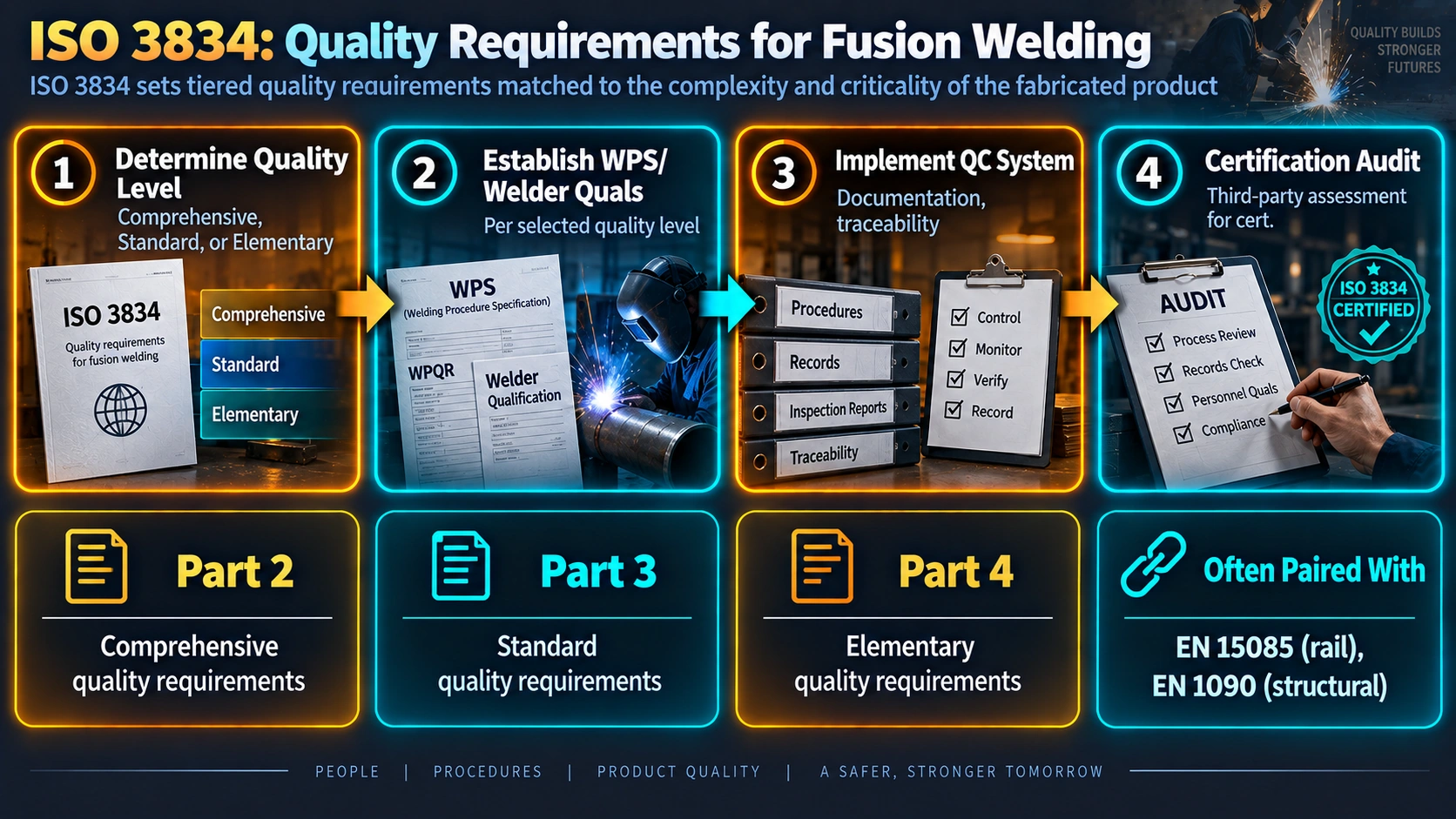
ISO 3834 is published in four normative parts plus supporting guidance. Understanding the relationship between the parts is essential before selecting the appropriate quality level for a contract or product standard reference.
Selection Criteria
Provides the framework for choosing the appropriate quality level (Parts 2, 3, or 4) based on product risk, complexity, and the applicable construction standard.
Comprehensive Requirements
The most demanding level. Applies to high-risk applications: pressure vessels, piping, offshore structures, power plant components, and safety-critical welds.
Standard Requirements
Intermediate level for moderate-risk fabrication: general structural steelwork, lifting equipment, process equipment where failure is unlikely to be immediately life-threatening.
Elementary Requirements
Minimum level for low-risk, non-safety-critical applications where welds are inspected by visual examination and simple repairs can be made without consequence.
ISO 3834-5 (now withdrawn and replaced by ISO/TR 3834-6) provided a list of standards that can be used to demonstrate conformance. ISO/TR 3834-6 is an informative technical report listing standards relevant to Parts 2, 3, and 4 across the full welding quality system — covering WPS qualification, welder testing, NDT, and inspection standards for each process and material group.
Selecting the Correct ISO 3834 Level
Clause 4 of ISO 3834-1 defines the factors to consider when selecting the appropriate quality level. The fundamental question is: what are the consequences of a weld defect in this product? Selection is governed by the applicable construction standard, but the fabricator and their client must also consider the following factors independently where no construction standard is specified:
| Selection Factor | ISO 3834-2 (Comprehensive) | ISO 3834-3 (Standard) | ISO 3834-4 (Elementary) |
|---|---|---|---|
| Range of products and welded items | High complexity, varied geometry, many joint configurations | Moderate complexity, standard joint types | Simple, repetitive joints of low complexity |
| Significance of the weld in the design | Welds carry primary load; failure is catastrophic | Welds are load-bearing but consequences of failure are manageable | Non-load-bearing or cosmetic welds only |
| Materials being welded | Difficult-to-weld materials: P91, duplex stainless, nickel alloys, titanium | Common engineering materials with known weldability | Low-alloy or plain carbon steels with simple requirements |
| Post-weld heat treatment | Mandatory PWHT; complex thermal cycles required | PWHT sometimes required | PWHT not required |
| NDT extent | Volumetric NDT mandatory (UT, RT) on significant proportion | Surface and some volumetric NDT | Visual examination sufficient |
| Construction standard reference | EN 1090 EXC3/EXC4, ASME VIII, API 650/620, EN 13445 | EN 1090 EXC2, EN 1993, crane standards | EN 1090 EXC1, simple metal fabrication |
ISO 3834-2: Comprehensive Requirements — Clause-by-Clause
ISO 3834-2 is the level most fabricators in the pressure equipment, power generation, and offshore sectors must achieve. The following section covers each major clause group and its practical implications for the fabrication facility.
Review of Requirements (Clause 5)
Before a contract is accepted or welding commences, the welding coordination personnel must review all technical requirements and ensure the fabricator is capable of meeting them. This review must be documented and must cover at minimum:
- The parent material specification and material group (in accordance with ISO/TR 15608 or ASME P-Number classification — see our P-Number and material grouping guide).
- The applicable product standard and its welding-specific requirements (acceptance criteria, NDT extent, PWHT requirements).
- The welding processes to be used and whether qualified WPS exists or needs to be developed.
- Any specific requirements: hydrogen control, preheat, interpass temperature limits, PWHT time-temperature cycles.
- Examination and testing requirements including the NDT methods, extent, and acceptance standards to be applied.
Technical Requirements (Clause 6)
6.1 Welding Personnel
ISO 3834-2 requires that all welding is supervised by personnel with appropriate technical knowledge. The welding coordinator must be qualified in accordance with ISO 14731, which maps directly to the International Institute of Welding (IIW) qualification scheme: International Welding Engineer (IWE), International Welding Technologist (IWT), or International Welding Specialist (IWS), depending on the complexity of the work.
All production welders and welding operators must hold valid qualification certificates in accordance with the applicable standard. For most steel fabrication this means ISO 9606-1 (manual welder qualification) or ISO 14732 (welding operator qualification for mechanised and automated welding). In ASME-governed shops the equivalent is ASME Section IX QW-300 series.
6.2 Welding Equipment
All welding and ancillary equipment (power sources, wire feeders, positioners, heating equipment, gas supply systems) must be fit for purpose and maintained in a calibrated and serviceable condition. ISO 3834-2 requires documented calibration records with appropriate intervals defined and evidence of current calibration status on each item of critical equipment. Equipment found outside calibration must trigger a non-conformance and assessment of product impact.
6.3 Welding Activities (Pre-Production)
This is one of the most operationally significant clauses in ISO 3834-2. Before production welding begins, the welding coordinator must confirm:
- A qualified WPS exists that covers the joint configuration, base material, filler material, welding process, and all applicable essential variables (see essential variables and material grouping).
- The WPS is supported by a valid PQR from an approved qualification standard (ISO 15614-1, ASME Section IX, or as specified by the contract).
- Welder qualification certificates are valid for the joint type, position, and process on the WPS.
- Parent materials are identified, marked, and traceable to their material test certificates (MTCs / mill certificates).
- Welding consumables are of the correct type and designation, correctly stored, and (where applicable) baked and issued through a controlled rod-room system.
- Joint fit-up, cleanliness, and dimensional accuracy have been checked against the applicable drawing and WPS requirements.
- Preheat, if required, has been applied and verified with a calibrated contact thermometer or thermocouple.
6.4 Welding Activities (In-Process)
During production welding, the coordinator or designated inspector must ensure that the approved WPS is followed and that all process parameters remain within the qualified range. This typically requires monitoring and recording of welding current, voltage, travel speed, and calculated heat input for critical joints. Interpass temperature must be measured and recorded before each subsequent pass where the WPS specifies a maximum interpass limit — particularly important for high-strength steels, duplex stainless steels, and heat-resistant alloys such as P91 chrome-moly steel.
6.5 Post-Weld Heat Treatment
Where PWHT is required by the applicable construction standard, design specification, or WPS, ISO 3834-2 requires that:
- The PWHT procedure is documented specifying heating rate, soak temperature and duration, cooling rate, and thermocouple placement requirements.
- The PWHT furnace or local heating equipment is calibrated and thermocouples are attached to the component in accordance with the documented procedure.
- A continuous time-temperature record (chart) is produced, retained as a quality record, and reviewed to confirm all requirements were met.
- The PWHT record is cross-referenced to the component identification and the corresponding weld map or joint identification system.
6.6 Inspection and Testing
ISO 3834-2 requires a documented inspection and test plan (ITP) covering all stages: receipt of material, dimensional inspection at fit-up, in-process inspection during welding, final inspection, and NDT. Each inspection activity must specify the method, extent, acceptance criteria, and the applicable standard. NDT personnel must be qualified in accordance with ISO 9712 (or equivalent such as ASNT SNT-TC-1A for ASME work) at the appropriate method and level. For detailed NDT methodology, refer to our guides on mechanical testing requirements and our ASME Section VIII Division 1 overview.
6.7 Non-Conformance and Corrective Action
Any weld found to be outside the applicable acceptance criteria must be handled through a documented non-conformance report (NCR) system. The NCR must identify the nature of the defect, the extent of the non-conformance, the proposed remedial action, and the re-inspection requirements after repair. Disposition options (repair, rework, accept-as-is with engineering justification, scrap) must be authorised by the designated welding coordinator or an independent authorising body as specified by the applicable product standard.
6.8 Calibration and Validation
Beyond welding equipment, ISO 3834-2 requires calibration of all measuring and testing equipment used to verify product quality: dimensional inspection instruments, temperature measurement devices, hardness testers, torque wrenches, and NDT equipment. Calibration records must reference the applicable calibration standard and provide traceability to national measurement standards.
6.9 Material Identification and Traceability
For ISO 3834-2, every piece of parent material used in a weld must be traceable to its material test certificate throughout the fabrication process. This requires a marking and transfer system that maintains identification from raw material receipt through to the finished weld. Heat number, material grade, and MTC reference must be transferable when plates are cut or sections are cropped.
6.10 Quality Records
Records must be retained for the period specified in the applicable construction standard or contract. At minimum, ISO 3834-2 requires retention of: WPS documents and supporting PQRs; welder/operator qualification records; material test certificates; calibration records; inspection records and ITPs; NDT reports; PWHT records; dimensional survey reports; non-conformance records; and the final acceptance documentation. Records may be in electronic or paper form but must be protected against damage, loss, or unauthorised alteration.
ISO 3834-2 vs. ISO 3834-3: Key Requirement Differences
Understanding the specific differences between ISO 3834-2 and ISO 3834-3 is critical for manufacturers operating across multiple execution classes or supplying to multiple markets. The table below compares the principal requirements clause by clause.
| Requirement Area | ISO 3834-2 (Comprehensive) | ISO 3834-3 (Standard) |
|---|---|---|
| Review of requirements | Full documented review before contract acceptance; all deviations resolved in writing | Review required but less formal documentation obligation |
| Welding coordinator | Full-time on-site coordinator with relevant IWE/IWT/IWS qualification per ISO 14731 | Coordination may be part-time; level of knowledge can be lower |
| WPS qualification | Qualified WPS mandatory for all welding; full PQR per recognised standard | Qualified WPS required; qualification may be by previous experience record or pre-qualified WPS where permitted |
| Welder qualification | All welders qualified to ISO 9606-1 or ISO 14732; records maintained and renewed | Welder qualification required; less onerous for simple, repetitive joints |
| Pre-production review | Mandatory for every new joint configuration; documented checklist | Pre-production review encouraged but not required in the same detail |
| Material traceability | Full heat-number traceability throughout fabrication; transfer of marks when cut | Materials must be identified but full heat traceability through all cuts is not explicitly required |
| Equipment calibration | All welding and inspection equipment calibrated; records with national traceability | Equipment must be suitable; calibration records less prescriptive |
| PWHT records | Continuous time-temperature chart; reviewed by coordinator; traceability to component | PWHT records required if PWHT is performed, but record depth may vary |
| Subcontractor control | Subcontractors must comply with same ISO 3834-2 requirements; evidence required | Subcontractors must be controlled; ISO 3834-3 compliance may suffice |
| Typical application | EN 1090 EXC3/EXC4, ASME VIII, API 650, EN 13445, offshore, nuclear | EN 1090 EXC2, cranes, general industrial structures, moderate process equipment |
Welding Coordination Personnel: ISO 14731
The welding coordinator is the person (or persons) responsible for ensuring that all welding activities in the facility are planned, supervised, and executed in accordance with ISO 3834. ISO 3834 defines the requirement but references ISO 14731 for the technical knowledge required.
Coordination Roles and IIW Qualification Levels
| IIW Qualification | Abbreviation | Background Required | Typical ISO 3834-2 Application |
|---|---|---|---|
| International Welding Engineer | IWE | Engineering degree + welding-specific education | Complex, safety-critical; pressure vessels, offshore, power plant |
| International Welding Technologist | IWT | Technical education + welding training | Structural steelwork EXC3, moderate pressure equipment |
| International Welding Specialist | IWS | Vocational/craft background + welding training | Simple structural work, EXC2, ISO 3834-3 applications |
| International Welding Practitioner | IWP | Operator level + basic welding knowledge | ISO 3834-4 elementary applications only |
WPS and PQR Requirements Under ISO 3834
The Welding Procedure Specification (WPS) and Procedure Qualification Record (PQR) are the documentary backbone of any ISO 3834-compliant welding quality system. ISO 3834 mandates their existence but specifies the content requirements through the applicable qualification standard, most commonly ISO 15614-1 for European work or ASME Section IX for ASME-governed equipment.
Qualification Routes Accepted Under ISO 3834
ISO 3834-2 accepts the following WPS qualification routes, as defined in the referenced qualification standards:
| Qualification Route | Standard | Description | When Typically Used |
|---|---|---|---|
| Welding procedure test | ISO 15614-1 / ASME IX | Test piece welded and subjected to mechanical testing; PQR documents results | Most common route; required for all critical applications |
| Pre-qualified joint design | As defined in product standard | Construction standard defines pre-approved joint parameters without requiring a welding procedure test | Limited use; structural applications with well-characterised materials |
| Standard welding procedure specification | ISO 15612 | Use of a qualified WPS from another manufacturer (transferred WPS) | For simple applications where transferability criteria are met |
| Previous welding experience | ISO 15611 | Documented evidence of satisfactory production welding experience for the same essential variable combination | For ISO 3834-3 and 3834-4 applications; not accepted for pressure equipment |
| Pre-production welding test | ISO 15613 | Test piece representative of production conditions; tests adjusted to match production | When geometry makes standard test piece unrepresentative |
Process: Change of process type requires new qualification (e.g., SMAW to GMAW)
Material group: Per ISO/TR 15608 grouping; change of parent material group = requalification
Filler material: Changes to yield strength class or flux type may require requalification
Dimensions: Thickness range = 0.5t to 2t (or per Table 1 of ISO 15614-1)
Position: Qualification in PC/PF covers specific positions per Table 2
Preheat: Reduction of preheat below qualified temperature = requalification
PWHT: Change from with PWHT to without (or vice versa) = requalification
Note: The WPS must explicitly state the qualified range for each essential variable.
For shops producing pressure equipment under ASME P-Number classification, the essential variables are defined in ASME Section IX QW-250 series. It is important that the welding coordinator understands which essential, supplementary essential, and non-essential variables apply to each process, as this determines when requalification is required and when a WPS revision without requalification is acceptable.
ISO 3834 and EN 1090: The Mandatory Link
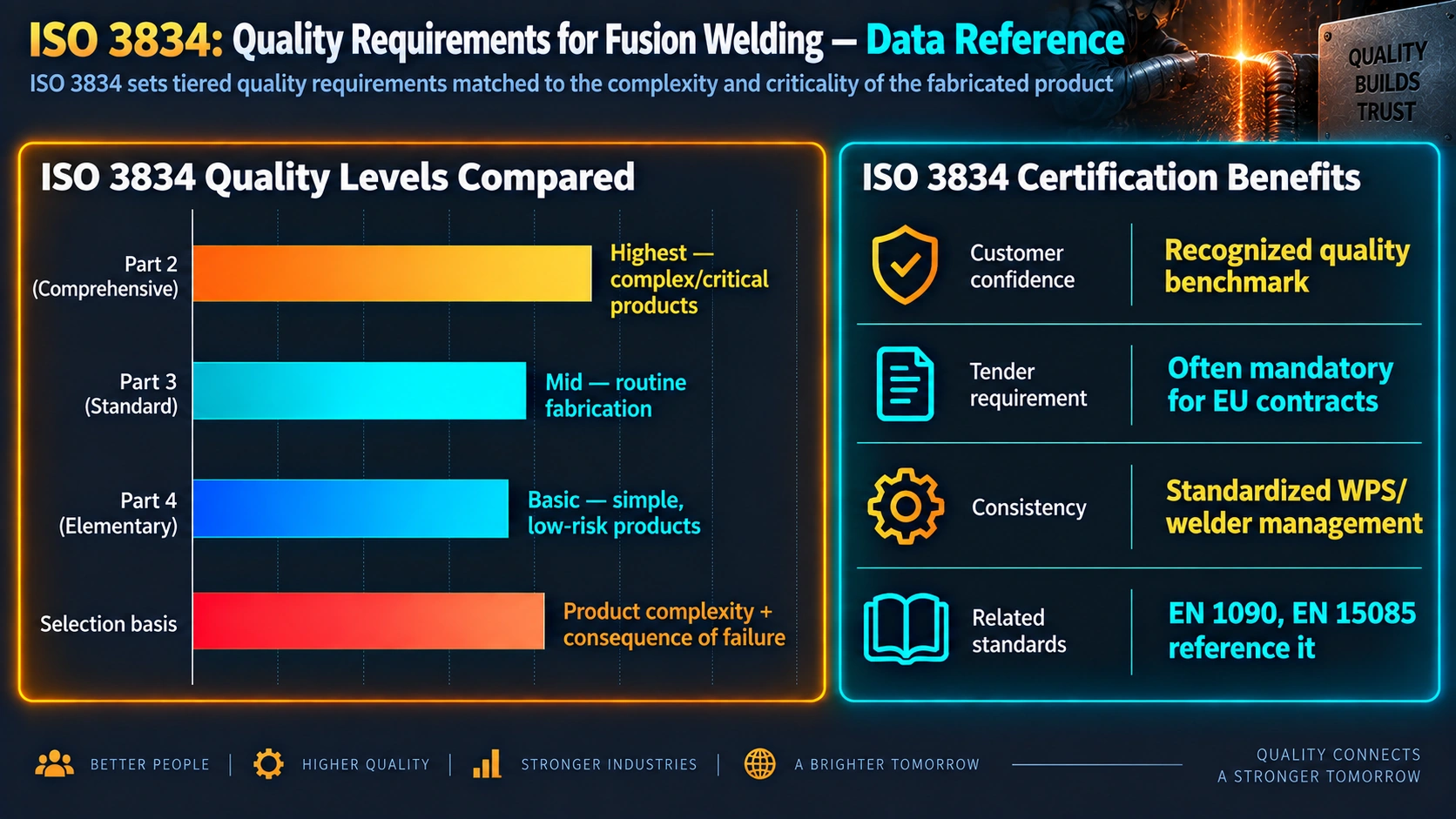
For European structural steel fabricators, the relationship between ISO 3834 and EN 1090 is direct and contractually binding. EN 1090-2 (Execution of Steel Structures) requires the manufacturer to implement a welding quality system in accordance with ISO 3834, with the specific level determined by the Execution Class (EXC) of the structure.
| Execution Class (EN 1090) | Required ISO 3834 Level | Typical Structure Type |
|---|---|---|
| EXC1 | ISO 3834-4 (Elementary) | Non-structural agricultural buildings, simple access structures |
| EXC2 | ISO 3834-3 (Standard) | Most buildings, simple bridges, general industrial structures |
| EXC3 | ISO 3834-2 (Comprehensive) | Seismic structures, large bridges, crane girders, stadiums |
| EXC4 | ISO 3834-2 (Comprehensive) | Extreme consequence of failure: blast-resistant, nuclear infrastructure |
Manufacturers must also hold an appropriate Factory Production Control (FPC) certificate under EN 1090-1 to affix the CE mark to structural components. The ISO 3834 certification is a prerequisite for the FPC audit at EXC2, EXC3, and EXC4 levels. A fabricator without a current ISO 3834 certificate cannot legally place CE-marked structural components on the European market at these execution classes.
Implementing ISO 3834-2: Step-by-Step Roadmap
The following roadmap provides a practical sequence for a fabrication facility implementing ISO 3834-2 from scratch. Facilities with an existing ISO 9001 quality management system will find that the documentation infrastructure is partly transferable; however, the welding-specific technical content must be developed independently.
- Gap AnalysisConduct a documented audit of the current facility against each clause of ISO 3834-2. Identify where practices exist but are not documented, where practices are absent, and where personnel qualifications are missing or expired. Assign a RAG status to each clause area and prioritise remediation by risk.
- Appoint and Qualify the Welding CoordinatorIdentify the person (or persons) who will fulfil the ISO 14731 welding coordination role. If no current employee holds an IWE or IWT qualification, initiate enrolment in an IIW-accredited training programme. The coordinator appointment must be documented with defined responsibilities and authority.
- Develop the Welding Quality PlanWrite the facility-level Welding Quality Plan (WQP) that maps the ISO 3834-2 requirements to the facility’s specific products, processes, and organisational structure. The WQP is the master document that references all subsidiary procedures (calibration procedure, consumable control procedure, PWHT procedure, NCR procedure, etc.).
- Qualify or Collect WPS and PQR DocumentsAudit the existing WPS library against current production scope. Identify gaps: new material groups, new joint configurations, processes not previously qualified. Initiate welding procedure tests for all gaps in accordance with ISO 15614-1 (or the applicable qualification standard). Archive all PQRs with mechanical test results and laboratory reports.
- Audit Welder and Operator QualificationsCompile a register of all welders and welding operators. Verify that each holds a current qualification certificate (ISO 9606-1 or ISO 14732) that covers the process, material group, thickness range, and position of their actual production work. Address expiry, gaps in coverage, and any process or position not currently qualified. Refer to our welding positions guide and P-Number grouping article for coverage mapping.
- Establish Equipment Calibration SystemCreate an equipment register listing every welding power source, wire feeder, heating unit, temperature measuring device, and inspection instrument. Assign calibration intervals to each item. Initiate calibration by an accredited body or in-house with documented traceability. Affix calibration status labels to all equipment.
- Implement Materials and Consumables ControlEstablish a rod-room system for controlled storage, baking, and issuance of electrodes and flux. Implement a materials receiving inspection procedure that verifies incoming material against MTC before acceptance. Establish a heat-number transfer and marking system for traceability during cutting operations.
- Develop Inspection and Test Plans (ITPs)For each product family or project type, develop a structured ITP that maps each inspection hold point, witness point, and review point through the fabrication sequence. The ITP must specify the inspection method, reference standard, acceptance criteria, and recording requirement at each stage. NDT personnel qualifications must be confirmed before each activity.
- Implement NCR and Corrective Action SystemDevelop a non-conformance reporting procedure with defined responsibilities for issuance, disposition, repair, and closure. Integrate the NCR system with the overall quality records management. Establish a root cause analysis (RCA) requirement for repeat non-conformances.
- Internal Audit and Management ReviewConduct at least one full internal audit against all ISO 3834-2 clauses before the certification body audit. Correct all major findings. Conduct a management review to demonstrate leadership commitment and review the welding quality system performance. Document both activities.
- Certification Body AuditEngage an accredited third-party certification body (Bureau Veritas, TUV SUD, Lloyd’s Register, DNV, SGS, or similar). The initial audit typically covers a document review stage and an on-site audit. Be prepared to present all WPS/PQR documents, welder certificates, calibration records, and sample inspection records. Witness of a production weld is common. Address any non-conformities and await certificate issuance.
ISO 3834 in Relation to Other Quality and Product Standards
ISO 3834 and ISO 9001
ISO 3834 supplements, rather than replaces, ISO 9001. An ISO 9001 quality management system provides the organisational infrastructure — document control, management review, audit, corrective action — that ISO 3834 builds upon. Many certification bodies offer combined ISO 9001 + ISO 3834 audits. However, it is important to understand that ISO 9001 alone does not demonstrate welding competence. Clients and notified bodies will look specifically for ISO 3834 certification as evidence that welding activities are technically controlled to the appropriate level.
ISO 3834 and ASME Code
ASME does not reference ISO 3834 directly; instead it uses the ASME Quality Control (QC) programme requirements (for stamps such as U-stamp, R-stamp, and S-stamp) which fulfil an equivalent role. However, fabricators supplying to projects where the owner specification requires both ASME code compliance and ISO 3834 certification — common in the liquefied natural gas, petrochemical, and combined-cycle power sectors — must maintain both systems in parallel. The WPS qualification routes differ: ASME Section IX defines its own essential variables that must be respected independently of ISO 15614-1.
ISO 3834 and Sour Service (ISO 15156 / NACE MR0175)
For equipment operating in hydrogen sulphide-containing environments, sour service requirements impose additional welding quality obligations beyond ISO 3834, including hardness limits on welds and HAZs (typically 22 HRC maximum), PWHT of welds in susceptible materials, and restrictions on welding consumable selection and heat input. The ISO 3834 quality system must explicitly address these additional requirements in the WPS, ITP, and inspection records when sour service is applicable.
Quality Record Requirements and Retention
A frequent audit finding in ISO 3834-2 facilities is inadequate record completeness or retention. The following table summarises the principal quality records required, the clause driving the requirement, and the minimum recommended retention period where not specified by the construction standard.
| Record Type | ISO 3834-2 Clause | Typical Retention |
|---|---|---|
| Contract review records | 5 | 10 years minimum or product lifetime |
| WPS documents | 6.3 | As long as WPS is in use + 5 years |
| PQR / welding procedure test records | 6.3 | As long as WPS is valid + 10 years |
| Welder qualification certificates | 6.1 | Duration of qualification + 2 years |
| Welding coordinator competence records | 6.1 | Duration of employment + 5 years |
| Equipment calibration records | 6.8 | 5 years minimum |
| Material test certificates (MTCs) | 6.9 | Product lifetime or 20 years min |
| Consumable certificates | 6.4 | 10 years minimum |
| Fit-up and dimensional inspection records | 6.6 | 10 years minimum |
| PWHT time-temperature charts | 6.5 | Product lifetime; min 20 years for pressure equipment |
| NDT reports and film/data | 6.6 | As per ISO 9712 + product lifetime; min 10 years |
| Non-conformance reports (NCRs) | 6.7 | 10 years minimum |
| Final inspection reports | 6.6 | Product lifetime |
Recommended Technical References
Disclosure: WeldFabWorld participates in the Amazon Associates programme (StoreID: neha0fe8-21). If you purchase through these links, we may earn a small commission at no extra cost to you. This helps support free technical content on this site.
Frequently Asked Questions
What are the four parts of ISO 3834 and how do they differ?
ISO 3834 consists of four active parts. Part 1 (ISO 3834-1) provides criteria for selecting the appropriate quality level. Part 2 (ISO 3834-2) sets comprehensive quality requirements for high-risk or complex applications such as pressure vessels and offshore structures. Part 3 (ISO 3834-3) establishes standard quality requirements for moderate-risk work such as structural steelwork at EXC2. Part 4 (ISO 3834-4) sets elementary quality requirements for low-risk, non-safety-critical applications. The key differences lie in the depth of documentation, the formality of pre-production review, the rigour of equipment calibration requirements, and the extent of material traceability obligations.
Is ISO 3834 certification mandatory or voluntary?
ISO 3834 certification is technically voluntary at the international level; however, it is frequently mandated by contract, client specification, or referenced construction standards. EN 1090 for structural steelwork in Europe mandates ISO 3834-2 or ISO 3834-3 depending on the Execution Class. Many pressure equipment directives and energy sector client specifications list ISO 3834-2 as a mandatory subcontractor requirement. In practice, for fabricators serving the pressure equipment, offshore, or heavy structural sectors, not holding ISO 3834 certification effectively disqualifies the facility from bidding on the majority of significant contracts.
What is the role of a Responsible Welding Coordinator under ISO 3834?
The Responsible Welding Coordinator (RWC) qualified to ISO 14731 is responsible for planning, executing, and supervising welding activities to ensure compliance with applicable requirements. Under ISO 3834-2, the RWC must review all technical requirements and contracts before fabrication begins, ensure that WPS and PQR documents are in place and cover the scope of work, confirm that welders hold valid qualifications matching their assigned tasks, supervise pre-production review at each new joint configuration, and review completed inspection records. The required IIW qualification level — IWE, IWT, or IWS — depends on the complexity of the welding operations in the facility.
What WPS and PQR documents does ISO 3834-2 require?
Under ISO 3834-2, all welding must be carried out in accordance with a qualified Welding Procedure Specification (WPS) supported by a Procedure Qualification Record (PQR) or other accepted qualification route. The WPS must be qualified in accordance with the applicable qualification standard — typically ISO 15614-1 for arc welding of steels in European applications, or ASME Section IX for pressure vessels under ASME code. Essential variables governing the WPS must be respected throughout production, and any change beyond the permitted range requires requalification. The WPS document itself must specify the qualified ranges for all essential and supplementary essential variables so that it is self-contained and auditable.
How does ISO 3834 relate to ASME Section IX and EN ISO 15614-1?
ISO 3834 is a quality management framework specifying what a manufacturer must do to control welding quality, rather than prescribing how to qualify a welding procedure. It mandates that WPS documents must be qualified, but defers to the applicable qualification standard for the method and acceptance criteria. ISO 15614-1 for arc welding of steels and ASME Section IX are the most widely referenced qualification standards within ISO 3834 compliant systems. A fabricator working under EN 1090 typically uses ISO 15614-1 while one supplying ASME pressure vessels uses ASME Section IX — but both systems operate within an overarching ISO 3834 quality framework that governs records, personnel, equipment, and inspection requirements.
What inspection and testing records must be maintained under ISO 3834?
ISO 3834-2 requires comprehensive records covering the entire fabrication lifecycle: WPS documents and supporting PQRs; welder and welding operator qualification certificates; equipment calibration records; material test certificates for all parent materials; consumable batch certificates; fit-up and dimensional inspection records; PWHT time-temperature charts; NDT examination reports; non-conformance reports and corrective actions; and the final inspection and acceptance report. Records must be retained for the period specified by the applicable construction standard or contract, which typically ranges from 10 years to the design life of the structure or component.
Can ISO 3834 be used alongside ISO 9001?
Yes. ISO 3834 is explicitly designed to complement, not replace, ISO 9001. Clause 1 of ISO 3834-1 states that the standard supplements the quality management requirements of ISO 9001 and covers welding-specific technical activities that are beyond the scope of generic quality management. A manufacturer holding ISO 9001 certification still requires ISO 3834 certification to demonstrate competence in the specific technical requirements of fusion welding. Many certification bodies offer combined ISO 9001 and ISO 3834 audits to reduce the administrative burden, but the technical welding content of the ISO 3834 audit must still be fully addressed regardless of the ISO 9001 status.
How long does ISO 3834 certification take and what does the audit involve?
Implementation and certification timelines typically range from 3 to 12 months depending on the current maturity of the manufacturer’s welding quality system. The third-party certification audit reviews the quality plan and welding documentation, inspects physical workshop conditions and equipment condition and calibration status, interviews welding coordination personnel, reviews WPS and PQR documents and welder certificates, examines NDT and inspection records, and may witness a production weld or review recent weld data. Surveillance audits are typically conducted annually and recertification is required every three years through a full reassessment audit.