IWE / IWS (International Welding Engineer/Specialist) — How to Qualify
The International Welding Engineer (IWE) and International Welding Specialist (IWS) are the most widely respected welding coordination qualifications in the world, issued under the framework of the International Institute of Welding (IIW) and its International Authorisation Board (IAB). What started as a European harmonisation initiative — originally known as the European Welding Engineer (EWE) — has evolved into a genuinely global certification system, now operational in more than 50 IIW member countries spanning Europe, Asia, the Americas, the Middle East, and Africa. If you work in structural steel fabrication, pressure vessel manufacture, oil and gas construction, power generation, or shipbuilding, the IWE or IWS diploma is no longer merely desirable — for many regulated scopes it is a contractual or legal requirement.
This guide explains exactly what the IWE and IWS qualifications cover, what the entry requirements are, how the training programme is structured under the IAB-252 guideline, and what career opportunities they unlock. Whether you are a welding engineer evaluating the Alternative Route or a diploma candidate planning the Standard Route through a local Authorised Training Body (ATB), you will find every key decision point addressed here.
For context, the IIW personnel qualification ladder covers five distinct levels: IWE, IWT, IWS, IWP, and IW. This article focuses on the two most commonly pursued by industry professionals — the engineer and specialist grades — while drawing comparisons across all levels where it helps clarify scope and expectations. Related career credentials such as the P-Number and F-Number system under ASME Section IX complement these IIW qualifications on project documentation.
The IIW Qualification System: Background and Governing Framework
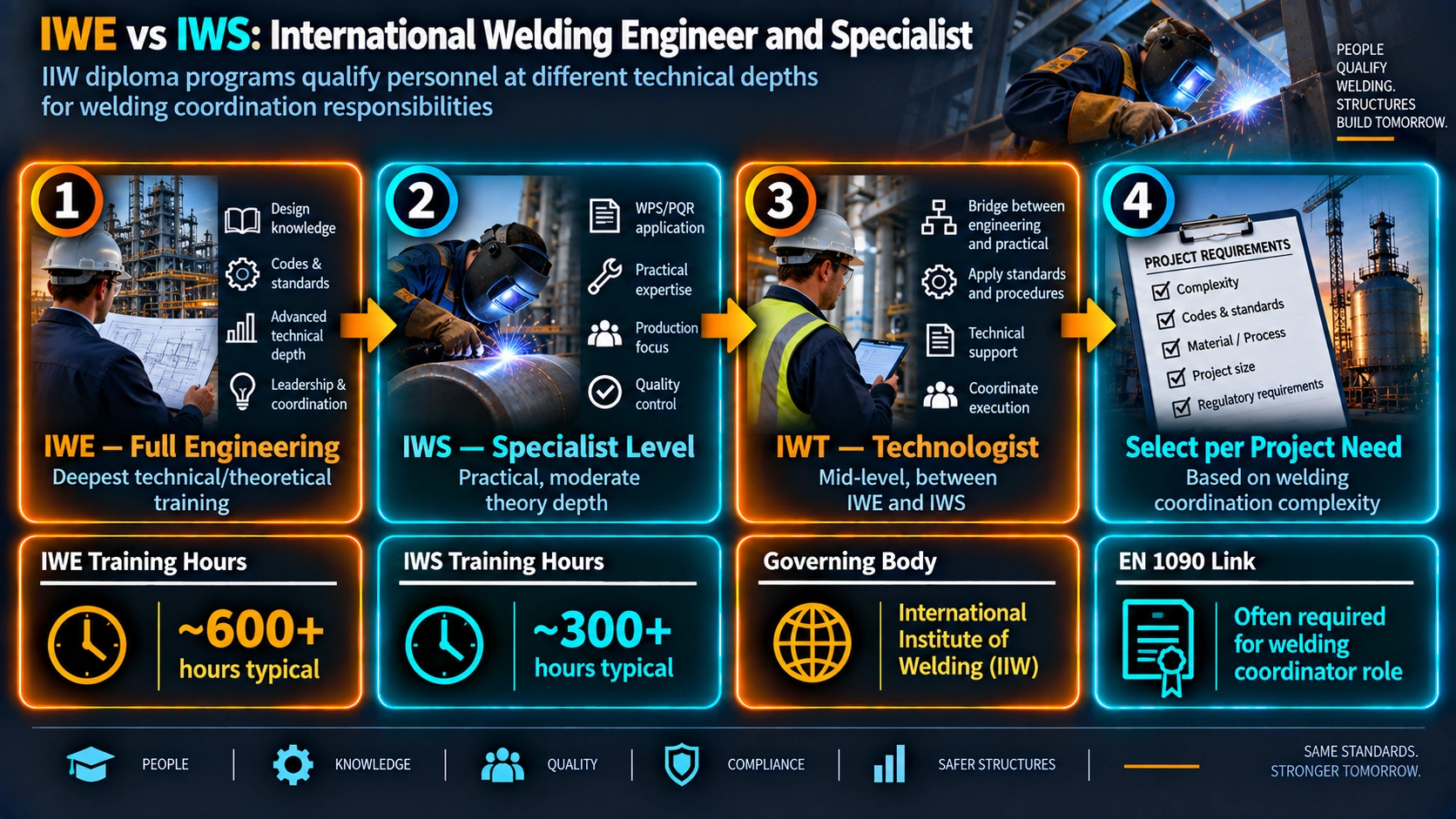
The International Institute of Welding was founded in 1948, and its personnel qualification system has been systematically harmonised through the International Authorisation Board (IAB). The governing document for all welding coordination personnel — IWE, IWT, IWS, and IWP — is IAB-252, which sets the minimum requirements for education, training, examination, and qualification.
Each IIW member country appoints an Authorised Nominated Body (ANB) to administer the qualification system at the national level. In India, the ANB is the Indian Institute of Welding (IIW-India). In the United Kingdom it is TWI. In Australia it is Weld Australia. The ANB accredits local Authorised Training Bodies (ATBs) — universities, polytechnics, and private training organisations — to deliver the Standard Route programme.
The qualification system has two routes to the diploma: the Standard Route (structured classroom training through an ATB) and the Alternative Route (experience-based, without full classroom attendance). Both routes lead to identical diplomas and identical examination standards, issued by the ANB.
Understanding the Four Qualification Levels
The IAB-252 ladder consists of four levels arranged by educational entry requirement and depth of technical knowledge. All four satisfy the definition of “welding coordinator” under ISO 14731, but the scope of construction complexity and technical field they may oversee differs substantially. Understanding where each level sits is essential before choosing which qualification to pursue.
| Level | Full Title | Min. Entry Education | Total Teaching Hours (Standard) | Scope |
|---|---|---|---|---|
| IWE | International Welding Engineer | Engineering degree (Bachelor or equivalent) | ~448 h | Comprehensive All construction types, unlimited complexity |
| IWT | International Welding Technologist | Higher technical diploma (polytechnic level) | ~360 h | Specific Selective/limited technical field |
| IWS | International Welding Specialist | Technical certificate (Level 3 / vocational) | ~220 h | Basic Simple constructions, limited technical field |
| IWP | International Welding Practitioner | Trade/craft level | ~150 h | Basic Basic welding activities, site-level coordination |
The depth to which each subject is treated is directly proportional to the hours allocated in IAB-252. An IWE candidate will study materials and metallurgy to roughly 115 contact hours; an IWS candidate covers the same subject matter block to approximately 56 hours. This means an IWS is expected to recognise and apply metallurgical concepts in routine fabrication decisions, while an IWE must be capable of independent engineering judgement on complex, multi-material, or post-weld heat treated assemblies. For more on how materials knowledge affects welding qualification, see our guide on P91 steel welding requirements — a perfect example of a scope that demands IWE-level competence.
ISO 14731 Coordination Levels and How They Map
ISO 14731:2019 defines three competence levels for welding coordinators: Comprehensive, Specific, and Basic. The IIW qualification ladder maps cleanly onto these:
| ISO 14731 Level | Description | IIW Qualification |
|---|---|---|
| Comprehensive | Advanced problem-solving, complex structures, high-risk weldments | IWE |
| Specific | Detailed management of a defined technical field | IWT |
| Basic | Supervision of simple welded constructions in a limited scope | IWS / IWP |
IWE — International Welding Engineer: Full Requirements
Entry Conditions
The IAB-252 guideline specifies that access to the IWE programme should be at postgraduate level. In practice, the minimum requirement is a primary degree in an engineering discipline — mechanical, materials, structural, manufacturing, chemical, or closely related fields. Candidates must submit their degree diploma to the Board of Examiners before being admitted to the final oral examination.
Many ANBs also accept chartered professional engineering status in lieu of a traditional degree, provided the candidate can demonstrate an equivalent level of engineering education. Candidates who do not hold a qualifying degree may access the programme only after passing a bridging assessment approved by the ANB.
Standard Route: The 4-Module Curriculum
The IWE Standard Route is divided into four subject modules, which collectively span a minimum of 448 teaching hours (where each teaching hour is at least 50 minutes of direct instruction). The modules are:
Practical sessions — covering welding demonstration, destructive testing observation, and NDT familiarisation — are typically scheduled alongside or after the theoretical modules. The programme concludes with a formal oral examination before the ANB Board of Examiners, at which the candidate must present their degree diploma.
Examination Structure
Examinations are set by the ANB and are typically conducted in two stages: written module examinations (multiple choice and structured written questions) at the end of each subject block, and a final oral examination before the Board of Examiners. A candidate who fails a module examination may be permitted to resit at the ANB’s discretion, subject to IAB-001 rules. The diploma is awarded only after all module examinations and the oral examination are passed to the required standard.
IWS — International Welding Specialist: Full Requirements
Entry Conditions
The IWS is designed for personnel who hold a Level 3 technical certificate from a medium or higher technical institute — broadly equivalent to a national vocational qualification, a City & Guilds Level 3, a BTech, or a diploma from a polytechnic. Candidates who do not quite meet the stated educational threshold may be required to sit and pass a free entry examination (typically 30 multiple-choice questions in 45 minutes, covering basic mathematics and science) before beginning the programme.
The 6-Module Programme
The IWS Standard Route is structured around six modules. Unlike the IWE, which consolidates content into four larger blocks, the IWS uses a more granular module breakdown totalling approximately 220 contact hours:
| # | Module Name | Approx. Hours (IWS) |
|---|---|---|
| 1 | Welding Processes and Equipment (Foundation) | ~32 |
| 2 | Advanced Welding Processes and Equipment | ~21 |
| 3 | Practical Welding Technology | ~20 |
| 4 | Materials and their Behaviour (Foundation) | ~56 |
| 5 | Design and Construction (Foundation) | ~46 |
| 6 | Fabrication and Application (Foundation) | ~45 |
Modules 1 through 5 can be attended in any order, but Module 6 (Fabrication and Application) is typically completed last, as it draws on knowledge from all preceding subjects. All six modules must be passed within a 3-year window. Candidates who wish to upgrade from IWS to IWT or IWE at a later date receive credit for common module content.
Standard Route vs Alternative Route: Which Is Right for You?
Full ATB Classroom Programme
- 448 h structured teaching (IWE)
- Progressive module examinations with feedback
- Practical sessions and laboratory demonstrations
- Structured study timeline with peer learning
- Suitable for candidates early in their careers
- Blended learning (online + residential) now widely available
Best for: Graduate engineers and technologists building foundational knowledge before taking on welding coordinator responsibility.
Experience-Based Application
- No structured classroom attendance required
- Minimum 4 years of relevant welding experience
- Self-study against full IAB-252 syllabus
- ANB scrutinises detailed IAB-442 application form
- Same written and oral examinations as Standard Route
- Optional 40-h refresher available from some ANBs
Best for: Experienced welding professionals already performing coordination duties who need formal recognition of their existing competence.
If you are unsure which route to take, speak to your national ANB. Many ANBs offer pre-application consultations or publish detailed guidance documents. In India, the IIW-India ANB provides downloadable guidance for Alternative Route candidates alongside an examination calendar. Related certification paths that complement the IWE/IWS qualification include the destructive mechanical testing knowledge base and an understanding of ASME Section IX for projects governed by ASME codes.
What the Examination Covers: Key Technical Topics
Knowing what the examinations test — at IWE depth — allows candidates to plan their study programme effectively. The four subject blocks of IAB-252 address the following technical areas in detail:
Welding Processes and Equipment
At IWE level, candidates are expected to have comprehensive understanding of all major fusion welding processes, including their physics, equipment design, shielding gas selection, and process variables. This includes understanding the arc transfer modes in GMAW, the influence of polarity in SMAW, the optics of laser beam welding, and the calibration requirements of resistance welding machines. Questions routinely ask candidates to select and justify a process for a given application — for example, welding P91 chrome-moly pipe in a power station, or austenitic stainless steel tubing in a heat exchanger. See our GTAW process guide and SMAW welding guide for detailed process reviews relevant to this module.
Materials and Behaviour during Welding
This is typically the most demanding block for candidates without a metallurgy background. It covers the iron-carbon phase diagram, weld pool solidification, HAZ formation, martensite, bainite, ferrite and their mechanical properties, hydrogen-induced cracking (HIC), solidification cracking mechanisms, lamellar tearing, weld decay in austenitic stainless steels, and the welding behaviour of aluminium alloys, nickel alloys, titanium, and copper. IWE candidates are expected to calculate carbon equivalent (CE) values and interpret their implications for preheat requirements.
Construction and Design
This block covers fatigue life assessment of welded joints, fracture mechanics principles, the application of welding symbols to engineering drawings, distortion prediction and control, residual stress, and the design of joints for fitness-for-purpose. Candidates are expected to read and interpret EN 1993 (Eurocode 3) fatigue class tables and understand the basis of fitness-for-purpose assessment methodologies such as BS 7910.
Fabrication, Applications, and Quality Management
This module ties the qualification to daily industrial practice. It covers WPS preparation and qualification under ISO 15614-1 and related standards, welder qualification under ISO 9606-1, the requirements of ASME Section IX, NDT method selection and acceptance criteria, ISO 3834 quality requirements, ISO 14731 coordinator responsibilities, and industry-specific applications in oil and gas, structural steel, pressure equipment, and railway vehicles. Candidates who have already studied tube-to-tubesheet qualification or reviewed impact testing requirements under ASME Section VIII will find this module considerably more approachable.
Career Scope and Industry Applications
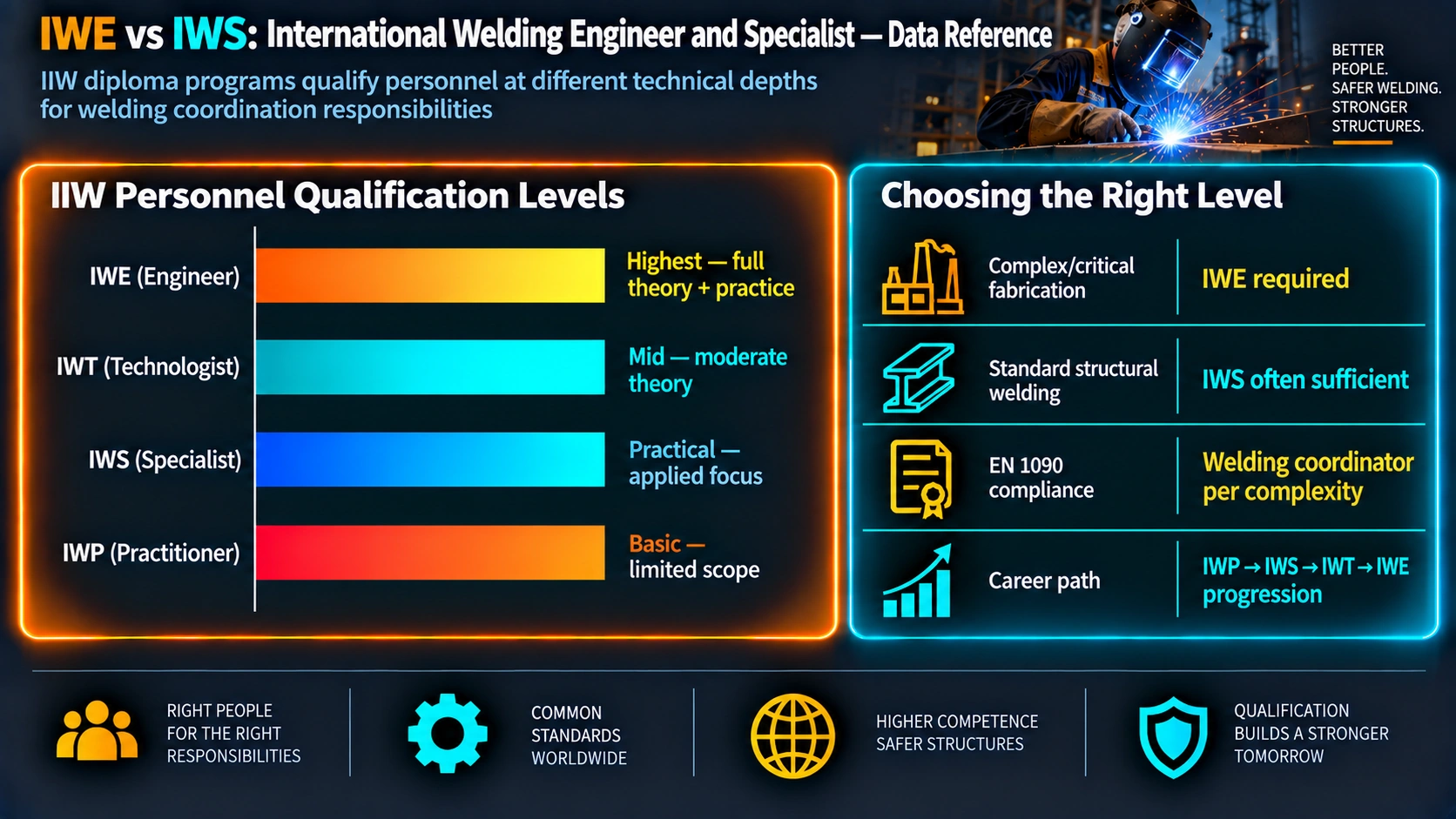
The IWE and IWS qualifications are increasingly demanded by industrial clients, certification bodies, and government procurement frameworks. The following industries most commonly specify IIW qualification for their welding coordination personnel:
| Industry Sector | Applicable Standard | Required Coordinator Level |
|---|---|---|
| Structural steel fabrication (EXC 3/4) | EN 1090-2, ISO 3834-2 | IWE |
| Structural steel (EXC 2) | EN 1090-2, ISO 3834-3 | IWT or IWE |
| Pressure vessels and boilers | EN 13445, PED 2014/68/EU | IWE |
| Rail vehicle manufacture | EN 15085-2 | IWE (CL1/CL2 shops) |
| Oil and gas — onshore and offshore | ISO 3834-2, ISO 15614, API 1104 | IWE preferred |
| Pipeline construction | ISO 12847, API 1104 | IWT or IWE |
| Shipbuilding | Classification society rules, ISO 3834 | IWE (complex vessels) |
| Nuclear | ASME Section III, RCC-M | IWE (typically) |
| Simple steel structures (EXC 1) | EN 1090-2, ISO 3834-4 | IWS |
Beyond mandatory roles, the IWE title opens career pathways that simply are not available to unqualified engineers. These include Chief Welding Engineer positions in EPC contractors, Welding Discipline Lead roles in oil and gas owner/operators, QA/QC Manager roles requiring ISO 3834 sign-off authority, third-party inspection and auditing roles for certification bodies, and independent welding consultancy. For professionals working on sour service and hydrogen service environments, the combination of an IWE diploma with deep knowledge of sour service requirements and duplex stainless steels is particularly valuable.
Global Recognition
One of the most practical advantages of IIW qualifications is their portability. The IIW qualification and certification system is fully harmonised on a global scale, based on cooperation among IIW members, and is offered in the local language in each member country. This means that an IWE diploma issued by IIW-India is recognised by the ANB in Germany, Australia, the UK, South Korea, or Brazil — enabling genuine career mobility across industrial regions.
For companies seeking certification at the comprehensive level (ISO 3834-2), the criticality of the weldments and metallurgical complications will probably require a welding coordinator who possesses an undergraduate degree in welding engineering, an AWS Certified Welding Engineer (CWEng), or an International Welding Engineer (IIW IWE) qualification. This places IWE on an equal footing with the AWS CWEng for ISO 3834-2 audits — a significant advantage when working with clients who specify either credential.
How to Apply: Step-by-Step Process
Maintaining Competence and Career Development after Qualification
Holding the IWE or IWS diploma is the beginning, not the end, of a professional development journey. The most effective welding engineers continually deepen their knowledge across processes, materials, and the code landscape. Post-qualification development typically involves:
- Gaining practical experience as a Responsible Welding Coordinator on ISO 3834 or EN 1090 certified projects
- Broadening knowledge of specific material groups — for example, studying the welding of P91 Cr-Mo steels, duplex stainless steels, or copper-nickel alloys
- Deepening understanding of NDT methods and acceptance criteria — complementary qualifications include PCN/ISO 9712 Level 2 in UT, RT, or PT
- Pursuing advanced IIW qualifications such as the International Welded Structures Designer (IWSD) or International Welding Inspector (IWI)
- Participating in continuing professional development (CPD) programmes recognised by the national ANB or professional engineering body
- Contributing to WPS and WPQR qualification programmes — see our guide to understanding the P-Number and F-Number classification system
Recommended Study References
The following titles are widely used as study references for the IAB-252 curriculum. All are directly relevant to the IWE and IWS module content.
Disclosure: WeldFabWorld participates in the Amazon Associates programme (StoreID: neha0fe8-21). If you purchase through these links, we may earn a small commission at no extra cost to you. This helps support free technical content on this site.
Frequently Asked Questions
What is the difference between IWE, IWT, and IWS?
IWE (International Welding Engineer) is the highest level, requiring a degree in engineering and covering comprehensive welding technology for complex structures and all material groups. IWT (International Welding Technologist) is the intermediate level, requiring a higher technical diploma, covering a selective and defined technical field. IWS (International Welding Specialist) is the entry-level coordination qualification, requiring a Level 3 technical certificate, suited to simple welded constructions in a limited technical scope.
All three qualify as welding coordinators under ISO 14731, but at different competence levels: IWE at Comprehensive, IWT at Specific, and IWS at Basic. When a company seeks ISO 3834-2 certification, the auditor expects a Comprehensive-level coordinator — typically an IWE.
How many training hours does the IWE program require?
The IWE Standard Route comprises a minimum of 448 contact teaching hours divided across four subject blocks: Welding Processes and Equipment (approximately 95 hours), Materials and their Behaviour during Welding (approximately 115 hours), Construction and Design (approximately 90 hours), and Fabrication, Applications, and Quality Assurance (approximately 148 hours). Each teaching hour is at least 50 minutes of direct instruction.
Additional time is required for practical sessions, self-study, and examination preparation. The Alternative Route does not include structured classroom hours — candidates self-study the IAB-252 syllabus and must sit the same written and oral examinations as Standard Route candidates.
What are the entry requirements for the IWE qualification?
For the Standard Route, candidates must hold a primary degree in an engineering discipline — mechanical, materials, structural, manufacturing, chemical, or a closely related field. Candidates must present their degree diploma to the ANB Board of Examiners before being admitted to the final oral examination.
For the Alternative Route, candidates must have a minimum of four years of relevant experience in welding-related work in a responsible position, plus a qualifying educational background. All candidates submit verified transcripts, a detailed CV endorsed by their employer, and a completed IAB-442 self-assessment form covering every module topic in IAB-252.
Is the IWE certification valid globally?
Yes. The IWE diploma is issued by an Authorised Nominated Body (ANB) accredited by the International Institute of Welding (IIW). It is recognised in all IIW member countries, which includes most major industrial nations across Europe, Asia, the Americas, and the Middle East. The certification is referenced in ISO 3834 and ISO 14731 as demonstrating comprehensive welding coordination competence.
Because the education, examination, and qualification requirements are fully harmonised under IAB-252, an IWE diploma issued by the ANB in India carries the same weight as one issued by TWI in the UK or the AWS in the United States. This portability is one of the most practical advantages for engineers working on international projects or planning to work abroad.
Which industries require IWE or IWS qualified welding coordinators?
Industries that routinely mandate IWE or IWS qualifications include: structural steel fabrication under EN 1090 (which requires a Responsible Welding Coordinator qualified per ISO 14731), pressure vessel and boiler manufacture under EN 13445 and the EU Pressure Equipment Directive, rail vehicle manufacture under EN 15085, offshore and onshore oil and gas construction under ISO 3834-2, power generation plant fabrication, shipbuilding, and nuclear construction.
Any company seeking ISO 3834 third-party certification must demonstrate that their welding coordinator holds an appropriate IIW qualification for the certification level sought. For ISO 3834-2 (Comprehensive), this typically means an IWE. For ISO 3834-3, an IWT may suffice. For ISO 3834-4, an IWS is generally acceptable.
Can I qualify as IWE through the Alternative Route without attending classes?
Yes. The Alternative Route allows working professionals with substantial welding experience to qualify without attending the full Standard Route classroom programme. Candidates complete a detailed IAB-442 application form demonstrating their knowledge and experience against every module topic in IAB-252. The ANB evaluates the application and, if satisfied with the evidence, admits the candidate to sit the same written and oral examinations as Standard Route candidates.
Some ANBs — including IIW-India — offer optional 40-hour online refresher courses to help Alternative Route candidates identify knowledge gaps before sitting examinations. These refreshers cover all 20 major topic areas of IAB-252 and are strongly recommended for candidates who have been out of structured learning for a significant time.
What is the role of ISO 14731 in the IWE/IWS framework?
ISO 14731 (Welding Coordination — Tasks and Responsibilities) defines what a welding coordinator must do during the manufacturing process. This includes reviewing design requirements for weldability, preparing and approving WPS documents, supervising welder qualification testing, controlling welding consumables and base materials, managing heat treatment requirements, overseeing in-process and post-weld inspection, and managing non-conformances.
The IWE qualification under IAB-252 is explicitly designed to demonstrate comprehensive competence across all tasks in ISO 14731 at the highest level. ISO 3834 requires that welding coordinators possess the technical knowledge defined in ISO 14731, making the IWE or IWS diploma the most direct, internationally recognised evidence of that compliance. For companies undergoing ISO 3834 certification audits, the welding coordinator’s IIW diploma is one of the first documents the auditor will verify.
How long does it take to complete the IWE qualification?
For the Standard Route, programme duration depends on the ATB’s delivery format. Full-time intensive programmes typically run 3 to 6 months. Part-time or blended-learning programmes — increasingly common, with online lectures and residential practical sessions — typically span 12 to 18 months. The IWS 6-module programme must be completed within a 3-year window.
For the Alternative Route, the timeline depends on how quickly the ANB processes the application and schedules examinations. Preparation, application submission, ANB review, and examination scheduling typically spans 4 to 12 months for candidates who are well-prepared. Candidates should allow at least 3 to 4 months of dedicated self-study before sitting the written papers, regardless of their experience level.