Non-Metallic Inclusion Rating in Steel
Non-metallic inclusion rating in steel gives engineers a standardized way to answer a question that matters directly for weldability and mechanical performance: how clean is this steel, really, and what shape are the impurities in it? Steel is never perfectly free of sulfides, oxides, and silicates left over from the melting and pouring process — the question is how much is present, what shape it takes, and whether that shape creates a directional weakness the way elongated manganese sulfide stringers famously do in lamellar tearing. ASTM E45 provides the standardized rating system used to answer that question consistently across mills, grades, and applications.
This guide covers how non-metallic inclusions form, the ASTM E45 inclusion type classification (A through D) and rating method, why inclusion content and shape matter directly for weldability and toughness, and how modern steelmaking controls inclusion shape through calcium treatment. For the specific failure mode most directly tied to inclusion shape, see the weldability of steels guide, and for the sour-service cracking mechanism inclusions contribute to, see the NACE MR0175 guide.
How Non-Metallic Inclusions Form
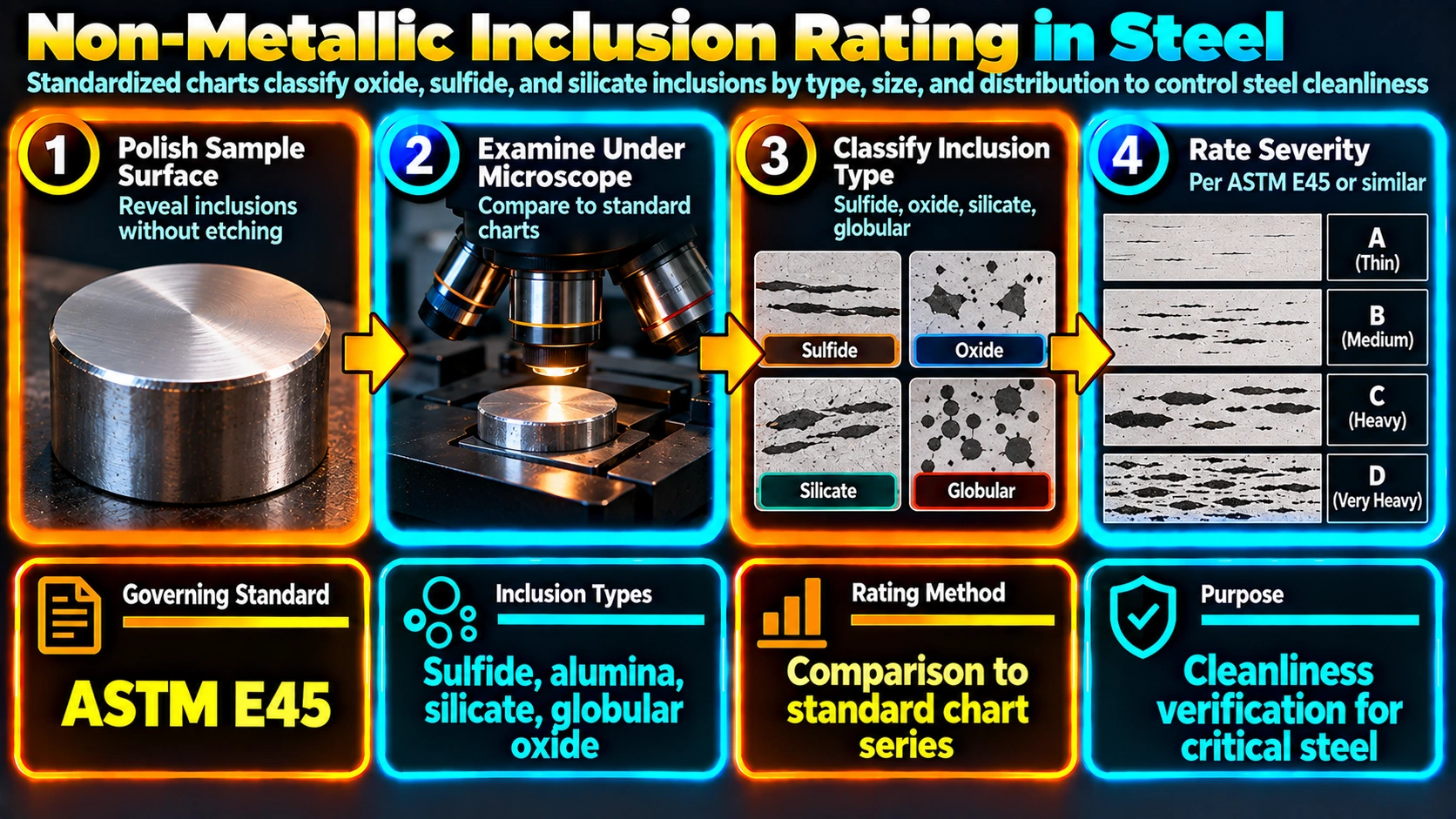
Non-metallic inclusions are chemical compounds — oxides, sulfides, nitrides, silicates — that end up embedded in the steel matrix as a result of the melting and pouring process, and they are generally classified by origin into two groups.
Endogenous (Indigenous) Inclusions
Endogenous inclusions form from chemical reactions within the melt itself, precipitating as the steel cools and solidifies. They are typically small, relatively evenly distributed, and directly related to the steel’s deoxidation practice and residual sulfur, oxygen, and nitrogen content.
Exogenous Inclusions
Exogenous inclusions come from external contamination during melting and pouring — entrapped slag, refractory material, or mold debris — and tend to be larger, more irregular in shape, and less predictably distributed than endogenous inclusions, since they depend on process upsets rather than steady-state chemistry.
ASTM E45 Inclusion Types (JK Rating System)
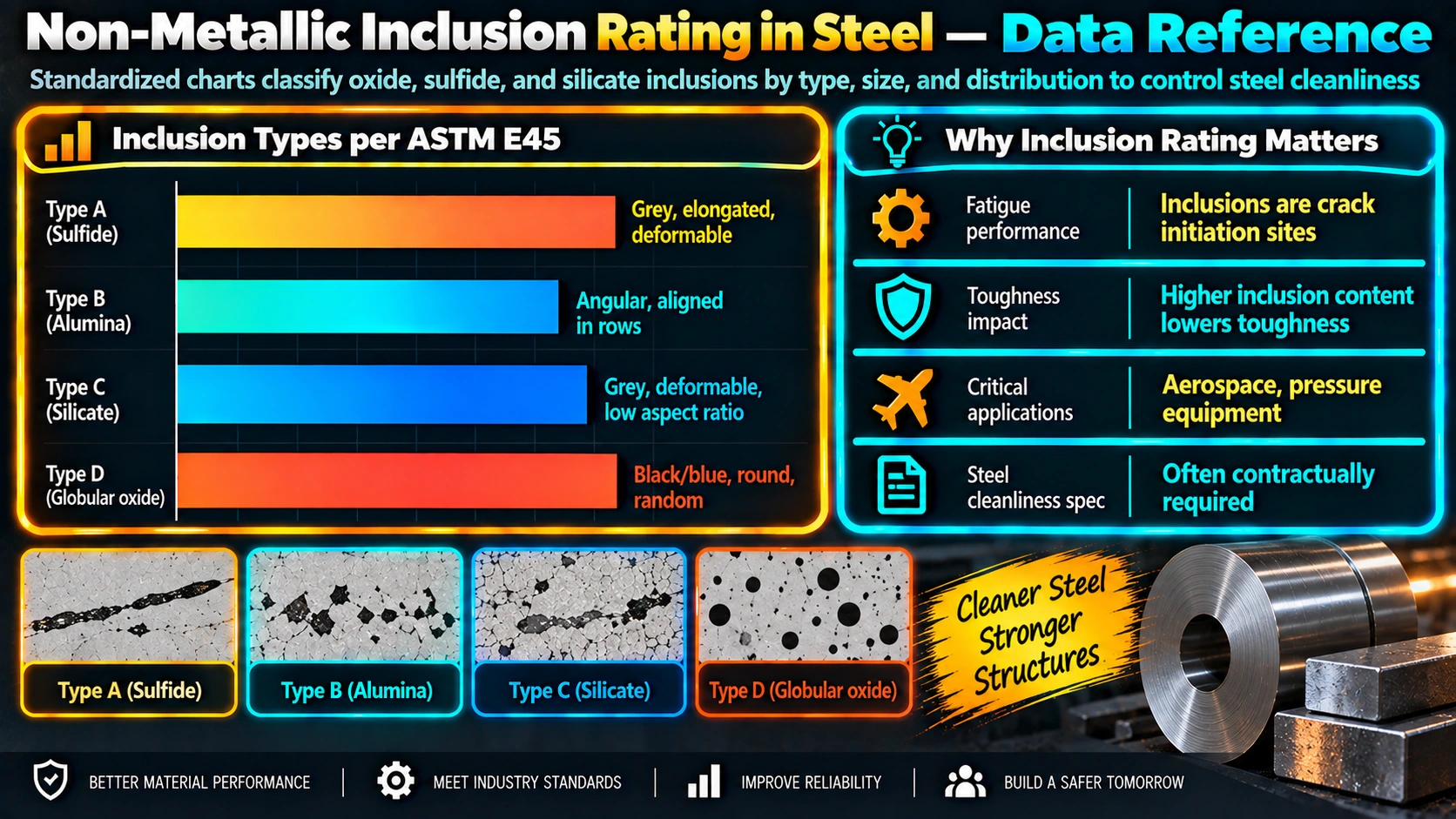
ASTM E45 classifies microscopic inclusions into four morphological types based on how they behave during hot working, not strictly on chemical identity, since inclusions of similar chemistry can look very different depending on whether they deform during rolling.
| Type | Common Composition | Morphology |
|---|---|---|
| A — Sulfide | Manganese sulfide (MnS) | Grey, ductile, elongates into stringers along the working direction |
| B — Alumina | Aluminum oxide (Al2O3) | Angular, undeformed, aligned in broken rows along the working direction |
| C — Silicate | Silicate-based oxides | Grey, deformable, elongated — similar appearance to Type A |
| D — Globular Oxide | Various oxide compounds | Undeformed, round, randomly distributed — no directional alignment |
The ASTM E45 Rating Method
Method A, the most commonly applied approach, examines a polished, unetched specimen at 100x magnification and identifies the field showing the most severe inclusion content for each type — the “worst field” — comparing it against standard reference charts. Each type is rated on a severity scale in half-step increments (0.5, 1.0, 1.5, 2.0, and so on) and further classified as thin or heavy series depending on the width of the observed stringers or particles. The reported rating reflects the worst-field severity for each type present, not an average across the entire specimen, since the worst location is generally the most relevant to mechanical property concerns.
Why Inclusion Content and Shape Matter
Lamellar Tearing
Elongated Type A (sulfide) inclusions create planes of weakness parallel to the plate surface. When a welded joint applies shrinkage strain through the plate thickness, these elongated inclusion planes provide an easy separation path, producing the characteristic step-like lamellar tear in thick-section, highly restrained joints — see the WeldFabWorld weldability guide for the full mechanism and prevention discussion.
Hydrogen-Induced Cracking (HIC)
In sour service, atomic hydrogen absorbed from H2S corrosion can accumulate at MnS stringers, building internal gas pressure that fractures the surrounding metal — an internal cracking mechanism distinct from surface-initiated sulfide stress cracking, and one where inclusion shape and distribution directly determine susceptibility. See the NACE MR0175 guide for how this relates to sour service material qualification.
Toughness and Fatigue
Inclusions act as stress concentrators and potential crack initiation sites, so higher inclusion content, particularly of the larger, more angular Type B alumina or aligned Type A/C morphologies, generally correlates with reduced Charpy toughness and lower fatigue life compared to cleaner steel of the same nominal grade.
Calcium Treatment: Controlling Inclusion Shape
Modern steelmaking practice frequently adds calcium (and sometimes rare earth elements) specifically to modify inclusion shape rather than simply reduce total sulfur content. Calcium treatment converts elongated, deformable manganese sulfide stringers into small, globular, largely undeformable calcium sulfide or calcium aluminate particles that resist elongation during subsequent rolling. This directly reduces the anisotropy (directional weakness) that elongated inclusions cause, improving through-thickness ductility, fatigue strength, and lamellar tearing resistance without necessarily requiring a large reduction in bulk sulfur content — a globular Type D-style inclusion is far less damaging than the same volume fraction of elongated Type A stringers.
Frequently Asked Questions
What is the difference between endogenous and exogenous non-metallic inclusions?
Endogenous (indigenous) inclusions form from chemical reactions within the melt itself — oxides, sulfides, nitrides, and similar compounds that precipitate as the steel cools — and are typically small and relatively evenly distributed. Exogenous inclusions come from external contamination during melting and pouring, such as entrapped slag, refractory material, or mold debris, and tend to be larger, more irregular, and more variable in location than the endogenous type, which is why the two are considered separately when assessing steel cleanliness.
What do the ASTM E45 inclusion types A, B, C, and D represent?
Type A (sulfide) inclusions are ductile, grey manganese sulfide particles that deform and elongate along the working direction during rolling, forming stringers. Type B (alumina) inclusions are angular, undeformed particles typically aligned in broken rows along the working direction. Type C (silicate) inclusions are similar in appearance to sulfides — grey, deformable, and elongated — but are chemically distinct oxide-based particles. Type D (globular oxide) inclusions are undeformed, randomly distributed round particles that do not align with the working direction, distinguishing them from the aligned types A-C.
How does the ASTM E45 rating method actually work in practice?
Method A, the most commonly used approach, involves examining a polished, unetched specimen at 100x magnification and comparing the field showing the most severe inclusion content (the worst field) against a set of standard reference charts for each inclusion type, rating severity on a scale in half-step increments (0.5, 1, 1.5, 2, and so on), and further classifying each type as thin or heavy series based on the width of the inclusion stringers or particles observed. The final rating reports the worst-field severity level found for each inclusion type present, not an average across the whole specimen.
Why do sulfide inclusions specifically increase lamellar tearing risk in welded steel?
Manganese sulfide (Type A) inclusions are rolled flat and elongated in the plate rolling direction, creating planes of weakness parallel to the plate surface. When a welded joint applies shrinkage strain through the plate thickness (the short-transverse direction), these elongated inclusion planes provide an easy path for the plate to separate along, producing the characteristic step-like lamellar tear. This is why through-thickness tested (Z-quality) plate, which specifies stricter sulfur content and inclusion shape control, is specified for thick-section, highly restrained joints where lamellar tearing risk is elevated.
How does calcium treatment during steelmaking reduce inclusion-related problems?
Calcium (and sometimes rare earth elements) is added during steelmaking specifically to modify the shape of sulfide and oxide inclusions, converting elongated, deformable manganese sulfide stringers into small, globular, largely undeformable calcium sulfide or calcium aluminate particles that do not elongate during subsequent rolling. This shape control directly reduces the anisotropy (directional weakness) that elongated inclusions cause, improving through-thickness ductility, fatigue strength, and lamellar tearing resistance without necessarily requiring a large reduction in total sulfur content.
Is a lower inclusion rating always better for every application?
For most structural and pressure-critical applications, yes — lower inclusion content generally means better toughness, fatigue resistance, and through-thickness ductility. However, free-machining steels are a deliberate exception: manganese sulfide inclusions are intentionally added at a controlled level because they act as internal chip-breakers during machining, improving tool life and surface finish, which is a case where a specific engineered inclusion content is a design choice rather than a defect to be minimized.
How do non-metallic inclusions in the base metal affect weld metal cleanliness?
Base metal inclusions can be incorporated into the weld pool through dilution, particularly at high-dilution welding processes or when heavy grinding of the base metal surface exposes near-surface inclusions just before welding. Weld metal also has its own separate inclusion sources — slag entrapment, oxide film entrapment, and reactions with flux or shielding gas — so weld metal cleanliness is assessed independently from base metal inclusion rating, even though poor base metal cleanliness can still contribute inclusions to the fused zone through dilution.
What is the practical difference between a macroscopic and a microscopic inclusion test method under ASTM E45?
Macroscopic methods — macroetch, fracture, step-down, and magnetic particle tests — assess inclusion content at a larger scale, generally suited to detecting larger or more severe inclusion clusters and macro-segregation across a bulk section. Microscopic methods, including the JK chart comparison approach, examine a small polished field at 100x magnification to classify and rate the finer inclusion population by type and severity. Depending on the steel grade and its intended application, either method alone or a combination of both may be specified to fully characterize inclusion content.
Recommended Reading
ASTM E45: Standard Test Methods for Determining Inclusion Content of Steel
The governing standard covering all macro and microscopic inclusion rating methods and reference charts.
View on AmazonSteelmaking and Refining Volume (AISE)
Covers deoxidation practice, calcium treatment, and inclusion formation and control during steelmaking.
View on AmazonMetallography of Welds — ASM Handbook Vol. 9
Reference-grade coverage of inclusion identification and rating within the broader metallographic examination context.
View on AmazonMechanical Metallurgy (Dieter)
Foundational coverage of inclusions as stress concentrators and their effect on fatigue and fracture behaviour.
View on AmazonDisclosure: WeldFabWorld participates in the Amazon Associates programme (StoreID: neha0fe8-21). If you purchase through these links, we may earn a small commission at no extra cost to you. This helps support free technical content on this site.