Confined Space Welding Safety Guide
Confined space welding safety is one of the highest-stakes disciplines in fabrication and maintenance work, because the two things welding always produces — heat and fume — are the exact two things a confined space cannot safely absorb. Tanks, vessels, pipe interiors, boilers, and ship compartments account for a disproportionate share of fatal welding incidents, almost always tracing back to a skipped atmospheric test, a missing attendant, or ventilation that was assumed to be adequate rather than actually measured. This guide sets out what a compliant confined space welding entry looks like in practice: how a space gets classified, what has to be tested and by whom, what equipment stays outside versus what goes in, and how a rescue plan needs to work before anyone strikes an arc.
None of the material here replaces a site-specific risk assessment or your employer’s confined space entry program, and local regulations may impose stricter limits than the general figures quoted below. Treat this as the technical backbone of a safe system of work, to be read alongside your site’s own permit-to-work procedure and applicable national standard, such as OSHA 29 CFR 1910.146 in the United States or equivalent confined space regulations elsewhere.
What Makes a Space “Confined” for Welding Purposes
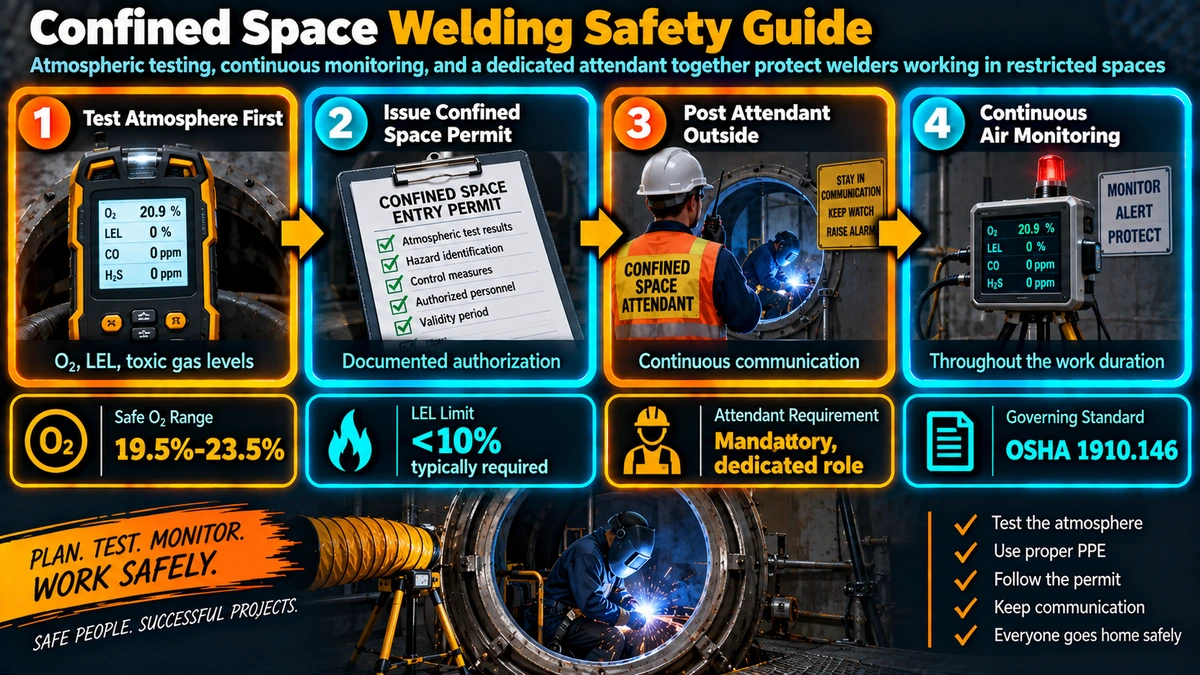
A confined space is any area large enough for a worker to enter and perform work, with limited or restricted means of entry and exit, that is not designed for continuous human occupancy. That definition alone covers a huge range of fabrication and maintenance scenarios: the inside of a pressure vessel awaiting final welds, a pipe spool during field tie-in, a ballast tank on a ship, or a manhole leading into buried piping.
Not every confined space carries the same risk level. Regulations typically distinguish a permit-required confined space, which has one or more additional hazards, from a non-permit space that lacks those hazards. Welding almost always converts a non-permit confined space into a permit-required one, because the welding process itself introduces a hazardous atmosphere even if the space was originally benign.
| Classification | Defining Feature | Typical Welding Scenario |
|---|---|---|
| Non-permit confined space | No hazardous atmosphere, engulfment risk, or other serious hazard present | Rare once welding starts; reclassify if atmosphere changes Reassess |
| Permit-required confined space | Hazardous atmosphere, engulfment risk, converging walls, or other recognised serious hazard | Tank interior, vessel, pipe section, boiler drum Permit required |
| Reclassified space | Space starts as non-permit but conditions change during work | Fume buildup or oxygen depletion develops mid-shift Stop and reassess |
Hazards Specific to Welding Inside a Confined Space
Atmospheric Hazards
- Oxygen deficiency — welding arcs consume oxygen, and shielding gases such as argon and carbon dioxide are heavier than air and can displace breathable air in low pockets of the space.
- Toxic fume accumulation — fume composition depends on base metal, coating, and filler metal; galvanised coatings, for instance, generate zinc oxide fume that causes metal fume fever, while stainless steel welding generates hexavalent chromium and nickel compounds of particular concern in an enclosed volume.
- Flammable atmosphere — residual product vapours in tanks that previously held fuels, solvents, or other flammable substances can combine with a welding arc’s ignition source to catastrophic effect if not purged and tested first.
Physical and Procedural Hazards
- Electric shock risk is elevated in damp or metallic confined spaces, since the entrant is often in continuous contact with grounded structure.
- Heat stress builds quickly where ventilation cannot remove the combined heat load of the arc, the entrant’s own body heat, and any ambient process heat.
- Limited egress slows both routine exit and emergency evacuation, turning a manageable incident into a fatality if a rescue plan is not already staged.
- Awkward welding positions inside restricted geometry increase fatigue-related quality and safety risk; see our guide to welding positions for how position affects both technique and physical demand.
Permit-to-Work and Pre-Entry Requirements
Before any welding equipment enters the space, a confined space entry permit (often combined with a hot work permit for the ignition source) must be completed and authorised by a designated entry supervisor. The permit should record the space identification, the hazards identified, the atmospheric test results, the isolation steps taken, the ventilation arrangement, and the names of the entrant, attendant, and rescue contact.
Isolation Before Testing
- Lock out and tag out any mechanical, electrical, or process connections that could introduce hazardous material or energy into the space.
- Blank or disconnect piping that could introduce liquid, vapour, or gas during the work, rather than relying on a closed valve alone.
- Purge and clean any residual product from tanks or vessels that previously held flammable, toxic, or reactive substances.
Atmospheric Testing Sequence
Testing must be performed by a trained, competent person using calibrated instruments, in a specific order, because each reading affects how the next one should be interpreted.
| Test Order | Parameter | Acceptable Range | Why This Order |
|---|---|---|---|
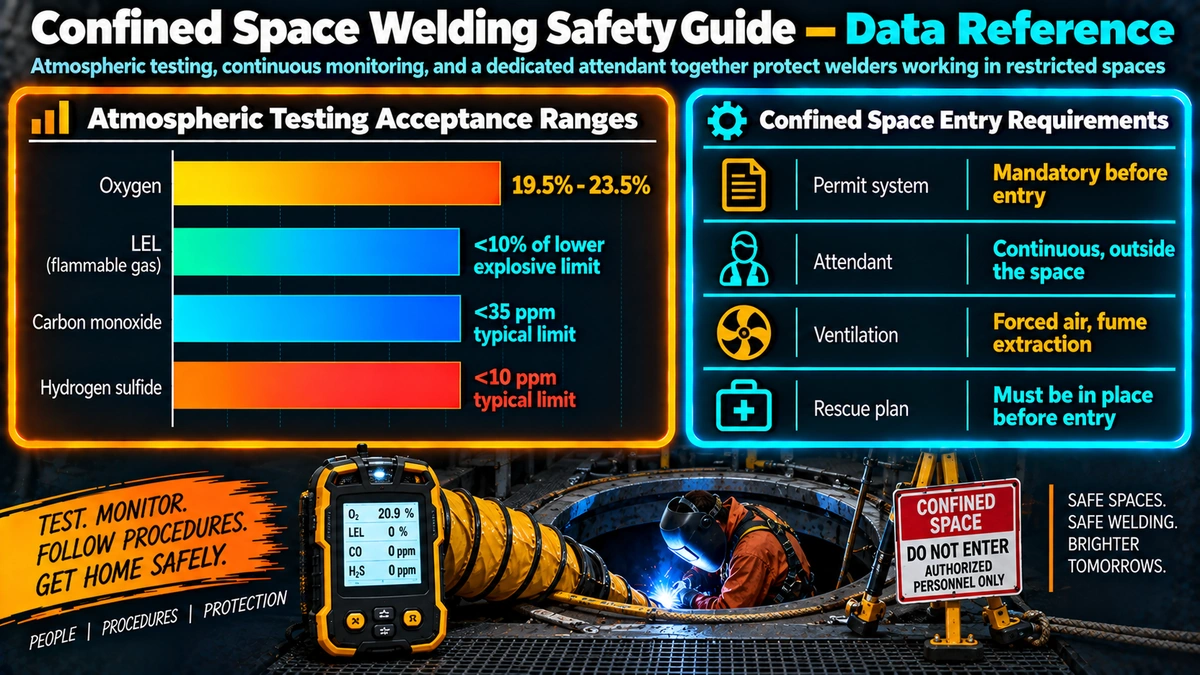
| 1 | Oxygen concentration | 19.5% to 23.5% by volume | Combustible gas meters can give false readings in oxygen-deficient or oxygen-enriched atmospheres Test first |
| 2 | Flammable gas / vapour | Below 10% of the Lower Explosive Limit (LEL) | Confirms it is safe to introduce an ignition source such as an arc Critical for hot work |
| 3 | Toxic contaminants | Below applicable occupational exposure limit for the substance | Identifies specific gases (H2S, CO) that general meters may not detect Substance-specific |
Ventilation Requirements for Welding Inside Confined Spaces
Natural ventilation is rarely sufficient once welding begins, because fume and gas generation typically outpaces passive airflow through a single opening. Mechanical forced ventilation is the standard approach, generally combining a fresh air supply directed toward the welder’s breathing zone with local exhaust ventilation (LEV) or general exhaust positioned to capture fume as close to the arc as practical.
- Position the supply duct so incoming air reaches the entrant before it mixes with contaminated air elsewhere in the space.
- Position exhaust extraction close to the fume source, ideally with a flexible hose the welder can reposition as the work location changes.
- Verify airflow direction; a poorly placed exhaust can pull fume across the entrant’s breathing zone instead of away from it.
- Where explosive atmospheres are a residual concern, use ventilation equipment rated for the appropriate hazardous area classification.
Roles and Responsibilities During Entry
| Role | Core Responsibility |
|---|---|
| Entry Supervisor | Authorises the permit, confirms all pre-entry conditions are met, and can cancel the permit if conditions change |
| Authorised Entrant (Welder) | Performs the welding task, monitors their own condition, and evacuates immediately if conditions deteriorate or on the attendant’s order |
| Attendant | Remains outside the space at all times, maintains continuous communication, monitors entry log, and initiates rescue procedures without entering personally |
| Rescue Team | Trained and equipped to retrieve an incapacitated entrant without becoming a casualty themselves, available within the response time set by the site plan |
Equipment That Stays Outside vs. What Goes In
- Gas cylinders for oxy-fuel processes.
- The welding power source itself, wherever cable length allows.
- Spare consumables and general tool storage not needed at the immediate work point.
- The torch or electrode holder, welding cables, and ventilation ducting.
- Task-specific PPE, respiratory protection, and a means of communication with the attendant.
- A fully insulated electrode holder, with electrodes removed from the holder during any break in arc welding.
This separation reduces both fire load and the volume of hazardous material inside the space, and it also keeps the entry and exit path clearer for emergency evacuation. It applies across processes; for background on process-specific setup, see our guides to SMAW, GMAW, and GTAW welding.
PPE for Confined Space Welding
Standard welding PPE, arc-rated clothing, gloves, and eye/face protection, still applies inside a confined space, but two additions become essential rather than optional: respiratory protection matched to the atmospheric hazard identified, and a retrieval harness compatible with the rescue method planned for that space. Refer to our detailed PPE for Welding guide for process-by-process PPE selection, and treat any confined space entry as requiring a task-specific PPE review rather than a default kit.
Common Non-Conformances in Confined Space Welding
- A single atmospheric test taken at the start of the shift, with no re-testing as work continued for hours.
- An attendant who left their post briefly “just for a minute,” during which the entrant lost consciousness.
- Ventilation ducting positioned near the entry point rather than near the actual arc location, leaving the welder’s breathing zone effectively unventilated.
- Gas cylinders left just inside the entry point rather than fully outside the space.
- No documented rescue plan specific to the space’s geometry, relying instead on a generic site emergency procedure.
Amazon Picks for Confined Space and Welding Safety
Portable Multi-Gas Detector
A four-gas monitor covering oxygen, LEL, and common toxic gases, suitable for pre-entry testing and continuous monitoring during confined space welding.
View on AmazonConfined Space Entry & Rescue Handbook
A practical reference covering permit systems, atmospheric testing, and non-entry rescue planning for supervisors and safety officers.
View on AmazonWelding Fume Extraction Torch
A fume extraction torch that captures fume at the arc, reducing the concentration a welder breathes during prolonged confined space work.
View on AmazonRetrieval Harness with Lifeline
A full-body harness with attachment point and lifeline suited to non-entry rescue retrieval from vertical or restricted confined spaces.
View on AmazonDisclosure: WeldFabWorld participates in the Amazon Associates programme (StoreID: neha0fe8-21). If you purchase through these links, we may earn a small commission at no extra cost to you. This helps support free technical content on this site.
Frequently Asked Questions
What officially counts as a confined space for welding work?
A confined space is large enough for a worker to enter and perform work, has limited or restricted means of entry and exit, and is not designed for continuous occupancy. Under OSHA 29 CFR 1910.146, a permit-required confined space additionally has a hazardous atmosphere, engulfment risk, converging walls or a sloped floor to a smaller cross-section, or another recognised serious hazard. Tanks, vessels, pipe interiors, boilers, and ship hulls typically fall into this category.
Why is welding in a confined space more dangerous than welding in open air?
Welding consumes oxygen and generates fumes, gases, and heat that cannot disperse in an enclosed volume. Oxygen levels can drop below the safe threshold within minutes, shielding gases can displace breathable air because they are heavier than air, and toxic fume concentrations can build up quickly. Limited entry and exit points also make emergency evacuation and rescue far slower and more difficult than in an open workshop.
What atmospheric readings must be checked before entry?
A competent person must test, in sequence, oxygen concentration, flammable gas or vapour as a percentage of the Lower Explosive Limit, and toxic contaminant concentration. Acceptable conditions are typically oxygen between 19.5 and 23.5 percent, flammable gas below 10 percent of the LEL, and toxic gas below the applicable exposure limit. Testing should be repeated periodically and continuously monitored while work continues.
Who needs to be present for a confined space welding entry?
A compliant entry typically requires an entry supervisor who authorises the permit, one or more authorised entrants performing the welding, and a dedicated attendant stationed outside the space who maintains continuous communication and never enters to attempt rescue themselves. A trained rescue team must also be available to respond within the timeframe established by the site’s rescue plan.
What ventilation is required for confined space welding?
Mechanical forced ventilation is almost always required rather than relying on natural airflow. A common arrangement uses a supply duct delivering fresh air near the welder’s breathing zone and an exhaust duct or local exhaust ventilation positioned to capture fume close to the arc, with airflow direction checked so exhaust does not recirculate fume back toward the entrant.
Can a welder work alone in a confined space if they wear a respirator?
No. A respirator addresses the atmosphere being breathed, but not entrapment, engulfment, electrical hazards, fire, or the need for rapid rescue. A dedicated attendant outside the space and continuous communication are required regardless of respiratory protection, and solo confined space entry for hot work is not an acceptable practice under recognised safety standards.
What welding-specific fire and electrical precautions apply inside a confined space?
Gas cylinders and engine-driven welding machines must stay outside the confined space, with only the torch, electrode holder, and cables entering. Electrode holders should be fully insulated, return leads secured close to the work, and when arc welding stops for a break, electrodes must be removed from the holder to avoid accidental arcing. Fire-resistant blankets and removal of combustible material further reduce ignition risk.