Quench Cracking: Causes and Prevention
Quench cracking is the failure mode that turns a heat treatment meant to strengthen a part into the reason it never leaves the shop: a crack that forms during or immediately after quenching, driven by the combination of steep thermal gradients and the volume change that comes with martensite formation. It is a well-understood, largely preventable failure — the same handful of contributing factors (geometry, quenchant severity, and delayed tempering) show up in case after case, which is exactly why a systematic prevention approach works as well as it does.
This guide covers the combined thermal and transformation stress mechanism behind quench cracking, the geometric and process factors that make it more or less likely, how it differs from other cracking mechanisms such as hydrogen cracking, and the practical prevention strategies — quenchant selection, martempering, and prompt tempering — used to control it. For the general quenching process in a welding and heat treatment context, see the heat treatments in welding guide, which this article builds on.
The Combined Stress Mechanism
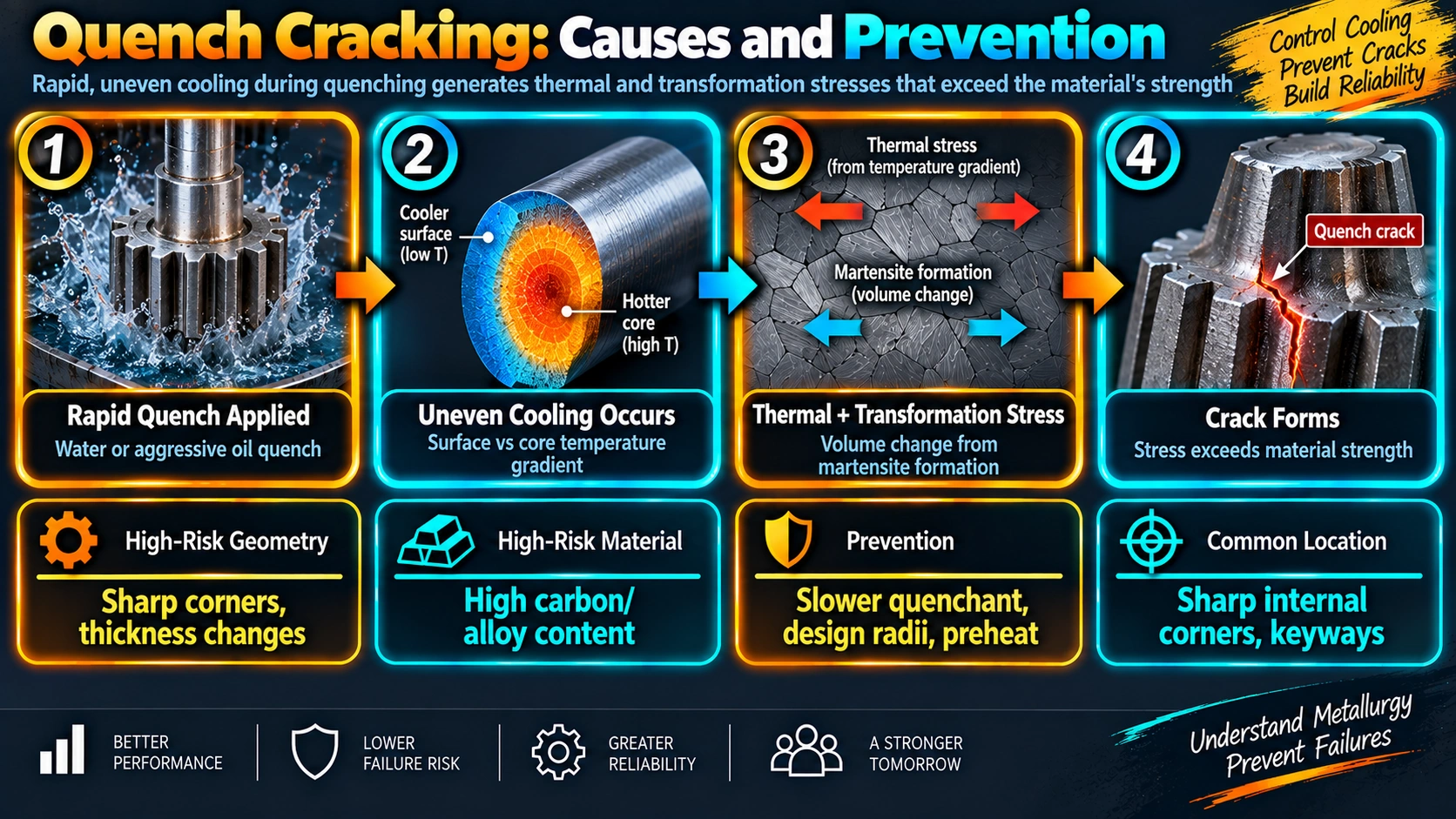
Quench cracking results from two stress sources acting together, not from either one alone in most practical cases.
Thermal Stress
During rapid cooling, the surface of a part cools and contracts faster than the core, which is still hot and has not yet started to contract. This mismatch generates thermal stress, and it becomes more severe as section thickness increases (a larger temperature difference develops between surface and core) and as quenchant severity increases (faster cooling widens that same temperature difference in less time).
Transformation Stress
When austenite transforms to martensite, the new phase occupies a larger volume than the austenite it replaced — martensite formation is accompanied by a volume expansion, not a contraction. Because the surface of the part typically reaches the martensite start temperature (Ms) and begins transforming before the core does, the expanding, transforming surface pushes against a core that is still austenite (and has not yet expanded), creating additional internal stress on top of the thermal stress already present.
Contributing Factors
Geometric Stress Concentrators
Sharp corners, keyways, drilled holes, thread roots, unblended fillets, and even stamped identification marks all act as stress risers, locally amplifying combined thermal and transformation stress well above the nominal level in the surrounding bulk material. A very high proportion of real-world quench cracks initiate at exactly these locations rather than in plain, uniform sections, which makes design-for-heat-treatment (generous radii, avoiding sharp internal corners, plugging small holes during quench where practical) one of the highest-value prevention measures available.
Section Thickness Variation
Abrupt changes in section thickness — a thin web adjoining a thick boss, for example — create differential cooling rates within the same part, and the resulting mismatch in transformation timing between the fast-cooling thin section and the slower-cooling thick section adds directly to the stress described above.
High Hardenability / High Carbon Content
Higher carbon content and higher alloy hardenability increase the volume fraction of martensite formed for a given quench, which increases the magnitude of the transformation stress itself — see the carbon equivalent guide for how these same alloying factors are screened for weldability, since hardenability drives both quench cracking risk and weld cold cracking risk through related mechanisms.
Quenchant Severity
A more severe quenchant (water, brine) cools faster and produces a steeper thermal gradient than a less severe quenchant (oil, polymer solution, air), directly increasing thermal stress magnitude. Selecting the least severe quenchant that still achieves the hardness and hardenability the specification requires is a standard risk-reduction measure.
Delayed Tempering
As-quenched martensite is at its most brittle and most internally stressed state immediately after quenching. Leaving a part at room temperature for an extended period before tempering keeps it in this high-risk condition longer than necessary — standard practice calls for tempering as soon as the part reaches a safe handling temperature, commonly within an hour or two of quenching, rather than allowing it to cool fully and sit.
Relationship to Welding and Fabrication
Quench cracking is primarily a bulk heat treatment phenomenon, but it intersects with welding and fabrication in several practical ways: post-weld quench and temper heat treatment of Q&T structural steels (A514, HY-80/100) must account for the same geometric and process risk factors as any other quenched part; weld repairs on previously quenched and tempered material require careful reheat treatment planning to avoid re-introducing quench cracking risk in the repaired zone; and induction hardening of weld toes or wear surfaces is itself a localized quench-and-temper operation subject to the same combined stress mechanism at a smaller scale.
Distinguishing Quench Cracking from Hydrogen Cracking
| Feature | Quench Cracking | Hydrogen Cracking (Weld HAZ) |
|---|---|---|
| Timing | During or immediately after quench | Delayed — hours to days after welding |
| Requires hydrogen | No | Yes — diffusible hydrogen is essential |
| Driving mechanism | Combined thermal + transformation stress | Hydrogen + hard microstructure + tensile stress |
| Typical location | Geometric stress risers on the bulk part | HAZ or weld metal specifically |
See the hydrogen cracking in steel welding guide for the separate, weld-specific mechanism.
Prevention Strategies
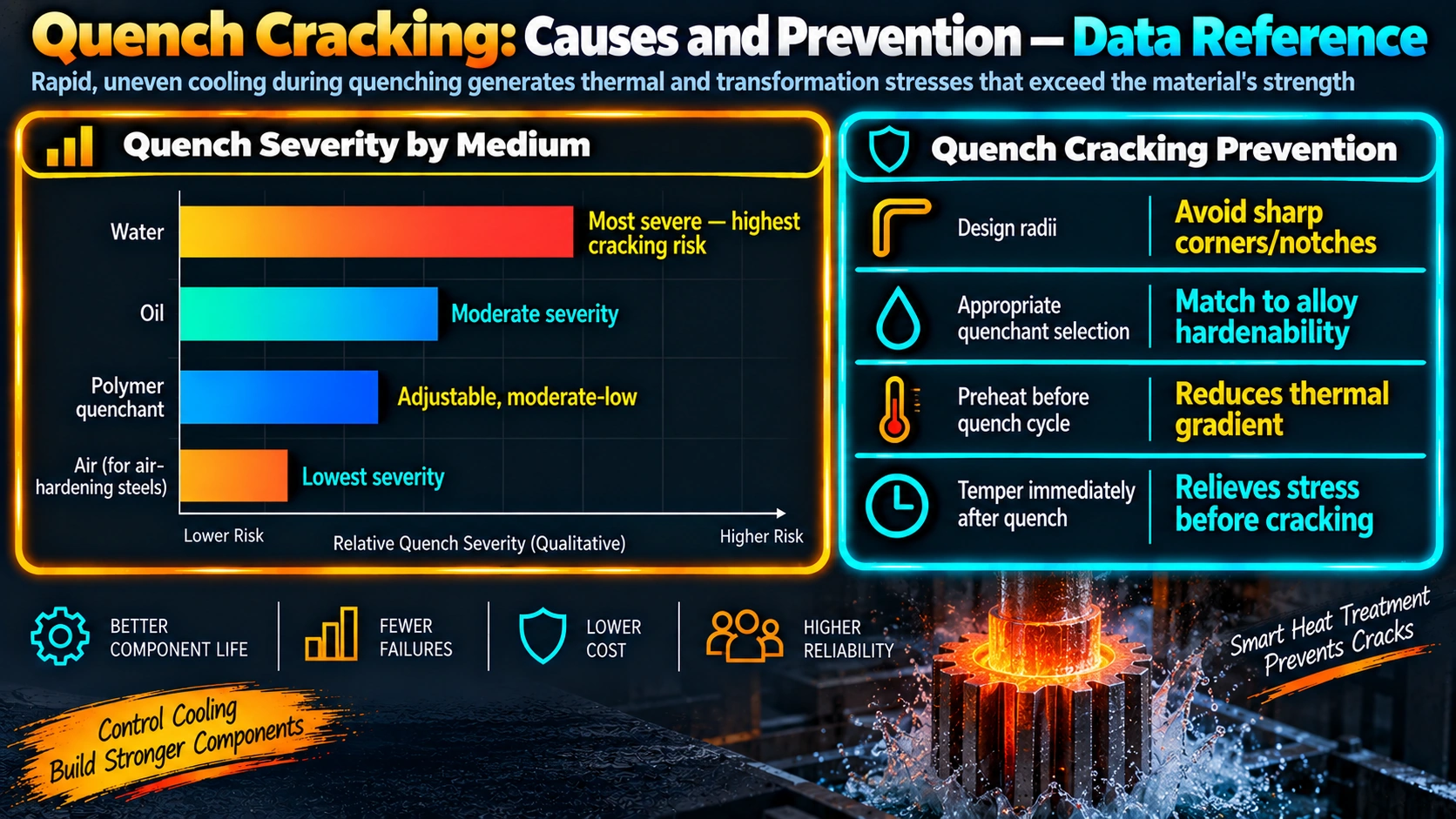
- Design for heat treatment — generous radii at internal corners, avoid unnecessary sharp features, protect or plug small holes and thread roots during quenching where practical.
- Select the least severe adequate quenchant — use oil or polymer quenchant instead of water/brine wherever hardenability allows it to still meet the required hardness.
- Temper promptly — move directly from quench to temper, minimizing time spent as brittle, untempered martensite at room temperature.
- Consider martempering (marquenching) for complex or thick-section parts — interrupting the quench in a hot bath just above Ms allows the part to equalize temperature before transformation begins, reducing both thermal and transformation stress compared to a direct quench.
- Ensure uniform austenitizing — adequate soak time and furnace temperature uniformity before quenching avoids adding a starting-temperature mismatch on top of cooling-rate mismatch.
- Control atmosphere to prevent decarburization — a decarburized surface layer transforms differently than the core, adding another layer of transformation mismatch directly at the surface.
- Avoid excessive quenchant agitation dead zones — uneven quenchant flow around the part can create localized vapor blanketing (the Leidenfrost effect), producing uneven cooling that mimics a section thickness problem even on a uniform part.
Frequently Asked Questions
What actually causes a part to crack during quenching?
Quench cracking results from the combination of thermal stress (caused by uneven cooling rates between the surface and core, and between thick and thin sections) and transformation stress (caused by the volume expansion that occurs when austenite transforms to martensite). When these combined stresses exceed the strength of the still-brittle, untempered martensite before it can be tempered, a crack forms, most often starting at a geometric stress concentrator rather than in a plain, uniform section.
Why do quench cracks so often start at keyways, holes, and sharp corners?
Sharp geometric features act as stress concentrators, locally amplifying the combined thermal and transformation stress well above the nominal stress level in the surrounding material, in the same way a notch concentrates stress in a fatigue specimen. A keyway corner, a small drilled hole, an unblended fillet, or even a stamped part number can raise the local stress enough to initiate a crack that would not have formed in an equivalent smooth, well-radiused section under the same quench severity.
Why is delayed tempering after quenching considered a major quench cracking risk factor?
As-quenched martensite is at its most brittle and most internally stressed state immediately after the quench, and residual stress from the transformation does not relieve itself on its own at room temperature within a useful timeframe — it needs the tempering heat treatment to redistribute and reduce it. Parts left to sit at room temperature for an extended period between quenching and tempering remain in this high-risk state longer than necessary, which is why standard practice calls for tempering as soon as the part reaches a safe handling temperature, ideally within an hour or two, rather than leaving quenched parts to cool fully and wait.
How does quenchant severity affect quench cracking risk?
A more severe quenchant (water or brine) cools the part faster and produces a steeper thermal gradient between surface and core than a less severe quenchant (oil, polymer solution, or air), and that steeper gradient increases both thermal stress and the mismatch in transformation timing between surface and core. Selecting the least severe quenchant that still achieves the required hardness and hardenability for the specific steel and section size reduces quench cracking risk without sacrificing the mechanical properties the heat treatment is meant to produce.
What is martempering (marquenching) and how does it reduce quench cracking risk?
Martempering interrupts the quench in a hot bath held just above the martensite start (Ms) temperature, allowing the part’s surface and core temperatures to equalize before the actual martensitic transformation begins, and only then cooling slowly (often in air) through the transformation range. Because the transformation itself then occurs more uniformly throughout the section rather than starting at the surface while the core is still hot, thermal and transformation stresses are both reduced compared to a conventional direct quench, lowering quench cracking risk, particularly in complex or thick-section parts.
Is quench cracking related to hydrogen cracking in welds?
They are distinct mechanisms, though both can affect similar hard, high-carbon or highly hardenable microstructures. Quench cracking occurs essentially immediately during or just after the quenching operation itself, driven by combined thermal and transformation stress, and is not dependent on diffusible hydrogen. Hydrogen cracking in welds is a delayed cracking mechanism specifically requiring diffusible hydrogen, a susceptible microstructure, and tensile stress together, and typically appears hours to days after welding rather than during the quench itself — see the WeldFabWorld hydrogen cracking guide for that separate mechanism.
Can uneven heating before quenching contribute to cracking, not just uneven cooling?
Yes — if a part is not uniformly heated to the austenitizing temperature before quenching, different regions can begin the quench from different starting temperatures, adding an additional source of thermal and transformation timing mismatch on top of the mismatch caused by section thickness variation during cooling. Proper furnace loading, adequate soak time, and temperature uniformity checks before quenching are as much a part of quench cracking prevention as quenchant selection and part geometry.
Does decarburization at the surface increase quench cracking risk?
Yes — a decarburized surface layer has lower carbon content than the core, so it transforms to martensite at a different temperature and forms a different volume fraction of martensite than the higher-carbon core beneath it during the same quench. This creates an additional layer of transformation mismatch directly at the surface, on top of whatever thermal gradient already exists, and is one reason atmosphere control during austenitizing (to prevent decarburization) is treated as part of quench cracking prevention, not just a separate surface quality concern.
Recommended Reading
Steel Heat Treatment: Metallurgy and Technologies (Totten)
Comprehensive handbook covering quenching theory, quench cracking mechanisms, and prevention across steel grades.
View on AmazonQuenching Theory and Technology (Totten, Bates, Clinton)
Focused reference on quenchant selection, severity, and quench cracking prevention strategy.
View on AmazonMechanical Metallurgy (Dieter)
Foundational coverage of transformation stress, residual stress, and fracture mechanics relevant to quench cracking.
View on AmazonASM Handbook Vol. 4: Heat Treating
Reference-grade coverage of quenching processes, martempering, and heat treatment defect prevention.
View on AmazonDisclosure: WeldFabWorld participates in the Amazon Associates programme (StoreID: neha0fe8-21). If you purchase through these links, we may earn a small commission at no extra cost to you. This helps support free technical content on this site.