Elastic vs Plastic Deformation in Metals
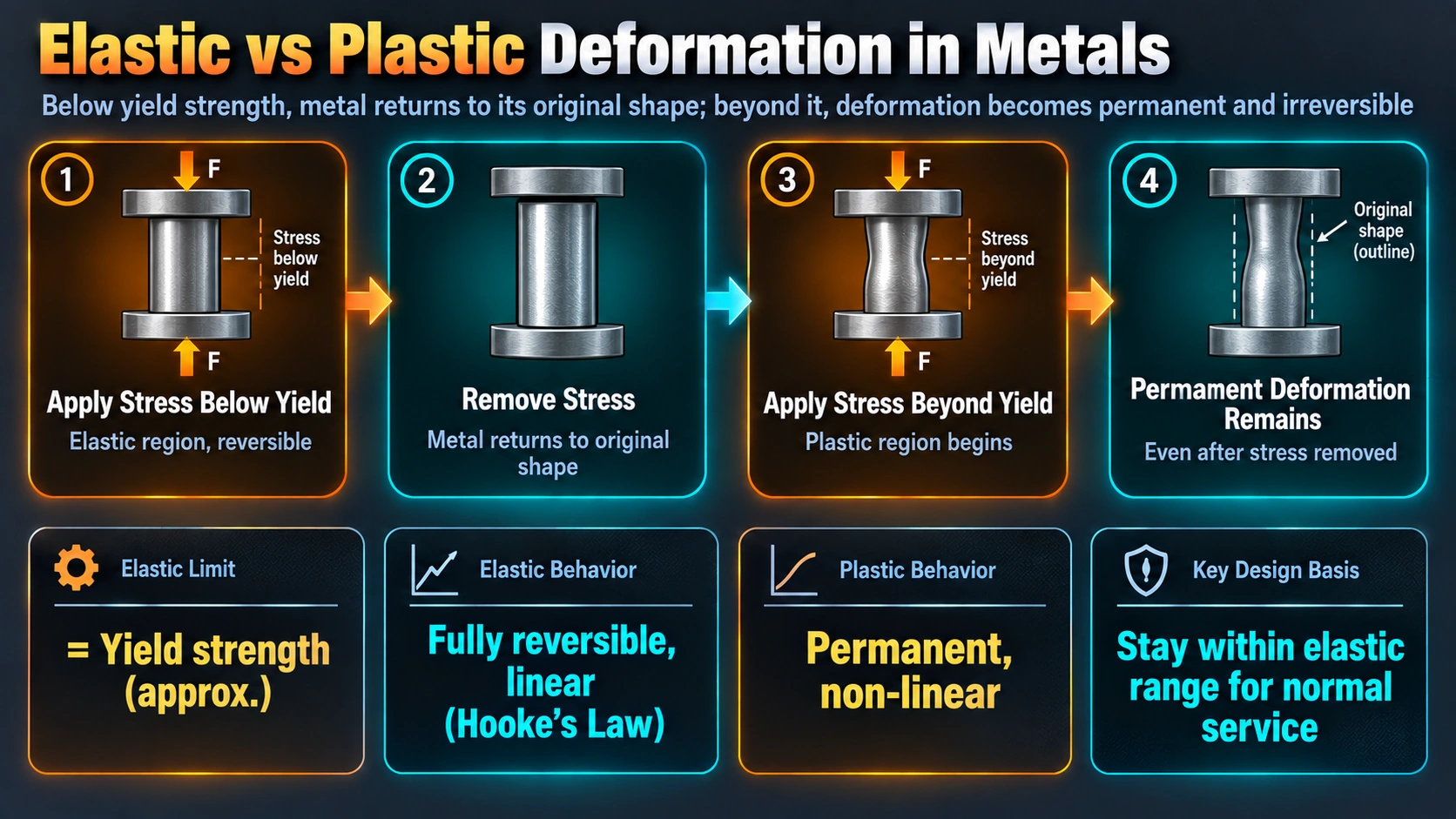
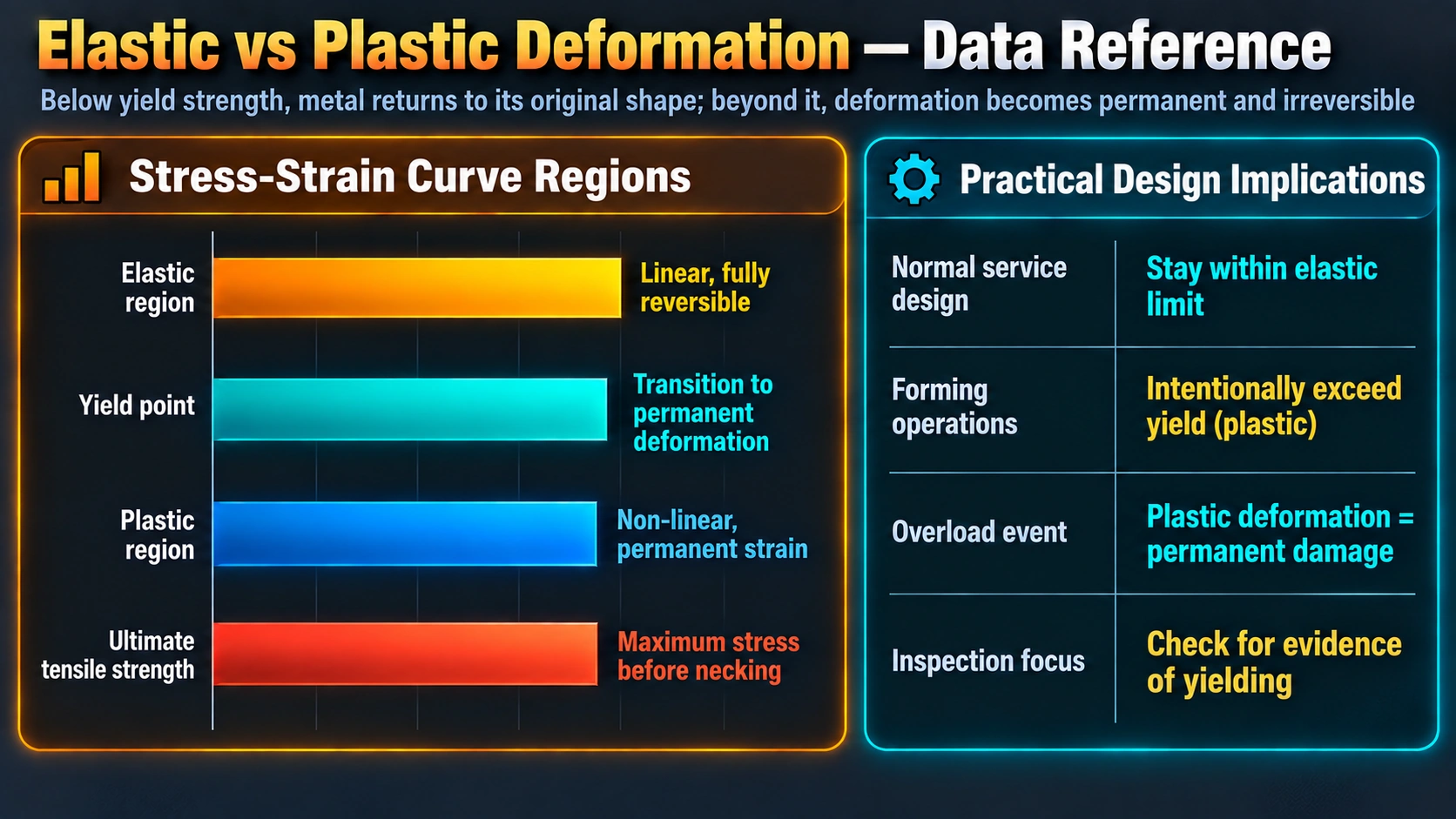
The macroscopic story of elastic versus plastic deformation — a metal springs back below yield, and stays permanently deformed above it — is well covered on its own terms elsewhere. What that story doesn’t explain is why: why some metals are far more ductile than others at the same temperature, why cold-worked material gets stronger but less forgiving, and why fine-grained steel is both stronger and tougher than coarse-grained steel of the same chemistry. All three answers come from the same place — dislocations, and how easily they move through a given crystal structure — and that atomic-scale mechanism is what this article covers.
For the macroscopic stress-strain behavior, yield point, and elastic modulus, see the stress-strain curve guide and the mechanical properties of metals guide; for how this elastic-to-plastic transition plays out specifically during a welding thermal cycle, see the residual stress in welded joints guide. This article goes underneath all three, to the crystallography that determines why the transition happens where it does and why it looks different from one metal to another.
What a Dislocation Actually Is
A dislocation is a line defect in the crystal lattice — a region where the otherwise regular, repeating atomic arrangement is disrupted along a line running through the crystal. The most common and easiest to visualize type, an edge dislocation, can be pictured as an extra half-plane of atoms wedged into the lattice, creating a region of local distortion around the edge of that extra plane. The Burgers vector quantifies the magnitude and direction of the lattice distortion a given dislocation represents, and it stays constant along the length of a dislocation line even as the dislocation’s character (edge, screw, or mixed) can vary.
Real metals are never dislocation-free — a well-annealed metal typically still contains on the order of 10^6 to 10^8 dislocations per square centimeter of cross-section, and heavily cold-worked metal can reach 10^12 or more. Plastic deformation occurs not by breaking and reforming every atomic bond across an entire slip plane at once (which would require enormous stress), but by dislocations moving through the lattice one atomic step at a time, requiring far less stress to propagate deformation than a defect-free crystal would need.
Slip Systems and Crystal Structure
A slip system is the combination of a specific crystallographic plane (the slip plane) and a specific direction within that plane (the slip direction) along which dislocations move most easily. Close-packed planes and directions — where atoms are packed as tightly together as the crystal geometry allows — require the least energy to shear past one another, so they are strongly preferred slip systems wherever the crystal structure provides them.
| Crystal Structure | Slip Systems | Ductility Character | Examples |
|---|---|---|---|
| FCC (Face-Centered Cubic) | 12 close-packed systems | Highly ductile, relatively temperature-insensitive | Copper, aluminum, austenitic stainless steel, nickel |
| BCC (Body-Centered Cubic) | Many potential systems, none truly close-packed | Ductile at higher temperature, brittle-prone at low temperature | Ferritic steel, chromium, tungsten |
| HCP (Hexagonal Close-Packed) | Few independent systems; twinning often needed | Limited, anisotropic ductility | Zinc, magnesium, titanium (at room temp) |
Schmid’s Law and Critical Resolved Shear Stress
Schmid’s law describes when slip actually begins on a given slip system: not when the applied stress reaches some fixed number, but when the resolved shear stress on that specific system reaches the critical resolved shear stress (CRSS), a threshold intrinsic to the material and slip system.
Because grain orientation varies randomly from grain to grain in a polycrystalline metal, different grains have different Schmid factors for the same applied stress, meaning some grains begin slipping before others even though the bulk applied stress is uniform. This is one reason real polycrystalline metals yield gradually rather than all at once, in contrast to the sharper behavior a single crystal specimen would show.
Strain Hardening at the Dislocation Level
As plastic deformation proceeds, dislocation density increases substantially, and the growing population of dislocations increasingly obstructs itself — piling up against grain boundaries, tangling with dislocations moving on intersecting slip systems, and generally interfering with further dislocation motion. Since plastic deformation depends on dislocations continuing to move, this growing obstruction means progressively higher applied stress is needed to sustain further deformation, observed macroscopically as strain hardening: the rising segment of the stress-strain curve between the yield point and ultimate tensile strength.
The Hall-Petch Relationship
Grain boundaries are especially effective barriers to dislocation motion, because the crystal orientation changes abruptly across a boundary, disrupting whatever slip system a dislocation was moving along and requiring dislocations to pile up at the boundary before deformation can transmit into the neighboring grain. This is the physical basis of the Hall-Petch relationship:
This is why grain refinement — through controlled rolling, normalizing, or controlling weld heat input to limit HAZ grain growth — is one of the few metallurgical strengthening mechanisms that improves toughness at the same time it improves strength, rather than trading one for the other. See the grain size measurement guide for how this relationship is quantified in practice using the ASTM grain size number.
Practical Consequences for Welding and Fabrication
Cold Forming and Strain Limits
Cold forming — bending or rolling below the recrystallization temperature — substantially raises dislocation density at the formed location, increasing strength but reducing ductility and toughness through the strain hardening mechanism described above. Codes such as ASME B31.3 set cold-forming strain limits above which post-forming heat treatment is required specifically to relieve this strain hardening before the material is welded or placed in service.
Recovery and Recrystallization
Annealing reverses strain hardening through two related processes: recovery, where dislocations rearrange into lower-energy configurations and partially annihilate without forming new grains, and recrystallization, where entirely new, strain-free grains nucleate and grow to replace the dislocation-dense deformed structure. See the heat treatments in welding guide for how these processes are applied deliberately in practice.
Why HAZ Behavior Depends on Prior Cold Work History
Because the welding thermal cycle can locally exceed the recrystallization temperature, a HAZ region that was previously cold-worked (strain hardened) can lose some or all of that strengthening as new, strain-free grains form during the weld thermal cycle — a distinct softening mechanism separate from the transformation-driven hardening or softening covered in the martensite, bainite and pearlite guide.
Frequently Asked Questions
What exactly is a dislocation in a metal crystal?
A dislocation is a line defect in the crystal lattice — a region where the regular atomic arrangement is disrupted along a line running through the crystal. The most common type, an edge dislocation, can be visualized as an extra half-plane of atoms inserted into the lattice; the Burgers vector describes the magnitude and direction of the lattice distortion the dislocation represents. Dislocations are not defects in the sense of being rare or accidental — real metals contain enormous numbers of them, and their motion through the lattice under applied stress is the primary mechanism of plastic deformation in crystalline metals.
Why are FCC metals generally more ductile than BCC metals?
Face-centered cubic (FCC) metals such as copper, aluminum, and austenitic stainless steel have 12 close-packed slip systems available, and dislocations move relatively easily along these close-packed planes and directions at essentially any temperature. Body-centered cubic (BCC) metals such as ferritic steel have more potential slip systems in total, but none of their planes are truly close-packed, so the stress needed to activate slip (the critical resolved shear stress) is higher and strongly temperature dependent — BCC metals become notably more resistant to dislocation motion, and therefore more brittle, at low temperature, which is the crystallographic root of the ductile-to-brittle transition seen in ferritic steel.
What is Schmid’s law and why does it matter for understanding yielding?
Schmid’s law states that slip begins on a given slip system once the resolved shear stress on that system reaches a material-specific threshold called the critical resolved shear stress (CRSS), calculated from the applied stress and the geometric orientation of the slip plane and slip direction relative to the loading axis (tau = sigma x cos(phi) x cos(lambda)). It matters because it explains why yielding is not simply about the applied stress reaching some fixed number — grain orientation relative to the load direction changes which slip systems are favorably oriented, which is part of why polycrystalline metals with randomly oriented grains yield more gradually than a single crystal would.
How does strain hardening (work hardening) actually work at the dislocation level?
As a metal is plastically deformed, the dislocation density increases substantially, and moving dislocations increasingly interact with and obstruct each other — piling up at grain boundaries, tangling with dislocations on intersecting slip systems, and generally making further dislocation motion progressively harder. Because plastic deformation requires dislocation motion, this increasing obstruction means a higher applied stress is needed to continue deforming the material, which is observed macroscopically as strain hardening: the rising portion of the stress-strain curve between yield and ultimate tensile strength.
What is the Hall-Petch relationship and why does grain size affect strength?
The Hall-Petch relationship states that yield strength increases as grain size decreases, following the form sigma_y = sigma_0 + k / sqrt(d), where d is average grain diameter. Grain boundaries act as barriers to dislocation motion because the crystal orientation changes abruptly across a boundary, disrupting the slip system a dislocation was moving along and requiring a pile-up of dislocations (and therefore higher stress) to transmit deformation into the next grain. A finer grain structure has proportionally more grain boundary area per unit volume, providing more of these barriers and raising the stress needed to sustain widespread plastic deformation.
Why does cold-formed pipe or plate sometimes need special heat treatment before or after welding?
Cold forming (bending, rolling, or forming below the recrystallization temperature) plastically deforms the material and substantially raises its dislocation density, increasing strength but reducing ductility and toughness through strain hardening at the location of the cold work. Codes such as ASME B31.3 set strain limits above which post-forming heat treatment is required specifically to relieve this strain hardening and restore adequate ductility and toughness before the material is put into service or welded, since a heavily cold-worked, strain-hardened zone can behave quite differently in a welding thermal cycle than the same material in its original, less-deformed condition.
How does annealing reverse the effects of strain hardening?
Annealing heats a cold-worked metal enough to activate recovery and recrystallization: recovery allows dislocations to rearrange into lower-energy configurations and partially annihilate through processes like dislocation climb, while recrystallization goes further, nucleating and growing entirely new, strain-free grains that replace the dislocation-dense deformed structure. Both processes reduce dislocation density and relieve the strengthening (and the loss of ductility) that strain hardening produced, restoring the metal closer to its original, more ductile condition.
Why do HCP metals like titanium and magnesium have more limited ductility than FCC metals?
Hexagonal close-packed (HCP) metals have far fewer independent slip systems readily available at room temperature than FCC metals, which limits the number of ways the crystal can accommodate an arbitrary applied strain through dislocation slip alone. To compensate, HCP metals often rely more heavily on deformation twinning — a different deformation mechanism that reorients part of the crystal lattice — alongside slip to achieve significant plastic deformation, but this generally still results in more limited overall ductility and greater sensitivity to loading direction (anisotropy) compared to FCC metals with their full set of close-packed slip systems.
Recommended Reading
Mechanical Metallurgy (Dieter)
The foundational reference on dislocation theory, slip systems, Schmid’s law, and strengthening mechanisms.
View on AmazonIntroduction to Dislocations (Hull & Bacon)
A focused, widely used text on dislocation geometry, motion, and interactions in crystalline materials.
View on AmazonPhysical Metallurgy Principles (Abbaschian, Abbaschian, Reed-Hill)
Covers crystal structure, slip systems, and the Hall-Petch relationship with worked examples.
View on AmazonWelding Metallurgy (Kou)
Applies these fundamentals directly to weld metal and HAZ microstructure formation.
View on AmazonDisclosure: WeldFabWorld participates in the Amazon Associates programme (StoreID: neha0fe8-21). If you purchase through these links, we may earn a small commission at no extra cost to you. This helps support free technical content on this site.