Cold Working vs Hot Working: Effects on Weldability
Cold working versus hot working is usually taught as a forming-process distinction, but for a welding engineer the more useful question is what condition that prior processing leaves the base metal in when it arrives at the weld joint — and how the weld thermal cycle then interacts with that condition. A cold-worked plate and a hot-worked or normalized plate of the identical nominal alloy can behave very differently under an otherwise identical weld procedure, and the differences show up specifically in preheat practice, HAZ response, distortion behavior, and residual stress, not in the alloy chemistry itself.
This guide focuses on those weldability consequences directly. It assumes familiarity with the underlying mechanisms — what recrystallization temperature is and how it governs HAZ softening, and how cold work and annealing generally affect strength and ductility — both of which are covered in depth elsewhere on WeldFabWorld. Here, the focus is on what a welding engineer or QA/QC inspector should actually do differently when the base metal in front of them is cold-worked rather than hot-worked or normalized.
Two Starting Conditions, One Weld Thermal Cycle
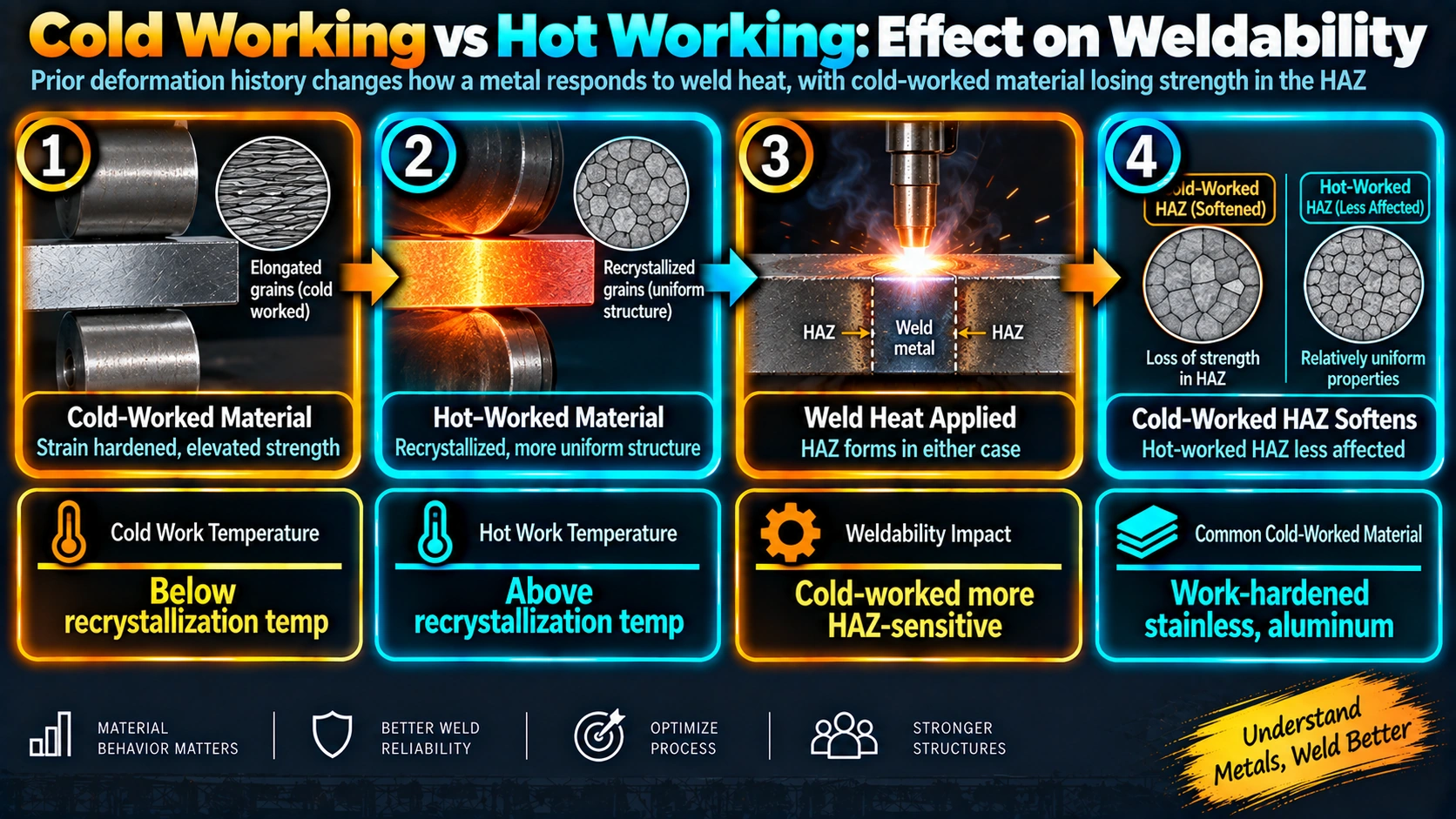
Hot working (rolling, forging, extrusion above the recrystallization temperature) leaves the metal in a largely stress-relieved, dynamically or subsequently recrystallized, near-equiaxed grain condition — the material has already gone through a version of the recrystallization process during forming itself. Cold working (rolling, drawing, forming below the recrystallization temperature) leaves the metal with an elongated, directionally deformed grain structure carrying a high density of stored dislocations, which is precisely what gives cold-worked tempers their elevated strength.
When either material is welded, the same physical process governs the outcome — heating above the recrystallization temperature erases a deformed dislocation structure — but the two starting conditions have very different amounts of that structure to lose, and that single difference cascades into the practical concerns below.
HAZ Response: Softening Zone vs Grain Growth Zone
The single most consequential weldability difference is what actually happens in the HAZ. On cold-worked base metal, any region heated above the recrystallization temperature recrystallizes and softens, permanently losing the cold-work strength contribution — this softened band sits alongside, and is distinct from, any grain growth that occurs closer to the fusion line. On hot-worked or normalized base metal, there is little stored cold work to lose, so the dominant HAZ concern shifts to grain growth of the existing equiaxed structure and, in hardenable compositions, phase transformation effects — the classic coarse grain HAZ and associated toughness loss.
| Aspect | Cold-Worked Base Metal | Hot-Worked / Normalized Base Metal |
|---|---|---|
| Dominant HAZ mechanism | Static recrystallization — strength loss | Grain growth — toughness loss |
| Recoverable by PWHT? | No — strengthening is permanently gone | Partially — grain refinement possible via normalizing |
| Primary preheat driver | Limiting HAZ softening width alongside hydrogen control | Carbon equivalent / hardenability & hydrogen control |
| Residual stress before welding | Present, directional, from forming | Comparatively low and more uniform |
| Mechanical anisotropy | Significant — direction-dependent properties | Minimal — near-isotropic |
| Typical failure concern | HAZ strength mismatch, distortion, directional cracking | CGHAZ toughness, hydrogen cracking, hardenability |
Preheat: Same Calculation, Different Practical Constraint
Preheat temperature for hydrogen cracking control is calculated from carbon equivalent and diffusible hydrogen level in essentially the same way regardless of whether the base metal is cold- or hot-worked — that calculation is not sensitive to prior mechanical processing history. What changes is a second, separate constraint that applies specifically to cold-worked material: preheat that is wider or hotter than strictly necessary will recrystallize and soften more of the surrounding cold-worked zone than the weld itself required.
Distortion and Residual Stress
Cold-worked stock arrives at the weld joint already carrying internal residual stress from the forming operation itself, and that pre-existing stress state is directional, following the rolling or drawing direction rather than being uniform. When welding residual stress is superimposed on top of this pre-existing, directional stress field, the resulting distortion pattern can deviate from the shrinkage and angular distortion predictions that are normally calibrated against a stress-relieved starting condition. This is most noticeable when the weld joint orientation cuts across the prior working direction rather than running parallel to it.
Hot-worked and normalized material, by contrast, starts from a comparatively low and more uniform residual stress state, so the weld-induced residual stress dominates the outcome and distortion behaves more predictably in line with standard shrinkage allowances and sequencing practice.
Anisotropy and Weld Procedure Qualification
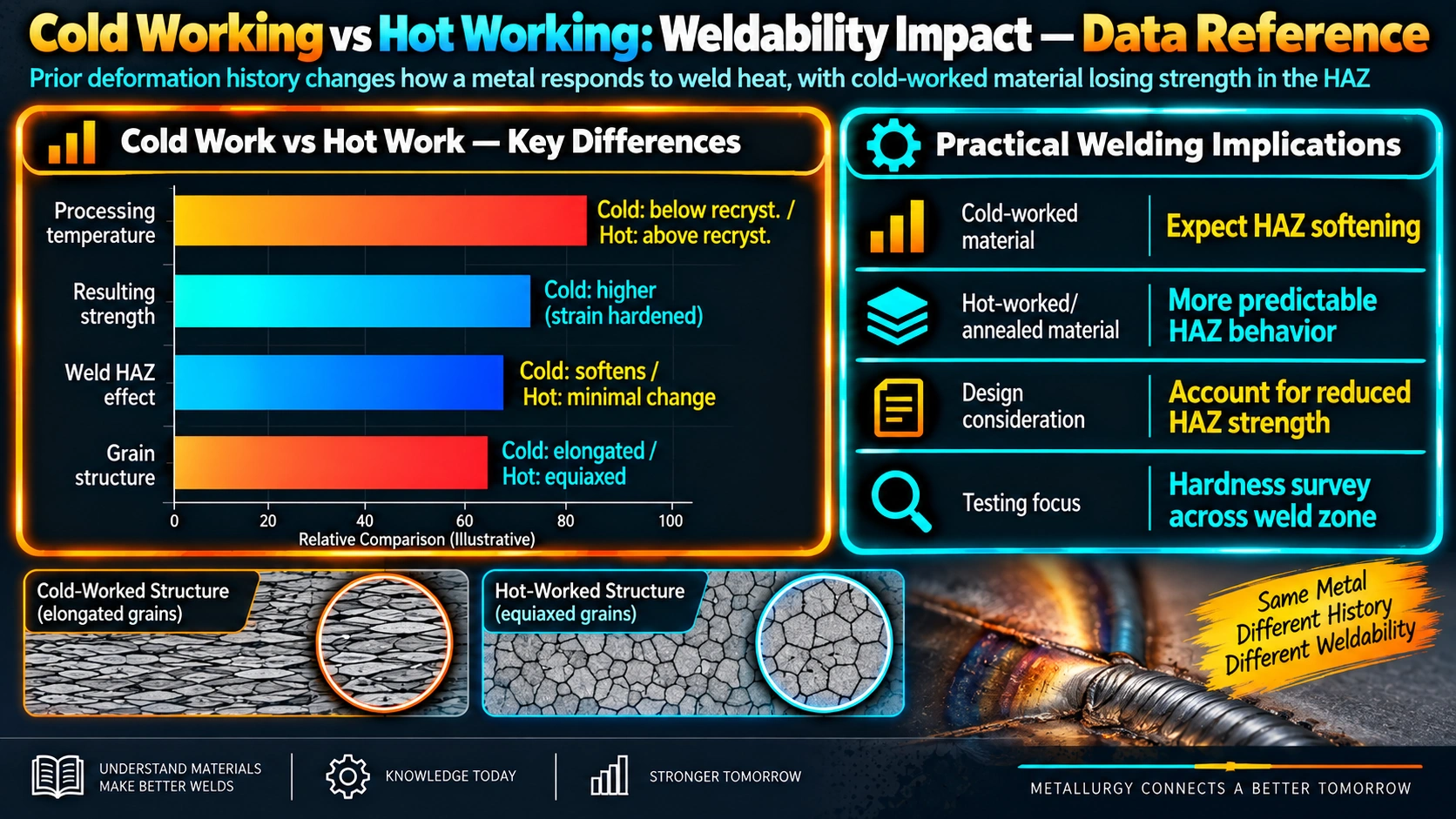
Cold working introduces mechanical anisotropy: strength, elongation, and toughness typically differ measurably between the rolling (longitudinal) direction and the transverse direction, because the elongated grain structure and aligned inclusions respond differently to load depending on orientation. This has direct weld procedure qualification consequences — bend test coupon orientation, and the orientation of the joint relative to prior working direction, can produce different qualification results on the same nominal material.
- Specify base metal temper precisely in the WPS (e.g., the exact H-series or T-temper designation), not just the alloy designation
- Match the procedure qualification test coupon’s temper and working direction to actual production material wherever practical
- Confirm temper from the mill certificate or material test report rather than assuming from appearance; hardness testing is a useful cross-check when documentation is unavailable
- Where joint orientation must cross the prior rolling direction, consider additional qualification testing in that orientation rather than relying on longitudinal-direction results alone
Hot-worked and normalized material is comparatively isotropic, so procedure qualification results are generally more transferable across joint orientations — one of the practical reasons normalized structural steel plate is often the preferred starting condition for large fabricated structures where joint geometry is complex and varied.
Practical Weldability Comparison
| Weldability Factor | Cold-Worked Base Metal | Hot-Worked / Normalized Base Metal |
|---|---|---|
| Preheat calculation basis | CE + hydrogen (same as hot-worked) | CE + hydrogen |
| Additional preheat constraint | Minimize HAZ softening width | None specific to prior working |
| Distortion predictability | Lower — pre-existing directional stress | Higher — closer to standard predictions |
| Bend test / PQR sensitivity to orientation | Higher | Lower |
| HAZ strength vs. base metal | Softer, permanently | Comparable or governed by hardenability |
| Documentation to confirm before welding | Exact temper designation, working direction | Heat treatment condition, CE calculation |
Recommended Reference Books
Welding Metallurgy (2nd Ed.) — Sindo Kou
Covers HAZ behavior across cold-worked and hot-worked starting conditions, including residual stress and distortion mechanisms.
View on AmazonWelding Metallurgy: Principles — John Lippold
Detailed treatment of weldability factors including base metal condition, preheat practice, and procedure qualification.
View on AmazonResidual Stress and Distortion in Welded Structures
Focused reference on residual stress interaction with prior processing and its effect on distortion prediction.
View on AmazonASM Handbook: Welding, Brazing, and Soldering
Comprehensive industry reference covering weldability of cold-worked and hot-worked tempers across alloy families.
View on AmazonDisclosure: WeldFabWorld participates in the Amazon Associates programme (StoreID: neha0fe8-21). If you purchase through these links, we may earn a small commission at no extra cost to you. This helps support free technical content on this site.
Frequently Asked Questions
Does welding cold-worked steel require different preheat than hot-worked steel?
The preheat calculation itself, based on carbon equivalent and hydrogen control, is largely unchanged by prior cold or hot working. What changes is the practical consequence of applying that preheat: on cold-worked material, a wider or hotter preheat band than necessary can recrystallize and soften more of the surrounding cold-worked zone than the weld itself required, unnecessarily enlarging the region of reduced strength. Preheat width and technique should be controlled more tightly on cold-worked stock for this reason, even where the calculated minimum temperature is the same.
Why does cold-worked base metal produce a weaker HAZ than hot-worked base metal?
Cold-worked material derives its strength from a high density of stored dislocations introduced during forming; wherever the weld thermal cycle exceeds the recrystallization temperature, that dislocation structure is replaced by new, strain-free grains and the strengthening is permanently lost. Hot-worked or normalized material has comparatively little stored cold work to lose in the first place, so its HAZ concern is dominated by grain growth and possible hardening phase transformations rather than by loss of a cold-work strengthening mechanism.
Does prior cold working increase distortion during welding?
Cold-worked material already carries internal residual stress from the forming process itself, and this pre-existing stress interacts with the new residual stress generated by welding in a way that is harder to predict than welding a stress-relieved, hot-worked or normalized starting condition. In practice this can produce distortion patterns that deviate from standard shrinkage predictions, particularly when the cold-worked directionality of the stock does not align cleanly with the weld joint orientation.
Should a WPS specify the exact temper of cold-worked base metal, not just the alloy?
Yes. Two pieces of nominally identical alloy in different tempers, such as an annealed O-temper sheet versus an H32 strain-hardened sheet of the same aluminum alloy, will produce very different HAZ properties from the same weld thermal cycle, because only the cold-worked temper has stored strain energy to lose. A weld procedure qualified on one temper does not necessarily represent the HAZ behaviour of the other, so the base metal condition should be specified precisely in the WPS and matched in the procedure qualification test coupon.
Is anisotropy from cold working a weldability concern?
Yes. Cold-worked plate and sheet develop elongated, directionally aligned grains and correspondingly directional mechanical properties, with strength and toughness typically differing between the rolling direction and the transverse direction. This affects bend test orientation requirements during procedure qualification and can influence fatigue performance at weld toes depending on how the joint orientation relates to the prior working direction, whereas hot-worked and normalized material is comparatively isotropic and behaves more consistently regardless of joint orientation.
Does hot-worked material have any weldability disadvantages compared to cold-worked material?
Hot-worked and as-rolled material is generally easier to weld predictably because it starts from a comparatively low residual stress, near-equiaxed condition, but it is not free of weldability concerns. Depending on composition and cooling rate after hot working, it can still be susceptible to coarse grain HAZ formation, hardenability-driven cracking in higher-carbon-equivalent grades, and banding or segregation inherited from the original casting and rolling process, none of which relate to cold work at all.
How is base metal condition verified before welding a cold-worked component?
Base metal condition is normally confirmed from the mill certificate or material test report, which should state the temper designation (such as H-series for aluminum or the cold-rolled/cold-drawn condition for steel), rather than assumed from appearance alone. Where the certificate is unavailable or in doubt, hardness testing can provide a useful cross-check, since cold-worked material typically reads measurably harder than the same alloy in an annealed or hot-worked condition.