Recrystallization in Metals: A Welding Perspective
Recrystallization in metals is the metallurgical process that quietly determines whether a cold-worked component keeps its strength after welding, whether a friction-stir weld nugget ends up fine-grained and tough, and why a structural steel HAZ can lose Charpy toughness even though nothing visibly went wrong during the weld. Understanding recrystallization as a mechanism — not just as a line item in a heat treatment schedule — is what lets a welding engineer predict these outcomes before they show up as a failed bend test or a rejected impact specimen.
This article covers recrystallization as a general metallurgical phenomenon and applies it specifically to welding: the three-stage recovery-recrystallization-grain growth sequence, typical recrystallization temperatures, and the two distinct ways it shows up in welded fabrication — static recrystallization that silently erases cold-work strengthening in the HAZ of non-ferrous and austenitic base metals, and dynamic recrystallization that actively builds a fine grain structure in solid-state joining processes such as friction stir welding.
The Three-Stage Sequence: Recovery, Recrystallization, Grain Growth
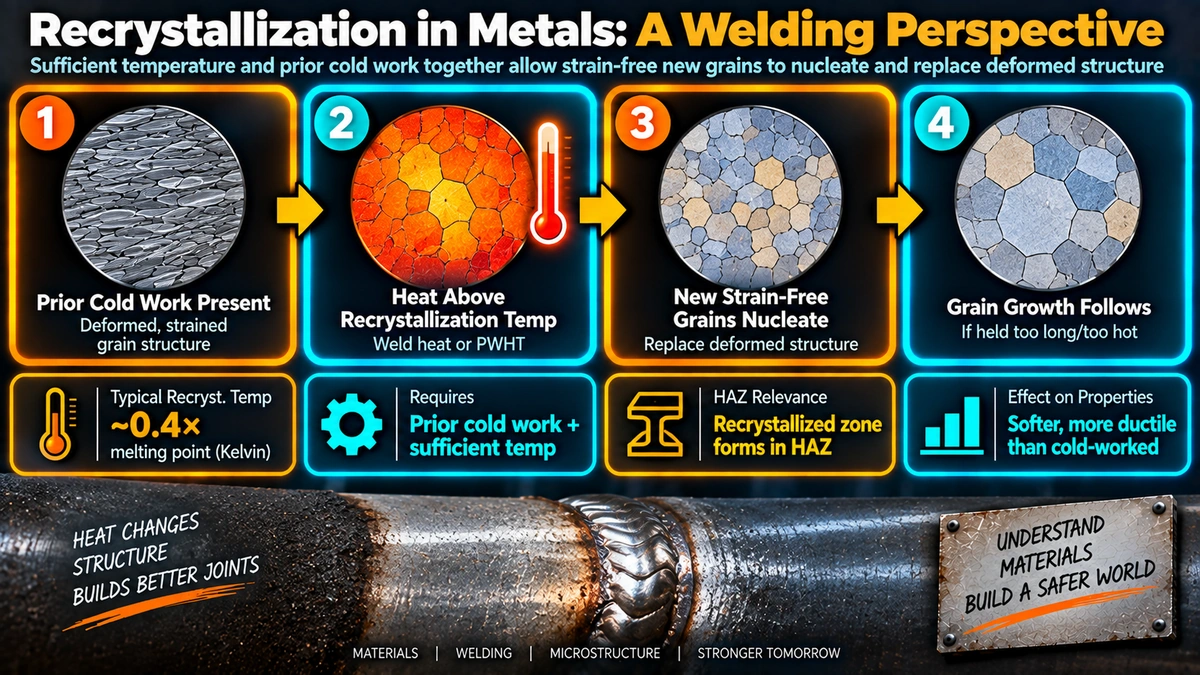
When a cold-worked metal is heated, its microstructure evolves through three distinct, sequential stages, each releasing some of the strain energy stored during deformation.
Recovery
At the lowest temperatures, dislocations introduced during cold working begin to rearrange and partially annihilate within the existing grain structure. No new grain boundaries form. Internal stress is relieved and some ductility is restored, but the elongated, deformed grain shape and much of the strength increase from cold working remain largely intact.
Recrystallization
At a higher temperature or after longer time, entirely new, strain-free grains nucleate — typically at existing grain boundaries, deformation bands, and other high-dislocation-density sites — and grow to consume the deformed structure completely. This is the stage that actually eliminates the cold-worked microstructure and, with it, the strengthening effect of cold work. The driving force is the stored strain energy itself: the system lowers its total energy by replacing a high-dislocation-density deformed structure with new, low-dislocation-density grains.
Grain Growth
Once recrystallization is complete, continued heating or holding time causes the newly formed grains to keep growing by grain boundary migration, driven by the reduction in total grain boundary energy as fewer, larger grains replace many smaller ones. Unlike recrystallization, grain growth does not require any prior cold work to occur — it will proceed in any polycrystalline metal held at sufficiently high temperature for long enough, which is why it is the dominant mechanism in the coarse grain HAZ of fusion-welded structural steel, a material that typically has little stored cold work to begin with.
Recrystallization Temperature
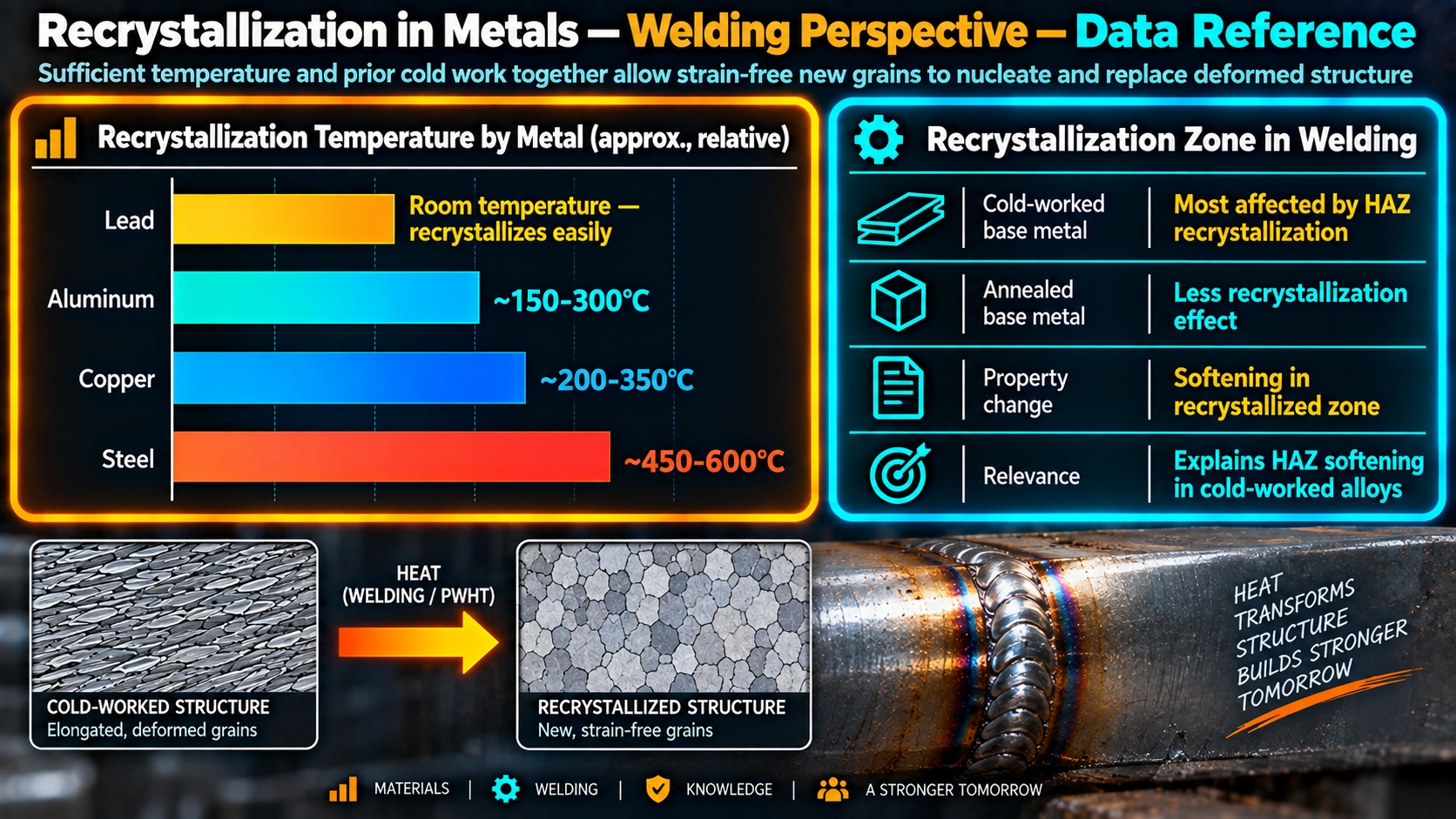
The recrystallization temperature is not a fixed physical constant but a practical threshold — the temperature at which recrystallization proceeds to completion within a normal industrial holding time (often taken as around one hour). As a rule of thumb, it falls at roughly 0.3 to 0.5 times the metal’s absolute melting point measured in Kelvin, with purer metals and more heavily cold-worked material sitting toward the lower end of that range.
T_recrystallization ≈ 0.4 × T_melting (both in Kelvin)
Worked example — carbon steel
T_melting (iron) ≈ 1811 K
T_recrystallization ≈ 0.4 × 1811 ≈ 724 K ≈ 451°C
Consistent with the commonly cited practical range of 400-700°C for cold-worked steel
Worked example — aluminum
T_melting (pure aluminum) ≈ 933 K
T_recrystallization ≈ 0.4 × 933 ≈ 373 K ≈ 100°C
Note: commercial aluminum alloys typically recrystallize somewhat higher (150-300°C) due to alloying and impurity effects
| Metal / Alloy Family | Typical Recrystallization Range | Relevance to Welding |
|---|---|---|
| Carbon & low-alloy steel | 400-700°C | HAZ of cold-worked/cold-formed plate; PWHT temperature selection |
| Austenitic stainless steel | 900-1100°C | Cold-worked tube/sheet HAZ softening; sensitization overlap zone |
| Aluminum alloys (non-heat-treatable) | 150-300°C | HAZ of cold-worked (H-temper) sheet and plate loses temper strength |
| Copper & copper alloys | 200-350°C | Cold-worked (1/4 to full hard) tempers soften irreversibly in HAZ |
| Nickel alloys | 600-1000°C | Solution and stress-relief treatments interact with recrystallization range |
| Titanium alloys | 550-750°C | Beta grain growth control critical for HAZ toughness |
- Degree of prior cold work — more stored strain energy lowers the recrystallization temperature and speeds the process
- Purity and alloy content — solute atoms and second-phase particles impede boundary motion and raise the recrystallization temperature
- Heating rate — very rapid heating (as in welding) can shift the effective onset temperature compared to slow furnace heating
- Time at temperature — recrystallization is time-dependent, so a short weld thermal cycle behaves differently from an hour-long furnace anneal at the same peak temperature
Static Recrystallization: HAZ Softening in Cold-Worked Base Metals
Many non-ferrous and austenitic alloys derive a significant part of their strength from cold work rather than from a hardening heat treatment — aluminum sheet in an H-temper, copper tube in a half-hard condition, or austenitic stainless steel cold-rolled to a specified minimum yield strength. None of these strengthening mechanisms survive contact with the welding thermal cycle.
Anywhere in the HAZ that the peak temperature exceeds the alloy’s recrystallization temperature, the cold-worked dislocation structure recrystallizes into new, coarse, strain-free grains, and the strength contribution from cold work is permanently lost in that zone. This is fundamentally different from the precipitation-hardening or solid-solution effects seen in heat-treatable alloys, because no post-weld heat treatment can restore a cold-worked condition once it has recrystallized — the deformed dislocation substructure that provided the strengthening is gone, not merely redistributed.
Dynamic Recrystallization: Grain Refinement in Solid-State Joining
Recrystallization is not always a loss mechanism. In friction stir welding, friction welding, and other solid-state joining processes, severe plastic deformation combined with frictional heating drives dynamic recrystallization — new grain nucleation and growth occurring while the material is still being actively deformed, rather than afterward in a separate cooling and reheating cycle.
The result in the stir zone or weld interface is typically a fine, equiaxed, recrystallized grain structure that often exceeds the mechanical properties of the surrounding base metal, particularly in age-hardenable aluminum alloys and other materials that are difficult to fusion weld successfully. This is one of the key metallurgical advantages of solid-state joining over conventional fusion welding for certain alloy systems, and is an active area of process development, including approaches that deliberately induce additional dynamic recrystallization in later passes of multi-pass fusion welds to refine an otherwise coarse HAZ grain structure.
Grain Growth Inhibitors and Coarse Grain HAZ Control
In structural steel, the region of the HAZ closest to the fusion line reaches temperatures near the melting point and undergoes rapid grain growth of the parent austenite, producing the coarse grain HAZ (CGHAZ) associated with reduced Charpy impact toughness and, in susceptible compositions, increased hydrogen cracking risk. Because as-rolled or as-normalized structural steel plate typically carries little stored cold work, this is predominantly a grain growth phenomenon rather than a recrystallization phenomenon in the strict sense — but the two are controlled by related metallurgical tools.
Fine carbonitride precipitates of niobium, titanium, and vanadium pin grain boundaries by a mechanism known as Zener pinning, physically obstructing boundary migration and restricting both recrystallization kinetics and subsequent grain growth. This is the underlying basis for HSLA (high-strength low-alloy) steel design, where controlled microalloying is used specifically to keep the CGHAZ fine enough to preserve toughness across a wider range of welding heat inputs — a central consideration when selecting heat input limits and preheat for structural steel fabrication.
| Scenario | Dominant Mechanism | Practical Consequence |
|---|---|---|
| Cold-worked aluminum/copper HAZ | Static recrystallization | Permanent local strength loss; not correctable by PWHT |
| Cold-worked austenitic stainless HAZ | Static recrystallization | Loss of cold-work yield strength contribution in HAZ |
| Structural steel CGHAZ | Grain growth (parent austenite) | Reduced Charpy toughness; controlled via heat input and microalloying |
| Friction stir weld nugget | Dynamic recrystallization | Fine, often high-strength equiaxed grain structure |
| Multi-pass welds with grain-refining techniques | Induced dynamic recrystallization | Refined HAZ grain size vs. conventional single-pass grain growth |
Recommended Reference Books
Welding Metallurgy (2nd Ed.) — Sindo Kou
The standard academic reference on HAZ microstructure evolution, grain growth, and recrystallization behavior across major alloy systems.
View on AmazonWelding Metallurgy: Principles — John Lippold
In-depth treatment of HAZ phenomena, phase transformations, and weldability across ferrous and non-ferrous alloys.
View on AmazonASM Metals Handbook: Metallography and Microstructures
Comprehensive reference for grain structure evolution, recrystallization, and heat treatment microstructures across metal families.
View on AmazonMaterials Science and Engineering — William Callister
Foundational textbook covering recovery, recrystallization, and grain growth fundamentals with worked examples.
View on AmazonDisclosure: WeldFabWorld participates in the Amazon Associates programme (StoreID: neha0fe8-21). If you purchase through these links, we may earn a small commission at no extra cost to you. This helps support free technical content on this site.
Frequently Asked Questions
What is the difference between recovery, recrystallization, and grain growth?
Recovery is the earliest stage, in which dislocations rearrange and partially annihilate within the existing deformed grains, relieving internal stress without forming new grain boundaries. Recrystallization follows at higher temperature or longer time, where entirely new, strain-free grains nucleate and grow, consuming the deformed structure and restoring ductility. Grain growth is a separate, later stage in which the newly recrystallized grains continue to enlarge by boundary migration if temperature and time permit, which can reduce strength and toughness if left uncontrolled.
What is the typical recrystallization temperature for common metals?
As a rule of thumb, the recrystallization temperature of a pure metal is approximately 0.3 to 0.5 times its absolute melting point in Kelvin, though the exact value depends heavily on purity, alloy content, and the amount of prior cold work. For carbon steel this typically falls around 400-700°C, for aluminum alloys around 150-300°C, and for copper alloys around 200-350°C. Higher degrees of cold work and higher purity both tend to lower the recrystallization temperature and shorten the time needed.
Can HAZ softening from recrystallization be reversed by post-weld heat treatment?
No. Once the cold-worked dislocation structure in a base metal has recrystallized into new, coarse, strain-free grains during welding, that strengthening mechanism is permanently lost in the HAZ and cannot be restored by any subsequent heat treatment. This is a key design consideration for structures built from cold-worked aluminum, copper, or austenitic stainless steel tempers, where the HAZ will always be softer than the surrounding base metal regardless of post-weld processing.
What is dynamic recrystallization and where does it occur in welding?
Dynamic recrystallization occurs when new strain-free grains nucleate and grow while the material is still being actively deformed at high temperature, rather than afterward during a separate heat treatment step. It is the dominant grain-refining mechanism in solid-state joining processes such as friction stir welding and friction welding, where the severe plastic deformation and frictional heating in the stir or weld zone produce a fine, equiaxed recrystallized microstructure that often has better mechanical properties than the surrounding base metal.
Is coarse grain HAZ (CGHAZ) the same thing as recrystallization?
Not exactly, though the two are closely related. The coarse grain HAZ forms in regions heated close to the melting point during fusion welding, where existing grains grow rapidly through boundary migration. Recrystallization, strictly speaking, refers to the nucleation of new strain-free grains from a previously deformed structure; grain growth is what happens next if temperature and time continue after recrystallization is complete. In practice, the CGHAZ of structural steel is dominated by grain growth of the parent austenite rather than recrystallization of cold work, since as-rolled steel plate typically has little stored cold work to drive recrystallization in the first place.
Why does the degree of prior cold work affect recrystallized grain size?
The driving force for recrystallization is the stored strain energy from dislocations introduced during cold working; more prior cold work means more stored energy, which promotes a higher density of new grain nucleation sites and therefore a finer recrystallized grain size once recrystallization is complete. Lightly cold-worked material recrystallizes more slowly, at a higher temperature, and typically produces a coarser grain structure, which is one reason critical cold-formed components specify a minimum reduction before an intermediate anneal.
How do grain growth inhibitors like niobium or titanium affect recrystallization in the HAZ?
Fine carbonitride precipitates of elements such as niobium, titanium, and vanadium pin grain boundaries through a mechanism known as Zener pinning, physically restricting boundary migration and slowing both recrystallization and subsequent grain growth. This is the metallurgical basis for HSLA (high-strength low-alloy) steel design, where controlled microalloying additions are used specifically to limit coarse grain HAZ formation and preserve toughness across a wider range of welding heat inputs.